
Laura Alcoba was born in Argentina in 1968 and has lived in Paris since she was 10 years old, when she fled Argentina during the period in the country’s history from 1976 to 1983 when military, security forces hunted down any political dissidents and/or anyone believed to be associated with socialism, or the Montoneros movement. Her father had been imprisoned and her mother had already fled the country, a wanted woman.
Many that were targeted were from the church, labour unions, artists, intellectuals and university students and professors were targeted. Pregnant women had their babies taken from them and then disappeared, many of these children were raised by military families, some of them today still have no idea of their origins, a few fortunate to be reaquainted with siblings or other family thanks to the tireless efforts of the Grandmothers of Plaza de Mayo. More than 400 children are believed to have been taken from political prisoners in Argentina during that era and the efforts of the grandmothers have reunited around 120 so far.
 In The Rabbit House, Laura rarely refers to the political situation that forced them to live in hiding, resulting in her having to change her name and be extra careful about how she engaged with others, for it is written from the perspective of her 7-year-old self, exactly as she recalls the events and changes that occurred in their lives at the time, with little understanding of the cause of this sudden change.
After her father is imprisoned, Laura and her mother go into hiding in a house in the suburbs, they live with a young couple, the woman Diana was pregnant with her first child.
During the day, “the labourer” and “the engineer” arrive to build a rabbit house, a place where they are going to breed rabbits, a cover for the job to create an underground space in which to house a printing press, to print and distribute a banned publication.
This is because we are doing some work on the shed so we can keep rabbits in there. These visible sacks justify – we hope – the endless comings and goings of the grey van. In this way we flaunt the busyness and waste materials appropriate to a modest rabbit breeding project. But behind the rabbit breeding area is concealed a whole other building site, huge, on another scale entirely – because the house we live in was chosen to hide the secret Montonera printing press.
Though there are things Laura has been told she can and can’t do, this precarious life and it’s rules aren’t well enough defined to help her with every situation, some of which she recounts here, creating the acute tension under which she lived, terrified of doing something wrong and endangering all their lives.
The only people in the house are Diana, seven months pregnant, my mother behind the false back wall, and me.
Oh, and the rabbits. And the rolls of wrapping paper and ribbon. and the secret printing press and hundreds of copies of a banned newspaper. And also the weapons, for self-defence.
And the ferocious kitten.
We are very afraid.
A visit with her paternal grandparents to see her father in prison is organised in a clandestine manner, and is so traumatising she is physically sick and it is decided not to take the risk again, her fear clearly outweighing any benefit in seeing her father.
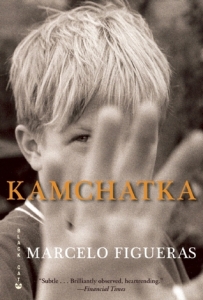
I was reminded of Marcelo Figueras’s book Kamchatka which I read in 2015, a novel also written from a child’s perspective, set in 1976. Figueras uses the novel form to inspire his storytelling, clearly drawing from his own memory and experiences of that same era.
The writing and narrating of Laura’s story is simplistic yet intense, she effectively portrays the sense of unease and desire of the child to not create trouble, but not knowing quite how, when the situations are complex and unknown, she is destabilised by the visible fear of the grown-ups, demonstrated in how quickly they anger when they fear she may have crossed a forbidden threshold.
First read for me in #WITMonth 2016 – Reading Women in Translation.
 Further Reading
My review of Marcelo Figueras Kamchatka
Argentina – A Terrible Period of State Terrorism/Genocide
Operation Condor conspiracy faces day of judgment in Argentina court
Madres of the Plaza de Mayo – Grandmothers of the Disappeared
How an Argentinian man learned his ‘father’ may have killed his real parents – Guardian 22 June 2016






 Proulx hasn’t published a novel since 2002 and has spent the last ten years researching, studying, writing about and travelling to visit trees and forests of the world. Her novel has at its heart, the theme of deforestation and uses the two families to illustrate her thinking, that there is no greater protector or more harmonious dweller of a lands natural resources than those who are native to the area.



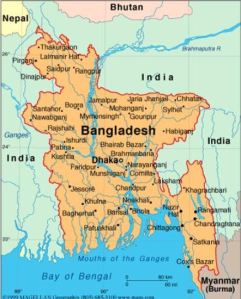
 Dear Husband,


 Dumped with an uncaring relative after his mother dies of consumption Andreas Eggers connects with the mountain more than with the family that barely tolerate him and when he is strong enough to resist the thrashings, will leave and make his own way as a labourer eventually earning sufficient to buy a plot of land up the mountain where he can build a cabin.
 Born in Vienna, Austria, Robert Seethaler is an actor (most recently in Paulo Sorrentino’s Youth) and writer, he grew up in Germany and now lives in Berlin. A Whole Life is his fifth novel and the first to be translated into English.
 An utterly charming novel based on a true story of the courtship of the authors parents, young Hungarian survivors of the Nazi concentration camps, post World War Two.
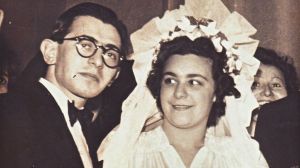 Gárdos has written a heart-warming, unsentimental account of their relationship and of the characters that surrounded the two young people during this time, their compatriots, the doctors and nurses and the Rabbi who received letters from a concerned friend of Lili, intent on stopping the liaison and her intention to convert to Catholicism.
 A woman working in an asylum centre as a translator is called to fill in for an interview. She utters the word she has all but banished from her vocabulary. Yes.


 Given this, our world is a classroom in which we have abundant opportunities to heal and transform. Through this lens we are our flat tyre, the butterfly on the windowsill, the flooded basement.
 There are practical exercises throughout the book to encourage reflection of both our inner and outer worlds. Acceptance, awareness and forgiveness are necessities: we are human, imperfect, but at the same time magnificent Divine co-creators of our life.
 Buddha in the Attic is a unique novella told in the first person plural “we”, narrating the story of a group of young women brought from Japan to San Francisco as “picture brides” nearly a century ago.
 And as if it couldn’t get any worse, war happens, and they discover they are the enemy, they are regarded suspiciously and in time sent away.
 It reminded me, not in style, but in subject of Jamie Ford’s
  Word by Word