Voices of the Lost by Hoda Barakat tr. Marilyn Booth

Those Who Are Lost

Lebanese Arabic LiteratureWritten in three parts, this award winning novel by Lebanese author Hada Barakat, is composed of a series of six letters written in a stream of consciousness narrative that are interlinked.  The letters are read, but not by their intended recipient, found between the pages of a book, dug out of a bin or otherwise encountered. They prompt the finder to write their own letter.

They are a kind of confession, written by the marginalised, floundering in exile. The letters excavate a depth of feeling that is raw, that traverses memory, hurts, an indifferent ability to cause pain, love, sorrow, longing, an abuse of kindness, a deterioration of the psyche.

“With this novel, I wanted to really listen to those millions of wandering souls who can’t speak for themselves: migrants. Their desperation to leave their country, no matter the cost, even if they know their lives will be at stake.”

Some of the letters are written to a family member, others to a lover, others to nameless recipients.

They are all experiencing deep loss having either been removed from all they’ve known or been connected to, or have been abandoned. Below, I’ve chosen a quote from each letter to give a sense of the narrative.

An undocumented immigrant writes to his former lover. He is unkind and doesn’t understand why she tolerates him. We learn that his mother put him on a train alone when he was eight or nine, effectively abandoning him, a sacrifice to gift him the education she never had. A man across from him is watching him through the window. Paranoia.

I’ve never written a letter in my life. Not a single one. There was a letter in my mind, which I brooded over for years, rewriting it in my head again and again. But I never wrote it down. After all, my mother could hardly read, and so I expect she would have taken my letter to one of the village men with enough education to read it to her. That would have been a disaster though!

a book in arabic writings

Photo by SafaPexels.com

A woman in a hotel room writes to a man from her past. She finds a perplexing letter in the pages of the telephone directory in the room. She wonders whether it was the man who penned it or the woman to which he wrote who left it there and why. It was clearly unfinished. She recalls the sweet succulence of the medlar fruits they ate walking the streets of Beirut.

This sweetness has nothing to do with the act of remembering. It’s not the delicious and sweet because it is linked to the past, to the time of our youth, where nostalgia for that time gives everything we can’t bring back a more beautiful sheen. Nothing in my childhood or my adolescence has ever prompted a longing for the past, a past that seems to me more like a prison than anything else. I am not here in this room in order to return to what was, nor to see you and thus see with you the charming young woman I once was, or how lovely and robust the springtime was that year, there in my home country. That country is gone now, it is finished, toppled over and shattered like a huge glass vase, leaving only shards scattered across the ground. To attempt to bring any of this back would end only in tragedy. It could produce only a pure, unadulterated grief, an unbearable bitterness.
flowers desk pen letter

Photo by KoolShootersPexels.com

An escaped torturer recounts his crimes to his mother. He got the idea to write a letter from observing a woman taking some folded papers from her handbag, read them, then tear them in half and drop them in a bin. He retrieves them.

You would say I deserve all this. You might even disown me, calling me the Devil’s offspring. And if I think of my father, I’d have to admit that you have a point. Still, after all that I’ve been through, is there any point in believing that if I asked you to pardon me, you might do it?

I know you won’t, I know there’s really no hope.

A former prostitute writes to her brother. She is on a plane that had been delayed due to the arrest of a passenger. She found a crumpled up letter shoved between the seat and the wall.

I know why security took him away in handcuffs, because I have a letter in my pocket that this man wrote to his mother. He must have tried to hide it before they reached him, because it’s not the kind of letter anyone would just forget about or be careless enough to lose.

A young queer man recounts to his estranged father his partner’s battle with AIDS. He stumbles across a letter written by a woman in a storage locker at a bar he worked in. That was two years ago, recently he reread it.

I read it again and again, as if I knew that woman personally. Or as if I could actually see her in front of me, asking someone’s forgiveness but discovering she could not get it. And not just because her letter would never arrive. It’s about the need we all have for someone to listen to us, and then to decide they will pardon us no matter what we have done.

Those Who Are Searching

In this second part, brief extracts focused on those who have some connection to the letter writers, those who are trying to find their place, searching, also at a loss.

Those Who Are Left Behind

Finally, the mailman leaves his own note, sheltering in the bombed out remains of the post office.

Neither the internet nor anything else would do away with the need for my rounds, not even after internet cafés were springing up everywhere like mushrooms.

Displaced, at a loss, rootless, untethered. Like the roll of the dice they were born into a place and era where stability, home and belonging would be denied them.

Haunting, at times disturbing, it is a compelling read, the rootlessness and isolation felt by the reader, due to the manner in which the letters are written. The edge of despair palpable. It’s as if the one who stayed, surrounded by destruction, is the only one left with a sense of belonging.

Further Reading

Article: The Return of the NonProdigal Sons by Hoda Barakat

Hoda Barakat

Winner International Prize for Arabic Fiction 2019Hoda Barakat was born in Beirut in 1952. She has worked in teaching and journalism and lives in France. She has published six novels, two plays, a book of short stories and a book of memoirs, as well as contributing to books written in French. Her work has been translated into a number of languages.

She received the ‘Chevalier de l’Ordre des Arts et des Lettres’ in 2002 and the ‘Chevalier de l’Ordre du Mérite National’ in 2008.

Her novels include: The Stone of Laughter (1990), Disciples of Passion (1993), The Tiller of Waters (2000) which won the Naguib Mahfouz Medal for Literature, and My Master and my Lover (2004). The Kingdom of This Earth (2012) reached the IPAF longlist in 2013. In 2015, she was shortlisted for the Man Booker International Prize, given (at that time) every two years to honour a writer’s achievement in fiction. Voices of the Lost won the International Prize for Arabic Fiction ((IPAF) in 2019.

N.B. Thank you to OneWorld Publications for providing me a review copy

Winter Flowers by Angélique Villeneuve tr. Adriana Hunter

Winter Flowers Angélique VilleneuveWinter Flowers (Les Fleurs d’hiver) by Angélique Villenueuve, translated by Adriana Hunter is published Oct 7 by Peirene Press, a boutique publishing house, specialising in high-quality first-translations of contemporary European novellas that can be read in an afternoon.

Review

A young woman in 1918 Paris is considered one of the fortunate, when her husband returns from war injured. Wearing a face mask. He lived. He is not the same man who left. When Toussaint Caillet was transferred from the department of facial injuries at Val-de-Grâce military hospital, he sent Jeanne a one sentence note ordering her not to visit.

They have a 3 year old daughter who only knows her father by the portrait of the soldier on the wall of their cramped quarters. She has two fathers, the Papa who left and the man who returned.

Of course she’d expected that the war and his injury would have changed him, but she’d never tried to imagine the scale or even the nature of this disruption. The letter he’d sent her in January 1917 had been a dark window and, once she’d stomached the pain of it, she’d made a point of not reopening it.

Jeanne works from home making artificial flowers, she is trying to be patient and understanding, but her husband’s refusal to engage inflames her.

Sitting at her table, Jeanne senses nothing. It has to be said that the huge red dahlias, whose wound-like qualities are accentuated by the light of the oil lamp, completely absorb her in a swirl of scarlet. The repeated gestures gradually steal over her body, leaving no part of her in which she can drift. When Jeanne sleeps or closes her eyes, when she’s most absent in mind or body, she knows this much: the flowers are still there and always will be.

red dahlia winter flowers angélique villeneuve wound like

Photo David JakabPexels.com

When he finally leaves the room, she follows him. It is not the first time.

Her neighbour Sidonie, a seamstress, has lost almost everything, they support each other. She is about to be tipped over the edge.

Winter Flowers exquisitely renders a situation many lived through and few understood. The silence and destruction of men who survived, who came back traumatised. Who never spoke of what happened. Who may or may not have healed. And the women who stood beside them, who persevered, who sacrificed and learned to live with the reality of what they too had lost.

Like all women whose husbands or sons had been mobilised, though, she’d heard countless stories about men’s homecomings. Poor women. Those who entrusted a sheep to their country  were given back a lion. Someone who’d sent out a young lad was said to have come home an old man, or mad.

And there were so many, Jeanne was well aware, who would never come home at all.

Despite the terrible events and circumstances, the hopes and fears, the woman too must participate and receive the words of recognition from those in power, despite their grief, unable to express their truth.

The mayor’s words are incomprehensible they come and go and sting. Jeanne doesn’t know whether it’s up to them, the women here, these workwomen, to tame the words and arrange them in the correct order, whether it’s really to them that they’re addressed. They flow too quickly. They fly too high. There are too many of them.

Thunder and fire, men freezing and caked in mud and half poisoned by noxious gases, heroes, brothers, love, defeat, hope, victory, history peace, blood, martyrs, children. His speech is riddled with these impassioned fragments. And, just like the battles experienced by those who are now dead, these official words accumulate terrifyingly, chaotically over the gathering. It’s a bombardment, and Jeanne, busy as she is shoring up her neighbour’s faltering frame, struggles to withstand its fire for more than a few minutes.

It is a lament, a form of consolation, a living mourning, of how a family rebuilds itself after an event that has wreaked devastation on them all. Day by day, acknowledging the small wins, with patience, forgiveness, empathy and imagination.

I loved it.  A heart-rending, visceral account of loss and the accompanying overwhelm of steadfast perseverance. The tidal-like edge of madness and the surreal act of continuing despite it. Women.

Every few pages, I marked passages, highlighted sentences and rereading them as I write this, felt like going back to beginning and reading it over again, so rare is it to encounter this perspective, to share how it might have been for those who waited and wailed, who persevered and attempted to recreate a new life from the wreck of what returned.

Angélique Villeneuve writes with great empathy, sensitivity and understanding in narrating a story from the little explored perspective of the young working woman dealing with the aftermath of war, in which they have all changed and must live in a post traumatic world, with little knowledge of how to navigate it.

Angélique Villeneuve, Author

Born in Paris in 1965, Angélique Villeneuve lived in Sweden and India before returning to her native France. The author of eight novels, she has also written numerous children’s books and poetry.

Les Fleurs d’hiver, originally published in 2014, won four literary prizes: the 2014 Prix Millepages, the 2015 Prix La Passerelle and Prix de la Ville de Rambouillet, and the 2016 Prix du Livre de Caractère de Quintin.

Villeneuve’s novel Maria (2018), won the SGDL Grand Prix for fiction. Her most recent work, La Belle Lumière (2020), is a fictional account of the life of Helen Keller’s mother.

Winter Flowers is the first of her books to be translated into English.

Adriana Hunter, Translator

An award-winning British translator, Adriana Hunter has translated over ninety books from French, mostly works of literary fiction. She won the 2011 Scott Moncrieff Prize for her translation of Beside the Sea by Véronique Olmi (Peirene Press, 2010) and the 2013 French-American Foundation and Florence Gould Foundation Translation Prize for her translation of Hervé Le Tellier’s Electrico W. Her translations have been shortlisted twice for the International Booker Prize.

N.B. Thank you to Peirene Press for providing me a review copy.

Winter Flowers Angélique Villeneuve French Literature

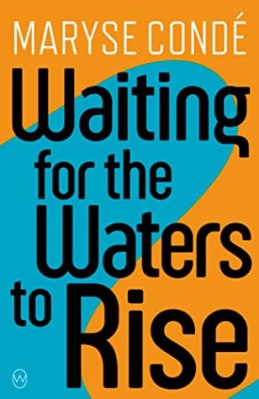
Waiting for the Waters to Rise by Maryse Condé (2021) tr. Richard Philcox

This story (originally published in French in 2010 as En attendant la montée des eaux) follows the character of Babakar, a Doctor from Segu, Mali who delivers babies. In the opening chapter while it pours with rain outside, he is called to attend a birth of a young woman he does not know but recognises, who does not survive the birth. Understanding that the man who accompanies her Movar, is not the father, he claims the baby as his own, seeing it as a sign, a return.

It does occasionally trouble him, what he has done and sure enough, one day Movar returns and tells him of the promise made to the young mother, to return her child to her family in Haiti, from where she had fled. The novel begins in Guadeloupe and moves to Haiti, while also travelling to other places through the backstories of the adjacent characters.

Waiting For the Waters to Rise Maryse CondeThough the story follows Babakar, each time we encounter a new character, there is this digression into their backstory(s), so we learn of all these male characters stories, Babakar (in Mali and the often present apparition of his mother Thécla Minerve), Movar, (in Haiti) Fouad (in Lebanon, though being Palestinian he dreams of the poetry of Mahmoud Darwich) who all come together in Haiti, and underlying the visit, this search to find family and learn why the young mother had fled.

Although the story is about the search for Anais’s (the baby) family, for all that this is an employed man raising a young baby on his own, she was remarkably absent, as were her carers, creating a bit of a disconnect, considering the entire motivation for this grand journey was supposedly her well-being, or the pursuit of this promise. The baby seemed to pose no great inconvenience, which seemed strange, the story centred solely on the male characters.

With so much of the novel told in backstory, there was a lot of ‘telling’ and I found myself reading over parts of those narratives quite quickly as they didn’t seem to progress or relate to the story itself. Perhaps there was something universal in the stories of the three main men, in the collapse of their earlier lives that found them seeking solace in each others company, but it didn’t work for me as well as I had hoped.

The family that Anais came from had its own complicated history and political associations, but was less in the foreground.

It was interesting, having just read Love, Anger, Madness: A Haitian Trilogy by Marie Vieux-Chauvet, to be back in Haiti and to understand more of the references and pick up on the atmosphere of the location, the unpredictability and quasi-fear around certain people, never quite knowing if they are safe or not and that metaphor of the title, suggesting disaster not far off.

close up water drop photography

Photo by PixabayPexels.com

As the novel came to a close, those waters began to rise and there is yet another opportunity to enter into an interesting story as the two characters make a plot direction changing decision and enter into an aspect of the story we will never know. And what about the baby, I wonder, not for the first time?

Maryse Condé is a Guadeloupean author writing in French, the author of many novels including the historical fiction masterpiece Segu and I, Tituba Black Witch of Salem.

She remains a favourite author and I’m looking forward to reading more of her work, last year’s Crossing the Mangrove was just brilliant as were her childhood essays in Tales from the Heart: True Stories from My Childhood.

Loop by Brenda Lozano tr. Annie McDermott

wp-1629982535768..jpgI picked up Loop for WIT (Women in Translation) month and I loved it. I had few expectations going into reading it and was delightfully surprised by how much I enjoyed its unique, meandering, playful style.

It was also the first work of fiction I have read, after a nine week pause, while I have been working on my own writing project, so its style of short well spaced paragraphs, really suited me. I highlighted hundreds of passages, an indicative sign.

Change. Unlearning yourself is more important than knowing yourself.

It was helpful to listen to the recent Charco Press interview linked below to understand that it is a kind of anti-hero story, inspired by her thinking about The Odyssey’s Penelope while her lover Odysseus is off on his hero’s quest – of the inner journey of the one who waits, the way that quiet contemplation and observation also reveal understanding and epiphanies.

Odysseus, he of the many twists and turns. Penelope, she of the many twists and turns without moving from her armchair. Weaving the notebook by day, unravelling it by night.

Penelope and OdysseusThe narrator is waiting for the return of her boyfriend, who has travelled to Spain after the death of his mother.
His absence coincides with her recovery from an accident, so she has a double experience of waiting, a greater opportunity to observe the familiar and unfamiliar around her, to see patterns, imagine connections, dream and catastrophise.

Childhood is so uncertain, so distant. It’s almost like childhood is the origin of fiction: describing any past event over and over to see how far away you are getting from reality.

And then there is her quiet obsession with notebooks, with the ideal notebook, another subject that evolves in her pursuit of it. It’s thought provoking, funny, full of lots of literary and musical references, which I enjoyed listening to while reading and quite unlike anything else I’ve read. And a nod to Proust. The dude.

I was left with a scar. I think telling stories is a way of putting a scar into words. Since not all blows or falls leave marks, the words are there, ready to be put together in different ways, anywhere, anytime, in response to any fall, however serious or slight.

Random observations over time create patterns and themes, eliciting minor epiphanies.

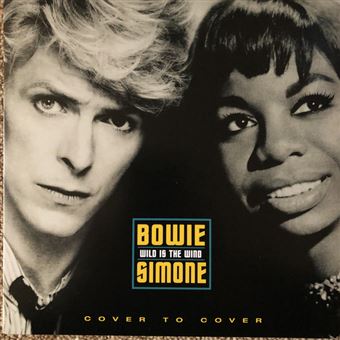
Wild-Is-The-WindA celebration of the yin aspect of life, the jewel within. And that jewel of a song, sung by both David Bowie and Nina Simone, Wild is the Wind.

…the present is also, as its name suggests, a gift. It doesn’t suggest longing or loss. It’s just a present, a gift, a time with no strings attached which is totally ours, to use however we want, however we please. There are days when I find the future overwhelming, with all the bright lights and commotion.

I highly recommend it if you enjoy plotless narratives that make you think and see meaning in the ordinary. And relate to the little things.

Dwarf things. Small things. Little things in relation to the norm. Insignificant things. Things with different dimensions. Curiously, the stories I like the most are made up of trivialities. Details. Trifles. These days, people look to what’s big. The big picture, big sales figures, success. Bright lights, interviews, breaking news. Whatever’s famous. Importance judged by fame. Maybe small things are subversive. Living on a modest scale compared to the norm. Maybe the dwarf is the hero of our time.

Brenda Lozano Author LoopBrenda Lozano is a novelist, essayist and editor. She was born in Mexico in 1981.
Her novels include Todo nada (2009), Cuaderno ideal (2014) published in English as Loop and the storybook Cómo piensan las piedras (2017). Her most recent novel is Brujas (2020).

Brenda Lozano was recognized by Conaculta, Hay Festival and the British Council as one of the most important writers under 40 years of age in Mexico and named as one of the Bogotá 39, a selection of the best young writers in Latin America.  She also writes for the newspaper El País.

Further Information

On Charco Press’s Instagram IGTV page there is a video interview with Brenda Lozano for WIT Month where she speaks about the process of translation as a part of the art of writing, about her influences as she wrote Loop and about how she has taken the story of Penelope and Odysseus as inspiration.

Don’t be alarmed if this isn’t going anywhere. Don’t expect theories, reliable facts or conclusions. Don’t take any of this too seriously. That’s what universities are for, and theses, and academic studies. Personally, I like cafés, bars and living rooms. Not to mention comfortable cushions. So nice and cosy.

The International Booker Prize Shortlist 2021

Since I’ve been in a bit of a reading slump I didn’t post about the International Booker longlist when it came out, and to be honest, nothing on it really jumped out at me, so I felt little motivation to share it.

However I do like to have a record of what was highlighted, so I’m sharing below the six books that have made the shortlist and below that the longlist. Clicking on any of the titles will take you a description of the book.

I don’t have any of these to read and I’m unlikely for the moment to add to my list of reading, since I’m looking for more of an uplifting read at the moment.

The 2021 International Booker Prize longlist

I Live in the Slums by Can Xue, translated from Chinese by Karen Gernant & Chen Zeping, Yale University Press

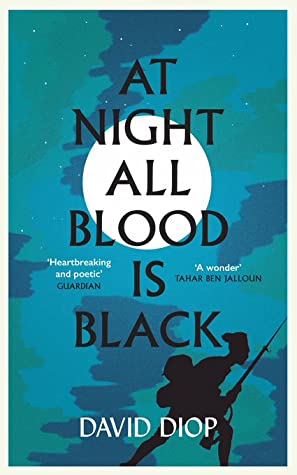
At Night All Blood is Black by David Diop, translated from French by Anna Mocschovakis, Pushkin Press

A novel that captures the tragedy of a young man’s mind hurtling towards madness and tells the little-heard story of the Senegalese who fought for France on the Western Front during WW1.

Alfa Ndiaye and Mademba Diop are two of the many Senegalese tirailleurs fighting in the Great War under the French flag. Whenever Captain Armand blows his whistle they climb out of their trenches to attack the blue-eyed enemy.  One day Mademba is mortally wounded, and without his friend, his more-than-brother, Alfa is alone amidst the savagery of the trenches, far from all he knows and holds dear. He throws himself into combat with renewed vigour, but soon begins to scare even his own comrades in arms.


The Pear Field by Nana Ekvtimishvili, translated from Georgian by Elizabeth Heighway, Peirene Press

The Dangers of Smoking in Bed by Mariana Enríquez, translated from Spanish by Megan McDowell, Granta Books

Unruly teenagers, crooked witches, homeless ghosts, and hungry women, these stories walk the uneasy line between urban realism and horror, with a resounding tenderness toward those in pain, in fear and in limbo. As terrifying as they are socially conscious, the stories press into the unspoken – fetish, illness, the female body, the darkness of human history – with bracing urgency. A woman is sexually obsessed with the human heart; a lost, rotting baby crawls out of a backyard and into a bedroom; a pair of teenage girls can’t let go of their idol; an entire neighbourhood is cursed to death when it fails to respond correctly to a moral dilemma.

When We Cease to Understand the World by Benjamín Labatut, translated from Spanish by Adrian Nathan West, Pushkin Press

Albert Einstein opens a letter sent to him from the Eastern Front during the First World War. Inside, he finds the first exact solution to the equations of general relativity, unaware that it contains a monster that could destroy his life’s work. The great mathematician Alexander Grothendieck tunnels so deeply into abstraction that he tries to cut all ties with the world, terrified of the horror his discoveries might cause. Erwin Schrödinger and Werner Heisenberg battle over the soul of physics after creating two equivalent yet opposed versions of quantum mechanics. Their fight will tear the very fabric of reality, revealing a world stranger than they could have ever imagined.

The Perfect Nine: The Epic Gikuyu and Mumbi by Ngũgĩ wa Thiong’o, translated from Gikuyu by the author, VINTAGE, Harvill Secker

The Employees by Olga Ravn, translated from Danish by Martin Aitken, Lolli Editions

Structured as a series of witness statements compiled by a workplace commission, The Employees follows the crew of the Six-Thousand Ship which consists of those who were born, and those who were made, those who will die, and those who will not. When the ship takes on a number of strange objects from the planet New Discovery, the crew is perplexed to find itself becoming deeply attached to them, and human and humanoid employees alike start aching for the same things: warmth and intimacy, loved ones who have passed, shopping and child-rearing, our shared, far-away Earth, which now only persists in memory.

Gradually, the crew members come to see their work in a new light, and each employee is compelled to ask themselves whether they can carry on as before – and what it means to be truly living. Wracked by all kinds of longing, The Employees probes what it means to be human, emotionally and ontologically, while simultaneously delivering an overdue critique of a life governed by work and the logic of productivity.

Summer Brother by Jaap Robben, translated from Dutch by David Doherty, World Editions

An Inventory of Losses by Judith Schalansky, translated from German by Jackie Smith, Quercus, MacLehose Press

Minor Detail by Adania Shibli, translated from Arabic by Elisabeth Jaquette, Fitzcarraldo Editions

In Memory of Memory by Maria Stepanova, translated from Russian by Sasha Dugdale, Fitzcarraldo Editions

The story of how a seemingly ordinary Jewish family somehow managed to survive the myriad persecutions and repressions of the last century. Following the death of her aunt, Maria Stepanova builds the story out of faded photographs, old postcards, letters, diaries, and heaps of souvenirs left behind: a withered repository of a century of life in Russia.

In dialogue with writers like Roland Barthes, W. G. Sebald, Susan Sontag and Osip Mandelstam, In Memory of Memory is imbued with intellectual curiosity and a soft-spoken, poetic voice. Dipping into various forms – essay, fiction, memoir, travelogue and historical documents – Stepanova assembles a vast panorama of ideas and personalities and offers an entirely new and bold exploration of cultural and personal memory.

Wretchedness by Andrzej Tichý, translated from Swedish by Nichola Smalley, And Other Stories

The War of the Poor by Éric Vuillard, translated from French by Mark Polizzotti, Pan Macmillan, Picador

The Protestant Reformation of the 16th century takes on the powerful and the privileged. It quickly becomes more about the bourgeoisie. Peasants, the poor living in towns, who are still being promised that equality will be granted to them in heaven, begin to ask themselves: and why not equality now, here on earth? There follows a furious struggle. Out of this chaos steps Thomas Müntzer, a complex and controversial figure. Sifting through history, Éric Vuillard extracts the story of one man whose terrible and novelesque life casts light on the times in which he lived – a moment when Europe was in flux. Inspired by the recent gilets jaunes protests in France: a populist, grassroots protest movement – led by workers – for economic justice. While The War of the Poor is about 16th-century Europe, this short polemic has a lot to say about inequality now.

Have you read anything on this longlist?

Fresh Water for Flowers by Valérie Perrin tr.Hildegarde Serle

“If life is but a passage, let us at least scatter flowers on that passage.”

cemetery keeper changer l'eau des fleursWhat a refreshing read to end 2020 with, a novel of interwoven characters and connections, threaded throughout the life of Violette Touissant, given up at birth.
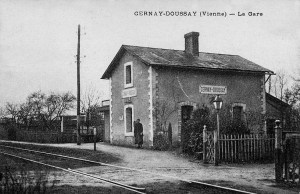
When I was born I didn’t even cry. So I was put aside, like a 2.67kg parcel with no stamp, no addressee, while the administrative forms were filled in, declaring my departure prior to my arrival.
Stillborn. A child without life and without a surname.

We first meet Violetteas an adult. Having been a level-crossing keeper she is now a cemetery keeper. She introduces her neighbours and their characteristics in common, they are an intriguing lot, who we are going to get to know better.

Those neighbours she lives among are the dead, while she lives in the heaven of the living, at the mid-range of life having been through plenty of pain and suffering to get there. Now rewarded, she has found her place, her people and those who deserve to be part of it, have found her too.

My present life is a present from heaven. As I say to myself every morning, when I open my eyes.
I have been very unhappy, destroyed even. Nonexistent. Drained. I was like my closest neighbours, but worse. My vital functions were functioning, but without me inside them.

Level Crossing Keeper

The 94 short chapters all begin with a thought provoking quote, the narrative seesaws back and forth to moments in that life, sometimes revisiting the same moments, but seeing them from the point of view of Violette, her husband Philippe and the many other pairs of characters we encounter, through their connection to those dead neighbours of hers.

Since taking on the job of cemetery keeper, after meeting one of the most life-changing characters, Sasha, she has been recording details of the events that take place in the cemetery, making diary-like entries, references that she is able to refer back to when people stop by to have a cup of tea or something stronger, looking for the resting place of someone important to them, not always family, but people with connections that weren’t always able to be fully expressed in life.

Death never takes a break. It knows neither summer holidays, not public holidays, nor dentist appointments…It’s there, everywhere, all the time. No one really thinks about it, or they’d go mad. It’s like a dog that’s forever weaving around our legs, but whose presence we only notice when it bites us. Or worse, bites a loved one.

The narrative returns to her early adult life, at 18, already married, she discovers the 821 page novel L’Oeuvre de Dieu, la part du Diable a French translation of John Irving’s The Cider House Rules, a book known to open minds and hearts, eliciting compassion for a set of circumstances no one really thinks about, making the reader look at the world in a slightly different way.

Which is perhaps what Fresh Water For Flowers does, taking characters in unconventional circumstances and sharing their stories, watching how those stories shock, enlighten, end and change lives.

Violette too will have to deal with death. A death that develops into the more significant mystery at the core of the novel. And with it, innumerable twists and turns, suspicions and revelations.

Life is but an endless losing of all that one loves.

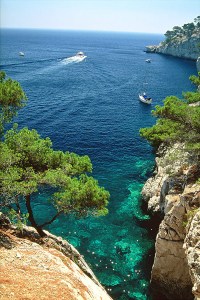
Every summer she stays in the chalet of her friend Célia, in the calanque of Sormiou, Marseille. A place of refuge and rejevenation, that Perrin too brings alive, eliciting the recovery and rehabilitation this nature-protected part of the Mediterranean offers humanity.
It’s a gentle novel because even though there are moments of tragedy, they are seen through the eyes of the most empathetic character, so even the most villainous, unlikable characters are given a generous, understanding hearing.

The details of the life of a keeper, whether it’s the level crossing or the cemetery are so realistic, evocative and visual, it wouldn’t surprise me to hear that this book may be turned into a series; it’s too long for a movie and with so many interconnecting lives, it  feels like it could have continued on, just as life and death does, always someone arriving, someone departing, and someone there to soothe the way through those transitions.

It’s not a book I have heard anything about until now, but it’s going on my list of favourites for 2020 and is one I highly recommend.

Not a day goes by without us thinking of you.

N.B. Thank you to Europa Editions for sending me a copy for review.

I, Tituba Black Witch of Salem by Maryse Condé tr. Richard Philcox

A Maryse Condé FanGirl Moment

I Tituba Black Witch of Salem Maryse Conde

When I opened I, Tituba to begin reading, on the first page there was a quote from the author Maryse Condé that read:

Tituba and I lived for a year on the closest of terms.
During our endless conversations she told me things she had confided to nobody else.

It gave me such a good feeling to read that, knowing that Condé was doing here, what she did in Victoire: My Mother’s Mother, when the grandmother she’d never met, awakened her from her dreams, to chastise her from the corner of the room.

Sometimes I would wake up at night and see her sitting in a corner of the room, like a reproach, so different to what I had become.

‘What are you doing running around from Segu to Japan to South Africa? What’s the point of all these travels? Can’t you realise that the only journey that counts is discovering your inner self? That’s the only thing that matters. What are you waiting for to take an interest in me?’ she seemed to be telling me.

But that book wasn’t published until 20 years after Condé was listening to Tituba tell her story.

A Caribbean Writer Returns

I, Tituba is the first novel written after Segu and The Children of Segu, historical masterpieces that inform, disrupt and provoke, however the initial reaction was such that Maryse Condé declared she would never write about Africa again.

Tituba came to me or I came to her at a period of my life when really I wanted to turn toward the Caribbean and start writing about the Caribbean.

Who was Tituba?

Tituba existed, she was accused and ultimately set free, however, despite the shelves of history books about the Salem witch trials, there is little factual information about her, who she was, who freed her, or her life after release from prison.
I felt this eclipse of Tituba’s life was completely unjust. I felt a strong solidarity with her, and I wanted to offer her her revenge by inventing a life such as she might perhaps have wished it to be told.

If we look for her story in the history of Salem, it isn’t there. Condé too, looked for her history in the colonization of the continent and found silences, omissions, distortions, fabrications and fleeting, enigmatic insinuations. And so she wrote this novel.

Review

On a ship sailing for Barbados, young Abena was raped by an English sailor, then sold to a planter along with two male slaves. She was employed in the household until the pregnancy discovered whereupon she was banished to the cabin of a male slave Yao. Tituba was born.

In a short reprieve, they find comfort in each other’s company and Tituba would adored by a man more father to her than any other. The joy that now lightened Abena’s world was seen by the master and desired for himself. She struck back, died for it, and for his concubine’s crime, Yao was sold.

Driven off the plantation, Tituba was taken in by Mama Yaya; still grieving for two sons, she had cultivated the ability to communicate with the invisible.

People were afraid of her, but they came from far and wide because of her powers.

Mama Yaya taught her everything, in the ways of her people:

Mama Yaya initiated me into the powers of knowledge. The dead only die if they die in our hearts. They live on if we cherish them and honour their memory, if we place their favourite delicacies in life on their graves, and if we kneel down regularly to commune with them.

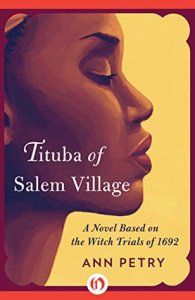
Ann Petry Tituba Salem Witch TrialsAnd so Tituba is given a past, skills and knowledge and might have remained in that life, had she not grown into a young woman with desires herself and fallen for the man who would become her husband John Indian.
He belonged to Susanna Endicott who I encountered in the memorable opening scene of Ann Petry’s Tituba of Salem Village.

After a short period in that household where John had lived most of his life, things deteriorated and in an act of revenge the mistress sold them both to the frightening Reverend Samuel Parris, who sailed for the Bay Colony the very next day.

From Island Life to Boston, Massachusetts

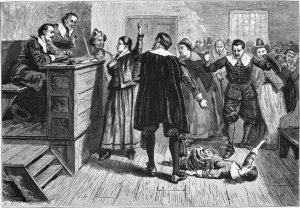
In Boston, with the mistress unwell in a room upstairs, Tituba spends time with the daughter Betsey and orphaned niece Abigail, who makes trouble that spreads like a contagion to other young girls in the community, as they fall prey to strange fits and mass hysteria.

I also recognized Abigail and Betsey’s companions in their dangerous games, those young girls whose eyes were shining with excitement. They were dying to roll on the ground too and to attract everybody’s attention.

And so the bad behaviours of girls given credence, turn into accusations of witchcraft against Tituba and others, they are jailed and many lose their lives, until the Govener writes to London for advice on legal proceedings concerning witchcraft resulting in a general pardon and Tituba is condemned to live.

Prison costs mean she can only leave if someone pays and a man with nine children who has lost his wife claims her. And it is through this relation that she will gain her freedom.

Freedom At What Price

If the first part is written from compassion, yet seeking revenge, the second part initially seems strange and challenges the reader, in its use of parody. I found it difficult to accept, the reader isn’t given the satisfaction of a gratifying ending, yet reading past the novel into the essay and interview at the end of the book, I’m confronted with my own subconscious bias and lack of understanding, in a clever and deliberate intervention by the author.

And so Tituba is granted her revenge. We are all complicit.

Reading the book and thinking about it after reading the interview resulted in a deeper reading experience and consideration. My feeling while reading was heightened by having read Ann Petry’s sympathetic version first, Condé takes a different approach, reckoning with the past.

I suggest that though Petry’s version was written 30 years before, it might be better to read her more optimistic version last.

What Is it About Witchcraft?

Magic witchcraft spells Tituba Isobel GowdieLike Condé, who said she knew nothing of witchcraft, I have decided to read a contemporary book next, published in 2020, to see what’s going on in the world of witchcraft today.

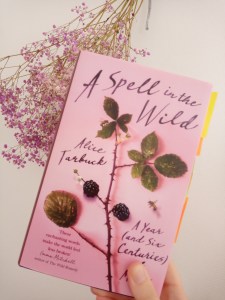
Next up A Spell in the Wild: A Year (and Six Centuries) of Magic by Alice Tarbuck.

Further Reading

Paper: Hesitating Between Irony and the Desire to Be Serious in I, Tituba by Sarah Barbour, Wake Forest University


The Lying Life of Adults by Elena Ferrante translated Ann Goldstein

Another excellent example of Elena Ferrante’s ability to zoom in close, with intensity into the subconscious of her protagonist, this time through the lens of a girl entering adolescence.

The Lying Life of Adults Elena Ferrante Ann GoldsteinFrom the opening pages, as Giovanna overhears a random comment from her father, it expands in her mind and overtakes her physically and mentally like a disease, affecting her mind, causing her to act in certain ways.

To the reader it may seem irrational, but to the hormone affected adolescent everything is magnified and causes her to imagine, lash out, withdraw, have moments of tenderness followed by hate and indifference.

She is uncomfortable in her skin and mind, lurching between strategies of action and non-action, always confrontational.

Though warned against her and until now they’ve never met, Giovanna cultivates a relationship with her estranged Aunt Vittoria, seeing her as a convenient tool of provocation and a source of not always reliable information.

She spewed bitterness, and yet those words now brought me relief, I repeated them in my mind. They affirmed the existence of a strong and positive bond, they demanded it. My aunt hadn’t said: you have my face or at least you look something like me; my aunt had said: you don’t belong only to your mother and father, you’re mine, too, you belong to the whole family that he came from, and anyone who belongs to us is never alone, is charged with energy.

It is a roller coaster of emotions and a river of consciousness as we ride along, wondering who is going to survive these years unscathed.

The Class Divide

There is the intensity we’ve come to expect of Ferrante, the twisted emotions and imaginings of her protagonist leading the story, reading the surface of behaviours of adults around her, creating confusion, with that precise, recognisable linguistic clarity. Her father and Aunt represent a class divide that Giovanni witnesses, growing up on one side her father has escaped to, and now intrigued by the other that her Aunt inhabits.

Their mutual hatred remained intact, and I soon gave up any attempt at mediation. I began instead to say to myself explicitly that that hatred was an advantage for me: if my father and his sister made peace, my encounters with Vittoria wouldn’t be exclusive, I might be downgraded to niece, and certainly I would lose the role of friend, confidante, accomplice. Sometimes I felt that if they stopped hating each other I would do something to make them start again.

I can’t really talk about the novel in the singular as I see her individual novels now as a tapestry of different women characters from Naples, in various stages of their life – the two friends in My Brilliant Friend, the daughter in Troubling Love and the betrayed wife of The Days of Abandonment.

The Lying Life of Adults Elena Ferrante

Photo by Luidi Cardoso on Pexels.com

Inside the overthinking mind of an adolescent and the pushing boundary-like behaviours, exposing that lying life, provoking reactions, seeing the damage of truth-telling and then the transition, an increasing self-awareness, noticing a reduced need to react to annoyances, about one’s parents, one’s friends, teachers, family. A letting go. A transition. Decisions. To care or not to care.

I behaved like that certainly to feel free from all the old bonds, to make it clear that I didn’t care anymore about the judgment of relatives and friends, their values, their wanting me to be consistent with what they imagined themselves to be.

Ferrante provides the reader no easy conclusions, makes no judgments, but leads you down paths that will confront you with your own, as you carry on a conversation inside your own mind, wondering and trying to guess what her character might do next.

As the novel nears the end, it reads almost like a thriller, as we can see she is moving towards adulthood, her behaviours are less volatile, she feels less of a need to respond so violently, and yet, there is the danger that now she is becoming one of them – an adult – those who hide their behaviours behind lies.

Raw, intense, a delightful, refreshing, “stand up to them” protagonist.

My Reviews of Ferrante Books

Photo by Emre Kuzu on Pexels.com

Troubling Love (novel)

The Days of Abandonment (novel)

The Neapolitan Quartet: (tetralogy – 4 novels)

My Brilliant Friend

The Story of a New Name

Those Who Leave and Those Who Stay

The Story of the Lost Child

Frantumaglia, A Writer’s Journey (nonfiction)

Further Reading

Review, Guardian:  a rebel rich girl comes of age

Elena Ferrante Shares 40 Favourite Books by Female Authors


Elena Ferrante Shares 40 Favourite Books by Female Authors

As I’m currently reading her most recent novel, The Lying Life of Adults published in September 2020 and being a fan of many of her books to date, including My Brilliant Friend, The Days of Abandonment, Troubling Love and Frantumaglia, I was interested to learn thanks to the publisher Europa Editions that:

Elena Ferrante has compiled a list of novels close to her heart, all by women authors, and exclusively for Bookshop.org, the new alternative to Amazon for socially conscious shoppers wanting to support high street bookshops when they shop online.

Given the type of characters and narratives Elena Ferrante is known for, her stories usually set in or have a connection with the working class neighbourhood of Naples and concern female protagonists coming to terms with their situation, whether they are girls, young mothers, grieving daughters or an adolescent trying to make sense of the adult world, I thought it would be interesting to know which authors she gravitates towards, who she has been influenced by and being Italian, she is likely to have read books that might be outside the common anglo reading mainstream.

I’m sharing the list here as an easy reference for me to look at and will link any of the titles I have already read to my reviews. I have read 13 of the titles, though only reviewed six of them.

Elena FerranteI’ve also added the countries the author is associated with, either by birth and/or nationality, as I find that helpful, it being one of the criteria by which I decide whether to read a book or not – to avoid always reading works from the same cultural influence.

The list is quite Euro-American influenced, with only one African representation (or two if you count Doris Lessing), so while not quite as diverse as what I like to read, it’s an interesting exploration of the female pysche through female literature of the ages from those cultures represented.

I did also read that the list was limited by what is available in English and by what is available from the Bookshop, so there are titles that haven’t been shared because either they haven’t been translated into English or are not available. I wish they had been included because that might have sparked an even more interesting debate about the lack of availability of works in other languages and to hear the chorus of readers who might have helped persuade publishers to do something about that.

Juliana at The Blank Garden has more to say about that in her critique of the list (see the link to her blog post below), she is very widely read across languages, a wonderful reviewer and has read 28 of the titles. I’ll be referring to her favourites of Elena’s favourites as a further guide!

Elena Ferrante’s top 40 books by female authors

Americanah by Chimamanda Ngozi Adichie (Nigeria/America)
The Blind Assassin by Margaret Atwood (Canada)
The Enlightenment of the Greengage Tree by Shokoofeh Azar (Iran/Australia) translated by Anonymous
Malina by Ingeborg Bachmann (Austria) translated by Philip Boehm (German)
A Manual for Cleaning Women by Lucia Berlin (US)
Outline by Rachel Cusk (UK)
The Year of Magical Thinking by Joan Didion (US)
A Girl Returned by Donatella Di Pietrantonio (Italy) translated by Ann Goldstein
Disoriental by Négar Djavadi (Iran/France) translated by Tina Kover
The Lover by Marguerite Duras (France) translated by Barbara Bray
The Years by Annie Ernaux (France) translated by Alison Strayer
Family Lexicon by Natalia Ginzburg (Italy) translated by Jenny McPhee
The Conservationist by Nadine Gordimer (South Africa)
Fates and Furies by Lauren Groff (US)
Motherhood by Sheila Heti (Canada)
The Piano Teacher by Elfriede Jelinek (Austria) translated by Joachim Neugroschel
Breasts and Eggs by Mieko Kawakami (Japan) translated by Sam Bett and David Boyd
Interpreter of Maladies by Jhumpa Lahiri (US/India)
The Fifth Child by Doris Lessing (Zimbabwe/UK)
The Passion According to GH by Clarice Lispector (Ukraine/Brazil) translated by Idra Novey
Lost Children Archive by Valeria Luiselli (Mexico)
Arturo’s Island by Elsa Morante (Italy) translated by Ann Goldstein
Beloved by Toni Morrison (US)
Dear Life by Alice Munro (Canada)
The Bell by Iris Murdoch (UK)
Accabadora by Michela Murgia (Italy) translated by Silvester Mazzarella
Le Bal by Irene Nemirovsky (Ukraine/France) translated by Sandra Smith
Blonde by Joyce Carol Oates (US)
The Love Object: Selected Stories by Edna O’Brien (Ireland)
A Good Man Is Hard to Find by Flannery O’Connor (US)
Evening Descends Upon the Hills: Stories from Naples by Anna Maria Ortese (Italy) translated by Ann Goldstein & Jenny McPhee
Gilead by Marylynne Robinson (US)
Normal People by Sally Rooney (Ireland)
The God of Small Things by Arundhati Roy (India)
White Teeth by Zadie Smith (UK)
Olive Kitteridge by Elizabeth Strout (US)
The Door by Magda Szabò (Hungary) translated by Len Rix
Cassandra by Christa Wolf (Poland/Germany) translated by Jan van Heurck
A Little Life by Hanya Yanagihara (US)
Memoirs of Hadrian by Marguerite Yourcenar (Belgium/US) translated by Grace Frick

Further Reading

Critic of the List: Elena Ferrante’s Shopping Advice | Reading Project

Article, Guardian: ‘This is revolutionary’: new online bookshop unites indies to rival Amazon

Article, Guardian: List by pseudonymous author of Neapolitan novels includes Zadie Smith, Sally Rooney and several Italian classics


Atlantis, A Journey in Search of Beauty by Carlo & Renzo Piano tr. Will Schutt

Art Architecture Nonfiction

What an unexpected pleasure this was. I spent a week reading it, always looked forward to picking it up and loved the shared narrative between father and son as they travelled around the world on an Italian Navy Research ship, during 8 months.

They revisit the sites of Renzo’s architectural designs, awakening his memory of the creative process, the people he met with to understand their needs and that of the community his structures would serve.

A lifetime of work he was passionate about and given him a unique perspective and wisdom, not to mention the deep cultural immersion all those projects provided this now 80-year-old architect and father.

A Sea-Lover’s Journey

Renzo and Carlo set sail from Genoa one late summer day, and from the blurb, would have us believe they are :

guided by the ancestral desire felt by many explorers before them to find Atlantis, the perfect city, built to harbour a perfect society.

It is as much a conversation as a travelogue and one that takes place when 80 year old Renzo is still contemplating retirement, this revisiting of his projects and the reflection they invite, of inspiration and ideas, of listening and understanding, a quiet dissatisfaction his son will probe, and that scandal his early work (Beaubourg – the Centre Pompidou in Paris) provoked.

Sins of Youth
After the Paris adventure he spent years defending himself against people who feared they would put pipes up everywhere. Rogers suffered the same fate, a fate reserved for heretics in the Middle Ages.

“I see Beaubourg as a joyful urban machine, which inspires more than a few questions.”

design inspiration italy Renzo Piano colour water boats

Photo by Pixabay on Pexels.com

As Carlo questions and muses, he creates a narrative structure within which his father responds and reflects and by the end I can’t even say whose narrative I prefer, there is such a wonderful synergy and relation between the two, a rhythmic flow of thoughts and words.

Perhaps Carlo is able to dig deeper and pick up on certain gestures, more so than another interviewer might, because it is his father he knows so well, referring to him by many names throughout, the Explorer, the Constructor, the Measurer, the Old Man.

Does he call him the Philosopher or the Artist? I’m not sure, but it is clear to me that he is both, his subjects creativity, beauty and place.

A lover of words and speaker of three languages, he educates us in how the word beauty differs in Italian, French and  other languages, something that means good and beautiful, intrinsic in the essence of something. He reminisces with his staff on their collective purpose in a letter he writes them onboard, the day of his 80th birthday.

“The pursuit of beauty. The word is hard to articulate. As soon as you open your mouth, it flies off, like a bird of paradise. Beauty can not be caught, but we are obliged to reach for it. Beauty is not neutral; pursuing it is a political act. Building is a grand act, a gesture toward peace, the opposite of destruction.”

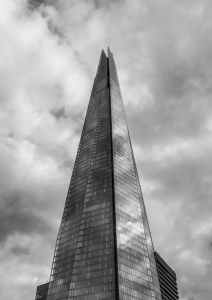
Shard Renzo Piano Architect Atlantis

Photo by Pixabay on Pexels.com

I found the entire book totally engaging, from start to finish; their journey and revisiting the building projects along the Thames and the Seine, in New Caledonia and New York, San Francisco and Osaka Bay and finally to Athens, providing just enough information and context to keep the narrative interesting and intriguing, with the addition of that element of humanity that only two people who know each other as well as these two could bring.

A light touch allows you, even at your most determined, to listen to others and seek to understand them. A heavy tread you’re better off without.
Lightness is key to understanding places, and, in that sense, an architect must inhabit the places where he works. I have been a Parisian, a Berliner, a New Yorker, a Londoner, a Kanak.

All the while remaining who I am.

I think an architect who does not recognize himself in the place he is building cannot capture its soul.

Further Reading

Renzo Piano Video : On the Shoulders of Giants – a wonderful, biographical interview with the Pritzker prizewinning Italian architect

Article (with photos): Les 10 projets les plus célèbres de l’architecte Renzo Piano by Marina Hemonet, AD Magazine – including one here in Aix-en-Provence (Le pavillon de photographie du Château La Coste)

Berlin Unorthodox Renzo Piano Architecture Potsdamer Platz

Photo by Esther on Pexels.com

Anecdote/Coincidence : Upon finishing the four part series Unorthodox this week, I watched the short film ‘The Making of Unorthodox’ intrigued by the storytelling, sense of place and adept characterisation it had evoked. It is filmed in Berlin and Williamsburg, but mostly in Berlin, where the Production Designer Silke Fischer, looking for a specific architectural look and feel to extend the metaphor of freedom, found a great location at Potsdamer Platz next to the Philharmonic.

Unbeknown to me, while I was reading Atlantis, I was also immersed in a series shot on location in one of his architecturally designed buildings.

N.B. Thank you kindly to the publisher Europa Editions for sending me a copy of the book.