
translated by Lazer Lederhendler (from French-Canadian into English).
Reading Women in Translation
 My final read of August for WITMonth was The Party Wall, French Canadian author Catherine Leroux’s third novel. It was shortlisted for the Scotiabank Giller Prize, which annually recognizes the best in Canadian fiction – and has just announced its 14 strong long list for 2020. The translation by Lazer Lederhendler won the Governor General’s Literary Award for translation (French to English).
This novel is told in chapters about paired characters; mother and son, brother and sister, husband and wife; so it stops and starts as we leave one pair and move to the next. There doesn’t initially appear to be a connection (although there is) between the lives so the stories are quite different, creating the effect of reading short stories with the expectation that the threads will come together to reveal the tapestry.
The novel opens with Madeleine (actually it doesn’t but it’s the more memorable opening chapter), a woman who has lost her husband; she visits the spot where his ashes lie beneath a tree and talks to him often. Her son has left home and she hears of him through the many travellers who arrive looking for a bed for a night, people he has given her address. There is a sadness of loss of the other in her, an affliction which is given a bizarre (but true) cause when she is told she is not a biological match for her son, when at last he does return.
Photo by Kristina Gain on Pexels.com
From the window of her office, Madeleine looks at the watchman doing his rounds. This is what she does when her eyes need a rest. There’s the sea, of course, but it isn’t at all restful. It’s a struggle, a call, a mystery whispered with every rising tide. The watchman, on the other hand, is calm and predictable. Afflicted by gout, he has never taken a day off. He circles around the lighthouse like a grey satellite; his hobbling in no way diminishes his reassuring presence.

As their lives move forward, the theme of separation becomes apparent, its inherent wounding manifesting in different ways in each pair of lives.
Oddly enough, it was a long time before they realised they had both been adopted. Marie, haunted by her origins, preferred to wait before broaching the subject and kept the truth sealed inside her chest. As for Ariel, his sense of belonging to the Goldstein family was so powerful that he rarely gave any thought to the fact he had been born elsewhere, welcomed into the world by unknown hands, which had passed him on to someone else like a baton in a relay race that was to lead to as yet unseen heights.
Silence as a Familial Weapon

Photo by Pixabay on Pexels.com
Carmen and Simon are siblings and we meet them around their mother’s deathbed, a woman who never revealed to her children who their father was, controlling them through withholding, keeping them attached through the sliver of possible revelation. Carmen runs marathons to forget, while Simon tries to avoid witnessing his marriage fall apart, removing himself by choosing to work the graveyard shift.
The term “graveyard shift” is perfectly apt: the darkness and silence of a cemetery always mask a ghostly existence, the invisible dramas of the dead and their mourners.
It’s a thought provoking and cleverly constructed novel, however the disjointed stories inevitably expose the weaknesses of one against the strengths of another, and so writing about it a week after reading highlights that which was memorable and that lost to the river of stories who are lost in the current.
Ultimately, what stays with the reader is the importance of the connections we do make, those we choose and those we pursue, for better or worse. A couple of the stories could have evolved into novels in their own right.
The Party Wall has its own logic and its own internal structure and systems: four stories that become intertwined as the book progresses. Three of those came about from extraordinary news stories I had come across. Catherine Leroux
Further Reading
Article CBC/Radio Canada: Catherine Leroux on the literary value of loose ends
Article: How Catherine Leroux ripped fiction from the headlines in The Party Wall
Article: 14 Canadian books make the 2020 longlist for $100k Scotiabank Giller Prize, 8 Sept 2020
 The last nonfiction book I read was also set in Morocco (at the time referred to as the Spanish Sahara) written by a foreign woman living openly with her boyfriend, it couldn’t be more in contrast with what I’ve just read here – although Sanmao does encounter women living within the oppressive system that is at work in this collection.
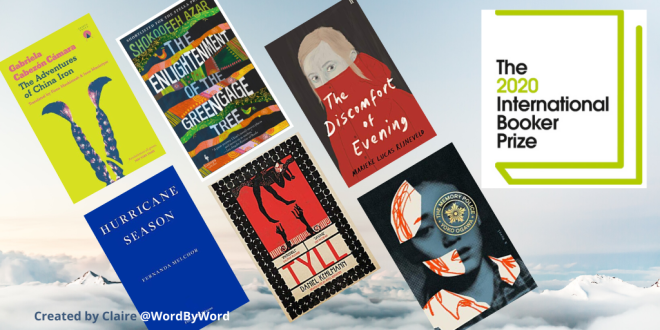

 Jas lives with her devout farming family in the rural Netherlands. One winter’s day, her older brother joins an ice skating trip. Resentful at being left alone, she makes a perverse plea to God; he never returns. As grief overwhelms the farm, Jas succumbs to a vortex of increasingly disturbing fantasies, watching her family disintegrate into a darkness that threatens to derail them all.
 Listening to the author read in Dutch was wonderful and the discussion between the judge, the translator and author worth listening to and may well influence more to discover what the book is about.
 Naondel is the name of the ship that will bring the First Women to the island of Menos.
 The darkness these women endure, the evil that is perpetuated by their ruler, is only alleviated by the foreknowledge that we already know these women will eventually escape it. So we read in anticipation of that event, in the meantime getting to know each of them and the powers they had before they were enslaved.
 Red Abbey is situated on the island Menos, run by women, a kind of educational refuge that has elements of sounding like a boarding school and a convent. On the mainland some are not even sure if it is myth or reality, but they send their girls there in hope that the rumours are trues. We learn that Maresi was sent there by her family during ‘Hunger Winter’ and that the abundance of food, the genuine care and education she is given makes it a place she adores.
 There are two maps at the front of the book, one of Red Abbey, a walled area showing various buildings, such as Novice House, Knowledge House, Body’s Spring, Temple of the Rose, named steps and courtyards and a map of the island drawn by ‘Sister 0 in the second year of the reign of our thirty-second mother, based on the original by ‘Garai of the Blood in the reign of First Mother’
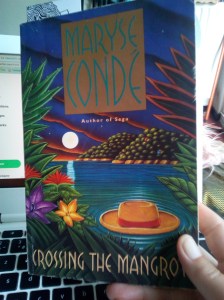 Maryse Condé is one of my favourite authors and I’ve been slowly working my way through her books since she was nominated for the
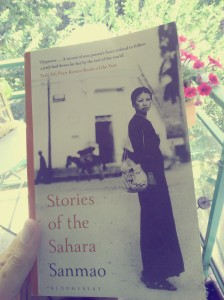 Usually when I come across a new book that sounds like my kind of read, meaning it is of cross-cultural interest, where a character (or person) from one culture (preferably not one I’m familiar with) encounters another, I’ll find others who’ve read it to discern whether it’s for me or not.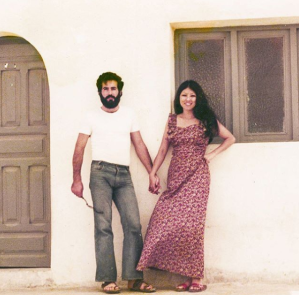

 I absolutely loved Stories of the Sahara, in its entirety and it will likely be my favourite nonfiction title of the year. It is so refreshing to read a travelogue by a woman from another culture and discover a writer beloved of Chinese and Taiwanese readers for decades.
 The combination of her naivete, determination and feminism – her refusal to be stopped from doing what she wants – create some of the most hilarious and alarming moments. Her kindness and frankness gain her entry inside the culture and landscape, providing insights few are capable of accessing. People trusted her – yes they often took advantage of her – but she was a willing participant. They provided rich literary material, clearly!

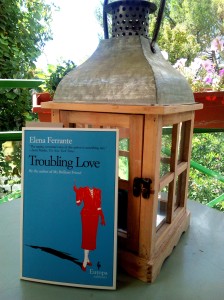
 That’s Ferrante.
 Passionate French Women Who Faced Death Unflinchingly
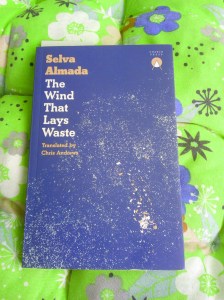 Evangalising Across the Argentinian Countryside

 Word by Word