
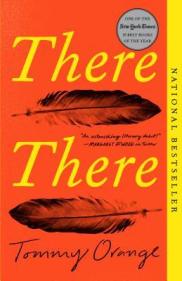
 There There by Tommy Orange was lent to me by a friend and was a debut novel that made a significant splash when it was published in 2018. The author is a member of the Cheyenne and Arapaho Tribes of Oklahoma, born and raised in Oakland, California.
The Egyptian-Canadian novelist Omar Al Akkad who won the 2021 Scottiabank Giller Prize for his refugee tale What Strange Paradise, a book that examines the confluence of war, migration and a sense of settlement, raising questions of indifference and powerlessness, had this to say:
“There There is a miraculous achievement, a book that wields ferocious honesty and originality in service of telling a story that needs to be told. This is a novel about what it means to inhabit a land both yours and stolen from you, to simultaneously contend with the weight of belonging and not belonging.”
The novel starts out with a two page very short summary of 12 characters, giving the reader a little information about each, but avoids anything that might be a spoiler in the stories to come. I liked having this summary there and I would go back to it each time I encountered those characters as they developed and as I became aware of what was being given and what was being held back for the reader to discover.
Photo by Pixabay on Pexels.com
The characterisation was excellent and I especially loved how the author built his female characters.
Jacquie kneeled in front of the minifridge. In her head she heard her mom say, “The spider’s web is a home and a trap.” And even though she never really knew what her mom meant by it, she’d been making it make sense over the years, giving it more meaning than her mom probably ever intended. In this case, Jacquie was the spider, and the minifridge was the web. Home was to drink. To drink was the trap.
There is an edge to the male characters and a tension that builds slowly over time that made their chapters harder to read.
The wound that was made when white people came and took all that they took has never healed. An unattended wound gets infected. Becomes a new kind of wound like the history of what actually happened became a new kind of history. All these stories that we haven’t been telling all this time, that we haven’t been listening to, are just part of what we need to heal.
The title ‘There There‘ has multiple references, the first being the name of a Radiohead song with the refrain, ‘just ’cause you feel it doesn’t mean its there’ and a Gertrude Stein quote ‘There is no there there’ referring to the place she’d grown up in that had changed so much, that there of her childhood, the there there, was gone.
The quote is important to Dene. This there there. He hadn’t read Gertrude Stein beyond the quote. But for Native people in this country, all over the America’s, it’s been developed over, buried ancestral land, glass and concrete and wire and steel, unreturnable covered memory. There is no there there.
As the novel builds, the connections between the characters and their journeys are revealed.
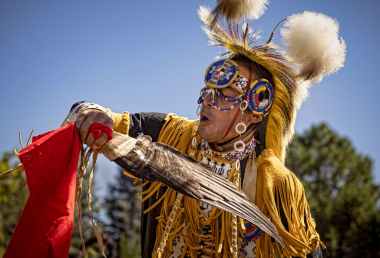
Photo by Ron Graham-Becker on Pexels.com
All the characters are Native and the way they identify, their identity, their knowledge or lack of knowledge about who they are and how they are perceived, how they cope, how they live is central to the kaleidoscopic narrative, that builds up to the final chapters, when they will be present at the Big Oakland Powwow festival.
We made powwows because we needed a place to be together. Something intertribal, something old, something to make us money, something we could work toward, for our jewellery, our songs, our dances, our drum.
I enjoyed the character building, the reflections, the cultural insights and getting to know their stories more than the actual plot.
They used to call us sidewalk Indians. Called us citified, superficial, inauthentic, cultureless refugees, apples. An apple is red on the outside and white on the inside. But what we are is what our ancestors did. How they survived. We are the memories we don’t remember, which live in us, which we feel, which make us sing and dance and pray the way we do, feelings from memories that flare and bloom unexpectedly in our lives like blood through a blanket from a wound made by a bullet fired by a man shooting us in the back for our hair, for our heads, for a bounty, or to just get rid of us.
The first two thirds of the novel was for me a 5 star read, but the ending had me imagining alternative choices. And yet, it could be said that the ending was foretold, that the ancestral memory had carried forward and become so twisted, it turned on itself.
Make them look and act like us. Become us. And so disappear. But it wasn’t like that.
Further Reading
There There was nominated for the Pultizer Prize (2019) and National Book Award (2018), won the PEN/Hemingway Foundation Award (2019) and was one of the New YorkTimes 10 best books of the year.
It was almost nominated for the Dublin Literary Award 2020 by 13 different international libraries.
Have you read There There? Share your thoughts below.
 The children at school ask about her skin colour and ethnic origin.

 Sally Morgan is one of Australia’s best-known Aboriginal artists and writers.
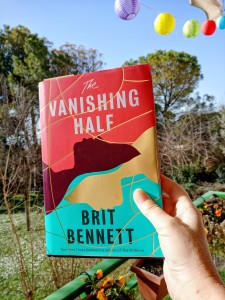 Brit Bennett’s novel features identical African American twins who leave home suddenly to make their way in the world, and looks at all the ways people survive and hide things about themselves, keep secrets and the impact that has not just on themselves but on others around them. And the many ways one can lose oneself.
 Born and raised in Southern California, Brit Bennett graduated from Stanford University and later earned her MFA in fiction at the University of Michigan. Her debut novel


 The narrating of family stories, taking us back as far as her great-grandfather Montazemolmolk with his harem of 52 wives, serves to provide context and an explanation for why certain family members might have behaved or lived in the way they did, helping us understand their motives and actions.





 The story concerns ‘the lawyer’, an educated and ambitious man regarded as one of the most successful Arab criminal attorneys in Jerusalem. One day he picks up a second-hand copy of Tolstoy’s novella ‘The Kreutzer Sonata’, recognising it as a volume his wife has mentioned in the past with enthusiasm, only to discover what he perceives as a love letter between its pages, in his wife’s handwriting. Discovering the name Yonatan on the inside cover, between bouts of violent and paranoid thoughts regarding his wife, he sets off to hunt the culprit down.
 They are Arab-Israeli’s, non-Jewish Israeli citizens whose cultural and linguistic heritage is Arab. A matter of geography and politics, those who live in the Occupied Territories (otherwise known as the West Bank and Gaza) are of the same ethnic origin but refer to themselves as Palestinian, they of the same family as Arab-Israeli’s, they just carry a different legal status, which affects their education and employment opportunities and much more.
 Word by Word