
translated from Italian by Ann Goldstein.
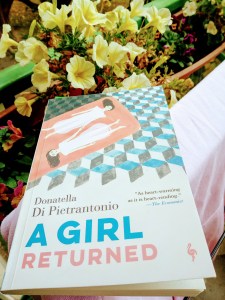 A Girl Returned came to my attention because I like to see what Europa Editions are going to be publishing, they are known for bringing Italian literature to readers of the English language and their big title in 2020 will be Elena Ferrante’s The Lying Life of Adults. One I will be reading soon.
The Adoptee Experience
I chose to read A Girl Returned because I am interested in reading as much as possible, fiction or nonfiction, stories that portray the adoptee experience. And the premise of this book is shocking as the title suggests, when a thirteen year old girl is returned to the family she is born into without being told why or there appearing to be any clear motive.
Though as anyone with a connection with adoption will know, it is rare for the process to exist without the presence of secrets, lies, clandestine activities, resentments, heartbreak and denial.
Book Review
I was thirteen, yet I didn’t know my other mother.
The story opens as a 13-year-old girl struggles up the stairs of an apartment with an unwieldy suitcase and a bag of jumbled shoes. The door is opened by her sister Adriana, whom she has never met.
We looked like each then, more than we do as adults.
Through the months of adjustment that follow, thrown back into the reluctant family she was born into, events are narrated with hindsight, as her memory of that vision of her sister attests. She is determined to unravel the cause of this separation and abandonment by both sets of parents, at birth by her biological family and at 13 by her adoptive family, the latter, whose love she never questioned.

Photo by Ian Panelo on Pexels.com
Aware her mother had been suffering, she continues to worry and wonder about her, we the reader do too, trying to imagine and fearful of what might have ailed her that she was unable to share with her only daughter.
Who knew how my mother was. Whether she’d started eating again, whether she was getting out of bed more often. Or if instead she’d been taken to hospital. She hadn’t wanted to tell me anything about her illness, certainly she didn’t want to frighten me, but I had seen her suffering in the past months, she hadn’t even gone to the beach, she who was usually there in the first warm days of May. With her permission I went to our umbrella by myself, since I was grown up now, she said. I had gone the day before my departure and had even had fun with my friends: I didn’t believe that my parents would really find the courage to give me back.
As time passes, small clues diminish her resolve and trust in those around her, who seem to believe in or at least practice, silence and deception. The only way will be to take matters into her own hands.
The idea came to me at night, I reported it to Patrizia in the morning under the umbrella.
The one unexpected joy in her changed circumstances, though she accepts it reluctantly and is wary of it, is the fierce love, and admiration tinged with jealousy, she receives from her younger sister. Like candle light in a dark room, she is luminous yet capable of harm. There are wild differences, given their different upbringings, but there exists the thread of undeniable connection.
I wasn’t acquainted with hunger and I lived like a foreigner among the hungry. The privilege I bore from my earlier life distinguished me, isolated me in the family. I was the arminuta, the one who’d returned. I spoke another language and I no longer knew who I belonged to. I envied my classmates in the town, and even Adriana, for the certainty of their mothers.
Identity, Exile and The Mother
In a brilliant essay-style review, translator Stiliana Milkova suggests that the main concern of the novel is how essential the role of the mother is to our sense of identity.
Looking at mothers as the figures that determine and define who we are allows us to think about A Girl Returned as a novel about exile and dislocation, rather than simply motherhood. The Arminuta (a word that in the language of the Abruzzo region of Italy means “the returned”) is unexpectedly forced to leave her maternal home, or what she considers her maternal home, and exiled to a place whose customs, and even the language, are almost foreign to her.
The longer she stays in this forced exile, the more detached she becomes from both her present and her past, to who she was, is. So much had been tied to a mother’s love or bond. Though she remembers the feeling of being loved, she now questions it, faced with such devastating evidence.
In certain melancholy moods, I felt forgotten. I’d fallen out of her thoughts. There was no longer any reason to exist in the world. I softly repeated the word mamma a hundred times, until it lost all meaning and was only an exercise of the lips. I was an orphan with two living mothers. One had given me up with her milk still on my tongue, the other had given me back at the age of thirteen. I was a child of separations, false or unspoken kinships, distances. I no longer knew who I came from. In my heart I don’t know even now.

Photo by Bahaa A. Shawqi on Pexels.com
A short novel, A Girl Returned packs a powerful, moving punch and generously provides that glimmer of hope, in an unexpected alliance. Rereading these passages I highlighted makes me wish to repeat the entire reading experience, the shock, the solace, the resistance and resilience.
We look less like each other now, but we find the same meaning in this being thrown into the world.
Highly Recommended.
Reviews
Bella Mia by Donatella Di Pietrantonio, review by HeavenAli (Published in 2014, translated to English in 2016)
My Mother is a River by Donatella Di Pietrantonio, review by HeavenAli (Published in 2011, translated into English 2015)
Further Reading
Reviews by Translators: The Mother Of All Questions: Donatella Di Pietrantonio’s “A Girl Returned,” tr. Ann Goldstein by Stiliano Milkova
Article New York Times: ‘The Ferrante Effect’: In Italy, Women Writers Are Ascendant by Anna Momigliano
N.B. Thank you kindly to Europa Editions for sending me a copy of the book.
 But the novel isn’t about politics, it concerns a few players and characters, who we are given glimpses of, in a style that is like a series of snapshots, a narrative that therefore has gaps and not the fluidity of a traditional story, nor enables us to really get to know too well the characters, limited as we are by this kaleidoscopic technique.
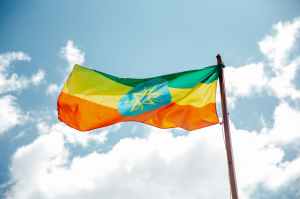
 One evening they listen to the radio and hear the (now) famous words of Empress Menen of Ethiopia disclosing the aggression to the World Women’s League, appealing to all world nations:
 Though she uses her imagination, it is historical fiction after all, this is not a fantasy or adventure, and the role these women took on and the sacrifices and risks they took in doing so, meant they were heroines not in the traditional masculine sense, but that they showed solidarity towards keeping these invaders away and presented an image of provocation and strength, one that no European army, likely had ever seen.
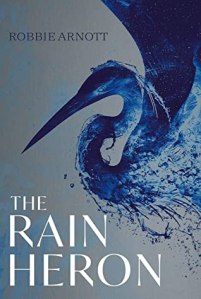 The first chapter tells what I imagined was the original fable of the rain heron and the unlucky farmer, and from what I can gather, the author has made this story up as well. It’s a story of a woman running a farm, the daughter of generations of farmers, but one who struggles for many reasons no matter what methods she tries.

 My final read of August for WITMonth was The Party Wall, French Canadian author Catherine Leroux’s third novel. It was shortlisted for the

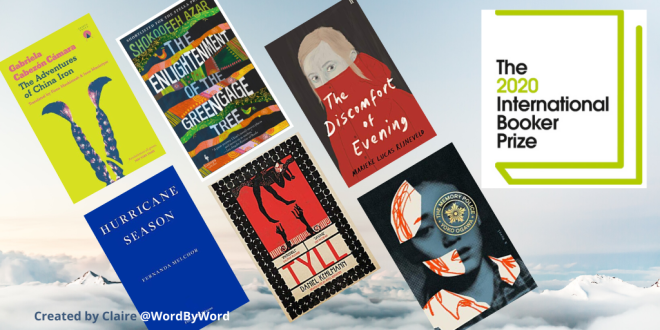

 Jas lives with her devout farming family in the rural Netherlands. One winter’s day, her older brother joins an ice skating trip. Resentful at being left alone, she makes a perverse plea to God; he never returns. As grief overwhelms the farm, Jas succumbs to a vortex of increasingly disturbing fantasies, watching her family disintegrate into a darkness that threatens to derail them all.
 Listening to the author read in Dutch was wonderful and the discussion between the judge, the translator and author worth listening to and may well influence more to discover what the book is about.
 Naondel is the name of the ship that will bring the First Women to the island of Menos.
 The darkness these women endure, the evil that is perpetuated by their ruler, is only alleviated by the foreknowledge that we already know these women will eventually escape it. So we read in anticipation of that event, in the meantime getting to know each of them and the powers they had before they were enslaved.
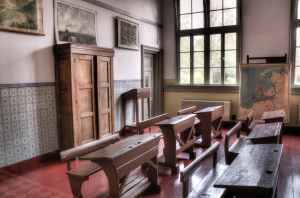
 Red Abbey is situated on the island Menos, run by women, a kind of educational refuge that has elements of sounding like a boarding school and a convent. On the mainland some are not even sure if it is myth or reality, but they send their girls there in hope that the rumours are trues. We learn that Maresi was sent there by her family during ‘Hunger Winter’ and that the abundance of food, the genuine care and education she is given makes it a place she adores.
 There are two maps at the front of the book, one of Red Abbey, a walled area showing various buildings, such as Novice House, Knowledge House, Body’s Spring, Temple of the Rose, named steps and courtyards and a map of the island drawn by ‘Sister 0 in the second year of the reign of our thirty-second mother, based on the original by ‘Garai of the Blood in the reign of First Mother’
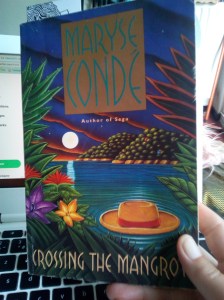 Maryse Condé is one of my favourite authors and I’ve been slowly working my way through her books since she was nominated for the
 Word by Word