Top Reads 2016

In 2016, I read 55 books, just over my ongoing intention, to read a book a week.

I managed to read books by authors from 26 different countries and 19 of them, just over a third, were translations. My absolute favourite book of the year, was written by an author from Guadeloupe, translated from French into English, and 3 of my top 5 fiction reads were translated.

Outstanding Read of 2016
Bridge of Beyond

The book that has stayed with me, that I loved above all else was Simone Schwarz- Bart’s The Bridge of Beyond, a novel that touched on the lives of three generations of women from the French Antillean island of Guadeloupe, narrated by the granddaughter Telumee as she grows up on the island, learning from experience and the traditions of her culture, guided by the wisdom of her grandmother Toussine, ‘Queen Without a Name’. A masterpiece of Caribbean literature, “an unforgettable hymn to the resilience and power of women,” translated from French, republished as a New York Review of Books (NYRB) classic.

Top 5 Fiction Reads

Human ActsHuman Acts, Han Kang (South Korea) tr. Deborah Smith

As much a work of art as novel, Human Acts is an attempt to understand a despicable act of humanity through story telling, Han Kang was one of the most thought provoking authors of 2016 for me, equally incredible was her novel The Vegetarian, which won the Man Booker International Prize in 2016.

What Lies Between UsWhat Lies Between Us, Nayomi Munaweera (Sri Lanka)

Like The Bridge of Beyond, Munaweera’s work is evocative of place and she brings a childhood in the gardens of Sri Lanka alive. A woman remembers her past from behind the walls of a cell, and as she reveals her upbringing and the changes that brought her family to live in America, we wonder what went terribly wrong, that caused her to lose everything. And best book cover!

zoraTheir Eyes Were Watching God, Zora Neale Hurston (USA)

I finally read this great American classic and it was absolutely fantastic, another story that touches on multiple generations of women and how the lives of each affects the other, as they all wish a different life for the future generation. Janie is determined to live her life differently, but some lessons have to be lived thought and not told. The prose is astounding, melodic and the whole reading experience one I’ll never forget.

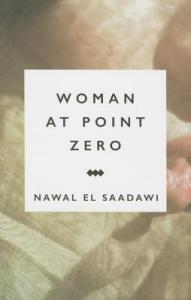
FirdausWoman at Point Zero, Nawal El Saadawi (Egypt) tr. Sherif Hetata

An internationally renowned feminist writer, activist, physician, psychiatrist and prolific writer, I’d been wanting to read her for some time and during August, reading books by Women authors in translation #WITMonth was the perfect opportunity. And what a novel! Inspired by real events, after she was given the opportunity to interview a woman who had been been imprisoned for killing a man and due to be executed, she retells this story of Firdous, too beautiful and poor to pass through life unscathed, who finds the desire to lift herself and others out of oppression and will pay the ultimate price. Haunting, beautiful, a must read author and book!
Days of AbandonmentDays of Abandonment, Elena Ferrante (Italy) tr. Ann Goldstein

The year wouldn’t be complete without Elena Ferrante, the reclusive Italian author whose identity was outed this year, although I didn’t read any of the reports, preferring she remain as unknown to me now as before. Days of Abandonment was published before her popular tetrology which began with My Brilliant Friend and is a compelling, searing account of one woman’s descent into semi madness following abandonment by her husband, in the days where the hurt prevents her from seeing things objectively and her rationality leaves her. It’s full of tension, as she has two young children and Ferrante uses her incredible talent to make the reader live through the entire uncomfortable experience of this roller coaster ride of temporary insanity.

Top Non Fiction Reads

Memoir

Brother Im DyingBrother I’m Dying by Edwidge Danticat (Haiti)

A beautiful memoir of her father and his brother, alternating between Haiti and America, it is a tribute to a special relationship and an insight into the sacrifices people make to better the lives of others, whether its family or their community. I’ve read her novel Breath, Eyes, Memory she is a wonderful writer with a gift for compassionate storytelling.

why-be-happyWhy Be Happy When You Could Be Normal by Jeanette Winterson (UK)

Wow, this is the adoption memoir that tops all others, a literary tour de force, an entertaining, horrifying account of a young girl’s childhood, survived by a strong passion for life and literature that gets her through some tough moments and develops an iron will to pursue the joy that appeals so much more than the conformity her mother sought. Brilliant.

woman-on-the-edgeA Woman on the Edge of Time by Jeremy Gavron (UK)

Less a memoir of the son, than one of his obsession to understand why his mother, when she appeared to have everything a young woman would ever want, decided to end it all. Having never asked questions about his mother’s suicide, Jeremy Gavron, now a father of two girls becomes obsessed with knowing who she was and what pressures lead her to her end. Early 1960’s insight.

The Blue Satin NightgownThe Blue Satin Nightgown by Karin Crilly (US)

A reading highlight of the year for me, I’ve seen Karin’s book go through many stages leading to publication this year, in my review you’ll read how I was involved a little in its development. I knew it would be a success, as we sipped champagne together in Aix after she won the Good Life in France short story competition for the first chapter, Scattered Dreams. Last seen, Karin and her friend Judy were in China continuing their adventures, which age will never hamper and there’s a mysterious new man appearing in her recent Facebook posts, suggesting she may be writing a sequel perhaps?

Soul Food

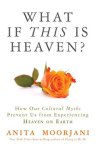
This year, in particular after the harrowing experience accompanying my 14-year-old daughter through back surgery to correct a curvature of the spine, I read a few books by authors published by Hay House, whose radio show I often  listen to. I’m already a fan and follower of Colette Baron-Reid and her book Uncharted came out this year, and through her I discovered, listened to and read What if This is Heaven by Anita Moorjani, Making Life Easy by Christiane Northrup and I’m still slow reading a few others. During challenging times, these authors are a soothing balm, reminding us of much we may already know, offering an alternative perspective on how we see things and tips for remaining grounded and healthy in body, mind and spirit.
Special Mentions
how-to-be-braveUnforgettable Reading Experience Ever: How to Be Brave, Louise Beech(UK)

I couldn’t let the year pass without mentioning the extraordinary reading experience of Louise Beech’s How to Be Brave. I read this book while I was in the hospital with my daughter and it was surreal, a captivating, incredible story, based partly on true events, both those of the author and her daughter, who are both coming to terms with a recent diagnosis of Type1 diabetes and a retelling of her grandfather’s epic journey lost at sea, after their ship was destroyed.

Bonjour TristesseBest Translations: Bonjour Tristesse(France) & The Whispering Muse (Iceland)

Two fabulous novellas, from Iceland, Sjón’s The Whispering Muse was my first read of the year for 2016 and I loved it, it’s a kind of parody of The Argonauts and had me looking up references to the Greek classic and enjoying both the story and its connections.

Bonjour Tristesse is an excellent, slim summer read, of a young woman’s regret, a heady summer on the French Riviera, engaging as she has a deft ability to portray her minds workings and see herself interacting with the others, aware of her own manipulative ability and yet unable to stop herself. Brilliant.
GeorgiaBest Fictional Biography: Georgia, A Novel of Georgia O’Keeffe, Dawn Tripp (US)

I love the work of the artist Georgia O’Keeffe, she’s probably my favourite artist in fact. And she was an incredible woman, who lived a long time and had an intriguing relationship with her husband, who discovered her as one of his protege, the photographer and gallery owner Alfred Steiglitz. Dawn Tripp has done an outstanding job of researching her life, bringing to this novel, insights from new material available and succeeds in doing what hasn’t really been done before, channelling the voice of the artist, providing a perspective that is loyal to the artist and how she may have thought.

Brief HistoryBiggest, Most Satisfying Challenge: A Brief History of Seven Killings, Marlon James (Jamaica)

Written a large part in Jamaican patois, with a wide array of characters, this 700+ page book won the Man Booker Prize in 2015 and was my summer chunkster for 2016. I gave it 5 stars for sheer effort, even though it’s not really my style of book, I tend to prefer the stories by women writers from around the Caribbean, Marlon James is perhaps too modern for me, he moves his story out of generational tradition and into the cold, dark, masculine front lines of survival, jealousy and ambition in a trigger happy, drug induced frightening world that is far from sleepy villages I prefer to inhabit.

Biggest Disappointment: The Fox Was Ever the Hunter, Herta Muller (Romania)(DNF)

It wasn’t on my reading list and I should have listened to my instinct, but since I was reading books by women in translation and I’d been sent this by the publisher (unsolicited), and it was a novel by a Nobel Prize winning author I attempted it. Impossible. Incomprehensible. Stop. Prize winning authors and books should be looked at like any other book I tell myself, forget about what a committee of 18 Swedish writers, linguists, literary scholars, historians and a prominent jurist with life tenure think, they are not you.

Well that’s it for 2016, another great reading year!

What was your outstanding read for 2016?
 

One Hundred Shadows by Hwang Jungeun tr.Jung Yewon

oe-hundred-shadowsEthereal, dream-like, accepting of their fate. South Korean working class literature.
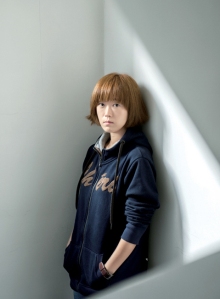
Two young people work in an electronics market and slowly develop a friendship.

We meet Eungyo as she is following her shadow, causing her to become separated from the group she is with. Mujae follows her and stops her. Shadows rise and seem to lure one to follow it, something that others try to prevent, for it feels death-like.

Although it is never explained the constant mention of human shadows and their various behaviours provoke the reader’s imagination to ascribe meaning. Ill health and approaching death cause it to rise, and perhaps thoughts, reaching the limit of what one is able to endure. One shouldn’t follow it.

Their bond is formed as the environment within which they work is threatened with demolition. There is a subtle interdependency between the market traders, repairing and selling electronics, so when people who have worked there for years suddenly disappear, it unsettles the tenants.

Rumours and false media reports hasten their demise. They hold onto rituals, sharing soup, drinking rice wine, telling stories.

Do you know what a slum is, Eungyo?
Something to do with being poor?
I looked it up in a dictionary.
What did it say?
An area in a city where poor people live. Mujae looked at me. They say the area around here is a slum.
Who?
The papers, and people.
Slum?
It’s a little odd, isn’t it?
It is odd.
Slum.
Slum.
We sat there repeating the word for a while, and then I said, I’ve heard the word, of course, but I’d never thought of this place as a slum.

This short novella witnesses the various encounters between these two, the stories they recount which often include shadows they’ve witnessed, the simple soups they consume, the songs they sing. Shadows, soup, songs, survival.

The novel was inspired by the effect on ordinary working class people affected by Korea’s eviction-centred redevelopment policies, where the government removed residents and vendors by intimidation and force. Redevelopment involved a complex web of often obscure relationships between corporations and government, wealthy landowners and hired thugs, low-income tenants and the police. The novella provides a gentle, poetic insight into those marginalised by those policies.

hwang-jung-eunHwang Jungeun’s debut novel, translated by Jung Yewon was a critical and commercial success in South Korea with its mix of oblique fantasy, hard-edge social critique, and offbeat romance.

“My home was described in the news as ‘a slum’. This was an outside view; I wrote my novel to show it from the inside.”

It won the prestigious Hankook Ilbo Literary Award and the Korean Booksellers’ Award. Mentioned by Han Kang, who won the 2016 Man Booker International Prize for The Vegetarian as South Korea’s rising literary star.

Click Here to Buy a Copy of One Hundred Shadows

Note: This novel was an ARC (Advance Reader Copy) kindly provided by the publisher, Tilted Axis as an e-book.

A Season in Rihata by Maryse Condé (Guadeloupe) tr. Richard Philcox #WITMonth

Marysé Conde is a Guadeloupean writer I came across in 2015 when she was nominated for the Man Booker International Prize, at a time when it was a two yearly prize for a lifetime’s work.

It has now evolved into an annual prize split between the author and translator for a book translated into English that year and in 2016 it was awarded to Han Kang (South Korea) and Deborah Smith (translator) for the novel The Vegetarian.

Maryse Condé didn’t win the prize back in 2015, but was the author on the list who most appealed to me.

Since reading about her at that time, I followed her own recommendations in terms of what to read to be introduced to her work, starting with a collection of vignettes in Tales from the Heart: True Stories from my Childhood, then Victoire: My Mother’s Mother and finally, the grand masterpiece and novel she is most well-known for, especially in academic circles, as it is widely studied and recognised as an important work of historical fiction set in the African Kingdom during a significant period of change: Segu.

I’ve wanted to read more of her work, so tracked down a couple more books that have been translated into English and was fortunate enough to have listened to her speak at our local library earlier this year – though she lived in France for many years, she is now retired and has returned to her native Guadeloupe to live, though still active in literary circles.

A Season in Rihata – reviewSeason in Rihata

Zek and his Guadeloupean wife Marie-Hélène live in a small fictitious African town of Rihata, with their six children and another due any day. It is far from Paris where they met and lived in very different way and far removed from the kind of life Marie-Hélène’s remembers on the island home of her childhood.

Like all men of his ethnic group, Zek had been brought up with a kind of fear and contempt of woman – malevolent creatures whose dark instincts had to be mastered. Love had taken him by surprise. He had difficulty accepting the power Marie-Hélène held over him and was convinced that no other man except him had undergone such humiliation.

Neither are happy; Zek has never been able to get over the feeling of being looked down on by his father, even though he is long dead, and remains resentful of his younger brother Madou, who found favour without having to do anything and who was the cause of him having to relocate his family due to the unwanted attentions of his brother towards his wife.

Influenced by a father who made no pretence of his preferences, Madou had soon considered Zek as a person of limited ability and in all ways inferior; although this did not exclude a certain brotherly affection.

Now Madou is coming to Rihata, he is a political Minister coming to conduct negotiations, his presence causing many to feel uneasy, a disruption in the sleepy town where not much usually happens.

It is a novel of discontent, of the effects of selfish behaviour, which none are immune to or able to rise above. Contentedness is within their reach, but so is temptation and the effect of indulging it ricochets through all members of the extended family and the rulers of the country.

While it doesn’t reach the heights of her other work I’ve read, it’s a worthy contribution to her body of literature and I look forward to reading more.

To Buy A Novel by Maryse Condé Click here (Book Depository Affiliate Link)

The Days of Abandonment by Elena Ferrante (Italy) tr. Ann Goldstein #WITMonth

ItalyOn the day when the nation is shocked and grieving after a devastating earthquake, that has destroyed entire villages and resulted in a significant loss of life, I don’t know how appropriate it is to share their literature, perhaps in the case of this particular novel, it serves to put things in perspective.
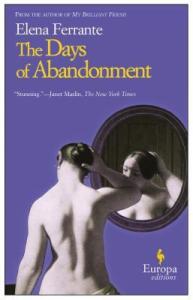
For while the protagonist of this novel may have felt her world was coming to an end, knowing how quickly and without warning life and home can be snatched away, might prompt us get over the more indulgent grievances of the heart.

Days of AbandonmentA national bestseller for almost an entire year, The Days of Abandonment shocked and captivated its Italian public when first published.

“One April afternoon, right after lunch, my husband announced that he wanted to leave me.”

Like an orchestrated composition that begins with a quiet, solo voice and rises to a crescendo with the addition of more instruments, Ferrante’s novel and its female character move from reasonable, melodic harmony to loud, discordant cacophony.

“I listened to him attentively, I contradicted him calmly, I didn’t ask him questions of any kind nor did I dictate ultimatums, I tried only to convince him that he could always count on me. But I have to admit that, behind that appearance, a wave of anguish and rage was growing that frightened me.”

Like the stages of grief, The Days of Abandonment charts the stages of decline following a lost love, beginning with the irony of a love more fierce than it was when it was present, then the deterioration, as the realisation and reality of life without it comes to pass for this mother of two children, cooped up in her apartment one hot August, with only the sad figure of a morose cellist living downstairs to observe her descent.

The abandoned woman acts terribly reasonably, only to deteriorate into desperate disillusionment. Like madness descending, the loss of love and the feeling of abandonment rages through the various emotions like a tempest, no person or animal immune to its violent, destructive force.

“The circle of an empty day is brutal and at night it tightens around your neck like a noose.”

It is shocking in how far the madness delves and astounding as it reaches a turning point and she is able slowly to perceive herself and the illusion of what she thought she had, for what it really was.

“It was really true, there was no longer anything about him that could interest me. He wasn’t even a fragment of the past, he was only a stain, like the print of a hand left years ago on a wall.”

Elena Ferrante observes the minutiae of human emotion and suffering, the obstinacy of a grasping, possessive love, the effect of our behaviour on those around us and the resilience of the human spirit.

Exhausting, terrifying, ferocious, we are both beast and beauty.

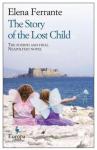
Elena Ferrante is the pseudonym of an Italian novelist, whose true identity remains a mystery, author of the four novels in the Neapolitan tetralogy My Brilliant Friend, The Story of a New Name, Those Who Leave and Those Who Stay and The Story of the Lost Child. The Days of Abandonment was the first of her novels to be translated into English by Europa Editions in 2005.

Buy The Days of Abandonment via Book Depository

WIT logo


Woman at Point Zero by Nawal El Saadawi (Egypt) tr.Sherif Hetata #WITMonth

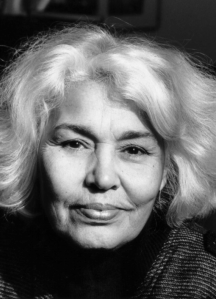
Author Nawal El Saadawi

Author Nawal El Saadawi

Nawal El Saadawi is an internationally renowned feminist writer, activist, physician and psychiatrist. Born outside Cairo, Egypt in 1931, she has published nearly 50 plays, novels and short story collections, translated into over 40 languages worldwide. Many of her works are taught in universities around the world.

While practising as a psychiatrist in the 1970’s she had the opportunity while conducting research into the causes of women suffering from neurosis, to meet with a woman who had been imprisoned for killing a man, a woman who was due to be executed. The woman had refused to speak to anyone until that point, and she had also refused to sign an appeal by the prison Doctor to the President so that her sentence might be commuted to life imprisonment.

The idea of ‘prison’ had always exercised a special attraction for me. I often wondered what prison life was like, especially for women. Perhaps this was because I lived in a country where many prominent intellectuals around me had spent various periods of time in prison for ‘political offences’. My husband had been imprisoned for thirteen years as a ‘political detainee’.

After days of refusal, just as El Saadawi was leaving the prison for the last time, the Doctor told her the woman had agreed to meet her. They spent as many hours as were left of that day together, the woman recounting her the story of her life that had led to that moment.

El Saadawi left at the end of that day, never to see her again. She would be executed by hanging, her story absorbed by El Saadawi who would eventually put it to paper, in this telling of Firdaus or Woman at Point Zero, originally published in 1973.

FirdausFrom her early days, Firdaus was a child who was noticed, though rarely looked out for, instances of cruelty and neglect made up the patchwork of her childhood. “Rescued” by an Uncle who’d already crossed filial boundaries, her one respite was to have been sent by him to school, his new wife further insisting she live there, perhaps the only paradisiacal period of her life, the one time she was left alone to flourish, to evolve, gaining her secondary school certificate, her sole prized possession.

Finding no place for her in her Uncle’s home on leaving school, still a teenager she is forced to marry the more than 60-year-old Uncle of her Aunt, eventually runs from him and is taken in by another only to suffer worse abuse, a fate she seems destined to continue to live through until she meets Sharifa, who takes her in and teaches her how to recognise and extract her value, a turning point in her awareness which will change her fate.

‘How is it possible to live? Life is so hard?’
‘You must be harder than life, Firdaus. Life is very hard. The only people who really live are those who are harder than life itself.’
‘But you are not hard, Sharifa, so how do you manage to live?’
‘I am hard, terribly hard, Firdaus.’
‘No, you are gentle and soft.’
‘My skin is soft, but my heart is cruel, and my bite deadly.’
‘Like a snake?’
‘Yes, exactly like a snake. Life is a snake. They are the same, Firdaus. If the snake realises you are not a snake, it will bite you. And if life knows you have no sting, it will devour you.’

She would learn the value of her flesh, of her person and how to ensure she was rewarded for it, she would find a measure of independence, and wished never to be beholden to man. She became an employee and discovered a world where women were held in even lower esteem, in many ways more a slave than a prostitute.

At various moments in her life, she experienced a feeling that might have been love, experienced like a poetic symptom, ‘two circles of intense black surrounded by two rings of pure white, expanding before my eyes’ but each time it fades to illusion, leaving a dark shadow on her heart.

But I expected something from love. With love I began to imagine I had become a human being…In love, I gave all: my capabilities, my efforts, my feelings, my deepest emotions. Like a saint, I gave everything I had without ever counting the cost. I wanted nothing, nothing at all, except perhaps one thing. To be saved through love from it all. To find myself again, to recover the self I had lost.To become a human being who was not looked upon with scorn, or despised, but respected, and cherished and made to feel whole.

Her story and those moments are narrated in spell-binding, lyrical prose with a compassionate sensitivity that underpins a tale of one woman’s life long oppression and desire to lift herself out of it, to put a stop to the cause of that injustice, to face the truth without fear, which she ultimately did so, through her fearlessness of death, in her absolute refusal to live.

Highly Recommended, a must read.

Buy Woman at Point Zero via Book Depository (Affiliate Link)

WIT logo

Affections by Rodrigo Hasbún (Bolivia) tr. Sophie Hughes

AffectionsSelected in 2010 as one of The Best of Young Spanish Language Novelists by Granta, Bolivian author Rodrigo Hasbún’s Affections is his second novel and will be published in ten languages. It was the winner of an English PEN Award 2016.
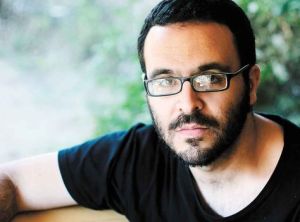
The novel is less a story and more a set of loosely connected vignettes from the lives and perspectives of the three daughters of  Aurelia and Hans Ertl, a family who fled post-war Germany in the wake of their father’s position as a cameraman, (he had worked on several Nazi propaganda films), to live in exile in Bolivia.

One of his daughters Monika Ertl became involved with the survivors of Che Guevara’s guerrilla movement and was allegedly involved in the assassination of the Bolivian consul in Hamburg, a man said to have ordered the hands of Guevara be cut off and sent to La Paz.

Hasbún’s novel takes these threads and weaves a disparate narrative, that highlights different moments in the lives of all members of this family, whose life trajectory was dramatically altered by their geographic displacement.

No sooner have they arrived, than Hans, a climber, explorer, photographer, seeker of adventure announces he is quitting climbing and organising an expedition to find a lost Inca city named Paititi buried somewhere deep in the Amazon forest. Two of his daughters come with him, and for his eldest Monika, it becomes a first step towards a life of social activism, which will result in her involvement in revolutionary guerilla warfare.

With a father seeking adventure and a mother prone to melancholy, the girls find themselves in a place they can never truly call home, where they will always be viewed as outsiders and find it difficult to find solace even among their ex-pat community, which in a cruel twist of fate, view them similarly to the way they were regarded in post-war Germany, only now it seems futile to escape their fate.

“All that grind to end up back where I started,” he complained to me one day down the phone. He said he’d experienced something similar after the war, that they’d already made him feel like an outcast once before, that during that period they closed one door after another to him, but that this time he wouldn’t move an inch.

Also included in the narrative are what appear to be the responses to an interview or interrogation of one of Monika’s lovers Reinhard, who was her brother-in-law, probably in a follow-up to the assassination of the Bolivian consul.

//yes, she’s the only one who matters now, the misunderstood child, the chaotic, rebellious teenager, the woman who went on to lose all perspective and no longer knew where to stop and ended up hurting herself and others. //Yes, if you pressed me I would say this is the definition of her that sticks: the woman who went on to cause so much hurt.

Bolivian Author, Rodrigo Hasbún

Bolivian Author, Rodrigo Hasbún

It is a fragmentary novel that depicts a family set adrift, unable to remain united nor to be held together by their adopted community, the daughters seek to carve out a life of their own, struggling in isolation.

The piecemeal structure of the novel with its alternating narrators is symbolic of that disconnect and isolation, exile may have heralded adventure and discovery, however the expedition to discover a lost city, became the catalyst to the disintegration of all that once kept them together.

It’s not true that memory is a safe place. In there too, things get distorted and lost. In there, too, we end up turning away from the people we love the most.

Note: Thank you to the publisher Pushkin Press for a copy of this haunting novella.

Further Reading

The City and the Writer: In Cochabamba with Rodrigo Hasbún – an interview by Nathalie Handal.

Buy a copy of Affections via Book Depository (Affiliate Link)

Bonjour Tristesse by Françoise Sagan tr. Irene Ash #WITMonth

Bonjour TristesseRachel Cooke in this Guardian article The subtle art of translation reflects on the importance of the right translation and relates her memory of reading Françoise Sagan’s Bonjour Tristesse.

Last year, I decided to treat myself to a new copy of Bonjour Tristesse by Françoise Sagan, a novel I have loved ever since I first read it as a teenager, and whose dreamy opening line in its original translation from the French by Irene Ash – “A strange melancholy pervades me to which I hesitate to give the grave and beautiful name of sadness” – I know by heart.

She decides to splash out and buy a new copy to read and chooses the Penguin Modern Classics version translated by Heather Lloyd.

Some days later, in bed, I began reading it. The shock was tremendous, disorienting. “This strange new feeling of mine, obsessing me by its sweet languor, is such that I am reluctant to dignify it with the fine, solemn name of ‘sadness’,” went the first sentence, which sounded to my ears a little as though a robot had written it.

Françoise Sagan

Author, Françoise Sagan

For a while she continued to read it, telling herself it was stupid to cling to one version, as if it were a sacred thing, however she gave up, it may have been an accurate translation but it lacked the magic of that fist reading experience. She ends by saying that if you tried this story and hated it, to please have another go and entrust yourself to Irene Ash’s gorgeous 1955 translation.

Having read the article, I had no hesitation in going straight for the Irene Ash translation and was transfixed from the very first pages, totally put under the spell of this charming little novella.

Cecile is looking back and recalling the summer she was seventeen, when she and her father spent 2 months on the French Riveria near St Raphael, having a blissful holiday. He is a widower who doesn’t lack for female company and she has just finished school and lives a life of privilege and indulgence, her father imposing few if any limits on her, they are in a sense like children both of them in adult bodies.

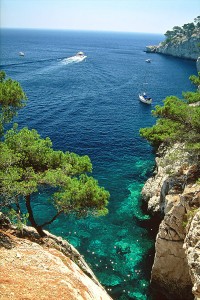
He had rented a large white villa on the Mediterranean, for which we had been longing since the spring.It was remote and beautiful, and stood on a promontory dominating the sea, hidden from the road by a pine wood; a mule path led down to a tiny creek where the sea lapped against rust-coloured rocks.

She is surprised to enjoy the company of a young man Cyril, preferring the company of more mature men and her father’s friends, and discovers she quite likes the attentions of this young man who is falling in love with her and she with him.

CalanquesIt should have been perfect, but things change when an old friend of her mother’s Anne arrives and she and her father announce their intention to marry. Although it is actually something Cecile feels is right for them and she adores Anne, part of her resents what signifies to her the end to the playful era she and her father have indulged, for Anne’s presence in their lives will certainly bring order and sensibility.

Yes, it was for this I reproached Anne: she prevented me from liking myself. I, who was so naturally meant for happiness and gaiety, had been forced by her into a world of self-criticism and guilty conscience, where, unaccustomed to introspection, I was completely lost. And what did she bring me? I took stock: She wanted my father, she had got him. She would gradually make of us the husband and step-daughter of Anne Larsen; that is to say, she would turn us into two civilised, well-behaved and happy people.

She embarks on a plan to provoke a change in this happy little situation, instantly regretting it, but unable to halt the progress of a development she has initiated.

Tears came into my eyes at the thought of the jokes we used to have together, our laughter as we drove home at dawn through the empty streets of Paris. All that was over. In my turn I would be influenced, re-oriented, remodelled by Anne. I would not even mind it, she would act with intelligence, irony and sweetness, and I would be incapable of resistance; in six months I should no longer even wish to resist.

It is a simple storyline, but what makes it incredible are the adept insights Cecile has into herself and her behaviour and to all those around her. She acts irresponsibly as if she is unable to help herself, but with a certain equanimity, it is as if she stands outside of herself and narrates events and what is driving each character to act their part in her little drama, which will escalate into tragedy.

Utterly engaging, I was riveted, loved that ability her character had to understand the personalities around her and her own flaws, despite being unable to stop the mischief she provoked, not to mention that this was written when the author was only 18 years old.

Buy Bonjour Tristesse from Book Depository (Affiliate Link)


The Bridge of Beyond by Simone Schwarz-Bart tr. Barbara Bray #WITMonth

Bridge of BeyondAbsolutely brilliant, astonishing, loved it, one of my Top Reads of 2016 for sure.

Originally published in 1972 as Pluie et vent sur Télumée Miracle, The Bridge of Beyond is acknowledged as one of the masterpieces of Caribbean literature. It was republished in English in 2013 as an NYRB Classic, with an introduction by Jamaica Kincaid, beautifully translated by Barbara Bray, described as ‘an intoxicating tale of love and wonder, mothers and daughters, spiritual values and the grim legacy of slavery’.

Telumee is the last in a line of proud Lougandor women on the French Antillean island of Guadeloupe. It is a novel best left to speak for itself, as the many quotes from the novel that follow here illustrate, a work infused throughout with a vital and vibrant female energy, a force that empowers them to forge ahead, no matter the circumstances, one that will permeate the reader, instilling courage and awe at the language that creates this positive, intoxicating feeling.

In the first part we learn about her people, her mother Victory,

“a laundress, wearing out her wrists on flat stones in the rivers, and her linen emerged like new from under the heavy waxed irons”

her father, his life cut short in a fatal stabbing,

“Angebert, had led a reserved and silent existence, effacing himself so completely
that no one ever knew who it was died that day. Sometimes I wonder about him, ask myself what anyone so kind and gentle was doing in this world at all.”

the man who pulled her mother out of her grief, and out of her daughter’s life,

“The fact is that a mere nothing, a thought, a whim, a particle of dust can change the course of a life. If Haut-Colbi had not stopped in the village my little story would have been different.”

and her grandmother Toussine, ‘Queen Without a Name’, to whom her mother sent her to live.

“My mother’s reverence for Toussine was such I came to regard her as some mythical being not of this world, so that for me she was legendary even while still alive.”

Simone Schwarz-Bart

Simone Schwarz-Bart

Telumee narrates the story of her life, in small details, in melodic, incantatory prose that lures the reader in, consuming her story with great pleasure. Every change of home, village, or great journey takes them across the Bridge of Beyond, a symbol of change and the unknown, the other side.

As she passes through various stages of life, she is guided but never pressured by her grandmother, remembering her stories, her songs, her advice.

“My little ember”, she’d whisper, “if you ever get on a horse, keep good hold of the reins so that it’s not the horse that rides you.” And as I clung to her, breathing in her nutmeg smell, Queen Without a Name would sigh, caress me, and go on, distinctly, as if to engrave the words on my mind: “Behind one pain, there is another. Sorrow is a wave without end. But the horse mustn’t ride you, you must ride it.”

She will fall in love, leave to work in the kitchen of wealthy white family, build her own home, experience both profound happiness and the depths of despair, brush up against madness and find its cure, and always the reassuring presence of her grandmother.

“Sometimes old thoughts arose in me, shooting up like whirls of dust raised from the road by a herd of wild horses galloping by. The Grandmother to try to whistle up a wind for me, saying we should soon be going away, for the air in Fond-Zombi didn’t agree with my lungs now.”

As Jamaica Kincaid articulates well in the introduction, The Bridge of Beyond is not a conventional novel, and it never tries to be. It is a fluid, unveiling of a life, and a way of life, lived somewhere between a past that is not forgotten, that time of slavery lamented in the songs and felt in the bones, and a present that is a struggle and a joy to live, alongside nature, the landscape, the community and their traditions.

The cultural traditions and historical events from which this work of art springs cannot be contained in a strict linear narrative. In fact, such a device might even lend a veneer of inevitability to them. For the narrative that began with a search for fresh water on an island one Sunday morning has no end – it circles back on itself, it begins again, it staggers sideways, it never lurches forward to a conclusion in which the world where it began is suddenly transformed into an ideal, new world. Schwarz-Bart’s prose awakens the senses and enlarges the imagination; it makes me anxious for my own sanity and yet at the same time certain of it; her sentences, rooted in Creole experience and filled with surprising insights and proverbs, resonate in my head and heart.” Jamaica Kincaid

It is one of the best books I have read in a long time, coming from a place of love and appreciation that reaches far back, acknowledging the gifts of all, that make up who we are. Outstanding.

Simone and André Schwarz-Bart

Simone and André Schwarz-Bart

Simone Schwarz-Bart was born in France(her parents were from Guadeloupe) in 1938, her father a solider, her mother a teacher. When war broke out, she and her mother returned to Guadeloupe. She studied in Paris, where she met her future husband, the writer André Schwarz-Bart.

They collaborating on more than one work of literature, including a six-volume encyclopaedia Hommage à la femme noire, (In Praise of Black Women), to honour the black heroines who were missing in the official historiography.

Click to Buy The Bridge of Beyond via Book Depository

(Affiliate Link)

WIT logo

The Door by Magda Szabó tr. Len Rix #WITMonth

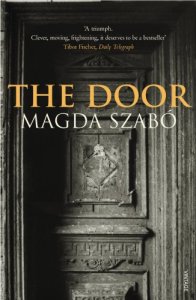
The DoorThe Door is an overwrought, neurotic narrative by “the lady writer”, (possibly Szabó’s alter-ego, as there are similarities) describing her 20 year relationship with Emerence, the older lady who interviews her prospective employer to see if she’ll consider accepting the cleaning job on offer.
The writer and her husband have recently had a ban on publication lifted from them (for political reasons) and anticipate requiring help around the house as they get back to work. Despite having little respect for intellectuals and only for those who do manual work, in her own time Emerence decides to accept them.

No formal agreement dictated the number of hours Emerence spent in our house, or the precise times of her arrival. We might conceivably see nothing of her all day. Then, at eleven at night, she would appear, not in the inner rooms, but in the kitchen or the pantry, which she would scrub until dawn.

Are they dependent on one another or do they despise each other? Is Emerence an altruistic soul, or a cunning manipulator? Is the lady writer narcissistic or consumed with guilt pursuing her idle occupation while the older woman takes on more and more work?

I stood there gazing after her, wondering why she still stuck with me when I was so very different from her. I had no idea what she liked about me. I said earlier that I still rather young,  and I hadn’t thought it through, how irrational, how unpredictable is the attraction between people, how fatal its current. And yet I was well versed in Greek literature,  which portrayed nothing but  the passions: death and love and friendship, their hands joined together around a glittering axe.

The entire novel hovers with each event between opposing emotional states as they appear to get the measure of the other only for the behaviour to completely change. Emerence will do anything and everything for everyone, she is loved by all, but has never opened the door to her home to a soul, her charges make it to her porch and no further. No one knows anything about her private life and she shuts down anyone who dares to pry.

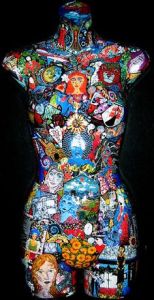
Dressmakers ribcageLater, only very much later, in one of the most surreal moments I have ever experienced, I wandered amidst the ruin of Emerence’s life, and discovered, there in her garden, standing on the lawn, the faceless dressmaker’s dummy designed for my mother’s exquisite figure. Just before they sprinkled it with petrol and set fire to it, I caught sight of Emerence’s ikonstasis. We were all there, pinned to the fabric over the dolls’ ribcage: the Grossman family, my husband, Viola, the Lieutenant Colonel, the nephew, the baker, the lawyer’s son, and herself, the young Emerence, with radiant golden hair, in her maid’s uniform and little crested cap, holding a baby in her arms.
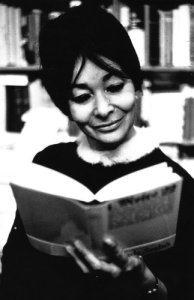
Seen through the prism of the writer, we observe Emerence only through her eyes, often confused, sometimes suspicious, frequently neurotic. She bears the hallmarks of an unreliable narrator.

It is a slow developing relationship and narrative that entwines these two women’s lives together, creating a delicate trust, the implications of which lead to its tragic denouement.

It’s a compelling, unsettling read, there is a sense of foreboding as the protagonist often jumps forward and provides brief glimpses as to what is coming, building tension and the sense of some kind of catastrophic event or revelation that awaits them all.

Magda SzabóMagda Szabó was born in 1917 in Debrecen, Hungary, her father a member of the City Council, and her mother a teacher.

In 1949 she was awarded the prestigious Hungarian literary Baumgarten Prize, given to “Hungarian authors with serious endeavour whether in literature or in science who are exempt of any religious, racial or social prejudices and serve only ideal aims…”

The prize was withdrawn from her for political reasons the same day it was awarded. She was dismissed from her job at the Ministry and during the establishment of Stalinist rule from 1949 to 1956, the government did not allow her works to be published.

In 2003, the French translation of ‘The Door’ won France’s Prix Femina Étranger.

She died in 2007, at the age of ninety and was one of Hungary’s best-known writers, although very few of her works have been published in English. The ‘Door’ however, was translated in more than 40 languages and published in 64 countries.

Reading Women Writers in Translation

This is my third read in August for #WITMonth, reading Women in Translation.  Have you read anything by Magda Szabó?

Further Reading

New Yorker Article, April 29, 2016 – The Hungarian Despair of Magda Szabó’s “The Door” by Cynthia Zarin

Guardian Review – Labours of love, A thinly veiled self-portrait emerges from Magda Szabó’s The Door by Elena Seymenliyska

Buy a copy of Magda Szabó’s The Door via Book Depository

The Rabbit House by Laura Alcoba tr.Polly McLean #WITMonth

Laura Alcoba was born in Argentina in 1968 and has lived in Paris since she was 10 years old, when she fled Argentina during the period in the country’s history from 1976 to 1983 when military, security forces hunted down any political dissidents and/or anyone believed to be associated with socialism, or the Montoneros movement. Her father had been imprisoned and her mother had already fled the country, a wanted woman.

Many that were targeted were from the church, labour unions, artists, intellectuals and university students and professors were targeted.  Pregnant women had their babies taken from them and then disappeared, many of these children were raised by military families, some of them today still have no idea of their origins, a few fortunate to be reaquainted with siblings or other family thanks to the tireless efforts of the Grandmothers of Plaza de Mayo. More than 400 children are believed to have been taken from political prisoners in Argentina during that era and the efforts of the grandmothers have reunited around 120 so far.

The Rabbit HouseIn The Rabbit House, Laura rarely refers to the political situation that forced them to live in hiding, resulting in her having to change her name and be extra careful about how she engaged with others, for it is written from the perspective of her 7-year-old self, exactly as she recalls the events and changes that occurred in their lives at the time, with little understanding of the cause of this sudden change.

After her father is imprisoned, Laura and her mother go into hiding in a house in the suburbs, they live with a young couple, the woman Diana was pregnant with her first child.

During the day, “the labourer” and “the engineer” arrive to build a rabbit house, a place where they are going to breed rabbits, a cover for the job to create an underground space in which to house a printing press, to print and distribute a banned publication.

This is because we are doing some work on the shed so we can keep rabbits in there. These visible sacks justify – we hope – the endless comings and goings of the grey van. In this way we flaunt the busyness and waste materials appropriate to a modest rabbit breeding project. But behind the rabbit breeding area is concealed a whole other building site, huge, on another scale entirely – because the house we live in was chosen to hide the secret Montonera printing press.

Though there are things Laura has been told she can and can’t do, this precarious life and it’s rules aren’t well enough defined to help her with every situation, some of which she recounts here, creating the acute tension under which she lived, terrified of doing something wrong and endangering all their lives.

EvitaMontoneraThe only people in the house are Diana, seven months pregnant, my mother behind the false back wall, and me.
Oh, and the rabbits. And the rolls of wrapping paper and ribbon. and the secret printing press and hundreds of copies of a banned newspaper. And also the weapons, for self-defence.

And the ferocious kitten.

We are very afraid.

A visit with her paternal grandparents to see her father in prison is organised in a clandestine manner, and is so traumatising she is physically sick and it is decided not to take the risk again, her fear clearly outweighing any benefit in seeing her father.

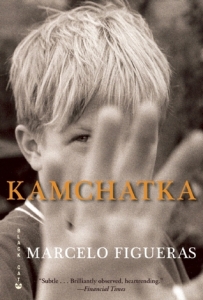
I was reminded of Marcelo Figueras’s book Kamchatka which I read in 2015, a novel also written from a child’s perspective, set in 1976. Figueras uses the novel form to inspire his storytelling, clearly drawing from his own memory and experiences of that same era.

The writing and narrating of Laura’s story is simplistic yet intense, she effectively portrays the sense of unease and desire of the child to not create trouble, but not knowing quite how, when the situations are complex and unknown,  she is destabilised by the visible fear of the grown-ups, demonstrated in how quickly they anger when they fear she may have crossed a forbidden threshold.

First read for me in #WITMonth 2016 – Reading Women in Translation.

KamcahtkaFurther Reading

My review of Marcelo Figueras Kamchatka

Argentina – A Terrible Period of State Terrorism/Genocide

Operation Condor conspiracy faces day of judgment in Argentina court

Madres of the Plaza de Mayo – Grandmothers of the Disappeared

How an Argentinian man learned his ‘father’ may have killed his real parents – Guardian 22 June 2016

******

Click here to Buy a copy of The Rabbit House via Book Depository