
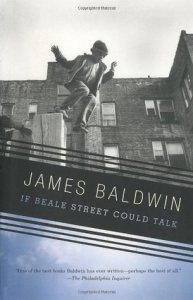
 If Beale Street Could Talk is the first work by James Baldwin that I have read. It was the first work he wrote after he moved to St Paul de Vence in the south of France, where he would pass the last 17 years of his life.
He also wrote his first two novels at the beginning of his literary career, Go Tell It on the Mountain and Giovanni’s Room, along with his best-known collection of essays, Notes of a Native Son during a nine-year period he lived in Paris.
When Jordan Elgrably of The Paris Review asked why he left the United States said:
I was broke. I got to Paris with forty dollars in my pocket, but I had to get out of New York. My reflexes were tormented by the plight of other people. Reading had taken me away for long periods at a time, yet I still had to deal with the streets and the authorities and the cold. My luck was running out. I was going to go to jail, I was going to kill somebody or be killed. My best friend had committed suicide two years earlier, jumping off the George Washington Bridge.
He found it increasingly difficult to be a witness to life in America so perhaps France provided him the distance from which to write. With Beale Street he was able to immerse in a love story, bringing out the emotional bonds that keep a family together, that give them something extra, to not just survive, but overcome the harsh, unjust realities of everyday life in America for black people.
The novel revolves around childhood sweethearts, 19-year-old Tish and 22-year-old Fonny. We meet them as she visits him in prison.
I don’t know why people always look down when they talk through a telephone, but they always do. You have to remember to look up at the person you’re talking to.
I always remember now, because he’s in jail and I love his eyes and every time I see him I’m afraid I’ll never see him again. So I pick up the phone as soon as I’m there and I keep looking up at him.
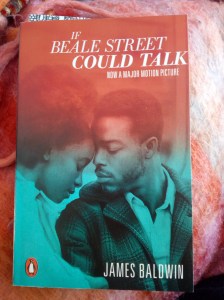 Interspersed with the regular visits, are flash-backs to childhood and the moment their friendship evolved to something deeper. Fonny takes Tish to his basement pad where he has set up a woodwork studio, his deepest passion is sculpting wood and stone, he wants to show her and for her to understand its importance to him.
After asking her to marry him, they’d looked for loft space together, they were planning a future together, when suddenly robbed of it by a false accusation. His alibi’s are discredited and he sinks into despair, but for her visits.
Though heartbroken, she is emboldened by her family, by the adamant support of her sister, who finds them a good lawyer, her mother, who travels to Porto Rico to confront the accuser, and her father, who works extra shifts to raise funds for Fonny’s bail.
It is the words, actions and support of the family that keep everyone from falling apart, they are a stalwart to Fonny especially, as his family crack under the pressure of a mother converted to a conservative faith prone to judgement and disappointment, more concerned about her own reputation than the innocence of her son.
It is interesting that Baldwin chose to narrate the novel from Tish’s perspective, and though it may have provoked criticism, it is perhaps one injustice that he sought to right – allowing the voice of a young black woman to rise and be heard.
Sharon, her mother, was a fabulous character. So in touch with her deepest roots, she is able to appease her daughter when she fearfully shares news of her pregnancy:
‘Tish’, she said, ‘when we was first brought here, the white man he didn’t give us no preachers to say words over us before we had our babies. And you and Fonny be together right now, married or not, wasn’t, wasn’t for that same damn white man. So let me tell you what you got to do. You got to think about that baby. You got to hold onto that baby, don’t care what else happens or doesn’t happen. You got to do that. Can’t nobody else do that for you. And the rest of us, well, we going to hold on to you. And we going to get Fonny out. Don’t you worry. I know it’s hard – but don’t you worry. And that baby be the best thing that ever happened to Fonny. He needs that baby. It going to give a whole lot of courage.’
Right there, the mother reinforces stability in their lives and I can’t help but be aware of the contrast, having just read the memoir An Affair With My Mother of a baby conceived within a culture that shame(s)d its daughters for pregnancy outside of wedlock, destroying lives, dividing families, creating unnecessary drama. This action and steadfast support by Sharon is a protest against the inherent culture and inherited religious beliefs, over which love and the family bond will prevail. It is a powerful matriarchal triumph, one that reaches far back in ancestral memory.
So the family encounter difficult circumstances and yet their ability to be there for each other sees them though and even Fonny is swept up in this wave of support, nourished by it, even though he has moments of sliding into darkness, as is human. By contrast, his family is fragmented, the mother and daughters reject the offer of unity offered by Joseph and Sharon, the father Frank gets it and tries to support them, to be part of this newly extended family, but without the strength of an unconditional bond within his own, he is left vulnerable.

James Baldwin in France
I think Baldwin succeeds if it was his intention to write about the powerful effect of love and family, in their ability to carry each other through difficult times, when they refuse to resort to blame (of themselves or others) or judgement, when they hold each other up and decide to be a force together and not give in to destructive tendencies.
I’ve just seen the film at our local cinema. It’s challenging to watch to a film you are still reflecting on reading.
In a recent interview, Director Barry Jenkins talked about Baldwin’s work:
I chose Beale Street because I felt the novel, more than any of his other works, represented the perfect blend of Baldwin’s dual obsessions with romance and social critique, as sensual a depiction of love as it is a biting observation of systemic injustice.
I thought the movie was a beautiful and moving depiction of the story, although my big takeaways from the book about that family bond, (especially the mother to the daughter) weren’t as strong in the film. Some of the most important lines I’d noted (and went back to check) were taken from the mother and given to the father, which surprised me, as it shifted the dynamic and removed what for me had been a significant and empowering statement coming from the mother (supported by the father). Passing those lines to the father risked putting the mother back into a supporting role, and lessened the matriarchal force Baldwin imbued her with.
The other significant moment in the book for me, which I’m not sure comes across in the film with quite the same impact, is a moment near the end where there is a change in Fonny, observed here by Tish, which you’ll have to read to find out more:
“- something quite strange, altogether wonderful, happens in him…”
All the more reason, even if you’ve seen the film, to get a copy of the book! And all that said, I’d recommend both without hesitation.
Buy a Copy of Beale Street via Book Depository
Have you read James Baldwin? Do you have a favourite?






 Below is a summary of
  This stylised memoir, set in the working-class north of England, is the book Jeanette Winterson wasn’t ready to write back in 1985 when at 25 years of age, she wrote the novel Oranges Are Not the Only Fruit, a book that plunged the reader into her universe, one that provided the author the liberty of narrating freely, without the confines of the story having to have been exactly as she had lived it – it was fiction, an imagined story, and she named the main character Jeanette, a provocative gesture for sure.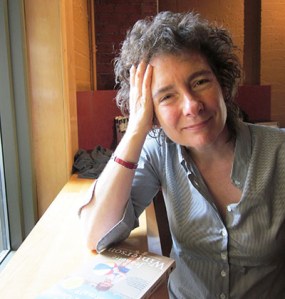
 If you have read or were considering reading Marlon James Booker winning
  Unable to protect her daughter, who was raped by her schoolteacher, her focus moves to Janie, whom the daughter leaves her with. As soon as adolescence beckons she arranges for her to marry an older farmer with land. Janie dreams of love and fulfilment and when mentions not finding it in this marriage is reprimanded by her grandmother for her romantic notions.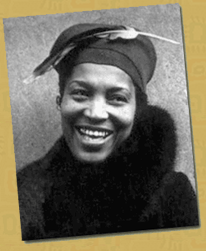
 Rachel Cooke in this Guardian article
 It should have been perfect, but things change when an old friend of her mother’s Anne arrives and she and her father announce their intention to marry. Although it is actually something Cecile feels is right for them and she adores Anne, part of her resents what signifies to her the end to the playful era she and her father have indulged, for Anne’s presence in their lives will certainly bring order and sensibility.
 A few years ago a lady who had recently moved here to Aix-en-Provence contacted me in relation to
  Excited about the opportunity to put her writing skills to the test, Karin took the first chapter of her book, moulded it as much as she could to meet the criteria, sent it to me to look over and to make recommendations on how to whittle it down further without losing any of the content and then sent it off! We came up with the title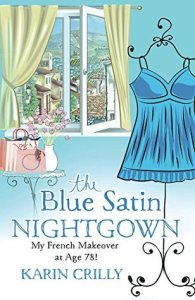


 A woman working in an asylum centre as a translator is called to fill in for an interview. She utters the word she has all but banished from her vocabulary. Yes.




 Which all leads me on to say it was with quiet anticipation to learn that Dawn Tripp had the courage, respect and admiration for O’Keeffe to decide to venture into creating a work of fiction, that attempts to channel the voice of Georgia O’Keeffe. What might she have really been thinking if it was her voice relating the story of this life and not someone from the outside.
 When the novel was almost complete, the correspondence of O’Keeffe and Stieglitz was published, having been sealed for twenty-five years after her death.
 “Pink Tulip”, 1926, Georgia O’Keeffe, oil on canvas, 36” x 30”


 Word by Word