Beside the Sea by Véronique Olmi, tr. by Adriana Hunter (French)

A single mother of two boys wants to take them on a little holiday near the sea. That might sound simple enough, but for this mother, it is a major life event and a challenge, as she suffers from some kind of mental affliction that normally requires her to take daily medication.

Beside the SeaThis trip is out of the ordinary and we experience it from inside the mind of the mother, the stream of consciousness narrative is so effective here, it gets inside our mind as we read. We feel her sense of anxiety acutely and become almost as sensitive as she is to the threatening hostility of the outside world, that place from which she wishes to protect her children.

She wants them to experience the wonder of the seaside, she takes them for hot chocolate and they visit a funfair, all of which present certain challenges. She observes and reflects on aspects of their characters with a poetic clarity that all mothers will relate to.

“I stopped on the sea wall, my two kids holding my hands, I wondered how to do it, how to say hello to the sea.  It was making a hellish noise, really angry, and the children cowered. I stayed there, not moving a muscle, watching it…I’d been waiting for it such a long time!”

It is an incredible novella and I appreciated it all the more, ironically, after following  recent discussion on Vishy’s review of Nabakov’s Lolita . They discuss that dilemma many readers have when they recognise an exceptional prose style but feel uncomfortable with the subject or the perceptions of the protagonist. It makes it hard to share an opinion and it takes time to understand our reactions. We observe them first and then try to understand them.

What I found most interesting in those subsequent comments actually came from the more experienced readers, those who had read it more than once and they describe what changed in terms of their own perceptions with subsequent readings. In the first read we react more to the story and character, in subsequent readings it seems the reader has greater insight into the intentions of the writer/artist, beyond surface character and plot.

Those comments made me think more about Beside The Sea and wonder if I might appreciate it more coming to it for a second time. I was in admiration of the style but uncomfortable with the journey. I would recommend it to the curious, thinking reader who isn’t quick to judge and it’s not one to read when you’re feeling fragile.

anxietyThe author does an incredible job in making the reader empathise with the mother, even though I didn’t particularly enjoy going into that state and arriving at its inevitable conclusion.

I also couldn’t help thinking about these kind of stories in the media, the short versions which usually focus on the result and not what leads people to where they end up. I don’t want to spoil the read, so you’ll just have to read it to find out what I mean by that. I think the enjoyment of this book will also be dependent on where one is on the ‘potential for empathy’ scale.

It is an interesting challenge, that an author would choose to travel inside the mind of someone like this and write in the stream-of-consciousness form.  I am sure this was one of the works that the publisher and writer Mieke Ziervogel read as background research in writing her own debut novella ‘Magda‘.

Poignant and thought-provoking given the issues that lie beneath its surface, this is the story that is almost never told and rarely understood by the public, who often only see that end result favoured by the media and judge it far too easily.

This is the first book in the Peirene Press Female Voices: Inner Realities series, all of which I am reading in January 2015.

Next Up : Stone in a Landslide by Maria Barbal (translated from Catalan)

Female Voice Inner Realities

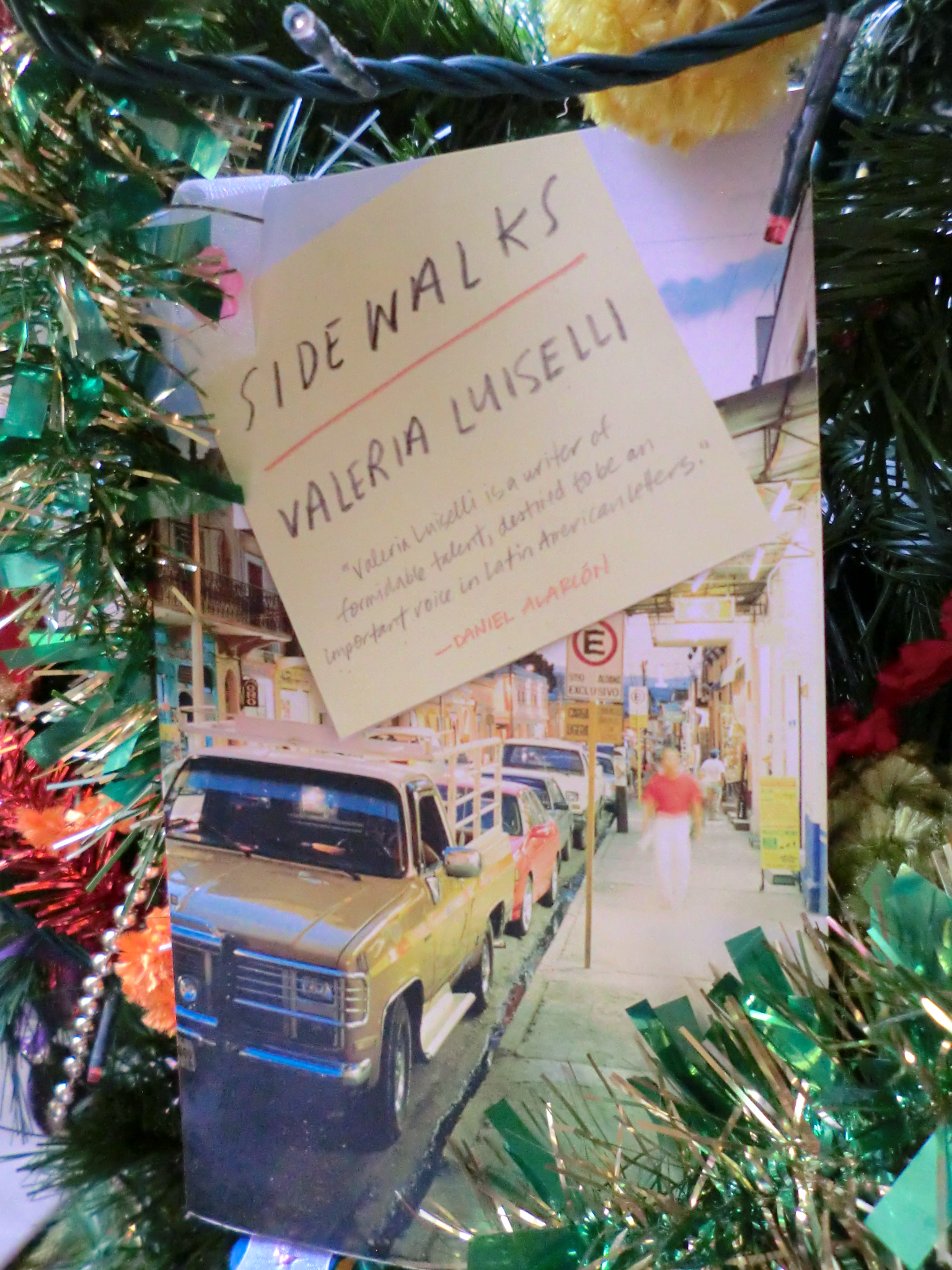
Sidewalks – Essays by Valeria Luiselli translated by Christina MacSweeney

SidewalksValeria Luiselli is a philosophical meanderer whose roving thoughts bring her to a cemetery in Venice in search of Russian poet,  Joesph Brodsky’s tomb and wandering that alluring city’s streets so late at night she is locked out of the one room she managed to find in a convent.

She ponders the map with the slow-moving icon of a plane on the screen as she flies home and thinks about the layout of the land beneath and later will find a connection between a photo of cartographers in the Mexican Map Library and  Rembrandt’s The Anatomy Lesson of Dr. Nicolaes Tulp.

Sidewalks sees her leaving the four walls of her apartment late at night for a last cigarette outside the front door, seeking escape and encountering the advice and wisdom of a doorman who shares his own long life views on how one best comes to know thyself.

“If there still exists a gaze blessed with liminal wisdom, it is the gaze of night-shift doormen. They are the only true free-thinkers – generous men capable of conversing intelligently at midnight; empathetic accomplices, offering the consolation of a companionship replete with the same reprehensible vices you yourself have and defend.”

She laments the age of the individual computer, the window inside the window that has all but eliminated household drama and made high-rise voyeurism unexciting if not nonexistent.

“It is clear that the personal computer is the great modern attack on good old-fashioned voyeurism. From the moment these machines were installed in our homes, the irreversible process of the degeneration of character began and ruled out the possibility of anyone doing anything interesting for the delight of their voyeuristic neighbour.”

Papelos

Original Spanish version

She is interested in spaces, voids, the edge of things, she tries to make sense of her home town in Mexico, a city whose first plan was allegedly scratched into sand and has continued to sprawl out of any recognisable or logical shape ever since.

Her essays reference other essayists as things she observes in her meandering bring back lines once read and remembered, passages of long dead authors become an old-fashioned, enjoyable distraction for a young woman, those words from the past arising unbidden while out walking sidewalks, no electronic media in sight.

In an essay on the river Spree, in Berlin, Fabio Morabito writes:

“A river tends to contain the city it crosses and to curb its ambitions, reminding it of its face; without a river, that is, without a face, a city is abandoned to itself and can become, like Mexico city, a blot.”

It is a slim volume and many of the essays are split into titled paragraphs, the first essay littered with the names and dates of the dead inhabiting the same resting place as Brodsky, although it wasn’t clear to me whether there was a link between the content and the named.

It feels as though there could well be much more to this collection than is picked up on first reading, especially given the original work was written in Spanish and many of the named places are foreign.

Intelligent, introspective essays that delight in being out and about and an appreciative and noteworthy introduction by the Dutch author and translator Cees Nooteboom. An author to watch out for.

Brodsky Luiselli

Joseph Brodsky & Valeria Luiselli


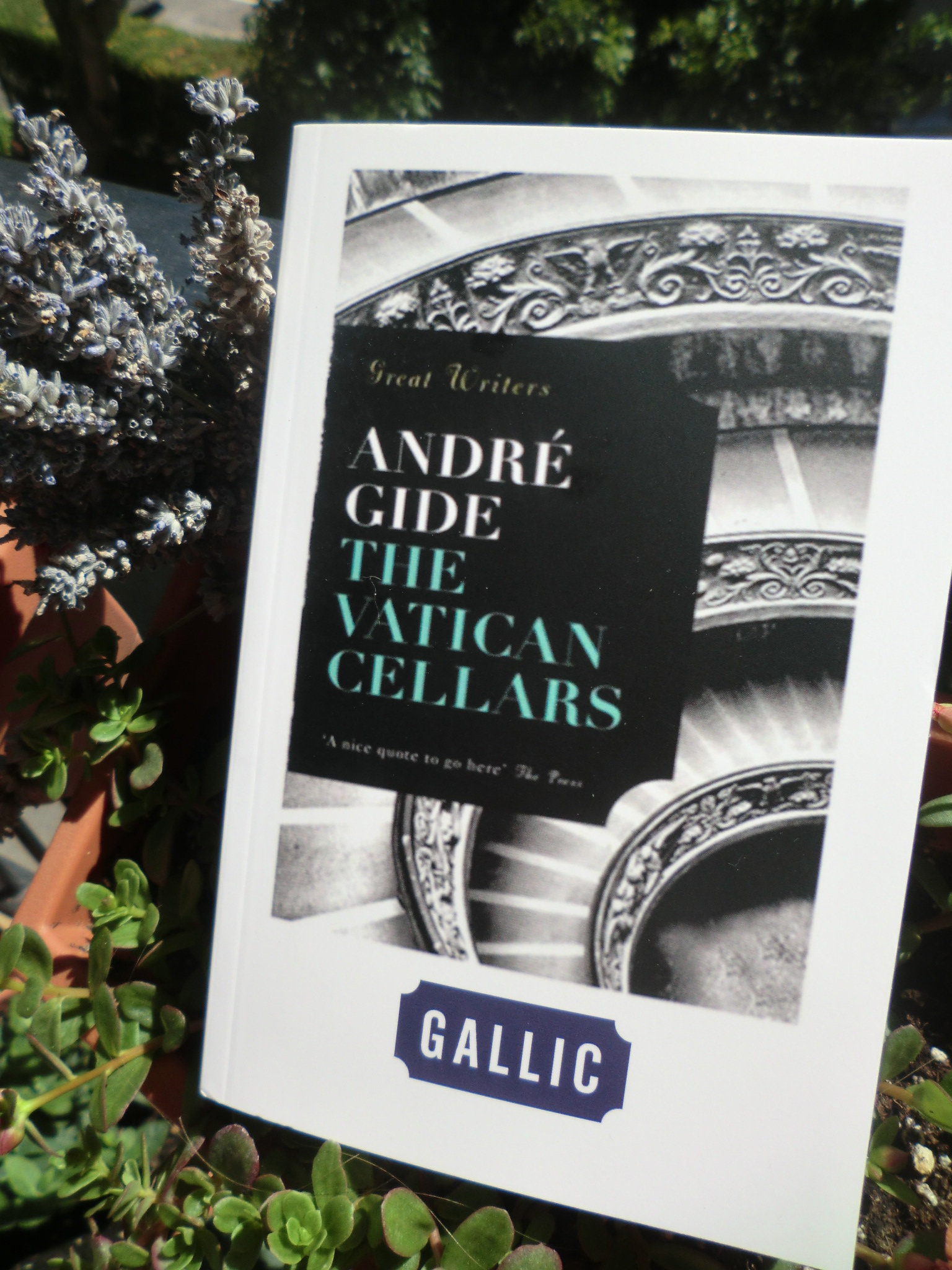
“All Paths Lead to Rome” – The Vatican Cellars by André Gide tr. by Julian Evans

Vatican CellarsOriginally published in the summer of 1914, this year is the 100th anniversary of André Gide’s Les Caves du Vatican otherwise known as The Vatican Cellars and sometimes as Lafcadio’s Adventures in English.

André Gide had quite a reputation and was adored and detested in equal measure in the French literary community during his time. He was a provocative writer, not sensationalist by today’s standards, but he rocked the foundations of robust entities in the early 1900’s and tested some of his friendships with his provocative, satirical works, that challenged the solemnity of the novelistic form and bourgeois attitudes of the time.

He declared the book not to be a novel, but a sotie, a medieval farce in which the players freely mock the powers that be, more often than not, the Church.

“Even in the authentic soties of the Middle Ages there was the attempt to demonstrate the madness of the real world by showing it capsized and lead by fools.” Wallace Fowlie, Andre Gide: His Life and Art

He did this to stand apart from that tradition of European fiction, characterised by its extreme seriousness. Many chose to judge it at face value, or to apply an interpretation that wasn’t his own and cause him to be ostracized by some.
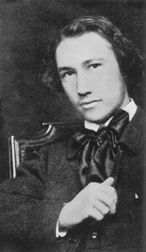
A Young Gide Source: Center for Gidean Studies andregide.org

A Young Gide
Source: Center for Gidean Studies
andregide.org

He wasn’t looking for recognition or accolades, but he was a writer who wasn’t afraid to take on a subject and look at it through a symbolic, metaphorical lens even if it did court contempt in some quarters. Though still highly controversial in France, he was awarded the Nobel Prize in Literature in 1947, he died in 1951 and a year later his works were placed on the Vatican’s list of banned books.

That act was certainly provocative and no doubt helped to heighten the author’s popularity as negative publicity tends to do. So when this book arrived unsolicited in my mailbox, I was curious to find out more, not just about the story, but André Gide, a writer previously unknown to me. In a strange coincidence, this week I see that Papal controversy – or is it just rumour, continue, when I read this headline in The Independent.

God isn’t a magician with a magic wand according to the pope and there are non-believing vicars 

The basic premise of The Vatican Cellars centres around the members of one family, whose connections are slowly revealed, whether by blood or marriage, the first three books (more like parts as the book is only 300 pages) are portrayed from each of the main characters point of view and running throughout the narrative is the effect of a rumoured plot that a gang has kidnapped the Pope and placed him in the Vatican cellars, an imposter installed in his place. The fourth book introduces us to the gang, referred to as The Millipede and the final book is dedicated to the young man Lafcadio and brings all the characters to Rome.

Book One introduces us to Anthime Armand-Dubois, a crippled freemason devoted to scientific research, an atheist who leaves France to settle in Rome to be near a specialist in rheumatic diseases. His departure causes his brother-in-law Julius De Baraglioul great sorrow and his wife Véronique small joy.

“As one of those people who fill their flat disappointed lives with countless small devotions, in her sterility she offered up to the Lord every attention that a baby would have demanded from her. Sadly she entertained almost no hope of leading her Anthime back to Him. She had known for a long time how much stubbornness that broad brow, knitted in perpetual denial, was capable of. Father Flons had warned her.”

Julius, his wife (Véronique’s sister) and their 9-year-old daughter Julie visit, during which Anthime experiences an apparition of the Virgin Mary and the miraculous healing of his affliction. He converts, but loses his freemason and lucrative research contacts and must move to Milan to await compensation promised by the Vatican.

André Gide Source: Centre for Gidean Studies andregide.org

André Gide
Source: Centre for Gidean Studies
andregide.org

Book Two is Julius De Baraglioul, a novelist who arriving back in Paris receives a letter from his father, who is on his deathbed and wishes him to anonymously make the acquaintance of a certain Lafcadio Wluiki to check out his ambitions and character. Julius visits the Lafcadio’s lodgings, meets Carola Venitequa and snoops around his things reading a private notebook since the room is unlocked and uninhabited. He eventually meets him and gives him a copy of his latest novel, one that has been panned by critics. Recognising the book is based on the author’s father, Lafcadio eyes the dying man as a potential new “Uncle” and goes to see him.

In Book Three we meet Amédée Fleurissoire, debated by some to be the true hero of this story; within these pages the entire plot to kidnap the Pope is unveiled. A priest calls on the widow Countess de Guy de Saint-Prix, Julius’s younger sister just after her return from her father’s funeral in Paris and regales her with the extraordinary tale of the Pope’s demise. And here there is an author interjection, a sidestep of the story plot to tell of the factual plot, as the story was inspired by real events that occurred in 1893 by a gang of fraudsters, taking advantage of the Pope’s sympathies toward the French Revolution.

“Whether God’s representative on earth could have been abducted from the Holy See and, by the intervention of the Quirinal, stolen from all of Christendom as it were, is an excessively thorny problem which I do not have the temerity to raise in these pages. But it is a historical fact that, around the end of 1893, rumours were circulating to that effect. It goes without saying that numerous devoted souls became deeply agitated. A pamphlet on the subject appeared in Saint-Malo and was suppressed. …There is no doubt that countless pious souls made financial sacrifices, but it was dubious whether all those who received donations were genuine campaigners, or whether some were perhaps fraudsters.”

The priest wishes the Countess to make a significant donation, so she rushes off to see Madame Fleurissoire, the younger sister of Véronique and Marguerite and wife of our genuine hero Monsieur Amédée Fleurissoire. Hearing about all the fuss Fleurissoire decides he must leave Pau and travel to Rome himself to see what can be done.

Book Four is The Millipede (the centipede) which continues to follow the travels of Amédée, the presence of the gang undetected. He is intercepted at the station and brought to slovenly rooms, where we again meet Carola and he is taken on a bit of a wild goose chase to Naples and back, bumping into Julius who has also appeared in Rome.

Then Book Five brings us back to Lafcadio, raised by his mother and five uncles, across different European countries, he is at home everywhere, but belongs nowhere. After his encounter with Julius’s dying father, he too decides to take the train south, but he is heading for adventure, his destination Borneo. He is the anti-hero, the free spirit, parentless, he lives without obligation or restraint, he can do as he pleases, provided he has the means. His charm takes care of that.

And what happens when they all find themselves in Rome? For that you’ll need to read the book.

As the literary critic Albert Guerard said:

“Perhaps only the maligned casual reader sees that les Caves du Vatican is above all a very funny book.”

It is a book that Gide had in the back of his mind for 20 years before writing it and many of the scenes were inspired from aspects of his own life or those close to him. For example, Anthime’s conversion is said to be based on Emile Zola’s Freemason cousin, who abjured his atheism in a public ceremony at a church in Rome.

The Vatican Cellars is an entertaining, easy read and can be intellectually stimulating if you are interested to analyse it further. I enjoyed it very much and all the more for having read around it, dipping into some of the published literary essays to understand the intentions of the author and the responses of the critics.

He was a humble author with a fascinating intellect who refused to accept literary prizes and acknowledgement at home, until it came to the Nobel, which he felt would have gone to Paul Valéry, if not for his untimely death and accepted it without reserve, though he was too ill to receive it in person.

In an open letter to several leading Swedish newspapers which had sought interviews, Gide confessed that he had received the Nobel Prize:

“with deep emotion, with tears in my eyes, like a schoolboy who has won a prize.”

I leave you with this very funny anecdote that I picked up from an essay by the critic George D.Painter.

“On 7 January 1930 Gide was returning by train from Toulon to Paris with Jacques de Lacretelle. At the opposite table, which was covered with flowers, sat a honeymoon couple, the husband engrossed in The Vatican Swindle. It was the first time Gide had ever seen a stranger reading himself. ‘Here’s your chance,’ said Lacretelle, ‘Tell him who you are – write him a dedication!’ But to do this, Gide would have had to feel sure that the unknown liked the book. Suddenly the young man pulled out a penknife. Good heavens, was he about, like Lafcadio, to plunge it in his thigh? But no, worse still, he seemed to intend to cut the book itself in pieces, and Lacretelle was seized with a fou rire. With great care the bridegroom cut the threads of the binding, detached the part he had read, handed it to his young wife; and both buried themselves in their reading.”

train reading

Note: Thank you most kindly to Gallic Books for sending me a copy of the book.

14 July La Fête Nationale: A Salmagundi of French Literature

Prise de la Bastille by   Jean-Pierre Houël Source:Wikipedia

Prise de la Bastille by Jean-Pierre Houël
Source:Wikipedia

Today is a holiday here in France, marking the celebration of la fête nationale or as we know it in English Bastille Day, commemorating 14 July 1789 when the population fearing an attack by the royal military stormed the Bastille prison and released the many political prisoners in what became a symbol of the end to the rule of the monarchy and the beginning of independence.

There will be a military parade in the Avenue des Champs-Élysées in Paris and here in Aix-en-Provence and most towns in France there will be organised displays of fireworks to commemorate.

To celebrate the National Holiday, I am following the initiative of Marina Sofia at Finding Time To Write to highlight some recently read and upcoming French reads, now available in English, here is my salmagundi of French Literature!

Click on the title to read the review and read to the end to find the definition of that tasty word for the day Salmagundi:

Two French Books I am looking forward to reading:

Poisoning (3)

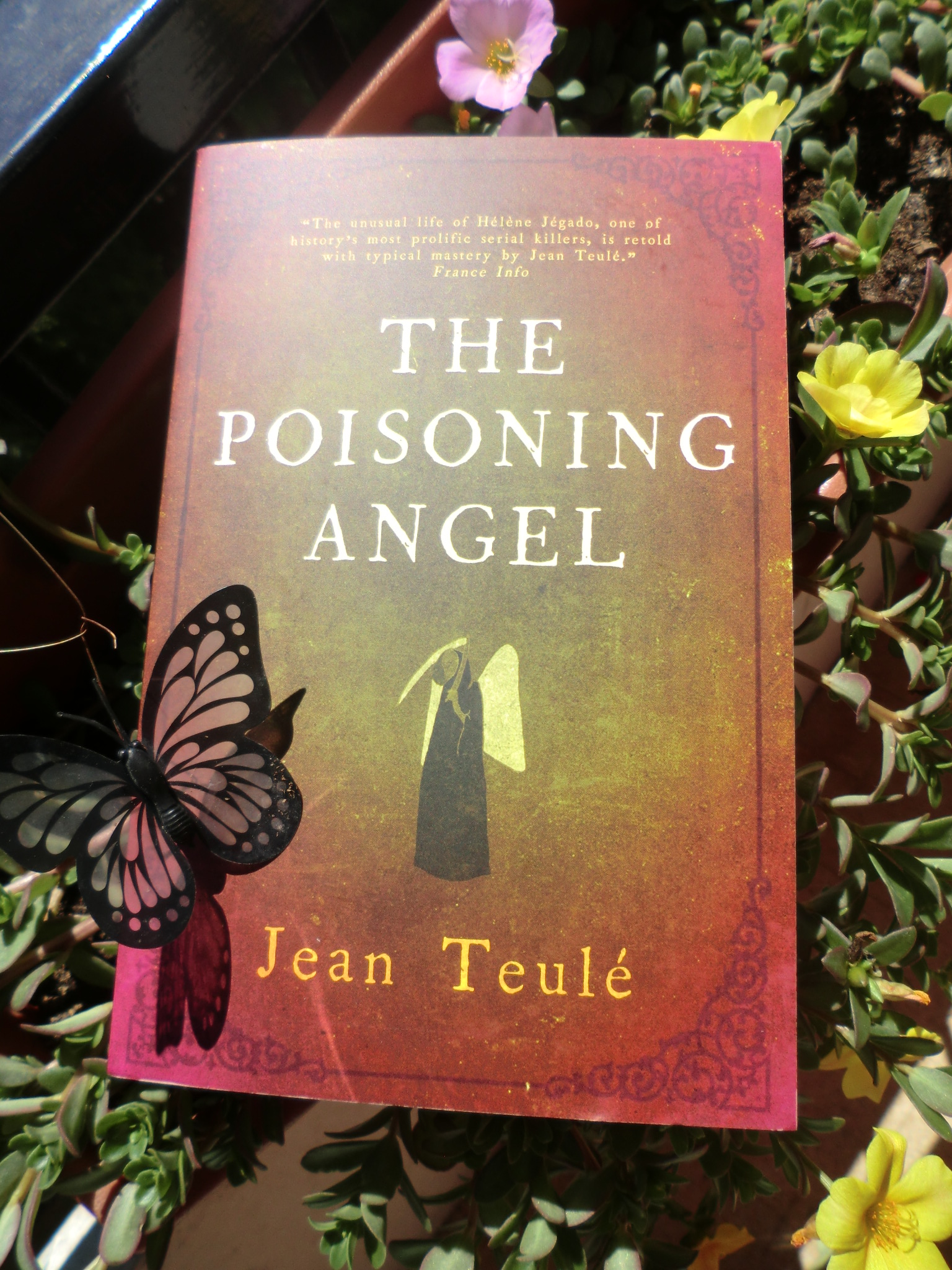
The Poisoning Angel by John Teule

translated by Melanie Florence

This book is actually to be published today 14 July 2014 and the author is a well-known name in French contemporary literature. In fact I have one of his books in French on the shelf already.

This one is based on a true but gruesome story of one of the most notorious serial poisoners that France has ever known and was described by the Sunday Telegraph as:

“a bawdy romp one minute, a gruesome tragedy the next. The writing is beautiful, witty, grisly and moving, and reeks of authenticity.”

Let’s hope all that comes off in translation.

Vatican Cellars

The Vatican Cellars by André Gide

translated by Julian Evans

This book will be published in August 2014 to mark the centenary of the book’s first publication. It is set in the 1890’s around a group of ingenious fraudsters who claim that the Pope has been imprisoned and a false Pope enthroned in his place.

I haven’t read anything by this author, but he sounds like he caused quite a sensation with this novel and others, as he took it upon himself to explore morality in his work and was a major influence on the writing of Jean-Paul Sartre and Albert Camus. He was awarded the Nobel Prize for Literature in 1947 and one year after he died (in 1951) his works were placed on the Vatican’s list of banned books.

Three French Books I Read This Year:

Nagasaki (2)

Nagasaki by Eric Faye

translated by Emily Boyce

A short novella, based on a true story of an event that happened in Japan, that will make you check your fridge contents and ensure you lock the door at night.

Foundling2

The Foundling Boy by Michel Deon

translated by Julian Evans

Coming of age story of a young boy left as a baby on a doorstep, who grows up and has an insatiable need to travel and experience the world. The sequel soon to be translated into English as well.

People in Photo

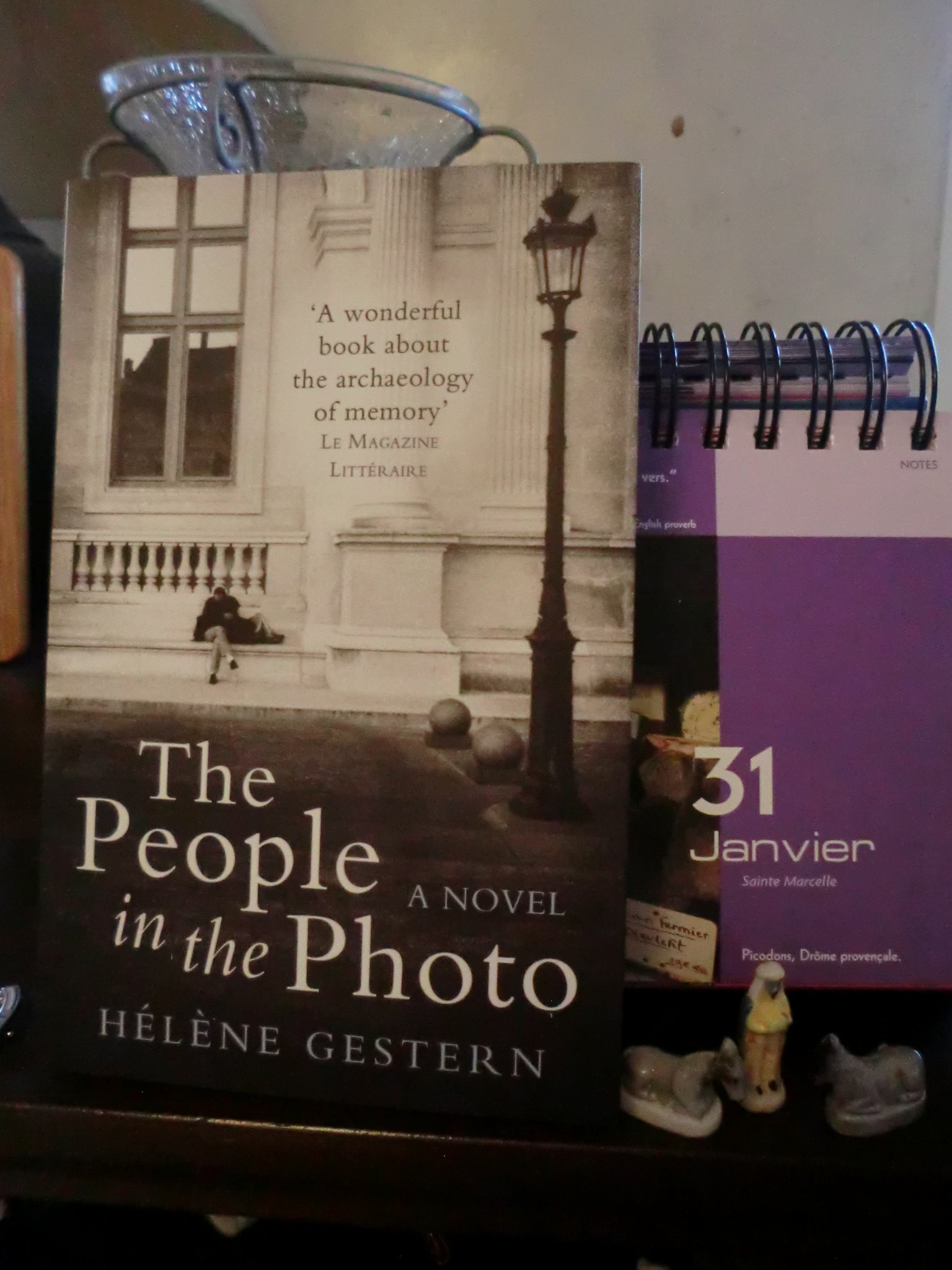
The People In the Photo by Hélène Gestern

translated by Emily Boyce,Ros Schwartz

A wonderful epistolary novel about a young woman searching for answers about events in her mother’s life before she was born, a photo provides a clue to those she knew.

Two Great Books Set in France:

All the Light

All the Light We Cannot See

by Anthony Doerr

Paris and Saint-Malo pre and during WWII following the lives of two children and their growth into adolescence, Marie-Laure who lost her sight at six and Werner who lost his parents and is raised in an orphanage. An excellent story that leads to the crossing of paths of these two characters and wonderfully evocative of place.

I Always Loved You

I Always Loved You

by Robin Oliveira

An insightful historical novel about the American painter Mary Cassatt, her life in late 1800’s Paris as she struggles to establish her name in the art world, enduring a life-long though fractious relationship with the impressionist painter and sculptor Edgar Degas.

Salmagundi:

  1. a mixed dish consisting usually of cubed poultry or fish, chopped meat, anchovies, eggs, onions, oil, etc., often served as a salad.
  2. any mixture or miscellany.

 Bonne Fête!


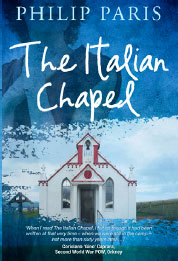
The Italian Chapel by Philip Paris

They were brought to the island as ‘the enemy’ and by the time they left they would have developed relationships and connections that continue to endure today between the inhabitants of the Orkney Islands and Moena, the Italian mountain village where the artist and decorator Domenico Chiocchetti originally came from and where he returned after the war.

the_italian_chapelPhilip Paris has written both a non-fiction account of the short history of the Italian Chapel on Lamb Holm and this book, the novel I have just read and adored. The fictional form allows the author to imagine some of the relationships for which there is little detail and create others that may have been.

It is a war-time story without guns, battles and tragedy, it could even be said it depicts what war purports to be all about, a strategy to create peace and establish tolerance and what better conduit to promote acceptance than to build a chapel, whose sole purpose is for prayer and reflection, a sanctuary from the day-to-day reality.

550 Italian soldiers are captured during WW2 in Egypt and sent to Camp 60 on Lamb Holm, Orkney Islands where they live in ramshackle Nissen huts and are used as free labour to build barriers between the islands to prevent entry to the mainland from invading forces.

“The nearest land is mainland Orkney, which is also an island. You will know from your journey that we are a long way from Italy. You’re all here to do a job, to help build a unique set of barriers between mainland Orkney to the north and between the islands to the south of Glimps Holm, Burray and South Ronaldsay. Four barriers in all.”

In the opening pages, bulldozers arrive with instructions to raze camp 60 to the ground, leaving no trace of the former POW camp. The Italian Chapel sits there beside the Nissen huts awaiting its fate. We then learn the story of how it came to be there.

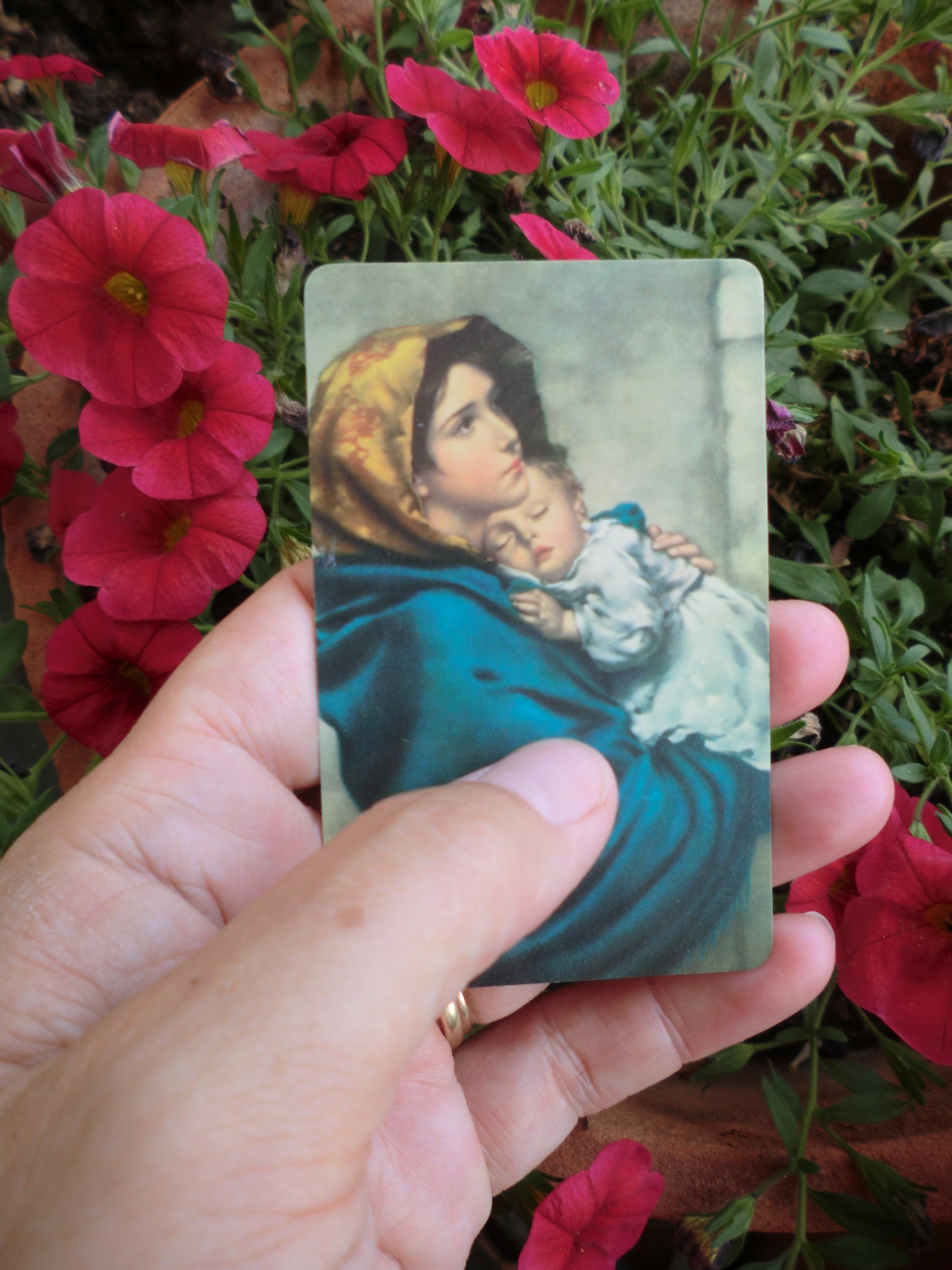
Image of the Madonna

Image of the Madonna

The novel introduces us to key characters in the camp, the artist Domenico Chiocchetti from the northern Italian village of Moena who keeps a small prayer card his mother gave him, with the image of the Madonna’s face in his pocket throughout the war, retrieving it at moments when he needed to escape the present, or remember the past and whose image will become a symbol of the thing he leaves behind, the only physical reminder that there was a POW camp on the Scottish island during the war.

We meet Aldo, who doesn’t talk about his family, but can source anything the men require, Buttapasta, a cement and stone artist, Giuseppe the romantic who had been a foundry worker in the US, they will all become instrumental in the project that occupies the men when the causeway barriers are complete and their status changes after Mussolini is sacked and the Italians are no longer the enemy. The men decide to create a chapel out of two unused Nissen huts and scraps from shipwrecks and whatever their captors can source.

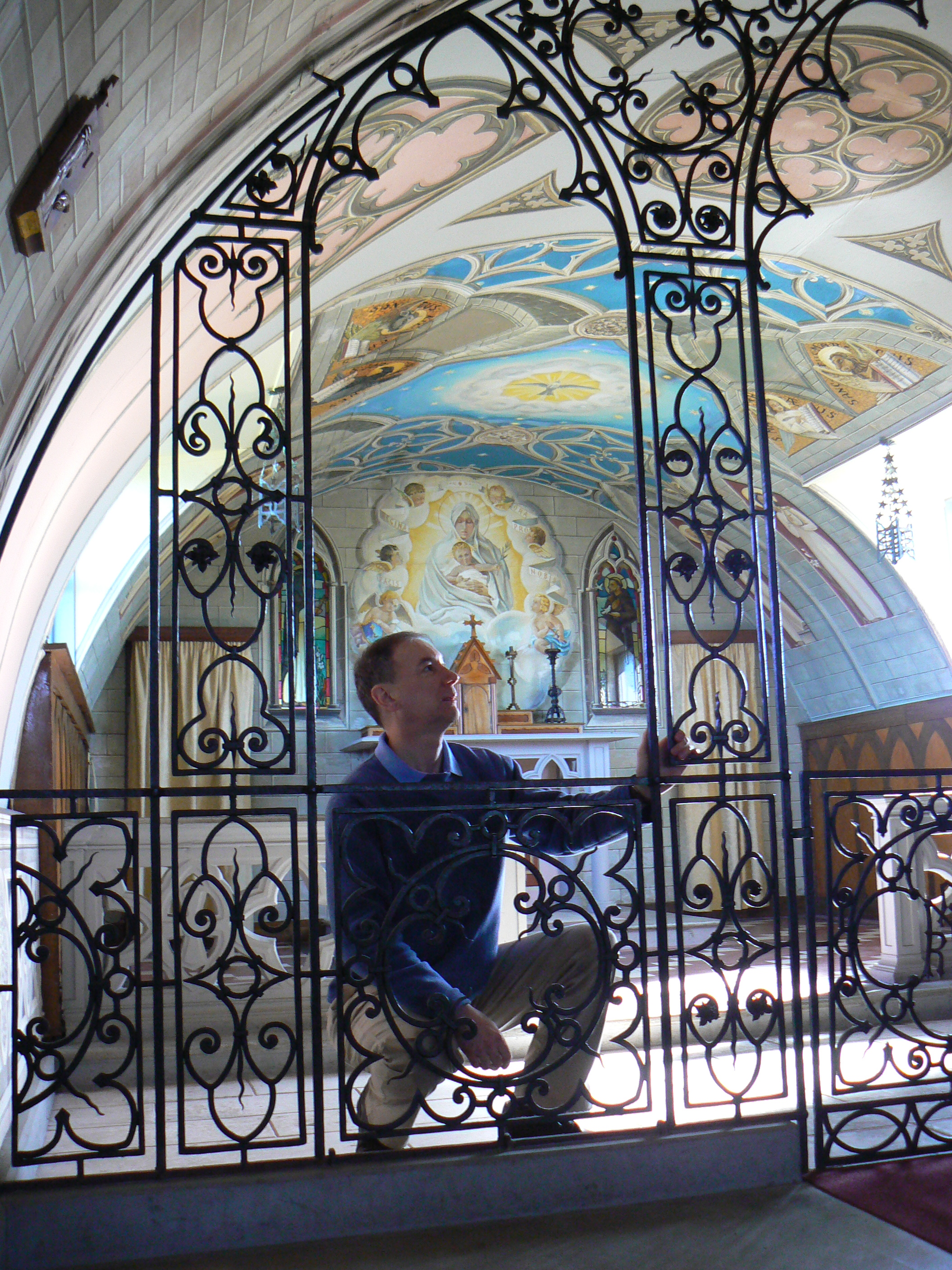
The prayer card becomes the inspiration for Chiocchetti’s portrait of the Madonna and child, painted on plasterboard behind the altar.  An altar is made from concrete left over from building the Barriers, tiles are rescued from a sunken blockship ( a ship deliberately sunk to prevent access to a channel) and wood salvaged from a shipwreck is transformed into a tabernacle. Carved lanterns are created from Bully Beef tins and candlesticks made from the brass stair rods, all contributing to create a beautiful and peaceful interior.

Philip Paris author observing the Rood Screen built by Italian POW soliders

Philip Paris author observing the Rood Screen built by Italian POW soliders

It is a story of optimism, incredible resourcefulness and the things men do to keep their spirits up when the circumstances are against them. It is an easy, light read and moving without being overly sentimental and knowing this wonderful refuge actually exists made it all the more meaningful and special for me as a reader.

Philip Paris has researched this period in history and tried to track down those who were on the island or their relatives and creates a memorable and heartfelt story of tough times that are lightened by a mutual desire to build not just a chapel, but a refuge of incredible beauty that can still be visited today.

“It was the prisoner’s escape, a tunnel to spiritual and cultural freedom, while their bodies remained in captivity.”

Art in Nature, Tove Jansson #TOVE100

Coming out of any intense, dramatic period of living can make it hard to choose appropriate reading material.

Recently I found it difficult to sustain reading as it all seemed too far removed from life’s demands that I be very present and attentive to the needs of those around me.

It made me reflect on what and who can I read I turn to during these kinds of periods. Short stories and/or non-fiction. Tove Jansson and The Dalai Lama.

TOVE 100 © Moomin Characters™

TOVE 100
© Moomin Characters™

I chose Tove Jansson (translated by Thomas Teal), because even her stories feel like they haven’t strayed too far from the reality within which they were inspired. I find immeasurable comfort in reading the words of this talented artist, the short form allowing a brief respite without requiring an ongoing commitment of a novel, when concentration spans are short.

Art in NatureArt in Nature is an intriguing collection of character studies, characters who happen to be creative, eccentric, obsessive, all curiously flawed in some way and Tove Jansson observes them in a situation until the cracks appear. They are a slice of life short narrative and any one of them could easily have morphed into a longer story such as her novel The True Deceiver I recently reviewed here.

The first story Art in Nature is about a caretaker watching over an exhibition of work in open air.

“He slept in the sauna down below the great lawn where the sculptures were set out among the trees.”

The day has its rhythm and characteristics and the evenings belong to the caretaker, the quiet contemplative time when he is alone among the unmoving silent works, still, post creation. He observes everything, every inclination, every watcher, he categorizes them and becomes attached to how things are.

“Almost all the feet moved respectfully. If they were with a guide, they’d stand still for a while, all turned in the same direction, and then they’d change direction all at the same time to look at something else. The lonely feet were uncertain in the beginning, then they’d move slowly at an angle, stop, stand with legs crossed, turn around, and sometimes they’d lift one foot and scratch with it because there were lots of mosquitos.”

Until one evening when a couple overstays, middle-aged adults breaking the rules, having a domestic argument. He intervenes, listens to them argue, provokes them with his own thoughts on the mystery of what art is.

Tove Jansson's Atelier © Moomin Characters™

Tove Jansson’s Atelier
© Moomin Characters™

The Cartoonist is a mysterious, insightful look into the daily work of an illustrator, a job that Tove Jansson’s mother did and one she dabbled in herself, making me wonder how much of this was inspired by the environment and circumstance of her mother.

A famous newspaper cartoonist has quit suddenly after 10 years and a new artist is required to assume his role without a break in the cartoon strip, without his fans knowing. The new artist slips easily into the role but becomes plagued with needing to know why his predecessor quit.

The Doll’s House is brilliant and shocking and quite different from anything else of Jansson’s I have read. Like The True Deceiver, it shows her deftness at spotting signs and cracks in character that over time can grow from barely visible flaw into raging psychological dysfunction when neither checked or dissipated.

Two recently retired men who have lived together and shared the same respect for the beautiful objects that surround them, are adjusting to the new routine of no longer having demanding day jobs. Alexander is a craftsman and Eric a retired banker.

“Alexander was an upholsterer of the old school. He was exceptionally skilled, and he took a craftsman’s natural pride in his work. He discussed commissions only with those customers who had taste and a feel for the beauty of materials and workmanship. Not wishing to show his contempt, he referred all the others to his employees.”

In the beginning they have difficulty adjusting to this new way of life, discovering that in such close proximity their interests aren’t as fine-tuned or in harmony as they had appeared when their time was absorbed by outside demands. Eric begins to take on more of the domestic role and Alexander begins a project to build a miniature house. He seeks the help of an electrician called Boy, who becomes his trusted helper.

“Boy came back almost every evening. He often brought little table lamps, sconces, or a chandelier that he’d found in some hobby shop or toy store. He came straight from work in his jeans and trailed street dirt over the rugs, but Alexander didn’t seem to notice – he just admired what Boy had brought him and listened gravely to his suggestions about improvements to the house.”

Just rereading these two quotes, makes me realise what clever insights Tove Jansson’s places into the text, the clues into character are there from the beginning and the simple daily events that follow turn these insights into something raw and dangerous.

Another excellent collection of stories from the Finnish artist and writer who would have been 100 years old next month.

Absolutely gripping!

Check out her books and events at TOVE100.com

Tove Jansson with her brother Per Olov © Moomin Characters™

Tove Jansson with her brother Per Olov
© Moomin Characters™


Literary Blog Hop Book #Giveaway

From today until Wednesday June 25th I am participating along with many other international bloggers in a Literary Blog Hop Giveaway hosted by Judith at Leeswamme’s Blog, an avid reader and reviewer from the Netherlands.

literarybloghop

Comment below to win the books I am offering and visit the other blogs to enter their offers.

I am offering two books, recent reads and not the usual thing you find in a bookshop. Both titles are literary gems, one an award-winning Norwegian translation, the other a riveting, thought-provoking glimpse into a cross cultural family that thanks to blogging and twitter connections I became aware of. They are fabulous reads, but do check out my reviews first to find out if they sound like something you might enjoy.

You can enter for one title only or for both, one comment puts you in the draw for both books, unless you tell me you are only interested in one of the titles. Ok, here they are:

COMMENT to WIN A COPY of

The Blue Room by Hanne Ørstavik translated by Deborah Dawkin – read my review here.

“a gripping portrayal of a mother-daughter relationship that will send a chill down your spine.”

OR

Carrots and Jaffas by Howard Goldenberg – read my review here.

 “a glimpse into the heart of an ancient land and a fractured family, through the story of a stolen child.”


BlogHop Button

To enter the giveaway, open worldwide to anyone whether you have a blog or not, just leave a comment below to be entered in the draw.

Follow my blog Word by Word to get two chances to win and mention it in your comment.

Follow the blog Word by Word and @clairewords on twitter to have three entries in the draw.

If you are already following, make sure to remind me in your comment.

Good Luck and enjoy visiting the other blogs listed here, just click to visit:

Linky List:

  1. Leeswammes
  2. The Misfortune of Knowing
  3. Bibliosue
  4. Too Fond
  5. Under a Gray Sky
  6. Read Her Like an Open Book (US)
  7. My Devotional Thoughts
  8. WildmooBooks
  9. Guiltless Reading
  10. Fourth Street Review
  11. Nishita’s Rants and Raves
  12. Word by Word
  13. Words And Peace (US)
  14. Ciska’s Book Chest
  15. Falling Letters
  16. Roof Beam Reader
  17. Readerbuzz
  18. The Relentless Reader (US)
  19. Mom’s Small Victories (US)
  20. Daily Mayo (US)
  1. The Emerald City Book Review (US)
  2. A Lovely Bookshelf on the Wall
  3. Lost Generation Reader
  4. Booklover Book Reviews
  5. Bay State Reader’s Advisory
  6. River City Reading (US)
  7. Books Speak Volumes
  8. Words for Worms
  9. Wensend
  10. Bibliophile’s Retreat
  11. Readers’ Oasis
  12. The Book Musings
  13. My Book Retreat (N. Am.)
  14. Books on the Table (US)

Tove Jansson Anniversary 100 years #TOVE100

TOVE 100 © Moomin Characters™

TOVE 100
© Moomin Characters™

2014 is TOVE100, 100 years since the birth of the Finnish artist and writer Tove Marika Jansson.

I have read a few of her books (the adult books translated by Thomas Teal), discovering her about a year ago and I have become a little obsessed with her work since then.

To celebrate her 100 years, I plan to read a few more books by or about Tove Jansson and invite you to join me if you wish.

Books Read

A Winter Booksee my review here

A quiet, honest collection of stories, containing evocative black and white photos that add to the atmosphere the author evokes making the reader experience life on the island and all its challenges, right up to the final story, Taking Leave, the last visit, when the nets have become too heavy to pull, the boat too difficult to handle, the sea too unpredictable for two aging women.

The Summer Booksee my review here

An elderly artist and her six-year-old grand-daughter spend a summer on an island in the gulf of Finland. Gradually, the two learn to adjust to each other’s fears, whims and desire for independence, coming to an understanding, teaching each other something along the way.

The True DeceiverSee my review here 

An aging women artist living alone on the outskirts of a village is befriended by a younger woman, who after faking a break-in moves in with her brother, allegedly to provide companionship. It is a relationship that peels back the layers of both women, bringing their inclinations and bugbears to the surface, a face-off between truth and kindness, both containing elements of deception.

Art in Nature – See my review here

Sculptors daughterStill To Read

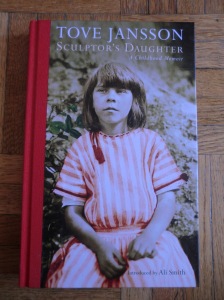
The Sculptor’s Daughter by Tove Jansson

Fair Play by Tove Jansson

Tove Jansson Life, Art, Words: The Authorised Biography, Written by Boel Westin, Translated by Silvester Mazzarella

The Moomintroll Books

Tove Jansson with her brother Per Olov © Moomin Characters™

Tove Jansson with her brother Per Olov
© Moomin Characters™

She wrote and illustrated children’s books and later in life began to write for adults as well. She was close to nature and spent nearly every summer on a family island in the Pellinge archipelago, in the Gulf of Finland, an environment that features often in A Winter Book and The Summer Book.

Born on 9 August 1914 to a family of artists, her mother was a graphic designer and her father a sculptor. An artist before anything, she was multi-talented, painting, illustrating and writing, not confined to any one genre. Her first book for adults was part fiction, part memoir, The Sculptor’s Daughter, written 10 years after her father’s death.

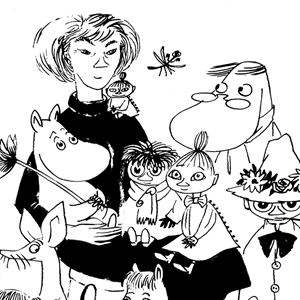
Although I admit to never having read any of them, she is most well-known for nine children’s books that grew out of her family of characters, little white trolls living in Moominvalley named Moomintroll, Moominmamma and Moominpappa along with other creative creatures such as the Hattifatteners, Mymbles and Whompers. She also illustrated other classic children’s books including versions of Alice in Wonderland and The Hobbit.

Tove Jansson and Her Moomintrolls © Moomin Characters™

Tove Jansson and Her Moomintrolls
© Moomin Characters™

Her career started early, drawing for a liberal satire magazine Garm at the age of 15, the title where her large nosed character Moomintroll made its first appearance. I think she may have been filling in for her mother, based on a comment I read in The New Yorker, but I’ll find out more when I read the biography. Her first book Sara and Pelle and the Octopuses of the Water Sprite – was published when she was just 13.

Her books have been translated into more than 40 languages, making her one of the most well-known Finnish artists, remembered by many from their own childhood and continuing to gain new audiences today.

“I didn’t realise it was set in a real place. I thought she’d made Finland up. Finland was like Narnia, with these incredible characters that were so strange but instantly recognisable because you had met lots of them – noisy Hemulens or neurotic, skinny Fillijonks.” Frank Cottrell Boyce

Events

There are numerous events happening worldwide and the national gallery of Finland, Ateneum Art Museum in Helsinki is holding an exhibition of all oeuvres of Jansson’s career, her surrealistic paintings of the 1930s, modernist art of the 1950s and more abstract works in the 1960s and ’70s, as well as her satirical anti-war illustrations for the magazine Garm, her murals created for public spaces, and illustrations of her Moomin characters and stories. I’m unlikely to make it to Helsinki, but was pleased to discover the audio presentations linked below, 2 minute descriptions (in English) of 12 of her paintings which you can view while listening.

Further Reading, Listening

Two Minute Audio Descriptions of 12 of her Paintings, via the Finnish Art Museum, Ateneum

TOVE100 – website with events happening internationally, resources

The Hands That Made the Moomins – An article in the New Yorker


Have you read any of Tove Jansson’s books? Are you planning to read any of them this year?

I Always Loved You: A Novel by Robin Oliveira

Mary SutterWhile looking at a Goodreads list of Historical Fiction due out in 2014, I noticed the name Robin Oliveira, author of the excellent novel My Name is Mary Sutter published in 2010.

I don’t read a lot of historical fiction, but occasionally via word of mouth, I hear about a well written, compelling title that I can’t resist, particularly if it is set in France.

Well researched historical fiction in the hands of a talented writer, is my preferred method of learning about French history (or any history); engaging characters propel the narrative forward and we invest ourselves in the characters who have inhabited the period and discover the chronology of events as if we are living them. Historical events when presented without the force, nuance and characteristic dialogue of personalities that have shaped them, risk becoming dry, uninteresting, sedative and read by the few.

Set in 19th century America on the cusp of civil war, My Name is Mary Sutter chronicles the life of a midwife with ambitions to become a surgeon, something she will be thrown into with the advent of war. Her ambition requires the courage to cope with an abundance of men suffering war injuries amid dire living/working conditions plus sacrifices in her personal and family life. She is a captivating heroine, strong-willed yet vulnerable, living in an incredible pioneering era for women.

In her research, the author learned that 17 young women became physicians after their nursing experiences in the civil war. While Mary Sutter is fictional, she is a truly inspired character about whom Robin Oliveira had this is say:

“And through it all there was Mary Sutter, whose story I needed to tell as a celebration of women who seize the courage to live on, to thrive, to strive, even, when men conspire to war. Mary, flawed and intelligent, careening between desire and remorse, stumbling forward out of courage and stubbornness, hiding a broken heart, but hoping to redeem something beautiful from a life humbled by regret.”

Which is a prelude to saying that seeing a new Robin Oliveira novel coming out in 2014 and set in France, I jumped at the chance to read it.

I Always Loved YouI Always Loved You, an unfortunate and slightly off-putting title, sorry, is about the life of  the American painter Mary Cassatt, her life in Paris struggling to make her name while remaining true to her art, and enduring a life-long fractious relationship with the impressionist painter and sculptor Edgar Degas. It also brings to life another female painter, Berthe Morisot and her relationship with the Manet brothers, Édouard and Eugène.

Mary had left her home town of Philadelphia to pursue artistic ambitions and after ten years of hard work, having once been accepted by the Salon for her work Ida (or Spanish Dancer Wearing a Lace Mantilla), has now been rejected and is feeling disillusioned and on the point of giving in to her father who wants her to return home, find a husband and be with her family. Had it not been for his fascination with Ida and the subsequent encounter with Degas, she may well have fulfilled her father’s bidding.

“C’est vrai. Voilá quelqu’un qui sent comme moi.”
(It’s true. Here it is, someone who feels as I do).
Edgar Degas commenting on Mary Cassatt’s painting, Ida

Through Mary, we learn what it meant to be a painter in Paris in the late 1800’s, the restrictive, suffocating influence of the Salon Jury, purveyors of the official annual exhibition of the Académie des Beaux-Arts, known as the Salon de Paris, to whom all artists looking for acknowledgement and recognition would submit one or two paintings and then await acceptance or rejection. Those deemed successful by the Jury would be hung at the next exhibition and if lucky, talked up by the critics. Those who weren’t, were resigned to another year of work before resubmitting – and they all did, for it was seen as essential to exhibit there in order to achieve any success, a status quo that existed for almost 200 years in France.

Salon de Paris

Salon de Louvre 1787
Source:Wikipedia

This process spurned a rebel group lead by Edgar Degas who refused to submit their work to the Salon Jury and began to hold an alternative exhibition.  These artists were willing to let go of the past with their references and rules and were bold with colour, subject and loose with their interpretation. They became referred to disparagingly by the media as Impressionists, a term Degas despised. It was a brave move and not all of the groups members managed to sustain their nerve, the lure of the Salon despite its limitations, not easy to stand up against.

Degas had admired Mary Cassatt’s work without knowing who she was and after organising to meet her, invited her to exhibit with his group of artists and to one of their weekly salons, a social gathering that included Édouard Manet, his brother Eugène, Berthe Morisot, Renoir, the writer Émile Zola, Pissarro, Gustave Caillebotte, Zacharie Astruc, the poet Stéphane Mallarmé and Claude Monet among others. The evening would mark the beginning of a long relationship between two talented artists whose work came before all else and whose similarities and stubbornness would continue to attract and repel them until their last days.

“He was right. The something, the leap an artist makes so that his painting is more than its technique, he had already achieved. And she wanted that.”

Edouard_Dantan Un Coin du Salon, 1880

Edouard Dantan
Un Coin du Salon, 1880
Source: Wikipedia

I had never heard of Mary Cassatt when I began reading and was intrigued to discover her art, but decided not to go looking at her or Degas’s work until I had finished, allowing my imagination to create an image of their creations during the period of their encounters, which added an exciting anticipation to the reading, especially while Cassatt was preparing for her first showing with the Impressionists and when Degas was working on his sculpture The Dancer.

I hesitate to show any of images of their art here, as it was such a reward for me upon finishing the book. Getting to know or reacquainting ourselves with the artists work is a personal journey and we should decide in our own time when to view the oeuvres of these great artists. No Spoilers here!

They were an inspiration to each other with regard to their work and Oliveira brings the two alive in rich detail, you can almost see their respective studios and smell the turpentine, imagining the furrowed brow of concentration as these two passionate artists throw themselves into their work and block out the world around them.

What they couldn’t inject into their relationship, they gifted to each other through their work, some of the most poignant and yet ironic scenes are when Degas helps Cassatt find her subject and confirms what it is she should be painting. And then the joy of finally seeing them and seeing the energy and vibrancy of those paintings she created during that period when they responded so positively to each others influence, fact or fiction, it stands out in the work.

“I have no money to pay a model,” Mary said to Degas. “I don’t know what to do.”

“You must find your subject.”

Mary said, “Like yours? Ballet, horses, brothels?”

“Obsessions are an artist’s gift. Obsession is poetry,” Degas said.

Just as other writers have brought alive the Lost Generation of writers resident in Paris in the 1920’s, Robin Oliveira does the same for this group of painters, awakening our interest in this turning point in the history of art and the influence of this group on painters in the wider world, which continues today. It is a brilliantly told story of fascinating characters and their passion for art.

National Gallery of Art Washington

National Gallery of Art
Washington

And if you are fortunate enough to live near or visit Washington, it appears that there is to be an exhibition of Cassatt and Degas’s work at the National Gallery of Art May 14 – Oct 5 focused on the critical period of the late 1870s through the mid-1880s when Degas and Cassatt were closest, bringing 70 various works together to showcase the fascinating artistic dialogue that developed between these two major talents and friends.

Note: This book was an ARC (Advance Readers Copy) provided by the publisher via NetGalley.