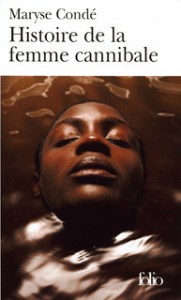
The Story of the Cannibal Woman by Maryse Condé, tr. Richard Philcox #WITMonth

Although she recommends you start with her book of essays Tales from The Heart: True Stories from My Childhood about growing up the youngest of eight children in a black bourgeois family in Guadeloupe, Maryse Condé cited The Story of the Cannibal Woman as her personal favourite of her works at a discussion I attended at our local library last year. It was translated by her husband Richard Philcox.

It was interesting to read this novel so soon after Yewande Omotoso’s The Woman Next Door, given certain points in common, both placing a black Caribbean woman in South Africa and observing her relations with others around her, in the post-apartheid context, it made me wonder if she had been aware of Condé’s earlier work.

As The Story of the Cannibal Woman opens, we learn Rosélie is a 50-year-old recent widow, living alone, without family connections and few friends in Cape Town, South Africa, after the brutal murder of her white British husband, a retired university professor, who nipped out after midnight one evening, allegedly to buy cigarettes and never returned home.

The police suspect it wasn’t a random encounter, something Rosélie refuses initially to acknowledge, completely ignoring her husbands study, a room she rarely ever ventured into, one strangely she is even less inclined to now.

“Aren’t you going to return home?”

Home? If only I knew where home was.

Chance had it I was born in Guadeloupe. But nobody in my family is interested in me. Apart from that, I have lived in France. A man took me to Africa, then left me. Another took me to the United States, then brought me to Africa, and he too left me stranded, this time in Cape Town. Oh, I forgot I’ve also lived in Japan. That makes for a fine charade, doesn’t it? No, my country was Stephen. I shall stay wherever he is.

Left alone without an income to support her (they’d never married though fortunately the house was in both their names), and having made only half-hearted attempts to exhibit her paintings, even then via the efforts of others willing her to succeed, rather than by her own initiative, she decides to offer her services and a healer/clairvoyant.

It is through these occasional appointments with clients that she encounters different members of the local population and the variety of issues confronting them, such as the former trade unionist, who’d languished for years in prison on Robben Island, now a tourist guide for the masses wishing to see where Nelson Mandela had been interned, “revisiting his abuse and torture day after day, describing it down to the last detail to the inquisitive hordes in an endeavour to satisfy their curiosity, the poor guy was losing his head”

10.00am, Patient No. 7, David Fagwela, Age: 73, Particularity: one of the few South African clients, Profession: retired miner

It is an intriguing dual mystery, the ongoing investigation and gradual uncovering of the motive behind the crime plays out at the same time as the intrigue mounts regarding the widow’s reluctance confront the truth about her husband, whose death has loosened the tongues of people close to her, they now freely express their disapproval of him and the way they perceive he treated Rosélie. She appears to be shocked by these revelations and thus retraces her memories of their lives together in London, New York, Tokyo and Cape Town.

It’s an astute medium through which to learn more of their back story, for in narrating those events Rosalie shares how she interpreted events, but the reader will create their own impression and begin to see the abyss between her perspective, Stephen’s and that of their friends.

The couple go on a safari soon after arriving in South Africa, Rosélie was terrified.

What did frighten her were the men. White men. Guides, game wardens, local visitors, foreign tourists. All wearing boots and safari hats, sporting double-barrelled guns, playing in a Western without a hint of a bison or an Indian now massacred or defeated, herded toothless into their reservations. Stephen, on the contrary loved dressing up in a bush jacket and canvas shorts in camouflage, a flask clipped to his waist and sunglasses perched on his nose.

“You don’t know how to enjoy yourself,” he reprimanded her, manly grabbing the wheel of the Land Rover.

Not her fault if she suffered from the complex of a victim and identified with those who are hunted.
At the same time Rosalie is going through her crisis, there is a well publicised case in the newspapers of a woman named Fiela, who allegedly murdered her husband. In court she refuses to speak, the public begin to turn against her, some calling her a witch, others a cannibal. The police officer on Stephen’s case wonders aloud whether she might open up to Rosalie, as many of her patients do. Rosalie has imaginary conversations with Fiela, the one personality to whom she feels able to ask questions (albeit in her dreams), that she can not utter to anyone else:

“Fiela, you’ve settled into my thoughts and dreams. No bother at all. As discreet as an alter ego. You hide behind everything I do, invisible, like the silk lining of a doublet. You must have been like me, a solitary child, a taciturn teenager….Fiela,  what have they got against him? He has always been by my side.Thoughtful.Considerate. Patient to my moods…Fiela, he always forgave me, I who was not beyond reproach, who, I confess, had been unfaithful before.”

Although there was the allegation against Fiela, this story wasn’t about her, it is about Rosélie, so after reading I didn’t understand the reference to the cannibal woman, so I looked it up to see what its symbolic meaning was and discovered that it is related to post colonisation and the loss of cultural memory, this post colonial world inevitably leading to a sense of spiritual devastation, it has even become in television series today, a symbol of self-awakening.

Rosalie is far from her roots and her culture and took shelter with a man, who further alienated her from that, even though he was relatively kind to her. His death has forced her to confront herself.
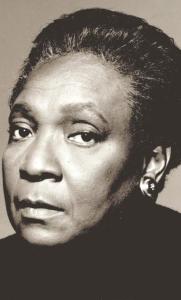
Maryse Condé

I thought this book was brilliant, it can be read superficially as a plot driven novel, or at a deeper analytical level, by looking at an outside view of post apartheid South Africa through the eyes of a bi-cultural, biracial couple, neither of whom come from there.

It’s techniques with flashbacks to fill in the story are typical of the Caribbean style which Maryse Condé does to great effect as are the dream sequences, where her subconscious self expresses itself openly, illuminating the reader. I understand why it is her favourite, she has accomplished a grand feat of literature in this one thrilling novel.

“The author demonstrates how one’s entire sense of self gets swallowed up by trauma and its dislocating aftermath.” – New York Times

Highly Recommended!

My Previous Reviews of Maryse Condé’s work:

Tales From the Heart: Stories From My Childhood

Victoire: My Mother’s Mother

Segu

A Season in Rihata

Buy a Copy of The Story of the Cannibal Woman via Book Depository

Reading Women in Translation #WITMonth

August is the month when the annual reading challenge #WITMonth or Reading Women in Translation takes place, initially begun three years ago by Meytal at Biblibio.

I’m not a big fan or participant of reading challenges or lists, as I love changing my mind and being spontaneous about what I read next, however I do like to follow this one and read the reviews and keep up with what is being published as well as reading more of those I have discovered. And this is a challenge that is making a big difference in the reading and publishing world, so the more we read and demand books like these, the more expansive the selection will become.

I recently wrote an article about how I have become quite a fan of reading literature in translation, which was published by Tilted Axis Press in their lead up to WIT Month. If you haven’t read it already, you can do so by following the link here. At the end of the article I mention a number of titles I’ve really enjoyed, with links to my reviews. Reading in Translation, A Literary Revolution.

This year I’ll be reading a few titles from my current bookshelves and another title from one of my favourite authors Maryse Condé. Below is a summary of the author, translator, the language translated and what each book promises:

The Complete Claudine by Colette tr. Antonia White (French) – Colette began her writing career with Claudine at School, which catapulted the young author into instant, sensational success. Among the most autobiographical of Colette’s works, these four novels are dominated by the child-woman Claudine, whose strength, humour, and zest for living make her a symbol for the life force.
Selected Letters by Madame Sévigne (Marie de Rabutin-Chantal de Sévigné) tr. Leonard Tancock (French) –  One of the world’s greatest correspondents, Madame de Sevigne (1626-96) paints a vivid picture of France at the time of Louis XIV, in eloquent letters written throughout her life to family and friends. A significant figure in French society and literary circles, her close friends included Madame de La Fayette and La Rochefoucauld, she reflected on significant historical events and personal issues, and in this selection spanning almost 50 yrs, she can be humorous, melancholic, profound and superficial. Whether describing the new plays of Racine and Moliere, speculating on court scandals including the intrigues of the King’s mistresses or relating her own family concerns, Madame de Sevigne provides an intriguing portrait of the lost age of Le Roi Soleil.

Iza’s Ballad by Magda Szabó tr. George Szirtes (Hungarian) – When Ettie’s husband dies, her daughter Iza insists  her mother give up the family house in the countryside and move to Budapest. Displaced from her community and her home, Ettie tries to find her place in this new life, but can’t seem to get it right. She irritates the maid, hangs food outside the window because she mistrusts the fridge and, in her naivety and loneliness, invites a prostitute in for tea.  Iza’s Ballad is the story of a woman who loses her life’s companion and a mother trying to get close to a daughter whom she has never truly known. It is about the meeting of the old-fashioned and the modern worlds and the beliefs we construct over a lifetime.

Troubling Love by Elena Ferrante tr. Ann Goldstein (Italian) – Following her mother’s untimely and mysterious death, Delia embarks on a voyage of discovery through the streets of her native Naples searching for the truth about her family. A series of mysterious telephone calls leads her to compelling and disturbing revelations about her mother’s final days. I’m keen to try this after reading all about it in Ferrante’s nonfiction book Frantumaglia, which I read and reviewed earlier this year.

Maryse Condé

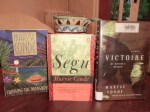
Ever since discovering Maryse Condé via the old style Man Booker International Prize, when it was a two yearly prize for an author’s entire works, I’ve been reading through her novels and stories, as suggested by the author I started with her Tales From the Heart: True Stories from My Childhood, Victoire: My Mother’s Mother, Segu,  and A Season in Rihata.

These are the books I still have on the shelf, and I’m already halfway into the novel the author said at a visit to our local library last year was the favourite of her novels, The Story of the Cannibal Woman, set in Cape Town, and centering on the life of a widow of a multicultural couple, reminding me of the character Hortensia in Yewande Omotoso’s excellent The Woman Next Door, which I just finished reading.

The Story of the Cannibal Woman – One dark night in Cape Town, Roselie’s husband goes out for a pack of cigarettes and never comes back. Not only is she left with unanswered questions about his violent death but she is also left without any means of support. At the urging of her housekeeper and best friend, the new widow decides to take advantage of the strange gifts she has always possessed and embarks on a career as a clairvoyant. As Roselie builds a new life for herself and seeks the truth about her husband’s murder, Conde crafts a deft exploration of post-apartheid South Africa and a smart, gripping thriller.

Crossing the Mangrove – Francis Sancher, a handsome outsider, loved by some and reviled by others, is found dead, face down in the mud on a path outside Riviere au Sel, a small village in Guadeloupe.  None of the villagers are particularly surprised, since Sancher, a secretive and melancholy man, had often predicted an unnatural death for himself.  As the villagers come to pay their respects they each, either in a speech to the mourners, or in an internal monologue, reveal another piece of the mystery behind Sancher’s life and death. Retaining the full colour and vibrancy of Conde’s homeland, Crossing the Mangrove pays homage to Guadeloupe in both subject and structure.

Children of Segu – Sequel to her masterpiece Segu, this fascinating story continues as brother fights brother and the powers of the globe threaten to change their world forever. If you enjoyed Homegoing By Yaa Gyasi, defintiely check out Segu.

Conversations With Maryse Condé by Françoise Pfaff– an exploration of the life and art of Maryse Condé, including conversations about Condé’s geographical sojourns and literary paths, her personality, and her thoughts. Their conversations reveal connections between Condé’s vivid art and her eventful, passionate life. In her encounters with historical and literary figures, and in her opinions on politics and culture, Condé appears as an engaging witness to her time. The conversations frequently sparkle with humour; at other moments they are infused with profound seriousness.

Maryse Condé was born in Guadeloupe, the youngest of eight children and her essays of childhood provide an excellent base for understanding the motivations that underpin much of her writing, firstly to get to know her family influences and aspirations and why she knew nothing of their origins (a past and ancestral pattern her mother was desperate for them to leave behind), her discovery of the turning points in the history of the Kingdom of Segu in Africa and the exploration of racial, gender and cultural issues in a variety of historical eras and locales, often focused on topics with strong feminist and political concerns. As she herself said:

“I could not write anything… unless it has a certain political significance. I have nothing else to offer that remains important.” extract from an interview with Rebecca Wolff

Further Reading

Who, What, When, Where: A Guide to #WITMonth 2017 – via WomeninTranslation.com

8 New or Forthcoming Books by Arab Women – via ArabLit.org

Have you read any of these?

What books have you decided to read for WIT Month?

Do you have a favourite to recommend as I’ll be topping up my shelf for next years reading!

Reading in #Translation, A Literary Revolution #WITMonth

Sometimes it’s interesting to pause and look back at a reading journey and observe the reading milestones that helped deliver us to where our preferences are today. As many of you who’ve been reading Word by Word for a while will know, I like to read around the world, across cultures and that has led me to read more literature in translation.

It has become easier to find more diverse literature than in the past, thanks to the wonderful community of readers/bloggers who write with passion about books and to initiatives like the annual August ‘Women in Translation’ #WITMonth, also lead by a passionate blogger, Meytal Radzinski who blogs at Biblibio.

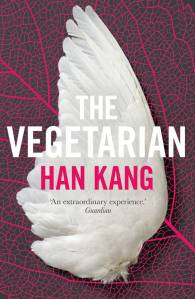
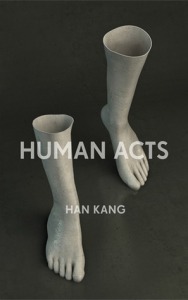
Tilted Axis Press was founded in 2015 by Deborah Smith, translator of Korean literature, while she was completing a PhD in contemporary Korean literature. She translated both of Han Kang’s excellent books, which I’ve read and reviewed here, the incredible Human Acts (my personal favourite) and last years Man Booker International Prize winner The Vegetarian. They are a small, not for profit publisher of works that might not otherwise appear in English, books with

“artistic originality, radical vision, the sense that here is something new”

Recently they asked me for my thoughts on  reading literature in translation, and published my response on their website, which I’ve linked here. It also includes a list of some of my favourite novels in translation and some of the excellent bloggers I rely on to keep me informed. Click on the link below to read the article.

My Thoughts on

Reading in Translation, A Literary Revolution

I hope you enjoy it and find a good book to read in translation during August. Do you have a recent favourite book that you’ve read in translation to recommend? Please let me know in the comments below.


Ladivine by Marie NDiaye tr. Jordan Stump

Ladivine, written by the Senegalese-French writer Marie NDiaye, known for her 2009 Prix Goncourt award-winning Trois Femmes Puissantes (Three Strong Women) came to my attention when it was longlisted for the Man Booker International Prize in 2016.

The blurb describes it as a novel about a women named Clarisse Rivière, who travels by train once a month to visit her mother Ladivine, a woman neither her husband, daughter or grandchildren, or anyone connected to her present life is aware of. They believe Clarisse, whose real name is Malinka, is an orphan and due to mixed parentage, a father unknown, she bears little resemblance to the mother she is ashamed to acknowledge.

The novel demonstrates this artifice of a life, where Clarisse spends every day trying to remove from her very essence who she really is, and while the result could be seen by some as perhaps attaining some kind of perfection, as a character she is hollow, superficial, not there. What makes it hard to accept or believe, is that there appears to be no reason for this decision, no apparent childhood trauma, no cruelty to have turned her into such a narcissist, except perhaps her isolation from normal family and social norms, being the daughter of a single, working mother who was obviously a foreigner, most likely from an African country.

“She kissed her mother, who was short, thin, prettily built, who like her had slender bones, narrow shoulders, long, thin arms,  and compact, unobtrusive features, perfectly attractive but discreet, almost invisible.

Where Malinka’s mother was born, a place Clarisse Rivière had never gone and would never go – though she had, furtive and uneasy, looked at pictures of it on the Internet –  everyone had those same delicate features, harmoniously placed on their faces as if with an eye for coherence, and those same long arms, nearly as slender at the shoulder, as at the wrist.

And the fact that her mother had therefore inherited those traits from a long, extensive ancestry and then passed them on to her daughter (the features, the arms, the slender frame and, thank God, nothing more) once made Clarisse Rivière dizzy with anger, because how could you escape when you were marked in this way, how could you claim not to be what you did not want to be, what you nevertheless had every right not to want to be?”

I admit, I found this novel strange, weird and inhuman. While I understand the author may have been trying to portray something about humanity, what results is the shadow of a human when an aspect of their humanity, their cultural and familial identity, is removed.

“And another realisation hit her at the same time, with the violence of a thing long known but never quite grasped, now abruptly revealed in all its simplicity: being that woman’s daughter filled her with a horrible shame and fear.”

Marie NDiaye by Nicolas Hidiroglou

As Clarisse, Malinka marries and has a child, who she names Ladivine, a daughter who drifts away from her family, when she moves to Berlin and who senses something missing in herself, but with no way to understand what it might be or how to resolve it. Clarisse’s husband Richard leaves her, for perhaps the same reason, again something he can’t quite communicate.

Slightly frustrated having finished the novel, which features a dog in various scenes, which may or may not be the incarnation of one of the characters, I decided to read a few interviews to discover what I was missing in understanding this weird novel by an award-winning and highly revered French novelist.

The details about Marie NDiaye’s life are telling, as are the common themes in her fiction to date. I’ll admit, I find I appreciate the novel more, for having been made aware of this background, to read it without this context, is to feel something this character, that something vital is missing!

Marie NDiaye is the daughter of a French mother and a Senegalese father she barely knows and is married herself to a white Frenchman. She, like the character Clarisse, was raised just south of Paris, and according to an interview in Le Monde, has spent only 3 weeks on the African continent, 2 of those weeks in Senegal, and was said to have felt “wholly foreign” to the continent. For me, this may explain why it feels as though Ladivine, the mother also has no heritage, it is clear she comes from elsewhere, but the author chooses not to provide the narrative any clue to that heritage or cultural reference and even when later in the book, it seems as though the daughter of Clarisse and her family visit that country, though it is never named, again the reader is kept from knowing the actual origins, except through the occasional physical description of the people, reminding us of those opening clues to her mother’s physique.

“NDiaye’s novels frequently feature biracial couples, absent or distant fathers, and strained filial relationships. Her characters often feel ill at ease within their communities, and struggle with doubts that they are not who they believe or wish themselves to be.” New Republic, The Metamorphoses of Marie NDiaye by Jeffrey Zuckerman

There is an emptiness at the core of the novel, a sad indictment of the policies of some countries in their attempt to assimilate the many cultures into one, a loss of a richness that even when unknown can be exhilarating to explore, which is why I have enjoyed so much the work of writer’s like Maryse Condé’s Victoire: My Mother’s Motherand Yaa Gyasi ‘s Homegoing who through their stories seek to explore that which they were not exposed to during their childhoods, but which they come to understand more by visiting the places or exploring through storytelling.

The article in the New Republic (linked below) is worth a read for its discussion of comparisons with Gustave Flaubert’s ‘free indirect discourse’ and how NDiaye submerges the reader into the speaker’s mind and the role of the element of fantasy, or those aspects that cause the reader to wonder whether what they just read was real or a hallucination or the product of an unreliable narrator.

Overall, an interesting read and an interesting writer and novel to read about, but that lack of a cultural heritage or interest in going there to seek it out and confront it, make me less inclined to want to read more of her work. I would however be interested in what she might come up with, should she decide to research her African roots and risk taking that inner journey that would no doubt enrich her fiction and interest this reader.

Further Reading

The Metamorphoses of Marie NDiaye, New Republic by Jeffrey Zuckerman

3 Generations Of Trauma Haunt ‘Ladivine’, NPR review by Jean Zimmerman

Eva Sleeps by Francesca Melandri tr. Katherine Gregor

Eva Sleeps is a thought-provoking novel that takes the reader on multiple journeys, as the narrative slowly unravels the mystery that connects Eva, her mother Gerda and Vito.

“Where’s Eva anyway?”

“Eva is sleeping.”

The brown parcel travelled backward along the road it had taken to arrive at that spot: two thousand, seven hundred and ninety-four kilometres in total,there and back.

Eva Sleeps is a reference from Paradise Lost and a quote in the book that is repeated both in the prologue (above) and at the end of the novel, referring to the delivery of a package that arrives from the postal worker for Eva, one that her mother rejects, saying it is unwanted. It is an indirect introduction to the three main characters, introducing a connection that will be alluded through throughout and revealed  by the end after we too have travelled that same journey the package takes.

“Let Eve (for I have drench’d her eyes, Here sleep below, while thou to foresight wak’st.”

John Milton, Paradise Lost, book XI

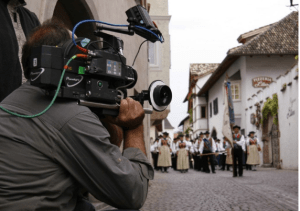
We meet Eva as she is met at Munich airport by Carlo, he will drive her the three-hour journey across two borders to her home in Sudtirol/Alto Adige in a German-speaking part of northern Italy. It is the beginning of the Easter holiday and the beginning of a longer journey she will make when she receives the call from Vito telling her he doesn’t have long to live and that he’d like to see her again.

Eva’s chapters are titled Kilometre 0, Kilometres 0-35, up to Kilometre 1397 ending with Kilometre 0, Today. These chapters contain her thoughts and observations as she makes the 1400km journey towards the dying Vito in Sicily.

The interposing chapters are Gerda’s story and they are labelled by the years within which her story is narrated, beginning in 1919, a year in which:

“…the peace treaty was being signed in Saint-Germain, with which the victorious powers of the Great War – France, especially – wishing to punish the dying Austrian Empire, assigned South Tyrol to Italy. Italy was very surprised. There had always been talk of liberating Trento and Trieste, but never Bolzano – let alone Bozen. It was perfectly logical. South Tyrolean’s were German people, perfectly at ease in the Austro-Hungarian empire, and didn’t need anyone to liberate them. Even so, after a war that had certainly not been won on the battlefield, Italy ended up with that stretch of the Alps as their unexpected booty.”

It was also the year her father inherited the family home after the death of his parents. The fate of the family would forever be affected by that political decision, for all those native to the area, who overnight were ruled in a language and culture foreign to their ways, making them like strangers in their own country, as people from the poorer southern parts of Italy were sent to live among them, in an effort to try to make these tall, blond people more Italian.

Gerda’s family is poor and as soon as she is old enough she is sent out to work, she works in the kitchen of a large hotel and alongside her striking beauty, develops a talent for creating delectable local dishes, twin characteristics that will lift her out of poverty and give her a measure of independence, much required after her father disowned her upon the arrival of Eva. She finds a way to continue working without losing her daughter.

Alongside the enthralling life of Gerda, who is the most well-rounded and well-known of the characters we follow, we are exposed to the context of the freedom fights of Alto Adige, those who protested against the cultural white-washing, labelled terrorists for their protests when they turn violent.

“Until a few years ago, when you said you were a German speaker from Alto Adige, they thought you were a terrorist. At the very least they’d ask: but why do you people hate Italians so much?

Then things changed. In the weekly supplement of the newspaper, a few months ago, the front cover was devoted to separatist ethnic movements in Europe. It mentioned:

Corsica, Slovakia, Scotland, Catalonia, the Basque country, Kosovo, Montenegro, Slovenia, Croatia, Bosnia and the Po Valley.

The Po Valley!

No sign of Alto Adige.

Eva Sleeps is a provocative novel of journeys, of connections and contradictions across cultures, of love in its many forms, of struggles and conflicts, identity and how we are connected to place.

Told in a compelling narrative while backgrounding the fascinating and little known history of this part of northern Italy, it does what the historical novels often do best, increase our historical knowledge, while highlighting the ricochet effects political decisions can have on humanity, on innocent civilians, making us understand why the oppression that results turn some towards violence and others to seek love, as ways to dull the pain.

The novel is being made into a film.

Note: This book was kindly provided to me by the publisher, Europa Editions.


The Bastards of Pizzofalcone by Maurizio De Giovanni tr. Andrew Shegaar #WorldNoir

Crime fiction isn’t my usual choice, but I’ve been reading Italian literature in the past week, and since this is also set in Naples and came from Europa Editions, I decided to take a break from the more literary style and read this novel classified as ‘world noir‘ (a tribute and new imprint dedicated to the best in international crime fiction).

A quick look up tells me that noir fiction has its roots in hard-boiled fiction ( a tough, unsentimental style American of crime writing) where the protagonist is often an outcast, alienated. However, Kim Fay from LA Review of Books, when reading noir, used to preparing herself for ‘bleak cynicism and uncomfortable moral ambiguity’ is pleasantly surprised, referring to De Giovanni’s Pizzofalcone precinct series and empathetic characters as ‘tender noir’:

“Reading the Pizzofalcone Precinct series, by Maurizio de Giovanni, I quickly discovered that I can still be surprised. These books didn’t get to me with an extra dose of soul-sucking fatalism or some harrowing new breed of self-destructive protagonist. Instead, their emotional “gotcha!” came in the unexpected form of tenderness.

Tender noir? Is such a thing possible? Yes — and it adds a richness that many noir novels lack.” Kim Fay, LARB

As for alienated, the entire team at the Pizzofalcone precinct in Naples fit that mould, the place was about to be closed down, due to the previous investigative branch have been suspended for being implicated in a crime, the precinct may still be shut down, depending on how this new team of misfits work together and whether they succeed.
The Pizzofalcone precinct covers four distinct neighbourhoods: upmarket, poor, business and historic, it is like a microcosm of the city of Naples, an area where each of it many elements are likely to sidle up against one another.

“The precinct isn’t big, but its crowded; it encompasses a part of the Spanish Quarter and stretches on down to the waterfront. Four different worlds, in other words: the lumpenproletariat, as we used to say in the old days; the white-collar middle class; the businessmen of the upper middle-class; and the aristocracy. Everything except manufacturing, in an area barely three kilometres on a side. One of the oldest police districts in the city, small but strategic.”

All of them have been transferred from their previous workplaces, renegades who are unwelcome where they currently are, involved in some kind of misdemeanour – although in the case of the Sicilican Inspector Lojacono, who becomes the lead investigator of the new murder case, he was both specially requested due to his reputation and passed on without regret, due to allegations of corruption that have tainted and alienated him, since he showed everyone up in his last case by solving it while everyone else was looking in a different direction.

He is new to Naples, he has a teenage daughter he is worried about, a pizza waitress who is eyeing him up and a high-ranking magistrate whom he daydreams inappropriately of.

The wife of a notary is found dead in their apartment with no forced entry and so they set to and investigate, introducing us to various elements of working and non-working Neapolitan life, including an elderly woman who sits at her window all day, every day and is suspicious about the new occupant of an apartment opposite her, a beautiful young woman also never leaves her apartment.

We are also introduced to the obsession of the policemen Giorgio Pisanelli, who collects information about all the recent suicides in the precinct, convinced there is a connection between them and that they are not suicides.

It’s a well-paced, intriguing read, a few short chapters in italics, portraying characters who may be suspects, characters who are trying to hide something, this narrative adding to the mystery and has the reader trying to guess who it might be.  I really enjoyed it and even though I didn’t guess the revelation at the end, I appreciated that it wasn’t overly full of twists, neither was it completely obvious.

The author succeeds in portraying Naples both through the eyes of the newcomer and with the familiarity of a local, adding a compelling element of discovery and opening the way for future instalments. The team was well portrayed, interesting but quirky characters, that clearly will continue, since the resolution of this crime should serve to keep the precinct open, these renegades forming into a solid team while navigating the fine edge between the ongoing surety of their positions and a volatile potential to destroy it with one reckless mistake.

Maurizio de Giovanni was born in Naples in 1958 and for many years worked in a bank, though not a natural vocation, his colleagues attest he always had his nose in a book and it was in fact they who entered him in a short story competition in 2005 for ‘giallo novelists’ (a 20th-century Italian mystery, thriller or horror genre of literature and film) that was the catalyst to his becoming a successful crime writer.

That story introduced detective Commissario Ricciardi and spawned a series of books set in 1930 Naples, fascist Italy. His parents were born in 1930’s Naples, their lives and experiences clearly an influence contributing to his passionate for pre-war Naples of the 1930’s and the city today.

The Bastards of Pizzofalcone, originally published in 2013, marked his transition from the noir genre to the police procedural and a move from the 1930’s to contemporary life in Naples. The series featuring Inspector Lojacono continues (there are six books in Italian) and is being made into a television series in 2017.

Note: Thank you to the publisher Europa Edition, for providing a copy of this book.

Frantumaglia, A Writer’s Journey by Elena Ferrante tr. Ann Goldstein

A fabulous collections of correspondence and essay like responses to interview questions over a period of twenty-five years since the publication of her first novel Troubling Love.

The title ‘Frantumaglia‘, a fabulous word left to her by her mother, in her Neapolitan dialect, a word she used to describe how she felt when racked by contradictory sensations that were tearing her apart.

She said that inside her she had a frantumaglia, a jumble of fragments. The frantumaglia depressed her. Sometimes it made her dizzy, sometimes it made her mouth taste like iron. It was the word for a disquiet not otherwise definable, it referred to a miscellaneous crowd of things in her head, debris in a muddy water of the brain. The frantumaglia was mysterious, it provoked mysterious actions, it was the source of all suffering not traceable to a single obvious cause…Often it made her weep, and since childhood the word has stayed in my mind to describe, in particular, a sudden fit of weeping for no evident reason: frantumaglia tears.

And so for her characters, this is what suffering is, looking onto the frantumaglia, the jumble of fragments inside.

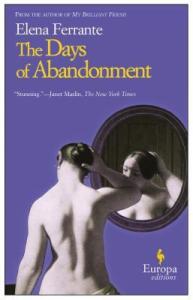
The first half chiefly concerns communication around Troubling Love and The Days of Abandonment, the latter written ten years after her debut, although other stories were written in between but never published, the author not happy with them as she so piercingly reveals:

I haven’t written two books in ten years, I’ve written and rewritten many. But Troubling Love and The Days of Abandonment seemed to me the ones that most decisively stuck a finger in certain wounds I have that are still infected, and did so without keeping a safe distance. At other times, I’ve written about clean or happily healed wounds with the obligatory detachment and the right words. But then I discovered that is not my path.

The second half implies a delay in the publication of the collection to include interviews and question-responses around the Neapolitan Quartet, beginning with the renowned My Brilliant Friend.

Readers ask poignant questions, while the media tend to obsess about her decision to remain absent (as opposed to anonymous) from promotional activity, to which she has many responses, one here in a letter to the journalist Goffredo Fofi:

In my experience, the difficulty-pleasure of writing touches every point of the body. When you’ve finished the book, it’s as if your innermost self had been ransacked, and all you want is to regain distance, return to being whole. I’ve discovered, by publishing, that there is a certain relief in the fact that the moment the text becomes a printed book it goes elsewhere. Before, it was the text that was pestering me; now I’d have to run after it. I decided not to.

Perhaps the old myths about inspiration spoke at least one truth: when one makes a creative work, one is inhabited by others-in some measure one becomes another. But when one stops writing one becomes oneself again.

…I wrote my book to free myself from it, not to be its prisoner.

She shares her literary influences (works of literature about abandoned women) from classic Greek myths, Ariadne to Medea, Dido to the more contemporary Simone de Beauvoir’s The Woman Destroyed, referring to recurring themes of abandonment, separation and struggle. She mentions literary favourites, Elsa Morante’s House of Liars.

One interviewer asks why in her early novels, her characters depict women who suffer, to which she responds:

The suffering of Delia, Olga, Leda is the result of disappointment. What they expected from life – they are women who sought to break with the tradition of their mothers and grandmothers – does not arrive. Old ghosts arrive instead, the same ones with whom the women of the past had to reckon. The difference is that these women don’t submit to them passively. Instead, they fight, and they cope. They don’t win, but they simply come to an agreement with their own expectations and find new equilibriums. I feel them not as women who are suffering but as women who are struggling.

And on comparing Olga to Madame Bovary and Anna Karenina, who she sees as descendants of Dido and Medea, though they have lost the obscure force that pushed those heroines of the ancient world to such brutal forms of resistance and revenge, they instead experience their abandonment as a punishment for their sins.

Olga, on the other hand, is an educated woman of today, influenced by the battle against the patriarchy. She knows what can happen to her and tries not to be destroyed by abandonment. Hers is the story of how she resists, of how she touches bottom and returns, of how abandonment changes her without annihilating her.

In an interview, Stefania Scateni from the publication l’Unità, refers to Olga, the protagonist of The Days of Abandonment as destroyed by one love, seeking another with her neighbour. He asks what Ferrante thinks of love.

The need for love is the central experience of our existence. However foolish it may seem, we feel truly alive only when we have an arrow in our side and that we drag around night and day, everywhere we go. The need for love sweeps away every other need and, on the other hand, motivates all our actions.

She again refers to the Greek classics, to Book 4 of the Aeneid, where the construction of Carthage stops when Dido falls in love.

Individuals and cities without love are a danger to themselves and others.

The correspondence with the Director of Troubling Love (L’amore molesto), Mario Martone is illuminating, to read of Ferrante’s humble hesitancy in contributing to a form she confessed to know nothing about, followed by her exemplary input to the process and finally the unsent letter, many months later when she finally saw the film and was so affected by what he had created. It makes me want to read her debut novel and watch the original cult film now.

Frantumagli is an excellent accompaniment to the novels of Elena Ferrante and insight into this writer’s journey and process, in particular the inspiration behind her characters, settings and recurring themes.

Note: Thank you to the publisher Europa Editions, for providing me a copy of this beautiful book.

Buy a copy of any of Elena Ferrante’s novels via Book Depository here.

Ties by Domenico Starnone (Italy) tr. Jhumpa Lahiri

Ties is a novel about the short and long-term effect of the first grand infidelity, on a couple, on their adult children and even on the life of their cat.

As I began to read, I had a strange feeling of deja vu, or should I say deja lu, the voice of the woman who writes the letters in the opening chapters isn’t the same, but the premise of her abandonment, being left with two children, it’s as if this novel reignited elements of how I imagined Elena Ferrante’s The Days of Abandonment, which I read last summer.

I found myself back there, in the same apartment, experiencing the same circumstances, only these were not the reflections of the same woman, nor of the same writer – well no – this is a man writing these letters from a woman (Vanda) and then in a voice that rings more true, that of the man (Aldo) who abandons, who wanted to suspend the life he found himself in, in pursuit of something that claimed nothing more than pleasure from him.

In Ferrante’s devastating, gripping novel, the voice of the wife takes hold of the reader from the outset, she is calm and rational, appearing reasonable on the outside, all the while anger and rage builds inside her like a furnace. We enter the narrative in this safe space, then feel it slowly disintegrate as that raging inferno can no longer be contained and erupts, spilling hazardously into reality.

In contrast Starnone’s protagonist Vanda, through excerpts from a few of the letters she wrote Aldo, that he rereads  40 years after they were written, is angry, opinionated and doesn’t hold back from sharing any of the catastrophic thoughts that come to her, about the damage he has done and is doing to her and the children.

The narrative structure is interesting, as the story is set around the departure and return of Vanda and Aldo from a holiday at the sea. They are in their 70’s and for the week they will be away, they’ve asked their adult children, who no longer speak to each other, to feed the cat.

The three parts of the novel encompass, book one, the letters Vanda wrote when her husband left her, book two, the departure for the holiday and the return narrated by Aldo, within which he deconstructs the marriage and his part in it. The return to their apartment and the circumstance they find themselves in, evoking in him a long period of contemplation, going over events, memories and perceptions as he tries to understand how it all came to this.

I held back. In general, faced with difficult situations, I slow down; I try to avoid making the wrong moves. She, on the other hand, after a moment of bewilderment, dives headfirst into terror, fighting it with everything she’s got. She’s always behaved this way, ever since I’ve known her, and it was what she did now.

There is one scene where Aldo discovers an old photo of Vanda and it is as if he sees her for the first time, he sees something of the essence of her in youth, and now fifty years later, has a partial realisation of what he has lost, of what he has failed to see, and by doing so, has extinguished in her.

I recognised the features of that period: flimsy clothes she sewed herself, scuffed shoes with worn-out heels, no make-up on her large eyes. What I didn’t recognise on the other hand, was her youth. This, then, was what was alien to me: her youth. In those pictures Vanda radiated a glow which – I discovered – I had no recollection of, not even a spark that allowed me to say: Yes she used to be like this.

And book three, narrated by the daughter Anna, on one of the alternate days she has agreed to feed the cat, convincing her brother who she hasn’t seen since he was favoured in her Aunt’s will years ago, to meet her there.

The novel is called Ties, a translation of Lacci or laces, which has a double meaning in Italian, meaning both the cords that we use to tie shoes and the connections or bonds between people and or things, a metaphor for the ties that continue to bind despite separation, distance, change, age. There are attempts to let go, by all the characters, attempts to distance, to free themselves of the bonds that tie, but none that really succeed. In some, the attempt to separate will result in the creation of new and more numerous ties, the son Sandro moves from one relationship to another, each resulting in another child.

It’s an intriguing novel, with what I felt was a slightly bizarre and unexpected ending. The story invoked immediate comparisons with The Days of Abandonment, however the experience of reading this novel was like viewing these lives from the outside, like looking at things from a distance, provoking a more questioning response, whereas Ferrante’s novel succeeds in transporting the reader into the narrative, it’s more cathartic and slightly terrifying, as she brings you to the edge of sanity, making you sense the danger in letting that temporary instability be observed by the outside world, a situation that many women in past centuries were indeed committed to asylums for, provoked as they often were by the cool, insensitive abandonment of the patriarch.

P.S. After reading the novel and writing the review, I’ve since seen a couple of articles that speculate 1), that Domenico Starnone might be Elena Ferrante (I don’t think so) and 2), that he may be married to the woman who uses the pseudonym, Elena Ferrante. Whether or not the latter is true, there is indeed a link between the two novels, the literary comparison of more interest than the pursuit of the personal lives of authors who wish to remain anonymous and separate from their work.

Note: Thank you to the publisher Europa Editions, for providing me with a copy of Ties.

Man Booker International Prize 2017 long list #MBI2017

The Man Booker International Prize used to appear every two years and the authors nominated were not just writers in translation, they were from outside the UK and a nomination was for their body of work, not for one recently published book. That prize, for a translated work of fiction was called, the IFFP (Independent Foreign Fiction Prize).
Now the two have joined together, with the format being the same as the IFFP prize and the name Man Booker International.

The judges for 2017  are Nick Barley, Director of the Edinburgh International Book Festival, translator Daniel Hahn; award-winning poet Helen Mort; Turkish author and academic Elif Shafak and Nigerian-born writer Chika Unigwe.

“Fiction in translation is flourishing: in these times when walls are being built, this explosion of brilliant ideas from around the world arriving into the English language feels more important than ever.” Nick Barley, Chair

Last year the prize was won by the South Korean author Han Kang and her translator Deborah Smith, for The Vegetarian.

MBI long list 2017

The 2017 longlist comprises 13 titles (from 126 submissions) translated into English from 11 languages: (summaries extracted from the Man Booker Prize website), the shortlist will be announced on April 20 and the winner on June 14th.

Title, Author (nationality), Translator

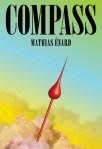
Compass by Mathias Enard (France), (tr. Charlotte Mandell) – As night falls over Vienna, Franz Ritter, an insomniac musicologist, takes to his sickbed with an unspecified illness and spends a restless night drifting between dreams and memories, revisiting important chapters of his life: his ongoing fascination with the Middle East and his numerous travels to Istanbul, Aleppo, Damascus and Tehran, and writers, artists, musicians, academics, orientalists, and explorers who populate this vast dreamscape. An immersive, nocturnal, musical novel, full of generous erudition and bittersweet humour, Compass is a journey and a declaration of admiration, a quest for the otherness inside us all and a hand reaching out.

Swallowing Mercury by Wioletta Greg (Poland), (tr.Eliza Marciniak) – Wiola lives in a close-knit agricultural community in 1980s Poland. Wiola’s father was a deserter but now he is a taxidermist. Wiola’s mother tells her that killing spiders brings on storms. Wiola must never enter the seamstresses’s ‘secret’ room. Wiola collects matchbox labels. Wiola is a good Catholic girl brought up with fables and nurtured on superstition. Wiola lives in a Poland both recent and lost in time. Swallowing Mercury is about the ordinary passing of years filled with extraordinary days. In vivid prose filled with texture, colour and sound, it describes the adult world encroaching on the child’s. From childhood to adolescence, Wiola dances to the strange music of her own imagination.

A Horse Walks Into a Bar by David Grossman (Israel) (tr.Jessica Cohen) – In a comedy club in a small Israeli town, an audience arrives expecting an evening of amusement and see a comedian falling apart on stage; an act of disintegration, a man crumbling before their eyes. They could get up and leave, or boo and whistle and drive him from the stage, if they were not so drawn to glimpse his personal hell. Dovale Gee, a veteran stand-up comic – charming, erratic, repellent – exposes a wound he has been living with for years: a fateful and gruesome choice he had to make between the two people who were dearest to him.

War and Turpentine by Stefan Hertmans (Belgium), (tr.David McKay) – Shortly before his death, Stefan Hertmans’ grandfather Urbain gave his grandson a set of notebooks containing detailed memories of his life. He grew up in poverty around 1900, the son of a struggling church painter who died young, and went to work in an iron foundry at 13. Afternoons with his father working on a church fresco were heaven; the iron foundry an inferno. During WW1, Urbain was on the front line confronting the invading Germans, haunted by events he can’t forget. War ends, he marries, then tragedy. Urbain recovers and like the obedient soldier he is, dutifully fulfils the expectations of family. Observations of a marriage with a sad secret at its heart, consolation found in art and painting.

The Unseen by Roy Jacobsen (Norway), Don Bartlett (tr.Don Shaw) – Ingrid Barrøy is born on a family owned island, her father dreams of a jetty to connect them to the mainland, but closer ties to the wider world come at a price. Her mother has her own dreams – and a question Ingrid must never ask. Island life is hard, so when Ingrid comes of age, she is sent to work for one of the wealthy families on the coast. But Norway too is waking up to a wider world, a modern world that is capricious and can be cruel. Tragedy strikes, and Ingrid must fight to protect the home she thought she had left behind.

The Traitor’s Niche by Ismail Kadare (Albania), (tr.John Hodgson) – At the heart of the Ottoman Empire, in the main square of Constantinople, a niche is carved into ancient stone. Here, the sultan displays the severed heads of his adversaries. People flock to see the latest head and gossip about the state of the empire: the province of Albania is demanding independence again, and the niche awaits a new trophy. Tundj Hata, the imperial courier, is charged with transporting heads to the capital – a task he relishes and performs with fervour. But as he travels through obscure and impoverished territories, he makes money from illicit side-shows, offering villagers the spectacle of death. The head of the rebellious Albanian governor would fetch a very high price.

Fish Have No Feet by Jon Kalman Stefansson (Iceland), (tr.Phil Roughton) – Keflavik: a town that has been called the darkest place in Iceland, surrounded by black lava fields, hemmed in by a sea that may not be fished. Its livelihood depends entirely on a U.S. military base, a conduit for American influences that shaped Icelandic culture and ethics from the 1950s to the dawn of the new millennium. It is to Keflavik that Ari, a writer and publisher, returns from Copenhagen at the behest of his dying father, two years after walking out on his wife and children. He is beset by memories of his youth, spent or misspent listening to Pink Floyd and the Beatles, fraternising with American servicemen – who are regarded by the locals with a mixture of admiration and contempt – and discovering girls. There is one girl in particular he could never forget – her fate has stayed with him all his life.

The Explosion Chronicles by Yan Lianke (China), (tr.Carlos Rojas)  – With the Yi River on one side and the Balou Mountains on the other, the village of Explosion was founded a thousand years ago by refugees fleeing a volcanic eruption. But in the post-Mao era, the name takes on a new significance as the rural community grows explosively from a small village to a town to a city to a vast megalopolis. Behind this rapid expansion, three rival clans linked together by a web of ambition, madness and greed,  transform their hometown into a Babylon of modern times – an unrivalled urban superpower built on lies, sex and thievery.

Black Moses by Alain Mabanckou (France), (tr.Helen Stevenson) – 1970 in the People’s Republic of Congo, a Marxist-Leninist revolution is ushering in a new age. Over at the orphanage on the outskirts of Pointe-Noire where young Moses has grown up, the revolution has strengthened the reign of terror of Dieudonné Ngoulmoumako, the institution’s corrupt director. So Moses escapes to Pointe-Noire, where he finds a home with a larcenous band of Congolese Merry Men and among the Zairean prostitutes of the Trois-Cents quarter. But the authorities won’t leave Moses in peace, and intervene to chase both the Merry Men and the Trois-Cents girls out of town. All this injustice pushes poor Moses over the edge. Could he really be the Robin Hood of the Congo? Or is he just losing his marbles?

Bricks and Mortar by Clemens Meyer (Germany), (tr.Katy Derbyshire) – Bricks and Mortar is the story of a city’s sex trade in the former GDR, from 1989 to the present day, charting the development of the industry from prohibition to legality in the 20 years following the reunification of Germany. It focuses on the rise and fall of one man from football hooligan to large-scale landlord and service-provider for prostitutes to, ultimately, a man persecuted by those he once trusted. And other voices: women who work in prostitution, their clients, small-time gangsters, an ex-jockey searching for his drug-addict daughter, a businessman from the West, a girl forced into child prostitution, a detective, a pirate radio presenter…

Mirror, Shoulder, Signal by Dorthe Nors (Denmark), (tr.Misha Hoekstra) – Sonja is an intelligent single woman in her 40s whose life lacks focus. The situation must change – but where to start? By learning to drive, perhaps. After all, how hard can it be? Very, as it turns out. Six months in, Sonja is still baffled by the basics and her instructor is eccentric. Sonja is also struggling with an acute case of vertigo, a sister who won’t talk to her, and a masseuse who is determined to solve her spiritual problems. Frenetic city life is a constant reminder that every man (and woman) is an island: she misses her rural childhood where ceilings were high and the sky was endless. Shifting gears is not proving easy.

Judas by Amos Oz (Israel), (tr. Nicholas de Lange) – Set in the still-divided Jerusalem of 1959-60, Judas is a tragi-comic coming-of-age tale and a radical rethinking of the concept of treason. Shmuel, a young, idealistic student, is drawn to a strange house and its mysterious occupants within. As he starts to uncover the house’s tangled history, he reaches an understanding that harks back not only to the beginning of the Jewish-Arab conflict, but also to the beginning of Jerusalem itself – to Christianity, to Judaism, to Judas.

Fever Dream by Samanta Schweblin (Argentina), (tr.Megan McDowell) – A young woman named Amanda lies dying in a rural hospital clinic. A boy named David sits beside her. She’s not his mother. He’s not her child. The two seem anxious and, at David’s ever more insistent prompting, Amanda recounts a series of events from the apparently recent past. As David pushes her to recall whatever trauma has landed her in her terminal state, he unwittingly opens a chest of horrors, and suddenly the terrifying nature of their reality is brought into shocking focus.

*******

 I haven’t read any of these titles, I’m naturally drawn towards the French translations, since they give me an idea of what people here are reading and enjoying, Black Moses sounds like an entertaining read.
Eileen Battersby has written an excellent article discussing the nominations, giving her opinion on them and a few notable omissions, I’ll be rereading her views before deciding what I might read and checking out the Shadow Panel reviews, a group of bloggers who will be reading the list and making their own conclusions on a short list and winner, from the 13 chosen here.
Further Reading:

To buy any of the books listed Click Here

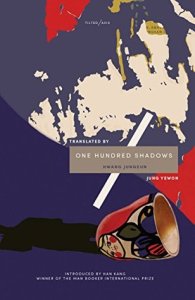
One Hundred Shadows by Hwang Jungeun tr.Jung Yewon

oe-hundred-shadowsEthereal, dream-like, accepting of their fate. South Korean working class literature.

Two young people work in an electronics market and slowly develop a friendship.

We meet Eungyo as she is following her shadow, causing her to become separated from the group she is with. Mujae follows her and stops her. Shadows rise and seem to lure one to follow it, something that others try to prevent, for it feels death-like.

Although it is never explained the constant mention of human shadows and their various behaviours provoke the reader’s imagination to ascribe meaning. Ill health and approaching death cause it to rise, and perhaps thoughts, reaching the limit of what one is able to endure. One shouldn’t follow it.

Their bond is formed as the environment within which they work is threatened with demolition. There is a subtle interdependency between the market traders, repairing and selling electronics, so when people who have worked there for years suddenly disappear, it unsettles the tenants.

Rumours and false media reports hasten their demise. They hold onto rituals, sharing soup, drinking rice wine, telling stories.

Do you know what a slum is, Eungyo?
Something to do with being poor?
I looked it up in a dictionary.
What did it say?
An area in a city where poor people live. Mujae looked at me. They say the area around here is a slum.
Who?
The papers, and people.
Slum?
It’s a little odd, isn’t it?
It is odd.
Slum.
Slum.
We sat there repeating the word for a while, and then I said, I’ve heard the word, of course, but I’d never thought of this place as a slum.

This short novella witnesses the various encounters between these two, the stories they recount which often include shadows they’ve witnessed, the simple soups they consume, the songs they sing. Shadows, soup, songs, survival.

The novel was inspired by the effect on ordinary working class people affected by Korea’s eviction-centred redevelopment policies, where the government removed residents and vendors by intimidation and force. Redevelopment involved a complex web of often obscure relationships between corporations and government, wealthy landowners and hired thugs, low-income tenants and the police. The novella provides a gentle, poetic insight into those marginalised by those policies.

hwang-jung-eunHwang Jungeun’s debut novel, translated by Jung Yewon was a critical and commercial success in South Korea with its mix of oblique fantasy, hard-edge social critique, and offbeat romance.

“My home was described in the news as ‘a slum’. This was an outside view; I wrote my novel to show it from the inside.”

It won the prestigious Hankook Ilbo Literary Award and the Korean Booksellers’ Award. Mentioned by Han Kang, who won the 2016 Man Booker International Prize for The Vegetarian as South Korea’s rising literary star.

Click Here to Buy a Copy of One Hundred Shadows

Note: This novel was an ARC (Advance Reader Copy) kindly provided by the publisher, Tilted Axis as an e-book.