
 I have wanted to read this novel for a while, ever since reading Jacqui’s review a few years ago. With August focused on #womenintranslation and being asking for a suggestion for our upcoming bookclub, it seemed the perfect moment to read it.
It is an incredible novel, written in a surreal time, while the writer was living in exile in Mexico, Anna Seghers (having left Germany in 1933 to settle in France) was forced (with her husband and two children) to flee from Marseille in 1940, the only port in France at that time that still flew the French flag, the rest under German occupation.
With the help of Varian Fry, (see his autobiography Surrender on Demand) an American journalist who came to Marseille for a year and helped 1500 artists, writers, intellectuals escape Europe; they found safe passage to Mexico, where they stayed until able to return to East Berlin, where she lived until her death in 1983.
While in Mexico she wrote this thought-provoking, accomplished, “existential, political, literary thriller” novel narrated by a 27-year-old German man who has escaped two labour camps (in Germany and France) before arriving in Paris where he promises to do a favour for a friend, coming into possession of a suitcase of documents belonging to a German writer named Weidel, who he learns has taken his own life.
There is an element of the absurd in many of the encounters throughout the entire novel, and one of the first is when the young meets the hotel proprietor, inconvenienced by the death of this man in her establishment, which she’d had to officially register and arrange for burial, she complains that he’d caused her more trouble than the German invasion and that they hadn’t ended there and goes into detail.
“Don’t think that my troubles are over. This man has actually managed to create trouble for me from beyond the grave.”
Our unnamed narrator offers to assist, requiring him to travel to Marseille, where he hopes to stay indefinitely. To avoid checkpoints, he leaves the train a few stops early and descends into the city.
Walking down from the hills, I came to the outer precincts of Marseille. At a bend in the road I saw the sea far below me. A bit later I saw the city itself spread out against the water. It seemed as bare and white as an African city. At last I felt calm. It was the same calm that I experience whenever I like something very much. I almost believed I had reached my goal. In this city, I thought, I could find everything I’d been looking for, that I’d always been looking for. I wonder how many times this feeling will deceive me on entering a strange city!

Descending into Marseille today
Alongside many others genuinely trying to flee, we follow him to hotels, cafes, consulates, shipping offices, travel bureaus and stand in line as he apples for visa and stamps that he has little vested interest in, observing the absurd demands made of people trying to find safe passage to what they hope is a free world. He is given a one month residency and then settles in to watch the world go by, ignoring that he must still establish his intention.
By now I felt part of the community. I had a room of my own, a friend, a lover; but the official at the Office for Aliens on the Rue Louvois had a different view of things. He said, “You must leave tomorrow. We only allow foreigners to stay here in Marseille if they can bring us proof that they intend to leave. You have no visa, in fact not even the prospect of getting one. There is no reason for us to extend your residence permit.”
The man he knows is dead, has a wife widow waiting for him in Marseille, her story becomes part of the young man’s quest, in this transitory city that holds a thin promise of a lifeline to the fulfillment of desperate dreams for so many refugees.
The complexity of requirements means many more are rejected than succeed and all risk being sent to one of the camps that the authorities without hesitation dispatch those whose papers are not in order.
Our narrator is independent, without family and not in possession of a story that invokes sympathy in the reader. A drifter without purpose, he likes the city and wants to stay. His circumstance removes something of the terror and tragedy of what people around him are going through, allowing the reader to see the situation outside of the tragic humanitarian crisis it was.
Instead we witness the absurd situation people have been put in, the endless, near impossible bureaucratic demands refugees encounter, when they are forced to flee homes they don’t want to leave, to go to a safe(r) place equally they don’t necessarily wish to go to, but will do so to survive and in an attempt to keep their families together. And the irony or blindness of those around them who continue with their lives as if nothing has changed.
Sometimes you find real Frenchmen sitting in the Brûleurs des Loups. Instead of talking about visas, they talk about sensible things like the shady deals that go on. I even heard them mention a certain boat that was sailing for Oran. While the Mont Vertoux customers prattle on about all the details of booking a passage on a ship, these people were discussing the particulars of the cargo of copper wire.
I highlighted so many passages that I will go back and reread, it’s a fascinating book that could perhaps only have been written from the safety of exile and from the perspective of the everyday man and woman, without going into detail about the reasons for their haste, for even a safe place can become unsafe, and a manuscript sufficient to sign a death warrant. And even though this book was written 77 years ago, there is much about the bureaucracy that continues to ring true for immigrants in Europe today.
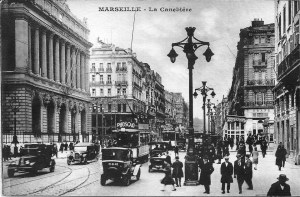
Marseill’s thoroughfare, Le Canibiére
The depiction of Marseille, though in a time of terror is evocative too of that city today, only the places mentioned here are now frequented by people from a different set of countries, those who have fled or left in search of something better in the last 30 years, from parts of Africa, Vietnam, Lebanon and those who just need to disappear for a while, finding anonymity and comradeship in the small alleys and cafes of Marseille, a city of temporary refuge, where everyone has a story that begins elsewhere.
Immigrants of the 21st century – Balade de Noailles
A while ago, I visited a quartier of Marseille, just off Le Canibiére, called Noailles, with a group of university professors looking to know the city’s immigrant population and influence better in anticipation of further developing their classes to incorporate the reality of today.
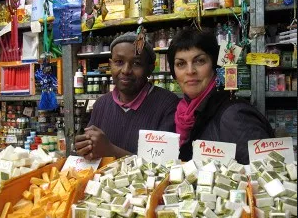
Bénédicte Sire & One of the Legends of Noailles
The personal tour was guided by local comedien/actor, Bénédicte Sire, who introduced us to a new generation of immigrants who have adopted Marseille as their home. We visited them in their shops tasting the food while listening to personal family stories, narrated either by Bénédicte taking on the persona of a relative, or a combination of her oral storytelling and the shop owner participating.
It was one of the most informative and personal visits I have made to Marseille, it was like a live version of the many novels I have read, translated from countries far away, only here they were living in a city 25 minutes away, facilitated by a warm, cheerful, empathetic woman who has developed authentic relationships with her fellow residents, gently guiding them to open up and share their often traumatic, personal stories with outsiders genuinely interested to know.
Highly Recommended if you ever visit the city of Marseille and wish to see it from within.
 Sister Outsider is something of a classic collection of essays that I first heard about some years ago, a collection that if you have any interest in issues of gender, feminism, or equality should be near the top of the list.
 Rebecca’s book Good and Mad will give you a deep and engaging (and sometimes enraging) historical deep dive into the way that women’s anger has been used throughout history to drive social movements, as well as how rage at the inequalities replicated within those social movements has worked to both slow them and make them stronger.
 Brittney’s book invites the question of what it takes to meet Audre Lorde’s challenge: how do we focus our anger with precision? Through a range of personal stories about becoming a feminist, navigating friendships and romance and the white-washed shoals of pop culture, as well as contending with the limits of white feminists and the legacy of white feminism, Brittney demonstrates what it means to harness anger as a superpower.
 All We Shall Know by Donal Ryan is a slim novella, the third book by this young Irish writer and his best in my opinion.
 Salt Creek by Lucy Treloar was published by Gallic Books new imprint Aardvark Bureau, I’ve loved all the books they’ve brought out under this imprint and Salt Creek might just be the best so far. It’s an historical novel, inspired by the events of the authors family, who immigrated to Australia from Britain, portraying one family trying to find success in farming in a harsh, unforgiving environment of South Australia.
 The Complete Claudine by Colette (translated by Antonia White) was my One Summer Chunkster for 2017, a French classic, relatively little known outside France among general readers, but an author who should be more widely read, especially by young adult readers, as it charts the young Claudine’s journey through her last year in school, then her adventures in Paris with her father, through marriage and into maturity.
 Two Old Women by Velma Wallis is a quirky fable-like book I read about and was intrigued by, recommended by a fellow reader. It is an Alaskan legend of betrayal, courage and survival, one which features, as the title suggests, two old women.
 My Story by Jo Malone is one of the six memoirs I read in 2017 and the one that was the most intriguing and personal to me, not because I’m a fan of her perfumes, but because I too have a love of the aromas of plants, flowers, resins, herbs and like to create remedies from essential oils and mix them with other plant oils to use therapeutically.





 After her abrupt departure from Paris back to her father’s home in Montigny, to the village home where she grew up, I was curious to know what was to come of our troubled Claudine and her errant husband.
 I loved Claudine at School for her exuberant overconfidence and love of nature, Claudine in Paris for her naivety and prudence, realising there was much about life she had still to learn and Claudine Married for the melancholy of marriage, of the realisation of her false ideals and indulgence of strong emotional impulses.
 The impulsive Claudine, thinking a marriage of her own making and choice (not one chosen by her father or suggested by a man who had feelings for her that weren’t reciprocated) embarks on her marital journey which begins with fifteen months of a vagabond life, travelling to the annual opera Festival de Bayreuth, in Germany, to Switzerland and the south of France.
 Their relationship plays itself out, up to the denouement, when Claudine seeking refuge decides to return to Montigny, to the safety of her childhood home, the woods, her animals whose loyalty she is assured of, and the affection of the maid Mélie and her humble, absent-minded father.
 If Claudine at School represents the unfettered, exuberant joys of teenage freedom, of the innocent and immature love between friends and the cruel indulgences of playful spite, Claudine in Paris is the slap in the face of regarding an approaching adult, urban world, one where the streets are inhabited by hidden dangers, the skies are more gloomy, people are not what they seem, even old friends from school become unrecognisable when the city and her frustrated inhabitants get their clutch onto the innocent.
 Below is a summary of
  If you have read or were considering reading Marlon James Booker winning
 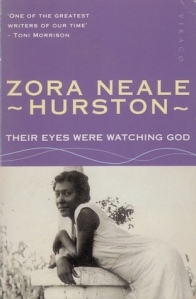 Unable to protect her daughter, who was raped by her schoolteacher, her focus moves to Janie, whom the daughter leaves her with. As soon as adolescence beckons she arranges for her to marry an older farmer with land. Janie dreams of love and fulfilment and when mentions not finding it in this marriage is reprimanded by her grandmother for her romantic notions.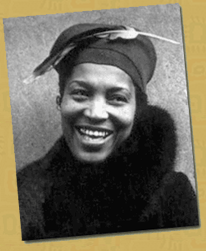


 Jean Rhys was born in the Caribbean island of Dominica in 1890, the daughter of a Welsh doctor and a third generation white Creole mother of Scots origin (‘Creole’ was broadly used to refer to any person born on the island, whether of white or mixed blood). When she was sixteen she was sent to England to school, mocked due to her accent, left and became a chorus girl. After a disastrous affair and disillusioned by events, she began to write, fictionalising many of her experiences and thanks to finding a mentor in Ford Maddox Ford, found moderate success.
 Absolutely brilliant, astonishing, loved it, one of my Top Reads of 2016 for sure.


 Word by Word