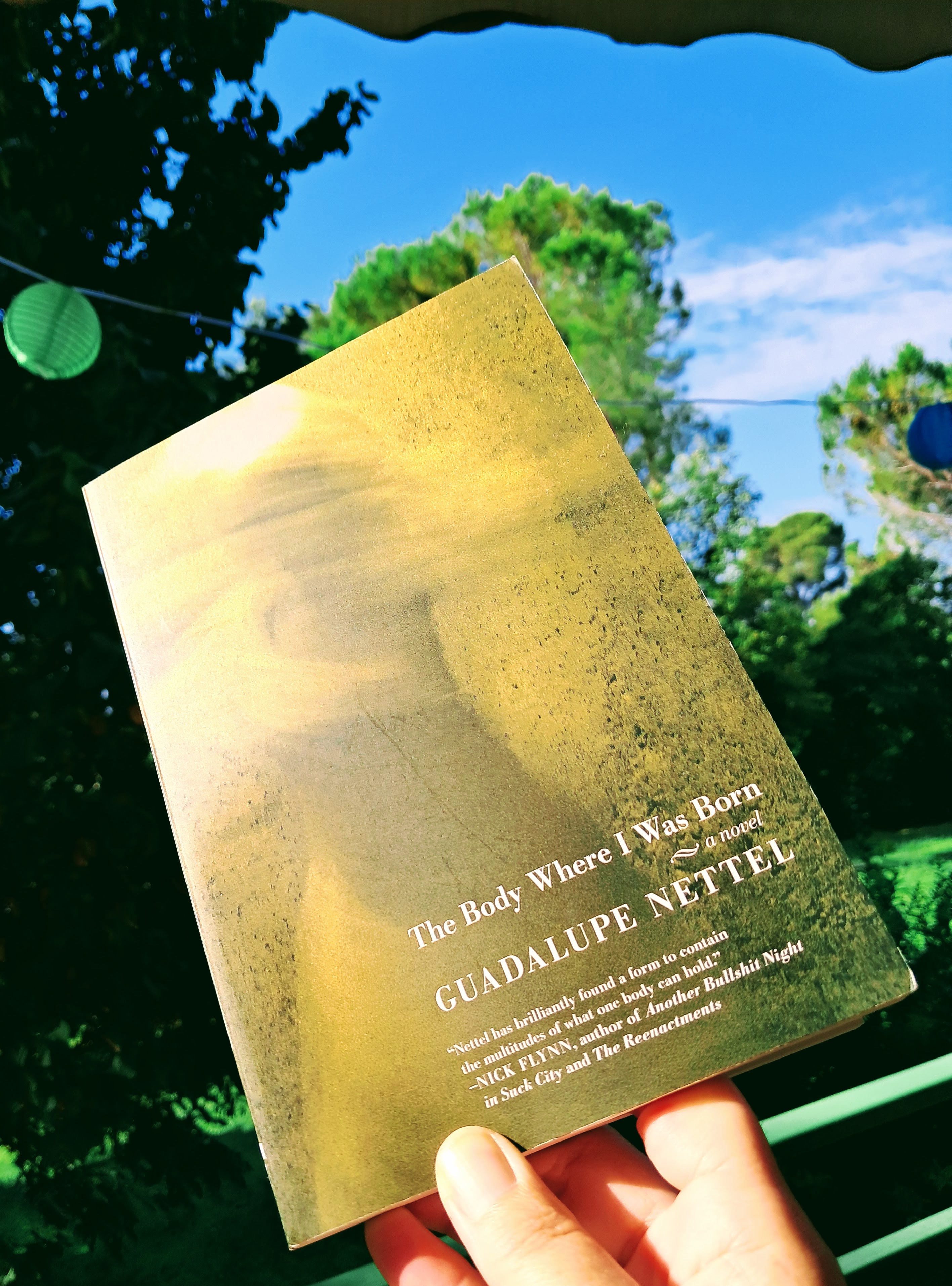
The Body Where I Was Born by Guadalupe Nettel tr. J.T.Lichtenstein #WITMonth

Feeling a little uninspired by recent reads, I decided to check my shelves for what I had in translation, August is WIT Month and my shelves are looking a little depleted in that regard!

I spotted Guadalupe Nettel’s novel The Body Where I Was Born and remembered how much I adored Still Born (my review here) in 2023, a book that was shortlisted for the International Booker Prize 2023. It’s a compelling exploration by two women into the question of whether or not to have children and how their ideas can change as life happens and circumstances arise that can awaken feelings not born of the mind.

Why Did I Do It, Doctor?

women in translation an autobiographical novel set in Mexico and Aix en Provence

It was the compelling style that made me want to read something else by Nettel and as I began to read The Body Where I Was Born I realised it is semi-autobiographical.

The novel is narrated from the psychotherapist’s chair and so occasionally there will an interruption where the narrator asks a question having recounted yet another episode of their childhood.

The novel is written in five parts, segmenting different parts of childhood and it is effectively a form of coming-of-age, albeit recounted to a therapist.

A Marked Childhood

As with her previous novel and writing style, I was immediately drawn into the narrative, which begins with the author recounting the consequence of having been born with a birthmark covering part of her eye.

The only advice the doctors could give my parents was to wait: by the time their daughter finished growing, medicine would surely have advanced enough to offer the solution they now lacked. In the meantime, they advised subjecting me to a series of annoying exercises to develop, as much as possible, the defective eye.

As a result, school became even more of an inhospitable environment and those measures marking her out for unwanted attention.

Condition and Correct, A Parental Institution

But sight was not my family’s only obsession. My parents seemed to think of childhood as the preparatory phase in which they had to correct all the manufacturing defects one enters the world with, and they took this job very seriously.

Our narrator ponders the harm of parental regimes and how we perpetuate onto the next generation the neuroses of our forebears, wounds we continue to inflict on ourselves.

In addition to these corrections, her parents were keen to adopt some of the prevailing ideas of the time (the seventies) about education, a Montessori school in Mexico City and a sexual education free of taboos and encouraging candid conversations.

Rather than clarifying things, this policy often made things more confusing and distressing for the children and was likely the cause of the rupture of the adults when they adopted a practice much in fashion at the time, the then-famous ‘open-relationship’.

During all the preparatory conversations I had worn the mask of the understanding daughter who reasons instead of reacts, and who would cut off a finger before aggravating her already aggravated parents. Why did I do it, Doctor? Explain it to me? Why didn’t I tell them what I was really feeling?

Separation and Abandonment

After the marriage separation their mother is interested for a while in community living, subjecting the children to another experiment, and later still sinks into a deep depression that affects them all.

Finally, in a burst of desperate willpower, she decided to exile herself. Hers was not political, but an exile of love. The pretext was getting a doctorate in urban and regional planning in the south of France.

But before they were sent to France, there was a period where their maternal grandmother – who much favoured her brother- came to live with and look after them. Full of questions about why their parents left them in this situation, the grandmother gave her usual cryptic response:

‘Since when do ducks shoot rifles?’ she’d say, meaning that children should not demand accountability from adults.

Heightened Observations, Humorous Occasions

Part II narrates the period with grandmother in charge, made all the more challenging for being in their own home, one that had held so many previously fond memories.

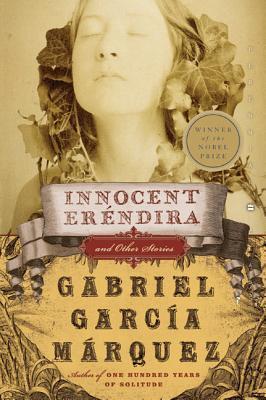
Reading was frowned upon, but the discovery of Gabriel Marcia Marquez’s The Incredible and Sad Tale of Innocent Erendira and her Heartless Grandmother cheered her up and provided a kind of solace.

Doctor, this discovery, as exaggerated as it sounds, was like meeting a guardian angel, or at least a friend I could trust, which was, in those days, equally unlikely. The book understood me better than anyone else in the world and, if that was not enough, made it possible for me to speak about things that were hard to admit to myself, like the undeniable urge to kill someone in my family.

From Mexico City to Aix-en-Provence

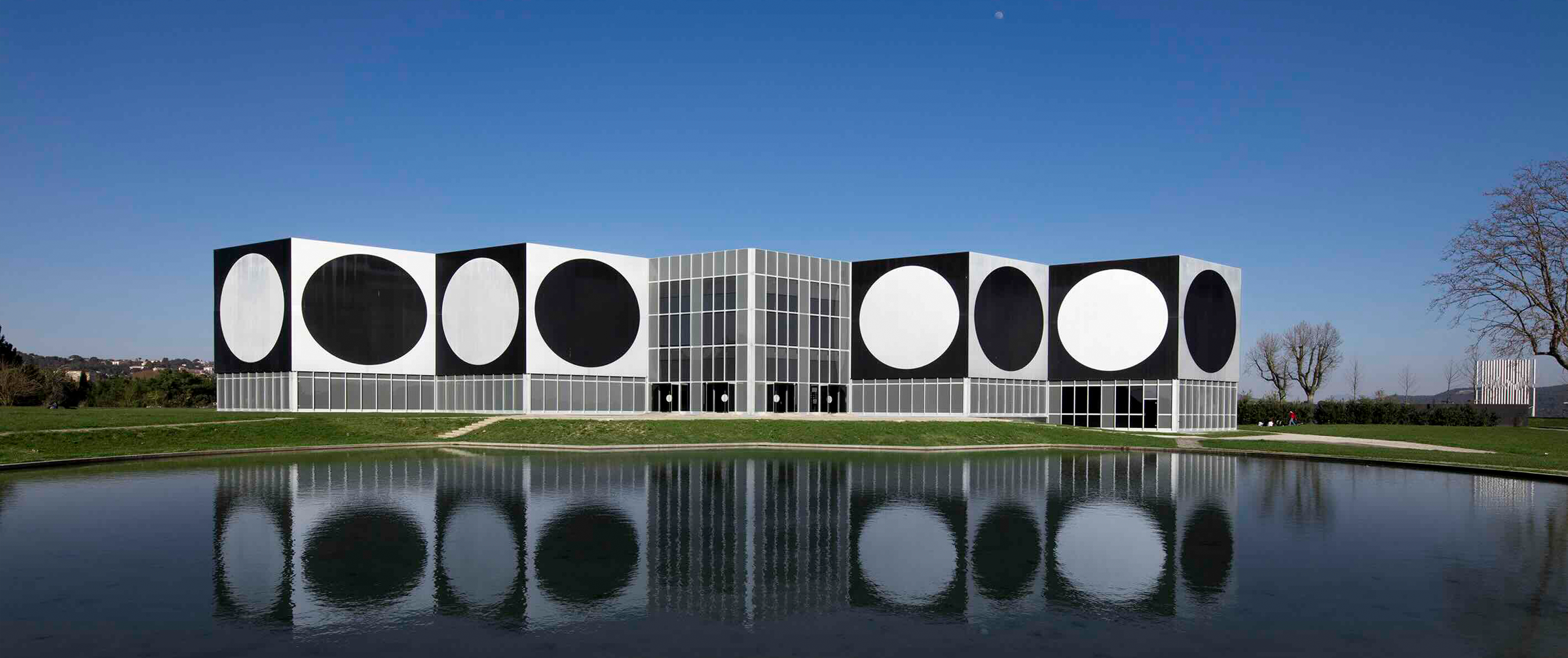
As I began part III, I was surprised to find the two young children following their mother to the south of France, to the Jas de Bouffan quartier of Aix en Provence near the musée Vasarely.

If I was already engaged in the novel, now I was riveted. I know the quartier well and the schools she and her brother are sent to, it awakened my own memories of being an outsider at the school gate, waiting for children to exit from the well regulated school environment.

Vasarely Musée, Aix en Provence

I have no doubt that my mother sought in Aix the institution that most resembled our school in Mexico. The percentage of atypical beings was equal, or maybe even higher. But still… everything there seemed strange to me.

From From the public Freinet education at La Mareschalé to the local middle school, Collège au Jas de Bouffan, a mix of children from multiple origins, North African, Indian, Asian, Caribbean and French.

To survive in this climate, I had to adapt my vocabulary to the local argot – a mix of Arabic and Southern French – that was spoken around me, and my mannerisms to those of the lords of the cantine.

Photo by Fernando G Pexels.com

In Part IV there is a visit back to Mexico, before Part V where they are sent off to a the infamous French institution, the colonie de vacances; supervised holiday camps organised according to interests or specialities, full of young people employed as ‘camp animateurs‘ an idealised form of first employment, being paid to be on holiday, looking after tweens and emerging teens.

The French experience is so well depicted, and gives an insight into the child’s perspective of being an uncommon foreigner among a population of more common second or third generation immigrants. When it ends back in Mexico City, I find myself wishing there were a follow up novel, to find out more about a life that started in this unusual way and had all these experiences in their formative years.

The novel is so engaging, a fascinating insight into a life that delves beneath the surface of events and happenings in a family that is culturally fascinating, as it moves between Mexico City and Aix en Provence, traversing childhood and adolescence, the relationships between a girl, her peers at different ages, her parents and her grandmother.

And then there are the layers of literary references, including the reference to the title, but those I leave the prospective reader to discover for themselves.

I loved it! Highly Recommended.

Author, Guadalupe Nettel

Guadalupe Nettel (born 1973) is a Mexican writer. She was born in Mexico City and obtained a PhD in linguistics from the École des Hautes Études en Sciences Sociales in Paris. She has published in several genres, both fiction and non-fiction.

The New York Times described Nettel’s acclaimed English-language debut, Natural Histories as “five flawless stories”. A Bogota 39 author and Granta “Best Untranslated Writer” The Body Where I Was Born was her first novel to appear in English. Her work has since been translated into more than twenty languages and adapted for theatre and film. Still Born, her most recent novel, was shortlisted for the 2023 International Booker Prize and her latest collection of short stories The Accidentals tr. Rosalind Harvey was published in April 2025.

She has edited cultural and literary magazines such as Número Cero and Revista de la Universidad de México. She lives in Paris as a writer in residence at the Columbia University Institute for Ideas and Imagination.

Whereabouts by Jhumpa Lahiri

Cerebral Distractions or Healing Attractions

Whereabouts indeed. I have been absent this space and reading less, as I pursued another passion, the great jigsaw puzzle of building a family tree, which started out as an exercise in tracing my female lineage looking for a particular pattern, I felt called to heal and ended up as a series of unfinished mysteries seeking to be resolved. And it is so much fun, imagining and reclaiming these lives!

Well, all of that is another story, but interesting enough to have pulled me away from my regular habit of sharing my reading here. I miss this space, and the interactions, so here we are, sharing a few recent reads.

I picked up the reading again as the temperatures here rocketed into full summer heat and my brain asked, “Can’t we just read a book today?”, instead of spending my free time working like the dedicated closet researcher I had become.

A day at the beach with a Jhumpa Lahiri novel turned the tide.

A Gifted Book Returns Unread

Whereabouts by Jhumpa Lahiri translated from Italian by the author

Whereabouts by Jhumpa Lahiri is a novel that came back to me, one I gifted a friend from abroad who has a love affair with the city of Rome. Back in Europe to visit the city again, she brought this book I gave her halfway round the world, pulled it out of the suitcase and said:

‘I haven’t read it yet. I’m going to read it in Rome. Here. You have got two weeks to read it before I go. We can talk about it when I get back from Ireland.’

Challenge accepted and quietly delighted; I really wanted to read it too.

Now I have.

I loved it.

It felt like I was reading a work of creative non-fiction. In disguise. Autofiction perhaps?

Jhumpa Lahiri is a British-American author of Bengali parents, whose earlier novels have highlighted the immigrant experience. For some years now she has lived in Italy, learned the language and her last two books were written and published in Italian before being translated into English.

Whereabouts is a collection of short vignettes of one woman’s highly observational, contentedly solitary, existence in Rome. The epigram, a quote from Italo Svevo provides a clue to what follows.

‘Every time my surroundings change I feel enormous sadness.It’s not greater when I leave a place tied to memories, grief, or happiness. It’s the change itself that unsettles me, just as liquid in a jar turns cloudy when you shake it.’

Averse to Change, Loves Movement

Disliking change, but always on the move, her days capture aspects of the surroundings she has grown attached to, taking us right there. The chapter titles nearly all begin with the prepositions: On, In or At.

On the Sidewalk, In the Street, At the Trattoria, In the Piazza, At the Bookstore, On the Couch, On the Balcony, At the Beautician, In the Sun, At my House, In Bed, On the Phone.

Jhumpa Lahiri autofiction Whereabouts set in Rome Italy

Near the end, as I began to notice this pattern and list of locations, I asked myself, “What is this ‘Whereabouts?’ and I flicked back to the contents page and read through the list of destinations. I then turned the page and the only chapter that doesn’t start with a preposition, Nowhere, seemed to be speaking to me, responding to my question.

It began by saying:

‘Because when all is said and done the setting doesn’t matter: the space, the walls, the light. It makes no difference whether I’m under a clear blue sky or caught in the rain or swimming in the transparent sea in summer.’

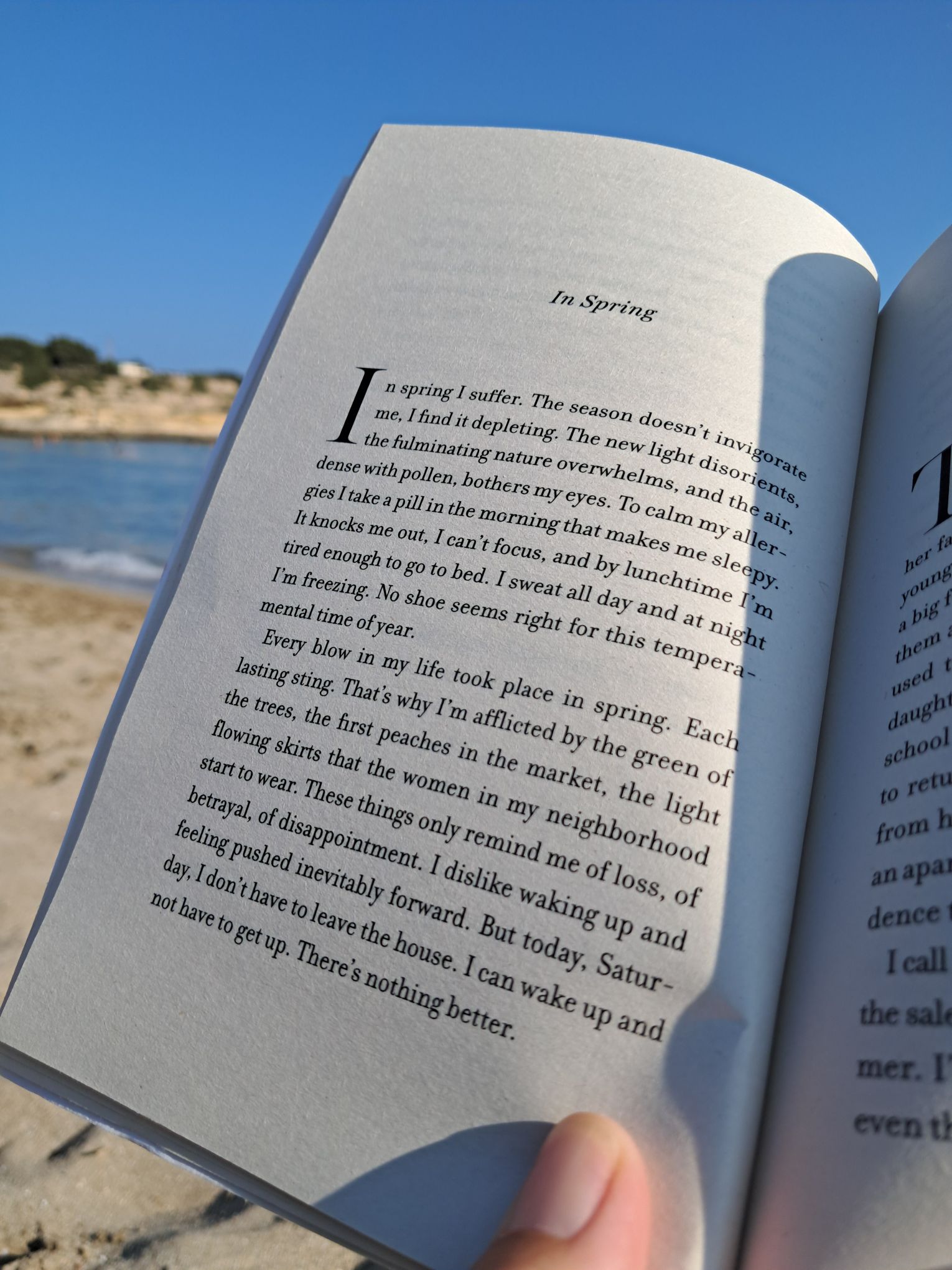
This has come just after Up Ahead, a sign of change, something our protagonist does not like and spends the entire short chapter of In Spring pondering. A chapter I sent to another friend, one who shares the protagonist’s dislike of that season.

Transition, Change and Things that Stay the Same

In Spring, a chapter from Jhumpa Lahiri's novel of vignettes Whereabouts

Now, she contemplates a transition; both of the day, and of a life, observing the peripheral characters to this solitary existence she has created, people in movement, marking the end of a day.

‘They’ll keep walking along these sidewalks. They’re permanent fixtures in my mind, knotted up in the fabric of my neighbourhood just like the buildings, the trees, the marble woman. These are the faces that have kept me company for years, and I still don’t know the people they belong to. There’s no point saying goodbye to them, or adding, we’ll meet again, even though right now I’m overflowing with affection for them.’

Overall, it’s a reflective relatively smooth paced novel in which not much happens and yet you feel as though you have visited and lived for a short time in a city apartment in one of the squares of this major European city of Rome, a part of it not populated by tourists, but where the everyday life continues to unfold week after week, year upon year, following the same rhythms, with small changes a natural part of its existence.

‘Is there any place we’re not moving through? Disoriented, lost, at sea, at odds, astray, adrift, bewildered, confused, uprooted, turned around. I’m related to these related terms. These words are my abode, my only foothold.’

Brilliantly crafted. Could not put it down, read it in a day.

Highly Recommended.

Have you read Whereabouts? Do you have a favourite by Jhumpa Lahiri? Tell us in the comments below.

Second-class Citizen by Buchi Emecheta

I read Buchi Emecheta’s Joys of Motherhood (1979) in 2019, it is such a great novel, one of my all time favorites, not yet reviewed here. I have been looking forward to reading more of her work since then, I picked up Second-class Citizen (1974) knowing it was likely to be equally good. She is known for her themes confronting girls and women, of motherhood, female independence and freedom through education.

A Girl Determined to Realise a Dream

Adah is a fabulous, determined character, a girl who when her father dies, her mother is inherited by his brother. Like many girl-orphans (fatherless), Adah was sent to live with her mother’s elder brother to work as a servant; any money her father left would be used for her brother Boy’s education.

Even if she was sent to school, it was very doubtful whether it would be wise to let her stay long. ‘A year or two would do, as long as she can write her name and count. Then she will learn how to sew.’ Adah had heard her mother say this many many times to her friends.

Determined to get an education herself, having already been punished for taking herself off to school without permission, the family decide to let her go, not for her own benefit, but because they recognise how it might benefit themselves. If Adah gets more schooling, the dowry that her future husband will have to pay them will be even bigger.

Adah wants more than just school, she wants a higher education, however she does not have the money to pay for the entry examination, let alone the other costs.

She was aware that nobody was interested in her since Pa died. Even if she had failed, she would have accepted it as one of the hurdles of life. But she did not fail. She not only passed the entrance examination, but she got a scholarship with full board.

My Struggles Become My Strength

The combination of hard work for the household and an education made Adah strongly responsible for herself and strategic in ensuring she stayed in education and succeeded enough to get a scholarship with full board. But to go even further with her studies, she needed a home, she would need to marry.

Her plan is to get to the UK but now she has a husband and in-laws and her good job not only supports them all, but makes many dependant on her and less inclined to be independent.

A New Motivation, I Do This Not Just for Myself

1960’s England is not what she expects, the challenges are even greater because now she has a woman’s body whose reproductive rights are not under her control and a partner who is no longer how he was in their home country, he seems invested in keeping her from shining.

He lifted his hand as if to slap her, but thought better of it. There would be plenty of time for that, if Adah was going to start telling him what to do. This scared Adah a little. He would not have dreamt of hitting her at home because his mother and father would not have allowed it. To them, Adah was like the goose that laid the golden eggs. It seemed that in England, Francis didn’t care whether she laid the golden egg or not. He was free at last from his parents, he was free to do what he liked, and not even hundreds of Adahs were going to curtail that new freedom. The ugly glare he gave Adah made that clear.

However, taking responsibility is what she knows best, she is determined to provide for her growing family and negotiate the mounting injustices she faces, in pursuit of achieving her dreams and caring for her children.

She was going to live, to survive, to exist through it all. Some day, help would come from somewhere.She had been groping for that help as if she were in the dark. Some day her fingers would touch something solid that would help her pull herself out. She was becoming aware of that Presence again – the Presence that had directed her through childhood. She went nearer to It in her prayers.

An inspirational story of the girl that never gives up, written by the woman who lived much of that experience, raising her own five children on her own in a foreign country and becoming a successful author.

Total inspiration and still relevant today. Highly recommended.

Further Reading

Review Guardian: Second-Class Citizen by Buchi Emecheta review – fresh and timeless by John Self, Oct 2021

Article: My mother, the pioneer: how Buchi Emecheta captured immigrant life in 1970s London by Sylvester Onwordi, 2021

Author, Buchi Emecheta

Buchi Emecheta OBE (1944 – 2017) was born in Lagos, Nigeria and moved to London with her student husband when she was eighteen. After her marriage broke up at the age of twenty-two, and while raising five children, she began writing and also obtained a degree in sociology from London University.

As well as writing numerous novels, she wrote plays for television and radio, and worked as a librarian, teacher, youth worker and sociologist, and community worker. She was one of Granta’s Best of Young British Novelists in 1983. Following her success as an author, Emecheta travelled widely as a visiting professor and lecturer.

She published over 20 books, including In the Ditch (1972), Second-Class Citizen (1974), The Bride Price (1976), The Slave Girl (1977) and The Joys of Motherhood (1979).

Her themes of child slavery, motherhood, female independence and freedom through education won her considerable critical acclaim. Emecheta once described her stories as “stories of the world…[where]… women face the universal problems of poverty and oppression, and the longer they stay, no matter where they have come from originally, the more the problems become identical.”

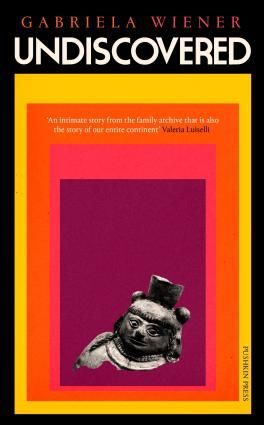
Undiscovered by Gabriela Wiener tr. Julia Sanches

Undiscovered was longlisted for the International Booker Prize 2024. I decided to read it because I did the quiz on their website which asked about 15 or so questions and then told you which book to read. Undiscovered was the result.

I was totally captivated from start to finish. Loved it.

Ancestral Threads

International Booker Prize longlist 2024 Peruvian literature autofiction

Gabriela Wiener is a Peruvian poet, journalist, writer who has lived in Spain for the last 20 years and her books to date (none of which I have read) seem to about body politics. This novel is about a search to unravel and understand her identity as a Peruvian woman now living in Spain, who has ties to both the coloniser and the colonised.

I was very intrigued to read this book for a few reasons, of course because it is written by a woman in translation, so that already interests me, because it is coming from outside the mainstream cultures that traditionally dominate publishing and also because of the interest in identity, in the influence of ancestry, of family mysteries uncovered.

The strangest thing about being alone here in Paris, in an anthropology museum gallery more or less beneath the Eiffel Tower, is the thought that all these statuettes that look like me were wrenched from my country by a man whose last name I inherited.

A Temporary Explorer

Gabriela is both fascinated and repelled by a ‘maybe ancestor’ Charles Wiener, an Austrian-Jew whose parents immigrated to France when he was sixteen. He became a German teacher in a French lycée, would convert to Catholicism and desired French nationality. He published an essay on the “communist empire” of the Incas;

a reign based on social equality and therefore, per his thesis, antithetical to freedom. In his writing he defended the delirious hypotheses that Louis XIV had been inspired by the Incas when he said “L’état, c’est moi.”

That publication resulted in the French government agreeing to send him on an expedition to South America in 1876. The studies he conducted and specimens collected would eventually be displayed in a large scale exhibit at the Paris Exposition Universelle in 1878. He wrote a book Peru and Bolivia.

On his return to France he was naturalised, retired from exploration and became a diplomat. In the less than two years he was in Peru, he fathered a child to a young widow, Maria Rodriguez. Her son, the author’s great-grandfather, Carlos Wiener Rodriguez, was born in May 1877, by which time Charles Wiener, was already in Bolivia. And most likely oblivious to what he had left behind.

We know everything about him and nothing about her. He left us a book, she left us the possibility of imagination.

The Unfaithful Father

In Undiscovered Gabriela explores the writings of her ancestor and has conflicting feelings about him, as she has conflicting feelings about herself, and her own father. The first half of the book takes place while she is on a return trip to Lima for her father’s funeral. He had a second life and family that he lived simultaneously, one she tries to make sense of by meeting his mistress and asking her mother personal questions.

But really she is interrogating those outside of her to understand something within her. She is of a different generation and even within that she lives an unconventional life. Is she how she is because that is how she is, or is there something of the past that runs through her veins which makes it harder to be anything other than that? Even in her unconventionality, she continues to cross her own boundaries and disappoint herself. She seeks to understand why.

The irritation I feel at the cruel, colonial, and racist passages in the book Wiener wrote about my culture gives way to a sudden compassion for his unwittingly anti-academic, self-aggrandizing self.

A Polyamorous Woman

On an existential quest tracing a legacy of abandonment, jealousy and colonial exploitation, she considers the effect on her own struggles with desire, love and race in a polyamorous relationship. At the same time uncovering physical traces of her ancestor and searching for the small boy Juan he brought back to France with him.

Juan isn’t a ceramic piece rescued from the rubble, nor is he made of gold or silver; he isn’t even a shrivelled child mummy destined for a museum far away from the volcanoes. Yet he crosses the pond as the adventurer’s property. Juan is just another of Wiener’s small contributions to the transformation of the European concept of history. He is part of Wiener’s “expedition,” which is not like that of conquistadors or pioneers but like those of other scientific travellers who sought to “reignite the Incan sun, brutally extinguished by the Spanish cross.”

Photo S.Hazelwood Pexels.com

I was totally captivated by this narrative from start to finish. Each sentence and paragraph so carefully constructed, I often went back and reread them, because they often articulated something that asked to be considered.

I had read a few reviews that criticised the attention she gave to herself, but I didn’t feel as if this was done without context. It is a work of autofiction and the author puts herself as much under the spotlight as her ancestor, she is self aware and critical of her own behaviours, she exposes them and puts them on public display to be judged.

Wiener really is a fluid narrator, a chronicler of minor details and excesses, the kind of storyteller who knows when to set aside principles and literary convention for the sake of hooking his readers, who doesn’t think twice before using whatever’s within reach to spice up his adventures, changing the rules of the game in a context where he really shouldn’t be taking it that far. He is also, without a doubt, the creator of the story’s hero: himself. Had he lived in the twenty-first century, he might have been accused of the worst possible crime an author can be accused of today: writing autofiction.

Broken Memories, Finding Reparation

Towards the end she seeks help or healing and her solution is to join a group called ‘Decolonizing My Desire’. She reaches out to a researcher for help about the ancestor, but finds that invalidating.

Ultimately it is her imagination and poetry that perhaps provides her with answers, the blank page that she is capable of filling, the stories she is able to create, the endings she can provide herself. She controls the narrative, no one else does.

Undiscovered is a well researched inquisition of family and colonial history, ancestral threads and both modern and ancient cultural connections that reflects one woman’s attempt to better understand herself for the benefit of her close relationships. It is about looking at personal and cultural wounds and creating solutions that help a person to move forward.

Further Reading

Read An Extract From the Book: Undiscovered by Gabriela Wiener

New York Times: Gabriela Wiener Does Not Care if You Don’t See Her Writing as Literature By María Sánchez Díez Oct 2023

Electric Lit: Gabriela Wiener Challenges the White Man in Her Head an interview by JR Ramakrishnan Oct 2023

In the interview, Wiener is asked about her surname growing up:

In countries that suffered colonization, both racism and classism from white creole elites towards people of Andean descent is virulent and normalized. Brown or “huaco” faces are penalized but so are brown surnames. And if you already have both you’re screwed. I used to be terrified of going on class trips to archeology museums because we would always pass by a huaco display and the kids would make fun of me, comparing my face to the huaco portraits. But at the same time my last name whitened me, protected me, it was my link to whiteness.

2018 Exposition Musée Quai Branly: « Le Pérou avant les Incas » au musée du Quai Branly

My Review of Ancestor Trouble; A Reckoning and A Reconciliation by Maud Newton

Author, Gabriela Wiener

Gabriela Wiener is a Peruvian writer and journalist based in Madrid, Spain. Her books include Nine Moons, a memoir on pregnancy and reproduction, and Sexographies, a collection of first person gonzo journalism essays on contemporary sex culture, swingers clubs and ayahuascha.

Her work has appeared in numerous publications and has been translated into six languages. She is a regular contributor to El Público (Spain), Vice and New York Times en Español. Wiener won Peru’s National Journalism Award for her investigative report on violence against women.

Why Did You Come Back Every Summer by Belén López Peiró (Argentina) tr. Maureen Shaughnessy

It’s been a good couple of weeks for Charco Press, with Not a River by Selva Almada (translated by Annie McDermott) on the shortlist for the International Booker Prize 2024 and Of Cattle and Men by Ana Paula Maia (translated by Zoë Perry) winning the Republic Of Consciousness Prize 2024.

An Unforgettable Summer

social legal justice #metoo voices silenced

This week I picked up Why Did You Come Back Every Summer from the 2024 Bundle, originally published in Spanish in 2018 as Por qué volvias cada verano and published in English for the first time in April 2024.

What a book.

A young woman experiences sexual abuse by a family member when she is a teenager. Some years later she reveals what happened. And there are all kinds of responses, reactions, accusations, procedures and legal processes.

Testimony or Treason

In this lucid text, a chorus of voices speak. Often they are speaking to her, only we do not hear her voice. We hear one side of conversations. We hear what they have all said. We see what they are all doing. We understand the selfish human inclination to protect one’s own. We become witness to observing a victim in need of love and support being hung out to dry.

In between the commentaries, are the affidavits. Short, streamlined, neutral texts presented in old fashioned type that all begin and end the same way, with their two or three salient points contained within.

Photo by Suzy Hazelwood on Pexels.com

The voices that speak are presented on the right hand page, the left hand page remains blank. It gives the text momentum, the pages pass quickly. The voices say so much more, they incriminate.

The legal texts are more dense, no white space between paragraphs and they cover consecutive pages. There is no space for reflection or consideration, as we read we can hear the sound of the keys typewriter striking the ribbon.

#MeToo Movement and the Sharing of Stories

The process for pursuing justice, rather than protect or bring about resolution, too often results in making the lives of women even worse. To pursue justice threatens exposure, judgement, scorn, rift, ostracism, it brings shame. It reached a tipping point in 2017 with the #MeToo movement. Frustrated, women began to share their stories, it was the only thing left to do and when it was done as a collective, it created community and support, if not justice. Long buried trauma rose to the surface, if not for justice, to begin to heal a wound of womanhood.

Reading Why Did You Come Back Every Summer reminded me of the recent documentary You Are Not Alone: Fighting the Wolf Pack, a Spanish feature film about a young woman seeking justice after a terrifying ideal at Spain’s iconic ‘running of the bulls’. Produced in secret, the film is told through the words of the victim survivors and recounts the mass protests the case sparked on account of the injustice experienced.

More than a million women and girls took to the streets chanting “Sister, I do believe you” and broke their silence on social media with #Cuéntalo (“Tell Your Story”).

There are many ways to share a story and Belén López Peiró has created a work of art that honours an experience that changed a young girls life forever, putting it into a form that has already become a literary, social and political phenomenon in her country and beyond.

It is a justice-seeking oeuvre narrated through a cacophony of voices that gives power to the unsaid, that allows the quiet to echo resoundingly, that shines a light on yet another shadow of humanity.

Highly Recommended.

Author, Bélen López Peiró

Belén López Peiró studied journalism and communication sciences in Buenos Aires University and has recently completed an MA in Creative Writing at the Barcelona’s Pompeu Fabra University. She currently coordinates non-fiction writing workshops with a gender perspective. 

Why Did You Come Back Every Summer is her debut novel. In 2021 she published her second book Donde no hago pie (Nowhere to Stand) which narrates the legal process the author went through to bring her abuser to justice.

The House on Via Gemito by Domenico Starnone (Italy) tr. Oonagh Stransky

That was quite an experience.

Starnone writes a work of fiction about the man his father was (we can assume it is autobiographical since his father’s name was Federico and he painted an artwork titled ‘The Drinkers’ which is in part featured on the cover). It is an attempt to tell the story of a man he spent his childhood in fear of and his adulthood trying not to be like.

Reconstructing a Life, Walking the Streets

In the novel, the narrator is the eldest son Mimi, who lives in Rome but has returned to Naples some time after the death of his father and is reconstructing memories, by walking the streets where they lived, visiting certain places to evoke other memories, like the hospital where his mother was when her husband could no longer deny her illness; the church where he made his first communion; the council offices, where he hopes to find some of his father’s paintings, including ‘The Drinkers’. Every location existed in service to his father’s existence and memories.

He was certain that both great and small events had a common thread: the mystery of his destiny. And he constantly tried to prove it to himself, his relatives, his friends, and to us children by weaving a vibrant pattern in which the only events that were true were the ones vitally connected to him. Consequently, all the names of cities and buildings and roads, all of geography, served merely to create a map of his needs, and this was how they were to be remembered.

Though the novel is about the man, the title refers to a street where they lived for a while and the use of street names rather than diary entries or even artworks, inscribes the neighbourhood into history, creating a different kind of legacy, one that will last longer than any man or work of art. A diary would be too intimate, a street map a kind of canvas.

Portrait of a Narcissist Father Via His Eldest Son

It is also about his own boyhood, however the character of the father overshadows the son, his wife, his wife’s family, in fact anyone in proximity to him. This is because he considers himself superior. According to himself. He makes it one of his main purposes in life to remind everyone around him of that fact. He can not be taken down or made to think he is anything less than how he perceives himself.

It’s true, he was lazy. He was arrogant. He was blowhard. He was all those things, and the first to admit it. He felt he had the right to be lazy, arrogant, and a blowhard – to anyone who busted his balls. He was born to be a painter, not a railroader.

The son walks familiar streets of Naples, streets he never strolled with his father – but knew intimately from his adolescence – as a way to navigate anecdotes about the way his father lived his life, the things he said (mostly insults about everyone else), the things he did (working for the railroad as a clerk, beating his wife, painting artworks) and his opinions about various matters. He walks and remembers. He walks and imagines anew.

A Determined Artist Perseveres

historical fiction Paris 1939 Domenico Starnone House on via gemito
Photo by Pixabay on Pexels.com

Federi is passionate about art and believes he possesses great artistic talent, but the art world is full of shit people who nominate their friends for prizes, then their friends create prizes and nominate those friends, therefore keeping him out of these circles. He blames everyone for his lack of success that he continues to strive for. Beginning with his own father who refused to educate him, in fact his parents abandoned him at a young age and sent him to live with his grandmother.

He becomes a working class man, who sees the most beautiful woman who he takes for a wife, raises four sons and a daughter and spends his free time at home painting or pursuing opportunities to advance his art.

A Literary Triptych

The book is in three sections. The first section ‘The Peacock’ introduces the character and is the part of the book where you might abandon, because it isn’t yet clear why it might benefit any reader to be subject to this psychological demonstration of one of the most extreme versions of the societal system of domination at work. The patriarchy thrives under this system, as Riane Eisler showed in her work The Chalice and the Blade: Our History, Our Future and Nurturing Our Humanity: How Domination and Partnership Shape Our Brains, Lives, and Future and the portrait this novel creates shows how someone who lives according to this conditioning impacts those in his proximity. Cycles of trauma, neglect and narcissism eroding relationships in pursuit of validation, not love.

A Masterpiece Created at All Cost

Much of the source material is inspired by journals his father kept, which trigger memories and dates of events he participated in. The artworks themselves are a kind of journal, a record of themes in his life. Part Two ‘The Boy Pouring Water’ is the most compelling and significant section, it documents the process of creating the largest, most significant art work he would do. ‘The Drinkers’ required the son to pose as the boy pouring water, other members of the family sat for him and the local fruit and vegetable seller.

The anxiety the young son would feel when he realises that there is a problem in the image, between the character holding out the glass and where he is pouring from will cause contortions of magnitude in him, to try and avoid the disaster he sees coming. His father never sees it and we think for a moment that the drama has been averted, alas no – disaster arrives at the height of his short-lived pleasure.

So why do we want to read a novel about an egomaniac? And one that was originally published just over 20 years ago.

It is both a psychological example of the effect a man with no empathy and worse, a need to belittle, insult and induce fear in people, can have on a family. It is set against a backdrop of 1960’s Naples, post WWII, a place where allegiances often changed, both in the halls of power and on the street, depending on how ‘enemies or allies’ treated the people.

It is the historical context and the journey of a working class man trying to break into the establishment of artists, who despite his unruly personality, perseveres and participates as much as is possible for someone who won’t allow himself to be intimidated. Everything is a struggle, he will fight to the end. Art ‘wasn’t fun, it was war’.

Fortunately as the years passed, I developed a strategy for blocking out his words. Using this technique, which I perfected as a teenager, the angrier he grew when telling the stories of his life and the reasons for his actions, the thicker the fog grew in my head, allowing me to think about other things. It helped establish a distance between us. It curbed the desire to kill him.

Fatherhood in Another Era, Produce, Punish, Protect

In the final part ‘The Dancer’ the humiliation of the son comes full circle as he enters adolescence and tries to impress a girl Nunzia and his father gives him terrible advice about what to do with women. As if things couldn’t get any worse, we learn that young girl has been abused by an Uncle and the son lies waiting for his fathers verdict.

The book ends with a scene that makes the reader pause to reflect on how reliable the narrator is, like the father, he too has the ability to exaggerate, to curate anecdotes and perspective.

Once I got into this, which didn’t take very long, I found it both shocking and compelling to read, the dedication by a son to honoring the passage of a man who made his boyhood hell. Thus he provides a kind of validation beyond the grave, but doesn’t hold back from focusing on the many flaws alongside the talent. It is the many layers that make it something of a classic, the psychological profile and repeat patterns of the man, the making of an artist and the impact on family and the social history of a city.

Highly Recommended.

The House on Via Gemito is a marvellous novel of Naples and its environs during and after the Second World War. The prism for this exploration is the relationship between the narrator and his railway worker / artist father – an impossible man, filled with cowardice and boastfulness. His son’s attempt to understand and forgive him is compelling; we are held through the minutiae of each argument and explosion, each hope and almost-success.’ International Booker Judges

Further Reading

New York Times Review June 2023: My Father The Frustrated Artist

A Reading Guide – The House on Via Gemito, International Booker Prize 2024

Read An Extract from the Opening Chapter here

To see the artwork of Federico Starnone visit https://starnone.it/gallery2/

Author, Domenico Starnone

About the author

Domenico Starnone is an Italian writer, screenwriter and journalist. He was born in Naples and lives in Rome

He is the author of 13 works of fiction, including First ExecutionTies, a New York Times Editors Pick and Notable Book of the Year, and a Sunday Times and Kirkus Reviews Best Book of the Year, Trick, a Finalist for the 2018 National Book Award and the 2019 PEN Translation Prize, and Trust. 

The House on Via Gemito won Italy’s most prestigious literary prize, the Strega in 2001 and was longlisted for the International Booker Prize 2024.

Family Lexicon by Natalia Ginzburg tr. Jenny McPhee

Family Lexicon (Lessico Famigliare) is a unique memoir or work of autofiction of family life and by Italian author Natalia Ginzburg. She advises the reader to read it like a novel, the places, events and people are real, recalled in the way she knew them, most often by the way they used language.

This is the first of her books I have read and since life informs fiction, I thought I would meet the characters from her life before reading more of her novels.

Family Sayings & Life Lessons

Rather than speak of her life as a narrative from childhood onwards, of her own exploits, she focuses on the characters around her, building a picture of them through noting their tendencies and favoured expressions. The things they said most often, which creates impressions of attitudes and the force of personality, so that we come to know something of the household, from when they were all together, through the war and beyond.

I had little desire to talk about myself. This is in fact not my story but rather, even with gaps and lacunae, the story of my family.

The character that looms largest in the family is her father, the patriarch. Devoid of sentiment, Ginzburg familiarises us with his brusque ways, his favourite insults, criticisms, judgments and orders. Taking the family on holiday to the mountains was a form of boot camp, compulsory hiking from dawn to dusk. His own mother, though joining them, refused to stay with him, preferring a less regimental nearby hotel. The children complaining of boredom elicited:

‘You lot get bored’, my father said, ‘because you don’t have inner lives.’

Photo by C. Czermak Pexels.com

There were five children in the family, Natalia being the youngest, the quiet observer, the astute note-taker.

Though they live in different cities, countries and rarely see each other, it is the family lexicon that unifies them, that one word or phrase that causes them to fall back into old roles and relationships, into childhood and youth again.

Those phrases are our Latin, the dictionary of our past, they’re like Egyptian or Assyro-Babylonian hieroglyphics, evidence of a vital core that has ceased to exist but that lives on in its texts, saved from the fury of the waters, the corrosion of time. Those phrases are the basis of our family unity and will persist as long as we are in the world, re-created and revived in disparate places on the earth, whenever one of us says, ‘Most eminent Signor Lipmann’, and we immediately hear my father’s impatient voice ringing in our ears; ‘Enough of that story! I’ve heard it far too many times already!’

On her mother, who is the opposite to the father:

But my mother’s affections were as erratic as ever, her relationships inconstant. Either she saw someone every day or she never wanted to see them. She was incapable of cultivating acquaintances just to be polite. She always had a crazy fear of becoming ‘bored’, and she was afraid visitors would come to see her just as she was going out.

Her mother preferred the much younger company of new mothers then those her own age who she referred to as “old biddies”.

Notables or Nobodies, An Extended Family

While much of what she recalls is far from endearing, it resonates loudly as realistic, the phrases that stand and repeat through time, by their nature, they are those that mark in the memory, while others float away like debris.

New characters arrive unbidden and I find myself reading back a few pages to see if they have been mentioned before, knowing their significance, like Leone Ginzburg, the man who will become her husband. He enters the text with his friend Pavese and the publisher they worked for; Pavese wrote poetry, as many we meet on these pages do, while Leone’s true passion was politics, at one time jailed and perceived as a dangerous conspirator.

As time passes and Natalia moves from Turin, to the countryside during the war and eventually to Rome, different people are around or mentioned, connected to the family in some way and again. We see snapshots of them, as she observes or listens to them during a significant event, though never how she feels, it is as if her memory exists only in the face and words of those who witness.

Words: Weapons or Wisdom

When Leone is arrested and doesn’t return home, she is at a loss what to do.

Leone was arrested in a clandestine printer’s shop. We were living in an apartment neat the Piazza Bologna and I was home alone with my children. I waited, and as the hours went by and he failed to come home, I slowly realised that he must have been arrested. The day passed and then the night, and the next morning Adriano came over and told me to leave the lace immediately, because Leone had, in fact, been arrested and the police might show up at any moment.

When she recalls this terrifying moment, the imprint of her memory is all about Adriano, the relief in seeing him a balm to the more terrifying thoughts she must have had for herself and her children.

For the rest of my life, I will never forget the immense solace I took in seeing Adriano’s very familiar figure, one I’d known since childhood, appear before me that morning after so many hours of being alone and afraid, hours in which I thought about my parents far away in the north and wondered if I would ever see them again. I will always remember Adriano hunched over as he went from room to room, leaning down to pick up clothes and the children’s shoes, his movements full of kindness, compassion, humility and patience. And when we fled from that place, he wore on his face the expression that he’d had when he came to our apartment for Turati; it was that breathless, terrified, excited expression he wore whenever he was helping someone.

Poetry as Freedom

During fascism, novelists and poets were silenced, starved of words, forbidden to freely express themselves, having to choose carefully from a slim, censored collection. In the post-war period, there was initial exuberance, followed by a reckoning, as the language of poetry and politics mixed, then separated. Perhaps it is was this experience, as much as being the youngest child, often interrupted, that contributed to her writing style.

At the time there were two ways to write: one was a simple listing of facts outlining a dreary, foul, base reality seen through a lens that peered out over a bleak and mortified landscape; the other was a mixing of facts with violence and a delirium of tears, sobs and sighs…It was necessary if one was a writer, to go back and find your true calling that had been forgotten in the general intoxication. What had followed was like a hangover, nausea, lethargy, tedium. In one way or another, everyone felt deceived and betrayed, both those who lived in reality and those who possessed or thought they possessed a means of describing it. And so everyone went their own way again, alone and dissatisfied.

Tim Parks tells us in the introduction that many of the characters and names mentioned are well-known figures in Italian history, however Ginzburg writes of them all with egality, they are friends and family, ordinary humans, with quirks and foibles, whether they are written about elsewhere under their various labels or not, here they are written about purely in relation to their connection to her family. In the end pages however, there are notes on all the names, foreign language phrases, excerpts that expand on the references casually made in the text.

page 241 my mother said, “Many clothes, much honour!” : a parody of the facist slogan “Many Foes, Much Honour”.

While initially the style feels quite abrupt, direct and unflinching, over time it becomes like a jigsaw puzzle, the family and their friends, acquaintances and situation slowly emerge with greater clarity, depicting something greater than a mere memoir of one member, it becomes an historical document in itself, recording the voices, concerns and passions of a group of people that together gave Natalia Ginzburg a lifetime of writing inspiration.

Natalia Ginzburg Italian literature Family Lexicon

Much is made elsewhere of this period in the 1930’s and 1940’s Italy being a hotbed of anti-Facist activity and this family being in the midst of it. Many of their friends were noted publishers, writers, professors, scientist -known to be anti-Fascist and Jewish.

I enjoyed the book all the more for not being aware of the labels and infamy of the characters while reading it, but it adds another layer of interest to read the end notes which give potted bio’s of those characters and further explanations to some of the phrases used or events written about.

Highly Recommended and I’m looking forward to reading her book of essays The Little Virtues and her debut novel The Dry Heart and more, coming soon!

Further Reading

New Yorker: Rediscovering Natalia Ginzburg by Joan Acocella, July 22, 2019 – In Ginzburg’s time, Italian literature was still largely a men’s club. So she wanted to write like a man.

The guardian: If Ferrante is friend, Ginzburg is a mentor by Lara Feilgel, 25 Feb, 2019 – the complex world of Natalia Ginzburg.

Natalia Ginzburg, Author

Natalia Ginzburg (1916-1991) was born in Palermo, Sicily. She wrote dozens of essays, plays, short stories and novels, including Voices in the EveningAll Our Yesterdays and Family Lexicon, for which she was awarded the prestigious Strega Prize in 1963.

She was the first to translate Marcel Proust’s Du côté de chez Swann into Italian.

Her work explored family relationships, politics and philosophy during and after the Fascist years, World War II. Modest and intensely reserved, Ginzburg never shied away from the traumas of history, whether writing about the Turin of her childhood, the Abruzzi countryside or contemporary Rome—approaching those traumas indirectly, through the mundane details and catastrophes of personal life.

She was involved in political activism throughout her life and served in the Italian parliament between 1983 to 1987. Animated by a profound sense of justice, she engaged with passion in various humanitarian issues, such as the lowering of the price of bread, support for Palestinian children, legal assistance for rape victims and reform of adoption laws. 

She died in Rome in 1991 at the age of seventy-five.

20 Books of Summer 2023

Cathy at 746 Books is hosting the annual 20 Books of Summer challenge, one I have never participated in, but I decided this year that I’m going to try and make space on the bookshelves and donate more books in September to a local vide grenier in Ansouis, Vaucluse, where there is always a large sale of English books.

Below are the 20 books I am will read from this summer, from now until the end of August. I’m predominantly a mood reader, however August is Women in Translation #WITmonth, so I have included a few titles for that. Here are the books on my list:

women in translation summer reading

Other People’s Books, Their Must-Reads

The pile on the left are books that have been lent or given to me by friends, these are books that when I see them on the shelf, I think, I must hurry up and read that, because I need to let my friend know what I thought of it. They are promising, because they were loved by the person who gave it to me! So come on Claire, hurry up and read them, there are potential gems hiding in here!

The title link is to the description in Goodreads, when I’ve finished, I’ll add a link at the end to my review.

  1. Nine Perfect Strangers by Liane Moriarty – I’m starting here today and it’s already given me a few laugh out loud moments. Nine people attend a remote health spa, somewhere north of Sydney, Australia, they’ve all responded to the offer to change their lives in 10 days, but who exactly is this intriguing person who is going to turn their lives around? On verra! – my review
  2. The Maid by Nita Prose – a friend bought this as an airport read and it was the the Goodreads Winner for Best Mystery & Thriller in 2022, it’s described as a locked-room mystery and a heartwarming journey of the spirit, exploring what it means to be the same as everyone else and yet entirely different. – my review
  3. The Tea Girl of Hummingbird Lane by Lisa See – hugely popular author of historical fiction, often connected to China, this novel is set in a remote mountain village tea plantation, exploring the rituals and traditions of the Akha people and the effect of a stranger in their midst. It promises strong and complex female characters and insights into little known aspects of Chinese culture. – my review
  4. All Are Welcome by Liz Parker – this romantic comedy novel was given to me by a friend and it was written by her cousin, got to support family ventures! A darkly funny novel about brides, lovers, friends and family and all the secrets and skeletons in the closet that come with them. Described by one reader as a hybrid ‘beach read’, character-driven, dysfunctional family story.
  5. Purged by Fire: Heresy of the Cathars by Diane Bonavist – a little known work of historical fiction about the struggle of the Cathars of the Languedoc region in Southern France (who rejected the teachings of the Catholic church) in the 13th century, and the papal directive to to root them out as they were deemed heretics, to confiscate property, and burn the unrepentant at the stake. Here is a story of three people trapped in the fatal complicities of that Inquisition.
  6. Dreams of Trespass by Fatema Mernisse – tales of a girlhood harem, this is a memoir of a young girl’s growing up in a French Morroccan harem in Fez, set against the backdrop of WWII.
  7. The Promise by Damon Galgut – this won the Booker Prize in 2021 and was lent to me by a friend, despite me saying I wasn’t going to read it, the premise sounds very much like the incredible South African novel Agaat by Marlene van Niekerk that I read in 2015, but I need to give this back, so…
  8. My Name is Resolute by Nancy E.Turner – this author wrote one of my favourite historical fiction trilogies about a pioneer woman who sought a living in the harsh, untamed lands of the Arizona Territory circa late 1800’s. They were based on the author’s great grandmother Sarah Prine; These is My WordsSarah’s QuiltA Star Garden.  This new book, begins in 1729, the heartfelt story of a woman struggling to find herself during the tumultuous years preceding the American Revolution.

Women in Translation #WITMonth

The pile on the right are all books I really want to read soon and they are a mix of works by women in translation and other books that I feel will be easy to pick up and get lost in, not overly challenging. I think I may be being rather ambitious as not only am I working throughout the summer, I have visitors coming and going throughout most of July and August. But there is a sense of freedom that summer brings and it is light so late, I’m going to create the list and then just see what happens.

  1. Fresh Dirt From the Grave by Giovanna Rivero (Bolivia) tr. Isabel Adey (Spanish) – gothic short stories from Latin America, this is part of my annual subscription to Charco Press. Six tales of a dark beauty that throb with disturbing themes: the legitimacy of revenge, incest as survival, indigenous witchcraft versus Japanese wisdom, the body as a corpse we inhabit. Rivero’s stories pierce the reader like a wound, but in the end also offer possibilities of love, justice and hope.
  2. Elena Knows by Claudia Piñeiro (Argentina) tr. Frances Riddle (Spanish) – a word of mouth sensation and International Booker Prize shortlist (2022) I’ve been wanting to read this for ages, so added it my 2023 bundle from Charco. The author has another book coming into English in July this year A Little Luck, so I may even get to that title this summer. – my review
  3. Boulder by Eva Baltasar (Spain) tr. Julia Sanches (Catalan) – shortlisted for the International Booker (2023) Eva Baltasar demonstrates her preeminence as a chronicler of queer voices navigating a hostile world― in prose as brittle and beautiful as an ancient saga. – my review
  4. Permafrost by Eva Baltasar (Spain) tr. Julia Sanches (Catalan) – having learned Boulder was #2 of a Triptych, I’ve added #1 to the list. Full of powerful, physical imagery, this prize-winning debut novel by acclaimed Catalan poet Eva Baltasar was a word-of-mouth hit in its own language. It is a breathtakingly forthright call for women’s freedom to embrace both pleasure and solitude, and speaks of the body, of sex, and of the self. There’s a third book Mamut not yet translated. – my review

My Summer Reading

best summer reads
  1. My Fourth Time, We Drowned by Sally Hayden – this non-fiction, journalistic masterpiece is chronicle of the plight of refugees that find themselves in Mediterranean water’s and the implicated political decisions that have made their lives that much worse. I came across this after reading Leila Aboulela’s River Spirit, historical fiction set in Sudan. Sally Hayden has written about the situation in Sudan today. Her book won the Orwell Prize for Political Writing 2022 and is described as a must read. #humanrights – my review
  2. The Coroner’s Daughter by Andrew Hughes – I should have read this in April, it was the One Dublin One Book choice for 2023. Last year we read the excellent Nora by Nuala O’Connor about the lives of Nora and James Joyce, this year it’s historical fiction set in 1816 Dublin, about a young lady sleuth operating at the dawn of forensic science.
  3. Promise at Dawn by Romain Gary – I have this in English and French and my neighbour keeps telling me to read it,I know this is going to be a gem, it is the story of the love for his mother that was his very life, their secret and private planet, their wonderland “born out of a mother’s murmur into a child’s ear, a promise whispered at dawn of future triumphs and greatness, of justice and love.”
  4. Homesick by Jennifer Croft – another title from Charco Press, not translated, but the author is a translator. This is a work of autobiographical fiction, longlisted for the Women’s Prize for Fiction.
  5. The Island of Missing Trees by Elif Shafak – I’ve read 4 of her novels The Forty Rules of Love, The Bastard of Istanbul, Three Daughters of Eve and Honour and one work of nonfiction The Happiness of Blond PeopleA Personal Meditation on the Dangers of Identity. I’m always interested in the work of Turkish writer Elif Shafak, who writes from the perspective, and comes from, the place where East meets West.
  6. Daughter of the King by Kerry Chaput – set in La Rochelle, France 1661 – historical fiction based on the true story of the French orphans who settled Canada, a story of one young woman’s fight for true freedom.
  7. The Amateur Marriage by Anne Tyler – far too long sitting on my shelf, I didn’t even realise I had this novel when I first read Tyler’s Ladder of Years. – my review
  8. End of Story by Louise Swanson – and here is the wonderful Louise Beech, whose novel How To Be Brave was such an unforgettable experience; this novel sees her using a new pen name for a different genre, a novel that is making a bit of a splash, it came about after a tweet made by a British politician (now the Prime Minister) suggested that people in the arts ought to retrain.

“This got me trying to imagine about a world without the arts. Without stories.”

Have you read any of these titles above, any recommendations, suggestions as to which to read first? Do you have summer (or winter) reading plans? Let me know in the comments below.


You Shall Leave Your Land by Renato Cisneros tr. Fionn Petch

“Who has not,
at one point or another,
played with thoughts of his ancestors,
with the prehistory of his flesh and blood?”

Jorge Luis Borges, I, A Jew

Our Father, Who Hath Sinned Against Us

Two centuries ago in Peru, Nicolasa Cisneros gave birth to seven children and raised them fatherless, responding to anyone who asked after her husband that he was travelling. This woman gave her name ‘Cisneros’ to these children. A maternal name that carried down another four generations via her youngest son Luis the Poet, to Fernán to Groucho to Renato, the author.

wp-1677233567875.This work of autofiction opens when the author with his elderly uncle is taken to a cemetery where the tomb of his great-great-grandmother lies, where he is shown proof of her close association with Gregorio Cartagena, a priest, the man who fathered all her children, whom she was never married to, a man who denied his children both his name and a relationship with their father.

Renato Cisneros struggles with the idea of having been denied this name and heritage, having embraced another that he had been proud of, but that now became a source of confusion and a questioning of much that he had assumed.

The upright and irreproachable men I had admired for as long as I could remember, the flesh of my flesh, abruptly became blurred, reduced to timid, vulgar and inconsequential individuals. My former clarity became turbid. Clay became crust. The tight weave became unstitched, revealing its threads.

An Identity Crisis

Question Identity Ancestry LineageThis novel is his way of exploring all that, of seeing how this new information informs him, how it makes apparent the patterns and threads of a lineage. Although much of the narrative by necessity has been ficitonlised, it reads like a work of creative nonfiction.

The custom of the double life has been repeated in each generation. If this is not a habit, a custom, a trend, I don’t know what it is. An enduring coincidence? A hereditary gene? A vice, an illness, an infection? An echo? How to escape it? Can atavistic viruses be eliminated? Can contagion be avoided? Can this intangible, genetically transmittable part of us ever be decontaminated, or does it become intrinsic from the start and all we can do is bear it? How can we be sure what is ours, our own, and what is passed on if everything comes to us melted down and mixed up at birth? Were the men of my family aware of obeying an established mould? Did they ever set to correct that tradition, or were they simply carried along by it? Am I yet another such man? Will I repeat the story I am writing? Or am I writing it down in order not to repeat it?

The narrative switches between a near present day Lima 2013/14 when he is searching and discussing his thoughts with his aged Uncle Gustavo, and delves into the family relationships of 1830’s Peru through and up to the early to mid 1900’s.

It was his Uncle who opened his eyes to the presence of the twin graves, who had been willing to engage him in an open conversation, as he tried to understand what occurred and how it was affecting him and discussed his right to document family secrets and lies perpetuated. Gustavo had tried to engage his siblings years before, without success.

They had no desire to understand or clear away the dense clouds that shrouded their world. The did not believe that ‘pain, if it brings truth, is always a good thing’.

Cisneros, having learned of the deception of the priest and the circumstance of his great great grandmother, finds correlating patterns down the lineage as he investigates.

Poets and Politicians, Journalists and Diplomats

The story unearths the life of Nicolasa and each of the subsequent grandfathers, moving from Peru to La Havre, to Paris, to Argentina and back to Peru, as these men’s careers rise and fall and move in parallel with Peruvian history and as they cross paths with a number of historical figures and events. The historical and political aspects are light enough not to impose too much on the narrative, while giving context to mobility of the family, both physically and socially.

Two of the grandfathers were renowned poets, whose verses were often performed at family gatherings, though the author knew little of who they really were.

I learned to both love and and to resist the Cisneros clan. Because they said things by halves, because they spent their lives speaking superficially about our dead ancestors at literary soirées that felt like joyful funerals, or rather the same funeral being reprised over the decades.

Ancestor Trouble, Lies Become Truths Become Lies Become Stories

Ombu Trees Argentina Peru

Photo by Johannes Plenio on Pexels.com

It reminded me in places of a similar journey taken by Maud Newton, in her equally riveting Ancestor Trouble: A Reckoning and a Reconciliation; estranged from her father, she too explores the concept of inter-generational inheritance, something she fears, but wishes to come to terms with. And how lies, even when they are known, can be passed down families to become ‘sort of’ truths, as Daphne du Maurier recounts in her work of autofiction The Glass-Blowers, a story that busts open the myth of her own family heritage and false name.

Although one might think a family history is personal, which it is, You Shall Leave Your Land is universally interesting for the questions it poses to us all, and for the cultural expose of a tumultuous period in Peruvian history as it developed into a Republic, with changes in leadership creating exiles of people overnight.

Blame and Misfortune, A Woman’s Lot

Vintage pointing hand illustration vectorIf I have one criticism, it would be the way the women in the story have been depicted, they are made to be responsible and given agency in a way that might raise the eyebrows of some readers. In times gone by, when a woman fell pregnant, there were few options open to them and very little choice.

For example, when Luis Benjamin is given an ultimatum by the mother of his children to legitimize their relationship, he takes the children and disappears and yet when she reverts to the life she had previously, he judges it and views this as an erasure of their bond and time together – whereas it is more likely that without the support of her children’s father, she had little choice but to use her talent and beauty to survive. Clearly there is much imaginative licence used, however, I found myself querying some of those authorial decisions.

Overall, I thought it was an excellent and thought provoking novel, another beautifully translated gem from Charco Press. It can be read as a standalone novel, though it is a prequel – an earlier novel The Distance Between Us is delves into the life of his father, who is barely mentioned in this book.

Renato Cisneros, Author

Renato Cisneros (Lima, 1976) is a well-known journalist, broadcaster and writer in Peru, where he presents current affairs programmes on radio and TV. Having published a number of books of poetry and two novels, in 2015 he stepped back from his career as a broadcaster to fully concentrate on his writing.

The Distance Between Us (a novel about a son embarking on a journey to understand his complex relationship with his father and how it shaped the man he is today) sold over 35,000 copies in Peru and was shortlisted for the Second Mario Vargas Llosa Biannual Award, longlisted for the Prix Médicis (2017) and was the winner of the Prix Transfuge du Meilleur Roman de Littérature Hispanique (2017). The prequel, Dejarás la tierra (You Shall Leave Your Land) is a bestseller in Spain and Latin America and was published in English in January 2023 by Charco Press. Renato Cisneros currently lives in Madrid.

Child of Fortune by Yuko Tsushima tr. Geraldine Harcourt

‘Hark, my distant, quiet friend, and feel
Your breath still enriching this emptiness.’
RilkeSonnets to Orpheus

Such a thought provoking novel.

Child of Fortune begins inside Koko’s dream. Dreams appear often in the narrative, as do memories, not exactly nightmares, they make her uneasy, leave her feeling unsatisfied.

The dream consisted simple of staring at the ice mountain. It had no beginning and no end. When she opened her eyes the mountain was there, and when she closed them it was gone. Cold and abrupt, it wouldn’t allow her emotions free play like any ordinary dream.

Japanese literature literary fiction36 year old Koko raises her 11 year old daughter Kayako alone, she works part time teaching piano, though the way she is obliged to teach it pains her. Since she bought her apartment (thanks to a partial inheritance) she has also become independent of her family, something her sister Shoko constantly criticizes her for.

Shoko chose to stay living in the family home after the death of their mother, using her money to upgrade their lifestyle, the children’s schools. She is full of judgement. Undermining Koko, she lures the daughter away, to the point where Kayako only spends Saturday’s with her mother.

Koko was in fact proud of the way she and her daughter lived in their apartment – with no frills, and entirely on her own earnings – and she wanted Kayako to share that pride, but the cousins in their setting made a too-perfect picture.

Not wishing to nag and risk losing her completely (as she had done with the father and her lover), she allows her this freedom to come and go. She suspects the visit is a way of her sister keeping an eye on her. Her daughter confirms it.

That’s right. She said we can’t let your mother out of our sight or there’s no telling what she’ll get up to next.

Child of Fortune Dreams Ice Mountain Yuko

Photo Simon Berger @ Pexels.com

Koko begins to feel unwell.

She remembers her marriage to Hatanaka and how ill-suited they were, her husband so focused on his studies, never working, all his women friends, the loss of the few of her own, because they didn’t like him.

Though she has no memory of it, her father died when she was young, she knew he had gone to live elsewhere before she was born. Her mother too had raised her children alone.

Koko suspects she may be pregnant. She ignores it.

Three people. Koko was strongly attracted by the number’s stability. Not two, not four, but three. A triangle: a full, beautiful form. There was something to be said for the square, too, but the triangle was the basis of all form. The dominant.

She remembers her affair with Doi, three years before, how attentive he had become when he became a father himself. Then in the fall, she began seeing Osada, a friend of Hatanaka, stirring up old, deep regrets.

He reminds Koko of her brother who died, a child who found happiness in making others happy. The loss of this childhood connection is deep, profound, forgotten, almost non-existent. He had been Kayako’s age.

She was sure there could be no happiness for her without her brother. For the first time, Koko knew a kind of joy that had nothing to do with the intellect. The boy’s emotions were unclouded: what pleased him meant joy, what displeased him meant anger; but he experienced his deepest joy in enduring what displeased him for the sake of those he loved. She wondered why. Though he lacked intelligence, he was endowed with love, which was another kind of wisdom.

The sister arranges an interview for Koko’s daughter at the school her cousins attend. Koko isn’t comfortable but allows it. Kayako is worried about what to say about her father, having heard a lot of people are turned down because of their home background.

Koko’s dreams are like insights into a state of mind she can’t quite grasp. She is passive, the consequences of which threaten to overwhelm her, the potential loss of her daughter, the pending arrival of a baby, the secrecy around it. She thinks of everything, except what she must do, make a decision, confront reality. She has become somewhat paralysed.

She could hear her sister’s voice now, drawing gradually closer: so you’ve finally begun to understand what a bad mother you’ve been, how little sense you’ve shown? And hear herself protest; no, that’s not it – don’t think I’ve liked choosing a different world from other people. I know I’ve been stubborn – but not about Kayako alone. All my life, though often I haven’t known which way to turn, I have managed to make choices of my own. I don’t know if they were right or wrong. I don’t think anyone can say that.

Because of the insight into her mind, her thoughts, dreams, her past, we see all aspects of Koko and we hear the damning, irresponsible voice of her sister, the judgement that wears down what little self-worth remains. There is no recognition of her pain, of her depression, neither seen within nor by others. It is never mentioned, never thought of, yet it is obvious.

One thing, though, was certain: that she had never betrayed the small child she’d once been; the child who had pined for her brother in the institution; the child who had watched her mother and sister resentfully, unable to understand what made them find fault with her grades, her manners, her languages. And she was not betraying that child now, thirty years later. This, she had always suspected, was the one thing that mattered. And although she was often tempted by a growing awareness of the ‘proper thing to do’ once Kayako was born – not only in the harsh advice she was constantly offered by others, but within her own mind – in the long run her choices had always remained true to her childhood self.

Tsushima explores this in a powerful stream of consciousness narrative that invites all kinds of reactions from readers, many sit in judgement, casting Koko as the bad mother, the unconventional mother, the selfish woman pursuing her own desires.

And yet, she is the new woman, safeguarding the home, choosing to do something she loves without it stealing all her time, so she has time for her daughter and herself. She is independent and does not aspire to that which accrued wealth can buy.

It is a reflection on the many manifestations of grief, of events, moods and emotions that arrive unbidden; often unseen, rarely unexplained, but very present; and how little patience our society can have for understanding, how punitive we can be in our insistence on conventionality, how intolerant of depression, of weakness, of prolonged grief.

Rather than stand for any one view, Tsushima presents her character Koko and shows us the effect of her struggle for freedom.

As I finished the book, which was originally published in 1978, I was struck by the relevance of a quote by the French author Constance Debré, author of Love Me Tender translated by Holly James; in the Guardian on 14 Jan, 2023:

“There’s always a price to pay for freedom. To me, that’s a happier, livelier way to see things: rather than saying there are injustices or blows raining down on you, you realise it’s all because you’re living life in the way you want, seeking out an existence … trying to give life some shape. That’s why life and literature are so connected: it’s the quest for form.”

Yuko Tsushima, Author

Japanese literature feminismYuko Tsushima (1947-2016) was a prolific writer, known for her stories that centre on women striving for survival and dignity outside the confines of patriarchal expectations. Groundbreaking in content and style, Tsushima authored more than 35 novels, as well as numerous essays and short stories.

Like her protagonist in Child of Fortune, Tsushima’s childhood was marked by the death of her disabled brother. Her father, Osamu Dazai was one of the most celebrated Japanese writers of the 20th century, who passed away when she was a year old.

Tsushima’s 1978 novel Child of Fortune  won the 1978 Women’s Literature Prize in Japan, it was published in English in 1986 by The Women’s Press, earning the translator Geraldine Harcourt the Wheatland Foundation’s translation prize in 1990.

Further Reading

New York Times: The Overlooked Autofiction of Yuko Tsushima By Abhrajyoti Chakraborty