
Another excellent example of Elena Ferrante’s ability to zoom in close, with intensity into the subconscious of her protagonist, this time through the lens of a girl entering adolescence.
 From the opening pages, as Giovanna overhears a random comment from her father, it expands in her mind and overtakes her physically and mentally like a disease, affecting her mind, causing her to act in certain ways.
To the reader it may seem irrational, but to the hormone affected adolescent everything is magnified and causes her to imagine, lash out, withdraw, have moments of tenderness followed by hate and indifference.
She is uncomfortable in her skin and mind, lurching between strategies of action and non-action, always confrontational.
Though warned against her and until now they’ve never met, Giovanna cultivates a relationship with her estranged Aunt Vittoria, seeing her as a convenient tool of provocation and a source of not always reliable information.
She spewed bitterness, and yet those words now brought me relief, I repeated them in my mind. They affirmed the existence of a strong and positive bond, they demanded it. My aunt hadn’t said: you have my face or at least you look something like me; my aunt had said: you don’t belong only to your mother and father, you’re mine, too, you belong to the whole family that he came from, and anyone who belongs to us is never alone, is charged with energy.
It is a roller coaster of emotions and a river of consciousness as we ride along, wondering who is going to survive these years unscathed.
The Class Divide
There is the intensity we’ve come to expect of Ferrante, the twisted emotions and imaginings of her protagonist leading the story, reading the surface of behaviours of adults around her, creating confusion, with that precise, recognisable linguistic clarity. Her father and Aunt represent a class divide that Giovanni witnesses, growing up on one side her father has escaped to, and now intrigued by the other that her Aunt inhabits.
Their mutual hatred remained intact, and I soon gave up any attempt at mediation. I began instead to say to myself explicitly that that hatred was an advantage for me: if my father and his sister made peace, my encounters with Vittoria wouldn’t be exclusive, I might be downgraded to niece, and certainly I would lose the role of friend, confidante, accomplice. Sometimes I felt that if they stopped hating each other I would do something to make them start again.
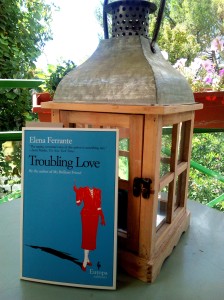
I can’t really talk about the novel in the singular as I see her individual novels now as a tapestry of different women characters from Naples, in various stages of their life – the two friends in My Brilliant Friend, the daughter in Troubling Love and the betrayed wife of The Days of Abandonment.

Photo by Luidi Cardoso on Pexels.com
Inside the overthinking mind of an adolescent and the pushing boundary-like behaviours, exposing that lying life, provoking reactions, seeing the damage of truth-telling and then the transition, an increasing self-awareness, noticing a reduced need to react to annoyances, about one’s parents, one’s friends, teachers, family. A letting go. A transition. Decisions. To care or not to care.
I behaved like that certainly to feel free from all the old bonds, to make it clear that I didn’t care anymore about the judgment of relatives and friends, their values, their wanting me to be consistent with what they imagined themselves to be.
Ferrante provides the reader no easy conclusions, makes no judgments, but leads you down paths that will confront you with your own, as you carry on a conversation inside your own mind, wondering and trying to guess what her character might do next.
As the novel nears the end, it reads almost like a thriller, as we can see she is moving towards adulthood, her behaviours are less volatile, she feels less of a need to respond so violently, and yet, there is the danger that now she is becoming one of them – an adult – those who hide their behaviours behind lies.
Raw, intense, a delightful, refreshing, “stand up to them” protagonist.
My Reviews of Ferrante Books

Photo by Emre Kuzu on Pexels.com
Troubling Love (novel)
The Days of Abandonment (novel)
The Neapolitan Quartet: (tetralogy – 4 novels)
Those Who Leave and Those Who Stay
Frantumaglia, A Writer’s Journey (nonfiction)
Further Reading
Review, Guardian: a rebel rich girl comes of age
Elena Ferrante Shares 40 Favourite Books by Female Authors



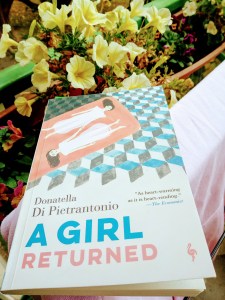 A Girl Returned came to my attention because I like to see what



 That’s Ferrante.
 A quick look up tells me that noir fiction has its roots in hard-boiled fiction ( a tough, unsentimental style American of crime writing) where the protagonist is often an outcast, alienated. However, Kim Fay from LA Review of Books, when reading noir, used to preparing herself for ‘bleak cynicism and uncomfortable moral ambiguity’ is pleasantly surprised, referring to De Giovanni’s Pizzofalcone precinct series and empathetic characters as ‘tender noir’:
 He is new to Naples, he has a teenage daughter he is worried about, a pizza waitress who is eyeing him up and a high-ranking magistrate whom he daydreams inappropriately of.
 Maurizio de Giovanni was born in Naples in 1958 and for many years worked in a bank, though not a natural vocation, his colleagues attest he always had his nose in a book and it was in fact they who entered him in a short story competition in 2005 for ‘giallo novelists’ (a 20th-century Italian mystery, thriller or horror genre of literature and film) that was the catalyst to his becoming a successful crime writer.
 On the day when the nation is shocked and grieving after a devastating earthquake, that has destroyed entire villages and resulted in a significant loss of life, I don’t know how appropriate it is to share their literature, perhaps in the case of this particular novel, it serves to put things in perspective.
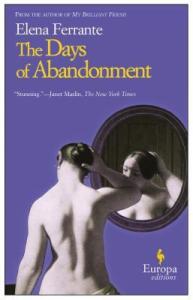 A national bestseller for almost an entire year, The Days of Abandonment shocked and captivated its Italian public when first published.


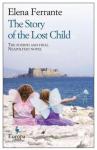
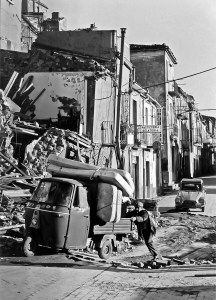 It is the 1980’s and one of the turning points in Lila’s deterioration is the earthquake that occurred on November 23, 1980 killing 3,000 and rendering 300,000 of Naples inhabitants homeless. It is used as a powerful metaphor for the destabilisation that occurs in Elena and Lila’s lives.



 Word by Word