Tove Jansson Anniversary 100 years #TOVE100

TOVE 100 © Moomin Characters™

TOVE 100
© Moomin Characters™

2014 is TOVE100, 100 years since the birth of the Finnish artist and writer Tove Marika Jansson.

I have read a few of her books (the adult books translated by Thomas Teal), discovering her about a year ago and I have become a little obsessed with her work since then.

To celebrate her 100 years, I plan to read a few more books by or about Tove Jansson and invite you to join me if you wish.

Books Read

A Winter Booksee my review here

A quiet, honest collection of stories, containing evocative black and white photos that add to the atmosphere the author evokes making the reader experience life on the island and all its challenges, right up to the final story, Taking Leave, the last visit, when the nets have become too heavy to pull, the boat too difficult to handle, the sea too unpredictable for two aging women.

The Summer Booksee my review here

An elderly artist and her six-year-old grand-daughter spend a summer on an island in the gulf of Finland. Gradually, the two learn to adjust to each other’s fears, whims and desire for independence, coming to an understanding, teaching each other something along the way.

The True DeceiverSee my review here 

An aging women artist living alone on the outskirts of a village is befriended by a younger woman, who after faking a break-in moves in with her brother, allegedly to provide companionship. It is a relationship that peels back the layers of both women, bringing their inclinations and bugbears to the surface, a face-off between truth and kindness, both containing elements of deception.

Art in Nature – See my review here
Sculptors daughterStill To Read

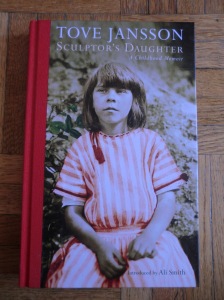
The Sculptor’s Daughter by Tove Jansson

Fair Play by Tove Jansson

Tove Jansson Life, Art, Words: The Authorised Biography, Written by Boel Westin, Translated by Silvester Mazzarella

The Moomintroll Books

Tove Jansson with her brother Per Olov © Moomin Characters™

Tove Jansson with her brother Per Olov
© Moomin Characters™

She wrote and illustrated children’s books and later in life began to write for adults as well. She was close to nature and spent nearly every summer on a family island in the Pellinge archipelago, in the Gulf of Finland, an environment that features often in A Winter Book and The Summer Book.

Born on 9 August 1914 to a family of artists, her mother was a graphic designer and her father a sculptor. An artist before anything, she was multi-talented, painting, illustrating and writing, not confined to any one genre. Her first book for adults was part fiction, part memoir, The Sculptor’s Daughter, written 10 years after her father’s death.

Although I admit to never having read any of them, she is most well-known for nine children’s books that grew out of her family of characters, little white trolls living in Moominvalley named Moomintroll, Moominmamma and Moominpappa along with other creative creatures such as the Hattifatteners, Mymbles and Whompers. She also illustrated other classic children’s books including versions of Alice in Wonderland and The Hobbit.
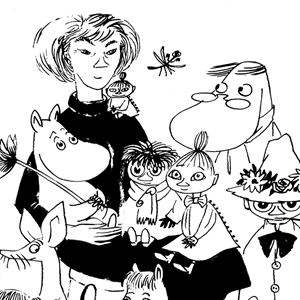
Tove Jansson and Her Moomintrolls © Moomin Characters™

Tove Jansson and Her Moomintrolls
© Moomin Characters™

Her career started early, drawing for a liberal satire magazine Garm at the age of 15, the title where her large nosed character Moomintroll made its first appearance. I think she may have been filling in for her mother, based on a comment I read in The New Yorker, but I’ll find out more when I read the biography. Her first book Sara and Pelle and the Octopuses of the Water Sprite – was published when she was just 13.

Her books have been translated into more than 40 languages, making her one of the most well-known Finnish artists, remembered by many from their own childhood and continuing to gain new audiences today.

“I didn’t realise it was set in a real place. I thought she’d made Finland up. Finland was like Narnia, with these incredible characters that were so strange but instantly recognisable because you had met lots of them – noisy Hemulens or neurotic, skinny Fillijonks.” Frank Cottrell Boyce

Events

There are numerous events happening worldwide and the national gallery of Finland, Ateneum Art Museum in Helsinki is holding an exhibition of all oeuvres of Jansson’s career, her surrealistic paintings of the 1930s, modernist art of the 1950s and more abstract works in the 1960s and ’70s, as well as her satirical anti-war illustrations for the magazine Garm, her murals created for public spaces, and illustrations of her Moomin characters and stories. I’m unlikely to make it to Helsinki, but was pleased to discover the audio presentations linked below, 2 minute descriptions (in English) of 12 of her paintings which you can view while listening.

Further Reading, Listening

Two Minute Audio Descriptions of 12 of her Paintings, via the Finnish Art Museum, Ateneum

TOVE100 – website with events happening internationally, resources

The Hands That Made the Moomins – An article in the New Yorker


Have you read any of Tove Jansson’s books? Are you planning to read any of them this year?
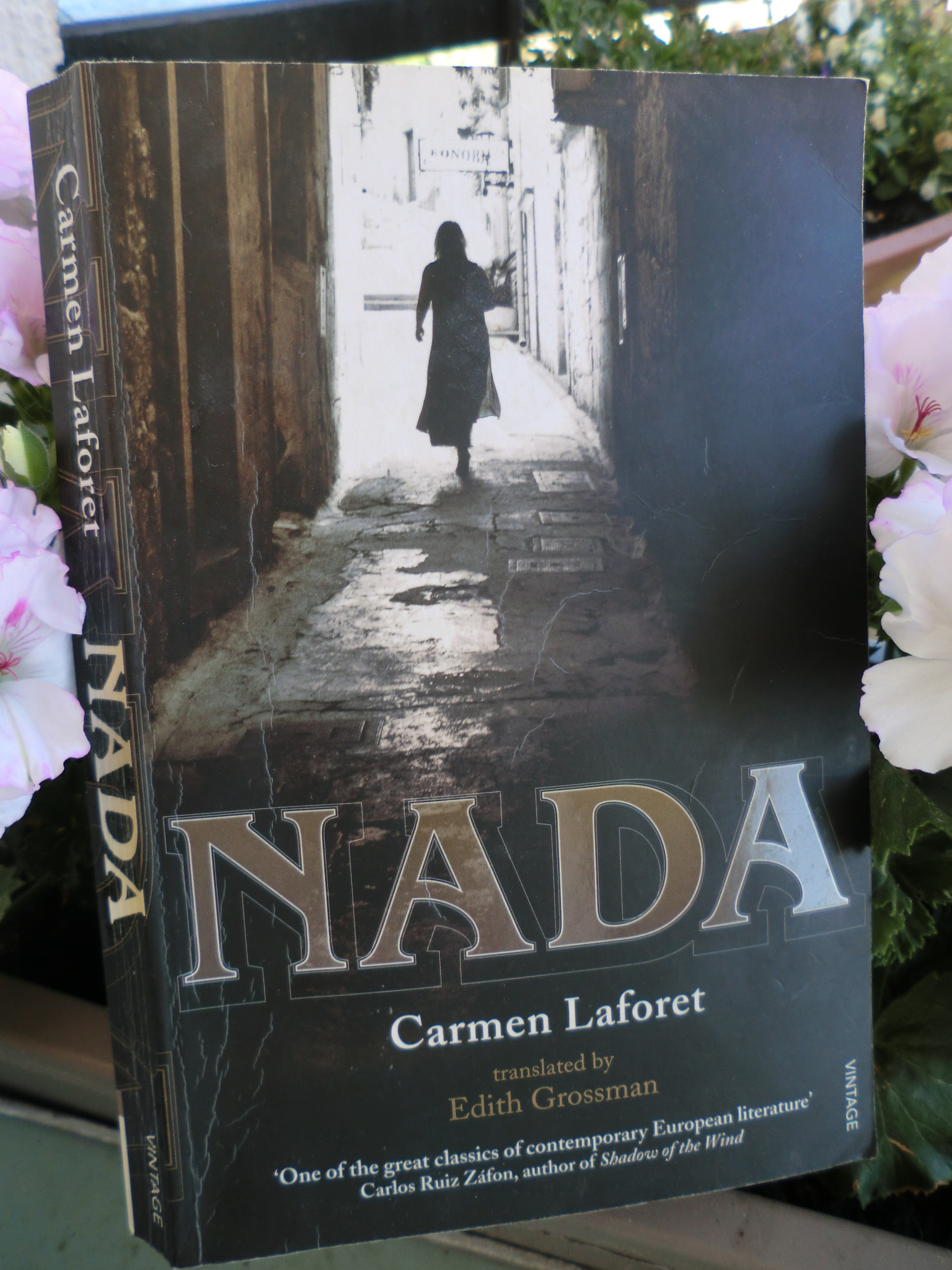
Nada by Carmen Laforet

Nada (2)On a recent visit to London, my Uncle was handing this book back to the friend who lent it to him and I listened intrigued as they discussed its merits. “Isn’t it brilliant?” she said.

Book envy hardly had time to rear its head before my Uncle said “but Claire, you must read this too” and rather than it returning to its owner, this book came home with me, delighted to be off the shelf once more, this time travelling closer to the territory where it was conceived.

Nada was written by Carmen Laforet when she was 23 years old and first published in Spanish in 1945. Born in Barcelona, she moved to Las Palmas in the Canary Islands when she was 2 years old and like her protagonist Andrea, moved to Barcelona when she was 18 to study literature and philosophy.

Edith Grossman, who also translated Gabriel Garcia Marquez and Mario Vargas Llosa (who writes a brilliant introduction in the opening pages) puts Nada into English in what Alberto Manguel describes as “a fluid translation”, one that I read as if it has been written in English as its first language. The book was finally published in 2007, three years after the death of its author.

Andrea has spent a dreamy summer in her hometown, looking forward to coming to Barcelona to study and spend time with her family she hasn’t seen in years and barely remembers. She arrives three hours late and thus finds her way to the Calle de Aribau alone in the dead of night, arriving at the dilapidated apartment to be met by an apparition, a strange gathering of eccentric characters.

gothic barcelonaHer family, weathered by years of neglect, corruption and psychological torment, live in a claustrophobic environment that causes Andrea to develop her own eccentric behaviour in an effort to escape theirs. The house is inhabited by her two uncles, Juan and Roman, her aunt Angustias, the maid Antonia, and Juan’s wife, Gloria, plus a menagerie of cats, an old dog and a parrot.

“That illuminated twinkling of stars brought back in a rush all my hopes regarding Barcelona until the moment I’d entered this atmosphere of perverse people and furniture. I was afraid to get into the bed that resembled a coffin. I think I was trembling with undefinable terrors when I put out the candle.”

Though never mentioned, the city and its people are in the shadow of the recent civil war which has pushed the population to its extremity, people are either starving or drowning in excess, oblivious to the plight of the depleted middle class, who grasp onto whatever they can, the more practical selling the candelabra and curtains no longer given occasion to flaunt their long-lost beauty.

“The memory of nights on Calle de Aribau comes to me now. Those nights that ran like a black river beneath the bridges of the days, nights when stagnant odours gave off the breath of ghosts.”

Carmen Laforet 1921 - 2004

Carmen Laforet 1921 – 2004

Carmen Laforet writes in a way that makes the reader experience the brutality of each encounter, while instilling in us something of the toughness of Andrea, we seem to know she will handle it all, despite her growing thinner by the day as she observes the decline into madness of her extended family.

The depth of the prose is extraordinary and intriguing, the kind of work that makes a reader want to listen to the writer talk about what inspired them and what was going through their mind when these words flowed onto the page.

Carmen Laforet has created a heroine who is witness to a decline, who is oppressed by it and at the same time somewhat oblivious to it, captured it with an intensity that causes us anguish, the story sits uncomfortably with the reader but compels us to turn the pages ravenously. An utterly absorbing and spellbinding read, what a treasure that took so long to be shared with the English reading world.

“She achieved this, and half a century after it was published, her beautiful, terrible novel still lives.” Mario Vargas Losa


Further Reading

Elena’s Books and Reviews – an excellent review by Spanish blogger, Elena Adler. Studying literature and humanities, her insights add much value to our reading and comprehension of the underlying tensions and dysfunction of society post the civil war.

The GuardianAlberto Manguel hails the first appearance in English of the modern Spanish classic Nada.


Nagasaki by Éric Faye

Thanks to Gallic Books, another recent English translation of a French literary work is being published in 2014, Nagasaki, a slim novella inspired by a newspaper cutting of real life events.

Belgravia Books

Belgravia Bookshop offering Gallic Books and other translations

Shimura Kobo lives alone in a quiet suburban street, by day he works as a meteorologist, he rarely socialises with his colleagues, nor does he see family much, his life causes fewer ripples in Nagasaki than the weather he forecasts for it.

“There comes a time when nothing happens any more. The ribbon of destiny, stretched too wide, has snapped. There’s no more. The shockwave caused by your birth is far, oh so far, behind you now. That is modern life. Your existence spans the distance between failure and success. Between frost and the rising of sap.”

Recently there have been a few barely detectable disturbances to his inanimate way of living. A container of fruit juice seems to have lost a few centimetres, and isn’t there one yoghurt pot less than was there this morning? He begins to take extra care securing his home, yet still has the feeling of something not being quite right.

Nagasaki (2)He sets up a webcam in his home and sits at work watching his kitchen as if studying the meteorological charts, waiting to detect any sign of disturbance.

It is a brief story where the revelation comes early, its slow residual effect only beginning in the aftermath. About halfway the narrative shifts, adding to the mystery of how the revelation impacts Shimura, as we no longer have access to his thoughts.

That it is based on a true story is enough to haunt the reader, but the way Eric Faye narrates it, contributes to the way this story inhabits the mind as we read. Like the best stories, it stays with you long after reading and invites discussion with others about how such a thing could happen in our society.

And it will make you check your door locks more carefully.


Note: Thank you to Gallic Books for providing a copy of the book.

The Foundling Boy – Le jeune homme vert by Michel Déon

Foundling2Thank you to publisher Gallic Books, who noticing that I had recently read The Lost Domain (le Grand Meaulnes) by Alain-Fournier suggested I might also enjoy Michel Déon’s The Foundling Boy. Originally written in French Le jeune homme vert was first published in 1975 and now translated into English for the first time, is beginning to be enjoyed by readers of the English language.

Set in Grangeville, Normandy in the inter-war years prior to WWII, it is a coming-of-age story of the young Jean Arnaud, who starts his life in a basket on the doorstep of Albert, a one-legged war veteran, now a pacifist gardener cum caretaker  and his wife Jeanne, who raise the child as their own.

Jean grows up in the shadow of Michel and Antoinette, children of Antoine de Couseau, an errant landowner whose father built up a fortune, only for his son to slowly lose it all – unsurprisingly as much of the first 200 pages is spent in his company, a man who whenever challenged by his wife or confronted by business decisions, takes to his latest model Bugatti, a car he replaces every year and heads south, following what becomes a well-worn trail via Lyon, Aix, St Tropez to Menton, allegedly to see his grown daughter Genevieve, recuperating in a hospital residence from lung problems.

The visits rarely last longer than a wave from the window before he heads off to enjoy the hospitality and warm sheets of various mistresses en route and this being France of course, the husbands all take it in their stride.

There is a real fascination throughout the novel for unique cars that love to take to the road. I went back to look at the references which I probably glossed over in my first read, now much more knowledgeable about Ettore Bugatti and his racing cars, from the 1923 Type 22 here on the left through many other models to the 1938 57SC Atlantic on the right. And Antoine de Couseau is not the only character whom Jean Arnaud meets, to possess a similar fascination. For being raised a peasant, he has seen many a luxurious interior when it comes to cars.

Jean too, has a love of his bike and travel and will spend four days in London, developing a taste and allure for freedom and adventure and not long after will follow in the footsteps of the writer Stendhal to Milan, Florence and Rome, meeting up with Ernst, a German lad who is following a similar trail in the footsteps of Goethe, his father’s hero – having swapped his son’s copy of Mein Kampf for Goethe’s Italienische Reise (Italian Journey).

Arnauds JourneyThe two young men share adventures, debate philosophical perspectives and encounter the fragility of friendship in the face of prejudice and racism.

Losing everything and having almost become the amoureux slave of a restaurant proprietor, who offers him a job so he can earn enough money to return home, Jean finally returns making the acquaintance of Palfry on his way, only to discover things at home vastly changed.

Throughout all Jean’s experiences, there are the interactions with family, friends, neighbours, villagers and people he meets along the way, it is not enough to accept the wisdom of others, he wants to explore for himself, whether it is the landscapes of neighbouring countries or the social acquaintances of his friend Palfry, a man who gave him a ride in his car dressed as a priest and whom he meets at various stages in his life who teaches him that things are not always as they seem. Ultimately, this searching might also be to understand who he really is, something within him, but that he also seeks outside from those he knows, the mystery of his birth.

“What is certain is that, overnight, Jean Arnaud matured by several years, learning that a priest may also be a plotter, and that without being thieves and murderers men might have to hide from the police because they were defending a noble cause. The world was not built of flawless blocks, of good and bad, of pure and impure. More subtle divisions undermined the picture he had so far been given of morality and duty. “

Fairly early on, it occurred to me that nearly every female character was caricatured as something of an object, the neighbour’s daughter, the house-maids, the women Antoine de Courseau encounters on his travels, even his daughter Geneviève becomes a ‘kept’ woman.

While it is an engaging and entertaining read, that moves along at the rambling, colourful pace of a joy-ride in a Bugatti, it began to feel like a book written for men, for it is they who travel (with the exception perhaps of Geneviève), have adventures, engage in meaningful banter, witty dialogue and to whom much of the advice within is given.

I admit to a moment of despair in being unable to think of one woman with redeeming qualities, that a female reader might relate to, why even the landlady of the Bed & Breakfast in Dover drags the poor 13-year-old youth off to the pub keeping him there till closing, Jean’s first impression of England is certainly one that stays long in his memory.

Jean purchases himself a notebook early on in his journeys and in his letters and notes, we are witness to how he begins to see the world:

I’ve bought myself a notebook where I’ve started making a few notes:

a) Duplicity: absolutely necessary for a life without dramas. You have to harden your heart. I need to be capable, without blushing to my roots, of sleeping with a woman and then being a jolly decent chap to her lover or husband. This is essential. Without it society would be impossible.

I guess, we could just say it is delightfully French and certainly the women are not portrayed as victims, quite the opposite in many cases, but they did make this reader pause for reflection. An eye-opening, memorable journey through the European landscape whilst inhabiting a very French culture and perspective.

Michel Déon inhabits his male characters with pride and indeed enjoys himself so much, he can’t help but put himself into the narrative from time to time speaking with much enthusiasm and familiarity directly to the reader. And with good reason, for it has been said of his young hero that:

“The character of Jean Arnaud has been heralded as one of French literature’s great adolescents, alongside Flaubert’s Frédéric Moreau, Stendhal’s Julien Sorel and Alain-Fournier’s Augustin Meaulnes.”

les vingt ans

Michel Déon has the last say, as he leaves Jean Arnaud in a military camp on the eve of war, a sealed envelope in his pocket with instructions not to open it unless he is in extreme need, his life full of promise yet hardly begun by telling us not to worry about those things he has not revealed, that here he was a foundling boy and in another book, he will tell the story of how his protagonist becomes a man.

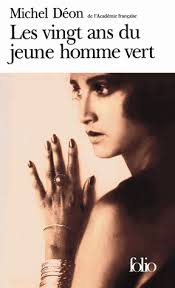
The sequel, The Foundling’s War (Les Vingt Ans du Jeune Homme Vert) is due to be translated into English and published also by Gallic Books. I am intrigued to know what Jean Arnaud makes of life given his experience thus far and how war might change him. Watch this space!

The People in the Photo – Eux sur la photo by Hélène Gestern

Belgravia BooksI have been patiently waiting for this book to be published since discovering it at the same time I learned of the existence of Gallic Books, francophile publishers based in London specialising in bringing a varied collection of excellent French titles across genres to the English reading world. You can buy their books online or at Belgravia Books which specialises in books in translation (5 mins walk from Victoria train station).

I had something of a French literature binge in December, reading Philippe Claudel’s Brodeck’s Report, Alain Fournier’s classic The Lost Domain, Faïza Guène’s young adult novel Just Like Tomorrow and a couple of Albert Camus essays in commemoration of his 100th anniversary. And I am set to continue this theme in 2014, perhaps even venturing into reading a few in the original language!

The People in the Photo is Hélène Gestern’s debut novel and centres on 40-year-old Parisian archivist Hélène’s personal endeavour to learn more about her mother Nathalie, who died when she was four-years-old and about whom no-one would ever speak, not her father, nor her step-mother or any other person and she never understood why.

Gestern

Her father has passed away and now her stepmother, the last living connection between her and her mother is seriously unwell, an event that prompts her into action.
Hélène has only one photo of her mother alongside two unknown men and places an advertisement to try to find anyone who might recognise them.

It marks the beginning of a correspondence and indeed much of the novel is in epistolary form, made up of letters and emails, with the exception of extracts that describe the various photos that are uncovered by Hélène and Stéphane, a Swiss biologist, who recognises one of the men in the photo.

The letters add more than just their content to the narrative, they are an adept device for creating pace and intrigue, their length and dates are significant measuring the time that passes, the pauses, the urgency of an occasional email and yet there is an unwillingness to let go of the controlled structure and single dialogue of the letter, their preferred medium; the revealing sign-off salutations a clue to the developing relationship between the two protagonists.

LettersIt is a revelatory journey of two people into the past of their parent’s lives. Inherent in delving into the past, no matter how necessary it may seem, is the risk of deception, disappointment, even horror in enlightenment.

Hélène Gestern deftly captures the seesaw of emotions as both characters experience waves of exhilaration in their search and periods of retreat from the insinuations of discovery, suggestions they aren’t always ready to face the implications of.

At times the characters seemed extraordinarily restrained, upon receiving a box likely to contain pertinent information, Hélène leaves it unopened for days, her excuse – no time or inclination, yet there is always sufficient to write the correspondence. It is understandable in a sense, the fear of what the revelation will bring, then Stéfane does the same, after developing a set of photos, has no time to look at them, yet has time for a 2 hour walk and his correspondence as well.

Perhaps the lure of corresponding with the living, that ever-present possibility of a future still to be enjoyed, sometimes overwhelms the need to continue digging into a dusty, forgotten past that holds little promise of joy. Or it might just be the sign of a compelling read, and our impatience with characters, living or between the pages of a book, who don’t act as we might, were we in their shoes.

It is a captivating read, intensely thought-provoking and intricately plotted, revealing little by little clues to lives lived in a distant era, yet which explain much of the more recent past for two young people allowing them greater understanding and the potential for forgiveness of those who, until their truth was revealed, were to them like shadows of their former selves.

Note: Thank you kindly to Gallic Books for sending me a copy of the book to read and review.

The Literary Blog Hop – #Giveaway

Today and until 12 February, I’m participating in a literary giveaway blog hop hosted by Judith at Leeswammes’ Blog, an avid reader and blogger.

literarybloghop

All the blogs listed below are participating and offering a literary giveaway to readers. Just leave a comment below to be in the draw for my giveaway and visit any of the blogs listed below, to be in with a chance to win a book. This giveaway is open to you all, worldwide!

WIN A COPY of

Philippe Claudel’s Brodeck’s Report !

I am giving away a copy of one of the best books I read in 2013, a brilliant English translation of a contemporary French novel and winner of a French literary Prize Brodeck’s Report by Philippe Claudel.

You can read My Review here or the brief summary I wrote immediately upon finishing it.

Quietly devastatingly brilliant. Claudel takes one village which happens to be near the border – and what is a border but an imagined line – of an occupying nation and uses the village and its resident to portray humanity and its many inclinations, when a stranger rides into town, makes himself comfortable and goes about his business, without letting anyone know what that business was.

Brodeck is tasked with writing an account of events that take place and as he does so, he simultaneously writes another account, his own, of what is occurring now and what has happened to them all in the recent past, he tries to make sense of it, as is his nature and to know what to do.

I have another giveaway running concurrently (only open to US readers), if you like historical fiction, I am offering a copy of the recently published I Always Loved You by Robin Oliveira recounting the life of the artist Mary Casssat and her friend Edgar Degas in Paris in the late 1800’s. Read my review here and enter the giveaway here.

This is a great opportunity to visit blogs that review literary books and win a book! Entry into the draw via comments are open until 12 February.

Linky List:

  1. Leeswammes
  2. Seaside Book Nook
  3. Booklover Book Reviews
  4. Biblionomad
  5. Laurie Here
  6. The Well-Read Redhead (US/CA)
  7. River City Reading
  8. GirlVsBookshelf
  9. Ciska’s Book Chest
  10. The Book Stop
  11. Ragdoll Books Blog
  12. Nishita’s Rants and Raves
  13. Lucybird’s Book Blog
  14. Reading World (N-America)
  15. Journey Through Books
  16. Readerbuzz
  17. Always With a Book (US)
  18. 52 Books or Bust (N.Am./UK)
  19. Guiltless Reading (US/CA)
  20. Book-alicious Mama (US)
  21. Wensend
  22. Books Speak Volumes
  23. Words for Worms
  24. The Relentless Reader
  25. A Lovely Bookshelf on the Wall (US)
  1. Fourth Street Review
  2. Vailia’s Page Turner
  3. The Little Reader Library
  4. Lost Generation Reader
  5. Heavenali
  6. Roof Beam Reader
  7. Mythical Books
  8. Word by Word
  9. The Misfortune of Knowing
  10. Aymaran Shadow > Behind The Scenes
  11. The Things You Can Read (US)
  12. Bay State Reader’s Advisory
  13. Curiosity Killed the Bookworm
  14. Lizzy’s Literary Life
  15. Books Can Save a Life (N. America)
  16. Words And Peace (US)
  17. The Book Club Blog

This giveaway is now closed.

Eugene Onegin – Chapters 7 & 8 Alexander Pushkin

Moscow, loved daughter of Russia,

where can we find your equal?

DMITRIEV

Eugene Onegin 7 8Chapter Seven

The beginning of Chapter 7 contains numerous quotes and I have noticed all through my reading of Eugene Onegin that the epigrams are a kind of clue to what will follow. So on reading the four quotes that adorn the first page of this chapter, it is clear that the action is going to take us to that great, revered city, Moscow.

A forlorn Tatyana remains in the countryside, nursing the remnant emotions of an unrequited love, like weeds that grow over the unvisited grave of the poet Lensky.

Dear Tatyana, lover of illusion:

Though there he’s no more to be found,

He’s left sad footprints on the ground.

We learn of the swift healing heart of Olga, wooed by another and whisked down the aisle, her tears dried up and replaced by a smile, abandoning her sister and confidant with not much of a glance behind. Tatyana bereft, walks unbidden, finds herself arriving at the country home of Eugene Onegin, his staff invite her in and show her round like a tourist visiting a noble home, the rooms where our hero entertained his solitary self.

At once Anisia came to greet her,

the doorway opened wide to meet her,

she went inside the empty shell,

in which our hero used to dwell.

Spying a collection of strange books she asks if she can return to read them, opening a window into his soul, one she is less sure of, the marks on the page don’t lie, revealing the thoughts of another reader. She comes to understand him via the page, though they are nothing like those she prefers to lose herself in.

The locals are not happy with her loveless state with no plans to marry, they advise her family to take her to Moscow, after a week of travelling they arrive to stay with family, where Tatyana will meet her cousins and slowly become drawn into their ways.

Moscow’s the place, the marriage-fair!

There’s vacancies in plenty there.

They make subtle changes to prepare her for the social activities and try to pry the secrets of her heart, she resists and even while attending the dance, thinks only of the woods, her flower garden and books .

But while she roams in thought, not caring

for dance, and din, and worldly ways,

a general of majestic bearing

has fixed on her a steady gaze.

Chapter Eight

The narrator expounds his poetic verse, carrying us forward, oft-times veering off course as if he were driving an open air carriage then taking his eye off the road to watch the clouds form or listen to birds and admire the wildflowers, then suddenly we are back in the ballroom, the driver his eyes back on the road and the events as we come to know them gradually unfold.

Tatyana is escorted to a ball and sitting quietly to the side, after all this time who does she spot but Eugene, just returned from travels and roaming, he arrives in the midst of this social whirlabout. Recognising her from a distance, though not sure, he asks the prince next to him, who she is:

Eugene Opera‘Can you say,

Prince, who in that dark-red beret,

just there, is talking to the Spanish

ambassador?’ In some surprise

the prince looks at him, and replies:

‘Wait, I’ll present you – but you banish

yourself too long from social life.’

‘But tell me who she is.’ ‘My wife.’

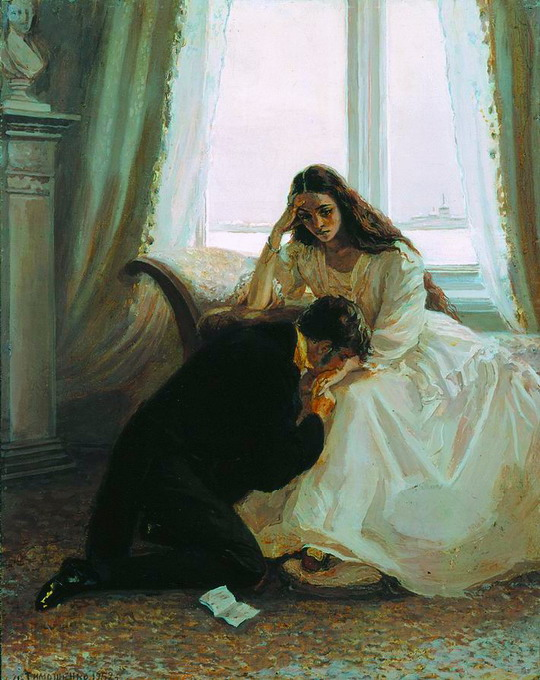
Two years have passed and time has not stood still, he is introduced to the princess and she is unmoved, he sees no trace of the Tatyana he knew and really isn’t sure if it is the same girl. The prince invites him to a soirée and uncharacteristically he responds in haste, eager to see Tatyana once more and is impatient for the evening to arrive. Tatyana playing the dutiful hostess is serene, Eugene falls for all that he has previously scorned, the madness of love. He finds no solace and surprise, surprise, what does he do, this lovesick fop, but write a letter!

Eugene 8No answer comes. Another letter

he sends, a second, then a third.

No answer comes. He goes, for better

or worse, to a soirée. Unheard

she appears before him, grim and frozen.

No look, no word for him: she’s chosen

to encase herself inside a layer

of Twelfth Night’s chilliest, iciest air.

He turns to his books and finds no reason and then as the seasons pass, one spring day he ventures out to see her, is given an audience with the women he can’t get out of his mind and finds the roles have switched, it is she who now lectures him, reminding him of his own behaviour in reprimanding her, she speaks of her love, but that she now belongs to another, to whom she will be true. She leaves the room and Eugene is thunder-struck – the husband arrives – and now we must leave them, this chase has gone on long enough.

The Verdict

Wow. I made it. A brilliant read-along and an entertaining read, although I am a somewhat cynical reader, in that I find it difficult to believe that Eugene Onegin could have become the man he ends up being, not just because of his character so firmly established, but surely after two years travelling he should have gained a kind of maturity that would have provoked a different outcome than this. Perhaps I should have read it 10 years ago when it was given to me!

Thanks to Marian at Tanglewood for organising the challenge, it’s been fabulous. I totally recommend you all give this classic epic poem a try!

Ashes in my Mouth, Sand in My Shoes by Per Petterson

This is Per Petterson’s first book, though only recently translated (by Don Bartlett) into English following the success of his novel Out Stealing Horses (translated into 40 languages) and the sequel to this novel , my personal favourite I Curse the River of Time.

Ashes in My MouthThis book provides a literary snapshot of a childhood growing up in the outskirts of Oslo, Norway in the early 1960’s. His father works in a shoe factory and his Danish mother used to work in a chocolate factory (in the good old days) and now works as a cleaner.

Arvid is six and a half years old and doesn’t always feel secure in the various environments he inhabits, whether at home or at school, or out fishing his Father and his Uncle, where there is no nagging voice to still their hand when they overindulge their mind altering beverage and revert to discussing childhood jealousies, a dialogue that descends into the physical.

His Grandfather has died and this alters things, even though they appear on the outside to be the same.

Arvid listens to the raised voices at night, hears the kitchen door slam and watches his mother tread the same long walk, out there to the dark and back, a walk with no destination, one she makes in the icy cold of night without wearing a coat.

One day he realises his mother is getting older, that time is moving on, and that it is also happening to him.

“He held his hands to his face as if to keep his skin in place and for many nights he lay clutching his body, feeling time sweeping through it like little explosions. The palms of his hands were quivering and he tried to resist time and hold it back. But nothing helped, and with every pop he felt himself getting older.”

I Curse

This is a quiet book whose observations cut deep, a sensitive child with a tough father who likes to remind those around him of his achievements, a boy who admires his father but lives in quasi-fear of not being able to live up to his expectations. It is an author getting into his stride, not as good as the work that will follow, though showing signs of the great work that was to come.

In the sequel, I Curse the River of Time, it is 1989 and Arvid Jensen is 37 years old,  in the throes of a divorce and has discovered that his mother is battling cancer.  It might sound grim, but it I remember it as an astonishing read and I shall make sure to reread it again in 2014, because I think this one could be one of my all time favourite reads.

Eugene Onegin – Chapters Three & Four Alexander Pushkin

Elle était fille, elle était amoureuse.

Jacques-Charles-Louis Clinchamps de Malfilâtre

Tatyana Eugene Onegin

January 25 – The Feast of Tatiana

What better day to write about these chapters, January 25 being the feast day of Saint Tatiana in Russia, a symbol of women and celebrated as a student festival. Both the name and the day have become even more popular since Alexander Pushkin made her the love interest of his epic poem.

Chapters Three & Four

Eugene Onegin inquires as to how his friend the poet spends his evenings and thus finds himself invited to join him for a family evening at the home of Olga and Tatyana, where they receive warm, old-fashioned hospitality, though afterwards he cannot remember which girl was Olga and which Tatyana. While the evening failed to ignite significant interest in our hero, it did set tongues wagging among the locals.

Conjecture found unending matter:

there was a general furtive chatter,

and jokes and spiteful gossip ran

claiming Tatyana’s found her man;

The girl who spends her hours immersed in romantic novels let her imagination run wild and fell for the insinuations, if not the man himself, suffering from a love sickness of her own making, culminating in a letter (in French) to the imagined hero she has shaped from the form of Eugene Onegin. A baffled Onegin, clearly does not read the same literary genre.

Who taught her an address so tender,

such careless language of surrender?

Who taught her all this mad, slapdash,

heartfelt, imploring, touching trash

fraught with enticement and disaster?

I can’t help but laugh, it is perhaps the poetic form combined with the ignorance of the hero, this bringing together of polar beings, to create such a discordant clash of romantic versus pragmatic. And so we wait to learn what will pass, when by chance the two meet, and Tatyana must listen to the unfeeling hero speak from a detached but well intended heart, warning her against baring her soul so easily in future. Though it is true, he tolerates and listens easily to similarly themed devotions from his friend the poet, for whom such outpourings are his raison d’être.

But I was simply not intended

for happiness – that alien role.

Should your perfections be expended

in vain on my unworthy soul?

Saint TatianaAnd finally the long autumn and winter bore him and he agrees to a second visit, one that will fall on Tatyana’s name day celebration!

Impressions of Tatayana and Olga

Tatyana is distant and aloof socially, yet vulnerable to the roller coaster of emotions she reads and studies at length in her romantic novels. Her falling in love is not as such inspired by meeting Onegin or anything he says or does in their first encounter, it is by the idea of him inflamed by the wagging tongues of neighbours, that allow her, now that she has some distance from the man himself, to imagine herself in love. She has a need to express herself and because she hesitates to ever do so in person, pours her emotion into the written word – a letter.

Olga we only see through the eyes of the enraptured poet Lensky, he is always with her, walking with her, reading to her, writing poems about her, he gives and receives love easily and neither of them appear subject to the more tumultuous vagaries of passionate love.

Onegin’s Reaction to Tatyana?

An almost fatherly response, he was concerned that she should not respond in the same manner when next she looks for love, outwardly he shows little emotional response to her revelations, however there is a hint that the words may have affected him at a more sub-conscious level that has yet to make its way into his more intellectual self. Fortunately, he does show careful consideration for her feelings, by refraining at least from criticising her too harshly or outrightly rejecting her. Ironically, it is his constant boredom that will lead back to the warm hospitality of her family home.

Le Grand Meaulnes

Le Grand Meaulnes

How Does it Contrast With Another Classic Romantic Novel?

I can only compare it with the most recent classic romantic novel I have read, though it was written nearly 100 years later, Alain Fournier’s Le Grand Meaulnes whose male characters are more afflicted by romantic notions in the vein of Tatyana, than Eugene Onegin. In Fournier’s novel and in his own personal experience, it is the women who dole out the practical advice and suggest that the young man is too young, only for him to become completely obsessed with her.

Overall, these chapters are much more dramatic and throw us deep into the story, they entertain, they shock and delight. It is a pleasure to read and I am looking forward to what the next two chapters will bring.

Click here to read the follow up review of Eugene Onegin Chapters 5 & 6

The Lost Domain – Le Grand Meaulnes by Alain Fournier

Classics don’t feature too often on my list and when they do, I tend to be attracted towards the Russian and French classics, because they offer an element of the unknown and the unfamiliar. I like reading across cultures and am fortunate to live within a culture that provides me with learning opportunities every day, whether I read the literature or not. But reading it adds so much more to the experience and to interactions with local people.

West End Lane Books

West End Lane Books

I had come across references to Le Grand Meaulnes a few times and nearly brought it home with me after visiting West End Lane Books in London last October, leaving it behind on that occasion, but purchasing Brodeck’s Report, which I have since read and Alistair Grayling’s non-fiction work Friendship, of which I read a few pages and found it a little dense, not yet abandoned, but left for a rainy day.

Le Grand Meaulnes crossed my path again via NetGalley, where I learned of the centenary version below which coincides with the 100th anniversary of Fournier’s death.  This version translated by Frank Davison, published by Oxford University Press.

I decided – enough – stop reading ABOUT the book and READ the book!

The Lost DomainAnd then what joy, to find myself in the company of Hermione Lee who has written such a wonderful introduction filling us in on Alain-Fournier’s life, that I could almost write an entire post on the gems she shares her excellent essay. She writes of the unique captivation this book has held over generations of readers and the literary qualities that have allowed it to continue to survive as a modern classic.

“Alain-Fournier’s only novel maps an imaginary vision onto a real landscape. It is the story of his childhood, transformed into a romantic quest. It is set in real places which he had known all his life, with real names of villages and towns and shops and train stations, but it takes us on mysterious journeys to places that seem to belong to a fairy tale.” Hermione Lee.

The title itself and its translation present a dilemma, as it is not possible to translate all that it means in one expression, it is a play on words, for it is the nickname of one of the chief characters and a reference to an estate, a château that he will search for in vain.

For a man who died at 28, Alain-Fournier lead a full and dramatic life, making one wonder what more he may have accomplished had he not been killed tragically in 1914 shortly after being called up to fight in WWI. The drama continued after his death, as this one book that he wrote became a cult sensation and created a feud over his legacy, complicated further by the split between his parents, claims by his sister and her husband (Fournier’s best friend) and the married women Simone (whose husband he had ghost written a book for) whom he’d had an affair with, who aborted his unborn child.

Alain-Fournier_maison_natale

Birthplace of Alain_Fournier
La Chapelle-d’Angillon
Source: Wikipedia

One gets the impression having read Le Grand Meaulnes, that having addressed childhood, the author was just warming up for an entire litany of novels, drawing on the many experiences and emotions he had already encountered in such a short life.

“His longing for his childhood places and his desire to turn that emotion into writing was one of the fundamental impulses behind Le Grand Meaulnes.”

Beginning in the 1890’s, Le Grand Meaulnes is narrated by the quiet, unassuming Seurel, a boy whose life at the schoolhouse is relatively uneventful until Meaulnes, nicknamed Le Grand Meaulnes arrives and just as soon disappears, only to return again.

The arrival of Augustin Meaulnes at a small provincial secondary school sets in train a series of events that will have a profound effect on his life. Lost and alone, he stumbles upon an isolated house, mysterious revels, and a beautiful girl. Determined to find the house again, and the girl with whom he has fallen in love, Meaulnes is torn between his love and competing claims of loyalty and friendship.

It is a story of a childhood and adolescence told by one who observes, follows, understands and tries to assist, at the expense of living his own life to fulfilment. What happened to his friend in those few days he disappeared will obsess both boys thereafter, one because he wants to know what happened and the other because he wants to return there and cannot remember the way.

The books first pages are narrated when Seurel is five, the main story taking place when he is 15 and Meaulnes is 18 and will end when Seurel is almost 20. Whenever Meaulnes is present, there is an air of drama. Life and even his character take on a different aspect for Seurel when his friend is there, and when he is not, he mulls over what has passed and tries to make sense of it, and at times even do something about it.

“Meaulnes gone, I was no longer following in the footsteps of a visionary path-finder; I was once more a village lad like the rest of them – a status which demanded no effort and concurred with my own inclinations.”

alain-fournier

Alain-Fournier
Source: Wikipedia

It is a nostalgic read, somewhat melancholy, infused with an air of pending tragedy – and reminiscent of the life of the author. It creates an ambiance of short-lived joy and then loss, one that is repeated often. We don’t read for the destination, but for the journey and its distractions, for the differences between characters facing the same situations. In this, it is a microcosm of humanity on a small scale during one phase of life, youth.

It is symbolic, not just of the end of childhood and romantic notions, but the end of an era of narrative style, published at the same time as Proust’s Swann’s Way, hailed as something new and a sign of the way forward for French literature, part of the new modernist movement, whilst Le Grand Meaulnes represented the end of the romantic tradition.

Loved it.

Note: This book was an ARC (Advance Reader Copy) provided by the publisher via NetGalley.