
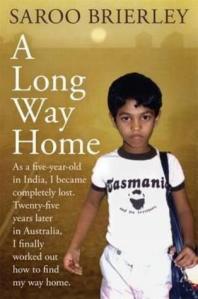
 I saw the film when it was on at the cinema about a year ago and like everyone who has seen it, I thought it was extremely moving. If you don’t know the story, it’s about a 5-year-old boy who is out with his teenage brother, who has told him to wait for him at a quiet train station near their home, and feeling tired, he climbs into an empty carriage, falls asleep and when he awakes, it is moving, the carriage locked and he will be transported, far, far from his home, which he won’t see for another 25 years.
The book only confirms how incredible and moving his story is, on top of the emotion it provokes, was the amazement at how many situations 5-year-old Saroo got into that he was miraculously saved from, often by his own well-honed instinct, other times sheer luck, and occasionally, surely, divine intervention.
Like befriending the teenage boy he trusted and went home with, who would be the first person to make an intervention on his behalf that would lead him to 25 years of safety, before he could find his way back home and be reunited with his family again. In the meantime he would spend those 25 years in a middle class Australian family in Hobart, Tasmania – far from his culture and birth family, learning another language, getting an education and developing a way of life that would benefit them all by the time his story comes full circle.
It’s a bittersweet story with a thrilling beginning as he falls asleep in the wrong place at the wrong time and his life is hurtled, like a rocket capsule, into another hemisphere, with a few obstacles to overcome on the way.
It’s sad because he was a boy who became lost from his family in a large country, he had difficulty pronouncing the name of the town he came from (and even his own name) and in the city he arrived in Calcutta (Kolkata), he spent weeks riding trains hoping one of them might take him back. Nighttime brought an element of danger, and even in the day while having fun with other children in the river, danger was never far away, he would be rescued a couple of times that might have been life-threatening, had not well intended strangers come to his aid.
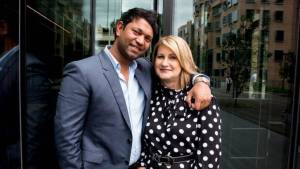
Saroo with his adoptive mother
The childless (through their own choice) couple that adopted him, were open and inclusive regarding his culture, furnishing his bedroom with a large map of India and items reminiscent of his country of birth, they joined an association connecting Indian families to their culture. However, unwanted memories could arrive unbidden, sometimes reconnecting with stories from India awakened his childhood trauma. He describes seeing the Hindi film Salaam Bombay:
Its images of the little boy trying to survive alone in a sprawling city, in the hope of returning to his mother, brought back disturbing memories so sharply that I wept in the dark cinema, my well-meaning parents unaware of the cause. Even sad music could set off emotional memories. Seeing or hearing babies cry also affected me strongly, but somehow the most emotional thing was seeing other families with lots of children. I suppose that even in my good fortune, they reminded me of what I had lost.
A few years later, his parents adopted another boy from India, who became his brother, the book doesn’t delve too deep into this relationship, however the film did bring out the contrast in their characters and the difficulty his parents, particularly his mother, who was a relatively quiet and calm woman, had in parenting him.
Mantosh and I were very different, partly because of the natural differences between our people, but also because of our different experiences in India. It’s one of the things that makes people who adopt children, especially from abroad, so brave: often the kids they’re taking in come with troubled backgrounds, having suffered in ways that make adjusting to their new life difficult, and which can be hard to understand and even harder to help. I was reticent and reserved; Mantosh, at least at first, was loud and disobedient. I wanted to please; he rebelled.
According to an interview, Mantosh was unhinged by the film, his protracted adoption wasn’t able to be finalised within the two month grace period the children’s home were given, so he was sent back to the large orphanage where lost or abandoned children would encounter all manner of youth, including bullies, criminals and abusers, the time he was obliged to spend there awaiting the administrative outcome scarred him physically and mentally. He didn’t have the good fortune of his brother, whose story is all the more remarkable for him having avoided abuse, though he was certainly close to encountering it, as his story shows.
“[His grandmother] couldn’t keep Mantosh in her care anymore, while he was waiting to come to Australia, once we’d accepted him. So he had to go back to [the orphanage] where he was burnt, raped, beaten, you name it. And I’m very bitter about that.” – Sue Brierley
There is most certainly a very different and equally important story to be told, if one follows Mantosh’s experience; it was interesting to listen to his mother speak on that in an interview recorded here. At least, she says, it did result in him beginning to open up more about his experiences and they were able to seek help for him, he represents the other side of adoption; the adoptive mother admitted they weren’t prepared for what it would mean to raise a child who’d been through such trauma, she didn’t have the support needed and experienced discrimination in the medical community when she did try to seek help.
 When Saroo really becomes intent on tracking down his family, (another element that is much more vividly portrayed in the film) no one except his girlfriend knows how obsessed he has become, he has had periods of searching in the past, spurred on by meeting other students who grew up in India, who’d make guesses as to where he might come from based on his memories, but when, with the help of Google maps and tracing railway lines out of Calcutta, he began to spend hours every night doing his research, he kept it to himself, in ways and for reasons many adoptees will recognise.
I didn’t tell many people what I was doing, not even my parents. I was worried they might misunderstand my intentions: they might think that the intensity of my search revealed an unhappiness with the life they’d given me, or the way they’d raised me. I also didn’t want them to think that I was wasting time. So even as it took up more and more of my life, I kept it to myself.
He was fortunate to have such a supportive girlfriend, he felt she would have been within her rights to feel alone in their still-new relationship, he was treading a fine line and would catch her looking at him sometimes as though she thought he was crazy. He was driven, determined and you knew he wouldn’t give up until he’d found something he recognised, the memories and maps in his head so well preserved over the years, surely he would find them if he kept going.
Perhaps to some extent sharing something so fundamental to me strengthened our connection – and that came through when we talked about what it all meant to me. It wasn’t always easy to articulate, especially as I was trying to keep a lid on my expectations, trying to convince myself it was a fascinating exercise, not a deeply meaningful personal quest.
In the book, Saroo spends a lot of time rationalising and expressing his gratitude, it’s clear he doesn’t wish to hurt anyone in his portrayal of the story, he understands he treads the line between two families in a topic that is almost a cause, that attracts fierce activism especially on the part of those who are pro-adoption, however he also acknowledges what many adoptees need to hear, the aspect that was healed in him in taking this journey, by his perseverance.
Rightly so in his case, as he wasn’t abandoned or given up in the first place. The trauma his mother must have gone through in finally accepting that he had disappeared, and what strength and love, to have believed for so long he may return, so strongly she believed it that she refused to leave the town they lived in, to join her other children and be nearer them and their families.
After being lost, I’d been lucky enough to adopted by a loving family, and not only lived somewhere else, but had become someone else from the person I might have been had I stayed in India. I didn’t just live in Australia, I thought of myself as an Australian. I had a family home with the Brierleys and had made my own home in Hobart with my girlfriend Lisa. I knew I belonged and was loved, in those places.
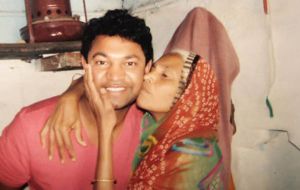
But finding Khandwa and my Indian family also felt like coming home. Something about being in the place just felt right. I was loved here too, and belonged, in a way I’d not thought much about beforehand and found hard to explain. This was where I’d spent my first years, where my blood was. When it was time for me to return to Hobart – a time that came around far too quickly – I felt the wrench of leaving deeply.
 The first woman who came to mind and whose book I want to recommend is Wangari Maathai’s Unbowed, One Woman’s Story. Kenyan and one of a group of young African’s selected to be part of the ‘Kennedy Airlift’ , she and others were given the opportunity to gain higher education in the US and to use their education to contribute to progress in their home countries. Maathai was a scientist, an academic and an activist, passionate about sustainable development; she started the The Greenbelt Movement, a tree planting initiative, which not only helped save the land, but empowered local women to take charge of creating nurseries in their villages, thereby taking care of their own and their family’s well-being.
 Henrietta Lacks is perhaps one of the most famous women we’d never heard of, a woman who never knew or benefited from her incredible contribution to science and humanity. A young mother in her 30’s, she was diagnosed with an aggressive form of cancer and despite being eligible for and receiving medical care at the John Hopkins hospital in Baltimore, a medical facility funded and founded to ensure equal access no matter their race, status, income or other discriminatory reason, she died soon after.
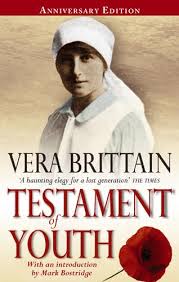 Vera Brittain was a university student at Oxford when World War 1 began to decimate the lives of youth, family and friends around her. It suspended her education and resulted in her volunteering as a VAD (Voluntary Aid Detachment) nurse. Initially based in a military hospital in London, events would propel her to volunteer for a foreign assignment, taking her to Malta and then close to the front line in France for the remaining years of the war.
 Maya Angelou is best known for her incredible series of seven autobiographies, beginning with I Know Why the Caged Bird Sings (1969), narrating her life up to the age of 17. She became a writer after a number of varied occupations in her youth.
 Diana Athill OBE (born 21 Dec 1917) is someone I think of as the ordinary made extraordinary. She was a fiction editor for most of her working life, forced into earning a living due to circumstance, for while her great-grandparents generation had made or married into money, her father’s generation lost it. She clearly remembers her father telling her ‘You will have to earn your living’ and that it was something almost unnatural at the time.
 The opening story is a mix of reportage and a retelling of the story of Mangilaluk Bernard Andreason, who when he was 11 years old, slipped out of the Inuvik residential boarding school he’d been sent to, along with two friends Jack and Dennis, to avoid being punished for stealing a pack of cigarettes, and spotting newly hung power lines, decided to follow them home to Tuktoyaktuk.

 Nothing Holds Back the Night is the book Delphine de Vigan avoided writing until she could no longer resist its call. It is a book about her mother Lucile, who she introduces to us on the first page as she enters her apartment and discovers her sleeping, the long, cold, hard sleep of death. Her mother was 61-years-old.
 I read this book in a day, it’s one of those narratives that once you start you want to continue reading, it’s described as autofiction, a kind of autobiography and fiction, though there is little doubt it is the story of the author’s mother, as she constructs thoughts and dialogue inspired by the information provided by family members, acknowledging that for many of the events, some often have a different memory which she even shares.
 Before I went to visit and spend two months in Bethlehem, Palestine some years ago, I wanted to read something about the history of the area, not a religious book, but something historical that went beyond the recent familiar history since the British abandoned those residing in these lands to their fate. I wanted to understand the wider context of how people came to be living here and what they’d had to endure to survive.
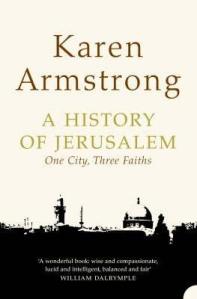 Recently I was recommended a couple more Karen Armstrong books

 which is a mild example of the kind of comportment (at different levels of societal power clearly) that nevertheless can lead to disharmony, conflict, war even, for if there is a conclusion to what Karen Armstrong has learned, it is a lesson she gifts to her readers, known as Hillel’s Golden Rule that all great leaders have taught, Confucius proclaimed it 500 years before him, Buddha and Jesus taught it, it is the bedrock of the Koran: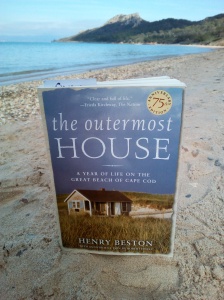
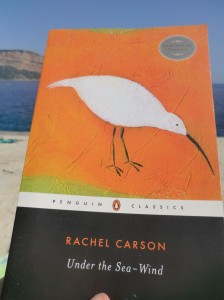 And though I enjoyed Henry Beston’s book considerably, Carson’s book for me left a greater impression, for who could not forget being made to see life through the eyes of the very creatures Henry Beston observes. Carson chose to narrate the three parts of her book from the point of view of a sanderling (bird), a mackerel, and a migrating eel. If you haven’t read it and loved this book, I am sure you will enjoy and appreciate Rachel Carson’s personal favourite of all the books she wrote, it is the perfect companion to The Outermost House.
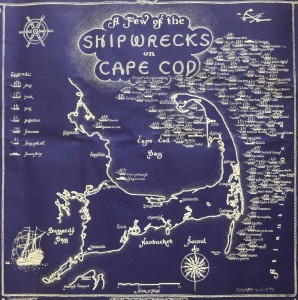 It was the late 1920’s and no doubt a year like any other, with its share of wrecks, disasters. The pragmatic attitudes of the locals, as likely to come to the rescue and do anything to help, as they are to salvage what is left, not always understood by the families of victims of the many shipwrecks.
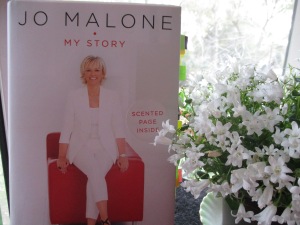 But Jo Malone the girl, wasn’t born into luxury. She was an ordinary girl raised in a family that struggled a bit on the good days, and a lot on the bad days, which were often brought on by her doting father’s gambling inclinations, her mother’s over-spending habit and the pressure to work long hours to keep the family afloat.
 When she really began to play around with fragrance, demand began to rise more than she could cope with, and Gary suggested they embrace the business, move it to its own premise and open a shop. Her business was beginning to overwhelm their living condition, he recognised the potential and offered to commit himself wholeheartedly it. That would be the beginning of Jo Malone, her signature brand.
 From there, a whirlwind of events follow and she will partner up with a perfume house in Paris, turning her instinct into a viable, enduring product. She tried to put into words her creative process and it is fascinating when she does, for it is something that can’t be copied or cloned, it is an insight into the pure magic of creativity, of how she uses image, colour and experience to create a scent.

 I absolutely loved this book, from it’s at times heartbreaking accounts of struggle in childhood, to the discovery of her passion, the development of her creativity and the strong work ethic that carried her forward, to finding the perfect mate and the journey they would go on together.
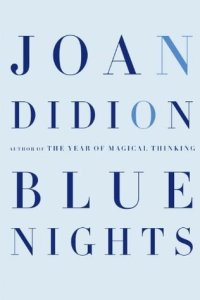 Written as a reflection on the death of her daughter at 39 years of age, the book begins as Didion thinks back to her daughter’s wedding seven years earlier, which then triggers other memories of her childhood, of family moments, of people and places, numerous hotels they have frequented.
 Although the main theme of the book is her daughter’s premature death, nowhere does she analyse or obsess about what actually happened in the way we vividly remember she did about her husband in My Year of Magical Thinking. Rather, the book appears to be as much an acknowledgement of her own ageing and decline, recognising and facing up to her own ‘frailty’, her obsession with her own health scares, recounting every little malfunction or symptom of a thing that never shows up on any of the numerous scans or tests she has. It is as if she writes her own denouement, to a death that never arrives, as the multitude and thoroughness of all the tests she has show how very much alive and in relative good health she is, despite herself.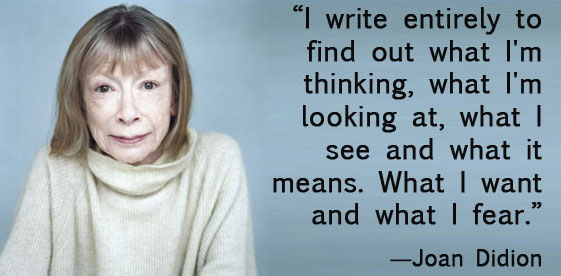




 Unforgettable Reading Experience Ever:
  Best Translations:
  Best Fictional Biography:
  Biggest, Most Satisfying Challenge:
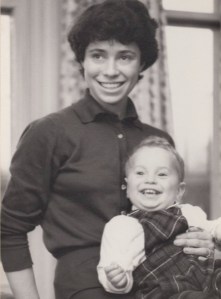
 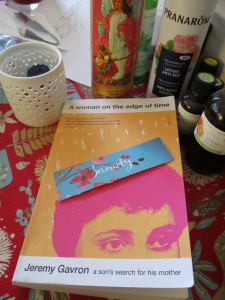 A Woman on the Edge of Time is a memoir that reads like a mystery, as Jeremy Gavron, a journalist, interviews family, old school friends, neighbours and colleagues of his mother Hannah Gavron, whom he has little memory of.


 Word by Word