Our Endless Numbered Days by Claire Fuller

Highgate London, November 1985
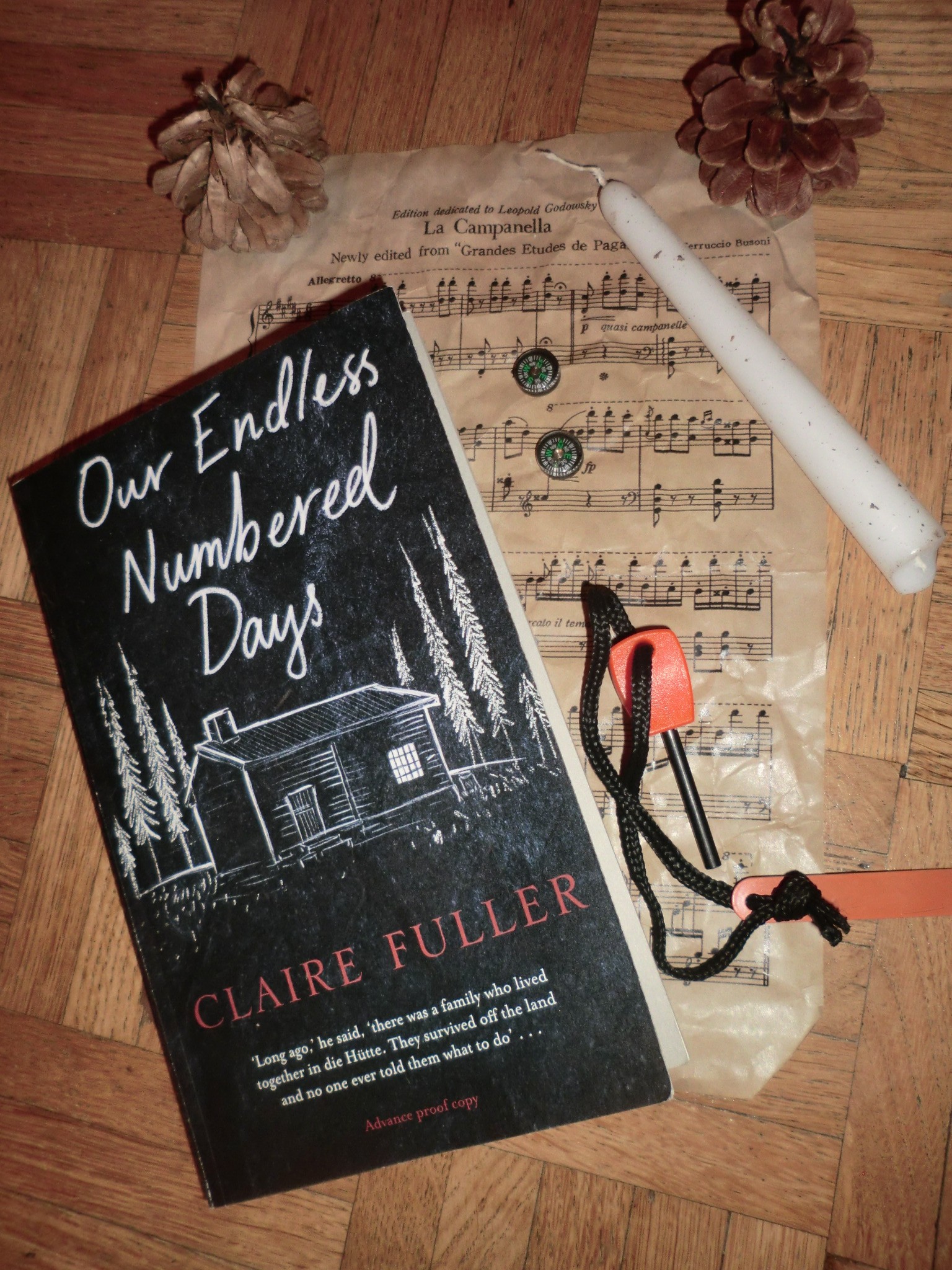
EndlessPeggy Hillcoat is 17 years old and has been back in her family for 2 months now, everything is familiar and strange at the same time. Her father is no longer there, but in his place is an 8-year-old brother Oskar, she hadn’t known of until her return. He is the same age now that she was when she and her father disappeared, for nine years, without trace.

Claire Fuller’s debut novel Our Endless Numbered Days is the story of Peggy, narrated looking back from the present, when she has returned, slowly revealing the events that occurred that summer when her mother travelled to her native Germany and her father decided to take her out of school early, so they could camp out in the back yard, applying his obsessively learned survivalist skills, as if in preparation for the great Armageddon.

“When my father invited members of the North London Retreaters to our house for meetings, I was allowed to open the front door and show the half-dozen hairy and earnest men into Ute’s sitting room. I liked it when our house was full of people and conversation, and until I was sent up to bed, I lingered, trying to follow their discussions of the statistical chances, causes and outcomes of a thing they called ‘bloody Armageddon’.”

Peggy’s mother Ute was a young concert pianist and at 25-years-old, while on a tour of England, met her father, a stand-in page-turner eight years her junior.

Throughout the story and as witnessed in the quote above, there is a level of perceived inferiority surrounding the father, he is at pains to fulfil his ambition, even if it is only to complete the fallout shelter in the basement, a job he completes on the same day Peggy returns from school to learn that her mother had gone on a concert tour of Germany without saying goodbye or telling her.

The chapters unfold and we witness Peggy happily camping out in their backyard, which backs onto the leafy Highgate cemetery, with her father, learning survivalist skills and it almost feels like a natural extension of their fun that they will put their learnings into practice by packing items written on the endless lists they’ve been creating to depart on a journey into a larger version of the backyard.  But we embark with hindsight, already knowing this is a forbidden trip, one that required them to take their passports, traverse a river and seek out that cabin in the woods Peggy’s father had been telling her about for a long time ‘die Hütte’.

It is because we are forewarned that nine years have passed, that we read of the camping trip with mild horror, wondering how they are going to survive and what might have occurred during this eternity of days that will follow. Especially when her father tells her that they are the only survivors, that the world really has ended. There is no going back.

“Each morning since we had arrived, my father had cut notches in die Hütte’s door frame, but when he got to sixteen he decided to stop.

‘Dates only make us aware of how numbered out days are, how much closer to death we are each one we cross off. From now on, Punzel, we’re going to live by the sun and the seasons.’ He picked me up and spun me around, laughing. ‘Our days will be endless.’”

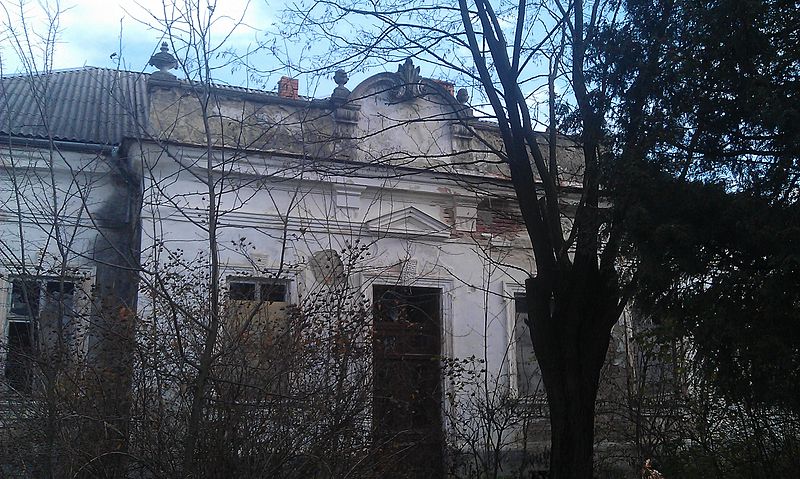
highgate-cemetery-grave

Highgate Cemetery

Ironically, though far from civilised society, Peggy learns the one thing her mother never passed on to her, how to play the piano. One of a number of obsessions that her father embarks upon, he fabricates a piano out of wood after Peggy who he has renamed Punzel expresses disappointment that the cabin doesn’t possess a piano as he had promised. He has brought the sheet music for ‘La Campanella’ with him, which she will learn by heart on an instrument incapable of making a sound.

‘Its going to take a lot of practice, Punzel. Are you sure about this?’

I knew it was a warning he thought he ought to give, rather than a challenge he wanted me to back down from. There was an enthusiasm bubbling inside him, like he hadn’t had since he started work on the fallout shelter. My father always needed  to have a project.

As the days pass, we become aware of the deterioration in stability of the father and the importance of every ritual to ensure their survival. Right from the beginning we read with a base layer of tension, as if waiting for something bad to happen, wondering what is going to tip the balance, who is going to survive and what the repercussions of these endless days will be.

Fuller keeps us on tenterhooks right until the end, even though Peggy has returned home on the very first page, right from that first page, when she cuts a picture of her father’s head out of a photo and hides it in her underclothing, we sense something not quite right. And by the end we too will be going out of our mind needing to know why.

Our Endless Numbered Days is an extraordinary debut and like Franz Liszt’s piece of classical music La Campanella, it draws us in, lulls us into its rhythm and carries us up as it builds to a crescendo, before crashing us down to experience its wild, unruly finale.

Note: This book was an ARC (Advance Reader Copy) kindly provided by the publisher.

Other Books by Claire Fuller (my reviews)

Swimming Lessons

Bitter Orange

Buy a Copy of Our Endless Numbered Days

Wake by Elizabeth Knox

Vinter's LuckElizabeth Knox is a well-known New Zealand author whom I first discovered via a book club I belonged to in London. We read her astonishing novel The Vintner’s Luck which provoked an animated discussion as opinions were so diverse, all agreeing we had not read anything like it before.

Since then she has published a fascinating pair of young adult novels The Dreamhunter Duet, a sequel to The Vinter’s Luck and another YA (young adult) book Mortal Fire, which I plan to read this year.

I met Elizabeth Knox when she and three other New Zealand writers visited France as part of Les Belles étrangères cultural visit some years ago and so I was delighted when she asked me a few questions recently about our local library here in Aix-en-Provence, a location that may feature in one of her upcoming adventures. So thanks Elizabeth for the copy of Wake, it certainly had me reading outside my comfort zone, but within a very familiar landscape.

Wake will be published in the UK by Little, Brown Book Group in March 2015. The book covers below show the New Zealand version on the left, illustrated by Dylan Horrocks and the pending UK version.

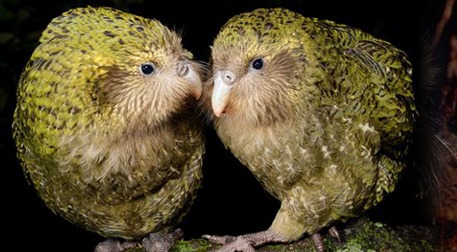
wake ukWake Elizabeth KnoxA sleepy, waterfront town in the South Island of New Zealand with a Kākāpō reserve is the setting for this macabre, sci-fi adventure, revolving around 14 survivors of an invisible, destructive and still hungry presence that has created  a kind of net outside which the survivors can not move without dire consequences.
When the presence arrives, as it does in the opening pages, death, destruction and bizarre, disgusting action follows, the kind of thing that might normally turn this reader off, however I have faith in the author, an adept mistress of storytelling, so I persevere, despite the feeling of dread as the initial pages are littered with zombie-like scenes, the kind I would never wish to see on celluloid.

The novel is narrated from the point of view of the survivors, as they learn how to stay within the threatening environment without succumbing to this invisible presence. They try to understand what has happened and what is continuing to happen, how to survive and overcome the insidious presence and whether they can trust each other.

It reads almost like a reality television show of survival, but in reverse because they remain in the town they know, only now they are its only inhabitants having no contact with the outside world and a sense of pending doom as their isolation pushes each of them toward their own mental limits.

We get to know the individual characters, thrown together seemingly at random, how their strengths and weaknesses both help and hinder the group and how as a team they attempt to survive.

With so many characters and little if any connection between them before this catastrophe, the story is as much an unveiling of character, as it is a journey toward its own conclusion. I found it a compelling read, once I got past the initial horror and enjoyed the mystery of trying to predict which characters were going to contribute to the final outcome.

There is a strong sense of place and whether it was the writing or the familiarity and ease at which I could imagine the surroundings, I found it a very visual read, I could see faces and hear the dialogue as I read almost as if I was indeed watching that version, I said I wouldn’t. Well, maybe with a cushion to hand when the creepy music starts.

It is a novel that keeps you thinking and guessing, trying to understand what the force portrayed actually is and whether it has a weak or vulnerable spot. It is made all the more complex by being invisible and the reader having no insight into what is happening in the world outside the devastated zone.

And the flightless, endangered Kākāpō? A metaphor of survival perhaps?

The Kākāpō, a large, flightless nocturnal bird, critically endangered, only 126 living as of March 2014

The Kākāpō, a large, flightless nocturnal bird, native to New Zealand, critically endangered, only 126 living as of March 2014

When did you last read a book that was outside your regular comfort zone? Did it surprise you?

Portrait of the Mother as a Young Woman by Friedrich Christian Delius tr. Jamie Bulloch

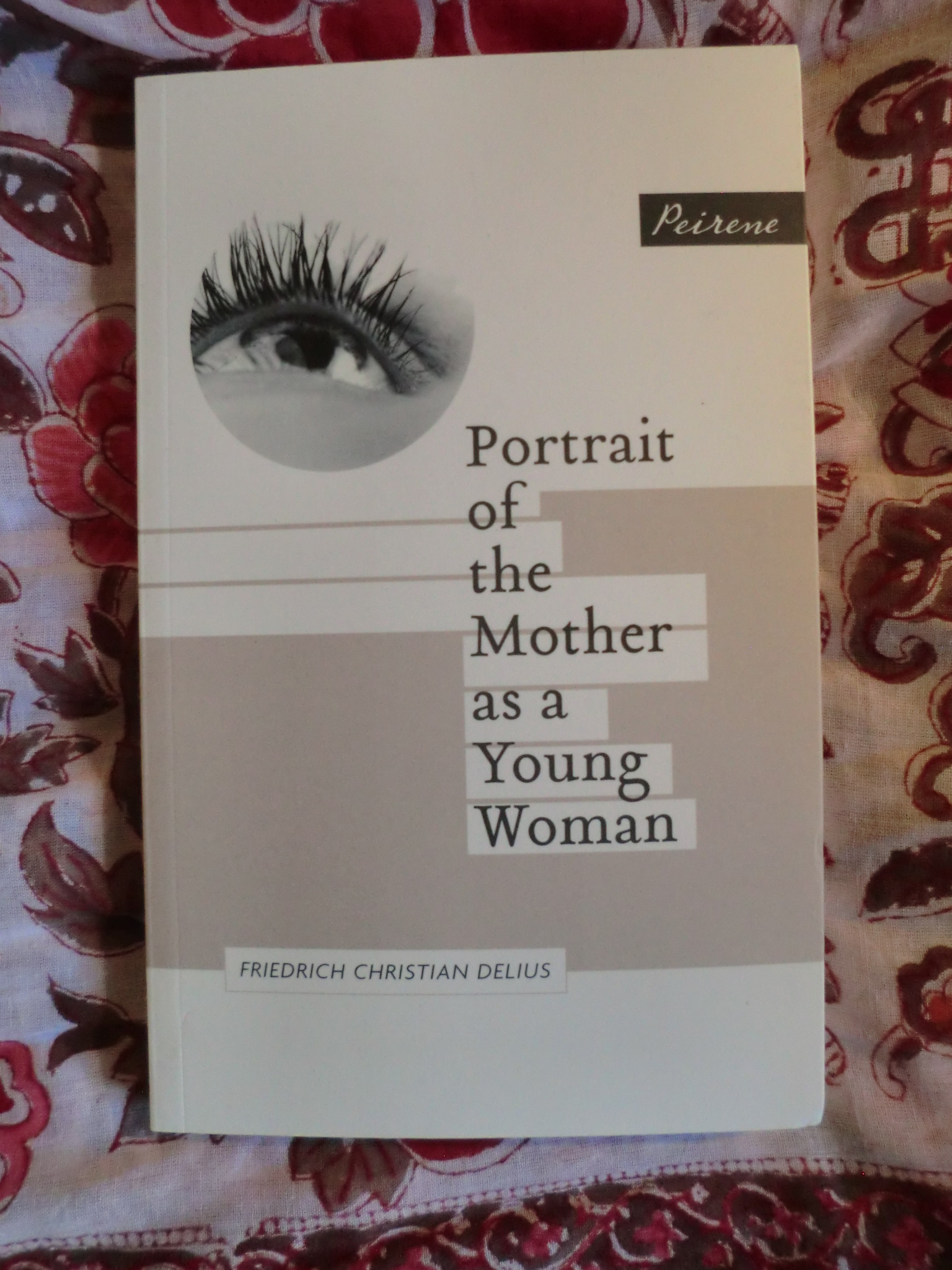
Portrait of the MotherThis 117 page long single sentence in a novella, is the third and final book in the Peirene Press series entitled Female Voices: Inner Realities.

If you missed the first two, you can read my reviews here:

Beside the Sea by Véronique Olmi (translated from French by Adriana Hunter)

Stone in a Landslide by Maria Barbal (translated from Catalan by Laura McGloughlin and Paul Mitchell)

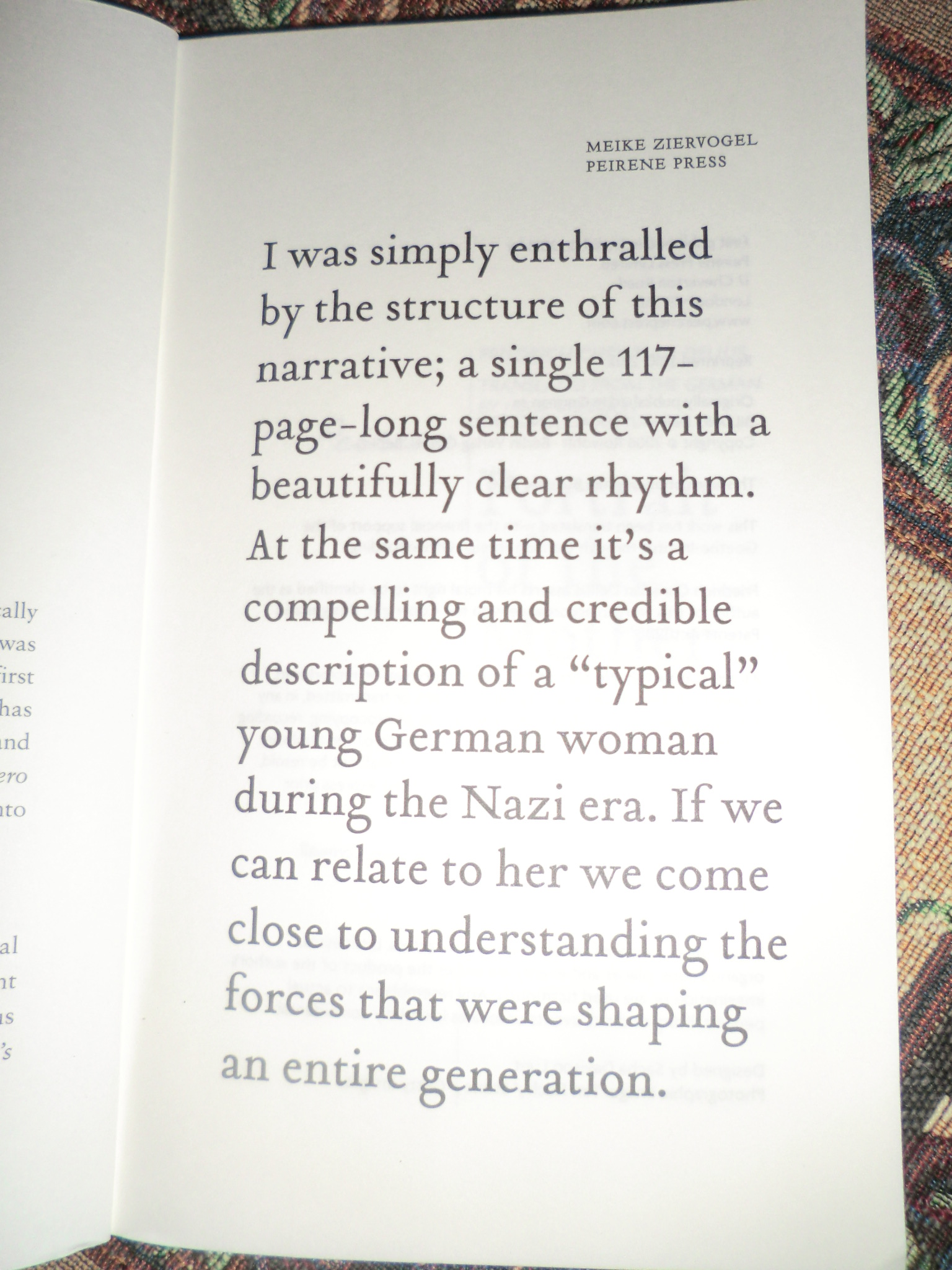
In my previous review I mention the enticing page at the beginning of all Peirene books where publisher Mieke Ziervogel shares what drew her to choosing this book for translation into English.

Here is a glimpse at what she says about this book:

Portrait 2

The book is set in Rome in 1943 when Italy and Germany remain allies during the second world war. The narrative takes place during an afternoon stroll as our young woman on the brink of becoming a mother is walking towards a Lutheran church where she will attend a classical concert.

Eight months pregnant, she is the young wife of a German solider and had been waiting for him to join her in Rome; after briefly reuniting, one day later he is redeployed to Tunisia. Alone again so soon, she walks to the Bach concert thinking about how her life has changed now as a married woman and how distant she feels from everything around her. She recalls recent memories of the short time spent with her husband wondering whether he will return to her safely or not.

Rome 1943Being outside her own country, without her husband and not yet active in her role as mother, it is as if she becomes more acutely aware of who she is, there is little to distract her and she often prefers to keep to herself.

Even the friendship that naturally developed with her room-mate Ilse, she keeps in check, worrying about the implications of being associated with those whose views are more vociferous than her own, she who wishes for a quiet life.

she worried about Ilse, who rarely had a good word to say about authority that was

invested by God, about Hitler and Mussolini, only a few days ago she had said Hitler always demanded that people show no weakness, but human beings were not made like that, and Mussolini always demanded that people had to hate the enemy, but the Italians that she knew were not fond of hatred, why should they hate the English and the Americans,

fortunately Ilse had broken off at this point, perhaps out of consideration for her, because she,

the younger woman, who was always silent when national and political questions were discussed, had just for a second wondered why it was necessary to hate the British and Americans, and in the same instant this forbidden thought made her feel guilty, confused and horrified,

She is not despondent for she has a deep faith and whenever her thoughts turn towards herself she recalls that war is God’s most difficult trial, lamenting:

“God, who is love, delivers this all to us, that it may benefit us in the end,

for it was un-Christian to shed tears for one’s own misfortune and to forget the far greater misfortunes of others, the joys of life were limitless”

Her thoughts enable the reader to understand her reluctance to do anything that might jeopardise what slim chance she may have at a normal life, she dislikes that by virtue of being foreign she already stands out, the opposite of what might give her peace of mind.

Portrait of the Mother as a Young Woman is a spellbinding portrayal of one woman’s internal conversation, her method of coping with the strangeness of her environment, talking herself into maintaining a calm state of mind, rationalising why they have found themselves in this situation. Though it is a trial for her, it is not enough to prevent her dreaming of the life she wishes they were living, something that seems increasingly like a fantasy, as the probability of her husband’s return grows slimmer as each day passes.

Poignant in its simplicity, expressing that universal feminine desire for love in a safe, nurturing environment.

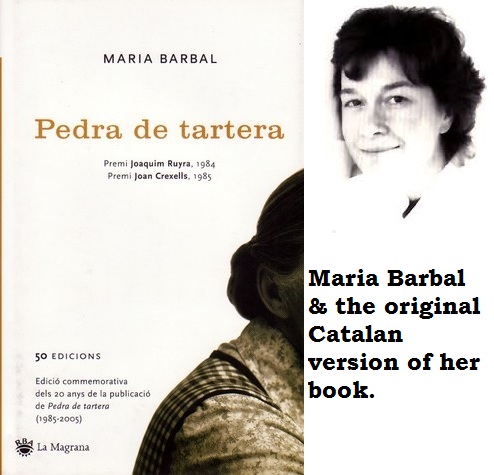
Stone in a Landslide by Maria Barbal, tr. from Catalan by Laura McGloughlin and Paul Mitchell

Stone  in a LandslideThis is the second in the Female Voices: Inner Realities series from Peirene Press.

Publisher, Mieke Ziervogel introduces each of their books with one or two sentences in extra-large font on the second page and it’s a page that you find yourself looking forward to whenever you pick up one of their books.

She shares what attracted the team to selecting that title as one of the Peirene books to translate into English and share with readers.

For Stone in a Landslide, she had this to say:

“I fell in love with Conxa’s narrative voice, its stoic calmness and the complete lack of anger and bitterness. It’s a timeless voice, down to earth and full of human contradictory nuances. It’s the expression of someone who searches for understanding in a changing world but senses that ultimately there may be no such thing.”

We meet Conxa as a 13-year-old girl living in the Catalan Pyrenees, Spain at the beginning of the last century, though she narrates the story from the other end of her life, reflecting back on her journey as an old woman.

One of six children, the opening lines tell us how she came to live with her childless aunt and uncle, leaving her family, home, village and mountain behind at such a tender age.

“Anyone could see that there were a lot of us at home. Someone had to go. I was the fifth of six children – Mother used to say I was there because God had wanted me to be there and you have to take what He sends you. The eldest was Maria, she, more than Mother, ran the house.  Josep was the son and heir and Joan was going into the church. We three youngest were told a hundred times that we were more of a burden than a blessing….So it was decided that I, who was level-headed and even-tempered, would be sent to help my mother’s sister, Tia.”

LandslideShe remembers going to school and how fortunate she was to be able to, on account of having older sisters who stayed home to do the work. Three winters she went to school, until she joined the family of her aunt and uncle and then had to help them with the outdoor work.

In short chapters of around two pages, we observe the change in Conxa’s life, her new duties, how people perceive her initially as an outsider and how that perception begins to change, she has become an heir to land thus her marriage prospects have increased. She suffers silently from being separated from her family, but in time accepts her new role and life.

“Time passed and no one spoke of home. Of my family. In five years I had seen Mother and Maria only once, when they came for the Festa Major during my first year at Pallarès….My aunt and uncle said nothing about going back and I didn’t dare mention it. Was I happy there? I had no idea. I’d lived with my heart in my mouth a bit, worried about what they might throw back in my face. Maybe the poverty of my family…But I’d got used to them and their way of doing things. And it’s true, the thought of leaving Pallarès to return to Ermita became stranger every day.”

We learn through Conxa’s experiences how people were perceived, eldest sons were destined to be the heir, a second son may have had to learn a trade and were therefore seen as lesser prospects. Ownership of land accrued status, men who earned a wage were less desirable.

“They knew him to be hard-working and quick-witted but, because of the nature of his work, he appeared to be a drifter and freer than most men, who only looked at the ground to work it or the sky to figure out what the weather will bring. I realised that they saw him as an outsider, someone who’d managed to earn himself a living, but this had more or less divided him from his family.”

Falling in love with a tradesman is about as rebellious as Conxa gets, her aunt and uncle soon realise that Jaume is a good match, and as with her life as the adopted daughter Conxa becomes as accepting of her new circumstances in her life with Jaume, who must by necessity travel a lot for his work.  He is more outspoken and for this Conxa will experience hardship as the Spanish Civil War impacts even the quietest villages.

Stone in a Landslide is such an apt metaphor for Conxa and yet she was not like the others. She doesn’t complain, she loves genuinely, she accepts her circumstances and only at the end when she is physically removed from her natural surrounding does she come close to realising how much a part of that landscape she is as a person. She coped with many changes, from daughter to adopted daughter, lover, mother within her natural environment, but the final move puts her somewhere beyond reach, beyond comprehension of how to be who she really is.

“Perhaps I had turned into a living stone, or it was just that I had never known how to rebel…. I felt that I was going to need to be strong, but I had no idea why.”

Another excellent addition to the collection and discovery of another wonderful writer.

Maria Barbal, born in 1949, is considered the most influential living Catalan author. The clarity with which she presents human relations and the passage of time has earned her critical acclaim and a wide readership. She lives in Barcelona.

Next Up: Portrait of the Mother as a Young Woman by Friedrich Christian Deluis.

Female Voice Inner Realities

Under the Tripoli Sky by Kamal Ben Hameda tr. by Adriana Hunter

We are in the city of Tripoli, bordering the Mediterranean in the 1960’s, though this is no seaside idyll.

Tripoli SkyThe narrative follows in the footsteps and the mind of a boy named Hadachinou who prefers the company of his mother, her friends, great-aunt’s and escorting girls sent on errands who are not yet kept indoors, bound by the shackles of marriage, in a society where a river of seething discontent courses through the veins of many, where the sexes barely tolerate each other and anyone who seems to have escaped the marriage trap is resented their so-called freedoms.

Hadachinou is privy to the thoughts, gossip and attitudes of women, a witness to their interior lives, he listens to their stories and absorbs their repressed desires as his own begin to awaken.

The tea ceremony was the only part of the day when my mother and her friends could live their lives in real times and tell their own stories. At last they could talk about dreams, longings and anxieties , all in the same breath and their bodies were at peace.

I sometimes wondered how these women who were all so different were able to spend hours at a time, each talking about her own god, her own people and thoughts, free to be wildly outspoken but without provoking any true conflict. It was because they had no power to preserve and no possessions to watch over. That was for the people on the other side of the wall: the men, the sheikhs, the governors and their hunting dogs! Scheming and calculating, diplomacy and power struggles were their domain.

Here with the women, my guardian angels, there were just words, spoken openly and easily, flitting and whirling about, a life force in themselves. Without these moments of trusting abandon, they would have dried up with sorrow. Or imploded as they toiled over their cooking pots.

Taynal Mosque

Taynal Mosque Source: wikipedia

While the men are at work, or at the mosque or in the coffee houses, the women finish their work and make time to see each other.

Here, great-aunt Nafissa has had enough of the women bad mouthing his mother’s childhood friend Jamila, words they only speak when his mother leaves the room, venomous remarks spiralling into bitterness about what they perceive as her secret life; flushed with rage, aunt Nafissa rails against them:

‘Leave Jamila alone,’ she cried. ‘Let her live her life. Its only because you’re jealous that you see evil in everything. She and her friends allow themselves freedoms you don’t have, freedoms you envy because your husbands keep you on a tight leash. What would you have her do? Stay at home like you, sitting on cushions and sucking on loukoums while you wait for men who never come home? You think those women are living bad lives? You make me laugh! But you don’t know when to hold your tongues, that’s for sure, and you’re full of spite. And, anyway, it’s not as if any of this has ever stopped you taking their money!’ she added, always ready to speak out against injustice.

OldTripoli

Old Tripoli Source: wikipedia

It is not easy to read about a repressed patriarchal society without much glimmer of hope, a slice of life narrative set in a pre-Gaddafi society on the verge of change.

I found it a sombre read, left wondering if this boy will be changed by virtue of his proximity to the women folk, or whether that might become a reason for his need to escape, lest he not fit in.

Looking out to sea, I remembered what Hadja Kimya had said: ‘Hadachinou, keep yourself busy doing simple things that delight you. Give yourself a goal. The soul of life is the little things, the minor events no one notices… That’s where life is, the pleasure of being alive, otherwise there’s just this vast blueness casting its shadow over us. Go on, keep yourself busy, do something, and then you might find yourself one day.’

This is cultural insight beyond the normal bounds of the English language, thanks to the translation of Adriana Hunter and the passion of Peirene Press in bringing these kinds of stories into the mainstream.

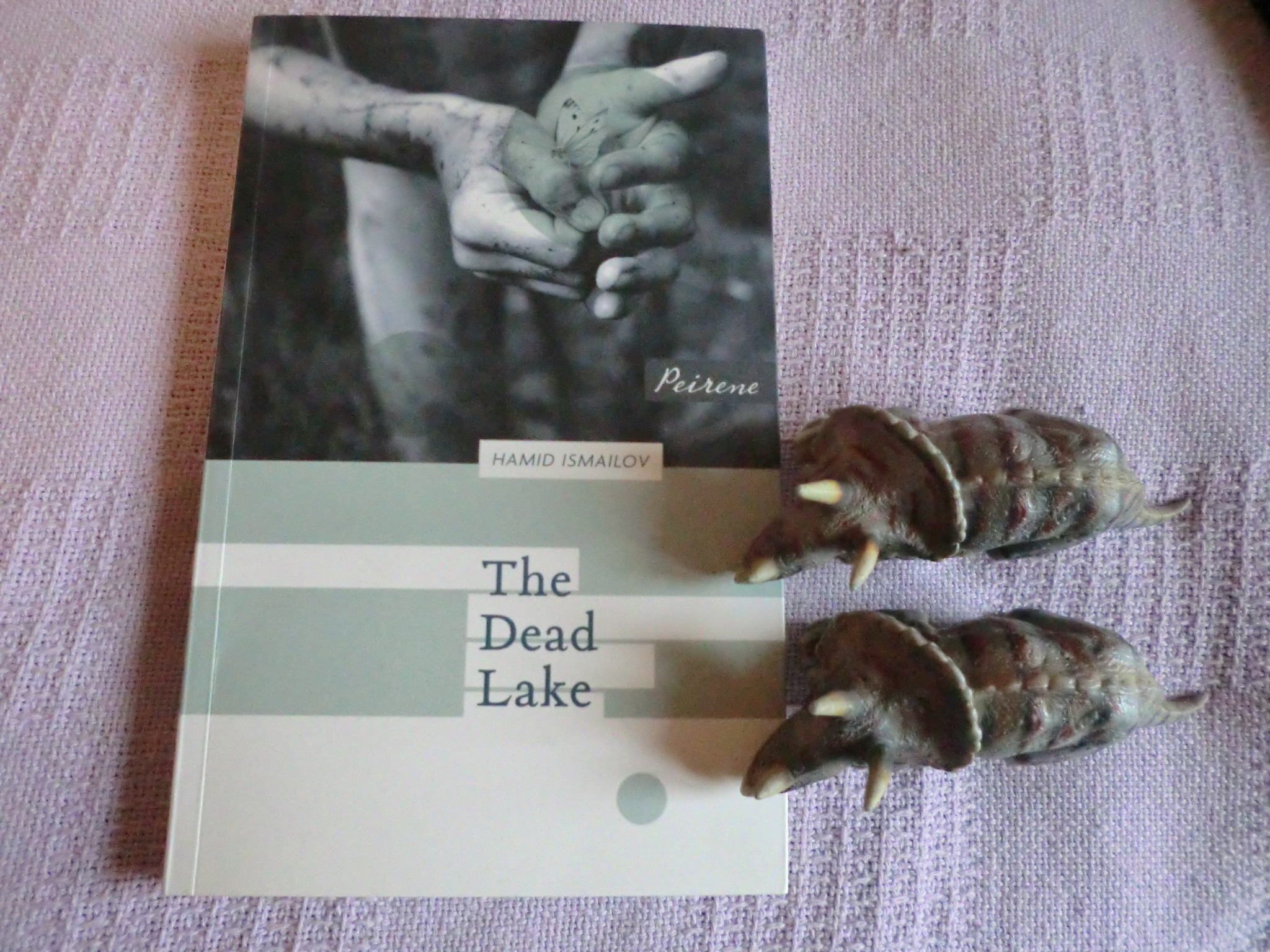
The Dead Lake by Hamid Ismailov, tr. Andrew Bromfield

Dead Lake 2An astonishing tale tinged with sadness, as recounted by the protagonist Yerzhan to a stranger on a train journey across the steppes of Soviet Kazakhstan, that in part continues to be imagined by the listener as from time to time, the young narrator sleeps.

The story begins when the boy enters the carriage playing Brahms on his violin in a manner that causes everyone to stop and look at him, not believing it possible that a boy who looks about ten to twelve-years-old could play to such perfection and with such awe-inspiring panache.

“Then, just as he had the entire carriage gaping after him open-mouthed, he broke off in mid-note. He slung the violin back over his shoulder like a rifle.

‘Wholesome local beverage – entirely organic!’ he exclaimed in a thick, adult voice. He swung a canvas sack down off his other shoulder and pulled out an immense plastic bottle of a yoghurt drink, either ayran or kumis. I approached him, without even knowing why.”

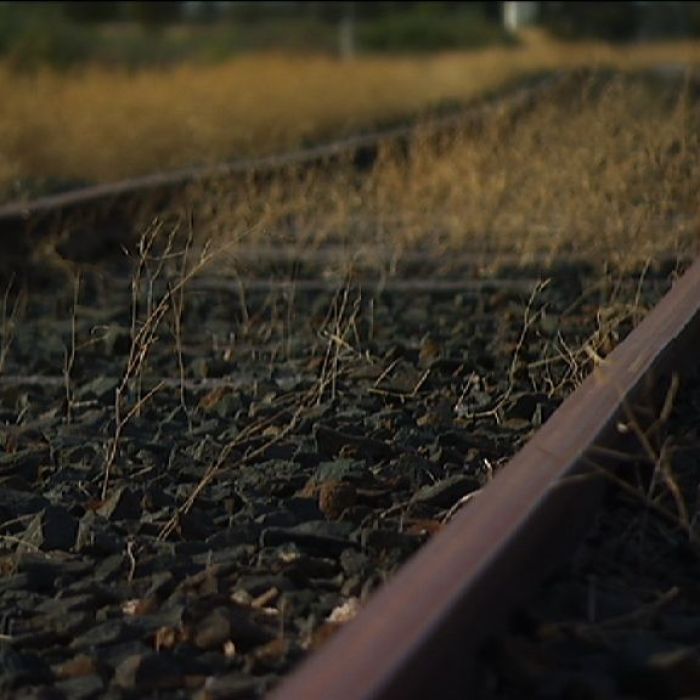
train trackYerzhan grows up at a remote railway siding in a part of the country where atomic weapons are tested. Two families live near each other, their lives more intertwined than appears on the surface.

Yerzhan and the neighbour’s daughter Aisulu travel many miles by donkey to go to school and many more miles to see the strange but talented bachelor, Petko, a Bulgarian violin teacher.

Every so often the ground shakes, another sun rises and everything is still. Then there is the Zone, that area where it is so silent, his ears ring.

“And the thing that loomed over him like a visceral fear could happen in the middle of the sweltering summer, when sheep suddenly started bleating as if they were under the knife and went dashing in all directions, cows dug their horns into the ground and the donkey squealed and rolled around in the dust…

And a slight rumble would run through the ground, Yerzhan’s legs would start trembling, and then his whole body, and the fear would rise up from his shaking knees to his stomach and freeze there in a heavy ache, until the sky cracked over his head and shattered into pieces, crushing him completely, reducing him to dust, to sand, to scraps of grass and wool. And the black whirlwind hurtled past above him with a wild howl.”

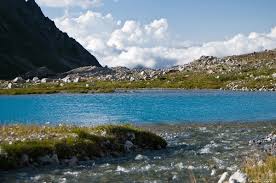
A young boy playing the dombra

A boy plays the dombra

His friend Aisulu’s Granny tells him a story of his conception and birth, intertwined with local legend; not knowing who his father is, he often replays the story in his mind, trying to understand it, and who he is.

“Granny Ulbarsyn’s story  wasn’t the only thing that had sunk deep into Yerzhan’s heart.  Grandad’s dombra playing stayed with him too. When no one was looking the boy took the instrument down from its nail high up on the wall. And while his grandfather tapped with the hammer on railway carriages, Yerzhan strummed the dombra secretly, imitating the old man’s knitted brows and hoarse voice. It didn’t take long before he picked out a few familiar melodies and then, with the keen eye he used to keep watch on Uncle Kapek’s behaviour, he followed and memorised  his granddad’s finger movements.”

Dead LakeYerzhan learns the dombra and violin and is bright, but the real light in his life is Aisulu, a light that gradually fades upon his reaching the age of 12, when he walks into the forbidden, radioactive Dead Lake to impress her and from that day on stops growing, destined to watch her pass him by.

“Other people noticed it too and wanted to help. Granny Ulbarsyn fed him with the livers of new born spring lambs, Grandad Daulet ordered carrots from the city through his  friend Tolegen,  and Uncle Shaken brought disgusting fish oil back from his shift. But that only produced a foul-smelling burp! Yerzhan ate it all. But he had stopped growing.”

Another of Peirene Press’s excellent novella’s, this really is an afternoon read, but so rich in the telling, it is a pleasure to go back and reread passages with the familiarity of having read the story. It is a tale tinged with  inevitable sadness as people live with the invisible terrors that are an environmental legacy of the Cold War.

If you want to read more contemporary European literature outside the English language, you can do no better than take out a fabulous subscription with Peirene Press. Three novellas a year and the kind you’ll rarely find in most bookshops.

Note: The author Hamid Ismailov was born in Kyrgyzstan and moved to Uzbekistan as a young man. He writes in both Russian and Uzbek and his novels have been translated into many European languages. Sadly his work is banned in Uzbekistan today and he has had to flee the country due to his ‘unacceptable democratic tendencies’.

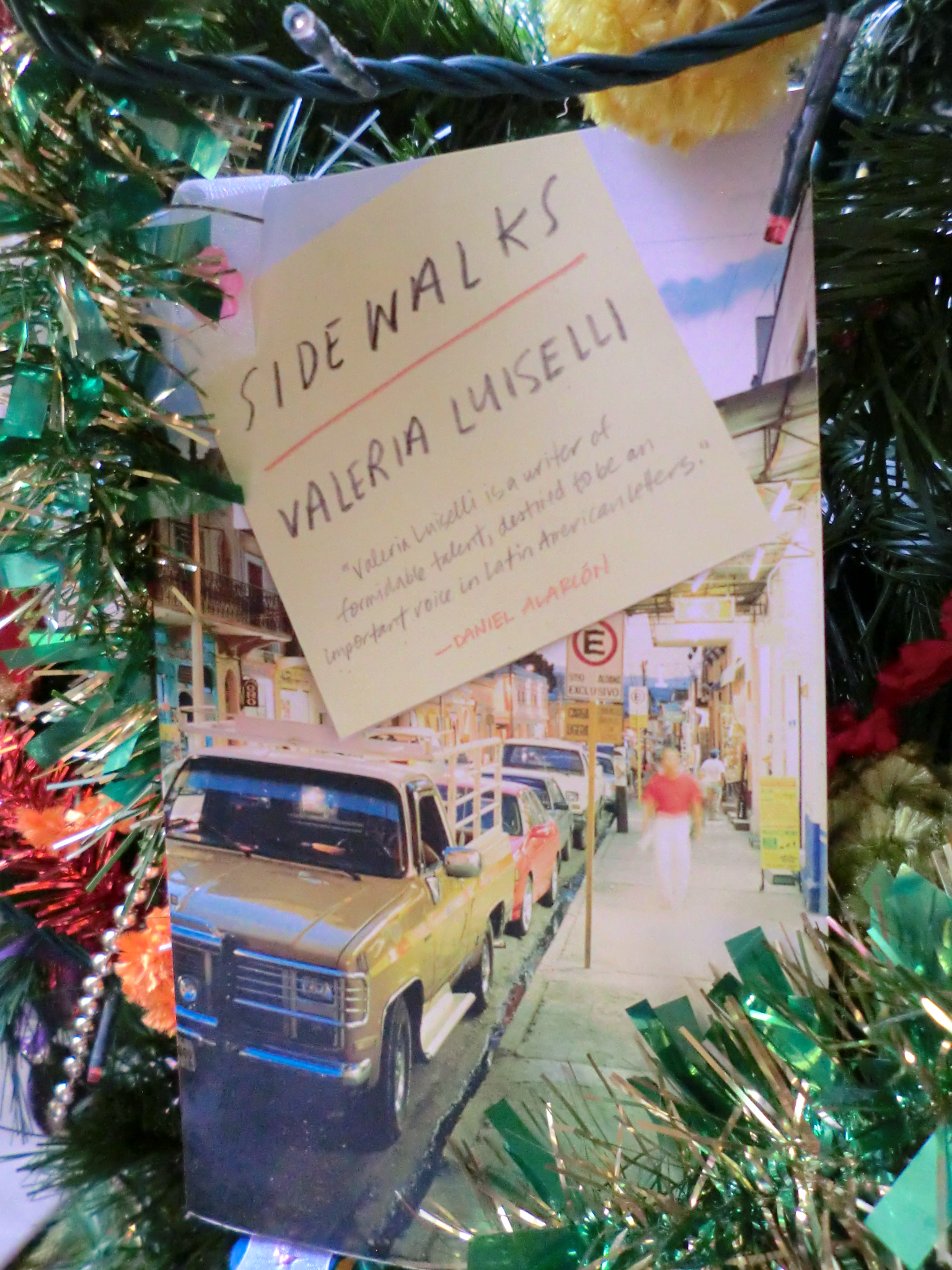
Sidewalks – Essays by Valeria Luiselli translated by Christina MacSweeney

SidewalksValeria Luiselli is a philosophical meanderer whose roving thoughts bring her to a cemetery in Venice in search of Russian poet,  Joesph Brodsky’s tomb and wandering that alluring city’s streets so late at night she is locked out of the one room she managed to find in a convent.

She ponders the map with the slow-moving icon of a plane on the screen as she flies home and thinks about the layout of the land beneath and later will find a connection between a photo of cartographers in the Mexican Map Library and  Rembrandt’s The Anatomy Lesson of Dr. Nicolaes Tulp.

Sidewalks sees her leaving the four walls of her apartment late at night for a last cigarette outside the front door, seeking escape and encountering the advice and wisdom of a doorman who shares his own long life views on how one best comes to know thyself.

“If there still exists a gaze blessed with liminal wisdom, it is the gaze of night-shift doormen. They are the only true free-thinkers – generous men capable of conversing intelligently at midnight; empathetic accomplices, offering the consolation of a companionship replete with the same reprehensible vices you yourself have and defend.”

She laments the age of the individual computer, the window inside the window that has all but eliminated household drama and made high-rise voyeurism unexciting if not nonexistent.

“It is clear that the personal computer is the great modern attack on good old-fashioned voyeurism. From the moment these machines were installed in our homes, the irreversible process of the degeneration of character began and ruled out the possibility of anyone doing anything interesting for the delight of their voyeuristic neighbour.”

Papelos

Original Spanish version

She is interested in spaces, voids, the edge of things, she tries to make sense of her home town in Mexico, a city whose first plan was allegedly scratched into sand and has continued to sprawl out of any recognisable or logical shape ever since.

Her essays reference other essayists as things she observes in her meandering bring back lines once read and remembered, passages of long dead authors become an old-fashioned, enjoyable distraction for a young woman, those words from the past arising unbidden while out walking sidewalks, no electronic media in sight.

In an essay on the river Spree, in Berlin, Fabio Morabito writes:

“A river tends to contain the city it crosses and to curb its ambitions, reminding it of its face; without a river, that is, without a face, a city is abandoned to itself and can become, like Mexico city, a blot.”

It is a slim volume and many of the essays are split into titled paragraphs, the first essay littered with the names and dates of the dead inhabiting the same resting place as Brodsky, although it wasn’t clear to me whether there was a link between the content and the named.

It feels as though there could well be much more to this collection than is picked up on first reading, especially given the original work was written in Spanish and many of the named places are foreign.

Intelligent, introspective essays that delight in being out and about and an appreciative and noteworthy introduction by the Dutch author and translator Cees Nooteboom. An author to watch out for.

Brodsky Luiselli

Joseph Brodsky & Valeria Luiselli


Migrating Voids by David H Walker

Migrating VoidsMigrating Voids is at its heart a coming-of-age story of 18-year-old Gideon Bradshaw, a young man who lives with his mother and stepfather, who at the beginning of the story remains in the latter stage of adolescence, remote and disconnected from his family and unwilling to view them from any other perspective that that of indifference and mild resentment.

“Two A levels and a place on an HND course at Technical College should have boosted his confidence, but no: he still felt that people were judging him and finding him wanting.”

Ambivalent about his studies, he takes up a part-time job at the local pub, where a chance encounter with an inebriated out-of-town pharmacist, opens his eyes to pathways he had not considered, a change in direction that once he decides upon it, resonates within him and ignites his interest in his future studies and the local area.

“Then he took a weekend job waiting-on at the Knott Arms, and discovered something he could do well. Not that he was the world’s best waiter; he simply found that he slipped into the role with an ease that surprised him.”

Granville is an older man, who owns a chemist’s shop in Manchester and often visits his sister, the widow who owns Harkcliffe Hall.  When he falls asleep in his chair after another solo drinking session, the Bar Manager gets him to surrender his keys and asks Gideon to drive the loner home.

After delivering him safely to his sister, the widow Judith also known as Lady Leybourne, invites Gideon to visit again and proposes alternative work for him, to assist her in the organisation and indexing  of her late husband’s business papers so that they can be passed on in time to the appropriate beneficiary.

Salt formation

Salt caverns, subsidence and sinkholes

In doing so Gideon develops an interest in the documentation which reveals the history of the estate and the area, the business that supported it and the controversy surrounding the underground salt mines that lead to the demise of the business.

Granville too, takes Gideon under his wing, inviting him to walk around the land, taking him to a somewhat clandestine dinner, leaving the reader questioning the older man’s motives. Gideon is appreciative of both the siblings attentions and doesn’t wish to undermine his good fortune having found an interesting job and a generous employer, however there is an air of unease that makes him watchful and ever more curious despite the growing disquiet that lurks on the edge of his consciousness.

Lady Leybourne is childless, thus the question of an heir hangs over the Estate and Gideon, a motiveless outsider, becomes drawn into a complex web of secrets and intentions that bring an air of menace to the surface of the dreamy existence he has been dwelling within.

“He had envisaged the possibility of entering their lives, but invisible chasms had opened up between him and them. Of course he was sharing secrets separately with Judith and Granville, but was bound to each in a complicity that excluded the other.”

It is something we take for granted, that the ground beneath us is solid and immovable and as Gideon walks with Granville across the land and listens to him speak, he too becomes aware of the falsity of that notion, as events of the past that no one ever speaks about are brought into the present, the land form around them seen in a new light as their secret history is unveiled.

“Gideon was becoming increasingly aware that the world he knew and had lived in up to now was a thin veil on the surface of the real world.”

dolyna-salt-mineThe presence of “voids” has both a physical and psychological aspect, representing that which exists and that which is unknown or hidden, be it the physical landscape and its brutal history, the people who live within it, their past and the secrets they harbour, voids that threaten destruction regardless of their form or origin.

Just as with Gideon’s coming of age, the novel is about noticing what was already there, that which is hidden from view and will remain so until we scratch beneath the surface, unless we are open to suggestion, to ideas, to understanding how what came before has an effect on what we see and understand now.

Migrating Voids is a brilliantly conceived story that starts at a leisurely literary pace, then surprises with its shocking, tidal revelation keeping the reader captivated and interested until its climatic end.

Unearthing its mystery, the reader can’t help being curious about its historical origin, the story inspired by real landscapes and historical fact, the book dedicated to the Project Wyre Group, a campaign of opposition to the storage of up to 900 million cubic metres of natural gas in 19 underground salt caverns at Preesall Saltfield.

All those sinkholes suddenly appearing all over England? This story could not have been better timed, than to have appeared at the same time as those other voids are opening up in the urban landscape.

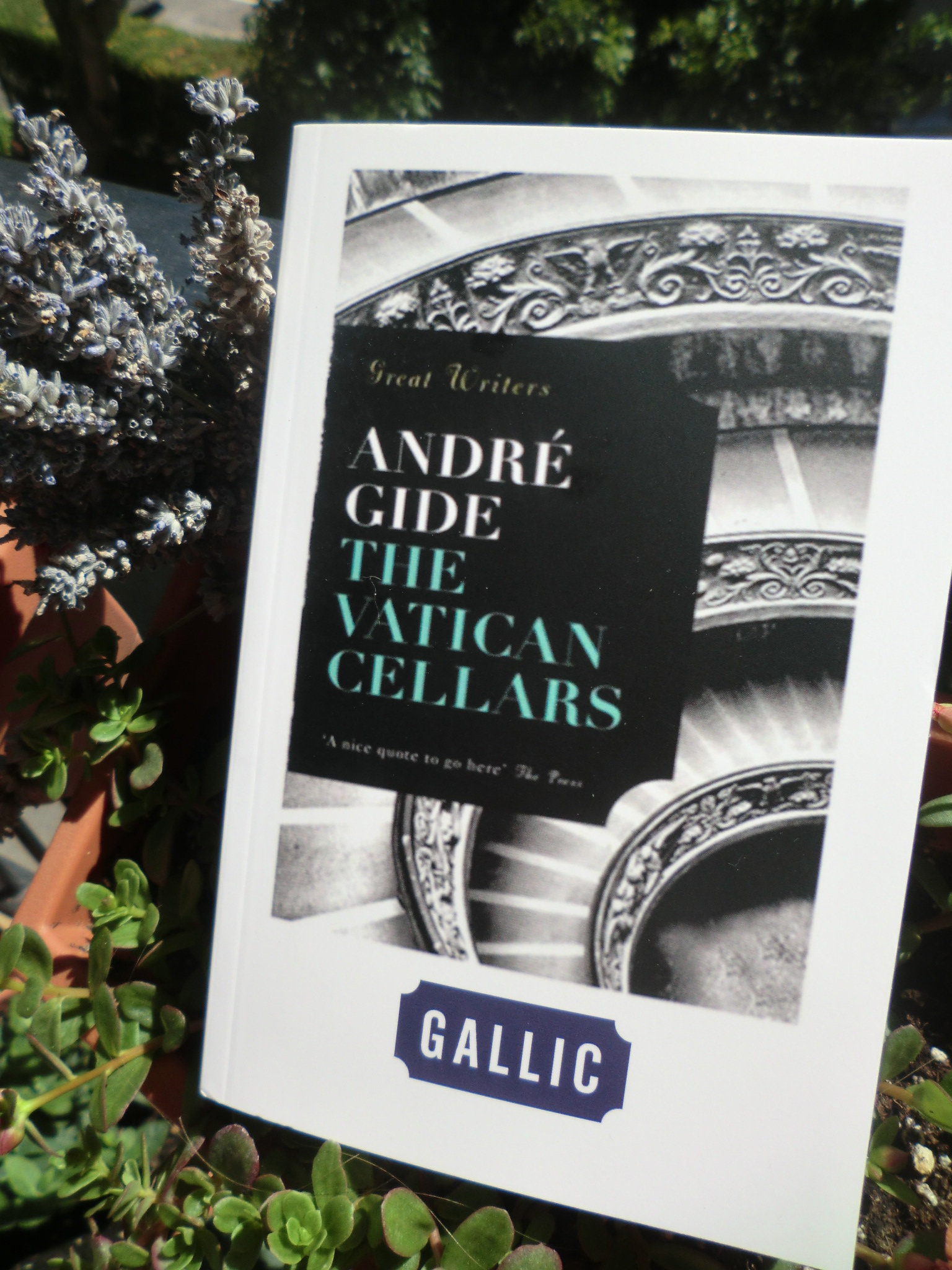
Vatican Cellars Note: Thank you to the author Professor David H Walker, an expert on French literature and culture, whom I met at a lecture he gave on André Gide’s The Vatican Cellars. I noted he’d recently published a novel and was delighted to be offered a copy after having the opportunity to meet him and discuss common literary interests.  His recent excellent review of the newly translated The Vatican Cellars appeared in The Times Literary Supplement on 10 December 2014.


Those Who Leave and Those Who Stay by Elena Ferrante tr. Ann Goldstein #FerranteFever

Those Who StayThis is the third book in Elena Ferrante’s Neapolitan tetralogy about two friends Elena and Lila, growing up in an impoverished neighbourhood of Naples.

It follows on from Book One, My Brilliant Friend and Book Two, The Story of a New Name (click on the titles to read earlier reviews).

Lila has married, had a child, reformed her husband’s business, strayed and finally separated from her husband and moved to another area outside the neighbourhood to live with Enzo, a childhood friend. She gets a job in a sausage factory, working under oppressive conditions that attract the interest of social activists and harsh threats from the ‘fascists’.

“Can you imagine what it means to go in and out of refrigerated rooms at twenty degrees below zero, and get ten lire more an hour – ten lire – for cold compensation? If you imagine this, what do you think you can learn from people who are forced to live like that?”

In Pisa, Elena has remoulded herself, no longer referring or comparing herself to Lila. She observes how people from her type of neighbourhood and class are perceived outside it, among the bourgeois, those raised within the milieu of intellectuals and achievers, those with access to money, social connections, many of whom are gifted with a presence she can only dream of. Elena finishes her university studies and becomes engaged to Pietro, who was raised within that other world; coming from a well-known academic family, he too will become a university professor, teaching and writing academic works like his father.

As she is concluding her studies, Elena writes a fictional story drawn from aspects of her past, though never admitting it is anything but fiction. She gifts the story to Pietro on an impulse, hoping he will read it. He passes the manuscript to his well-connected mother Adele, thus Elena treads the path laid in front of her, towards becoming an author. Adele introduces her to contacts that will result in her first book being published, establishing her career as a writer.

“I spoke of the necessity of recounting frankly every human experience, including – I said emphatically – what seems unsayable and what we do not speak of even to ourselves.”

Though Elena does her best to avoid it, Pietro finally meets her family and though he insists on a civil ceremony for their marriage, a decision that stuns and terribly disappoints her mother, he wishes to do the traditional thing by asking her father for her hand. Her father is calm and accepting, however her mother’s thoughts insist on an airing and she lectures the young professor unabashedly.

  “When at last she was silent, he said that he knew very well how precious I was and that he was grateful to her for having brought me up as I was.”

Through marriage, Elena succeeds in elevating herself above her roots, though finds herself stranded in not quite belonging to either her future role or her past. They are like roles she assumes outside herself, taking care not to stand out when she returns to the neighbourhood and paying attention to how she should behave in her new role as the wife of a professor.

“As soon as I got off the train, I moved cautiously in the places where I had grown up, always careful to speak in dialect, as if to indicate I am one of yours, don’t hurt me.”

However, marrying the young professor, writing the story that turns into a successful novel, moving to Florence and becoming a mother leave her little time to play any other role than that of housewife.

Lila leaves the neighbourhood, escaping her marriage and taking on a job in a sausage factory owned by a friend of Nino Sarratore, whom the girls met one summer. Her job leaves her little time to spend with her son. Unwillingly, she becomes connected with worker’s rights activists and discovers the dirty arm of the neighbourhood loan sharks who are leaning on her employer, while continuing to try to lure her back into their realm.

Lila and Elena’s worlds drift further apart and although they are aware of the need to share with the other, they each possess the instinct to soldier on without admitting their struggle or need for support or encouragement. Elena will receive both her mother-in-law and her mother at different times so that she can write and Lila will return to the neighbourhood to ease her difficulties. Both have opportunities within their reach, yet both are susceptible to self-destruction.

“Too many bad things, and some terrible, had happened over the years, and to regain our old intimacy we would have had to speak our secret thoughts, but I didn’t have the strength to find the words and she, who perhaps had the strength didn’t have the desire, didn’t see the use.”

Those Who Leave and Those Who Stay is a compelling story of the lives of two women and those around them, and a penetrative observation on the creation and consequence of decisions women make, how they live with those decisions and the often destructive way they bring about change. It narrates a journey of moving away from one’s origins and the sacrifice the attainment of that desire requires.

Elena leaves her past and a life she didn’t want, behind her, however in attaining a new life, she loses sight of who she really is and what drives her. She is just coming to the point of realising that when her world spins out of control. And thankfully for us all the fourth book is being translated. I expect the wheel may come full circle.

Italian Screenwriter Francesco Piccolo

Italian Screenwriter Francesco Piccolo

Note:  It has been announced that My Brilliant Friend will be made into a television series in Italy. The author/screenwriter Francesco Piccolo, winner of the esteemed Italian literary Strega Prize 2014 (with his bittersweet memoir of life on the Italian Left, ‘Il desiderio di essere come tutti’ (The Desire To Be Like Everyone) will work on the screenplay.

Next Book in the Series: The Story of the Lost Child