The Crane Wife by Patrick Ness

The Extraordinary Happens Every Day

A Monster Calls

A Monster Calls

You may remember that last year Patrick Ness’s A Monster Calls was one of my few 5 star reads for the year, a young adult novel, it told the story of a teenage boy coping with his mother’s illness and his nightly visits from a tree-like monster creating an allegory that captures the angst and silent rage of a fearful boy like nothing I have ever read.

Not only is the storytelling incredible as well as moving, the author was telling a story that another author Siobhan Dowd wanted to tell, but her own illness kept her from doing so. If you haven’t read it, keep an eye out for it, it is a timeless classic.

I had seen a few reviews for The Crane Wife, an adult novel by Patrick Ness that sounded intriguing and when our local English bookstore put the hardcover version of it out in their sale, I snapped it up and immediately stopped everything I was reading to begin reading. Such is the power of words written by Patrick Ness for this reader. He is a writer who deftly uses a touch of magic realism which I like, not to dwell in it all the time, but when used sparingly with purpose to elevate or create a turning point in a story, I find it no trouble to accept.

The Crane Wife is inspired by the Japanese myth of the same name Ness was read in kindergarten by the Japanese-American teacher he adored, in which a sail maker finds an injured crane and helps it and the next day a mysterious woman walks into his life, whom he falls in love with and marries. She tells him, “I can weave you beautiful sails, as long as you don’t watch me weave”. She does so, they grow rich, until he becomes too consumed by greed and curiosity and breaks his promise, only to experience irretrievable loss.

The_Crane_Wife__pentaptych_by_Crooty

The story stayed with the author over the years and then many years later he heard The Decemberists song The Crane Wife 1 which captured the emotion of the story just as he felt it. It was the catalyst to start writing, he was ready to tell the story that had been in incubation for so long. And what a beautiful song, I can’t stop listening to it myself.

In this novel, George wakes one morning to hear a mournful keening come from his backyard and in the freezing temperatures, investigates to find a large crane with an arrow shot through its wing. He assists the crane and then watches it fly off. The next day in his print shop as he is working on his latest obsession, making paper cut-outs from second-hand abandoned books, in walks a woman we come to know as Kumiko, an event that marks the beginning of an artistic and love bound encounter, touching the lives of George, his daughter Amanda and those close to them.

George is in his 40’s and in something of a comfortable rut, amicably divorced, running his small shop with the help of Mehmet, his assistant and alter-ego. His daughter Amanda lives alone with her son Jean-Pierre, her uncontrollable anger having driven out her French husband, despite their still burning love.

Crane Wife

There is much unsaid between characters and that which is communicated, isn’t always done so as it was intended, until Kumiko and George begin to collaborate through their art, work that affects all who see it, accessing those uncommunicative wordless depths and giving them expression. The work affects them all, artists and observers.

It is a story about humanity, how even those who act out of kindness make mistakes, are tempted by greed and suffer tragic consequences. It is also about how a story changes depends on who is telling it, the power of the imagination in creating different perspectives, viewed in the shadow or in the light. Kumiko says,

‘A story must be told. How else can we live in this world that makes no sense?’

‘How else can we live with the extraordinary?’ George murmured.

‘Yes,’ Kumiko said, seriously. ‘Exactly that. The extraordinary happens all the time. So much, we can’t take it. Life and happiness and heartache and love. If we couldn’t put it into a story-‘

‘And explain it-‘

‘No!’ she said, suddenly sharp. ‘Not explain. Stories do not explain. They seem to, but all they provide is a starting point. A story never ends at the end. There is always after. And even within itself, even by saying that this version is the right one, it suggests other versions, versions that exist in parallel. No, a story is not an explanation, it is a net, a net through which the truth flows. The net catches some of the truth, but not all, never, all, only enough so that we can live with the extraordinary without it killing us.’ She sagged a little, as if exhausted by this speech. ‘As it surely, surely, would.’

In the beginning I was reminded a little of Nick Hornby, the London novel set in a shop, the banter between employer and employee, the vulnerable, angry young woman, the great dialogue and strong characters that come to life from the very first pages and the immediate interest in what will befall them, wondering what consequences their flaws will make manifest. But then Kumiko walks in, a traveller from afar and I remember this is Patrick Ness, something extraordinary is going to happen, even if it is not immediately apparent.

He writes with compassion and as a reader I trust him, whether it’s tragedy, darkness or exhilaration, he handles it all with responsibility, without resorting to cliché and makes me want to slow read every word.

Coincidentally, yesterday on The Guardian, Patrick Ness participated in the books podcast performing an exclusive short story, an addition to his short story collection for adults Topics About Which I Know Nothing which is to be republished and talked to Claire Armistead about writing short stories and the differences in writing for adults and teenagers.

Armistead thought he was being coy about the differences between young adult (YA) and adult fiction, suggesting YA books had a ‘more cheerful trajectory’ to which he replied:

‘I always say the concerns of a teenage novel tend to be about testing your boundaries and finding out who you are and finding out the limits of yourself and crossing those limits and discovering it hurts or discovering that it’s a new thing that you can be and are, and an adult novel tends to be …about someone whose boundaries are already solidified and the story tends to be about what happens when you are taken outside those boundaries or how those boundaries are limited to you …both make for fantastic stories, intellectual ones, complex ones, the concerns might be different, but it’s not a simplistic thing, that you must be direct in one and indirect in another’ Patrick Ness

Literary Blog Hop Winners!

literarybloghop

Thank you so much to you all for entering and participating in the Literary Blog Hop and visiting Word by Word and thanks to Judith at Leeswammes for hosting it.

I was happy to offer two books that I read very recently and given that I read books by authors from 22 countries last year (What Do We Read?), it seemed appropriate to offer a book that had been translated from a foreign language, alongside a shiny new book just published this month.

Therefore, I am delighted to announce two winners, firstly thanks to the Penguin Group for offering a beautiful copy of Robin Oliveira’s historical novel I Always Loved You.

This book will soon be winging its way to …

I Always Loved You

Jenna Sauber!

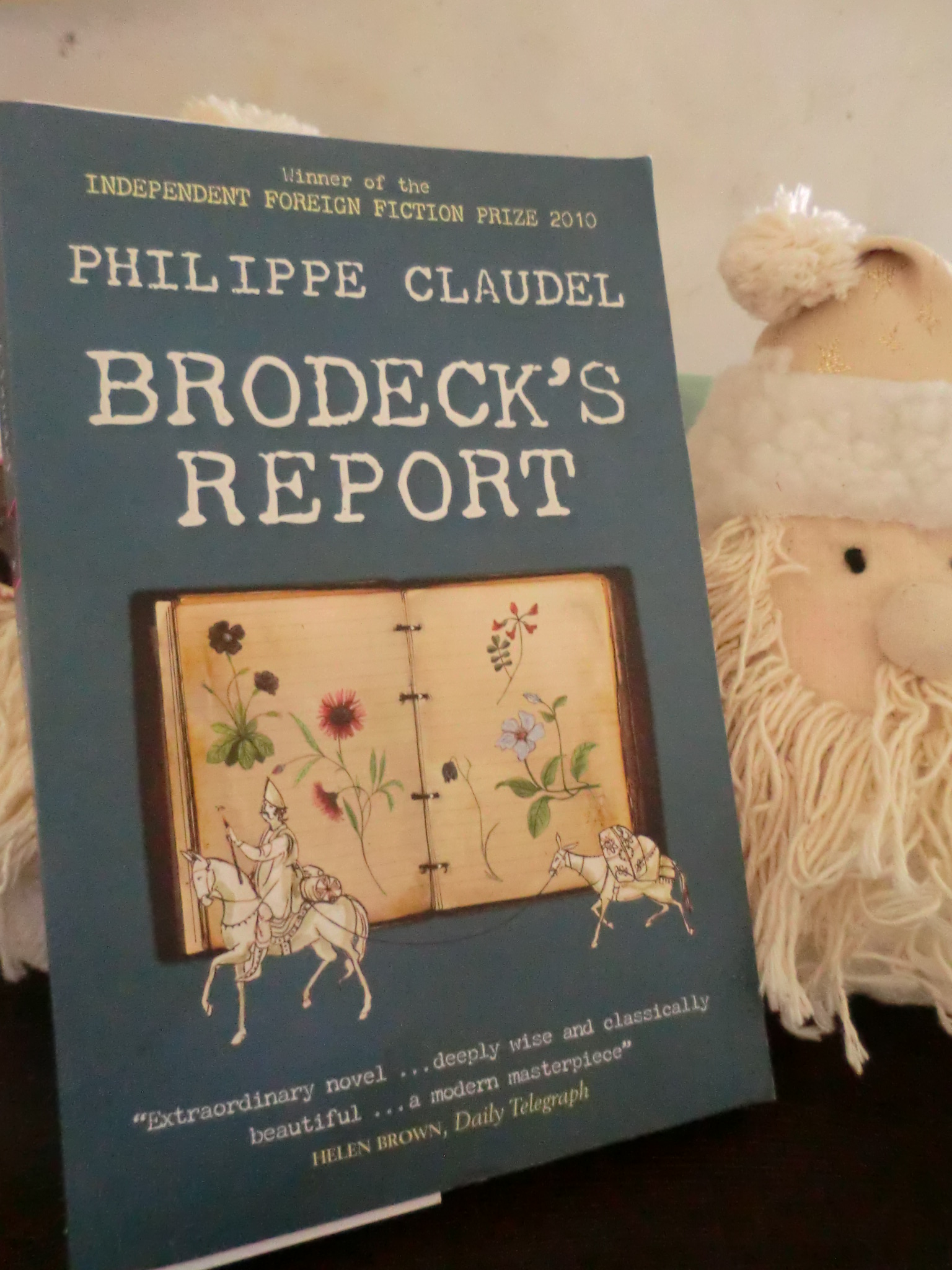
And for those who courageously put their name down to read this French literary gem, translated into English, Philippe Claudel’s Brodeck’s Report will soon be on its way to…

Le Rapport de Brodeck

Le Rapport de Brodeck

Susanna P!

Thanks again to everyone who visited my blog and was able to enter, happy reading to the winners and thank you to those who have decided to follow Word by Word, I hope you find some good recommendations here.

The People in the Photo – Eux sur la photo by Hélène Gestern

Belgravia BooksI have been patiently waiting for this book to be published since discovering it at the same time I learned of the existence of Gallic Books, francophile publishers based in London specialising in bringing a varied collection of excellent French titles across genres to the English reading world. You can buy their books online or at Belgravia Books which specialises in books in translation (5 mins walk from Victoria train station).

I had something of a French literature binge in December, reading Philippe Claudel’s Brodeck’s Report, Alain Fournier’s classic The Lost Domain, Faïza Guène’s young adult novel Just Like Tomorrow and a couple of Albert Camus essays in commemoration of his 100th anniversary. And I am set to continue this theme in 2014, perhaps even venturing into reading a few in the original language!

The People in the Photo is Hélène Gestern’s debut novel and centres on 40-year-old Parisian archivist Hélène’s personal endeavour to learn more about her mother Nathalie, who died when she was four-years-old and about whom no-one would ever speak, not her father, nor her step-mother or any other person and she never understood why.

Gestern

Her father has passed away and now her stepmother, the last living connection between her and her mother is seriously unwell, an event that prompts her into action.
Hélène has only one photo of her mother alongside two unknown men and places an advertisement to try to find anyone who might recognise them.

It marks the beginning of a correspondence and indeed much of the novel is in epistolary form, made up of letters and emails, with the exception of extracts that describe the various photos that are uncovered by Hélène and Stéphane, a Swiss biologist, who recognises one of the men in the photo.

The letters add more than just their content to the narrative, they are an adept device for creating pace and intrigue, their length and dates are significant measuring the time that passes, the pauses, the urgency of an occasional email and yet there is an unwillingness to let go of the controlled structure and single dialogue of the letter, their preferred medium; the revealing sign-off salutations a clue to the developing relationship between the two protagonists.

LettersIt is a revelatory journey of two people into the past of their parent’s lives. Inherent in delving into the past, no matter how necessary it may seem, is the risk of deception, disappointment, even horror in enlightenment.

Hélène Gestern deftly captures the seesaw of emotions as both characters experience waves of exhilaration in their search and periods of retreat from the insinuations of discovery, suggestions they aren’t always ready to face the implications of.

At times the characters seemed extraordinarily restrained, upon receiving a box likely to contain pertinent information, Hélène leaves it unopened for days, her excuse – no time or inclination, yet there is always sufficient to write the correspondence. It is understandable in a sense, the fear of what the revelation will bring, then Stéfane does the same, after developing a set of photos, has no time to look at them, yet has time for a 2 hour walk and his correspondence as well.

Perhaps the lure of corresponding with the living, that ever-present possibility of a future still to be enjoyed, sometimes overwhelms the need to continue digging into a dusty, forgotten past that holds little promise of joy. Or it might just be the sign of a compelling read, and our impatience with characters, living or between the pages of a book, who don’t act as we might, were we in their shoes.

It is a captivating read, intensely thought-provoking and intricately plotted, revealing little by little clues to lives lived in a distant era, yet which explain much of the more recent past for two young people allowing them greater understanding and the potential for forgiveness of those who, until their truth was revealed, were to them like shadows of their former selves.

Note: Thank you kindly to Gallic Books for sending me a copy of the book to read and review.

The Literary Blog Hop – #Giveaway

Today and until 12 February, I’m participating in a literary giveaway blog hop hosted by Judith at Leeswammes’ Blog, an avid reader and blogger.

literarybloghop

All the blogs listed below are participating and offering a literary giveaway to readers. Just leave a comment below to be in the draw for my giveaway and visit any of the blogs listed below, to be in with a chance to win a book. This giveaway is open to you all, worldwide!

WIN A COPY of

Philippe Claudel’s Brodeck’s Report !

I am giving away a copy of one of the best books I read in 2013, a brilliant English translation of a contemporary French novel and winner of a French literary Prize Brodeck’s Report by Philippe Claudel.

You can read My Review here or the brief summary I wrote immediately upon finishing it.

Quietly devastatingly brilliant. Claudel takes one village which happens to be near the border – and what is a border but an imagined line – of an occupying nation and uses the village and its resident to portray humanity and its many inclinations, when a stranger rides into town, makes himself comfortable and goes about his business, without letting anyone know what that business was.

Brodeck is tasked with writing an account of events that take place and as he does so, he simultaneously writes another account, his own, of what is occurring now and what has happened to them all in the recent past, he tries to make sense of it, as is his nature and to know what to do.

I have another giveaway running concurrently (only open to US readers), if you like historical fiction, I am offering a copy of the recently published I Always Loved You by Robin Oliveira recounting the life of the artist Mary Casssat and her friend Edgar Degas in Paris in the late 1800’s. Read my review here and enter the giveaway here.

This is a great opportunity to visit blogs that review literary books and win a book! Entry into the draw via comments are open until 12 February.

Linky List:

  1. Leeswammes
  2. Seaside Book Nook
  3. Booklover Book Reviews
  4. Biblionomad
  5. Laurie Here
  6. The Well-Read Redhead (US/CA)
  7. River City Reading
  8. GirlVsBookshelf
  9. Ciska’s Book Chest
  10. The Book Stop
  11. Ragdoll Books Blog
  12. Nishita’s Rants and Raves
  13. Lucybird’s Book Blog
  14. Reading World (N-America)
  15. Journey Through Books
  16. Readerbuzz
  17. Always With a Book (US)
  18. 52 Books or Bust (N.Am./UK)
  19. Guiltless Reading (US/CA)
  20. Book-alicious Mama (US)
  21. Wensend
  22. Books Speak Volumes
  23. Words for Worms
  24. The Relentless Reader
  25. A Lovely Bookshelf on the Wall (US)
  1. Fourth Street Review
  2. Vailia’s Page Turner
  3. The Little Reader Library
  4. Lost Generation Reader
  5. Heavenali
  6. Roof Beam Reader
  7. Mythical Books
  8. Word by Word
  9. The Misfortune of Knowing
  10. Aymaran Shadow > Behind The Scenes
  11. The Things You Can Read (US)
  12. Bay State Reader’s Advisory
  13. Curiosity Killed the Bookworm
  14. Lizzy’s Literary Life
  15. Books Can Save a Life (N. America)
  16. Words And Peace (US)
  17. The Book Club Blog

This giveaway is now closed.

Eugene Onegin – Chapters 7 & 8 Alexander Pushkin

Moscow, loved daughter of Russia,

where can we find your equal?

DMITRIEV

Eugene Onegin 7 8Chapter Seven

The beginning of Chapter 7 contains numerous quotes and I have noticed all through my reading of Eugene Onegin that the epigrams are a kind of clue to what will follow. So on reading the four quotes that adorn the first page of this chapter, it is clear that the action is going to take us to that great, revered city, Moscow.

A forlorn Tatyana remains in the countryside, nursing the remnant emotions of an unrequited love, like weeds that grow over the unvisited grave of the poet Lensky.

Dear Tatyana, lover of illusion:

Though there he’s no more to be found,

He’s left sad footprints on the ground.

We learn of the swift healing heart of Olga, wooed by another and whisked down the aisle, her tears dried up and replaced by a smile, abandoning her sister and confidant with not much of a glance behind. Tatyana bereft, walks unbidden, finds herself arriving at the country home of Eugene Onegin, his staff invite her in and show her round like a tourist visiting a noble home, the rooms where our hero entertained his solitary self.

At once Anisia came to greet her,

the doorway opened wide to meet her,

she went inside the empty shell,

in which our hero used to dwell.

Spying a collection of strange books she asks if she can return to read them, opening a window into his soul, one she is less sure of, the marks on the page don’t lie, revealing the thoughts of another reader. She comes to understand him via the page, though they are nothing like those she prefers to lose herself in.

The locals are not happy with her loveless state with no plans to marry, they advise her family to take her to Moscow, after a week of travelling they arrive to stay with family, where Tatyana will meet her cousins and slowly become drawn into their ways.

Moscow’s the place, the marriage-fair!

There’s vacancies in plenty there.

They make subtle changes to prepare her for the social activities and try to pry the secrets of her heart, she resists and even while attending the dance, thinks only of the woods, her flower garden and books .

But while she roams in thought, not caring

for dance, and din, and worldly ways,

a general of majestic bearing

has fixed on her a steady gaze.

Chapter Eight

The narrator expounds his poetic verse, carrying us forward, oft-times veering off course as if he were driving an open air carriage then taking his eye off the road to watch the clouds form or listen to birds and admire the wildflowers, then suddenly we are back in the ballroom, the driver his eyes back on the road and the events as we come to know them gradually unfold.

Tatyana is escorted to a ball and sitting quietly to the side, after all this time who does she spot but Eugene, just returned from travels and roaming, he arrives in the midst of this social whirlabout. Recognising her from a distance, though not sure, he asks the prince next to him, who she is:

Eugene Opera‘Can you say,

Prince, who in that dark-red beret,

just there, is talking to the Spanish

ambassador?’ In some surprise

the prince looks at him, and replies:

‘Wait, I’ll present you – but you banish

yourself too long from social life.’

‘But tell me who she is.’ ‘My wife.’

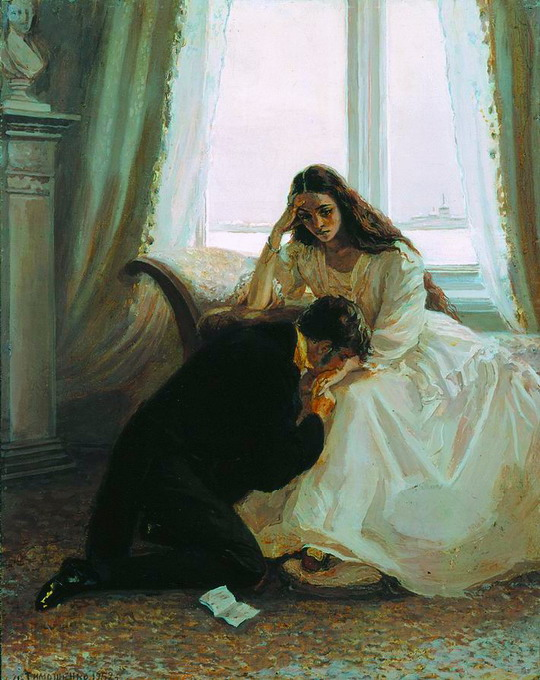
Two years have passed and time has not stood still, he is introduced to the princess and she is unmoved, he sees no trace of the Tatyana he knew and really isn’t sure if it is the same girl. The prince invites him to a soirée and uncharacteristically he responds in haste, eager to see Tatyana once more and is impatient for the evening to arrive. Tatyana playing the dutiful hostess is serene, Eugene falls for all that he has previously scorned, the madness of love. He finds no solace and surprise, surprise, what does he do, this lovesick fop, but write a letter!

Eugene 8No answer comes. Another letter

he sends, a second, then a third.

No answer comes. He goes, for better

or worse, to a soirée. Unheard

she appears before him, grim and frozen.

No look, no word for him: she’s chosen

to encase herself inside a layer

of Twelfth Night’s chilliest, iciest air.

He turns to his books and finds no reason and then as the seasons pass, one spring day he ventures out to see her, is given an audience with the women he can’t get out of his mind and finds the roles have switched, it is she who now lectures him, reminding him of his own behaviour in reprimanding her, she speaks of her love, but that she now belongs to another, to whom she will be true. She leaves the room and Eugene is thunder-struck – the husband arrives – and now we must leave them, this chase has gone on long enough.

The Verdict

Wow. I made it. A brilliant read-along and an entertaining read, although I am a somewhat cynical reader, in that I find it difficult to believe that Eugene Onegin could have become the man he ends up being, not just because of his character so firmly established, but surely after two years travelling he should have gained a kind of maturity that would have provoked a different outcome than this. Perhaps I should have read it 10 years ago when it was given to me!

Thanks to Marian at Tanglewood for organising the challenge, it’s been fabulous. I totally recommend you all give this classic epic poem a try!

I Always Loved You – #Giveaway

Thanks to the generous team at the Penguin Group, US and today, the day of its publication I offer one lucky reader (you must be resident in the US – sorry) a copy of this fabulous book:

I  ALWAYS  LOVED  YOU

by

Robin Oliveira

I Always Loved You

Read my review here of this historical novel set in 1880’s Paris, which the publisher describes as:

A novelization of Mary Cassatt and Edgar Degas’s relationship in Belle Époque Paris. It captures the golden age of Impressionism and is peopled with many prominent figures of the movement including artists Édouard Manet and Berthe Morisot (the only other prominent female artist working in Paris at that time).

Robin Oliveira writes with grace and uncommon insight into the lives of artists and the passions and foibles of the human heart.

Leave a comment below if you wish to be in the draw to be held on 12 February!

This giveaway is now closed.

I Always Loved You: A Novel by Robin Oliveira

Mary SutterWhile looking at a Goodreads list of Historical Fiction due out in 2014, I noticed the name Robin Oliveira, author of the excellent novel My Name is Mary Sutter published in 2010.

I don’t read a lot of historical fiction, but occasionally via word of mouth, I hear about a well written, compelling title that I can’t resist, particularly if it is set in France.

Well researched historical fiction in the hands of a talented writer, is my preferred method of learning about French history (or any history); engaging characters propel the narrative forward and we invest ourselves in the characters who have inhabited the period and discover the chronology of events as if we are living them. Historical events when presented without the force, nuance and characteristic dialogue of personalities that have shaped them, risk becoming dry, uninteresting, sedative and read by the few.

Set in 19th century America on the cusp of civil war, My Name is Mary Sutter chronicles the life of a midwife with ambitions to become a surgeon, something she will be thrown into with the advent of war. Her ambition requires the courage to cope with an abundance of men suffering war injuries amid dire living/working conditions plus sacrifices in her personal and family life. She is a captivating heroine, strong-willed yet vulnerable, living in an incredible pioneering era for women.

In her research, the author learned that 17 young women became physicians after their nursing experiences in the civil war. While Mary Sutter is fictional, she is a truly inspired character about whom Robin Oliveira had this is say:

“And through it all there was Mary Sutter, whose story I needed to tell as a celebration of women who seize the courage to live on, to thrive, to strive, even, when men conspire to war. Mary, flawed and intelligent, careening between desire and remorse, stumbling forward out of courage and stubbornness, hiding a broken heart, but hoping to redeem something beautiful from a life humbled by regret.”

Which is a prelude to saying that seeing a new Robin Oliveira novel coming out in 2014 and set in France, I jumped at the chance to read it.

I Always Loved YouI Always Loved You, an unfortunate and slightly off-putting title, sorry, is about the life of  the American painter Mary Cassatt, her life in Paris struggling to make her name while remaining true to her art, and enduring a life-long fractious relationship with the impressionist painter and sculptor Edgar Degas. It also brings to life another female painter, Berthe Morisot and her relationship with the Manet brothers, Édouard and Eugène.

Mary had left her home town of Philadelphia to pursue artistic ambitions and after ten years of hard work, having once been accepted by the Salon for her work Ida (or Spanish Dancer Wearing a Lace Mantilla), has now been rejected and is feeling disillusioned and on the point of giving in to her father who wants her to return home, find a husband and be with her family. Had it not been for his fascination with Ida and the subsequent encounter with Degas, she may well have fulfilled her father’s bidding.

“C’est vrai. Voilá quelqu’un qui sent comme moi.”
(It’s true. Here it is, someone who feels as I do).
Edgar Degas commenting on Mary Cassatt’s painting, Ida

Through Mary, we learn what it meant to be a painter in Paris in the late 1800’s, the restrictive, suffocating influence of the Salon Jury, purveyors of the official annual exhibition of the Académie des Beaux-Arts, known as the Salon de Paris, to whom all artists looking for acknowledgement and recognition would submit one or two paintings and then await acceptance or rejection. Those deemed successful by the Jury would be hung at the next exhibition and if lucky, talked up by the critics. Those who weren’t, were resigned to another year of work before resubmitting – and they all did, for it was seen as essential to exhibit there in order to achieve any success, a status quo that existed for almost 200 years in France.

Salon de Paris

Salon de Louvre 1787
Source:Wikipedia

This process spurned a rebel group lead by Edgar Degas who refused to submit their work to the Salon Jury and began to hold an alternative exhibition.  These artists were willing to let go of the past with their references and rules and were bold with colour, subject and loose with their interpretation. They became referred to disparagingly by the media as Impressionists, a term Degas despised. It was a brave move and not all of the groups members managed to sustain their nerve, the lure of the Salon despite its limitations, not easy to stand up against.

Degas had admired Mary Cassatt’s work without knowing who she was and after organising to meet her, invited her to exhibit with his group of artists and to one of their weekly salons, a social gathering that included Édouard Manet, his brother Eugène, Berthe Morisot, Renoir, the writer Émile Zola, Pissarro, Gustave Caillebotte, Zacharie Astruc, the poet Stéphane Mallarmé and Claude Monet among others. The evening would mark the beginning of a long relationship between two talented artists whose work came before all else and whose similarities and stubbornness would continue to attract and repel them until their last days.

“He was right. The something, the leap an artist makes so that his painting is more than its technique, he had already achieved. And she wanted that.”

Edouard_Dantan Un Coin du Salon, 1880

Edouard Dantan
Un Coin du Salon, 1880
Source: Wikipedia

I had never heard of Mary Cassatt when I began reading and was intrigued to discover her art, but decided not to go looking at her or Degas’s work until I had finished, allowing my imagination to create an image of their creations during the period of their encounters, which added an exciting anticipation to the reading, especially while Cassatt was preparing for her first showing with the Impressionists and when Degas was working on his sculpture The Dancer.

I hesitate to show any of images of their art here, as it was such a reward for me upon finishing the book. Getting to know or reacquainting ourselves with the artists work is a personal journey and we should decide in our own time when to view the oeuvres of these great artists. No Spoilers here!

They were an inspiration to each other with regard to their work and Oliveira brings the two alive in rich detail, you can almost see their respective studios and smell the turpentine, imagining the furrowed brow of concentration as these two passionate artists throw themselves into their work and block out the world around them.

What they couldn’t inject into their relationship, they gifted to each other through their work, some of the most poignant and yet ironic scenes are when Degas helps Cassatt find her subject and confirms what it is she should be painting. And then the joy of finally seeing them and seeing the energy and vibrancy of those paintings she created during that period when they responded so positively to each others influence, fact or fiction, it stands out in the work.

“I have no money to pay a model,” Mary said to Degas. “I don’t know what to do.”

“You must find your subject.”

Mary said, “Like yours? Ballet, horses, brothels?”

“Obsessions are an artist’s gift. Obsession is poetry,” Degas said.

Just as other writers have brought alive the Lost Generation of writers resident in Paris in the 1920’s, Robin Oliveira does the same for this group of painters, awakening our interest in this turning point in the history of art and the influence of this group on painters in the wider world, which continues today. It is a brilliantly told story of fascinating characters and their passion for art.

National Gallery of Art Washington

National Gallery of Art
Washington

And if you are fortunate enough to live near or visit Washington, it appears that there is to be an exhibition of Cassatt and Degas’s work at the National Gallery of Art May 14 – Oct 5 focused on the critical period of the late 1870s through the mid-1880s when Degas and Cassatt were closest, bringing 70 various works together to showcase the fascinating artistic dialogue that developed between these two major talents and friends.

Note: This book was an ARC (Advance Readers Copy) provided by the publisher via NetGalley.

Arctic Dreams – Imagination and Desire in a Northern Landscape by Barry Lopez

“Sometimes we need a story more than food to stay alive.”

Barry Lopez

Valorie Hallorin

This quote sits on the home page of one my favourite blogs, Books Can Save A Life and it is also where I came across the non-fiction writer Barry Lopez. Not just in this quote, but in her reviews of a number of his collections, reading about Barry Lopez makes me want to read every book he has written.

From the essays I review below, it may appear he is a nature writer, but he can not be categorised so easily, he  writes about humanity and could I am sure turn his pen towards any subject and make it an engaging read.

About This Life

Valories shares this quote from her review of About This Life: Journeys on the Threshold of Memory and the following conversation gives us a flavour of the diversity of his observations and subsequent learnings about life.

In the introduction to his essay collection About This Life: Journeys on the Threshold of Memory, Barry Lopez tells of meeting a man on a plane who asked what words of advice he could pass on to his teen-age daughter, who wanted to be a writer. This is what Lopez said:

She must read, and her choices should be whatever she is drawn to.

She should read the classics, too, but she’ll have to work harder to find stories of heroism, love, and our noblest values that are written by women.

Second, she must “become someone” and “speak to us from within those beliefs.”

Third, he advised that she “separate herself from the familiar.” After exploring other places and meeting a diversity of people, she’ll know why she loves the familiar and share this knowledge through her writing.

Arctic dreamsHowever, it was her review Arctic Dreams – gathering words that had me chasing up this book, because it was not only a powerful book of nature essays, but as she says, it is a source of “the most dazzling and poetic passages about the natural world you’ll ever encounter.”

Valorie is “into words” and does Lexicon Practice, inspired by the author of The Writer’s Portable Mentor, Pricilla Long. Lexicon Practice involves compiling new words encountered in books into a notebook, noting the original sentence and creating a new one. It inspires our vocabulary which may otherwise degenerate into those overused phrases we read every day in various media. And Barry Lopez exposes us to an abundance of wonderful new words!

Arctic Dreams was originally published in 1986 and won the US National Book Award for non-fiction. It is a compilation of around 10 essays, which can be read separately, each one focusing on a different subject, as Lopez focuses on the inhabitants, visitors and four-legged, two-winged migrants of a frozen territory in the North.

Reading his work is a little like being mesmerised by a compelling narrator in a nature documentary, for it is not just the images of the animals and the landscape that are interesting, but his recounting philosophical thoughts of our interaction with nature and  local populations, whether they are polar bears, seals or Arctic peoples.

Narwhal

The Narwhal

I don’t think I have ever highlighted so many passages in one book, as I have in Lopez’s Arctic Dreams, it is a privilege to walk in his footsteps, to figuratively look over his shoulder and see inside a compassionate mind as he whispers words onto the page of this incredible collection of observations of natural life.

I recognise that change that can come over us, when we spend long enough in an environment completely foreign to our norm, long enough that our behaviour starts to change, something primal occurs and so it is no surprise to me when Lopez mentions that on his evening walks, he starts bowing to the birds he encounters. This ritual will inspire his own questions into how humanity imagines the landscapes they are in and how in turn the land shapes the imaginations of the people who dwell within it. And so he journeys into the unknown to find out.

“I took to bowing on these evening walks. I would bow slightly with my hands in my pockets, towards the birds and the evidence of life in their nests – because of their fecundity, unexpected in this remote region, and because of the serene arctic light that came down over the land like breath, like breathing.”

muskox

Musk-oxen

And so I find myself immersed in chapters that expound on characteristics and behaviour of musk-oxen, polar bears, the narwhal, the influence and importance of ice and light, the great migrations and more.

“Watching the animals come and go, and feeling the land swell up to meet them and then feeling it grow still at their departure, I came to think of the migrations as breath, as the land breathing. In spring a great inhalation of light and animals. The long-bated breath of summer. And an exhalation that propelled them all south in the fall.”

Barry Lopez has a unique voice, on the page and in person. Even you never read his words in a book, listen to him here speaking for less than two minutes about the gift of story in our lives.

Note: This book was an Advance Reader Copy(ARC) kindly provided by the publisher via NetGalley.

Eugene Onegin Chapters Five & Six Alexander Pushkin

O, never know these frightful dreams,

thou, my Svetlana!

VASILY ZHUKOVSKY

Eugene Onegin5

Reading the epigram above and looking into its source, I discover how little I really know about this poem, because of my ignorance of Russian poets and folklore, for Vasily Zhukovsky, a prominent figure in Russian literature in the 1800’s and tutor to a Duchess and her son, the future Tsar-Liberator Alexander II, was highly esteemed by Pushkin. His heroine Tatyana is modelled in some way on the heroine Svetlana in Zhukovsky’s poem of the same name, where there are dreams of snowy nights, a hovel and a corpse who manifests into her beloved, just as there are in Chapter 5 of Pushkin’s poem.

Chapter Five

Vasily Zhukovsky_1815

Vasily Zhukovsky, 1815
Source: Wikipedia

Tatyana, who is prone to superstition and susceptible to clairvoyance, is plagued by dreams, of a snowstorm and a large bear stalking her, she can’t escape the sense of being pursued and will be taken by the bear to a gathering in a hovel, where she is reunited with her love Eugene Onegin, who feasts with bizarre creatures. Her happiness is short-lived as he embarrasses her in front of the audience gathered, only to claim her like a worthy hero, making her swoon in quickly forgiven ecstasy.

Tatyana is troubled by her dream and won’t speak of it to her sister, instead she descends into the safe passages of a book, with their trustworthy, predictable heroes.

January 25, her name day arrives and the mood changes as friends, family, neighbours, the local army Major and more descend upon the Larin household and word has it the regimental band is coming!

Dinner is served amid much excitement and the merriment rises in volume when the doors open to admit the latecomers Lensky the poet and his friend Eugene Onegin. Finally! Seated opposite Tatyana, who becomes a bundle of nerves, our hero isn’t impressed with her lovesick feminine display and mentally passes judgement on them all. I ask myself, is the man a psychopath, he displays zero empathy!

Fortunately no one notices, the gluttons, as more food arrives and flutes for champagne and cries of ‘Speech’ to toast the beautiful Tatyana who pulls herself together to respond to each guest individually, stumbling when she reaches Eugene, who seems to take pity, for his face shows something she interprets as tenderness – more fool her!

They move to the salon, tea and cards and the sound of the band arriving, the ball is underway, the Russian Waltz on display! And now the trouble starts as Eugene claims Olga, shocking the crowd in their stomping frenzy and outraging his friend! What is he up to this player of dangerous games! How will Lensky react?

He finds the shock beyond all bearing;

so, cursing women’s devious course,

he leaves the house, calls for his horse

and gallops. Pistols made for pairing

and just a double charge of shot

will in a flash decide his lot.

Chapter Six

Seeing his friend depart, Eugene becomes bored with his game and will leave alone. While bodies sprawl everywhere in sleep, Tatyana sits at her window and peers into the darkness, a coldness creeping over her heart.

We meet another landowner with a shady past, who delivers a message to Eugene, a letter from his friend Lensky, challenging him to a duel. He accepts, this manly hero, though on his own he laments his role.

With reason, too: for when he’d vetted

in secret judgement what he’d done,

he found too much that he regretted:

last night he’d erred in making fun,

so heartless and so detrimental,

of love so timorous and gentle.

Lensky wakes in anger like a raging bull intent on not seeing his love, but relents and is confused to find her as much in love as she ever was, his anger abates and he regrets his haste, but wants to teach his friend a lesson. No one spares a thought for our heroine. Lensky cleans his pistols and spends all night writing his last poem.

How did these two friends becomes foes and what madness have they entered into, to continue this game of death. Pistols ready, they march, they turn, a shot. Our poet holds his hand to his heart, inspired right up to his last seconds in this world, he departs.

Reader, whatever fate’s direction,

we weep for the young lover’s end,

the man of reveries and reflection,

the poet struck down by his friend!

Even the narrator stalls, he can not go on, he needs to pause. He will come back and tell us what will happen when he can face it.

Reactions

A.S.Pushkin

Alexander Pushkin by Vasily Tropinin
Source: Wikipedia

Since Tatyana and her sister rarely speak, the dream sequence helps us understand her state of mind, her fears and desires, her confusion and unwillingness to share it with anyone. It is like a premonition of what will come, the roller coaster of highs and lows on her name day, where even then the only high note she experiences in relation to her beloved is a look on his face that may or may not have been tenderness.

My opinion of Eugene Onegin has not changed, he has not a shed of empathy, neither for Tatyana or ever more tragically for his dear friend, the poet Lensky. How will he redeem himself from this pistol waving mess!

And the Narrator? I recall that this poem was written over several years and when the Narrator interjects and seems to need to pause, I find myself wondering if these pauses represent the intervening years. No doubt some scholar has the answer.

Brilliant. Loving this!

Click here to read the final follow up review of Eugene Onegin Chapters 7 & 8

What Do We Read?

Photo0652

Recently there has been discussion in the media, on twitter and on various blogs about how books written by women are represented with respect to published reviews and the #readwomen2014 campaign launched as a result.

The annual survey carried out by VIDA – The Count continues to show them as  being under represented in most of the major publications that provide reviews and in translated fiction.

It made me wonder what I do read. I don’t think I have a bias towards male or female authors, but I do have a preference for cross-cultural fiction and I like to read translations, so I decided to look back over the last year and see how I fared.  As you can see below, I definitely read more female than male authors and slightly more than 2012 when 62% of the books I read were by women.

Gender 2013

In total, during 2013 I read 70 books, slightly more than the one book a week I have as an intention and 10 books more than I read in 2012.

As those who read this blog may know, I like to read cross-cultural, contemporary literature, so I read more modern than classics and I like to read around the world. What I hadn’t realised was that last year I read books by authors from 22 countries! Check out this fabulous pie chart.

Country 2013

Compared to 2012 when I only read books from 17 countries! From the US and the UK, I read exactly the same number of books (19) and a visit to Istanbul in May prompted an increase in Turkish literature (5) and three books in December helped my French literature (4) to increase, but I hope that will improve in 2014.

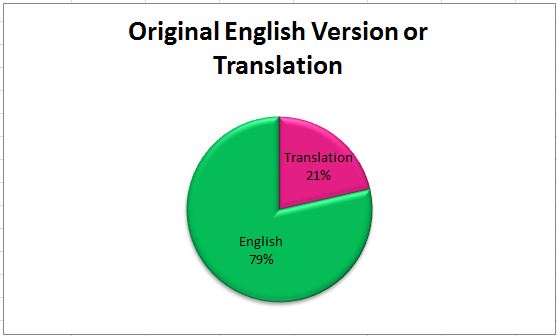
To read that widely, it is necessary to read translated work and 15 of the books I read or 21% were translated compared to only 10% in 2012. I’ve certainly travelled the world through books, I may have to start checking the globe to see which continents are missing.

Translation 2013

And what kind of books do I read? Well mostly fiction, a hefty 76% compared to 23% non-fiction and only 1% poetry, but less than 2012 when 82% of my reading was fiction and 16% non-fiction. I did read some excellent non-fiction in 2013 and hope to do the same this year.

Genre 2013

And lastly, how do I read? Yes, I have a kindle and in 2012 I read 25 books or 41% of them electronically. In 2013 that has increased to 46%, that’s 32 books on the kindle, almost half my reading! That’s thanks mostly to NetGalley who send me ARC’s (Advance Reader Copies) from the publishers that I request, which I am immensely grateful for.

E Book 2013

So now I know what I read and I think I shall just keep on doing the same, which is to be as spontaneous as possible, to engage with others who read for recommendations and keep reading around the world!