Not the Orange Women’s Prize for Fiction Longlist

Womens prize logoThere may not be a new sponsor yet, however 20 books appear on the long list for the international Women’s Prize for Fiction and although there are certain predictable inclusions, such as Hilary Mantel’s Bring Up the Bodies, Barbara Kingsolver’s Flight Behaviour and Zadie Smith’s NW, it is great to see such a diverse range of excellent books.

life after lifeI have managed to read a few already, here are links to my reviews of Elif Shafak’s HonourM.L.Stedman’s The Light Between Oceans and Kate Atkinson’s Life after Life. I enjoyed all three books, but won’t be trying to guess the winner, it’s much too subjective to choose, read the reviews and see what appeals to you. I am sure there is something for everyone.

There is an interesting article in The Guardian today with links to a synopsis and reviews for all of the books. They include reader reviews as well as journalist reviews. The Guardian Bookshop is an interesting alternative for buying new books in the UK, particularly as they don’t charge an additional delivery charge for every book.

The Women’s Prize for Fiction 2013 is awarded for the best novel of the year written by a woman. Any woman writing in English of any nationality, country of residence, age or subject matter is eligible. The shortlist will be announced on April 16. Happy Reading!

The Longlist of 20 novels

Womens-Prize-longlist

Kitty Aldridge A Trick I Learned From Dead Men

Kate Atkinson Life After LifeHonour

Ros Barber The Marlowe Papers

Shani Boianjiu The People of Forever are Not Afraid

Gillian Flynn Gone Girl

Sheila Heti How Should A Person Be?

A M Homes May We Be Forgiven

Barbara Kingsolver Flight Behaviour

Deborah Copaken Kogan The Red Book

Hilary Mantel Bring Up the Bodies

Bonnie Nadzam Lamb

Emily Perkins The Forrests122012_0454_TheLightBet1.jpg

Michèle Roberts Ignorance

Francesca Segal The Innocents

Maria Semple Where’d You Go, Bernadette

Elif Shafak Honour

Zadie Smith NW

M L Stedman The Light Between Oceans

Carrie Tiffany Mateship with Birds

G. Willow Wilson Alif the Unseen

The Unlikely Pilgrimage of Harold Fry by Rachel Joyce

627 miles in 87 days

There is something appealing about the idea of making a pilgrimage and reading about it is almost as satisfying on another level, even when the pilgrim in question doesn’t know that is what he is doing.

Unlikely Pilgrimage

Harold Fry was not prepared for a pilgrimage at all, he was on his way to post a letter, a note written in haste that the closer he came to the post-box, the less satisfied he was with what he had composed, as if the letter had somehow come to represent all that he had achieved with his life – showing him up as incapable of stringing together the appropriate words that might express the sentiment he wished to convey – while harbouring his mild but growing discontent, he continues on to the next post-box and then the next and then one thing lead to another…

Harold’s letter is a reply to Queenie Hennessy, an ex-colleague whom he hasn’t seen since the day she disappeared from work, a disappearance that is in some way connected to Harold.  Queenie’s short letter informs Harold of her illness, he learns she is lying in a hospice in Berwick-upon-Tweed, in the very northern tip of England, about as far from Kingsbridge, South Devon as one could possibly be.

The walk to the post-box and an encounter with a young shop assistant in a garage prove to be the tipping point for Harold, he sets off to Berwick, convinced that by making his pilgrimage, he might save Queenie from certain death.

Harolds journey
Harolds journey up England

Harold is propelled by instinct, an urgency to make some kind of difference and as his feet carry him North, little by little he comes to understand the significance of his undertaking, as the layers of his self-protective habits built up over the years, peel away at a similar rate to the soles of his shabby yachting shoes, until eventually even words are no longer required to explain; his purpose and inspiration shine out of him, attracting followers and making him almost unrecognisable to the woman he has lived with for the past forty years, his wife Maureen.

Harold believed his journey was truly beginning. He had thought it started the moment he decided to walk to Berwick, but he now saw that he had been naïve. Beginnings could happen more than once, or in different ways. You could think you were starting something afresh, when actually what you were doing was carrying on as before. He had faced his shortcomings and overcome them, and so the real business of was walking was happening only now.

Rachel Joyce’s debut novel was short-listed for the Booker Prize, however it would be wrong to think of her as a novice writer and as the back pages inform us, she has written over twenty original afternoon plays for BBC Radio 4 as well as drama adaptations to television. It is clear from the first pages that this is a confident and accomplished writer and I couldn’t help but imagine these characters already on-screen, it is as if we have seen Harold before, so much of that reserved part of his character seems so familiar, even if he does appear to fill a stereotype, however he does not remain typecast for long, yet neither does he change completely.

A very English novel, not just the landscape, it is the slow unmasking of Harold, a man who barely made a ripple in his working life, having done his best to keep unpleasant matters from being aired or making a fuss.

He had always been too English; by which he supposed he meant that he was ordinary. He lacked colour. Other people knew interesting stories, or had things to ask. He didn’t like to ask, because he didn’t like to offend. He wore a tie every day but sometimes he wondered if he was hanging on to an order or set of rules that had never really existed.

An enjoyable read, Rachel Joyce is working on a second novel, another “celebrating the ordinary, linking laughter and pain” story, she said.

Further Reading

BBC

Interview – Rachel Joyce discusses how her background writing radio plays informed the novel and how her father (to whom she dedicates the book)and others shaped the character of Harold.

Wild by Cheryl Strayed – my last review of a different kind of pilgrimage, the true story of Cheryl Wild’s hike of the Pacific Crest Trail

Note: This book was an ARC (Advance Reader Copy) provided by the publisher via NetGalley.

Honour by Elif Shafak

US edition cover

US edition cover

Elif Shafak comments in her essay on identity The Happiness of Blond People about the stereotyping or tendency of books written by or about women from the East, that they often sport covers with an image of a veiled woman.

It is something that makes her other books stand out, because they don’t do that. The Bastard of Istanbul and The Forty Rules of Love (at least the editions that I read) have enticing covers that invite you to enter another world, depicting vibrant, warm colours and referencing stunning forms of Eastern architecture, curves, arabesques, spires and sparkling elements.

When I first spied the UK cover of her new book Honour I thought ‘Oh no’, not one of those books – I was disappointed as it looked like it belonged to that genre, the misery tale of a woman’s lot in a society where the veil is used as a symbol of varying degrees of oppression. That was before I read and reviewed the essay I refer to above, in which she cites those books with similar disdain.

It was some comfort to see that the US edition has nothing like that cover, preferring the safe symbolism of the open arches, inviting us in to take a look within its pages, no veils, no dark colours, no fear, no buying into outdated stereotypes. It would be interesting to know which cover  attracts the most readers.

Honour

UK edition cover

There is a plethora of lifestyles among Muslims, a variety of personal stories to consider; and yet only some of these stories come to the fore. They almost always happen to be the most problematic ones: we seldom hear about happy Muslims, in particular about happy Muslim women. Honour killings, female circumcision, child brides, the veil, gender segregation, lack of freedom… Gender is the number-one topic where the so-called Clash of Civilisations is manifest and crystallized. It is no coincidence that a considerable number of books related to Islam have female images on their covers, and in many, if not most cases, these females appear to be sad, silenced, secluded or suffering. Women with their mouths covered, or eyes peeking out from behind their hijab, or heads bowed miserably down… Elif Shafak, The Happiness of Blond People

Book covers aside, this is a very credible story, one that many women who have uprooted their lives and brought up or given birth to children in a foreign culture may relate to. Narrated by her daughter Esma, the story centres around the life of Pembe, identical twin to Jamila and one of eight educated daughters of a family raised in a Kurdish village, the desire and constant striving for a son eventually taking the mother in childbirth.

Life here is a precarious path for young woman, where one wrong step can easily lead to condemnation. One of the twins dreams of a life far away, the other seeks to learn from those around her, from nature and experimentation. Love is the sacrifice that will enable them to attain their so-called dreams.

Their adult lives are lived far from each other, Jamila becoming a renowned village midwife and Pembe, fulfils that desire to live elsewhere, travelling further than she ever dreams, her husband Adem, from Istanbul, brings her to live in East London where they will raise their three children Iskander, Esma and Yunis.

To her the future was a land of promises. She had not been there yet, but she trusted it to be bright and beautiful. It was a place of infinite potential, a mosaic of shifting tiles, now in a seamless order, now in mild disarray, for ever re-creating itself.

To him the past was a shrine. Reliable, solid, unchanging and, above all, enduring. It provided insight into the beginning of everything; it gave him a sense of centre, coherence and continuity.

Through the story, which alternates between 1940’s Kurdistan and 1970’s London, we come to know each of these family members and begin to understand how their individual and collective experiences has moulded them, Pembe and Jamila in their traditional village with its elders, family, traditions, superstitions; Adem with an alcoholic father and angst-ridden mother who eventually abandons her children, unable to cope with the Jeckyll and Hyde character of her husband. Each has been in some way touched by the repercussions of a ‘loss of honour’.

Iskander is raised in London with memories of his early life elsewhere, carrying memories of disappointment like molten rock deep within. He is sensitive to a vibe between his parents he doesn’t understand, something that makes him want to act. When his father leaves home and it becomes clear that his mother is moving on, the pressure of that molten rock within him causes him to explode.

RumiHonour touches on many great themes and then excels in sharing all the familial details, the interactions between its characters, the people and culture around them, to the point where we identify with each character as we spend time seeing things from their perspective and then experience a sense of anxiety knowing that these perspectives are likely to clash and the outcome will not be good.

And then there is Zeeshan, a character who arrives unexpectedly, but one I recognise instantly, knowing of Shafak’s interest in Sufism and the work of the 13th century poet and philosopher Rumi; Zeeshan is a gift and offers a lifeline to Iskender representing hope.

Elif Shafak is a writer with an interesting perspective, as she herself says, she has one foot in Istanbul and the other travels and makes connections in cities around the world.

Writing that crosses cultures and observes characters doing the same invokes a sense of empathy, she is a writer whose work I will be following and whose city I look forward to visiting in May this year.

Elif Shafak speaking in Sophia, Bulgaria Photo courtesy of Tayna Tzvetkova

Elif Shafak speaking in Sophia, Bulgaria
Photo courtesy of Rayna Tzvetkova

Note: This book was an Advance Reader Copy (ARC) provided by the publisher via NetGalley.

The Romantics, A Novel

RomanticsAfter so much non-fiction and short stories, from my sick-bed this last week, I was trying to think what I had on the shelf that I could just sink into, a good novel and I thought briefly about Amitav Ghosh’s The Sea Poppies, which I know is there somewhere, but too high on the shelf, too heavy in hardback and so my arm reached out and landed instead on Pankaj Mishra’s  The Romantics.

This wasn’t just about needing to lose myself in a story, I wanted to escape to somewhere exotic but familiar and Mishra offered a view from a rooftop apartment in Benares (Varanasi) India, that instantly awakened pleasant memories, but did so via a young Indian protagonist whom I knew would give me another perspective to life there.

The Romantics is a story about a lost young Brahmin, Samar, whose family for centuries followed the same traditions, having been favoured by a sixteenth-century Mogul emperor who granted them land, passing on their legacy with little thought to the past or the future, tending their land at the foothills of the Himalayas somewhat oblivious to the subsequent twists and turns of history.

My own knowledge of the past went only back as far as my great-great-grandfather, in the last century, but I can’t imagine his own ancestors deviated much from the well-worn Hindu grooves in which he and his son and grandson spent their own lives: studentship in Benares, adulthood and marriage, late-middle-age detachment and then the final renunciation followed by retreat to the Himalayas.

CIMG2125

The Ganges, Benares

With India’s independence this well-trodden familial cycle was thrown into disarray, lands and accumulated wealth lost, his father became just another citizen seeking employment. Samar has finished his studies but faces an uncertain future after the premature death of his mother and his father’s announcement that he wishes to spend his last days in Pondicherry.

Samar makes Benares his home and befriends Miss West, an English expatriate, and others who are ‘passing through’, idealist Americans, Buddhist contemplatives and the young Frenchwoman Catherine whom he falls in love with, despite her living with a young local sitar player, whom she imagines she will transition to Paris with.

The reality of my position was made more apparent by Debbie’s reply when I asked her what she was doing in Benares. ‘Passing through,’ she had said, and the words had stayed with me. They had suggested a kind of perpetual journeying through the world, a savouring of life in a way I had no means of knowing, the life itself seeming – as it did in the pictures in Miss West’s room – unimaginably adventurous.

He also makes the acquaintance of Rajesh, a fellow Brahmin, whom he suspects of being involved in shady political or criminal dealings; Samar passes his days between these two cultural thresholds, participating fully in neither, observing himself and others yet not quite able to stop himself from complicating his life unnecessarily, not so different from them all.

CIMG3772Through Samar, Mishra writes with a quiet equanimity which permits us interesting insights into the lives of all the characters,  though his insights do little to prevent him making similar mistakes. Eventually he leaves, after an extended visit to his sick father and finds himself a job in Dharamshala where he will settle, until something reminds him of the past and once again, he will give in to a baser instinct.

The perfect escape novel and always interesting to read about the stayers, young people who went to visit India or any other country vastly different from their own, who end up for one reason or another staying.

A Winter Book by Tove Jansson

Too many days have passed in a fog and even this is hard to write, because I had already written and lost it, so peeking out from the blur of la grippe (flu), I hope I find the inspiration that assisted me first time round.

A Winter BookI came across a review for Tove Jansson’s A Winter Book after spending an evening reading Katie Metcalfe’s sublime poetry here.

Metcalfe is a young contemporary poet from Teesside, in the North of England, who churns out poetry at an astonishing rate and has an abundant talent for getting to the heart of it, all of it, any of it, whatever it is she chooses to write about in that heart-felt way that only poetry can do.

Inspired by the Arctic and snowy landscapes, it was no wonder a book like Jansson’s would appeal to her. And something about it appealed to me too, a collection of tales to read in winter, semi-autobiographical bite sized vignettes of another creative spirit.

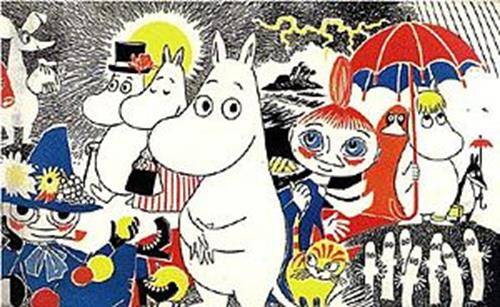
The Moomin Family

Tove Jansson (1914-2001) was not known to me, but will be known to many as she was the author of the children’s fantasy Moomin books. The Moomins are a family of pale, rotund trolls with large snouts, resembling hippopotamuses. Sniff, Snufkin, Moominmamma, Moominpapa and more, they live in Moominvalley in the forests of Finland and have lots of adventures.

Jansson was awarded the Hans Christian Andersen Award for her lasting contribution to children’s literature in 1966.

Her first collection of stories for adults The Summer Book was published in 1972, and this more recent collection spans her writing career, like seaside keepsakes gathered over the years. I now have The Summer Book, but shall make that a seasonal read as well.

The daughter of creative parents, her father a sculptor and her mother an illustrator, Jansson’s own imagination has been given full rein and it comes out in her first stories, which are told from the perspective of a girl, whom I am sure was the author herself. In fact all through the book, I was left more with a feeling of reading non-fiction than anything else. This selection draws from five collections presenting the best of her short fiction.

In one story entitled Snow, she writes of a girl and her mother being snowed in, the light slowly disappearing as the windows are covered up and expresses her delight in having escaped the outside world, warm in the safe and secure presence of her cheerful mother.

“..we have gone into hibernation. Nobody can get in any longer and no one can get out!”

I looked carefully at her and understood that we were saved. At last we were absolutely safe and protected. This menacing snow had hidden us inside in the warmth for ever and we didn’t have to worry a bit about what went on there outside.

Jansson spent every summer living and working on a tiny island off the coast of Finland, returning to Helsinki for the more difficult months and clearly spent many summers in boats and on the island during her childhood. Another memorable story was The Boat and Me, she is given her first boat at twelve-years-old and wastes no time in asserting her new-found independence, taking the boat out along the coast to look at her favourite spots from another perspective, with little regard for the hours that pass by or the hearts that might be fretting.

I go slowly, hugging the shore, into each creek and out round each headland; I mustn’t miss anything out because it’s a ritual. Now I’m about to see my territory from the sea for the first time, that’s important.

I pulled up the anchor-stone and rowed straight out into the path of the moon. Of course the moon’s path is lovely as a picture in calm weather, but when it’s rough, it’s even more beautiful, all splinters and flakes from precious stones like sailing through a sea set with diamonds.

And at that very moment Dad turned up…

Tove SquirrelBut my favourite story has to be the one that follows, in a section entitled Travelling Light, signifying the latter years, where annoyance is more likely the emotion of choice to greet uninvited guests in place of the enthusiasm or delight of her more youthful years. Even when that guest is an island-hopping squirrel.

Either I am incredibly gullible or this story will teach you something new about the intelligence of squirrels, as a reader I was right there with squirrel and hoping for the best, while Jansson was lining up his escape options, ill inclined to do anything to encourage the lonesome animal to stay.

She didn’t care about squirrels, or fly fishermen, or anyone, but just let herself slip down into a great disappointment and admit she was disappointed. ‘How can this be possible?’ she thought frankly. ‘How can I be so angry that they’ve come at all and then so dreadfully disappointed that they haven’t landed?’

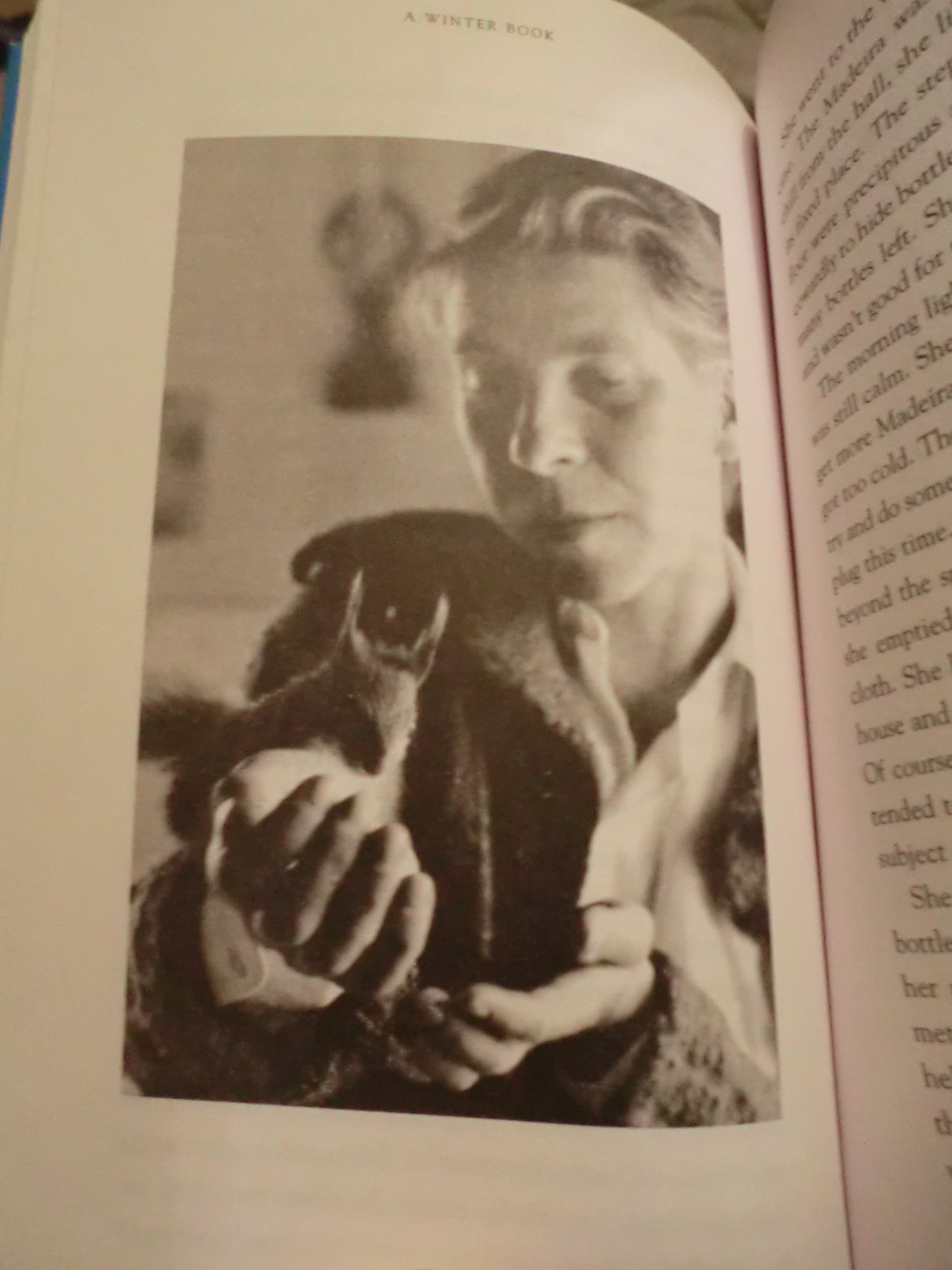
Not just a quiet, honest collection of stories, but containing wonderful black and white photos that add to the atmosphere the author evokes and make us feel the heaviness and significance of that final story, Taking Leave, the last visit, when the nets have become too heavy to pull, the boat too difficult to handle, the sea too unpredictable for two aging women. It is with a quiet sadness but knowledge that many happy hours were spent, that we turn the last page on that final visit.

Elizabeth and her German Garden, Elizabeth von Arnim

Elizabeth von ArminStaying overnight with friends in England just before Christmas, this book by Elizabeth von Arnim was placed on my bedside table and though there was no chance I would finish it, I was captivated and charmed by Elizabeth’s garden right from those first few pages.

May 7th – I love my garden. I am writing in it now in the late afternoon loveliness, much interrupted by the mosquitoes and the temptation to look at all the glories of the new green leaves washed half an hour ago in a cold shower. Two owls are perched near me, and are carrying on a long conversation that I enjoy as much as any warbling of nightingales. The gentleman owl says, and she answers from her tree a little way off,, beautifully assenting to and completing her lord’s remark, as becomes a properly constructed German she-owl. They say the same thing over and over again so emphatically that I think it must be something nasty about me; but I shall not let myself become frightened away by the sarcasm of owls.

I left without the book, only for it to land on my doorstep late January on my birthday, and in these cold harsh months when the comforts of a garden are not so easy to find, when I have been finding solace instead in the nature essays of Kathleen Jamie and the short stories of Tove Jansson (review to come), this novel was a welcome respite.

Elizabeth von Arnim

Elizabeth von Arnim

It is fiction, though reads very much like an autobiography and was initially published anonymously in 1898. The author (a cousin of Katherine Mansfield) is said to have been born in Sydney, in NZ and in England, I’m not sure about any of that, but her parents did leave Sydney and return to England where she was raised (while her father’s brother and family remained in New Zealand).

Katherine Mansfield

Katherine Mansfield

It seems likely that Katherine Mansfield spent time with these relations when she moved to England herself, I found one reference confirming this, a comment by the journalist (and relation of the two) Louise Ahearn, who is currently researching Elizabeth’s life and it is mentioned in the book that Katherine visited her cousin at the home she built Chateau Soleil, in Switzerland.

On a tour of Europe, while in Rome with her father when she was 23-years-old, her talented piano playing was overheard by Il Conte the German Graf Henning August von-Armin-Schlagenthin, who was travelling to help get over the death of his wife and child the previous year. After a persistent courtship they were married and soon settled into upper-class life in Berlin, where she gave birth to three girls in quick succession.

Nassenheide Schloss, the family estate by Alexander Duncker ex wikipedia

Nassenheide Schloss, the family estate by Alexander Duncker ex wikipedia

Not happy in Berlin and homesick for England, in 1896 she was introduced to the family estate Nassenheide, ninety miles north of Berlin in Pomerania. A seventeenth century-schloss, located at the time near the German border (now in Poland), it had been a convent and had not been lived in for more than 25 years, surrounded by an unkempt, rambling, derelict garden which Elizabeth immediately fell in love with. She insisted on living there and it seems she got her way (at least for the summer months), much to the chagrin of her husband, whom she affectionately refers to in the novel as the Man of Wrath.

The book captures many moments of appreciation of this unorthodox wilderness the character Elizabeth is so content within, and equal moments of candour at the annoyance of those who dare impose themselves to visit. She has difficulty keeping the gardener who often hands in his notice while she somehow convinces him to stay, until events dictate that drastic action is necessary to get rid of him.

The gardener has been here a year and has given me notice regularly on the first of every month, but up to now has been induced to stay on. On the first of this month he came as usual, and with determination written on every feature told me he intended to go in June, and that nothing should alter his decision. I don’t think he knows much about gardening, but he can at least dig and water, and some of the plants he plants grow, besides which he is the most unflaggingly industrious person I ever saw, and has the great merit of never appearing to take the faintest interest in what we do in the garden. So I have tried to keep him on, not knowing what the next one may be like, and when I asked him what he had to complain of and he replied “Nothing,” I could only conclude that he has a personal objection to me because of my eccentric preference for plants in groups rather than plants in lines. Perhaps, too, he does not like the extracts from gardening books I read to him sometimes when he is planting or sowing something new.

The author is at her best when describing her longing for the garden and the simple pleasure it brings her, though equally adept are her recounts of conversations with city ladies of her social standing, capturing their inability to comprehend that it is by her own choice that she spends so much time in this savage wilderness, they are convinced they must feel sorry for her and that she has been deposed there, belonging as they do to that breed of women who absolutely require the regular company of their peers and the invitations to social occasions, something Elizabeth does her best to avoid.

Content with the book, inspired by but lacking the garden, we instead take a drive and a stroll around a much closer abandoned ruin, appreciating its beauty among the weeds.

CIMG3742

Ruins of L’oppidum de la Quille, Puy Sainte Réparade

CIMG3751

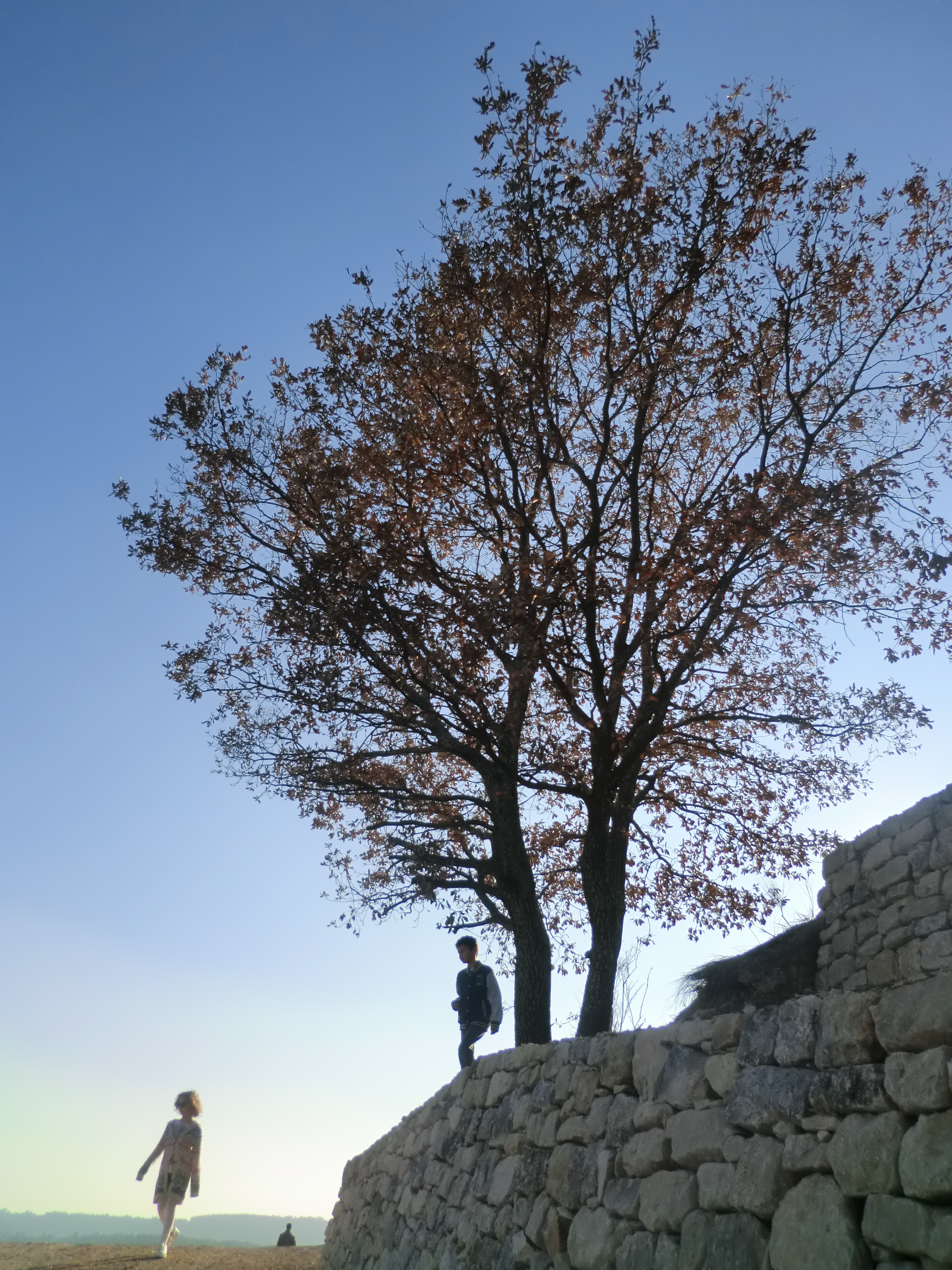
The fading winter light of Provence, Puy Sainte Réparade

What We Expect When We Don’t Expect Much From Love: Stories by Ludmilla Petrushevskaya

LudmillaThere Once Lived A Girl Who Seduced Her Sister’s Husband, And He Hanged Himself. The title itself is intriguing, though if you have read the author before, you will recognise the tendency, she is the bestselling author of There Once Lived A Woman Who Tried To Kill Her Neighbour’s Baby.

I took the book with me on a recent visit to London, as my alternative to the kindle, since I have been caught out a couple of times with that little machine dying on me even though the battery wasn’t run down. I have since discovered the 20 second rule. When the kindle fails to come to life when it should, hold it in the on position for 20 seconds to reboot it. Like many gadgets today I’m not sure these things are designed to last, not as long an old-fashioned book anyway. And I have Penguin to thank for sending me a bona-fide book!

The blurbs quote Chekov, Poe, Beckett, Tolstoy and various others to entice you in, making promises that will no doubt encourage dissent; it is a tall order to be compared to literary greats. I haven’t read all those greats, but there is one collection I am reminded of, not because she writes like him, but because the voice is clear from story to story and at the end I am left with the notion that “there is consistency in that voice” and “she says it how it is”.

Carver LoveIf Ludmilla Petrushevskaya reminds me of any writer, it is Raymond Carver and his collection what we talk about when we talk about love. Ironically, when pulling this volume off the shelf, I also find tucked in its last page, a boarding card for a flight from Marseille to London, dated June 2008.

So back to the book.

Seventeen episodes of attempts at love or connection with another, in all their dysfunction, set within the context of post revolutionary Russia when private ownership of housing was forbidden and many family apartments were divided and sub-divided and the space people came to occupy diminished, along with many of their hopes and expectations of each other.

By 1972, when Petrushevskaya published her first story, Moscow was ringed with concrete buildings containing these overcrowded units where the majority of these love stories take place.

Born in 1938 in Moscow, Ludmilla Petrushevskaya never knew family life. Evacuated with her mother to Kuibyshev during the war, she was left there in the care of her aunt and grandmother while her mother returned to Moscow to attend college. Members of the family of “an enemy of the people”, they were treated as pariahs – and were slowly starving. At age eight, Petrushevskaya began to run away from her temporary home and spend summers as a street beggar. Her mother returned after four years and brought her back to Moscow, where they were officially homeless. As a young girl there, Petrushevskaya and her mother lived under a desk in her insane grandfather’s room, while occasionally renting cots in nearby communal apartments. It was an unsettled, unhappy childhood, one experienced without the consolation of siblings.” Extract from Introduction by translator Anna Summers

The stories are collected into four sections, the first A Murky Fate contains stories of characters who consider entering relationships that are flawed or doomed, in readiness for a chance at that diminished flutter of something that may resemble love. It is not to be moved by these circumstances that we read these stories, it is to bear witness to another’s reality. They are uncomfortable, fatalistic and near-true.

She’ll wait for his long-distance call in a phone booth at the post office. For ten prepaid minutes they’ll become one soul again, as they did over the twenty-four prepaid days of their vacation. They’ll shout and cry across thousands of miles, deceived by the promise of eternal summer, seduced and abandoned.

As we read the stories, our own expectations are so low for these women, that it is possible to experience our own small pleasure in expecting nothing and finding delight in an obscure change in their fortune, even if only for a short period.

I mentioned to a friend that it was as if I was sitting across the table from the writer listening to an oral narration of people she knew, that it reminded me of other tables I have sat at, listening to stories of other women from different cultures and how they found themselves living in this or that country or city, so often lead by the allure of love or the promise of an improved lifestyle.

dollsEach community, era, culture has its stories to share, it disappointments to shed and its eternal hope for future generations, that they may do better. Reading these stories is like reading another chapter in the evolution of humanity and reminds us that we have a long way to go before arriving near any kind of nirvana.

…the day is burning its last, and Milgrom, eternal Milgrom, sits in her little pensioner’s room like a guard at the museum of her own life, where there is nothing at all but a timid love.

Note: This book was kindly made available by the publisher.

Revenge by Yoko Ogawa (Japan) – Eleven Dark Tales

RevengeWow! Those of you who have been reading this blog long enough to remember my post on Why People Don’t Read Short Stories may remember that they are something I usually savour, rarely devouring an entire collection in one sitting, but Yoko Ogawa breaks the mould and her newly published book Revenge is full of hooks and devices that stopped me putting it aside and saw me instead ploughing on to read one after the after.

Like a curious sea creature taking the glistening bait, after reading the first story, I dove into the next, caught in the deft grip of Ogawa’s clever and haunting narration, each story carrying the slimmest thread into the next, sufficient to keep the reader interested and more than that, inquisitive to continue and see what she would come up with next.

I first read Yoko Ogawa last year, attracted by her slim collection of three stories contained within The Diving Pool and then her novella The Housekeeper + The Professor, they are very different books, so I was interested in how this collection would compare.

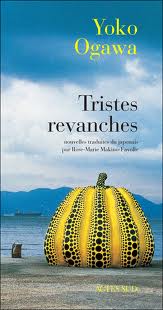
tristes revancesShe has written prolifically over the years and much of her work has been translated into French, very little thus far in English, though perhaps that will change as her short stories are increasingly appearing in contemporary English language publications. The Nobel Prize winning author Kenzaburō Ōe when speaking about her work said:

‘Yoko Ogawa is able to give expression to the most subtle workings of human psychology in prose that is gentle yet penetrating.’

Revenge is an apt title, there are traces of it in every story, calculated revenge, obsessive revenge, inexplicable revenge and cold-blooded revenge. Each story exists on its own, but I read it like a novel, not wanting to pause between titles and feeling right from the end of the first story a tightness in the solar plexus and realisation that I had been holding my breath.

It’s not just the story, it’s awe at how she can write in such an engaging way, where very little actually happens, but we begin to understand more about what is going on in the mind of the character from all the little details she gives, creating a growing image in our own minds, just before she delivers the final blow. And even when we don’t know much about a particular character, someone on the periphery perhaps, not important to the story, chances are we are about to find out more about them in the next story. And so we read on to find out if we guessed right or if she will insert some other connection.

I share this from the blurb, which encapsulates something of these stories in a more concise manner than I ever could:

An aspiring writer moves into a new apartment and discovers that her landlady has murdered her husband. Years later, the writer’s stepson reflects upon his stepmother and the strange stories she used to tell him. Meanwhile, a surgeon’s lover vows to kill him if he does not leave his wife. Before she can follow-through on her crime of passion, though, the surgeon will cross paths with another remarkable woman, a cabaret singer whose heart beats delicately outside of her body. But when the surgeon promises to repair her condition, he sparks the jealousy of another man who would like to preserve the heart in a custom tailored bag. Murderers and mourners, mothers and children, lovers and innocent bystanders—their fates converge in a darkly beautiful web that they are each powerless to escape.

Ogawa is certainly not the first writer to do this, to infuse stories with their subtle threads and connections, Alice Hoffman does it with Blackbird House, Colum McCann did it with Let The Great World Spin and I believe Cloud Atlas (which I have not read) has something that makes it too, more like vaguely connected stories than a novel.

jigsawRevenge isn’t a complicated kind of clever though, there’s no need to question or ponder too deeply over it, the links are clear, but it will leave you wondering how she does it, how she maps out those stories and creates those links. It’s like a jigsaw puzzle with multiple subjects, the letters R E V E N G E scratched across the surface.

Note: This book was an Advance Reader Copy (ARC) provided by the publisher via NetGalley.

The Zenith by Dương Thu Hương

In 1996 I spent three months travelling in Asia, limiting my visit to four countries, India, Nepal, Vietnam and Thailand.

It was in Vietnam that I first travelled on my own and perhaps for this reason, it has always resonated deeply within me. It is a special place and I experienced it at a unique time, the city of Hanoi had no cars and most of its population travelled by bicycle, unlike the city of Saigon in the South full of the noise pollution of motorbikes. 090212_1801_IntheShadow1.jpg

That’s not to suggest it was easy to navigate those intersections, with bicycles coming from all directions, the ring of the bicycle bell a constant stream of warning as the masses somehow managed to criss-cross in opposite directions without accident. I watched that flow for a long time before I understood and dared to join it. The trick? Do not hesitate.

While in Hanoi, I decided to read a couple of Vietnamese authors, I was interested in reading something that came from a local perspective and not from the English-speaking perspective which seemed more prominent.  A young boy in the street sold me two books, Bao Ninh’s The Sorrow of War and Dương Thu Hương’s Paradise of the Blind, the latter a story that illustrated the effect of a rigid communist ideology on a family in the wake of the land reforms of the 1950’s, as narrated by a young woman travelling to Moscow in the 1980’s.

A quote on the back written by Grace Paley, confirmed my thoughts.

“At last a woman, a Vietnamese woman, tells us Vietnamese life: the village, the city, the repression and expansion, the middle peasant, the poor peasant, the years of exquisite food and no food, working in the Soviet Union – and all beautifully told so that we begin to understand not where we were for years, but where and how they – the Vietnamese – are now.”                                                      – Grace Paley

090212_1801_IntheShadow6.jpgThe author’s depiction of ordinary people, in both rural and urban Vietnam was compelling and the definition of terms at the back of the book, particularly of food and practical items was especially useful for me as I cycled my way around the city and out along the river, past markets and temples and saw how people lived, ate and spent their days. This book was the first Vietnamese novel published in the US (1993) I have since discovered, so no surprise that I had never come across this enlightened perspective before.

zenithDương Thu Hương now lives in exile in Paris and her latest novel The Zenith has recently been published. It gets off to a slow start initially, when Ho Chi Minh, the President looks back as a 70-year-old man at parts of his life with regret. He regrets the lack of contact with children that he fathered and the loss of a woman he loved, he regrets the distance that has come between himself as a man and the people he sought to represent.

Wishing to retrieve something of that contact, he attends the funeral of a woodcutter to pay his respects, only to realise the suffering his presence will have caused because of his distinguished position and the expectations that are carried with it should he grace them with his presence. He despairs at having lost sight of that which motivated him to first become involved in the revolution, to bring equality to all.

A bitter longing mixed with a searching curiosity flowers in his heart; he wants to attend the funeral of the woodsman because he wants to experience the funeral of a real father.

Things pick up in pace and interest when we learn more of the story of the woodcutter, his family and village, this one story perhaps seen to represent various stages in the country’s own experience of communism, both its idealistic benefits for the community and its destructive elements against the weak and innocent, when power, greed and envy are present within its leadership, turning even family members against each other. The story-telling reaches its zenith and had me totally convinced of the authenticity of the relationship between the wise sixty-something father/grandfather Mr Quang and his new 18-year-old bride Miss Ngan and relishing the way they managed the reactions of close family and their community with their provocative yet bona-fide marriage.

Of old, it was said: “Tears run downward.” So true.

“Filial love for parents can’t equal the ties of anxious love in a father’s soul for a child. Because when we love our parents we look up but when we love our children we look down. And according to the laws of heaven and earth, tears always flow downward. Especially whenever we recognise that as fathers we have done wrong. Hell itself will then open a door straight into the heart.”

It highlights the enormous gap that can grow between those who rule and have power and/or wealth and those who are trying to survive, just like the distance between rich and poor in a democratic society, similarly it exists between those who yield power and those who don’t in a communist society, trust breaking down within a community as people become increasingly desperate and open to being corrupted while others live in constant fear.

This is not a book to be read quickly, nor even understood immediately. I continue to think about what I read and what it attempted to portray about society, leadership, workers, family and the effect of power and its oft great distance from the reality of how people live, the destructiveness of jealousy and the perseverance of those who will never be compromised, who will always fight for what they perceive is good and right.

The country, its writers and message continue to allure and despite all the suffering, both past and present, there remains for me a quiet tranquility that pervades it, a steadfast patience and determination I admire.

Note: This book was an Advance Reader Copy (ARC) provided by NetGalley on behalf of the publisher.

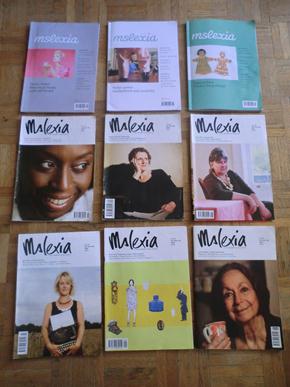
mslexia – for women who write

I’ve been subscribing to mslexia magazine for a few years now and since it is both a great stimulant to the writing process as well as an excellent source of reading recommendations and a directory of sorts, I thought I’d share a little about it.

Mostly I like it, because it doesn’t feel in any way elitist, this is a kind-hearted, generous resource, contributed to and read by ordinary women who like to write, including many who like me, don’t participate in this activity as a job, but manage to scribble away for a few hours each week – read this and you realise you are part of a large, like-minded community of women who believe in making the impossible possible.

It might be published in the United Kingdom, but it has a very international flavour and inclusive attitude, important when you live outside your country of birth and don’t write in the language of your country of residence and want to participate.

mslexia (ms = woman, lexia =words) is a quarterly publication with feature articles on some aspect of writing (and open to idea submissions), an interview with a published writer, featured short stories or poetry written to the issue theme, or winning entries from the regular competitions they run.

It was Issue 48 in Jan/Feb/Mar 2011 that introduced me to the writer Susan Hill, just as her short novel A Kind Man was being released and I’ve since read three more of her books.

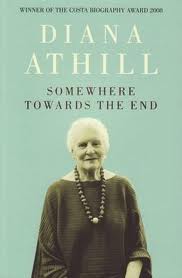
In the latest edition there is a wonderful interview with Diana Athill, what an inspiring woman she is, winning the Costa biography award at 91 with her book Somewhere Towards the End and still writing from her North London residential retirement home.  She says it how it is and cites Jean Rhys’ for teaching her this, she mines her own experiences for a story, and cautions against being cruel to others, “you can be ruthless about yourself, but not when writing about friends” – you can read an extract from the interview here.

athill“I have never understood how many writers moan and groan about how awful writing is. Absolute nonsense.” Diana Athill

Recently, they have been conducting mini-surveys of readers which are then incorporated into the lead articles and some of the smaller snippets of information found throughout the magazine. It is extremely readable, which I put down to the fact that there is a reasonable portion of bite-sized articles, such as letters, extracts from posts, emails, tweets, along with fun and short, contemporary submissions from writers under the headings of rants, raves, a week of tweets, monologue, pen portrait, how I keep going, four lines that rhyme, a poetry or book review. Something for everyone.

Each quarter there is a themed New Writing section, always an excellent writing prompt whether you are interested to submit or not, short narrative or story up to 2,200 words, prose or sometimes poetry, the successful entries appearing in a future edition. I have seen many women being published for the first time through these exercises.

There is an annual poetry and short story competition and in 2012 there was a children’s novel competition for unpublished women novelists.

In addition to all the wonderful information it lays at your fingertips, one of the things I love the most are the short bio’s of contributors, here is one from the 2009 poetry competition in which Pat Simmon’s touching poem ‘Jack discovers impermanence’ was a winner:

PAT SIMMONS, 64, was head of communications for ‘Send a Cow’, an African agricultural organisation, but has since retired. The conviction that whatever she writes will be rubbish stilts her creative progress, but an encouraging family keep her inspired and motivated. Finding writing by hand shackling, she works directly onto her laptop, a practice to which she wishes to dedicate more time. She was Blagdon’s 2005 Apple Wassail Queen – your guess is as good as ours – and on a trip to Rwanda was re-christened Munyanika: ‘As valuable as a cow.’

It is available online, but this is one publication that I like to have the physical magazine to read, there are so many gems and I return to back issues often. Oh and lets not forget the back page, always a delight to conclude with, ‘the bedside table‘, introduces an artist, author, intellectual or well-known personality who shares what’s currently on their nightstand, like gossip for book-lovers.

The next deadline of 18 March 2013 is for Issue 58: The Women’s Short Story Competition for stories up to 2,200 words on any topic. There are prizes for 1st, 2nd and 3rd and three other finalists will also be published in that issue of Mslexia. You don’t have to be   a subscriber to enter, just a woman.  Stories are accepted from any nationality and country.

Happy Writing!