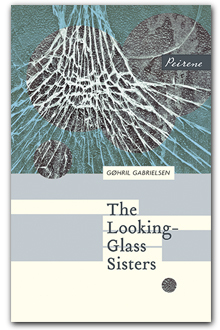
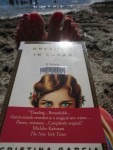
The Looking-Glass Sisters by Gøhril Gabrielsen tr. John Irons #WITMonth

This is a tragedy about a woman who yearns for love but ends up in a painfully destructive conflict with her sister. It is also a story about loneliness – both geographical and psychological. Facing the prospect of a life without love, we fall back into isolating delusions at exactly the moment when we need to connect.

Mieke Ziervogel, Peirene Press

Looking Glass SistersTwo sisters have lived in the same house all their lives, their parents long gone and they can barely tolerate each other. They are bound together in one sense due to the practical disability of the younger sister, but also through the inherent sense of duty and responsibility of the first-born.

At times like these, in the dark, maybe with a candle lit, a sudden, intense feeling overcomes me that Ragna and I are one body, completely inseparable. We have gradually let go of parts of ourselves in favour of the other. Over the years, through conflicts and confrontations, we have shaped, kneaded and formed ourselves into a lopsided, distorted yet complete organism. Ragna has the body and I have the soul. She puts on the firewood, I do the thinking. She makes the tea, I read and write.

They manage with their hostile acceptance of each other until the new neighbour Johan begins to visit and competes for the attention of the able, caring, repressed Ragna, a potential disruptive threat to her invalid sister and to the way things in their household have been for a long time.

Days and weeks go by, I glide into a soothing rhythm of calm everydayness. It is an illusion, I know that, for beneath the dependable surface conspiracies smoulder, along with my sister’s hot-tempered desire for her own life.

Narrated from the perspective of the crippled sister in a stream of consciousness style, its intense, frustrating and laced with a sense of foreboding as the third character, Johan, arrives and either in her imagination or in reality – we are never quite sure – convinces the sister to make plans to change their circumstances.

Can it be that I, the sick one, have given rise to impatience in Ragna because of my exaggerated gestures and unreasonable demands? Can it be that I, the helpless one, have bred the anger in her by making myself more pathetic than I am? And can it be that I, in my struggle to gain the inviolable position of victim, have forged and fashioned Ragna the violator?

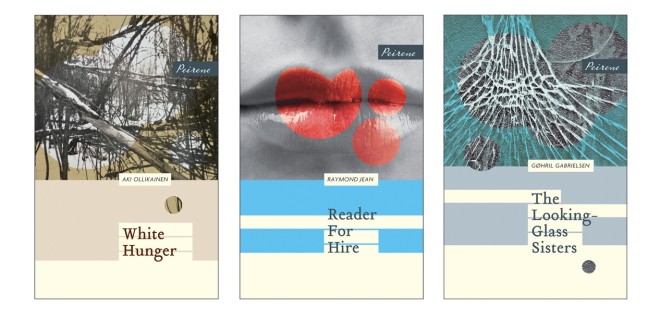
Claustrophobic, at times surreal, it fits perfectly with the Peirene Press Close Encounters theme, which comprised the three novellas below.

Chance Encounter Series

Peirene Press publish three books a year in a themed series. Their 6th series ‘Chance Encounters’ comprised three books that explored different aspects of interpersonal relationships and the importance of the Other in our development as individuals and our understanding of ourselves.

10 Great Books That Transport You Around the World #BookLoversDay

Yesterday it was International Cat Day and today it’s BookLovers Day, well any day will do to celebrate reading, so since it’s summer and I’m not going away this year, here are some easy travelling locations to visit by book, all great reads. Click on the title to read my review

10 Books That Transport You Around the World

Snowy Alaska – The Bright Edge of the World by Eowyn Ivey

Northern England – The Drowning of Arthur Braxton by Caroline Smailes

Coastal Italy – The Enchanted April by Elisabeth von Arnim

Spanish Pyrenees – The Yellow Rain by Julio Llamazares tr. by Margaret Jull Costa

France – The President’s Hat by Antoine Laurain

Turkey – Portrait of a Turkish Family by Irfan Orga

Afghanistan – The Honey Thief by Najaf Mazari (as narrated to Robert Hillman)

Ethiopia – Cutting for Stone by Abraham Verghese


Cuba – Dreaming in Cuban by Cristina Garcia

Vietnam – Ru by Kim Thuy

New Zealand – Hummingbird by James George

And since I’ve already read all of these, today I’m choosing to go to Guadeloupe and will begin reading The Bridge of Beyond by Simone Schwarz-Bart,

“A masterpiece of Caribbean literature – an intoxicating tale of love and wonder, mothers and daughters, spiritual values and the grim legacy of slavery on the French Antillean island of Guadeloupe.”

Happy Reading!

Bridge of Beyond

Click Here to Buy Any Of These Books at Book Depository

The Blue Satin Nightgown by Karin Crilly #memoir

Tell me, what is it you plan to do with your one wild and precious life? Mary Oliver, Poet

Outdoor MassageA few years ago a lady who had recently moved here to Aix-en-Provence contacted me in relation to Flairesse, my aromatherapy therapeutic massage business. She became a regular client and over time I got to know her well, discovering a mutual interest in culture, books and writing. She had a strong passion for travel, the lives of others and the excitement of discovery, which was the name of a blog she’d set up to keep a record of her adventures while living in France.

I learned that she was writing a book, which had initially been planned to be a collection of a dozen or so stories she had related to her clients over the years, (she had been a Marriage and Family Counsellor for 30 years in Southern California) these stories had been her way to illustrate a particular teaching, something she had found that people absorbed more easily through storytelling than being given the lesson directly.

However, and given her adventurous spirit, it came as no surprise to me, once she sat down to write it, she realised that looking back and recounting the past, the stories she had spent 30 years narrating, no longer excited her, so she decided to change direction and push her focus forward, towards the unknown lifescape before her and share this grand adventure she had embarked on, three years after her retirement, at the unstoppable age of seventy-eight.

Every month, I would hear how the book was progressing and I’d also hear about Karin’s latest travels, culinary adventures, her move to a quieter apartment, her daily five Tibetans rites of rejuvenation ritual, and always that infectious laugh and sense of fun she had about life. I lent her a few writing books and then suggested she might like to enter The Good Life France writing competition, 1,000 words about France – about memories, a favourite place, or something you love about France.

good lifeExcited about the opportunity to put her writing skills to the test, Karin took the first chapter of her book, moulded it as much as she could to meet the criteria, sent it to me to look over and to make recommendations on how to whittle it down further without losing any of the content and then sent it off! We came up with the title ‘Scattered Dreams’ and a few weeks later heard the fantastic news, a confirmation if ever any was needed of how realistic this dream was in coming to fruition, that she had won first prize! She was now published and on her way to fulfilling that goal of becoming an inspirational author.

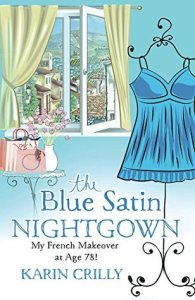
And so, today I am delighted to be able to introduce you now to published author Karin Crilly, and the book that made its first chapter appearance in The Good Life France where it was so fabulously awarded the recognition it deserved – The Blue Satin Nightgown, My French Makeover at Age 78.

I had to share this photo which Karin sent me one night as I was scribbling notes over one of her chapters in the book, (after that first success, I read all her manuscript and tried to concentrate on making notes for feedback, which was difficult, as her stories were so entertaining and often had me open-mouthed in surprise).

She’d told me she was going to an Elton John concert earlier in the evening and then later this picture arrived, showing her accepting a lift home from Xavier – the husband of her friend Marie-Paule, a couple who became like family to her –  it so depicts the excitement and sense of adventure Karin was always up for and no wonder her book is so full of laughs and the pure delight of living life to the full.

The Blue Satin Nightgown is an enchanting, easy reading memoir of Karin’s two years based here in the small town of Aix-en-Provence, taking us through both the trials and delights of her attempt to integrate into French culture, finding an apartment, discovering the markets, learning French cuisine – though she is already an excellent cook, and shares some new and favourite recipes throughout the book.

She attracts men without trying and there are many entertaining chapters of close encounters and demonstrations of what we might refer to as, the French culture’s ‘art of seduction‘, a term that doesn’t have the same meaning in English, more of a natural charm that often surpasses the boundaries of the Anglo-American experience and is practised by young and old.

One of the endearing aspects of Karin’s writing and of her character is her ability to look at herself and see how she reacts in certain situations, to talk to herself as if she were one of her own clients. She brings a natural and gracious wisdom to the page and often thought back to wonder how her late husband Bill, to whom she dedicated the book, would have responded to what she had experienced and often asked herself what lesson she needed to learn. She finds wisdom not just in her own encounters, but by maintaining a strong and positive link to her loved one, a memory that never held her back, one she found a way to help push her forward and kept at her side, without ever succumbing to grief or self-pity.

Karin is not just an inspiration to those in their seventies or those who have lost a life partner, she is an inspiration to all of us, who have ever thought about doing something a little adventurous or extraordinary.

When my husband died from complications of Parkinson’s disease, I wondered if I could still be extraordinary. I had expended so much energy being his caregiver for eighteen years, the last five years of which demanded my entire being. After grieving for several years, I retired from thirty years of counselling. I needed to reinvent my life. I believed what I have always known: that the true self is presented  with ideas that it is capable of fulfilling.

When I received the call at age seventy-eight, I remembered my clients and my advice to them.  And I said YES!

Karin Crilly, Introduction, The Blue Satin Nightgown

Buy a copy of Karin’s The Blue Satin Nightgown via Book Depository here (affiliate link)

or Buy a Kindle E- book version here

*****

Aix

The Door by Magda Szabó tr. Len Rix #WITMonth

The DoorThe Door is an overwrought, neurotic narrative by “the lady writer”, (possibly Szabó’s alter-ego, as there are similarities) describing her 20 year relationship with Emerence, the older lady who interviews her prospective employer to see if she’ll consider accepting the cleaning job on offer.
The writer and her husband have recently had a ban on publication lifted from them (for political reasons) and anticipate requiring help around the house as they get back to work. Despite having little respect for intellectuals and only for those who do manual work, in her own time Emerence decides to accept them.

No formal agreement dictated the number of hours Emerence spent in our house, or the precise times of her arrival. We might conceivably see nothing of her all day. Then, at eleven at night, she would appear, not in the inner rooms, but in the kitchen or the pantry, which she would scrub until dawn.

Are they dependent on one another or do they despise each other? Is Emerence an altruistic soul, or a cunning manipulator? Is the lady writer narcissistic or consumed with guilt pursuing her idle occupation while the older woman takes on more and more work?

I stood there gazing after her, wondering why she still stuck with me when I was so very different from her. I had no idea what she liked about me. I said earlier that I still rather young,  and I hadn’t thought it through, how irrational, how unpredictable is the attraction between people, how fatal its current. And yet I was well versed in Greek literature,  which portrayed nothing but  the passions: death and love and friendship, their hands joined together around a glittering axe.

The entire novel hovers with each event between opposing emotional states as they appear to get the measure of the other only for the behaviour to completely change. Emerence will do anything and everything for everyone, she is loved by all, but has never opened the door to her home to a soul, her charges make it to her porch and no further. No one knows anything about her private life and she shuts down anyone who dares to pry.

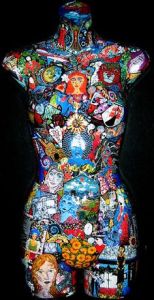
Dressmakers ribcageLater, only very much later, in one of the most surreal moments I have ever experienced, I wandered amidst the ruin of Emerence’s life, and discovered, there in her garden, standing on the lawn, the faceless dressmaker’s dummy designed for my mother’s exquisite figure. Just before they sprinkled it with petrol and set fire to it, I caught sight of Emerence’s ikonstasis. We were all there, pinned to the fabric over the dolls’ ribcage: the Grossman family, my husband, Viola, the Lieutenant Colonel, the nephew, the baker, the lawyer’s son, and herself, the young Emerence, with radiant golden hair, in her maid’s uniform and little crested cap, holding a baby in her arms.
Seen through the prism of the writer, we observe Emerence only through her eyes, often confused, sometimes suspicious, frequently neurotic. She bears the hallmarks of an unreliable narrator.

It is a slow developing relationship and narrative that entwines these two women’s lives together, creating a delicate trust, the implications of which lead to its tragic denouement.

It’s a compelling, unsettling read, there is a sense of foreboding as the protagonist often jumps forward and provides brief glimpses as to what is coming, building tension and the sense of some kind of catastrophic event or revelation that awaits them all.

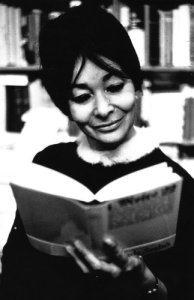
Magda SzabóMagda Szabó was born in 1917 in Debrecen, Hungary, her father a member of the City Council, and her mother a teacher.

In 1949 she was awarded the prestigious Hungarian literary Baumgarten Prize, given to “Hungarian authors with serious endeavour whether in literature or in science who are exempt of any religious, racial or social prejudices and serve only ideal aims…”

The prize was withdrawn from her for political reasons the same day it was awarded. She was dismissed from her job at the Ministry and during the establishment of Stalinist rule from 1949 to 1956, the government did not allow her works to be published.

In 2003, the French translation of ‘The Door’ won France’s Prix Femina Étranger.

She died in 2007, at the age of ninety and was one of Hungary’s best-known writers, although very few of her works have been published in English. The ‘Door’ however, was translated in more than 40 languages and published in 64 countries.

Reading Women Writers in Translation

This is my third read in August for #WITMonth, reading Women in Translation.  Have you read anything by Magda Szabó?

Further Reading

New Yorker Article, April 29, 2016 – The Hungarian Despair of Magda Szabó’s “The Door” by Cynthia Zarin

Guardian Review – Labours of love, A thinly veiled self-portrait emerges from Magda Szabó’s The Door by Elena Seymenliyska

Buy a copy of Magda Szabó’s The Door via Book Depository

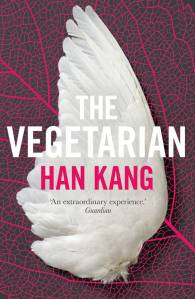
The Vegetarian by Han Kang tr. Deborah Smith #WITMonth

A novel in three acts that centre around the middle sister whose behaviour goes relatively unnoticed by those around her until she decides to become vegetarian, because “I had a dream“.

I’m already under the spell of Han Kang, having read Human Acts earlier this year, an extraordinary and unique book and I find The Vegetarian equally compelling, perhaps even more disturbing, a visceral, disturbing depiction of the fragility of the mind and the strange mechanisms, illusions we attach to in order to cope. It won the Man Booker International Prize 2016 and I’m reading it as part of #WITMonth, reading women in translation.

The Vegetarian reminded me of the distressing yet refined style and experience of reading Yoko Ogawa’s novel of interlinked stories Revenge and the shock and compulsion of Ken Kesey’s One Flew Over the Cuckoo’s Nest but really it is in a league of its own, a remarkable literary expression of the effect of people, our external environment and of our internal methods of coping, questions Han Kang poses through the situations she puts these characters into and our observations of what then happens.

The book is structured into three parts:

I. The Vegetarian – right from the beginning Kang draws up the husband and wife (Yeong-hye) characters with such precision, skill and intrigue, I was completely hooked from those initial pages. Their uneventful life changes suddenly with her decision to become vegetarian, bringing out the worst in everyone.

Before my wife turned vegetarian, I’d always thought of her as completely unremarkable in every way. To be frank, the first time I met her I wasn’t even attracted to her…However, if there wasn’t any special attraction, nor did any particular drawbacks present themselves, and therefore there was no reason for the two of us not to get married.

II. Mongolian Mark – this is a reference to a kind of birthmark that disappears post adolescence, it becomes the cause of an infatuation by Yeong-hye’s narcissistic brother-in-law, the obsessive video artist who is inspired to create what he perceives will be his greatest work, if he can convince his sister-in-law to become the subject of his oeuvre, and balance the fine line between art and pornography.

‘Will the dreams stop now?’ she muttered, her voice barely audible.

III. Flaming Trees Yeong-hye is in a psychiatric hospital, her sister her only visitor, the visits and the realisations she is having take their toll on her as she begins to understand her sisters descent from being human into believing that she is like or wishes to become a tree, that all she needs is sunlight and moisture, slowly depriving her human form of sustenance.

This pain and insomnia which, unbeknownst to others, now has In-hye in its grip – might Yeong-hye have passed through this same phase herself, a long time ago and more quickly than most people? Might Yeong-hye’s current condition be the natural progression from what her sister has recently been experiencing? Perhaps, at some point, Yeong-hye had simply let fall the slender thread which had kept her connected with everyday life.

It’s a sad tale of a woman’s descent into madness and how it affects those around her and has the reader wondering if this was brought about by the effect of attitudes and behaviour towards this one woman or whether this was something that was in her all along, something that is in everyone and under certain terrible circumstances can degenerate a sensitive human being into such a state.

Not one to let the reader off so easily Han Kang explores all avenues and leaves the reader continuing to ponder the same questions that perhaps inspired her to create this extraordinary, award-winning novel.

Click Here to Buy a Copy of The Vegetarian via Book Depository

WIT logo

The Rabbit House by Laura Alcoba tr.Polly McLean #WITMonth

Laura Alcoba was born in Argentina in 1968 and has lived in Paris since she was 10 years old, when she fled Argentina during the period in the country’s history from 1976 to 1983 when military, security forces hunted down any political dissidents and/or anyone believed to be associated with socialism, or the Montoneros movement. Her father had been imprisoned and her mother had already fled the country, a wanted woman.

Many that were targeted were from the church, labour unions, artists, intellectuals and university students and professors were targeted.  Pregnant women had their babies taken from them and then disappeared, many of these children were raised by military families, some of them today still have no idea of their origins, a few fortunate to be reaquainted with siblings or other family thanks to the tireless efforts of the Grandmothers of Plaza de Mayo. More than 400 children are believed to have been taken from political prisoners in Argentina during that era and the efforts of the grandmothers have reunited around 120 so far.

The Rabbit HouseIn The Rabbit House, Laura rarely refers to the political situation that forced them to live in hiding, resulting in her having to change her name and be extra careful about how she engaged with others, for it is written from the perspective of her 7-year-old self, exactly as she recalls the events and changes that occurred in their lives at the time, with little understanding of the cause of this sudden change.

After her father is imprisoned, Laura and her mother go into hiding in a house in the suburbs, they live with a young couple, the woman Diana was pregnant with her first child.

During the day, “the labourer” and “the engineer” arrive to build a rabbit house, a place where they are going to breed rabbits, a cover for the job to create an underground space in which to house a printing press, to print and distribute a banned publication.

This is because we are doing some work on the shed so we can keep rabbits in there. These visible sacks justify – we hope – the endless comings and goings of the grey van. In this way we flaunt the busyness and waste materials appropriate to a modest rabbit breeding project. But behind the rabbit breeding area is concealed a whole other building site, huge, on another scale entirely – because the house we live in was chosen to hide the secret Montonera printing press.

Though there are things Laura has been told she can and can’t do, this precarious life and it’s rules aren’t well enough defined to help her with every situation, some of which she recounts here, creating the acute tension under which she lived, terrified of doing something wrong and endangering all their lives.

EvitaMontoneraThe only people in the house are Diana, seven months pregnant, my mother behind the false back wall, and me.

Oh, and the rabbits. And the rolls of wrapping paper and ribbon. and the secret printing press and hundreds of copies of a banned newspaper. And also the weapons, for self-defence.

And the ferocious kitten.

We are very afraid.

A visit with her paternal grandparents to see her father in prison is organised in a clandestine manner, and is so traumatising she is physically sick and it is decided not to take the risk again, her fear clearly outweighing any benefit in seeing her father.

I was reminded of Marcelo Figueras’s book Kamchatka which I read in 2015, a novel also written from a child’s perspective, set in 1976. Figueras uses the novel form to inspire his storytelling, clearly drawing from his own memory and experiences of that same era.

The writing and narrating of Laura’s story is simplistic yet intense, she effectively portrays the sense of unease and desire of the child to not create trouble, but not knowing quite how, when the situations are complex and unknown,  she is destabilised by the visible fear of the grown-ups, demonstrated in how quickly they anger when they fear she may have crossed a forbidden threshold.

First read for me in #WITMonth 2016 – Reading Women in Translation.

KamcahtkaFurther Reading

My review of Marcelo Figueras Kamchatka

Argentina – A Terrible Period of State Terrorism/Genocide

Operation Condor conspiracy faces day of judgment in Argentina court

Madres of the Plaza de Mayo – Grandmothers of the Disappeared

How an Argentinian man learned his ‘father’ may have killed his real parents – Guardian 22 June 2016

******

Click here to Buy a copy of The Rabbit House via Book Depository