The Bees by Laline Paull

I came across this book The Bees by Laline Paull during the Literary Bloghop giveaway. Deb from The Book Stop was offering it as one of her giveaways and I was intrigued by the premise as it is narrated from the point of view of Flora 717, a worker bee!

Bees2The story begins with Flora’s awakening as she becomes conscious of her surroundings and who she is and what she is capable of doing. For not all bees are born equal in The Hive. Flora is a sanitation bee, one of the lowest kin and perceived by others as the most ugly, neither are they capable of speech. Except Flora. She has characteristics that are not like her kin and is fortunate being a mutant bee that she has been allowed to live.

The majority of the bees in the hive are female, except the Drones, the only male bees and the only kin who don’t work. The bee kins have names like Clover, Sage,  Thistle. They mutter a mantra ACCEPT OBEY SERVE around the more senior sisters and priestesses, they do Devotions, are punished with Kindness, communicate what they have learned on the outside in the Dance Hall, including information about the dangers of the Myriad.

“The golden fragrance drew Flora on, until to her shock she realised she had passed unscathed through the scent-gates on the staircase to the highest level of the hive.”

Their talents and work include cleaning the hive, feeding the newborns with Flow, a substance some bees are able to regurgitate, foraging to collect nectar and pollen, working in the Patisserie, grooming the Drones and tending to the Queen.
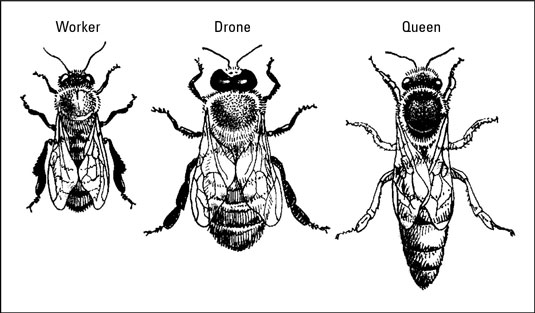
Bee Castes

The bees possess a collective consciousness and through it they can receive information from the Hive Mind and Energy and Love from their Queen; their thoughts are able to be read by others through their antennae, unless they close them down, which Flora begins to do increasingly as she crosses boundaries and experiences thoughts she knows could endanger her life and others, should any of the  kin-sisters read them.

“Flora tucked her antennae sleek down her back as she advanced her speed. Never again would she leave her channels open in the hive, for any bee to grab and read. Sister Teasel was old and  could no longer work efficiently – but Flora’s wings beat with a new strength. She felt she could fly a hundred leagues  to serve her hive, and the sky streamed with all the scents rising from the wet earth – including mesmerisingly delicious nectar. Flora locked onto it.”

There are threats both within the Hive and outside.  The beehive is like a cult, its members know their place, their role and their boundaries, however everywhere there are risks and dangers both outside and more dangerously, within. ACCEPT, OBEY, SERVE. They live in a symbiotic relationship that ensures the safe function and progression of the hive. When something threatens that relationship, their safe haven is no longer assured.

Laline Paull has channelled an incredible and yet what read like a totally credible life and universe within a beehive, from the perspective of Flora 717. I know little about the bee world, but the environment the author creates is fascinating, intriguing and imaginative with references to monarchy, spiritual devotion, universal instinct and power. It also contains a subtle environmental reference, one that will be recognised by nature lovers everywhere, without compromising the essence of great storytelling.
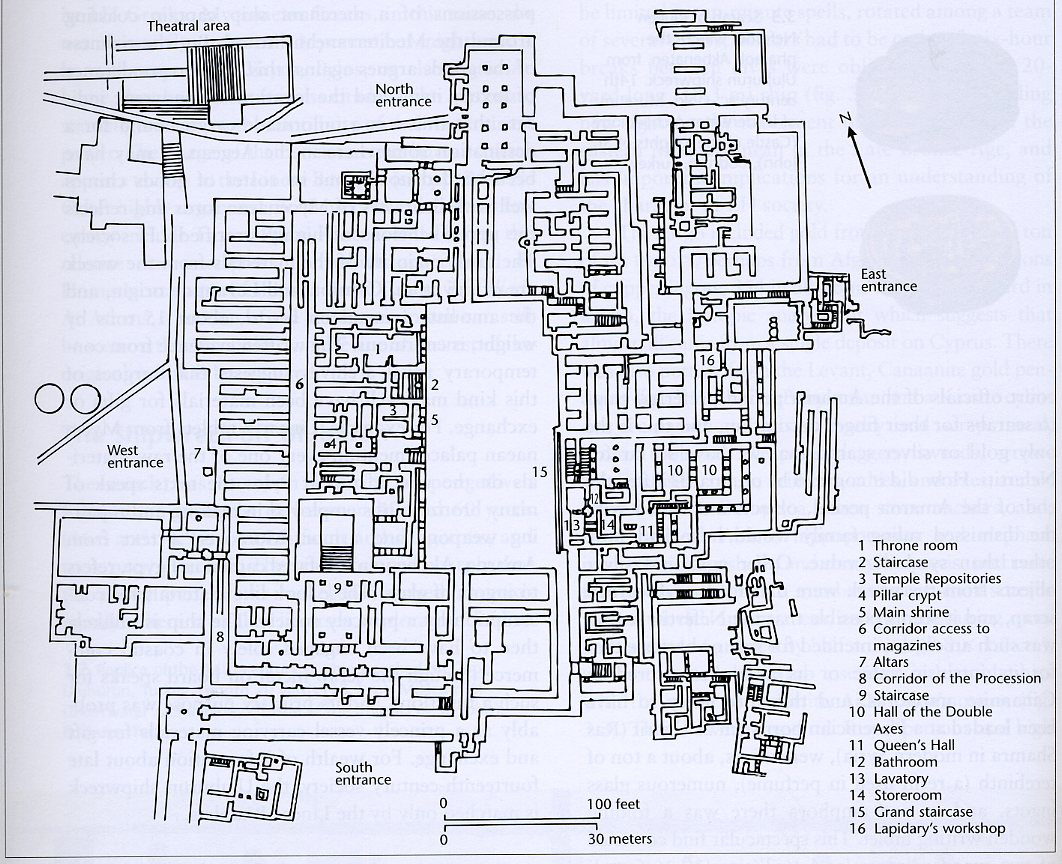
Labyrinthe of Knossos, Crete

Labyrinth of Knossos, Crete

Intrigued by the book, I was also interested to learn that Laline Paull was inspired by a Bronze Age Minoan Palace.

“The Cretan Minoan civilization dates from 1700BC, and was very sophisticated and sexually egalitarian, if not biased towards women. It was an inspiration for translating a real beehive into a fictional landscape.” Laline Paull

This description of the Labyrinth at Knossos, the largest of the Minoan palaces, gives you an idea of the influence on Flora’s world.

“Knossos is the largest of the Minoan palaces, and like others it is an agglomeration of rooms clustered around a long, rectangular central court. Only the ruins of its foundations have survived, but these reveal a vast interconnected complex of small corridors, staircases and private rooms containing residential quarters, workshops, administrative areas and many different cult centres.” Christopher Berg, Amazeing Art: Wonders of the Ancient World

The Bees is an utterly captivating read and a masterful feat of the imagination, Laline Paull has the reader on a knife-edge, knowing the dangers Flora 717 faces, yet her discretions feel necessary and we will her to continue, to survive and overcome all the challenges she faces.

I started it slowly and have since read others did find it is a slow start, however once into it, I could not put it down, it has been one of the best and most original reads of 2014 for me.

The Narrow Road to the Deep North by Richard Flanagan

Flanagan

A novel of the cruelty of war, the tenuousness of life and the impossibility of love.

I started reading this in July/August 2014, during the summer and to begin with I was fine with reading it, but by halfway I found myself not wanting to pick it up, the scenes described, horrific, grueling, they went on for too long, they were so vivid, my insides contracted each time I picked it up.

I read reviews, entered into discussions and debate about the necessity of being so exposed to such scenes as a way of understanding what men went through in war and I am not one to avoid that, but I couldn’t balance that intellectual point of view with the sickness I felt on reading this.

I was reading it on the kindle and at 50% I decided to stop and I picked up Vera Brittain’s Testament of Youth which I reviewed here, the true story of her wartime experience, some distance from the war but dealing with the effect of it, both in the hospitals where she volunteered and the letters from her fiance, brother and friends who were all fighting and who would all lose their lives.

Vera’s story brought meaning and understanding, empathy and insight, but it didn’t make me feel sick. Her life afterwards was affected by her experience in a positive way, it is a grand testament to a woman’s work and need to more than understand, but to make a contribution to try to change the world and our violent, destructive tendencies.

Richard Flanagan’s book then won the Booker Prize, so I tried again. I sped through the next 100 pages and had to pause again as that sick feeling refused to go away. So I stopped.

Today for the third and last time I picked the book up once again, but by now I could almost feel the pages of horror coming, whether it was Dorrigo trying to sew up his friends leg or watching the beating of a friend. And now I say enough. This book has many, many fans and has brought the author immense and deserved success, however, it doesn’t need my contribution and I don’t need to continue to torture myself by trying to read it, in the hope of some kind of enlightenment.

I read 65% and I am sure I missed out the redeeming parts of the book.

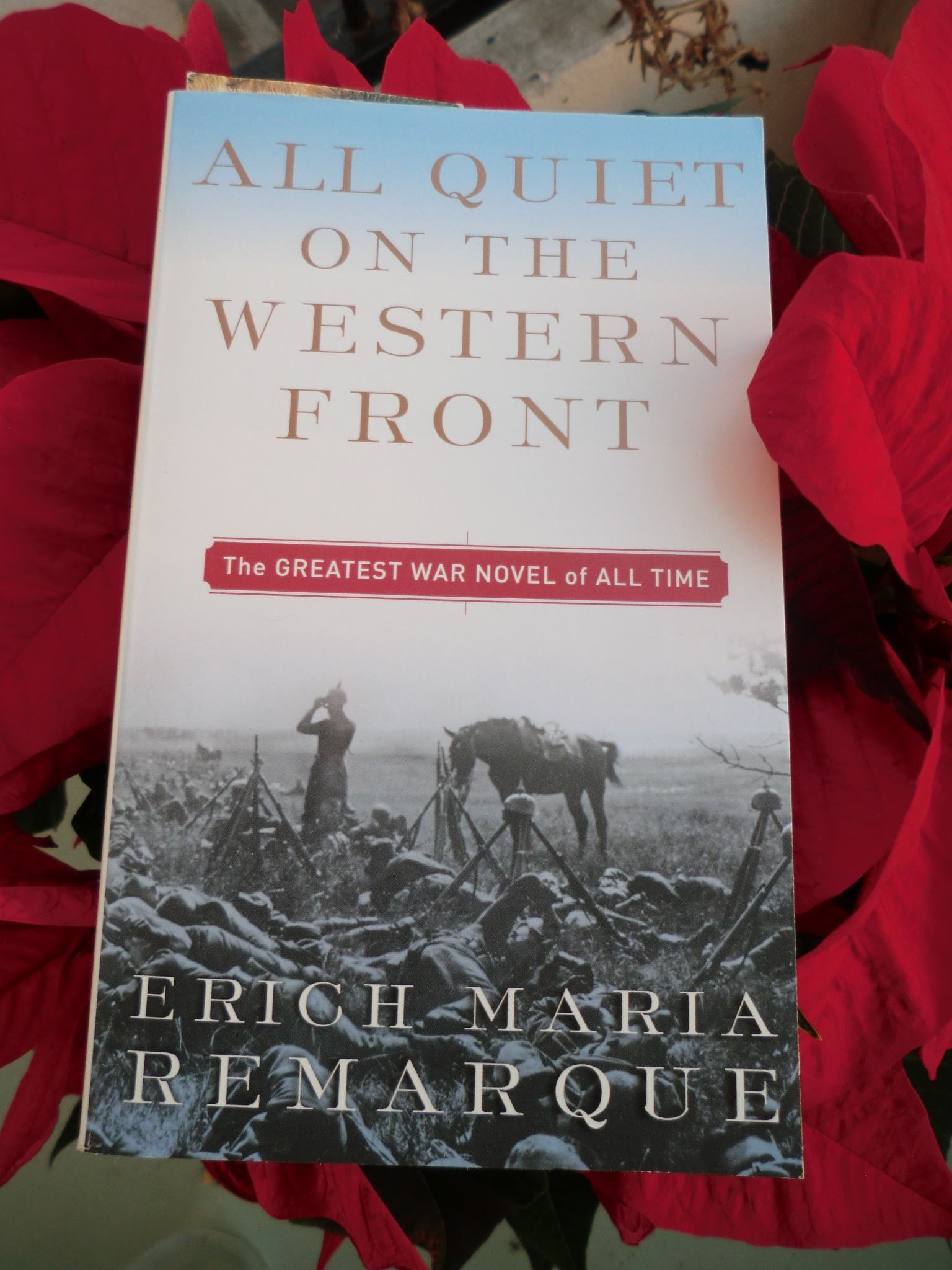
All QuietI leave it there and will turn to Erich Maria Remarque’s All Quiet on the Western Front instead to conclude a year of anniversary reads for WWI.

Note: This was an ARC (Advance Reader Copy) kindly provided by the publisher via NetGalley.

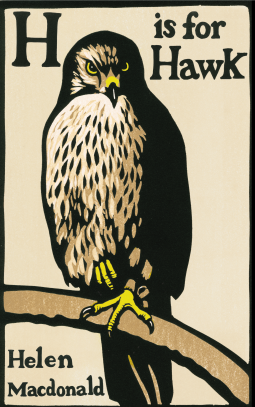
H is for Hawk by Helen Macdonald

Winner of Samuel Johnson Prize, Costa Prize

H is for Hawk and for Helen Macdonald, and her Hibernation from Humanity in coping with her father’s untimely death and her own pending transition, as her Cambridge University fellowship is coming to an end and she must soon leave the comfortable country cottage that came with it.

H is for HawkResponding to an instinctive need to escape reality she obtains a goshawk, retreats into her cottage, unplugs her telephone and focuses on training the raptor at the same time observing her own behaviour which begins to resemble the bird’s.

“The kind of madness I had was different. It was a madness designed to keep me sane. My mind struggled to build across the gap, make a new and inhabitable world. The problem was that it had nothing to work with. There was no partner, no children, no home. No nine-to-five job either. So it grabbed anything it could. It was desperate, and it read off the world wrong.”

In all her years as a falconer, she had never wanted to fly a goshawk, she feared them and comes to realise she has taken on the attitudes of those who glorified falcons, bird of nobility, of aristocracy, men of privilege, those who mocked the humble goshawk. But times and perceptions had changed, and getting to know and train a goshawk was the challenge she set for herself.

“Goshawks were ruffians: murderous, difficult to tame, sulky, fractious and foreign.”

She waits on a Scottish pier for the Belfast ferry, which is transporting a man and his goshawk, soon enough she will become the owner of the bird she names Mabel.

One Woman’s Obsession

The days pass and her focus must be with Mabel, she spurns human company, spending her free time in the company of T.H White, rereading The Goshawk, a book she had read as a child when her passion for birds was in its formative stages. White wrote about his failed attempt to train a goshawk, his account wrapped up in childhood fears and inclinations. Helen Macdonald reads around the life and writings of this man in order to understand him, as if to explain to her childhood self, why he did what he did.

“I understood why people considered it a masterpiece. For White made falconry a metaphysical battle. Like Moby-Dick or The Old Man and the Sea, The Goshawk was a literary encounter between animal and man that reached back to Puritan traditions of spiritual contest: salvation as a stake to be won in a contest against God.”

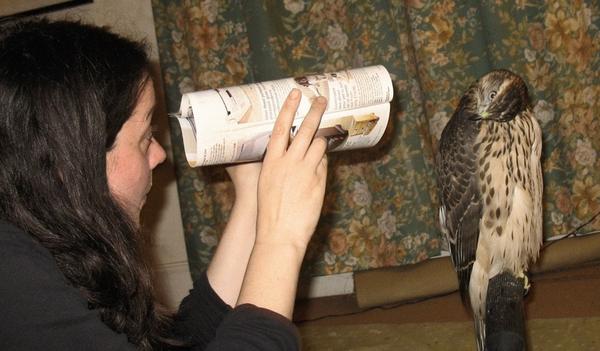
Mable and Helen playing with a paper telescope Photo by Christina McLeish @_Xtin_

Mable and Helen playing with a paper telescope
Photo by Christina McLeish @_Xtin_

It is a fascinating and insightful read as the author shares her commitment to an obsessive need to tame the hawk and exposes her vulnerability in coping with all that she wishes to avoid. Writing about the training of a goshawk is also a way of avoiding talking about herself.

We must read outside the narrative of the book to know more about Helen’s previous experience and expertise with hawks, we can tell she is no amateur, however she avoids looking back or enlightening the reader too much about her past, we are kept very much in the present, as unnerved as she is by her descent into hawk-like behaviours and instincts.

Nature Writing Memoir

I love nature writing that stimulates the imagination, that offers more than just an observation of what the author sees, but describes the environment and what an observer brings to it, one that provokes us to think about our own relationship to birds, animals and nature. Helen Macdonald comes to her goshawk challenge with fixed ideas about the need to escape all, she sets herself up like a scientific hypothesis, begins her transformation into a hawk like creature and then slowly deconstructs it, coming back to the realisation of her own humanity.

“Hands are for other human hands to hold. They should not be reserved exclusively as perches for hawks. And the wild is not a panacea for the human soul; too much in the air can corrode it to nothing.”

Falconry_sport_of_kings_(1920)

Falconry, the sport of Kings Source: wikipedia

She reminds us of the place and symbolism of falconry within humanity, its association with the hunt, with death, war, power and subservience.

It is unique in being a woman’s perspective within a heritage that has long been the domain of men, nobility, landowners, gentry, medieval lords.

It is refreshingly alive, honest and knowledgeable, exhibiting how our weaknesses and our strengths advance and recede in unison as naturally as the ebb and flow of tides.

Note: This book was an ARC (Advance Reader Copy) kindly provided by the publisher via NetGalley.

Very Inspiring Book Blogs

The Very Inspiring Blogger Award is flying like an angel around the blogosphere, touching down on many of the dedicated and inspiring people out there dedicated to books and writing and sharing the word on literature.

very-inspiring-blog-award-logo

So congratulations to the following for being nominated, you are all an inspiration to me and I thank you most kindly for nominating Word by Word.

Thank you:

  1. Lizzi at These Little Words – Thoughtful considered reviews,she reads a mix of contemporary recent publications and favourites from the shelf waiting to be read.
  2. Sandra Danby Author of Ignoring Gravity – a new blog for me, but I am soon to read her book, so watch this space.
  3. Jacqui at Jacqui Wine’s Journal – Long-time reader and tweeter, new recruit to blogging, excellent shelf of reads with a penchant for translated fiction and a connoisseur of wine! Also part of the Shadow Jury for IFFP – see Stu below.
  4. Nancy at Ipsofactodotme – Out of The Comfort Zone Reading more like it, Nancy is Inspiration extraordinaire, taught herself to read in French through reading classic French literature, with a cat and a Heineken for company, while living in the Netherlands, I love the eccentricity and achievements of inspirational bloggers!

The award has the following rules:

  • Thank and link to the person who nominated you.
  • List the rules and display the award.
  • Share seven facts about yourself.
  • Nominate 15 other amazing blogs and comment on their posts to let them know they have been nominated.
  • Optional: display the award logo on your blog and follow the blogger who nominated you.

Seven Things About Me You May Not Know:

  1. Golden Plover - the other life...

    Golden Plover – the other life…

    The first time I went on a date I had to ride 6 kilometres across farmland on my horse to get there.

  2. I learnt to drive on a Massey Ferguson tractor with no second gear.
  3. I was once an extra in a film called ‘Bedlam Britannica’ a documentary about how the British treated their mentally ill. My role was a lunatic, part of a patient’s hallucination.
  4. When I was travelling in India, someone asked me if I was Japanese.
  5. Now people ask me “Vous êtes Anglais?”
  6. I once attended two weddings in subsequent weekends; the first was in Beirut, the second in Lagos.
  7. I love the sea and sometimes wonder how life might have unfolded had I said yes to that job on a tall ship sailing around the world.

So Fifteen Book Bloggers That Inspire Me Today:

  • The Lonesome Reader – I will read anything and everything he reviews, whether I like the book or not, Eric is an inspirational and aspirational reviewer, one of the best. His reviews read like compelling essays and I know Col (see below) is a big fan of his too.
  • Vishy The Knight – Diligent reader, lover of books across genre, the most comprehensive reviews ever & the kindest, most attentive blog commenter in history.
  • The Only Way Is Reading – When Col gives a 10 (check out his awesome rating system) I absolutely have to read the book, introduced me to Primo Levi.
  • The Writes of Women – Reviews of Books By Female Writers, Influential Opinion Maker on Books @Frizbot
  • Winstons Dad – Stu is the Super Champion of Translated Fiction and Chair Person of the Shadow Jury for IFFP (International Foreign Fiction Prize), a Translation Activist who reads around the world!
  • HeavenAli – Unearths and Rediscovers Forgotten Books, has read more Persephone Books than Anyone I know!
  • My Writing Life – Julia Hones, a creative spirit writing, reading and sharing insightful and compassionate pearls of wisdom, a place to rest a while.
  • A Life In Books – Susan is an ex bookseller and knows what’s coming out, writes informed reviews and contributes to the conversation.
  • Book to the Future – SteJ reads books with the weirdest covers ever, he thrives on finding the literary bizarre and his reviews and blogs are compelling and original. Blogging shines a bright light out from under the bushel for this one.
  • KimberlySullivan – Kimberly is based in Rome but travels a lot and writes amazing short stories and she goes to the Matera Women’s Fiction Festival every year!! One day I’m going to meet her there! She is total inspiration and gets out there and achieves her dreams and reads and blogs and juggles kid stuff.
  • Thinking in Fragments – Alex is a thinker, a reader and comes to blogging having left the academic world which we are all the richer for having her valued presence and contribution to our virtual world.
  • Books and Reviews – Elena, Spanish Feminist, I came across her wonderful blog when we both read Carmen LeForet’s Nada at the same time, inspirational indeed!
  • ReadEng. Didi’s Press – Well Deidre is up there in the North of France and I’m down here in the South and one day we’ll meet in the middle, I love her, love her blog and A D O R E her Youtube channel! She’s evolved into a SuperStar BookTuber, Go Girl! Love all her recommendations, and she’s great to listen to. More on Youtube than the blog these days. I’m sure we knew each other in a previous life. J
  • Mes étagères en franglais – What dedication, reading in French and English, she puts up her reviews in both languages, dedication to books and reviewing and the French/English languages. Bravo I say!
  • Biblioglobal – Another champion of reading around the world, across cultures, translated fiction and fiction written by those who live or come from other cultures, always love visiting here.

Wow, that was hard work! And sorry for those I missed, there are too many to choose from, so many great blogs by writers as well as readers, I hope you enjoy the selection and find someone new to visit and follow. Just click on the title to go there. And of course, no obligation to those nominated to participate.

After all that, I need a little inspiration from Matera!

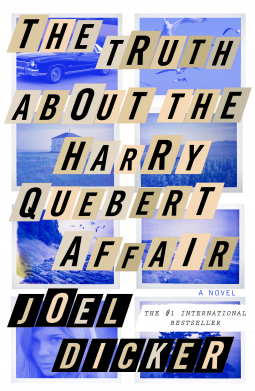
The Truth About the Harry Quebert Affair by Joël Dicker

Ok a few truths.

TruthAboutHarryThe Truth About the Harry Quebert Affair was originally written and published in French. The Swiss author, 28-year-old Joël Dicker’s first novel wasn’t a big hit, but he followed it up by writing this 600 page satire of  a young American man (his age) who writes one bestseller and then can’t write anything else.

His pushy agent and publisher threaten law suits and ruin unless he meets a deadline on his next big thing. Rather than write, he visits his ageing writing professor in New Hampshire, who was once a young man who wrote a bestseller and then didn’t write anything else. He gives him advice that prefaces many of the chapters:

“Books are interchangeable: People want a story that excites them, relaxes them, entertains them. And if you don’t give them that, someone else will – and you’ll be history.”

More truth.

Harry QuebertYesterday I was in the popular French bookstore FNAC (a kind of WH Smith equivalent) in Lyon and saw La Vérité sur l’Affaire Harry Quebert is still in the Number 1 slot. I saw it the day before in the giant supermarket Carrefour in the same position. It’s been a bestseller for over a year in France.

I do love watching a book become a runaway success and don’t always read them, but this is a book in translation, double victory –  the rights sold to 35 countries and translated into 37 languages and it won two prestigious French book awards.

The Harsh Truth.

However despite all the accolades, I have to be honest and say that I did not enjoy the read, it offered very little in terms of what I like to get from a book and worse, it annoyed me immensely in parts.

Maybe Not Your Truth Though.

But first the story, because it is a somewhat compelling read which many have and still may enjoy; full of twists and turns, a disappearance,a cold case reopened, concerning teenage girls, older men, appearances not what they seem, everyone with something to hide and more twists than an old-fashioned telephone cord. So many twists in fact, I can’t remember who did it. No, everyone did it, didn’t they? Well, Dicker certainly has a skill in making you think they’re all capable of murder.

So Marcus Goldman is living the life of a rich and famous writer in New York on the strength of a debut bestseller, when his writers block starts to have menacing consequences and he has to come up with a solution, quickly. He visits his old university professor Harry Quebert, whom he had kind of forgotten while he was busy being famous and pursued by actresses and other celebs. Not long after his visit, Harry is accused of the murder of Nola Kellergan (Nola, Lola, Lolita?), a 15-year-old girl who disappeared 30 years ago, whose remains are discovered, implicating Harry Quebert.

Marcus returns to Harry’s home when he is arrested and makes the investigation of his innocence his new purpose in life, he meddles in police affairs, interviews locals and even receives his own menacing threats penned by someone who wants him to leave town. The case might well provide him with the solution he requires, as his publisher asks him to write The Truth about what went on between Harry Quebert and Nola Kellergan.

Joel Dicker

Joël Dicker speaking in FNAC bookstore

A Consuming Truth

Viewing the wall of bestsellers is the first thing you see when you enter major supermarkets in France like Geant Casino and Carrefour; it says a lot about local culture that people are being enticed to grab a book at the very first moment they enter a supermarket! I don’t think I have seen that in any other country, I have listened to experts talk about enticing customers with fresh healthy fruit at the entrance, but not literature.

Too Many Additives

For me, although I get the requirement of a modern social satire to exaggerate, the Harry Quebert story carried too many characters that were inflated caricatures of American stereotypes, with insufficient humour to make it work. Trying to be a satire, a pastiche and a murder mystery with its innumerable twists made it for me, like a cocktail made by an unsupervised teenager  who, rather than combining two ingredients, like a mature pre-adult can’t resist adding a little of everything on offer until ultimately it becomes unpalatable.

I viewed it as an outsiders attempt at making a comment on modern American society, media, publishing, the sensationalism and obsession with broadcasting the trials of celebrities. That a 28-year-old writer could enter into a police murder investigation and  didn’t ring true enough for me to be able to read it without the constant presence of low-level annoyance at its flaws. Perhaps if I had saved it for a summer read when my expectations are lower, I may have enjoyed it more.

I do love that a French bestseller was picked up by international publishers and translated into English, the author interviewed in The Observer and elsewhere, but sadly, this award-winning novel wasn’t my cup of tea.

Great Gatsby2And in a twist of Great Gatsbyish irony, it seems that thousands of the English translation books are languishing in storage, waiting for a boom that has yet to arrive. Will it take a generation to be revered as an apt indictment of the times or will it languish in obscurity as a publishers costly mistake?

Further Reading:

The Observer Article – Joël Dicker: ‘I lost a bit of control of my life’

Note: This book was kindly sent to me by the publisher via NetGalley.

Scattered Dreams by Karin Crilly

On March 4th I sent an email to Karin Crilly about a competition being run on The Good Life France. I saw this competition mentioned on twitter  @lifefrance and thought of Karin as I knew she was writing a memoir about her year in Aix-en-Provence and I thought it would be a good idea for her to send something out into the world.

The Good Life France is an independent online magazine that celebrates life in France and attracts a number of writers and contributors who write on a wide range of subjects, keeping visitors and residents informed about France and all things French. The competition was to celebrate the 2nd anniversary since their inception and they invited contributions of work up to 1000 words on France or French related.

Good Life

Karin replied and said she would be very interested in entering the competition and asked if I would like to read the extract she had chosen, from the first chapter of her book.

Unbeknown to us both at the time, it was the beginning of the two of us working together. I read her work, made some suggestions and she polished her already excellent prose into a shape resembling 1000 words of an evocative experience in Paris that did indeed wow the judges, moving some of them to tears yet uplifting them at the same time.

Earlier this week, to our great joy, we learned that Karin had won the competition, ahead of more than 100 other entries and her story Scattered Dreams in Paris has now been published on The Good Life France.

You can read the story here by clicking on the title.

Winner of 2014 Writing Competition The Good Life France!

Scattered Dreams in Paris by Karin Crilly

CIMG2976


Congratulations Karin and  Bonne Continuation!

Update: Karin’s memoir has now been published, you can find out more by reading my review here: The Blue Satin NightGown by Karin Crilly.

Daphne’s Dilemma – Part I

Daphne is pregnant.

She is no longer my teat sucking, sun frolicking pet calf, she has matured into a fully grown cow. She doesn’t even look like my Daphne anymore – but I know it is her because I recognize the familiar black and white patchwork pelt she wears and she still walks up to me in the paddock, something no other cow will do.

I no longer feed her milk from a bottle, nor offer my hand to her once willing, hungry mouth; the welcome teat substitute she liked to suckle in a noisy rhythmic motion, her rough sand-paper like tongue producing sticky foam milk bubbles from the sides of her mouth. She is almost ready for milking now. We will be digesting the warm, nutritious contents of her udder with our Weet-Bix very soon.

CowWhen I say she doesn’t look like my Daphne anymore, it is her face that I am referring to. When she was a calf she had an eager, yearning sort of facial expression, a hungry face, hungry for her next feed and starving for my affection. Now she has a mature cow’s face – I’ve noticed that with all the calves, when they grow up they stop smiling. Something happens as their facial features mature that makes their grown up expression more like a frown than a smile, they no longer exhibit the contentedness of frolicking calves, high on powdered milk and the scent of fresh spring pastures.

So Daphne has a mature grown up look now, but despite this I know she remembers me, even though those baby calf memories of less than two years ago for me, are the equivalent of nine cow years ago for her.

Sweet scented Daphne is both my mother’s favorite fragrant, flowering shrub and the name of her mother, our Nana. I have always loved this name and thought that everyone would understand and appreciate the gesture, to name my pet calf after my very dear grandmother and something sweet-smelling and adored by my mother. Unfortunately my parents didn’t agree, though they allowed me to keep the name, they just made sure that Nana was never to learn of the esteemed honor I had gifted her.

Daphne is really fat now, she has a baby calf inside her and this morning at breakfast Dad announced she is ready to drop. At lunch there is a call from a neighbor to say he has seen a cow in distress down by the airstrip gate. Although I don’t hear the words myself, I can tell from what Dad is saying that it is my Daphne. I know because I feel this terrible pain in my chest and stomach, my heart is beating way too fast, there is a dry lump in my throat and I can’t even finish my favourite cold roast lamb and home-made chutney sandwich. I haven’t experienced a feeling like this since Annie died.

“Better go take a look” Dad says, placing the receiver of the party line telephone back on its cradle and ringing off one short to let callers know the line is free. There are few secrets in this neighborhood when four families share one telephone line and bored operators sit with nothing better to do than listen in. I imagine by tonight everyone will have heard about Daphne.

“I’m coming too” I say, pushing back my chair and getting up from the table.

“No, you stay put for now, finish your lunch and help your mother clean up first. I’ll bring ‘er up to the yards next to the shepherd’s cottage. You can meet us up there. It’s best not to have too many people around, you know they’re warrant to get a bit spooked and we don’t want ‘er taking fright and bolting off down by that big hole.”

“Alright” I mutter, slumping back in my chair, arms crossed, appetite ruined. I know what he says makes sense, though I don’t believe she will be scared off because of me. More likely those yapping dogs that never listen when you shout ‘Shut Up!’ or ‘Get in behind!’ I’d like to say, but don’t.

Animals’ giving birth is a common and natural event in the spring, although here it is more common to see thousands of sheep giving birth, not so many cows and a very large pet giving birth is a new experience for us. Pet lambs always go back into the main flock before they became adult sheep, so we never know whether they give birth or not, but despite the familiarity with animals giving birth, I am worried about Daphne.

I too have matured in these past two years, I am about to go off to boarding school in the city away from my family; I know I am old enough not to become attached to farm animals, but somewhere in a dark chamber of my mind, a closed-door of slumbering memories has drifted open and I cannot stop the rush of disturbing flashbacks which enter my mind and begin to replay that terrible thing that happened to Annie.

Daphne’s Dilemma – Part II 

This is the Story of a Happy Marriage by Ann Patchett

Ann Patchett MarriageAs a metaphor for a collection of essays that pays tribute to a life of writing, it’s an apt title, though as the title of a book that lures me towards picking it up to read the blurb and buy it, I admit to being slow to respond to this collection. It is actually a very beautiful minimal cover, the fact that it has a white background and contains only text proof it is a book targeted at existing fans of Ann Patchett, no need for seductive images or clever marketing to lure readers, this cover has the mark of confidence and attitude.

It also contains something of an illusion, the author’s name is embossed in a shiny aquatic blue, which depending on how much light you expose it to, either appears blue or black. It occurred to me while reading, that this might not be an accident, I played around with the cover, watching letters I would swear were shiny blue disappear and become matt black. Appearances are not always the truest guide, looking at things from a slightly different angle, can significantly alter perceptions. Even this title is not all that it seems and now that I have finished the book, I find it most apt.

Many of the essays have been published in other publications, as Ann Patchett describes how she grew to become a writer of fiction, something she always wanted and knew she would do, but that necessitated a slew of other jobs as well as writing non-fiction articles for magazines that would pay. As she points out in the very first lines of the book:

“The tricky thing about being a writer, or about being any kind of artist, is that in addition to making art you also have to make a living. My short stories and novel have always filled my life with meaning, but, at least in the first decade of my career, they were no more capable of supporting me than my dog was.”

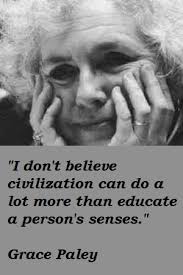
Grace PaleyWe read about the memorable story her father read to her over the telephone one Christmas, her fiction teacher Allan Gurganus who made them write a story every week for two semesters, turning them into musicians of language who learnt that a habit of regular practice leads to improvement and classes with Grace Paley, for whom support of human rights sometimes trumped attendance at class, whether that meant her disappearing to protest in Chile or being absent from a scheduled appointment having given her attention to a tearful tale from another student.

“Grace wanted us to be better people than we were, and she knew that the chances of our becoming real writers depended on it. Instead of telling us what to do, she showed us. Human rights violations were more important than fiction. Giving your full attention to a person who is suffering was bigger than marking up a story, bigger than writing a story.”

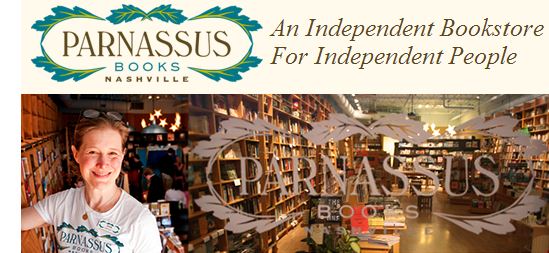
It is perhaps not until she opens her own bookstore, Parnassus Books that the influence of Grace Paley rises, as Ann Patchett becomes something of an activist herself for the plight of the independent bookstore, which she writes about ni the essay The Bookstore Strikes Back.

Parnassus Books

She writes about a legacy of separation and divorce stretching back generations, not so much present in the genes, more like evidence that we all need to experience those natural life stages that often mean a significant relationship or marriage doesn’t survive. Finding it hard to accept and taking advice from her mother to heart, she vows never to remarry. She is wedded to her work. And she has a dog. She loves.

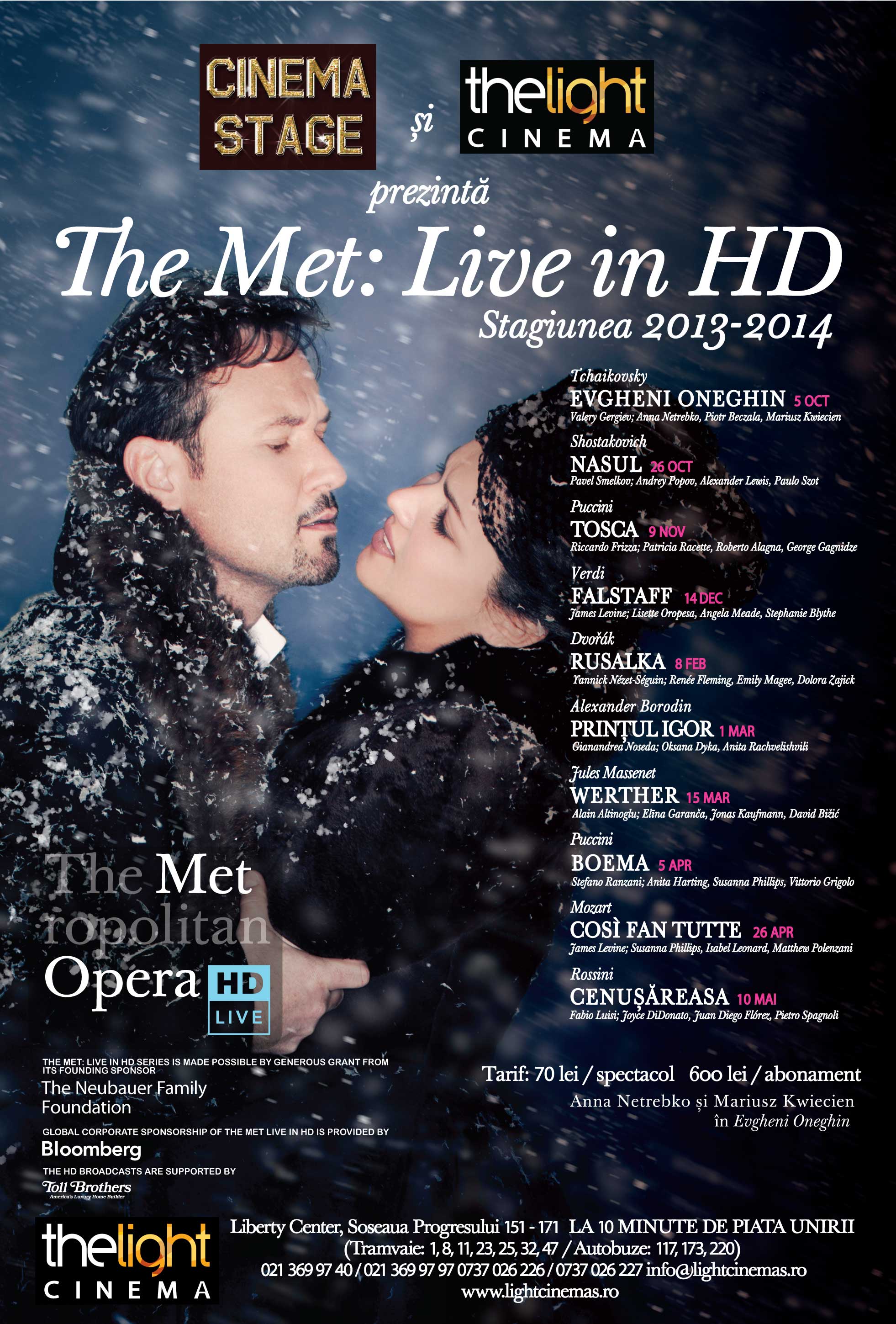
She shares a growing love of opera, a late bloomer having discovered it almost by accident while researching her novel Bel Canto she discovers what becomes a lifelong passion, which living in Nashville, known for another type of music altogether wasn’t so easy to foster, until The Met realising that thousands of people would love to see opera regularly but couldn’t, came up with the idea of bringing it to the masses via cinema – live high-definition opera performances.

Met Opera“We watch the patrons in New York, people who have paid ten times more for tickets, and some more than that, as they make their way to their seats. Like us, the audience members on the screen stop to greet the familiar people around them, and like the audience in New York, we clap for both arias and curtain calls. We call out Brava! And Bravo! The rational mind understands the singers can’t hear us, and yet we are living so completely in our high-definition moment it is easy to forget.”

“There, in a comfortable fold-down seat with a whiff of popcorn in the air, I watched Anna Netrebko lie on her back, dangle her head down into the orchestra pit, and sing Bellini like her heart was on fire.”

And The Story of a Happy Marriage? Yes, it is an essay in the collection and one that she was endlessly encouraged to write and in the end becomes the cover title of this book, because the metaphor is all embracing of a woman who always knew what she wanted, never straying from that despite the numerous obstacles and even finds time now to give back to those who helped set her out on the path early on.

The essays stand on their own but equally form a cohesive narrative and are written as if Ann Patchett is writing to that one true friend, one of the reasons that many readers and reviewers have commented on this collection by saying they could imagine being friends with
her. And as she says in one of her books, Truth and Beauty:

“Writing is a job, a talent, but it’s also the place to go in your head. It is the imaginary friend you drink your tea with in the afternoon.”

Write A Book Review, Anyone Can Do It

GyannA little while ago I received a request from Corinne, an inspirational blogger from Mumbai in India, who shares her thoughts on keeping life simple, authentic and holistic at Everyday Gyann.

She recently started another blog called Write Tribe – Motivation and Support for Writers and Bloggers.  Write Tribe sometimes offers books for review to its followers and as Corinne is a loyal follower of Word by Word, she asked if I could write a post on How to Write a Book Review.

Write Tribe

I’m not a rule follower myself, but I decided to share my thoughts on this habit I have been practising for the last two years, as when something becomes a regular habit, there develop patterns. So I wrote 10 tips on writing a book review and then added number 11 which is to ignore the rules!

The Review Notebooks!

The Review Notebooks!

If you would like to read my thoughts on writing a book review, you can read them in Corinne’s three-part series over at Write Tribe, just follow the links below.

How To Write A Book Review – Part 1

How To Write A Book Review – Part 2

How To Write A Book Review – Part 3

Thanks again Corinne for the invitation and I hope this might encourage readers of this blog who might have been considering it, to go ahead and write a review too.

Claire

and the Man Booker Prize winner is…

Catton2

The Luminaries by Eleanor Catton

I have just put it aside on page 508 to watch the presentation and I could not be more pleased!

Congratulations to our young and so talented novelist, from whom we will no doubt see much more.

The book is still alive and rather than cower under the threat of the alternative entertainment available to people today, they are taking the book to the masses.

According to the Man Booker Prize website, there is to be a free event at London’s Regent Street Apple Store, where Eleanor Catton will discuss her book and what it means to win the prize.

I hope Apple are offering the books for sale and not just their own devices to read them.

Ok, a big event is about to take place in the book too, so I’m off back there to find out what’s happening.