The Bridge of Beyond by Simone Schwarz-Bart tr. Barbara Bray #WITMonth

Bridge of BeyondAbsolutely brilliant, astonishing, loved it, one of my Top Reads of 2016 for sure.

Originally published in 1972 as Pluie et vent sur Télumée Miracle, The Bridge of Beyond is acknowledged as one of the masterpieces of Caribbean literature. It was republished in English in 2013 as an NYRB Classic, with an introduction by Jamaica Kincaid, beautifully translated by Barbara Bray, described as ‘an intoxicating tale of love and wonder, mothers and daughters, spiritual values and the grim legacy of slavery’.

Telumee is the last in a line of proud Lougandor women on the French Antillean island of Guadeloupe. It is a novel best left to speak for itself, as the many quotes from the novel that follow here illustrate, a work infused throughout with a vital and vibrant female energy, a force that empowers them to forge ahead, no matter the circumstances, one that will permeate the reader, instilling courage and awe at the language that creates this positive, intoxicating feeling.

In the first part we learn about her people, her mother Victory,

“a laundress, wearing out her wrists on flat stones in the rivers, and her linen emerged like new from under the heavy waxed irons”

her father, his life cut short in a fatal stabbing,

“Angebert, had led a reserved and silent existence, effacing himself so completely
that no one ever knew who it was died that day. Sometimes I wonder about him, ask myself what anyone so kind and gentle was doing in this world at all.”

the man who pulled her mother out of her grief, and out of her daughter’s life,

“The fact is that a mere nothing, a thought, a whim, a particle of dust can change the course of a life. If Haut-Colbi had not stopped in the village my little story would have been different.”

and her grandmother Toussine, ‘Queen Without a Name’, to whom her mother sent her to live.

“My mother’s reverence for Toussine was such I came to regard her as some mythical being not of this world, so that for me she was legendary even while still alive.”

Simone Schwarz-Bart

Simone Schwarz-Bart

Telumee narrates the story of her life, in small details, in melodic, incantatory prose that lures the reader in, consuming her story with great pleasure. Every change of home, village, or great journey takes them across the Bridge of Beyond, a symbol of change and the unknown, the other side.

As she passes through various stages of life, she is guided but never pressured by her grandmother, remembering her stories, her songs, her advice.

“My little ember”, she’d whisper, “if you ever get on a horse, keep good hold of the reins so that it’s not the horse that rides you.” And as I clung to her, breathing in her nutmeg smell, Queen Without a Name would sigh, caress me, and go on, distinctly, as if to engrave the words on my mind: “Behind one pain, there is another. Sorrow is a wave without end. But the horse mustn’t ride you, you must ride it.”

She will fall in love, leave to work in the kitchen of wealthy white family, build her own home, experience both profound happiness and the depths of despair, brush up against madness and find its cure, and always the reassuring presence of her grandmother.

“Sometimes old thoughts arose in me, shooting up like whirls of dust raised from the road by a herd of wild horses galloping by. The Grandmother to try to whistle up a wind for me, saying we should soon be going away, for the air in Fond-Zombi didn’t agree with my lungs now.”

As Jamaica Kincaid articulates well in the introduction, The Bridge of Beyond is not a conventional novel, and it never tries to be. It is a fluid, unveiling of a life, and a way of life, lived somewhere between a past that is not forgotten, that time of slavery lamented in the songs and felt in the bones, and a present that is a struggle and a joy to live, alongside nature, the landscape, the community and their traditions.

The cultural traditions and historical events from which this work of art springs cannot be contained in a strict linear narrative. In fact, such a device might even lend a veneer of inevitability to them. For the narrative that began with a search for fresh water on an island one Sunday morning has no end – it circles back on itself, it begins again, it staggers sideways, it never lurches forward to a conclusion in which the world where it began is suddenly transformed into an ideal, new world. Schwarz-Bart’s prose awakens the senses and enlarges the imagination; it makes me anxious for my own sanity and yet at the same time certain of it; her sentences, rooted in Creole experience and filled with surprising insights and proverbs, resonate in my head and heart.” Jamaica Kincaid

It is one of the best books I have read in a long time, coming from a place of love and appreciation that reaches far back, acknowledging the gifts of all, that make up who we are. Outstanding.

Simone and André Schwarz-Bart

Simone and André Schwarz-Bart

Simone Schwarz-Bart was born in France(her parents were from Guadeloupe) in 1938, her father a solider, her mother a teacher. When war broke out, she and her mother returned to Guadeloupe. She studied in Paris, where she met her future husband, the writer André Schwarz-Bart.

They collaborating on more than one work of literature, including a six-volume encyclopaedia Hommage à la femme noire, (In Praise of Black Women), to honour the black heroines who were missing in the official historiography.

Click to Buy The Bridge of Beyond via Book Depository

(Affiliate Link)
WIT logo

The Man Booker Prize Longlist 2016 #FinestFiction

Thirteen novels make up the Booker Dozen longlist, a list with a lot of new names that few predicted. Six are by women, seven by men, with five American writers, six British, one Canadian and one South African.

The biggest name is probably two-time winner J.M.Coetzee and there are the familiar names of Deborah Levy (shortlisted in 2012 for Swimming Home), Elizabeth Strout and AL Kennedy, as well as four debut authors.

Booker Longlist

Chair of the 2016 judges, Amanda Foreman, commented:

‘This is a very exciting year. The range of books is broad and the quality extremely high. Each novel provoked intense discussion and, at times, passionate debate, challenging our expectations of what a novel is and can be…From the historical to the contemporary, the satirical to the polemical, the novels in this list come from both established writers and new voices. The writing is uniformly fresh, energetic and important. It is a longlist to be relished.’

The Longlist – click on the title to find a Goodreads summary of the book

Paul Beatty (US) – The Sellout 

J.M. Coetzee (South African-Australian) – The Schooldays of Jesus 

A.L. Kennedy (UK) – Serious Sweet

Deborah Levy (UK) – Hot Milk 

Graeme Macrae Burnet (UK) – His Bloody Project

Ian McGuire (UK) – The North Water 

David Means (US) – Hystopia

Wyl Menmuir (UK) – The Many 

Ottessa Moshfegh (US) – Eileen

Virginia Reeves (US) – Work Like Any Other 

Elizabeth Strout (US) – My Name Is Lucy Barton

David Szalay (Canada-UK) – All That Man Is 

Madeleine Thien (Canada) – Do Not Say We Have Nothing 

WIT logoI’m focusing on reading Women In Translation #WITMonth during August, so I won’t be reading too many on this list, though I have dipped into Madeleine Thien’s Do Not Say We Have Nothing, the book that appeals to me the most – a story of musicians, composers, two generations of an extended family, from the Chinese cultural revolution to a new life in modern-day Vancouver.

I’m also keep to read Deborah Levy and can tell you that Elizabeth Strout’s book My Name is Lucy Barton has had many great reviews.

For now, I’m 100 pages into reading last years Man Booker Prize winner by Marlon James, A Brief History of Seven Killings and wow – it’s like entering into another world, a dark, dangerous, impulsive world inside a Jamaican ghetto, via a range of characters and voices.

The Shortlist and Winner Announcements

The shortlist of six books will be announced on Tuesday 13 September and the winner will be announced on Tuesday 25 October.

Click Here to Buy Any Book On the Longlist Via Book Depository

So, have you read any of the books on the list?

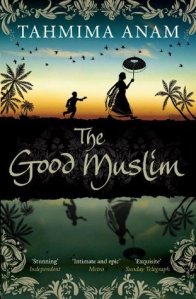
The Good Muslim (Bangladesh #2) by Tahmima Anam

In A Golden Age, the first novel in Tahmima Anam’s Bangladesh trilogy, the focus is on Rehana, the mother of Maya and Sohail and most of the book takes place from March to December 1971, during the Bangladesh War of Independence. It shows how families, neighbours, ordinary citizens coped with war, how they got involved and the effect it had on them all.

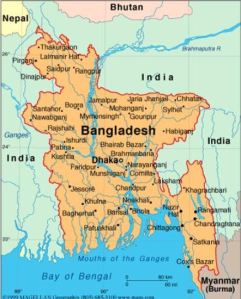
Now, in The Good Muslim it is some years after the war and Maya has just returned to Dhaka, to the family home and over the course of the novel we discover her reasons for leaving, her disenchantment with how the war has affected her brother, who is not the same person as he was before. Looking for inner peace and more of an understanding of life, he becomes religious and inaccessible to her, any attempt to influence him, futile. She resists his path and throws herself into a more active, immersive role.

It is the same family, but Rehana is more of a background figure, the home has been taken over by women wearing the burka, there are sermons on the roof and Sohail’s son Zaid runs around the place looking and acting more like the son of a servant boy (there is one scene where Maya takes him shopping for sandals and though his neglect is obvious, she is insulted when the shoeseller assumes he is the child of a house servant).

Once she had given everything for her children. Now she was in retreat from them, passively accepting whatever it was they chose to do: turning to God, running away, refusing to send their children to school. There was nothing of the struggle in her any more.

17th century Mughal fort, Dhaka, Bangladesh

They are living in the newly independent Bangladesh, under a Dictatorship, the shadow of war hasn’t left them. There are men living among them who the population wants tried for war crimes. Then there are the young women shamed by having been made one of the spoils of war, viciously raped, many of them pregnant and unwanted, put on flights to Pakistan, banished, out of sight, out of mind.

Bangabandhu had promised to take care of the women; he had even given them a name – Birangona, heroines – and asked their husbands and fathers to welcome them home, as they would their sons. But the children, he had said he didn’t want the children of war.

Maya has become a doctor, putting her own personal life on hold, she has seen too much and doesn’t feel capable of fulfilling any other role. She helps many of these women and wonders if she would ever be capable of love.

She had told herself many times that marriage could not be for her. Or children. She saw them coming into the world every day, selfish and lonely and powerful; she watched as they devoured those around them, and then witnessed the slow sapping of their strength as the world showed itself to be far poorer than it had once promised to be.

bangladesh map

It’s a sad picture of post-war trauma and the difficulties people have in returning to family life and love after all that they have experienced.

Though an equally easy and immersive read, it’s not quite as engaging as A Golden Age, which was the novel of action, deep in the daily situation of revolution and war.

This is the novel of aftermath, a much more sombre undertaking and a reminder that even in victory, the consequences of war on families are ever-present in their lifetime.


Links:

Book One: A Golden Age

The Buddha in the Attic by Julie Otsuka

Buddha in the AtticBuddha in the Attic is a unique novella told in the first person plural “we”,  narrating the story of a group of young women brought from Japan to San Francisco as “picture brides” nearly a century ago.

In eight chapters, that read like a rhythmical chant, it traces the brides’ lives, beginning at the point of departure after leaving their predictable village lives, to the much-anticipated, though often frightening, boat journey and their arrival in San Francisco.

Some of us were so dizzy we could not even walk, and lay in our berths in a dull stupor, unable to remember our own names, not to mention those of our new husbands. Remind me one more time, I am Mrs. Who?

It recounts their first nights as new wives, the hard manual labour in new fields, cleaning house for white women, their struggles to master the language and understand the culture, to experiences in childbirth, as mothers, raising children who will lose their heritage and history, though continue to be marked by it, with the terrifying arrival of war and it damning label of them as the enemy.

At night we sat in our kitchens with our husbands as they pored over the day’s papers, scrutinizing every line, every word, for clues to our fate. We discussed the latest rumours. I hear they’re putting us into work camps to grow food for the troops.

Julie Otsuka has created a unique and original way to narrate the collective story of these Japanese mail order brides and their many experiences around common themes, we imagine the narrator as one of them, though we do not know which of the experiences are hers, as she balances them equally, one beside the other, in repetitive, elegiac prose.

This collective storytelling in effect brings our perception of them together, creating a sense of community, despite the suffering. It s as if, through sharing their experiences in these paragraphs, they become stronger, better able to cope, the author bringing them together. The “we” narrative unites them, we read and feel for them as a group, as if they are together. Otsuka brings them together in a lyrical expression of tasks, sufferings, looks, sighs, memories.

Apart from the initial boat ride over the seas from Japan to the US, there is little joy, they discover they are the lowest of low in the pecking order, equivalent to slaves, seen as quiet and submissive, hard workers.  Some take it in their stride, others will fall by the wayside.

They admired us for our strong backs and nimble hands/ Our stamina. Our discipline. Our docile dispositions. Our unusual ability to tolerate the heat, which on summer days in the melon fields of Brawley could reach 120 degrees. They said that our short stature made us ideally suited for work that required stooping low to the ground. Wherever they put us they were pleased. We had all the virtues of the Chinese – we were hardworking, we were patient, we were unfailingly polite – but none of their vices – we didn’t gamble or smoke opium, we didn’t brawl, we never spat. We were faster than the Filipinos and less arrogant than the Hindus. We were more disciplined than the Koreans. We were soberer than the Mexicans. We were cheaper to feed than the Okies ad Arkies, both the light and the dark. A Japanese can live on a teaspoonful of rice a day. We were the best breed of worker they had ever hired in their lives.

041812_1115_HotelontheC2.gifAnd as if it couldn’t get any worse, war happens, and they discover they are the enemy, they are regarded suspiciously and in time sent away.

This part is narrated by “them”, the communities within which they have existed alongside, though never really been a part of, certainly not appreciated – at least not until the Orkies and Arkies move in, who are not quiet and hard-working like the Japanese.

It is a soulful lament, a long sad narrative of a life of toil and disappointment that is endured, a disappearance that is unwarranted, a tribute to those who dreamed of a better life, who travelled across an ocean believing they would find it only to be betrayed bitterly.

041812_1115_HotelontheC1.jpgIt reminded me, not in style, but in subject of Jamie Ford’s The Hotel on the Corner of Bitter and Sweet, a story of childhood friends in Seattle, second generation immigrants caught up in the brutal reality of being perceived as untrustworthy, having the skin of an enemy.

Their plows weighed more than we did, and were difficult to use, and their horses were twice the size of our horses back home in Japan. We could not harness them without climbing up on orange crates, or standing on stools, and the first time we shouted out to them to move they just stood there snorting and pawing at the ground. Were they deaf? Were they dumb? Or were they just being stubborn? “These are American horse,” our husbands explained. “They don’t understand Japanese.” And so we learned our first words of horse English. “Giddyap” was what you said to make the horse go forward, and “Back” was what you said to make it back up. “Easy” was what you said to make it slow down, and “Whoa” was what you said to make it stop. And after fifty years in America these would be the only words of English some of us could still remember by heart.

Julie Otsuka speaks here (in English) about the inspiration behind Buddha in the Attic, which won the French Prix Femina Etranger 2012 translated as Certaines n’avaient jamais vu la mer for the French edition.

Man Booker International Longlist 2016 #MBI2016

MBI logoToday the longlist of the newly formed Man Booker International (MBI) 2016 was announced. In the past, this award was made every two years to an author for a body of work, so usually an author who has written numerous novels and is recognised as having made a significant literary contribution.
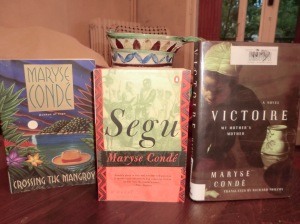
That changed after 2015, which was the last year under the old rules, I remember last year, from the longlist of 10 authors you can see here, I decided to read some of the works of the Guadeloupean author Maryse Condè.

She didn’t win the prize, but she was the right choice for me. I read her childhood essays Tales From The Heart, True Stories From My Childhood , the novel Victoire: My Mother’s Mother and the masterpiece she is most well-known for Segu.

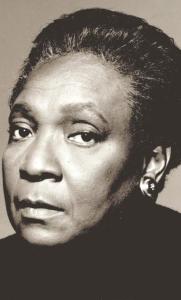
Maryse Condé

Maryse Condé

Literary Works of Maryse Condé

In addition to the MBI, there was another prize called the Independent Foreign Fiction Prize (IFFP) which rewarded one novel, a recent publication, that had been translated into English in the previous year.

In 2016, these two prizes have joined together, to become one, retaining the rules of the IFFP Prize and the name of the Man Booker International Prize. The £50,000 prize is shared equally between the author and the translator.

Boyd Tonkin, chair of the 2016 Man Booker International Prize judging panel, said:

‘For the first longlist in its new form, the Man Booker International Prize invites readers to share a thrilling journey of discovery across the finest fiction in translation.

The 13 books that the judges have chosen not only feature superb writing from Brazil to Indonesia, from Finland to South Korea, from Angola to Italy. Our selection highlights the sheer diversity of great fiction today.

From intense episodes of passion to miniature historical epics; from eerie fables of family strife to character-driven chronicles of urban life, this list showcases fiction that crosses every border. It also pays tribute to the skill and dedication of the first-rate translators who convey it to English-language readers.’

Thirteen books have been announced on the longlist:

José Eduardo Agualusa (Angola) Daniel Hahn, A General Theory of Oblivion – On the eve of Angolan independence an agoraphobic woman bricks herself into her apartment for 30 years, living off vegetables and the pigeons she lures in with diamonds, burning her furniture and books to stay alive, writing her story on the apartment’s walls.

Elena Ferrante (Italy) Ann Goldstein, The Story of the Lost Child – book four in the Neapolitan saga of two friends, Lena and Lila, now adults, returning to their childhood town, dealing with life as mother’s, lovers, surviving an earthquake, tragedies of nature and humanity.

Han Kang (South Korea) Deborah Smith, The Vegetarian – Yeong-hye, seeking a more ‘plant-like’ existence, decides to become a vegetarian, prompted by grotesque recurring nightmares. In South Korea, where vegetarianism is almost unheard-of and societal mores are strictly obeyed, Yeong-hye’s decision is a shocking act of subversion.

Maylis de Kerangal (France) Jessica Moore, Mend the Living – takes place over twenty-four hours surrounding a fatal accident and a resulting heart transplant as life is taken from a young man and given to a woman close to death, examining the deepest feelings of everyone involved.

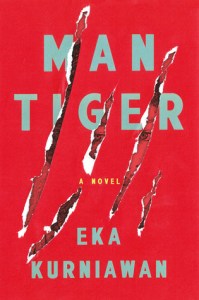
Eka Kurniawan (Indonesia) Labodalih Sembiring, Man Tiger – A slim, wry story set in an unnamed town near the Indian Ocean, Man Tiger tells the story of two interlinked and tormented families, and of Margio, an ordinary half-city, half-rural youngster who also happens to be half-man, half-supernatural female white tiger.

Yan Lianke (China) Carlos Rojas, The Four Books – In the ninety-ninth district of a sprawling labour camp, the Author, Musician, Scholar, Theologian and Technician are undergoing Re-education, to restore their revolutionary zeal and credentials. In charge of this process is the Child, who delights in draconian rules, monitoring behaviour and confiscating treasured books.

Divided into four narratives, echoing the four texts of Confucianism and the four Gospels of the New Testament, The Four Books tells the story of one of China’s most controversial periods, demonstrating the power of camaraderie, love and faith against oppression and the darkest possible odds.

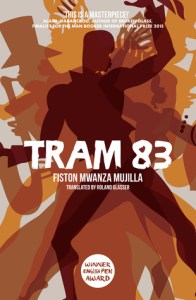
Fiston Mwanza Mujila (Democratic Republic of Congo/Austria) Roland Glasser, Tram 83 – In a war-torn African city-state tourists converge with students, ex-pats and locals. Their one desire: to make a fortune by exploiting the wealth of the country, both mineral and human. As night falls, they go out to drink, dance, eat and abandon themselves in Tram 83, the only night-club of the city, a den of all iniquities. An African-rhapsody novel infused with the rhythms of jazz.

Raduan Nassar (Brazil) Stefan Tobler, A Cup of Rage – A pair of lovers – a young female journalist and an older man who owns an isolated farm in the Brazilian outback – spend the night together. The next day they proceed to destroy each other. Erotic cult novel by one of Brazil’s most infamous modernist writers explores alienation, the desire to dominate and the wish to be dominated.

Marie NDiaye (France) Jordan Stump, Ladivine – a psychological tale of a trauma that ensnares three generations of women, via a woman captive to a secret shame. Once a month, Clarisse Rivière leaves her family and secretly takes the train to visit her mother, Ladivine. Just as Clarisse’s husband and daughter know nothing of Ladivine, Clarisse has hidden nearly every aspect of her adult life from this woman, whom she dreads, despises but also pities.

Kenzaburō Ōe (Japan) Deborah Boliner Boem, Death by Water – his recurring protagonist and literary alter-ego returns to his hometown village in search of a red suitcase fabled to hold documents revealing the details of his father’s death during WWII: details that will serve as the foundation for his new, and final, novel.

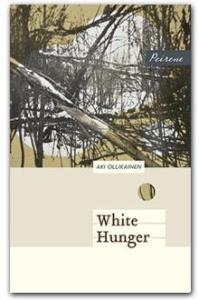
Aki Ollikainen (Finland) Emily Jeremiah & Fleur JeremiahWhite Hunger – 1867: a year of devastating famine in Finland. Marja, a farmer’s wife from the north, sets off on foot through the snow with her two young children. Their goal: St Petersburg, where people say there is bread. Others are also heading south, just as desperate to survive.

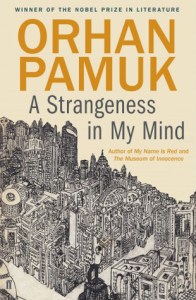
Orhan Pamuk (Turkey) Ekin Oklap, A Strangeness in My Mind – the story of Mevlut, the woman to whom he wrote three years’ worth of love letters, and their life in Istanbul. Mevlut Karataş sells boza (a traditional mildly alcoholic Turkish drink) in Istanbul and wishes for love and riches. He doesn’t have the best of luck (falling in love with a woman and accidentally eloping with the sister) as he ages, attempts to discover what is missing from his life.

Robert Seethaler (Austria) Charlotte Collins, A Whole Life – Andreas lives his whole life in the Austrian Alps, arriving as a boy taken in by a farming family. A man of few words, when he falls in love with Marie, he has friends light her name at dusk across the mountain. When she dies in an avalanche, pregnant with their first child, Andreas’ heart is broken. He leaves the valley just once more, in WWII – and is taken prisoner in the Caucasus – returning to find modernity has reached his remote haven.

*****

A fabulous lineup of books and authors across countries and languages. I have read two of the books, Elena Ferrante’s The Story of the Lost Child and Aki Ollikainen’s White Hunger, both of which are excellent, and although I haven’t read The Vegetarian, I have read Han Kang’s more recent novel Human Acts which was brilliant!

I’d love to read Marie NDiaye, Orhan Pamuk, Kenzaburō Ōe, Robert Seethaler, Yan Lianke, they all sound fantastic. And Man Tiger sounds interesting, and I definitely want to read more of Han Kang!

A shortlist of six books will be announced on 14 April.

So many great reads, which of these sounds the most appealing to you? Have you read any already?

Further Reading

The Guardian ArticleMan Booker International 2016 longlist includes banned and pseudonymous authors

Purchase A Book:

If you wish to buy one of the above books, you can do so via the Book Depository link below, with whom I have an affiliation.

Buy One of These Books at Book Depository


Two Serious Ladies (1943) by Jane Bowles

Bellezza who reviews at Dolce Bellezza (click on words or image below to visit) and reads a lot of interesting literary and translated fiction, recently invited me to join her and a few others to read Two Serious Ladies by Jane Bowles.

DolceBellezza

I didn’t know anything about the book, but I liked the idea of a January readalong, the last one I participated in was Pushkin’s Eugene Onegin in January 2014 and it became one of my Top Reads of 2014!

Background

Jane Bowles was married to the composer, writer and translator Paul Bowles (author of the 1949 classic, post-colonial alienation and existential despair novel The Sheltering Sky). They were part of avant-garde literary circles in their home town of New York and adopted homes of Paris, Mexico and Tangiers, known as well for their bohemian lifestyle as their literary success’.

Two Serious LadiesJane Bowles (born in New York City, Feb 1917) wrote one novel, a play and six short stories. The novel Two Serious Ladies, though panned at the time, (critic Edith Walton writing in the Times Book Review didn’t understand it, calling it ‘senseless and silly’), became regarded as a modernist, cult classic, helped when Tennessee Williams named it his favourite book.

She was famous as the enigmatic and entertaining half of a celebrated couple, for her near permanent writer’s block, her daring attitude to life, and her provocative relationships with women.

Both husband and wife, though dedicated to each other, indulged same-sex relations with others outside their marriage; notable was the relationship Jane Bowles developed with Cherifa, a Moroccan peasant, the only woman in Tangier to run her own market stand. They are photographed; Jane, wearing a white, sleeveless short dress walks on the arm of Cherifa, cloaked in a black niqab, wearing dark sunglasses (said to carry a knife beneath her robes for protection). See the photo in The New Yorker article linked below.

Review

Two Serious Ladies introduces us to two characters Christina Goering, daughter of a powerful industrialist, now a well-heeled spinster, adrift and bored with her comfortable, predictable existence and Frieda Copperfield, married to a man who pursues travel and adventure, dragging his wife (who funds this insatiable desire) out of her comfort zone, to the untouristed, red-lit parts of Panama, where she finds solace and digs her heels in, at the bar/hotel of Madame Quill, befriending the young prostitute Pacifica.

Christina, referred to as Miss Goering and Frieda, Mrs Copperfield, acquaintances, meet briefly at a party and will come together again briefly at the end, both having had separate life-changing adventures, driven by a latent, sub-conscious desire to radically change their situations, both of which come about in a random, haphazard way.

Miss Goering invites a companion Miss Gamelon, to move into her comfortable home and at the party where she encounters Mrs Copperfield, she meets Arnold. Though she doesn’t particularly like either of these characters, when she decides to sell her palatial home and move to a run-down house on a nearby island, they agree to come with her. Neither are enamoured of her decision, to remove them from her previous comforts, which they were quite enjoying.

“In my opinion,” said Miss Gamelon, “you could perfectly well work out your salvation during certain hours of the day without having to move everything.”

“The idea,” said Miss Goering, “is to change first of our own volition and according to our own inner promptings before they impose completely arbitrary changes on us.”

Once on the island, still restless, she abandons her invitees and takes the ferry to the mainland, opening herself up to whatever random encounters await her, as if seeking her destiny or some kind of understanding through a series of desperate and reckless acts.

Jane Bowles

Jane Bowles

Mrs Copperfield seems less to seek out the depraved, than be attracted by a perceived sense of belonging, she spurns the comfortable, pretentious trappings of the Hotel Washington, declines to go walking in the jungle with her husband and instead takes the bus back to the women she has met at the Hotel les Palmas whom she feels an affinity with, despite their lives of poverty and prostitution being so far removed from her own. She recognises they possess a kind of freedom and strength she lacks; in their presence, she begins to feel energised and empowered.

It is a strange book at first, it requires finishing and reflecting upon to figure out what it was all about. It is recounted in a straight forward style, we observe the actions of the two women without reflection on their part, making it necessary to unravel their intentions, which inevitably becomes a matter of reader interpretation, to find the meaning, if indeed there is any.

For me, it was clear the women lacked something significant in their lives, in their existence, even if they were unable to articulate it or even search appropriately for it, they sensed something missing in their lives of privilege and sought it among the downtrodden. They were experiencing an existential crisis.

In terms of style, the writing has been described as elliptical prose, a term I looked up, coined in 1946 by Frederick Pottle who used elliptical to refer to a kind of pure poetry that omits prosaic information, providing the possibility of intensity through obscurity and elimination.

@Jimthomsen on twitter asked the same question and got this response:

Meaning, there’s much that isn’t said or thought or written and more that might be implied, discovered between the lines. A form of literary diet perhaps? I do prefer plain language.

Bowles takes two female characters from a similar social class (similar to her own) dissecting a woman’s presence and existence in society in a form of confrontational daring that was liable to elicit both scorn and eye-brow raising in her own time and continues to provoke a certain amount of bemusement in our own.

“I know I am as guilty as I can be, but I have my happiness which I guard like a wolf, and I have authority now and a certain amount of daring, which I never had before.” – Mrs Copperfield

Reading it alongside the life of Jane Bowles, was a pleasure, I enjoyed reading it and taking the extra time to understand the context within which it was written.

Thanks Bellezza for the invitation, I look forward to reading everyone else’s reviews!

Links

The Madness of Queen Jane – Article in The New Yorker, by Negar Azimi June 12, 2014

A Short Biography of Jane Bowles by Millicent Dillon

Other Reviewers Reading & Reviewing Two Serious Ladies – Scott, Frances, Dorian, and Laurie

The Gift of Stones by Jim Crace

The Gift of StonesFrom whispering muse to the gift of stones, this was the second book I read in 2016, one of Jim Crace’s earlier philosophical works, telling the tale of a village of stone workers, who live a simple life working stone into weapons, which are then traded with passers-by for food and other essentials, which they are not able to provide for themselves, in the arid landscape within which they reside. It is a livelihood they think little about, it is all they know.

A boy’s destiny is changed after he is injured in the arm by an arrow. The arrow is a symbol of change and both opens and closes this short, though provoking novella.

The injury becomes a turning point for a boy, his arm partially amputated, making him unable to follow in the village tradition, he must find another way of contributing to his community. His predicament is a foretelling of what is to come, but first he alone must learn to adapt.

He ventures outside, further from the village than anyone has ever been, near the sea and the heath, bringing them tales of beyond, discovering the allure and power of imagination. Experiencing things and feelings he has never encountered.

Already an orphan living with his uncle in a stone age village of people who work with flint, his injury turns him into a storyteller, inspired by his walks along the coastline towards the heath where he meets a woman with her baby living alone in a hut. He discovers how to captivate and amuse an audience, to take their minds off their day-to-day torments.

‘The paradox is this – we do love lies. The truth is dull and half-asleep. But lies are nimble, spirited, alive. And lying is a craft.’

He brings the woman back to the village, however she isn’t welcomed by the villagers, set in their ways. She too symbolises the lessons they must learn, though they will realise this much too late. When he tells the villagers her history, a truth, they become bored and turn away.

‘Quite soon they found it far too dark and cold to listen to my father any lore. They peeled away before the tale was done, unmoved by my father’s portrait of the widow and her child on the heath, her struggles not to die, her hardships, grief and hunger, the slaughter of the geese, the crushing of her hut. Quite soon there were no cousins left to hear my father’s tale. His audience – excluding bats and mother – had crept away, unamused and angered by the venom in his voice.

My father stood alone and startled – for now he understood the power of the truth.’

flint arrow head

It is a philosophical tale of unrequited love, abandonment, survival and the heralders of change, how communities react to the necessity to adjust, and to those who are different, outsiders.

It touches on the role of imagination and storytelling, not just as entertainment and a craft, but as those who foresee change, create invention, imagine other ways of life.

Poignant and intriguing, given the era within which it is set and a kind of tribute to the greater importance of storytelling within society.


The Immortal Life of Henrietta Lacks by Rebecca Skloot

Henrietta LacksIn the same way we sometimes debate whether the story should be seen as an entirely separate entity to the writer, so too scientists perceive a sample of cell tissue as separate to the human body it was extracted from.

Except that it is not possible to extract a story from a writer’s imagination without their consent. 

Henrietta Lacks was a young mother in her early thirties when she was diagnosed with an aggressive form of cancer that would quickly take her life. She was fortunate to live close to John Hopkins hospital, built in 1889 as a charity hospital for the sick and poor, to ensure equal access to medical care for all, no matter their race, status, income or any other characteristic that might have otherwise given cause to discriminate in many of the hospitals at the time.

Before undergoing treatment, one of the Doctors took a tissue sample of both her healthy cells and the cancerous cells, as he had been doing to most patients, in an effort to try to find cells that would continue to replicate without dying – searching for the elusive “immortal” cell. It had never been done successfully with human cells.

He succeeded and the cells became known the world over – as he gave them away freely – as HeLa cells, immortal human cells that never died and could be used over and over to test for cures to disease and to observe how cells react to numerous variables, furthering science in ways unimaginable previously.

‘In culture, cancer cells can go on dividing indefinitely, if they have a continual supply of nutrients, and thus are said to be “immortal”. A striking example  is a cell line that has been reproducing in culture since 1951. (Cells of this line are called HeLa cells because their original source was a tumour removed from a woman called Henrietta Lacks.)’

Few paused to ask about the woman behind these cells, what was her story, how her family felt about the multi million dollar research industry that made great strides in science , yes, but also made entrepreneurial types wealthy in the process.

Rebecca Skloot first heard of the HeLa cells in 1988, she was 16-years-old, sitting in her biology class listening to a lecture on cell culture by her instructor Donald Defler. He described the many things that have been learned by being able to grow cells in culture, indicating that much we knew today was due to the proliferation of cells made available thanks to Henrietta Lacks.

‘HeLa cells were one of the most important things that happened to medicine in the last hundred years, ” Defler said.

Henrietta_LacksSkloot made Henrietta the subject of her research for 10 years in the creation of this thorough, respectful account of the life of Henrietta Lacks and her journey to uncover the events of the time within the context of what was the norm in her day.

In much of her location research, when she travelled to meet and interview people, she was accompanied by Henrietta’s daughter Deborah, a passionate woman, unable to find peace in her own life, until she had helped bring her mother’s story to light.

Henrietta Lacks was born in Roanoke, Virginia in August 1920, in a small shack overlooking a busy train depot, where freight cars constantly shunted to and fro. She lived there with her parents and 8 older siblings until 1924, when her mother died giving birth to her tenth child.

Her father lacked the patience for raising children, so took them all to his family in Clover, Virginia, where they farmed tobacco and split the children between those who could take them. Henrietta went to live with her grandfather, Tommy Lacks and her nine-year-old-cousin Day, left there after his birth, by his mother.

‘A twelve year old cousin and midwife named Munchie delivered him, blue as a stormy sky and not breathing. A white doctor came to the home-house with his derby and walking stick, wrote “stillborn” on Day’s birth certificate, then drove his horse-drawn buggy back to town, leaving a cloud of red dust behind.’

Their life there, became one filled with chores, waking at 4 o’clock in the morning, feeding animals, tending the family garden and then off to the tobacco fields to work.

Skloot finds out about her childhood, her marriage to Day, the 10 years they were married and had their children and the diagnosis that she kept from everyone, until it became obvious she was going to die.

It is tragic, sad and yet also a brilliant and informative story and piece of scientific medical history that reads like a novel and brings our awareness to the many who unknowingly make sacrifices for the better of others and that always present aspect of commercial vultures, hovering in the wings, recognising an opportunity to profit.

It rightly reveals and celebrates the life of the little-known woman behind those cells, Henrietta Lacks, who died at a young age from a ravaging cervical cancer, her children’s struggle, the family’s history and all that is kept from them in the name of science.

The Immortal Life of Henrietta Lacks was one of my Top 5 Non-Fiction Reads of 2015.

Segu by Maryse Condé tr. by Barbara Bray

As I have been on something of a reading journey through Maryse Condé, I want to capture a little background leading up to how she came to write this masterpiece of historical fiction, set in a time of major change in this part of Africa where her ancestors came from.

Background

 Maryse Condé grew up in a large black bourgeoise family in Guadeloupe, well-educated, with regular family visits to Paris, in fact her parents felt French and were surprised when people they deemed of a lesser status than they, (like Parisian cafe waiters) commented on how well they spoke French, in a patronising way.

Maryse Condé

Maryse Condé

Maryse Condé was the youngest of eight children, her mother married an older, financially and professionally stable man, she was a formidable teacher, a staunch, authoritative force to be reckoned with.

She died when Maryse was 14 and it wasn’t until years later that Condé began to question why her mother had been the way she had been with her and others, wondering what unseen forces had been pushing from within. this led her to research her grandmothers story, which she published as the novel Victoire, My Mother’s Mother (reviewed here).

Her own childhood she writes about in the beautiful set of vignettes, autobiographical essays collected in Tales of the Heart, Stories from My Childhood (reviewed here).

What she discovered in researching her mother and grandmother’s lives was a history of struggle, of single, compromised women, forced by the abuses inflicted upon them – for which they were harshly judged, though little more was expected of them – to raise their children alone and make do as best they could.

While Condé’s mother was fortunate to have been gifted the opportunity to acquire an education, it was a favour she wanted little or nothing to do with, never sharing the reasons  or people behind it, for her mother Victoire, had been the open mistress of her employer, a friend of his wife, a situation her daughter detested and determined to remove herself far from.

Embarking on her own education, the young Maryse Condé, discovered that though she’d had the best education possible, enabling her to find success in France and Guadeloupe, she learned little about her own history or that of  her people. It was a gap in her education she couldn’t live with, that she wished to fill and it sent her off on a historical pursuit to understand both her maternal history and the voyage of her ancestors.

HeremakhononHer novel Heremakhonon(1976), which I’ve not yet read, is a semi-autobiographical story of a sophisticated Caribbean woman, teaching in Paris, who travels to West Africa in search of her roots and an aspect of her identity she has no connection with.

It is an insightful and somewhat disappointing experience, however for Maryse Condé personally, it was a springboard to the research and work that would follow, as her subsequent novels explore issues of race, gender and culture in a variety of historical periods and locations.

From this context, we come to what is considered a significant and radiant accomplishment, Segu (1984), set in the 19th century Kingdom of Segu (contemporary Mali), entering the soul of the African continent, at a point of prophetic enlightenment, as multiple forces and influences enter into the lives of those, who until now have known great spiritual power and authority.

Review

SeguIn 1797, the kingdom of Segu is thriving, its noblemen are prospering, its warriors are prominent and powerful, at their peak. 
Their people, the Bambara are guided by story-telling griots and divining priests, their lives ruled by the elements and tradition. However their visions fall short in preparing their followers for what is to come.

From the East, religion revolutions have spread Islam across two-thirds of West Africa; from the West, despite laws passed to stop it, the slave trade continues to flourish, and from within merchants make new demands for tropical goods, developing legitimate commerce.

Segu follows the life and descendants of Dousika Traore. He is the king’s most trusted advisor and the fate of his four sons epitomise the challenges that threaten to tear their family and society apart, in this historical turning point of African history. 

Dousika falls out of favour with the King and his son’s each go off in search of adventure outside the kingdom, where they discover quite a different perception of their people and their race.

Tiekoro, renounces his people’s religion, travels North to become a religious scholar and embraces Islam. He is by turn revered, scorned, returns to his home and becomes respected. However his position is always in flux and the balance of power between peoples and their associated beliefs are continuously challenged, he falls in and out of favour.

Siga, initially accompanies his brother and must survive in the same town, but without the introductions his brother has received to help him, he retains his belief in the Bambara gods, defending tradition and becomes a merchant. Although he was born on the same day as Tiekoro, his mother was a slave, so he must accept a less ambitious, less well-connected future.

Naba, is snatched by slave traders and sold and somehow ends up as a slave on a plantation in Brazil. He escapes, only to live on another plantation, a kind of free slave, to be near the woman he loves, whose children will reconnect with the family through a series of coincidences.

Malobali, the youngest, could no longer bear to listen to his older prodigal brother preaching, storms off one day in contempt, never to return. He becomes a mercenary, spending a period of time in a makeshift army, eventually converting to Christianity to improve his chances and has an encounter with the spirit of one of his brothers.

Based on actual events, Segu transports the reader to a fascinating time in history, capturing the earthy spirituality, religious fervour, and violent nature of a people and a growing nation trying to cope with jihads, national, tribal and family rivalries, racism and suspicion, amid the vagaries of commerce.

It shines a light on the impact of cross tribal marriage and partnership, of slavery, both that perpetuated by the Europeans and from within the African continent. The role of the son and the daughter, the rules of marriage, the perceptions of religion, the rise of Islam, the practices of fetishists and superstitions of their followers. The importance of relaying history through the storytelling griots, an inherited role, passed down from family member to family member.

Intuition

Just as with Condé’s previous work, here too there is communication and connections between family members not present, whether alive or manifesting as departed ancestors, they enter via dreams, intuition, providing guidance and reassurance. The presence and guiding voice of ancestors and the reincarnation of souls is important, as is the effect of love/lust on each of them.

As with the best of historical fiction, Segu takes us through a period of significant change, by engaging the reader with a family and its members, its traditions and those who wish to rebel against them, the will to modernise, to make their way forward in a world that is rapidly changing.

It engagingly portrays the balance of power and perceptions between people from different ethnic groups, where one is judged on everything except character. We encounter historic family feuds, feuds between peoples, religion and the rise of Islam, fetish priests, slaves, concubines and nobles, a complex society.

It was a deliberately slow read for me, but at the same time riveting, a book that scratches at the surface of a significant and fascinating subject and does wonders to assist in helping that era and people become more understood.

Buy Segu by Maryse Condé via Book Depository

The Colour by Rose Tremain

The Colour

It’s been a long time since I have read a Rose Tremain book; I think Music and Silence was the last one I read, I remember that she is a captivating storyteller and creates interesting characters, as she has done here with The Colour.

I was intrigued to read it too, because it is set in New Zealand (where I am from originally), a location rare to find in literature outside homegrown, Rose Tremain being a British author.

Similarly to Eleanor Catton’s The Luminaries (reviewed here), The Colour is set in the South Island during the gold rush period. TLuminarieshough in contrast to that epic tome that won the Man Booker Prize in 2013, Rose Tremain’s novel features only one man seduced by the gold or and gives us an insight into two women, Harriet his wife and Lilian his mothers, their hopes, achievements and personal struggles in trying to make a life in this untamed country.

Joseph and Harriet Blackstone depart England as newlyweds, arriving in Christchurch, from where they buy land in isolated countryside near a river, signifying a new beginning for them all including Joseph’s mother Lilian, although she quickly begins to make plans in her head about how she might leave her son’s newly constructed Cob House, to return to the more civilised town. 

Harriet had felt stifled in England and was almost resigned to her state as a spinster governess, until Joseph’s surprise engagement and a chance for her to start anew, to create a new life for them in this foreign land, which bore little of the attitudes and social stratification of home.

“Harriet had asked her new husband to take her with him. She clung to him and pleaded – she who never whined or complained, who carried herself so well. But she was a woman who longed for the unfamiliar and the strange. As a child, she’d seen it waiting for her, in dreams or in the colossal darkness of the sky: some wild world which lay outside the realm of everything she knew.”

Joseph and Lilian were also fleeing something, although their memories and associations were a little more shameful and sinister, secrets they keep from others, that continue to haunt them on the other side of the world, distance found insufficient to wipe their conscience clean of the past.

110611_1523_TheForestfo1.jpgThey know it will be a tough existence and they will need to learn from mistakes, as all pioneers do, but they find the challenges of this harsh Canterbury landscape almost soul destroying and Joseph is quickly lured away by the glitter and promise of gold dust he finds in his river and soon sets off to join the other men, also seduced by their lust for “the colour”, in new goldfields over the Southern Alps, leaving the two women to fend for themselves.

‘I must go,’ he said.  ‘I must go before all the gold is gone.’

‘And if there isn’t gold?’

‘Men are not risking their lives for nothing, Harriet.’

‘Men are risking their lives in the hope of something. That is all.”

‘I have dreams about the Grey River. I shall come back with enough…enough gold to transform our world.’

‘What have we been doing for all these months,’ she said, but endeavouring to “transform our world”?’

Harriet befriends a family that is succeeding in making a living as they hope to, a horse ride away at Orchard House, although they too have their share of difficulty with their son Edwin and his longing for the Maori nanny they’d let go after an accident. Edwin has a strong spiritual connection with Pare, something his parents don’t understand and are afraid of, as they believe her enchantment over him is making him I’ll.

Overall, it is an enjoyable, entertaining and quietly gripping read with a well-rounded character whose development and journey captivates the reader.

Its only weakness for me, was the subplot featuring Pare, the Maori nanny, her superstitions and behaviours seemed odd to me, somewhat fantastical, bordering on magical realism, a little patronising in terms of my understanding and experience of the legends, culture and tradition I grew up with, though perhaps reminiscent of the colonial attitude of that era and beyond.