The Man Who Snapped His Fingers by Fariba Hachtroudi tr. Alison Anderson

Layout 1A woman working in an asylum centre as a translator is called to fill in for an interview. She utters the word she has all but banished from her vocabulary. Yes.

Now she faces the man with the voice she recognises, the man who snapped his fingers and changed her life, in their country, all those years ago.

One last interview with an asylum seeker who’s a bit of a problem, said my interlocutor, who was not anyone I knew. He went on, It’s a Colonel from the Theological Republic. But – I read your file. “Refuses to do any simultaneous translation for military or government personnel from her country of origin.”

Fariba Hachtroudi’s novella (translated from French) is a dual narrative, switching between two characters as they experience the present and remember the past in flashbacks, a kind of first person stream-of-conscious prose that is tense and withholding, though ultimately revealing.

We know bad things have happened, but no one wishes to relive or explain them, their thoughts rarely go there and yet we feel the presence of the past that hangs over them and the danger in the present. They both live with fear, paranoia and suffer from separation, from the memory and pain of love. They seek answers, atonement and their brief meeting will move them closer to it.

Now the Colonel is one of the hunted. He has been reinstated as a citizen. We have become full-fledged compatriots.  But what about the past? Can you just erase it with a swipe of your hand? And that pool of putrefaction that he waded into, without blinking an eyelid? The stench of it?

They live in isolation and with the memory of a great love and yet they have this terrible connection, which they must move beyond if they are to benefit each other. Can one overcome the memory of torture, the victim and the perpetrator and establish some other understanding?

Torture, like love, destroys, distorts, and transforms. Indubitably. Love, like torture, alters bodies. From the precipices of torment. Both love and torture mortify the soul deep in one’s inner chaos. Where the self disintegrates.

It’s a book that would benefit from being read twice as the narrative isn’t chronological, the characters and their loved ones are revealed slowly so thoughts shared in the beginning without reader knowledge add more to the story if we flip back and reread them.

Though a short novella, it requires concentration and acceptance that the threads will become clear, even while things are unclear, there is a mounting tension and discomfort that is hard to articulate, but is testament to the profound, tightly woven writing style of the author, this her first translation into English.

Fariba Hachtroudi

Fariba Hachtroudi

Fariba Hachtroudi was born in Tehran, leaving Iran after the 1979 revolution and settling in France. She spent 2 years in Sri Lanka teaching and researching Theravada Buddhism.

An account of her return to Iran after 30 years in exile was the subject of a memoir The Twelfth Iman’s a Woman? Following that visit she set up MoHa, a humanitarian foundation that advocates for women’s rights, education and secularism.

Note: Thank you to the publisher Europa Editions for kindly providing a copy of this novel.

Baileys Women’s Prize for Fiction 2016 Winner #BaileysPrize

After looking at the six titles shortlisted for the Baileys Women’s Prize for Fiction and after listening to Eric at Lonesome Reader discussing the six titles in-depth, it comes as no surprise to me that this years winner is:

the extraordinary debut, a novel of literary humour and insight:

The Glorious Heresies

by Lisa McInerney


Further Reading/Watching


Man Booker International Prize 2016 #MBI2016

MBI 2016 LogoWhile adrift from the internet and with little time to read and review, I missed this literary event, which I’ll still mention as it’s one of the literary highlights of the year for readers of world and translated fiction like me.

The prize is timely as it coincides with an increasing trend for reading translations, up 96% since 2001 though still only counting for 7% of fiction sold in the UK.

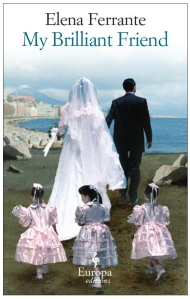
My Brilliant FriendThe most popular literature languages translated into English in 2015 were French, Italian, Japanese, Swedish and German while the top-selling author was Elena Ferrante, with her all-consuming, Neapolitan series of four books: My Brilliant Friend, The Story of a New Name, Those Who Leave and Those Who Stay and The Story of the Lost Child.

So, from the Man Booker longlist of 13 books reviewed here, the six titles below made the shortlist for the Man Booker International Prize in 2016:

José Eduardo Agualusa (Angola) Daniel Hahn, A General Theory of Oblivion – On the eve of Angolan independence an agoraphobic woman bricks herself into her apartment for 30 years, living off vegetables and the pigeons she lures in with diamonds, burning her furniture and books to stay alive, writing her story on the apartment’s walls.

Elena Ferrante (Italy) Ann Goldstein, The Story of the Lost Child – book four in the Neapolitan saga of two friends, Lena and Lila, now adults, returning to their childhood town, dealing with life as mother’s, lovers, surviving an earthquake, tragedies of nature and humanity.

Han Kang (South Korea) Deborah Smith, The Vegetarian – Yeong-hye, seeking a more ‘plant-like’ existence, decides to become a vegetarian, prompted by grotesque recurring nightmares. In South Korea, where vegetarianism is almost unheard-of and societal mores are strictly obeyed, Yeong-hye’s decision is a shocking act of subversion.

As her rebellion manifests in ever more bizarre and frightening forms, Yeong-hye spirals further and further into her fantasies of abandoning her fleshly prison and becoming – impossibly, ecstatically – a tree. Fraught, disturbing, and beautiful, The Vegetarian is a novel about modern day South Korea, but also a novel about shame, desire, and our faltering attempts to understand others, from one imprisoned body to another.

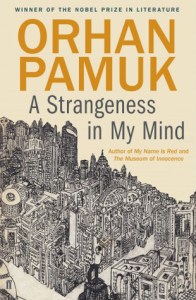
Orhan Pamuk (Turkey) Ekin Oklap, A Strangeness in My Mind – the story of Mevlut, the woman to whom he wrote three years’ worth of love letters, and their life in Istanbul. Mevlut Karataş sells boza (a traditional mildly alcoholic Turkish drink) in Istanbul and wishes for love and riches. He doesn’t have the best of luck (falling in love with a woman and accidentally eloping with the sister) as he ages, attempts to discover what is missing from his life.

Robert Seethaler (Austria) Charlotte Collins, A Whole Life – Andreas lives his whole life in the Austrian Alps, arriving as a boy taken in by a farming family. A man of few words, when he falls in love with Marie, he has friends light her name at dusk across the mountain. When she dies in an avalanche, pregnant with their first child, Andreas’ heart is broken. He leaves the valley just once more, in WWII – and is taken prisoner in the Caucasus – returning to find modernity has reached his remote haven.

Yan Lianke (China) Carlos Rojas, The Four Books – In the ninety-ninth district of a sprawling labour camp, the Author, Musician, Scholar, Theologian and Technician are undergoing Re-education, to restore their revolutionary zeal and credentials. In charge of this process is the Child, who delights in draconian rules, monitoring behaviour and confiscating treasured books.

Divided into four narratives, echoing the four texts of Confucianism and the four Gospels of the New Testament, The Four Books tells the story of one of China’s most controversial periods, demonstrating the power of camaraderie, love and faith against oppression and the darkest possible odds.

And the Man Booker International 2016 winner was:

South Korean writer Han Kang’s The Vegetarian translated by Deborah Smith.

Vegetarian

I haven’t read The Vegetarian, but was stunned by Han Kang’s Human Acts which I read earlier this year, and reviewed here. She is a remarkable writer and thinker and it’s brilliant that her work is being recognised and will find its way to a wider audience. I highly recommend reading her work, if you are interested in extraordinary minds trying to make sense of the most troubling aspects of humanity.

To purchase any of the above titles, click here:

Buy One of These Books Here

The Buddha in the Attic by Julie Otsuka

Buddha in the AtticBuddha in the Attic is a unique novella told in the first person plural “we”,  narrating the story of a group of young women brought from Japan to San Francisco as “picture brides” nearly a century ago.

In eight chapters, that read like a rhythmical chant, it traces the brides’ lives, beginning at the point of departure after leaving their predictable village lives, to the much-anticipated, though often frightening, boat journey and their arrival in San Francisco.

Some of us were so dizzy we could not even walk, and lay in our berths in a dull stupor, unable to remember our own names, not to mention those of our new husbands. Remind me one more time, I am Mrs. Who?

It recounts their first nights as new wives, the hard manual labour in new fields, cleaning house for white women, their struggles to master the language and understand the culture, to experiences in childbirth, as mothers, raising children who will lose their heritage and history, though continue to be marked by it, with the terrifying arrival of war and it damning label of them as the enemy.

At night we sat in our kitchens with our husbands as they pored over the day’s papers, scrutinizing every line, every word, for clues to our fate. We discussed the latest rumours. I hear they’re putting us into work camps to grow food for the troops.

Julie Otsuka has created a unique and original way to narrate the collective story of these Japanese mail order brides and their many experiences around common themes, we imagine the narrator as one of them, though we do not know which of the experiences are hers, as she balances them equally, one beside the other, in repetitive, elegiac prose.

This collective storytelling in effect brings our perception of them together, creating a sense of community, despite the suffering. It s as if, through sharing their experiences in these paragraphs, they become stronger, better able to cope, the author bringing them together. The “we” narrative unites them, we read and feel for them as a group, as if they are together. Otsuka brings them together in a lyrical expression of tasks, sufferings, looks, sighs, memories.

Apart from the initial boat ride over the seas from Japan to the US, there is little joy, they discover they are the lowest of low in the pecking order, equivalent to slaves, seen as quiet and submissive, hard workers.  Some take it in their stride, others will fall by the wayside.

They admired us for our strong backs and nimble hands/ Our stamina. Our discipline. Our docile dispositions. Our unusual ability to tolerate the heat, which on summer days in the melon fields of Brawley could reach 120 degrees. They said that our short stature made us ideally suited for work that required stooping low to the ground. Wherever they put us they were pleased. We had all the virtues of the Chinese – we were hardworking, we were patient, we were unfailingly polite – but none of their vices – we didn’t gamble or smoke opium, we didn’t brawl, we never spat. We were faster than the Filipinos and less arrogant than the Hindus. We were more disciplined than the Koreans. We were soberer than the Mexicans. We were cheaper to feed than the Okies ad Arkies, both the light and the dark. A Japanese can live on a teaspoonful of rice a day. We were the best breed of worker they had ever hired in their lives.

041812_1115_HotelontheC2.gifAnd as if it couldn’t get any worse, war happens, and they discover they are the enemy, they are regarded suspiciously and in time sent away.

This part is narrated by “them”, the communities within which they have existed alongside, though never really been a part of, certainly not appreciated – at least not until the Orkies and Arkies move in, who are not quiet and hard-working like the Japanese.

It is a soulful lament, a long sad narrative of a life of toil and disappointment that is endured, a disappearance that is unwarranted, a tribute to those who dreamed of a better life, who travelled across an ocean believing they would find it only to be betrayed bitterly.

041812_1115_HotelontheC1.jpgIt reminded me, not in style, but in subject of Jamie Ford’s The Hotel on the Corner of Bitter and Sweet, a story of childhood friends in Seattle, second generation immigrants caught up in the brutal reality of being perceived as untrustworthy, having the skin of an enemy.

Their plows weighed more than we did, and were difficult to use, and their horses were twice the size of our horses back home in Japan. We could not harness them without climbing up on orange crates, or standing on stools, and the first time we shouted out to them to move they just stood there snorting and pawing at the ground. Were they deaf? Were they dumb? Or were they just being stubborn? “These are American horse,” our husbands explained. “They don’t understand Japanese.” And so we learned our first words of horse English. “Giddyap” was what you said to make the horse go forward, and “Back” was what you said to make it back up. “Easy” was what you said to make it slow down, and “Whoa” was what you said to make it stop. And after fifty years in America these would be the only words of English some of us could still remember by heart.

Julie Otsuka speaks here (in English) about the inspiration behind Buddha in the Attic, which won the French Prix Femina Etranger 2012 translated as Certaines n’avaient jamais vu la mer for the French edition.

Human Acts by Han Kang tr. Deborah Smith

Han Kang AuthorHuman Acts is the author Han Kang’s attempt to make some kind of peace with the knowledge and images of the Gwangju massacre in South Korea in 1980.

Her family had left that city just one year before, she was 10 years old when the 10 day uprising occurred, but she became aware of it through the overheard, whispered conversations of her family and the silence that surrounded them speaking of the home where they used to live. She learned three young people from that household had lost their lives, one, a boy Dong-Ho probably shared the same room she had lived in for many more years than the short time he had.

What made the events sear into her mind and perhaps permanently affect her psyche, was the forbidden photo book that was given to her family, books circulated secretly to let survivors know what had really happened, a book her parents tried to hide, one she sought out, opening its covers to images she would forever be haunted by.

At night, though, when all the grown-ups were all sitting in the kitchen and I knew I’d be safe…I crept into the main room in search of that book. I scanned every spine until finally I got to the top shelf; I still remember the moment when my gaze fell upon the mutilated face of a young woman, her features slashed through with a bayonet. Soundlessly, and without fuss, some tender thing deep inside me broke. Something that, until then, I hadn’t even realised was there.

Asked why she felt motivated to write this book – which begins with the immediate after-effects of the massacre, the very real logistical management of the bodies, the bereaved, mass memorial rituals and the burials and goes on to enter the after death consciousness of one the victims, seeing things from outside his body – she responded that the experience of seeing those images left her scared, afraid of human cruelty, struggling to embrace human beings.

It left her with the two internal questions below, they became her motivation to enter into the experience and try to write her way out of it, spurred on by the events surrounding the 1980 massacre in her birthplace of Gwangju and then the more recent social cleansing that took place in the Yongsan area of Seoul in 2009:

1. How can human beings be so violent?
2. How could people do something against extreme violence?

Human ActsHuman Acts, which seems to me to be an interesting play on words, is divided into six chapters (or Acts), each from the perspective of a different character affected by the massacre and using a variety of narrative voices.

The opening chapter entitled The Boy, 1980 introduces us to Dong-Ho, but seen from outside himself, written in the second person singular narrative voice ‘You’. It is after the initial violence in the square and something has driven this boy, initially searching for the body of his friend who he witnessed being shot on the first day, to volunteer and help out, confronting him in a visceral way with so much more death and tragedy than he had escaped from on the day itself.

We meet the shadow of his friend in the second chapter, as he exits his body, but is unable to escape it, he tries to understand what is happening around him and observes his shattered body and others as they arrive, until something happens that will release him whereupon he senses the death of those close to him, his friend and his sister.

How long do souls linger by the side of their bodies?

Do they really flutter away like some kind of bird? Is that what trembles at the edge of the candle flame?

In another chapter, we learn one of the volunteers from the first chapter is an editor, we meet her again five years later in a short, violent episode, that is revealed in the seven days of healing that follow. Devastatingly brilliant, it delves into the cost of censorship and the risk of being anywhere near it.

She had no faith in humanity. The look in someone’s eyes, the beliefs they espoused, the eloquence with which they did so, were, she knew, no guarantee of anything. She knew that the only life left to her was one hemmed in by niggling doubts and cold questions.

The following chapters skip years, but never the prolonged effect of what happened, the events never leave those scarred by them. The narrative works its way back to the origins of the uprising, to the factory girl, the hard-working, little educated group of young women trying to improve their lot, to obtain fair wages and equal rights. They become bolder when they meet in groups and speak of protesting, they educate themselves and each other and feel part of something, a movement and a feeling they wish to express publicly, with the naive assumption they won’t be arrested or killed.

It brings us back to humanity’s tendency to group, to find common interests, to progress as a team with common interests, to support each other and to the tendency of those in power to feel angry, threatened and violent towards those who have an equal ability to amass support, regardless of the merits of their cause.

Deborah Smith’s translation with all the narrative changes and structural vagaries works so well, it’s only the names and the occasional script that remind us that this was a work written in a language, so very different in its structure and ability than English, a challenge Smith was very much aware of, but overcame in this stunning result. I can only imagine how it must feel to read it in the original language.

Han Kang so immersed herself in these stories and events, that it is as if we are reading the experience of a holocaust survivor, a torture sufferer; we know only a little of what it must be like to live with the memory and the reluctance to want to share it, the heavy price that some pay when they do.

Despite the suffering and proximity to events, I was riveted by this novel all the way through, reading it slowly, endeavouring to expand my awareness to try to comprehend where the artist is taking us, to try to receive the answers too to those questions that have haunted her for so long.

I was constantly racking my brains.

Because I wanted to understand.

Somehow or other, I needed to make sense of what I’d experienced.

I remember Primo Levi’s book If This is A Man: The Truce, a memoir, and his words, which could easily have been a guide for Han Kang herself, in the way she has approached this incredibly moving, heart-shattering novel. It seems a fitting note on which to conclude this review, to recall his words and his intention in setting things down on paper.

052812_1909_IfThisisaMa1.jpgI believe in reason and in discussion as supreme instruments of progress, and therefore I repress hatred even within myself: I prefer justice. Precisely for this reason, when describing the tragic world of Auschwitz, I have deliberately assumed the calm, sober language of the witness, neither the lamenting tones of the victim nor the irate voice of someone who seeks revenge. I thought that my account would be all the more credible and useful the more it appeared objective and the less it sounded overly emotional; only in this way does a witness in matters of justice perform his task, which is that of preparing the ground for the judge. The judges are my readers.

Primo Levi


Further Reading

Buy This Book

Click on the link to buy this book.

Buy Human Acts at Book Depository

Note: This book was kindly provided by the publisher Portobello Books.


What Lies Between Us by Nayomi Munaweera

I came across this title on the Goodreads List below, Anticipated Literary Reads for Readers of Colour which is an excellent source for finding out books that are due to be published soon that might be written by authors from different cultures and traditions than those we generally find on the bestseller tables in bookshops.

GR Cultural Reads 2016

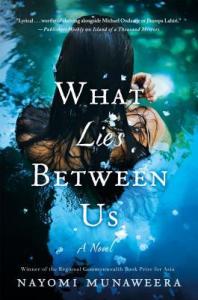
Nayomi Munaweera’s novel, at Number 2 on the list, stands out immediately with one of the most enticing covers I have seen for a long time and it lives up to that promise of an alluring appearance with a dark, mysterious reveal.

What Lies Between UsThe cover is an apt metaphor of the book, where water plays a significant role in multiple turning points in the novel and the image of a woman half-submerged, reminds me of that ability a person has of appearing to cope and be present on and above the surface, when beneath that calm exterior, below in the murky depths, unseen elements apply pressure, disturbing the tranquil image.

The prologue mentions the maternal instinct of a mother, to sacrifice for her young, describing the aptly named moon bear due to the white shape on its chest, an animal that is hunted for medicinal purposes and capable of going to extremes in order to protect its young.

Structured into five parts, the book is written in the first person by an unnamed narrator, and opens from within a cell. We understand the protagonist is a woman who for her crime often receives hate mail from mothers and marriage proposals from men. She mentions atrocities from the civil war in her home country, stories she says she was detached from, suffering that was not hers.

‘They think that maybe growing up in a war-torn land planted this splinter of rage within me, like a needle hidden in my bloodstream. They think that all those years later, it was this long embedded splinter of repressed trauma that pierced the muscle of my heart and made me do this thing.’

From here, she begins to narrate her story, her confession:

‘…in the beginning, when I was the child and not yet the mother…’

tropical gardenWe arrive in a hill city of Kandy in Sri Lanka where she recounts her solitary, yet idyllic childhood, among the scent of tropical gardens, a big old house, ‘sweeping emerald lawns leading down to the rushing river‘ overlooked by monsoon clouds.

Her father is a historian, her mother elegant, beautiful, prone to mood swings, making her feel awkward, tongue-tied and self-conscious, unlike when she is in the garden with Samson, or in the kitchen with Sita, domestic servants with whom she feels more like herself.

Lulled by lyrical descriptive prose into this dreamy, idyllic childhood, albeit with somewhat detached parents, there develops a feeling of something being not quite right, the child’s perspective clouds reality, something haunts her and the reader, a sense of unease.

Tragedy hits the family and the girl and her mother move to America to live with her cousin, Aunt and Uncle.

‘How can I leave this patch of earth that has been mine? Samson taught me once that the hydrangea blooms in a range of shades depending on the soil it sinks its roots into. From faintest pink to darkest night blue, the flower reflects the acidity of its patch of earth. How am I different? This person I am, will I be killed in the transition across the planet? What new person will emerge in that other soil?’

Having always looked towards her cousin as the epitome of modern, something she aspired to, it is a shock to learn of her upcoming arranged marriage, she agrees to be bridesmaid, despite strong feelings to the contrary, grateful that her mother, though troubled, knows better than to push her daughter in this direction.

‘I am grateful for this. Amma might throw plates, lock herself in the bathroom for hours, and cut her wrists. She might scream and yell, but this is something she could not do, this selling of a child to the highest bidder. For once we are united.’

She will fall into the way of life of those who surround her, reinventing herself, almost becoming like one who was born there, if not for that backwash of childhood, that sometimes pushes its way back into her life, threatening to sweep her out of domestic bliss like a freak wave, dumping her mercilessly on the foreshore. As strange memories resurface, her carefully created new world begins to fall apart at the edges as she frantically tries to keep all that is precious to her together.

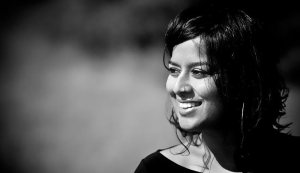
Nayomi Munaweera by Nathanael F. Trimboli

Nayomi Munaweera by Nathanael F. Trimboli

What Lies Between Us is a powerful, accomplished novel of parts that could be stories in themselves. Munaweera’s deft, lyrical prose lulls and transports the reader into an idyllic childhood of sweet-smelling tropical scents and beauty, open vistas, an enchanted natural world, only to be pulled up short by signs of disturbance, until in an instant they become tragic.

Slowly mother and daughter adapt to the new way of life, except the past will never leave them, it haunts them, consciously and sub-consciously, destroying precious moments and threatening to derail their lives completely.

Like Toni Morrison’s God Help the Child it is a novel highlighting the effect of childhood on an adult, how the past continues to affect the present and can take everyone along with it. It blinds us, and like an invisible cloak with far-reaching tentacles, it can reach into every pocket of our lives, dampening and rotting the good.

Heartbreaking, compelling, so unfair, it is also a story representing the very real cost of ignoring mild disturbances of mental health, portraying how easily they can evolve and transform into horrific tragedy, when left untreated or ignored, not to mention how unforgiving and despicable humanity can be in dealing with those affected by it.

Highly Recommended.

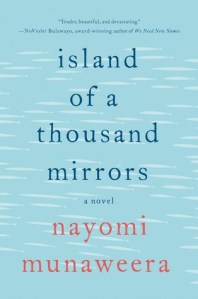
Nayomi Munaweera’s debut novel, Island of a Thousand Mirrors was long-listed for the Man Asia Literary Prize and the Dublin IMPAC Prize. It won the Commonwealth Regional Prize for Asia. I’ve ordered a copy and plan to read it this year as well. She and her family left war-torn Sri Lanka when she was three years old and moved to Nigeria and eventually to America.

Island of a Thousand Mirrors


Charming Billy by Alice McDermott

Charming Billy was the last book I read, as 2015 came to a close and a fitting end it was, as it opens at the funeral and wake of a man called Billy, a man who over-comforted himself with drink, for reasons that everyone present was happy to speculate on, most of them coming to the conclusion , that he’d never got over the fiancée that returned to Ireland with his ring and a promise to join him soon.

Close friends and family come together to mourn and remember Billy, this man of Irish descent who fell for Eva one summer, who promised himself to her and sent her the money he’d borrowed from his new boss, so she could return to him after she went back to Ireland.

It had been a short romance, but one that everyone present at his wake had an opinion on, yet no one appeared to have known the full truth of what really transpired. This becomes even more clear as the novel progresses towards the memory of Billy’s trip to Ireland about 30 years later, truth confronting him in a way grief could not.

Charming BillyThe novel unfolds and weaves like threads in a tapestry, as characters share their understanding of Billy, their memories of his charm and inclinations and what they knew about the short-lived romance with the Irish girl Eva.

They debate whether Billy’s demise and descent into alcoholism was part of who he was or the consequence of the heartbreak he had endured over the years, despite his marriage to Maeve, the widow, like wallpaper adorning the kitchen, witnesses all, but sits quietly in the background of this narrative.

“There was tremendous affection in Billy’s eyes, or at least they held a tremendous offer of affection, a tremendous willingness to find whomever he was talking to bright and witty and better than most.”

Slowly it creates a picture of a life and all lives, how they are formed, changed, steered by certain events, fractured by grief, sustained by community, vulnerable to and comforted by addiction, driven by faith, seduced by deception.

‘In the arc of an unremarkable life, a life whose triumphs are small and personal, whose trials are ordinary enough, as tempered in their pain as in their resolution of pain, the claim of exclusivity in love requires both a certain kind of courage and a good dose of delusion.’

Much of the novel is narrated by the daughter of Dennis, Billy’s cousin. Dennis was close to Billy, they were together when that summer when they met the two girls Mary and Eva, at Dennis’s mother and stepmother’s holiday home, a place Billy would never return to, perhaps due to those memories, and a location that provides something of a twist near the end.

A nostalgic tale, imbued with sadness, post war expectations and a new world Irish charm, it carries a sense of stepping back in time, of being on the threshold of a new modern era, Billy, one of the last links to a bygone era.

It read like a tapestry, one story viewed through various perspectives, so we go over events again and again, as seen by numerous characters, like colourful threads in a tableau.

I picked this book up from the library after it had been highly recommended to me, I have another of her books on the shelf Someone, a 1920’s Irish-American coming-of-age portrait of a woman’s life through childhood, adolescence, motherhood and old age.

Have you read any of Alice McDermott’s work?

February by Lisa Moore

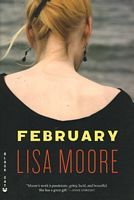
FebruaryFebruary is a novel constructed around a real and tragic historical event that occurred in Newfoundland, Canada just over thirty years ago, a tragedy that remains deeply felt in the area today. All Newfoundlanders of a certain age, remember where they were on the night the Ocean Ranger sank, a technological wonder that was supposed to be unsinkable, one that if safety procedures had been followed, indeed, may not have done so.

The book was longlisted for the Man Booker Prize in 2010. The cover doesn’t tell us much about the scope of this novel, I expect it represents the protagonist Helen, at about the age she must have been, in her 30’s when she learned she had lost her husband at sea.

From Wikipedia:

Ocean Ranger was a semi-submersible mobile offshore drilling unit that sank in Canadian waters on 15 February 1982. It was drilling an exploration well on the Grand Banks of Newfoundland, 267 kilometres (166 mi) east of St. John’s, Newfoundland, for Mobil Oil of Canada, Ltd. with 84 crew members on board when it disappeared. There were no survivors.

OceanRanger

‘Ocean Ranger Oil Rig’ – Licensed under Fair use via Wikipedia

It was the day after Valentine’s Day, Helen, received a card from her husband Cal, a day or so later. Cal’s mother phoned the Coast guard and shouted at them, saying they’d got it wrong. If the men were dead the company would have informed the families.

Helen knows in her heart it is true, but she needs the body of her husband. Her father-in-law convinces her that she doesn’t want to remember him that way.

‘There were people who went on hoping for months. They said there must be some island out there, and that’s where the survivors were. There was no island. Everybody knew there was no island. It was impossible. People who knew the coast like the back of their hand. But they thought an island might exist that they hadn’t noticed before.’

At night she dreams of him and believes he wishes her to join him.

‘How awful. Death has made him selfish.

Forget the children. This is what he means. Forget yourself. Come with me. Don’t you want to know what happened?

She feels as though she is betraying him by staying. It is relentless and exhausting, every time she says no him, she forgets him a little more.

The novel moves between the 1970’s when she and Cal were married to October, November 2008, the present, when Helen awaits the arrival of her son John, who has called from Tasmania, Australia to tell her he is going to become a father.

Helen is kept busy running her own dressmaking business and at the insistence of her sister Louise, is having her floors replaced by Barry. She doesn’t want the job to end, she becomes used to his presence, his ignorance of her. It makes her desire him.

John’s story also moves between 2008 and the mid 90’s when he makes a career change, becoming an engineer for the same industry that took the life of his father. He has had a high risk job and never wanted to become a father. The novel gives more space to John and the mother of his soon to be born child, Jane, while giving little space to the two daughters, who appear on the fringes, are not close to their mother, nor developed with much depth.

‘John has avoided being a father all his adult life. It has taken stealth and some underhandedness. It has taken clarity of purpose when the moment called for dreamy abandon. He has practised withdrawal. He has kept what he wants, what he actually wants for his life, in the centre of his thoughts, even while in the throes of orgasm. He’s kept a tight fist on the reins of himself.’

February is a brilliantly constructed  and thought-provoking vision of one woman’s grief in the wake of her husband’s death, leaving her pregnant and with three children to raise. It illustrates the way this event and the memories it triggers, return in waves from that point forward, that death is not really death, it is a form of ever-present, albeit fading memory.

While never overly melancholic, Helen’s recollections and reconstructions of what may have happened to her husband in those last minutes, her studying of the manuals to understand how to resolve the problem that caused the sinking, reminded me of Joan Didion’s study and reliving of her own husband’s death in The Year of Magical Thinking (2005).

However life continues on and around Helen and those quotidian narratives reminded me of the work of Anne Tyler as we see-saw between the practical elements of daily life and the introspection of a death that stays with someone their entire life and in those still moments, returns as potently, as if it were yesterday.

Moore lost her father a few years before the Ocean Ranger sank, she was 16 and her sister 12, giving her first hand experience of how grief works it way through a family, how it makes and shapes the lives of those left behind, an experience that enriches the novel and brings it alive, makes it feel authentic.

Quietly compelling, highly recommended.

‘I think the most important thing I’ve learned about grief – and coming through it – is that you don’t forget the person you’ve lost. Rather, the memories become sharper, gather new meaning, and are richer over time. The absent become more present, not less so, as time goes on.’ Lisa Moore, extract from an interview with Bookgroup.info


The Gift of Stones by Jim Crace

The Gift of StonesFrom whispering muse to the gift of stones, this was the second book I read in 2016, one of Jim Crace’s earlier philosophical works, telling the tale of a village of stone workers, who live a simple life working stone into weapons, which are then traded with passers-by for food and other essentials, which they are not able to provide for themselves, in the arid landscape within which they reside. It is a livelihood they think little about, it is all they know.

A boy’s destiny is changed after he is injured in the arm by an arrow. The arrow is a symbol of change and both opens and closes this short, though provoking novella.

The injury becomes a turning point for a boy, his arm partially amputated, making him unable to follow in the village tradition, he must find another way of contributing to his community. His predicament is a foretelling of what is to come, but first he alone must learn to adapt.

He ventures outside, further from the village than anyone has ever been, near the sea and the heath, bringing them tales of beyond, discovering the allure and power of imagination. Experiencing things and feelings he has never encountered.

Already an orphan living with his uncle in a stone age village of people who work with flint, his injury turns him into a storyteller, inspired by his walks along the coastline towards the heath where he meets a woman with her baby living alone in a hut. He discovers how to captivate and amuse an audience, to take their minds off their day-to-day torments.

‘The paradox is this – we do love lies. The truth is dull and half-asleep. But lies are nimble, spirited, alive. And lying is a craft.’

He brings the woman back to the village, however she isn’t welcomed by the villagers, set in their ways. She too symbolises the lessons they must learn, though they will realise this much too late. When he tells the villagers her history, a truth, they become bored and turn away.

‘Quite soon they found it far too dark and cold to listen to my father any lore. They peeled away before the tale was done, unmoved by my father’s portrait of the widow and her child on the heath, her struggles not to die, her hardships, grief and hunger, the slaughter of the geese, the crushing of her hut. Quite soon there were no cousins left to hear my father’s tale. His audience – excluding bats and mother – had crept away, unamused and angered by the venom in his voice.

My father stood alone and startled – for now he understood the power of the truth.’

flint arrow head

It is a philosophical tale of unrequited love, abandonment, survival and the heralders of change, how communities react to the necessity to adjust, and to those who are different, outsiders.

It touches on the role of imagination and storytelling, not just as entertainment and a craft, but as those who foresee change, create invention, imagine other ways of life.

Poignant and intriguing, given the era within which it is set and a kind of tribute to the greater importance of storytelling within society.


Top Reads 2015

If you’ve noticed a lack of reviews recently, please know it’s not from a lack of interest, time or reading, just a temporary technical problem, not yet resolved but should be by mid January.

So, 2015 was a bumper reading year, I surpassed my book a week ambition and actually read 65 books from 26 different countries, a third of what I read was translated from another language, something I seek out in my interest to experience literature and storytelling from within other cultures and not only by those who have access to the English language.

I will create a separate post to talk more about my impressions and attractions of reading outside the main literary cultures and the cultures and landscapes that keep drawing me back for more.

As with previous years, I’ll share my one Outstanding Read and the Top 5 Fiction and Non-Fiction reads, with a few special mentions.

Outstanding Read of 2015
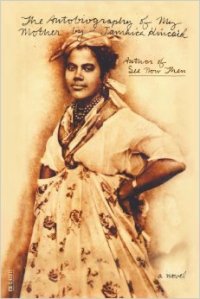
Autobiography MotherThe Autobiography of My Mother by Jamaica Kincaid My first read of the long-established author Jamaica Kincaid (Antigua) and it moved me like no other book had since last years outstanding read, Jennifer Clement’s Prayers for the Stolen.

This is a novel about a young woman growing up without a mother, abandoned for a time by her father and looking back at her life and the thoughts, reactions she had back then, using all the senses.

It is a kind of awakening, a visceral account that is insightful and squeamish both. It was for me too, the beginning of a season of Caribbean reads that were one of the major reading highlights of the year, soon after this I read three books by Maryse Condè (Guadeloupe), Cristina García’s Dreaming in Cuba, Edwidge Danticat’s Breath, Eyes, Memory (Haiti) all of which were 5 star reads.

Top Fiction

Click on the title below to read the review.

1.  The Wall,  Marlen Haushofer a riveting story of one womans survival in the aftermath of a catastrophic event, with only a few animals for companions. A lost classic that was revived years after the death of the writer and one that had me spellbound until the end.

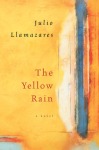
2. The Yellow Rain, Julio Llamazares set in an almost abandoned village in the Spanish Pyrenees, this is a haunting, elegiac account of one man who refused to leave and was witness to the degradation of all that man had contributed as nature reclaimed what was left. Captivating in the way it is written, you will want to slow read it, brief yet unforgettable.

3. Dreaming in Cuban, Cristina Garcia spanning three generations of women from Cuba, told from their differing perspectives, particularly the grandmother who is rooted in her country and culture, it explores separation, identity, the strong bonds of family and the weight of expectation. How these women survive their circumstances. Just brilliant and part of a great collection of literature from the region.

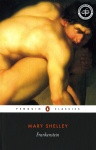
4. Frankenstein, Mary Shelley well it started with listening to the BBC audio broadcasts for learners of English, followed by watching a relayed broadcast of Benedict Cumberbatch in the London National Theatre adaptation, which was brilliant, to finally reading the work itself. I was a little hesitant, old classics aren’t really my thing, but I loved reading Frankenstein and couldn’t help but admire the tremendous achievement of Mary Shelley in creating it. Made all the more fabulous by having seen how it continues to inspire creative direction in the 21st century.

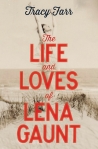
5. The Life and Loves of Lena Gaunt, Tracy Farr I didn’t read a lot of newly published works in 2015, but this one was a standout read for me, I was quickly drawn into the world of Lena Gaunt, an Australian theremin player who was born in Asia and had a few life changing experiences from her encounters there, who lived without much parental guidance or supervision, and developed her musical talents amid an eclectic group of artistic friends, had one true love and faced certain tragedy, all of which is brought to life after a recital she gave in her eighties attracted the attentions of a filmmaker. All the more interesting, for it being inspired by a true legend.

Top Non-Fiction

1. Unbowed: Autobiography of Wangari Maathai the truly inspiring story of Kenyan Nobel Peace Prize winner Wangari Maathai, the work she did, the challenges overcome that gave her a top education and the will to make a real difference, particularly for the lives of women in her country. She empowered others and created enduring projects and movements for all.

2. Under the Sea-Wind, Rachel Carson first in a nature inspired trilogy about the sea and her inhabitants, brought to life in a creative narrative, as seen from the perspective of three sea creatures, part one, the edge of the sea shows the habitat from the point of view of a female sanderling bird, she names Silverbar, part two, the Gulls way, is dedicated to the open sea and navigated by Scomber, the mackerel, and finally part three, river and sea, we follow Anguilla the eel as he travels from his coastal river pool downstream towards the sea and that deep instinctual pull towards the abyss.

3. Tales of the Heart: Stories from my Childhood, Maryse Condé essays, vignettes of childhood, recommended as the place to start in reading the work of this talented and enthralling writer from Guadeloupe. Loved it and was quick to follow-up with Victoire, My Mothers Mother, a book she says is true, though sold as a novel by her publishers due to the tendency of her research subjects to rely on oral stories to pass on their history. Brilliantly told, as she delves into the unknown life of her grandmother to better know and her own mother who died when she was 14.

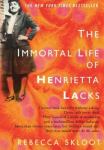
4. The Immortal Life of Henrietta Lacks, Rebecca Skloot (review to come) the background story to the global presence and utilisation of the immortal HeLa human tissue cells, that were discovered to be unique in that they never died, continued to replicate and could be used to do all manner of tests for disease and drugs and how cells respond, something of a revolution for medical science.

HeLa were the initials of the person from whom the samples were taken, as was the procedure at the time. But who was HeLa and what did she or her family have to say about these extraordinary developments thanks to the cells of one woman? Rebecca Skloot spent 10 years researching the life of Henrietta Lacks and the subject of the HeLa cells to bring this extraordinary narrative.

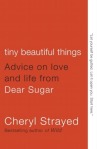
5. Tiny, Beautiful Things: Advice on Love and Life from Dear Sugar, Cheryl Strayed these are letters from the columnist Sugar, who it turned out was Cheryl Strayed, author of the book Wild about her solo journey to trek the Pacific West trail in her twenties.

These letters are written when she is in her forties and though still young, has lived multiple lives and had more than her share of extreme and dysfunctional experiences, from which to draw her own brand of wisdom. It’s a pick up at will kind of book, but her confrontational yet compassionate style is refreshing and thought-provoking, her ability to be very clear on her opinion and advice, without being judgmental.

Special Mentions

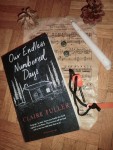
Outstanding Debut – Our Endless Numbered Days Claire Fuller

Excellent Classic – The Enchanted April, Elizabeth von Arnim

Most Uplifting Read – Antoine Laurain’s The Red Notebook and The President’s Hat

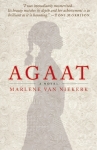
Most Disturbing Read – Agaat by Marlene Van Niekerk

Most Disappointing Read – The Waves , Virginia Woolf