Unbowed, One Woman’s Story by Wangari Maathai

WangariWangari Maathai was an exceptionally hard working, charismatic, altruist, who came from humble rural beginnings, toiling the land barehanded from a young age to become one of a group of young Africans identified as part of the “Kennedy Airlift”, provided the opportunity to gain bachelor’s and master’s degrees in the US, then completing a PhD in her native Kenya and using her education to work for the betterment of her country and people in terms of sustainable environmental practices social justice.

In addition to a senior role as a scientist and researcher at a university in Nairobi, needing to do something practical and far-reaching, she founded the sustainable tree planting initiative, The Green Belt Movement and would go on to become a responsible and practically minded activist, working to protect the natural resources and people of Kenya, through her knowledge of where to apply pressure, through her strong international network and above all the high regard in which she was esteemed by many, though sadly, that didn’t include the government of Kenya, who over many, many years continued to block her, plant obstacles in her way, arrest her and make it very difficult for her to continue in her role as an academic and to run her own business.

Wangari Maathai possessed a spirit that refused to lie down, with every setback, she gathered herself and whatever limited resources she still had, and at times this was nearly nothing and always looked towards the one step she could take, that first step towards a solution.

Wangari Maathai, Tree Hugger Extraordinaire!

Wangari Maathai, Tree Hugger Extraordinaire!

Planting a tree was both symbolic and life-sustaining. As more and more of Kenya’s forest was being deforested, underground water sources were drying up, land that had been planted with indigenous trees was being replaced with cash crops like tea and coffee, stripping the soil of nutrients and occupying land previously used to produce traditional foods for people to eat. As a consequence women began to feed their families more processed foods, requiring less energy to produce, less firewood and increasing the incidence of malnutrition.

“While I was in the rural areas outside Nairobi, I noticed that the rivers would rush down hillsides and along paths and roads when it rained, and that they would be muddy with silt. This was very different from when I was growing up. “That is soil erosion,” I remember thinking to myself. “We must do something about that.” I also observed that the cows were so skinny that I could count their ribs. There was little grass or other fodder for them to eat where they grazed, and during the dry season much of the grass lacked nutrients.”

And she took people with her, she made them part of the solution. To grow The Green Belt Movement required a large network of people to plant trees and to source and nurture seedlings. She went to the women, women like herself who grew up with their hands in the earth, she empowered them to create nurseries in their villages and tend the small trees and keep planting.

“Although the leadership of the NCWK (National Council of Women of Kenya) was generally elite and urban,  we were concerned with the  social and economic status of the majority of our members, who were poor, rural women. We worried about  their access to clean water,  and firewood,  how they would feed their children,  pay their school fees,  and afford clothing, and we wondered what we could do to ease their burdens. We had a choice: we could either sit in an ivory tower wondering how so many people could be so poor and not be working to change their situation, or we could  try to help them escape the vicious cycle they found themselves in. This was not a remote problem for us. The rural areas were where our mothers and sisters still lived. We owed it to them to do all we could.”

Tumutumu Hills nursery

Tumutumu Hills nursery

These women were already farmers, they knew how to nurture beans, maize and millet seeds, and Wangari and her team reminded them, they didn’t need a diploma to plant a tree. All they needed was their “women-sense”. These women succeeded, they showed other women what to do and became known as their “foresters without diplomas”. At every stage they looked to see if they could improve the way they did things and to overcome any obstacles the women encountered. It was a huge and sustainable success.

Unfortunately, the government for much of the 80’s and 90’s was against her, almost as if it were a personal affront, to witness a woman speak out and lead and inspire others to stand up to authority; Wangari Maathai was an advocate for proper governance and management of public resources and as soon as she heard about abuses of powers that threatened to remove public rights, she moved her supporters to action.

Through perseverance she won many battles, to save the last big public park in the middle of Nairobi, Uhuru Park from urban development, preventing Karura Forest from being given to friends and political supporters of politicians, the release of political prisoners and even the lobbying of the World Bank to forgive Kenya’s national debt which had escalated out of control. due to interest payments, despite the original loan amounts having been repaid .

“When I see Uhuru Park and contemplate its meaning, I feel compelled to fight for it so that my grandchildren may share that dream and that joy of freedom as they one day walk there.”

« Maathai and Obama in Nairobi » Source: Fredrick Onyango,  Nairobi, Kenya Wikipedia

« Maathai and Obama in Nairobi » Source: Fredrick Onyango, Nairobi, Kenya Wikipedia

Unbowed, One Woman’s Story, is an astonishing and important recollection of the life and work of Wangari Maathai. She applied herself to everything she did with vigour and heart, the opportunity to be educated, something that continues to be lobbied for so many girls in third world countries, was a major turning point and became the first of many open doorways she walked through and made the most of, not for own benefit, but always for the good of all.

It seems almost like a utopian fantasy, to imagine what the world could be like, if more women were given the opportunity to gain the necessary knowledge that could allow them to facilitate solutions to village and country problems, that allowed them to live sustainably and not in fear or poverty without understanding why. Wangari Maathai knew and practised that one person can’t change everything, it is through showing and empowering others that change happens.

She was an amazing, inspirational and practical woman, who responded to the call for help on many significant issues that would benefit all Kenyan’s and was an example to the world, rightfully acknowledged and awarded the Nobel Prize for peace in 2004. Sadly she passed away in 2011 from ovarian cancer.

“Throughout my life, I have never stopped to strategize about my next steps. I often just keep walking along, through whichever door opens. I have been on a journey and this journey has never stopped. When the journey is acknowledged and sustained by those I work with, they are a source of inspiration, energy and encouragement. They are the reasons I kept walking, and will keep walking, as long as my knees hold out.”

Wangari tells a wonderful story of how the hummingbird responds to a forest fire, in a delightful metaphor that describes exactly her attitude to life and the many challenges that surround us. It has been made into a 2 minute animated film, Dirt, narrated by Wangari Maathai and is a wonderful introduction to her faithful, persevering spirit. A wonderful short film and one of my Top Reads for 2015.

I will be the hummingbird…

Kamchatka by Marcelo Figueras tr. Frank Wynne (Spanish, Argentina)

KamcahtkaKamchatka is a novel by the Argentinian writer Marcelo Figueras set in 1976, one year during a disturbing era of Argentinian history under military dictatorship, often referred to as The Dark Ages, a time when speaking out against the establishment gave rise to a terrible number of “Disappeared”.

Ordinary people vanished without trace, neither arrested nor imprisoned, there was no record of their detainment, they simply disappeared, believed to have been disposed off.

In an interview with Stu a huge reader of translated fiction who reviews at Winston’s Dad, Marcelo Figueras said this about his own experience as a child growing up in those years, words that are clearly an inspiration for the novel he has written:

“On the one hand, I was the typical boy on the verge of adolescence: shy, introspective, living in a bubble made of books ,music, comics, TV and movies. I played Risk a lot. I watched The Invaders. I enjoyed Houdini, the movie with Tony Curtis and Janet Leigh, but rejected its sad, sad ending. I fell in love every day. I danced alone.

But on the other hand, I lived in fear. I knew nothing about what was happening, my family had always been apolitical. In spite of that, I sensed something awful was going on: it was everywhere, even in the air, atoms of fear mixed with oxygen and nitrogen.

That was one of the main ingredients of the military Junta’s perversity: they tried to keep the appearance of normality, Buenos Aires’ streets were calm and orderly (and filled with policemen), as if nothing out of the ordinary was really happening. But people were being kidnapped in the dark, locked in dungeons, tortured and killed, and their bodies hidden in massive, anonymous graves or dropped into the sea. So something wicked was indeed happening. And my nose picked it up somehow.”

The author goes on to say that the subject has been written about by many authors and in his opinion many of those stories follow a similar trajectory of a romantic young man or woman, their involvement in politics, a kidnapping occurs, torture, death and the law courts follow.

He wanted to do something different, to write about what those who were not kidnapped endured, a different horror. By making a 10-year-old the narrator of his novel, he puts the reader right into this fearful and confusing situation of sensing being in danger and yet understanding nothing about where that fear is coming from.

HoudiniEarly on in the novel, our narrator and his younger brother, whom he affectionately refers to as The Midget, are pulled out of school abruptly by their mother and they go on what she describes as a holiday, to stay in a safe house.

The boys are told to choose a name for themselves, to change their identity and after finding a book about Harry Houdini on top of a cupboard, our narrator calls himself Harry and decides he wants to become an escape artist, something he goes to great lengths to tell us is very different to being a magician.

“Since the uncertainties of the present weighed heavily on me, I had been spending a lot of time thinking about my future. The idea of becoming an escape artist struck me as clearly as a vision: once the notion was firmly planted in my brain, all my worries  disappeared. Now I had a plan, something that would, in the near future, make it possible to tie up the loose ends of my circumstances. I imagined that Houdini himself had done much the same thing. ”

Risk Map

The ‘Risk’ Map of the World

The stay doesn’t feel like a holiday to Harry, however he passes his time doing the things he enjoys, playing Risk with his father, a post colonial game of strategy to take over the territories of the world. Harry wants to conquer but he never does, his father believes it is important he learns how to win through continual practice, not to have victory handed to him.

Finally the match occurs where Harry begins to win, he pushes his father back, gaining all but one last territory, that last bastion of strength, Kamchatka. He fails to take it and from that moment on his fortune turns.  Kamchatka is this place on the map that few have heard of, but it contains a hidden strength and it is both a figurative place Harry will return to in later years and a physical landscape of extraordinary elements that he will also visit.

Our Harry is very curious and intelligent and the book is structured into sections like lessons from a day at school. In each of these parts he reflects on philosophical ideas, covering subjects the book is divided into, biology, geography, language, astronomy and history. These reflections were one of the magical parts of the book for me, I recognise that beautiful curiosity of a young mind, trying to make connections between what he knows and what he thinks might be, growing his brain on the page.

“Sometimes I think that everything you need to know about life can be found in geography books. The result of centuries of research, they tell us how the Earth was formed…They tell us about how successive geological strata of the planet were laid down, one on top of the other, creating a modem which applies to everything in life. (In a sense too, we are made up of successive layers. Our current incarnation is laid down over a previous one, but sometimes its cracks and eruptions bring to the surface elements we thought long buried.)”

Most of the narrative takes place in this suburban exile for the period that the two boys are with their parents, during that time they invite their Grandmother to visit, a formidable woman who doesn’t get on with her daughter and whom The Midget plays a deathly trick on.

There is  a swimming pool and often the boys find a dead toad floating within it, so they devise a method for the toad to escape, hoping to improve the genetic selection of toads, as only the intelligent will figure out how to escape. It is a child’s game invested with hope.

And Kamchatka?

“The last thing Papa said to me, the last word from his lips, was ‘Kamchatka’.”

I thought this book was incredibly well told, the voice of the child narrator was so authentic and believable, his curiosity, frustrations and fear penetrate the pages and make the reader feel it all. You can’t help but read the book with a certain amount of tension, not knowing what the outcome will be. I was left wanting to read a sequel, to know how Harry coped and lived in the teenage years that would have followed, when life must have been so different to everything he and The Midget had known up until then.

A 5 star read for me, highly recommended.

The book was short listed for the Independent Foreign Fiction Prize in 2011.

A Note on That Place Called Kamchatka

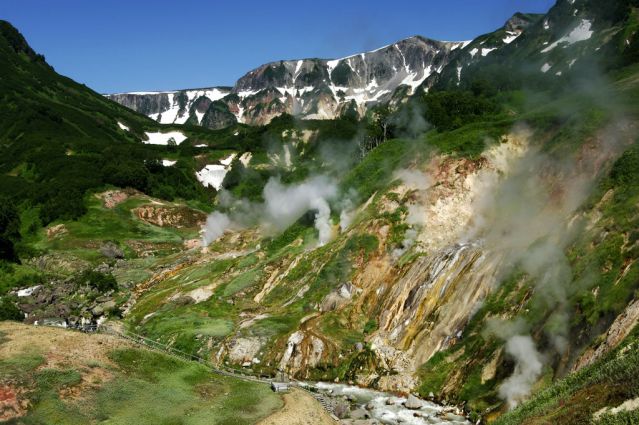
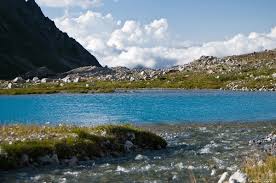
Kamchatka landscapeIn the easternmost region of Russia, eight time zones from Moscow, closer to Japan than most of Russia lies the region and peninsula of Kamchatka. A land of legends and a kingdom of bears. The region is stunning to look at and sees all the elements come together, snow topped hills, ramblings brooks, luscious greenery and volcanic vapours, yes there are frequent volcanic eruptions and earthquakes.

I realised some days after finishing this wonderful book that I knew about Kamchatka because some months ago my son made me go with him to see a stunning documentary at the cinema called ‘Terre des Ours’ which is set right on the heart of Kamchatka, a territory that is the home of brown bears, who only come out of hibernation for 3 months of the year and during that time they leave the snow topped mountainous regions and traverse the lava fields and go down to the river and lakes which are heaving with salmon. They must eat enough to get them through the next hibernation and the female bears have an even more challenging role as they have to catch enough for themselves and their offspring, while fending off the attentions of the lone male bears.

Below is a one minute trailer that show you a little of that magical world. The film is brilliant, sadly I don’t think it is available in English, the voice over is done by Marion Cotillard. But do watch this snippet, its magic.

Stone in a Landslide by Maria Barbal, tr. from Catalan by Laura McGloughlin and Paul Mitchell

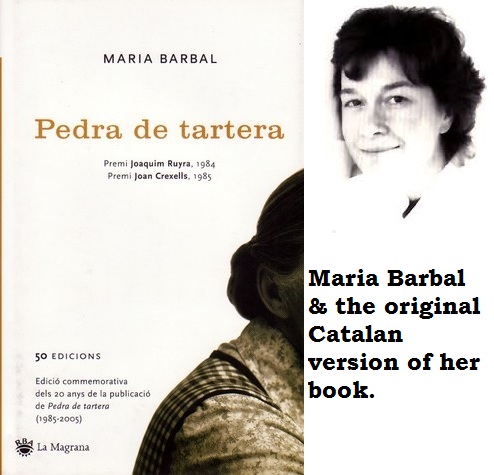
Stone  in a LandslideThis is the second in the Female Voices: Inner Realities series from Peirene Press.

Publisher, Mieke Ziervogel introduces each of their books with one or two sentences in extra-large font on the second page and it’s a page that you find yourself looking forward to whenever you pick up one of their books.

She shares what attracted the team to selecting that title as one of the Peirene books to translate into English and share with readers.

For Stone in a Landslide, she had this to say:

“I fell in love with Conxa’s narrative voice, its stoic calmness and the complete lack of anger and bitterness. It’s a timeless voice, down to earth and full of human contradictory nuances. It’s the expression of someone who searches for understanding in a changing world but senses that ultimately there may be no such thing.”

We meet Conxa as a 13-year-old girl living in the Catalan Pyrenees, Spain at the beginning of the last century, though she narrates the story from the other end of her life, reflecting back on her journey as an old woman.

One of six children, the opening lines tell us how she came to live with her childless aunt and uncle, leaving her family, home, village and mountain behind at such a tender age.

“Anyone could see that there were a lot of us at home. Someone had to go. I was the fifth of six children – Mother used to say I was there because God had wanted me to be there and you have to take what He sends you. The eldest was Maria, she, more than Mother, ran the house.  Josep was the son and heir and Joan was going into the church. We three youngest were told a hundred times that we were more of a burden than a blessing….So it was decided that I, who was level-headed and even-tempered, would be sent to help my mother’s sister, Tia.”

LandslideShe remembers going to school and how fortunate she was to be able to, on account of having older sisters who stayed home to do the work. Three winters she went to school, until she joined the family of her aunt and uncle and then had to help them with the outdoor work.

In short chapters of around two pages, we observe the change in Conxa’s life, her new duties, how people perceive her initially as an outsider and how that perception begins to change, she has become an heir to land thus her marriage prospects have increased. She suffers silently from being separated from her family, but in time accepts her new role and life.

“Time passed and no one spoke of home. Of my family. In five years I had seen Mother and Maria only once, when they came for the Festa Major during my first year at Pallarès….My aunt and uncle said nothing about going back and I didn’t dare mention it. Was I happy there? I had no idea. I’d lived with my heart in my mouth a bit, worried about what they might throw back in my face. Maybe the poverty of my family…But I’d got used to them and their way of doing things. And it’s true, the thought of leaving Pallarès to return to Ermita became stranger every day.”

We learn through Conxa’s experiences how people were perceived, eldest sons were destined to be the heir, a second son may have had to learn a trade and were therefore seen as lesser prospects. Ownership of land accrued status, men who earned a wage were less desirable.

“They knew him to be hard-working and quick-witted but, because of the nature of his work, he appeared to be a drifter and freer than most men, who only looked at the ground to work it or the sky to figure out what the weather will bring. I realised that they saw him as an outsider, someone who’d managed to earn himself a living, but this had more or less divided him from his family.”

Falling in love with a tradesman is about as rebellious as Conxa gets, her aunt and uncle soon realise that Jaume is a good match, and as with her life as the adopted daughter Conxa becomes as accepting of her new circumstances in her life with Jaume, who must by necessity travel a lot for his work.  He is more outspoken and for this Conxa will experience hardship as the Spanish Civil War impacts even the quietest villages.

Stone in a Landslide is such an apt metaphor for Conxa and yet she was not like the others. She doesn’t complain, she loves genuinely, she accepts her circumstances and only at the end when she is physically removed from her natural surrounding does she come close to realising how much a part of that landscape she is as a person. She coped with many changes, from daughter to adopted daughter, lover, mother within her natural environment, but the final move puts her somewhere beyond reach, beyond comprehension of how to be who she really is.

“Perhaps I had turned into a living stone, or it was just that I had never known how to rebel…. I felt that I was going to need to be strong, but I had no idea why.”

Another excellent addition to the collection and discovery of another wonderful writer.

Maria Barbal, born in 1949, is considered the most influential living Catalan author. The clarity with which she presents human relations and the passage of time has earned her critical acclaim and a wide readership. She lives in Barcelona.

Next Up: Portrait of the Mother as a Young Woman by Friedrich Christian Deluis.

Female Voice Inner Realities

Under the Tripoli Sky by Kamal Ben Hameda tr. by Adriana Hunter

We are in the city of Tripoli, bordering the Mediterranean in the 1960’s, though this is no seaside idyll.

Tripoli SkyThe narrative follows in the footsteps and the mind of a boy named Hadachinou who prefers the company of his mother, her friends, great-aunt’s and escorting girls sent on errands who are not yet kept indoors, bound by the shackles of marriage, in a society where a river of seething discontent courses through the veins of many, where the sexes barely tolerate each other and anyone who seems to have escaped the marriage trap is resented their so-called freedoms.

Hadachinou is privy to the thoughts, gossip and attitudes of women, a witness to their interior lives, he listens to their stories and absorbs their repressed desires as his own begin to awaken.

The tea ceremony was the only part of the day when my mother and her friends could live their lives in real times and tell their own stories. At last they could talk about dreams, longings and anxieties , all in the same breath and their bodies were at peace.

I sometimes wondered how these women who were all so different were able to spend hours at a time, each talking about her own god, her own people and thoughts, free to be wildly outspoken but without provoking any true conflict. It was because they had no power to preserve and no possessions to watch over. That was for the people on the other side of the wall: the men, the sheikhs, the governors and their hunting dogs! Scheming and calculating, diplomacy and power struggles were their domain.

Here with the women, my guardian angels, there were just words, spoken openly and easily, flitting and whirling about, a life force in themselves. Without these moments of trusting abandon, they would have dried up with sorrow. Or imploded as they toiled over their cooking pots.

Taynal Mosque

Taynal Mosque Source: wikipedia

While the men are at work, or at the mosque or in the coffee houses, the women finish their work and make time to see each other.

Here, great-aunt Nafissa has had enough of the women bad mouthing his mother’s childhood friend Jamila, words they only speak when his mother leaves the room, venomous remarks spiralling into bitterness about what they perceive as her secret life; flushed with rage, aunt Nafissa rails against them:

‘Leave Jamila alone,’ she cried. ‘Let her live her life. Its only because you’re jealous that you see evil in everything. She and her friends allow themselves freedoms you don’t have, freedoms you envy because your husbands keep you on a tight leash. What would you have her do? Stay at home like you, sitting on cushions and sucking on loukoums while you wait for men who never come home? You think those women are living bad lives? You make me laugh! But you don’t know when to hold your tongues, that’s for sure, and you’re full of spite. And, anyway, it’s not as if any of this has ever stopped you taking their money!’ she added, always ready to speak out against injustice.

OldTripoli

Old Tripoli Source: wikipedia

It is not easy to read about a repressed patriarchal society without much glimmer of hope, a slice of life narrative set in a pre-Gaddafi society on the verge of change.

I found it a sombre read, left wondering if this boy will be changed by virtue of his proximity to the women folk, or whether that might become a reason for his need to escape, lest he not fit in.

Looking out to sea, I remembered what Hadja Kimya had said: ‘Hadachinou, keep yourself busy doing simple things that delight you. Give yourself a goal. The soul of life is the little things, the minor events no one notices… That’s where life is, the pleasure of being alive, otherwise there’s just this vast blueness casting its shadow over us. Go on, keep yourself busy, do something, and then you might find yourself one day.’

This is cultural insight beyond the normal bounds of the English language, thanks to the translation of Adriana Hunter and the passion of Peirene Press in bringing these kinds of stories into the mainstream.

The Dead Lake by Hamid Ismailov, tr. Andrew Bromfield

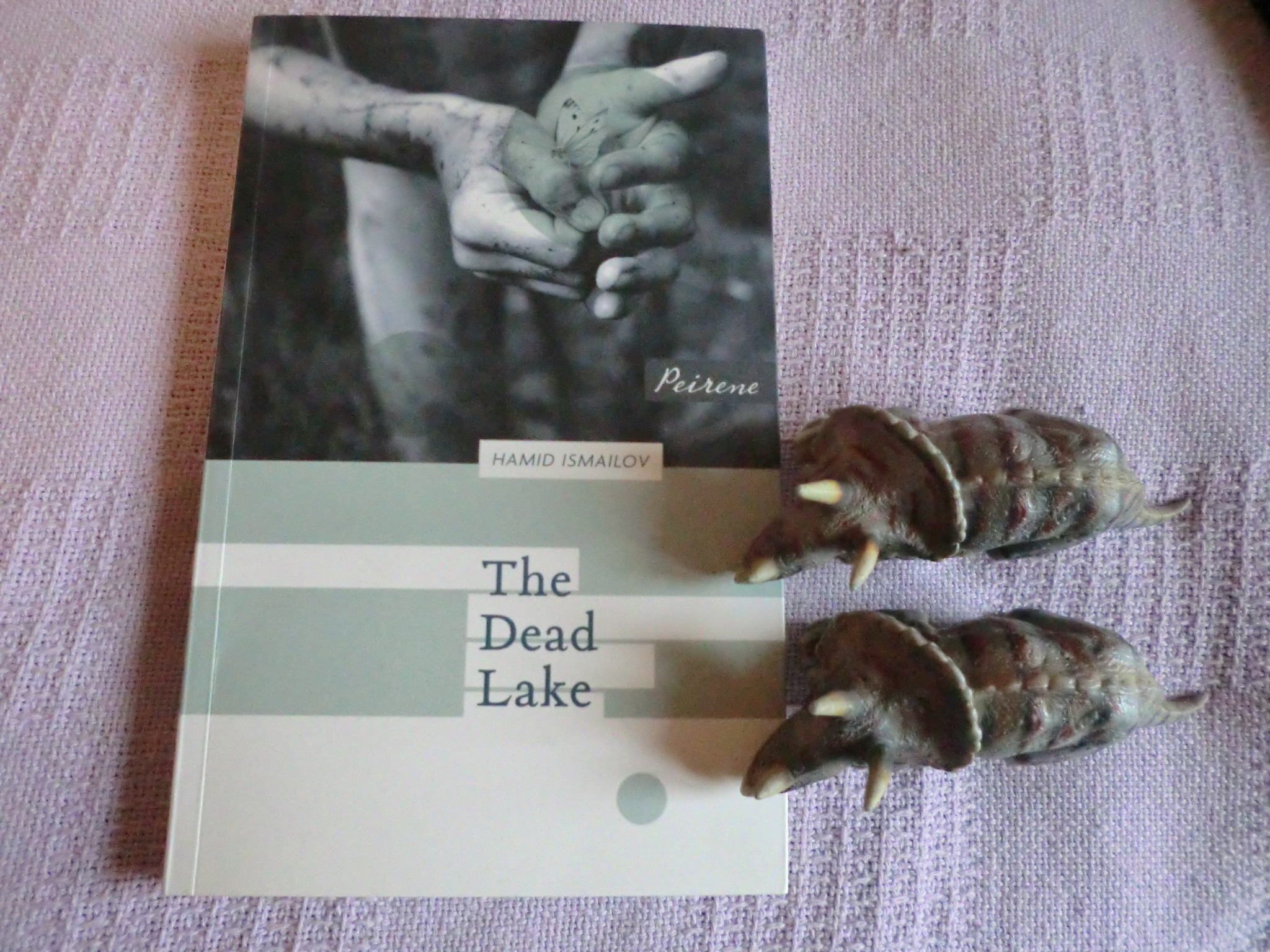
Dead Lake 2An astonishing tale tinged with sadness, as recounted by the protagonist Yerzhan to a stranger on a train journey across the steppes of Soviet Kazakhstan, that in part continues to be imagined by the listener as from time to time, the young narrator sleeps.

The story begins when the boy enters the carriage playing Brahms on his violin in a manner that causes everyone to stop and look at him, not believing it possible that a boy who looks about ten to twelve-years-old could play to such perfection and with such awe-inspiring panache.

“Then, just as he had the entire carriage gaping after him open-mouthed, he broke off in mid-note. He slung the violin back over his shoulder like a rifle.

‘Wholesome local beverage – entirely organic!’ he exclaimed in a thick, adult voice. He swung a canvas sack down off his other shoulder and pulled out an immense plastic bottle of a yoghurt drink, either ayran or kumis. I approached him, without even knowing why.”

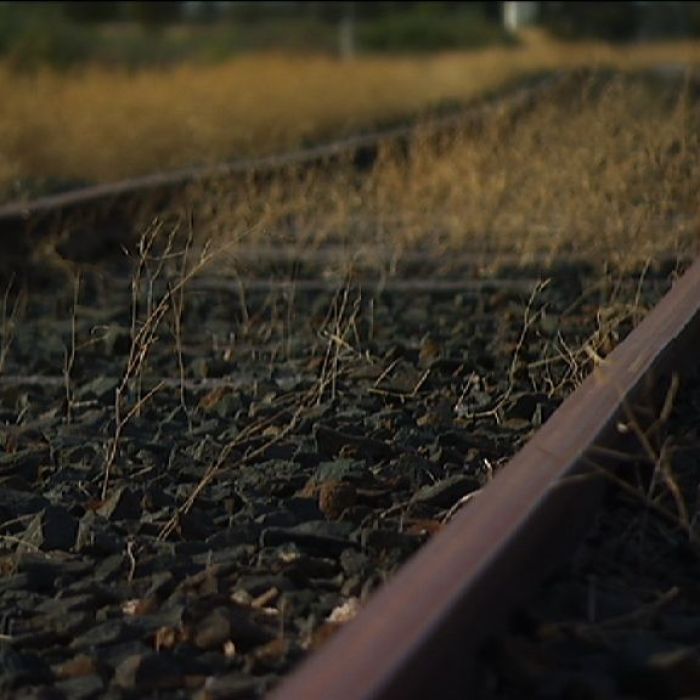
train trackYerzhan grows up at a remote railway siding in a part of the country where atomic weapons are tested. Two families live near each other, their lives more intertwined than appears on the surface.

Yerzhan and the neighbour’s daughter Aisulu travel many miles by donkey to go to school and many more miles to see the strange but talented bachelor, Petko, a Bulgarian violin teacher.

Every so often the ground shakes, another sun rises and everything is still. Then there is the Zone, that area where it is so silent, his ears ring.

“And the thing that loomed over him like a visceral fear could happen in the middle of the sweltering summer, when sheep suddenly started bleating as if they were under the knife and went dashing in all directions, cows dug their horns into the ground and the donkey squealed and rolled around in the dust…

And a slight rumble would run through the ground, Yerzhan’s legs would start trembling, and then his whole body, and the fear would rise up from his shaking knees to his stomach and freeze there in a heavy ache, until the sky cracked over his head and shattered into pieces, crushing him completely, reducing him to dust, to sand, to scraps of grass and wool. And the black whirlwind hurtled past above him with a wild howl.”

A young boy playing the dombra

A boy plays the dombra

His friend Aisulu’s Granny tells him a story of his conception and birth, intertwined with local legend; not knowing who his father is, he often replays the story in his mind, trying to understand it, and who he is.

“Granny Ulbarsyn’s story  wasn’t the only thing that had sunk deep into Yerzhan’s heart.  Grandad’s dombra playing stayed with him too. When no one was looking the boy took the instrument down from its nail high up on the wall. And while his grandfather tapped with the hammer on railway carriages, Yerzhan strummed the dombra secretly, imitating the old man’s knitted brows and hoarse voice. It didn’t take long before he picked out a few familiar melodies and then, with the keen eye he used to keep watch on Uncle Kapek’s behaviour, he followed and memorised  his granddad’s finger movements.”

Dead LakeYerzhan learns the dombra and violin and is bright, but the real light in his life is Aisulu, a light that gradually fades upon his reaching the age of 12, when he walks into the forbidden, radioactive Dead Lake to impress her and from that day on stops growing, destined to watch her pass him by.

“Other people noticed it too and wanted to help. Granny Ulbarsyn fed him with the livers of new born spring lambs, Grandad Daulet ordered carrots from the city through his  friend Tolegen,  and Uncle Shaken brought disgusting fish oil back from his shift. But that only produced a foul-smelling burp! Yerzhan ate it all. But he had stopped growing.”

Another of Peirene Press’s excellent novella’s, this really is an afternoon read, but so rich in the telling, it is a pleasure to go back and reread passages with the familiarity of having read the story. It is a tale tinged with  inevitable sadness as people live with the invisible terrors that are an environmental legacy of the Cold War.

If you want to read more contemporary European literature outside the English language, you can do no better than take out a fabulous subscription with Peirene Press. Three novellas a year and the kind you’ll rarely find in most bookshops.

Note: The author Hamid Ismailov was born in Kyrgyzstan and moved to Uzbekistan as a young man. He writes in both Russian and Uzbek and his novels have been translated into many European languages. Sadly his work is banned in Uzbekistan today and he has had to flee the country due to his ‘unacceptable democratic tendencies’.

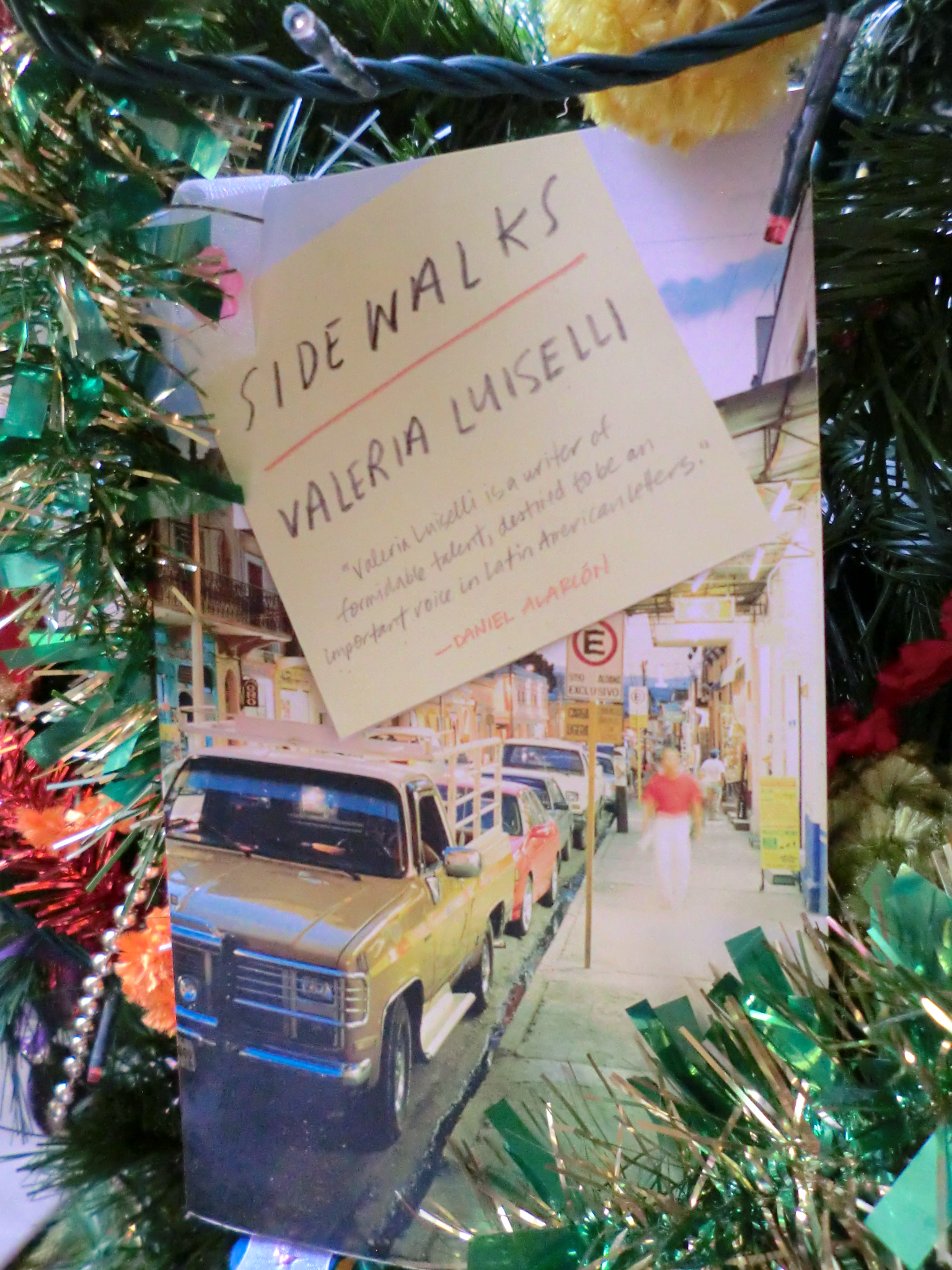
Sidewalks – Essays by Valeria Luiselli translated by Christina MacSweeney

SidewalksValeria Luiselli is a philosophical meanderer whose roving thoughts bring her to a cemetery in Venice in search of Russian poet,  Joesph Brodsky’s tomb and wandering that alluring city’s streets so late at night she is locked out of the one room she managed to find in a convent.

She ponders the map with the slow-moving icon of a plane on the screen as she flies home and thinks about the layout of the land beneath and later will find a connection between a photo of cartographers in the Mexican Map Library and  Rembrandt’s The Anatomy Lesson of Dr. Nicolaes Tulp.

Sidewalks sees her leaving the four walls of her apartment late at night for a last cigarette outside the front door, seeking escape and encountering the advice and wisdom of a doorman who shares his own long life views on how one best comes to know thyself.

“If there still exists a gaze blessed with liminal wisdom, it is the gaze of night-shift doormen. They are the only true free-thinkers – generous men capable of conversing intelligently at midnight; empathetic accomplices, offering the consolation of a companionship replete with the same reprehensible vices you yourself have and defend.”

She laments the age of the individual computer, the window inside the window that has all but eliminated household drama and made high-rise voyeurism unexciting if not nonexistent.

“It is clear that the personal computer is the great modern attack on good old-fashioned voyeurism. From the moment these machines were installed in our homes, the irreversible process of the degeneration of character began and ruled out the possibility of anyone doing anything interesting for the delight of their voyeuristic neighbour.”

Papelos

Original Spanish version

She is interested in spaces, voids, the edge of things, she tries to make sense of her home town in Mexico, a city whose first plan was allegedly scratched into sand and has continued to sprawl out of any recognisable or logical shape ever since.

Her essays reference other essayists as things she observes in her meandering bring back lines once read and remembered, passages of long dead authors become an old-fashioned, enjoyable distraction for a young woman, those words from the past arising unbidden while out walking sidewalks, no electronic media in sight.

In an essay on the river Spree, in Berlin, Fabio Morabito writes:

“A river tends to contain the city it crosses and to curb its ambitions, reminding it of its face; without a river, that is, without a face, a city is abandoned to itself and can become, like Mexico city, a blot.”

It is a slim volume and many of the essays are split into titled paragraphs, the first essay littered with the names and dates of the dead inhabiting the same resting place as Brodsky, although it wasn’t clear to me whether there was a link between the content and the named.

It feels as though there could well be much more to this collection than is picked up on first reading, especially given the original work was written in Spanish and many of the named places are foreign.

Intelligent, introspective essays that delight in being out and about and an appreciative and noteworthy introduction by the Dutch author and translator Cees Nooteboom. An author to watch out for.

Brodsky Luiselli

Joseph Brodsky & Valeria Luiselli


Those Who Leave and Those Who Stay by Elena Ferrante tr. Ann Goldstein #FerranteFever

Those Who StayThis is the third book in Elena Ferrante’s Neapolitan tetralogy about two friends Elena and Lila, growing up in an impoverished neighbourhood of Naples.

It follows on from Book One, My Brilliant Friend and Book Two, The Story of a New Name (click on the titles to read earlier reviews).

Lila has married, had a child, reformed her husband’s business, strayed and finally separated from her husband and moved to another area outside the neighbourhood to live with Enzo, a childhood friend. She gets a job in a sausage factory, working under oppressive conditions that attract the interest of social activists and harsh threats from the ‘fascists’.

“Can you imagine what it means to go in and out of refrigerated rooms at twenty degrees below zero, and get ten lire more an hour – ten lire – for cold compensation? If you imagine this, what do you think you can learn from people who are forced to live like that?”

In Pisa, Elena has remoulded herself, no longer referring or comparing herself to Lila. She observes how people from her type of neighbourhood and class are perceived outside it, among the bourgeois, those raised within the milieu of intellectuals and achievers, those with access to money, social connections, many of whom are gifted with a presence she can only dream of. Elena finishes her university studies and becomes engaged to Pietro, who was raised within that other world; coming from a well-known academic family, he too will become a university professor, teaching and writing academic works like his father.

As she is concluding her studies, Elena writes a fictional story drawn from aspects of her past, though never admitting it is anything but fiction. She gifts the story to Pietro on an impulse, hoping he will read it. He passes the manuscript to his well-connected mother Adele, thus Elena treads the path laid in front of her, towards becoming an author. Adele introduces her to contacts that will result in her first book being published, establishing her career as a writer.

“I spoke of the necessity of recounting frankly every human experience, including – I said emphatically – what seems unsayable and what we do not speak of even to ourselves.”

Though Elena does her best to avoid it, Pietro finally meets her family and though he insists on a civil ceremony for their marriage, a decision that stuns and terribly disappoints her mother, he wishes to do the traditional thing by asking her father for her hand. Her father is calm and accepting, however her mother’s thoughts insist on an airing and she lectures the young professor unabashedly.

  “When at last she was silent, he said that he knew very well how precious I was and that he was grateful to her for having brought me up as I was.”

Through marriage, Elena succeeds in elevating herself above her roots, though finds herself stranded in not quite belonging to either her future role or her past. They are like roles she assumes outside herself, taking care not to stand out when she returns to the neighbourhood and paying attention to how she should behave in her new role as the wife of a professor.

“As soon as I got off the train, I moved cautiously in the places where I had grown up, always careful to speak in dialect, as if to indicate I am one of yours, don’t hurt me.”

However, marrying the young professor, writing the story that turns into a successful novel, moving to Florence and becoming a mother leave her little time to play any other role than that of housewife.

Lila leaves the neighbourhood, escaping her marriage and taking on a job in a sausage factory owned by a friend of Nino Sarratore, whom the girls met one summer. Her job leaves her little time to spend with her son. Unwillingly, she becomes connected with worker’s rights activists and discovers the dirty arm of the neighbourhood loan sharks who are leaning on her employer, while continuing to try to lure her back into their realm.

Lila and Elena’s worlds drift further apart and although they are aware of the need to share with the other, they each possess the instinct to soldier on without admitting their struggle or need for support or encouragement. Elena will receive both her mother-in-law and her mother at different times so that she can write and Lila will return to the neighbourhood to ease her difficulties. Both have opportunities within their reach, yet both are susceptible to self-destruction.

“Too many bad things, and some terrible, had happened over the years, and to regain our old intimacy we would have had to speak our secret thoughts, but I didn’t have the strength to find the words and she, who perhaps had the strength didn’t have the desire, didn’t see the use.”

Those Who Leave and Those Who Stay is a compelling story of the lives of two women and those around them, and a penetrative observation on the creation and consequence of decisions women make, how they live with those decisions and the often destructive way they bring about change. It narrates a journey of moving away from one’s origins and the sacrifice the attainment of that desire requires.

Elena leaves her past and a life she didn’t want, behind her, however in attaining a new life, she loses sight of who she really is and what drives her. She is just coming to the point of realising that when her world spins out of control. And thankfully for us all the fourth book is being translated. I expect the wheel may come full circle.

Italian Screenwriter Francesco Piccolo

Italian Screenwriter Francesco Piccolo

Note:  It has been announced that My Brilliant Friend will be made into a television series in Italy. The author/screenwriter Francesco Piccolo, winner of the esteemed Italian literary Strega Prize 2014 (with his bittersweet memoir of life on the Italian Left, ‘Il desiderio di essere come tutti’ (The Desire To Be Like Everyone) will work on the screenplay.

Next Book in the Series: The Story of the Lost Child

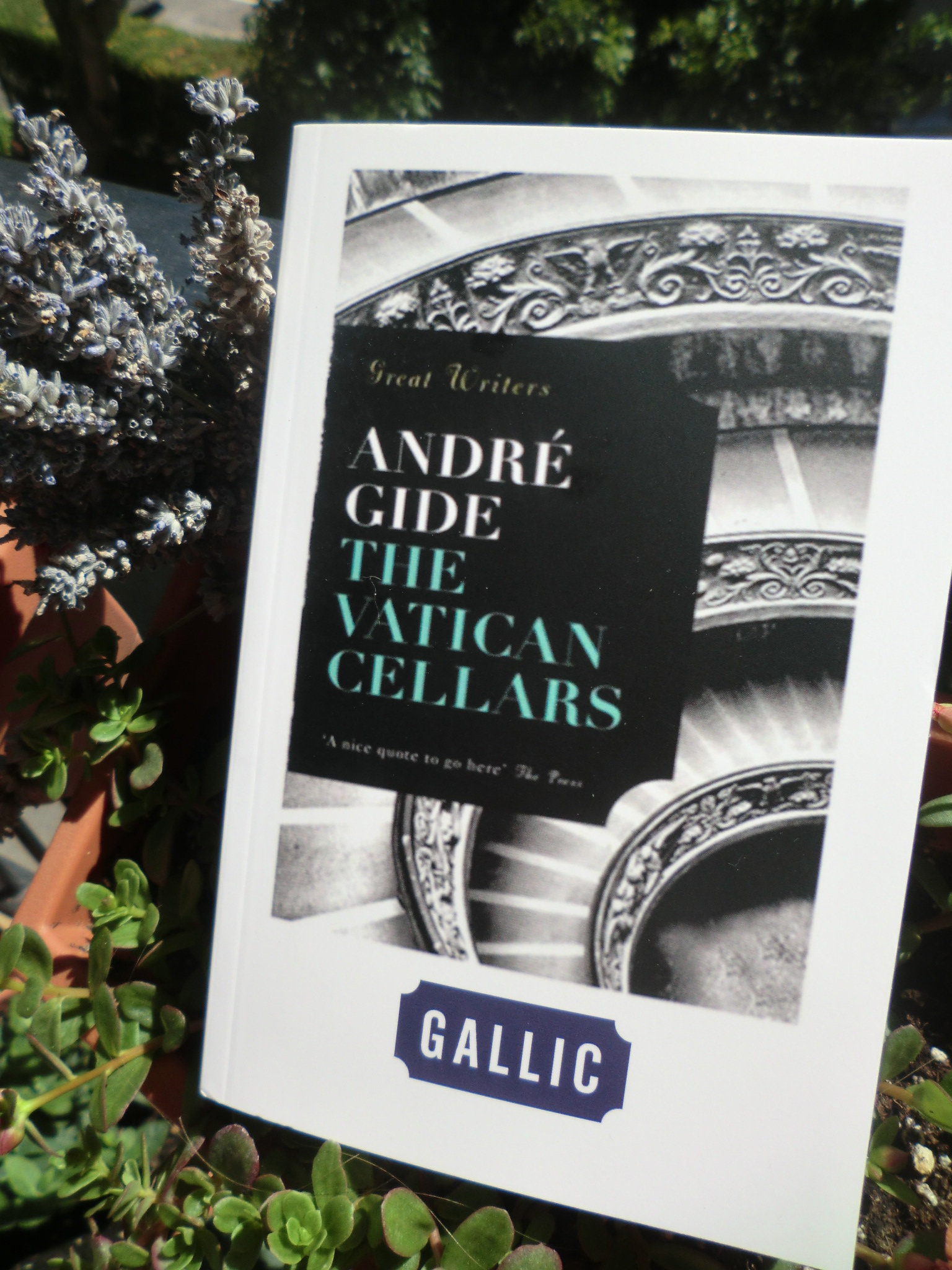
“All Paths Lead to Rome” – The Vatican Cellars by André Gide tr. by Julian Evans

Vatican CellarsOriginally published in the summer of 1914, this year is the 100th anniversary of André Gide’s Les Caves du Vatican otherwise known as The Vatican Cellars and sometimes as Lafcadio’s Adventures in English.

André Gide had quite a reputation and was adored and detested in equal measure in the French literary community during his time. He was a provocative writer, not sensationalist by today’s standards, but he rocked the foundations of robust entities in the early 1900’s and tested some of his friendships with his provocative, satirical works, that challenged the solemnity of the novelistic form and bourgeois attitudes of the time.

He declared the book not to be a novel, but a sotie, a medieval farce in which the players freely mock the powers that be, more often than not, the Church.

“Even in the authentic soties of the Middle Ages there was the attempt to demonstrate the madness of the real world by showing it capsized and lead by fools.” Wallace Fowlie, Andre Gide: His Life and Art

He did this to stand apart from that tradition of European fiction, characterised by its extreme seriousness. Many chose to judge it at face value, or to apply an interpretation that wasn’t his own and cause him to be ostracized by some.

A Young Gide Source: Center for Gidean Studies andregide.org

A Young Gide
Source: Center for Gidean Studies
andregide.org

He wasn’t looking for recognition or accolades, but he was a writer who wasn’t afraid to take on a subject and look at it through a symbolic, metaphorical lens even if it did court contempt in some quarters. Though still highly controversial in France, he was awarded the Nobel Prize in Literature in 1947, he died in 1951 and a year later his works were placed on the Vatican’s list of banned books.

That act was certainly provocative and no doubt helped to heighten the author’s popularity as negative publicity tends to do. So when this book arrived unsolicited in my mailbox, I was curious to find out more, not just about the story, but André Gide, a writer previously unknown to me. In a strange coincidence, this week I see that Papal controversy – or is it just rumour, continue, when I read this headline in The Independent.

God isn’t a magician with a magic wand according to the pope and there are non-believing vicars 

The basic premise of The Vatican Cellars centres around the members of one family, whose connections are slowly revealed, whether by blood or marriage, the first three books (more like parts as the book is only 300 pages) are portrayed from each of the main characters point of view and running throughout the narrative is the effect of a rumoured plot that a gang has kidnapped the Pope and placed him in the Vatican cellars, an imposter installed in his place. The fourth book introduces us to the gang, referred to as The Millipede and the final book is dedicated to the young man Lafcadio and brings all the characters to Rome.

Book One introduces us to Anthime Armand-Dubois, a crippled freemason devoted to scientific research, an atheist who leaves France to settle in Rome to be near a specialist in rheumatic diseases. His departure causes his brother-in-law Julius De Baraglioul great sorrow and his wife Véronique small joy.

“As one of those people who fill their flat disappointed lives with countless small devotions, in her sterility she offered up to the Lord every attention that a baby would have demanded from her. Sadly she entertained almost no hope of leading her Anthime back to Him. She had known for a long time how much stubbornness that broad brow, knitted in perpetual denial, was capable of. Father Flons had warned her.”

Julius, his wife (Véronique’s sister) and their 9-year-old daughter Julie visit, during which Anthime experiences an apparition of the Virgin Mary and the miraculous healing of his affliction. He converts, but loses his freemason and lucrative research contacts and must move to Milan to await compensation promised by the Vatican.

André Gide Source: Centre for Gidean Studies andregide.org

André Gide
Source: Centre for Gidean Studies
andregide.org

Book Two is Julius De Baraglioul, a novelist who arriving back in Paris receives a letter from his father, who is on his deathbed and wishes him to anonymously make the acquaintance of a certain Lafcadio Wluiki to check out his ambitions and character. Julius visits the Lafcadio’s lodgings, meets Carola Venitequa and snoops around his things reading a private notebook since the room is unlocked and uninhabited. He eventually meets him and gives him a copy of his latest novel, one that has been panned by critics. Recognising the book is based on the author’s father, Lafcadio eyes the dying man as a potential new “Uncle” and goes to see him.

In Book Three we meet Amédée Fleurissoire, debated by some to be the true hero of this story; within these pages the entire plot to kidnap the Pope is unveiled. A priest calls on the widow Countess de Guy de Saint-Prix, Julius’s younger sister just after her return from her father’s funeral in Paris and regales her with the extraordinary tale of the Pope’s demise. And here there is an author interjection, a sidestep of the story plot to tell of the factual plot, as the story was inspired by real events that occurred in 1893 by a gang of fraudsters, taking advantage of the Pope’s sympathies toward the French Revolution.

“Whether God’s representative on earth could have been abducted from the Holy See and, by the intervention of the Quirinal, stolen from all of Christendom as it were, is an excessively thorny problem which I do not have the temerity to raise in these pages. But it is a historical fact that, around the end of 1893, rumours were circulating to that effect. It goes without saying that numerous devoted souls became deeply agitated. A pamphlet on the subject appeared in Saint-Malo and was suppressed. …There is no doubt that countless pious souls made financial sacrifices, but it was dubious whether all those who received donations were genuine campaigners, or whether some were perhaps fraudsters.”

The priest wishes the Countess to make a significant donation, so she rushes off to see Madame Fleurissoire, the younger sister of Véronique and Marguerite and wife of our genuine hero Monsieur Amédée Fleurissoire. Hearing about all the fuss Fleurissoire decides he must leave Pau and travel to Rome himself to see what can be done.

Book Four is The Millipede (the centipede) which continues to follow the travels of Amédée, the presence of the gang undetected. He is intercepted at the station and brought to slovenly rooms, where we again meet Carola and he is taken on a bit of a wild goose chase to Naples and back, bumping into Julius who has also appeared in Rome.

Then Book Five brings us back to Lafcadio, raised by his mother and five uncles, across different European countries, he is at home everywhere, but belongs nowhere. After his encounter with Julius’s dying father, he too decides to take the train south, but he is heading for adventure, his destination Borneo. He is the anti-hero, the free spirit, parentless, he lives without obligation or restraint, he can do as he pleases, provided he has the means. His charm takes care of that.

And what happens when they all find themselves in Rome? For that you’ll need to read the book.

As the literary critic Albert Guerard said:

“Perhaps only the maligned casual reader sees that les Caves du Vatican is above all a very funny book.”

It is a book that Gide had in the back of his mind for 20 years before writing it and many of the scenes were inspired from aspects of his own life or those close to him. For example, Anthime’s conversion is said to be based on Emile Zola’s Freemason cousin, who abjured his atheism in a public ceremony at a church in Rome.

The Vatican Cellars is an entertaining, easy read and can be intellectually stimulating if you are interested to analyse it further. I enjoyed it very much and all the more for having read around it, dipping into some of the published literary essays to understand the intentions of the author and the responses of the critics.

He was a humble author with a fascinating intellect who refused to accept literary prizes and acknowledgement at home, until it came to the Nobel, which he felt would have gone to Paul Valéry, if not for his untimely death and accepted it without reserve, though he was too ill to receive it in person.

In an open letter to several leading Swedish newspapers which had sought interviews, Gide confessed that he had received the Nobel Prize:

“with deep emotion, with tears in my eyes, like a schoolboy who has won a prize.”

I leave you with this very funny anecdote that I picked up from an essay by the critic George D.Painter.

“On 7 January 1930 Gide was returning by train from Toulon to Paris with Jacques de Lacretelle. At the opposite table, which was covered with flowers, sat a honeymoon couple, the husband engrossed in The Vatican Swindle. It was the first time Gide had ever seen a stranger reading himself. ‘Here’s your chance,’ said Lacretelle, ‘Tell him who you are – write him a dedication!’ But to do this, Gide would have had to feel sure that the unknown liked the book. Suddenly the young man pulled out a penknife. Good heavens, was he about, like Lafcadio, to plunge it in his thigh? But no, worse still, he seemed to intend to cut the book itself in pieces, and Lacretelle was seized with a fou rire. With great care the bridegroom cut the threads of the binding, detached the part he had read, handed it to his young wife; and both buried themselves in their reading.”

train reading

Note: Thank you most kindly to Gallic Books for sending me a copy of the book.

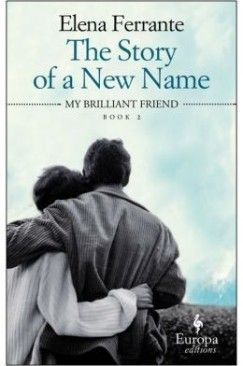
The Story of a New Name by Elena Ferrante tr. By Ann Goldstein … Neapolitan Tetralogy Book 2

The Story of a New NameThe second in the tetralogy of books about two friends Elena and Lila, growing up in an impoverished neighbourhood of Naples. The first book My Brilliant Friend I reviewed here.

Both girls were bright students in primary school, and perhaps because the story is narrated from Elena’s perspective she often sees herself in the shadow of her friend Lila, as if she must strive to attain her success, while Lila’s comes more naturally.

Lila fights to elevate herself, suggesting Elena studies with her to help her friend, thereby attaining the knowledge herself and through imposing her will on her husband, her family and business associates, who need her input and influence which she uses to both help them and to ensure her often rebellious stance is understood by them all.

It is Elena who despite her family circumstances progresses through high school and at the suggestion of a teacher applies to a university in Pisa where she can continue her studies.

Lila whose beauty and bravado bring her more to the attention of local boys wanting to move themselves up in the world financially, becomes entangled in their schemes and part of their negotiations and is married at sixteen to Stefano the grocer, partly in order to avoid the attention of the Solara brothers.

“How difficult it was to find one’s way, how difficult it was not to violate any of the incredibly detailed male regulations.”

Through her personal notebooks that she entrusts to Elena for safekeeping and Elena’s inability to withhold from the temptation of what they offer, we too as readers understand more from within the bounds of Lila’s marriage and life than we might otherwise from the limited perspective of her friend, particularly during the frequent periods where the friendship was being tested and therefore withheld.

Though unwilling to be trapped inside marriage, Elena does envy her friend the space and luxury her new status as Signora Raffaella Carracci has given her and when Lila’s husband suggests a summer holiday on doctor’s orders to increase her chances of conceiving a child, Lila’s insistence that her friend accompany becomes Elena’s excuse to find a way to be in close proximity to Nino Sarratore, the brilliant student she has had a crush on for years. His arrival becomes a turning point in their lives, though not the outcome either of them were wishing for.

Pisa NormaleElena distances herself from Lila and from her family and moves to Pisa, where initially she struggles to brush off the ways of her neighbourhood, her origin, her accent, things that make it obvious to others she is not one of them. She throws herself into her studies and into becoming more like her contemporaries; a new boyfriend aids her transition.

“That day, instead, I saw clearly the mothers of the old neighbourhood. They were nervous, they were acquiescent. They were silent, with tight lips and stooping shoulders, or they yelled terrible insults at the children who harassed them….

They had been consumed by the bodies of husbands, fathers, brothers, whom they ultimately came to resemble, because of their labours or the arrival of old age, of illness. When did that transformation begin? With housework? With pregnancies? With beatings? Would Lila be misshapen like Nunzia?…

And would my body too, one day be ruined by the emergence of not only my mother’s body, but my father’s? And would all that I was learning at school dissolve, would the neighbourhood prevail again, the cadences, the manners, everything be confounded in a black mire,…”

Leaving Naples allows Elena to begin to reform herself, to blend in, the novel highlights the tension between the Neapolitan dialect spoken in her neighbourhood and the correct Italian spoken by the professional, educated classes. Dialect is associated with aggression, insults and anger, with all the negative emotions and difficult challenges of a repressed community, while the Italian symbolises upward mobility and refinement.

Napoletana“Be careful where all this studying leads, Lenu. Remember who you are and which side you’re on.”

I found Book 2 just as engaging as Book 1, more than just narrating the events that mould the two girls’ lives is the underlying philosophical question of whether one can rise above one’s origins via the attainment of significant wealth or education. Elena and Lila represent these twin avenues, in their attempt to escape their origins.

The novel continues to focus on the friendship of the two girls and their connections with others, both those from within their sphere and those they encounter outside, a measure of how far they have progressed in their aim to rise up and out of the confines of the neighbourhood.

The narrative is less dramatic than it might be by some of the omissions. Elena doesn’t recount much of her own dialogue with her boyfriends and much of the story is narrated or told, rather than putting the reader in the midst of the events as if to experience them. It is the psychological and philosophical elements of the placement of the two women in these situations that lend themselves a kind of accepted inevitability, we won’t be shocked by anything that happens, knowing their backgrounds, it is the lure of that question of whether either of them can or will escape their fate that entices us to read on.

Next Book in the Series: Those Who Leave and Those Who Stay (click title to read review)