
 Nothing Holds Back the Night is the book Delphine de Vigan avoided writing until she could no longer resist its call. It is a book about her mother Lucile, who she introduces to us on the first page as she enters her apartment and discovers her sleeping, the long, cold, hard sleep of death. Her mother was 61-years-old.
De Vigan collects old documents, stored boxes, talks to members of her family, the many Aunts and Uncles and creates a snapshot of Lucile’s childhood, a large family of nine children living in Paris and then Versailles, holidaying at a ramshackle country house Pierremont, where they would all come together for summers throughout childhood and for many years to come.
Part One strings together the many anecdotes of memories of her mother’s past, and even in their telling, though the purpose is to reveal Lucile’s childhood, she is like a shadow, the one voice that is missing, whose presence is inferred but rarely at the forefront of the drama. She is a beautiful middle child, her beauty quickly capitalised on by her parents, who turn her into a pliable child model.
Her reticence and fear of being alone, is visible when their parents announce they are going to London for a weekend, leaving the children alone to take care of themselves:
Lucile greeted the news like the announcement of an imminent earthquake. A whole weekend! That seemed to her like an eternity, and the idea that a serious accident might happen when Liane and Georges were away made her breathless. For several minutes, Lucile stared into space, absorbed by the horrible visions she could not banish – shocks, falls, burns affecting each of her brothers and sisters in turn, and then she saw herself slip under a metro train. Suddenly she realised how vulnerable they were, how their lives ultimately might hang by a thread, turn on a careless step, one second more or one second less. Anything – especially something bad – could happen. The apartment, the street, the city contained an infinite number of dangers, of possible accidents, of irreparable dramas. Liane and Georges had no right to do this. She felt the tears run down her cheeks and took a step back to hide behind Lisbeth, who was listening attentively to her father.
Though Lucile isn’t given a voice (unless the author imagines it) in the section about her family and upbringing, the events depicted show her reactions and create a vision of the fragile woman she would become; lost, finding it difficult to cope alone, struggling to raise two daughters when she could barely take care of her own needs.
De Vigan goes through the family history, though only one generation, she isn’t as interested in inter-generational patterns, she searches the near past for clues:
The fact is that they run all the way through families like pitiless curses, leaving imprints which resist time and denial.
She asks what happened, what caused the turning point, the change in a family that appeared to be happy and thriving, that then was subject to trauma, cracks in its foundation, broken parts.
And so I asked her brothers and sisters to talk to me about her, to tell their stories I recorded them, along with others, who had known Lucile and our joyful but ravaged family.
She is particular about who she interviews, deciding early on not to speak to any of the men who temporarily came into her mother’s life, including her father. It’s as if she wishes to remove the possibility of judgement, by those who saw something of the effect on a life and not the life in its entirety.
This is her mother’s story and the daughter is fiercely protective, while being very open and honest about what she and her sister experienced. She is also an experienced investigative journalist and is practised in presenting her findings to meet a preconceived aim. She doesn’t wish to harm the family and yet she wants to present a truth, exorcise certain demons that keep her awake at night. Thus the first part reads a little like a novel as she immerses herself into the characters and lives she wishes to portray bringing them alive by imagining their thoughts and dialogue.
A daughter arrives part way through a mother’s life and so she goes back to fill in the gaps, to see her as a child, a sister, a daughter and for the rest, she narrates her story, as the daughter of this fragile woman, whose early life contributed to a deterioration in her mental health, who struggled to continue regardless, even though part of her yearned for an escape. Part Two therefore reads more like a memoir as she no longer has to step into the shoes of others and imagine a time when she wasn’t there, from now on she selectively recalls her own experience and that of her sister.
De Vigan shows her mother’s perseverance alongside her inability to cope, her periods of stability alongside events that trigger her periods of instability, her creativity alongside the terrible hallucinations and paranoia, no one knowing how long either of those states will endure and whether either one will persist.
 I read this book in a day, it’s one of those narratives that once you start you want to continue reading, it’s described as autofiction, a kind of autobiography and fiction, though there is little doubt it is the story of the author’s mother, as she constructs thoughts and dialogue inspired by the information provided by family members, acknowledging that for many of the events, some often have a different memory which she even shares.
Manon and I had become adults, stronger for Lucile’s love, but fragile as a result of having learned too young that life could collapse without warning and that nothing around us was completely stable.
With the end of summer holidays approaching, I was in one of the local French bookshops buying a new French dictionary for my son, when I spotted this next book from Delphine de Vigan and in a moment of spontaneity, decided I would try reading it in French. Not straight away, but watch this space, for a review in English of a novel read in French.
Have you read any of Delphine de Vigan’s works?
Further Reading
Guardian Review – Ursula Le Guin is fascinated by a dark yet luminous memoir that straddles the line between fiction and non-fiction.
New York Times Review – A Mother in Absentia by Nancy Kline
 The impulsive Claudine, thinking a marriage of her own making and choice (not one chosen by her father or suggested by a man who had feelings for her that weren’t reciprocated) embarks on her marital journey which begins with fifteen months of a vagabond life, travelling to the annual opera Festival de Bayreuth, in Germany, to Switzerland and the south of France.
 This living in the past causes her even to forget that she now lives in this new apartment, coming out of her daydream, she readies herself to return home (to her father) only to realise she no longer lives there and ponders where her home really is.
 Their relationship plays itself out, up to the denouement, when Claudine seeking refuge decides to return to Montigny, to the safety of her childhood home, the woods, her animals whose loyalty she is assured of, and the affection of the maid Mélie and her humble, absent-minded father.
 Khushwant Singh takes the Punjabi farming village of Mano Majra, a small village on the border between India and Pakistan, one of strategic importance to the railway system, and narrates the moment when news of this change arrives and shows how it affects this community.
 ‘Why, don’t you people want to be free? Do you want to remain slaves all your lives?
 Donal Ryan is the Irish author many of us remember for his debut
  Into this isolation comes another Traveller, partially rejected by her family and community, whom Melody befriends and becomes attached to, picking up her teaching with Mary, where she left off with Martin. Here’s their encounter when they first meet:
 It is interesting that Donal Ryan chose to highlight characters from within the Irish Traveller community, as 2017 was a significant year in terms of identity for them. There are estimated to be between 29,000 – 40,000 Travellers in Ireland, representing 0.6% of the population. Recent DNA research has proven they are as genetically different from the settled Irish as they are from the Spanish and that this difference may have emerged up to 12 generations ago, as far back as 1657.
 Louise Beech is a unique author who I feel like I have a personal connection with, after the incredible experience of reading her debut novel How To Be Brave in October 2016, which for me included communicating with her as I endured a hellish experience on the 9th floor of Timone Hospital in Marseille. Twitter hashtags truly can bring incredible people into your lives at pivotal moments, both the living and those that have passed on. #LouiseBeech
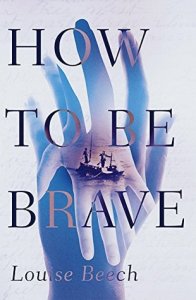 It was also the story of her grandfather who had been lost at sea for over 50 days when he was a young man. Both the diagnosis and the story of the grandfather are true stories, however she used her creativity and imagination to write a novel that blends fact and fiction, taking the reader on an emotionally charged, high sea journey towards healing.
 In chapter two a woman named Bernadette tells us that the book is missing. It is the day she has finally summoned the courage to leave her husband, she’s spent all day preparing and fretting about it, he is a man who values impeccable timing, expecting others to meet his standards, especially his wife Bernadette. She is waiting for him to walk through the door at 6pm like he does every evening before she intends to leave. Only he is late, more than late, he doesn’t come home at all.
 The Complete Claudine by Colette tr. Antonia White (French) – Colette began her writing career with Claudine at School, which catapulted the young author into instant, sensational success. Among the most autobiographical of Colette’s works, these four novels are dominated by the child-woman Claudine, whose strength, humour, and zest for living make her a symbol for the life force.





 Before reading Kamila Shamsie’s Home Fire, I downloaded a translation of Antigone to read, she acknowledges herself that Anne Carson’s translation of Antigone (Oberon Books, 2015) and
  “Stories are a kind of nourishment. We do need them, and the fact that the story of Antigone, a story about a girl who wants to honour the body of her dead brother, and why she does, keeps being told suggests that we do need this story, that it might be one of the ways that we make life and death meaningful, that it might be a way to help us understand life and death, and that there’s something nourishing in it, even though it is full of terrible and difficult things, a very dark story full of sadness.”
 Kamila Shamsie was born in Karachi and now lives in London, a dual citizen of the UK and Pakistan. Her debut novel In The City by the Sea, written while still in college, was shortlisted for the John Llewellyn Rhys Prize in the UK and every novel since then has been highly acclaimed and shortlisted or won a literary prize, in 2013 she was included in the Granta list of 20 best young British writers.
 Loved it, this is my kind of popular summer read, it brought to mind the recent Alaskan classic I read and enjoyed immensely

 I’ve been aware of this novel and reading about it for a long time, watching it come through and finally win the 2017

 Home Fire by Kamila Shamsie (UK-Pakistan) (Bloomsbury) –
  Word by Word