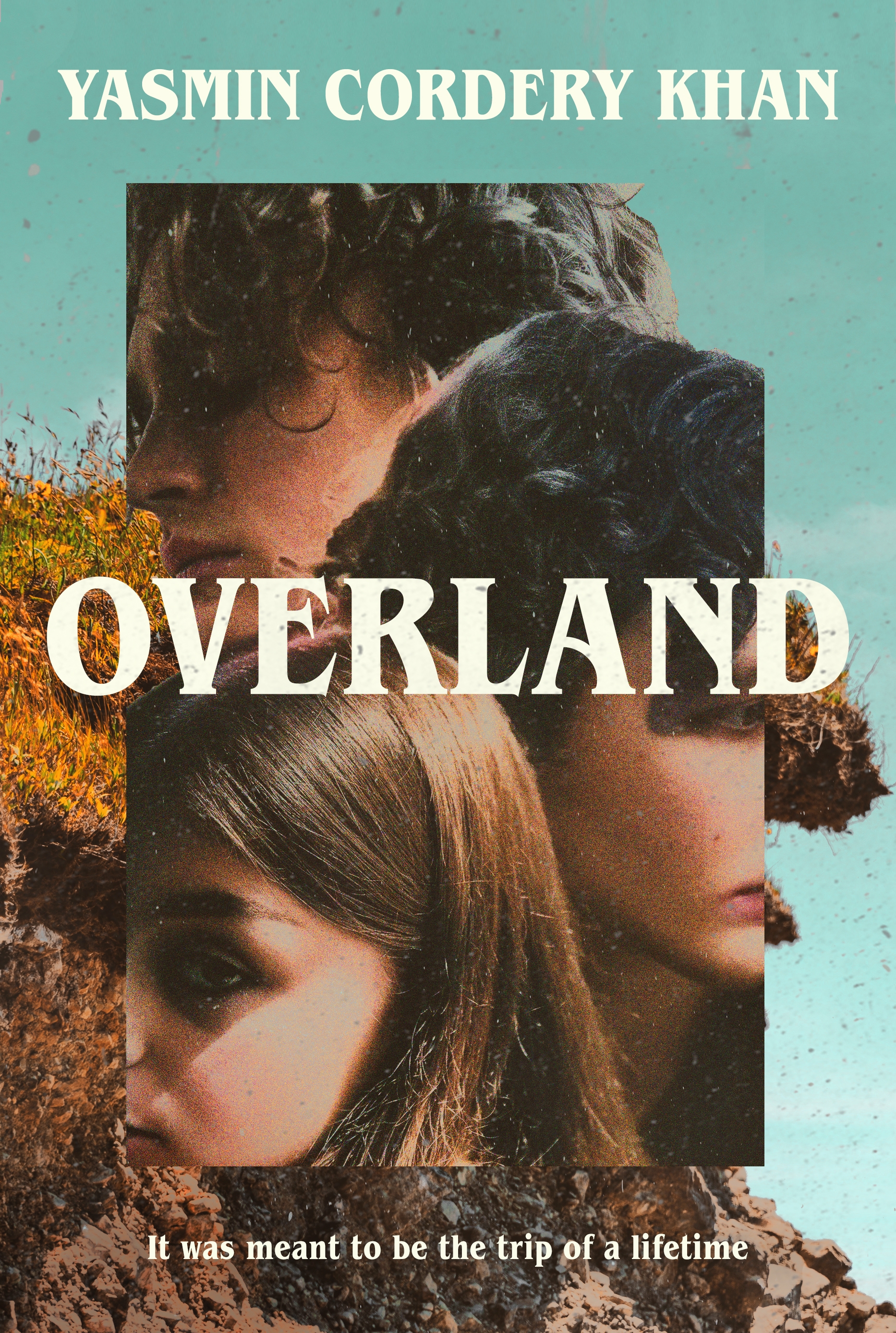
Overland (2024) by Yasmin Cordery Khan

The Overland, the Hippie Trail, the Big OE

I was interested to read this to observe some of this particular overland route that many young people took in the late 1960’s early 1970’s.

While for some it signified the hippie trail, for others, for example, those coming from New Zealand, it was a kind of right of passage, referred to as ‘the Big OE’, the ‘overseas experience’, which that culture accepts is something that every young person might do in their twenties, while still single, and eligible to get a working holiday visa in the UK to help fund their travels.

By the 1990’s when I did my OE, the overland route had changed, it was no longer advisable to take the route that those from the 1970’s had taken. My mini version of the overland, was to spend three months travelling through India, Nepal, Vietman and Thailand.

Employers expected many young in their twenties to leave to take up the two year visa opportunity and gain valuable experience from living in another country and travelling in other cultures. I remember my boss when I told him I was leaving telling me that he learnt more in first couple of weeks travelling in Asia than he had in the previous couple of years in his employment. It did make me wonder what happened in those couple of weeks!

Both of my birth parents travelled a similar route, from different starting points, and reading Overland made me want to know more about their experiences, because they were very different from what I read here.

Both had to find work in foreign countries to fund their travels, and set off on their own, without a vehicle or travelling mate, although as anyone travelling alone soon discovers, it doesn’t take long to connect with other like minded travellers.

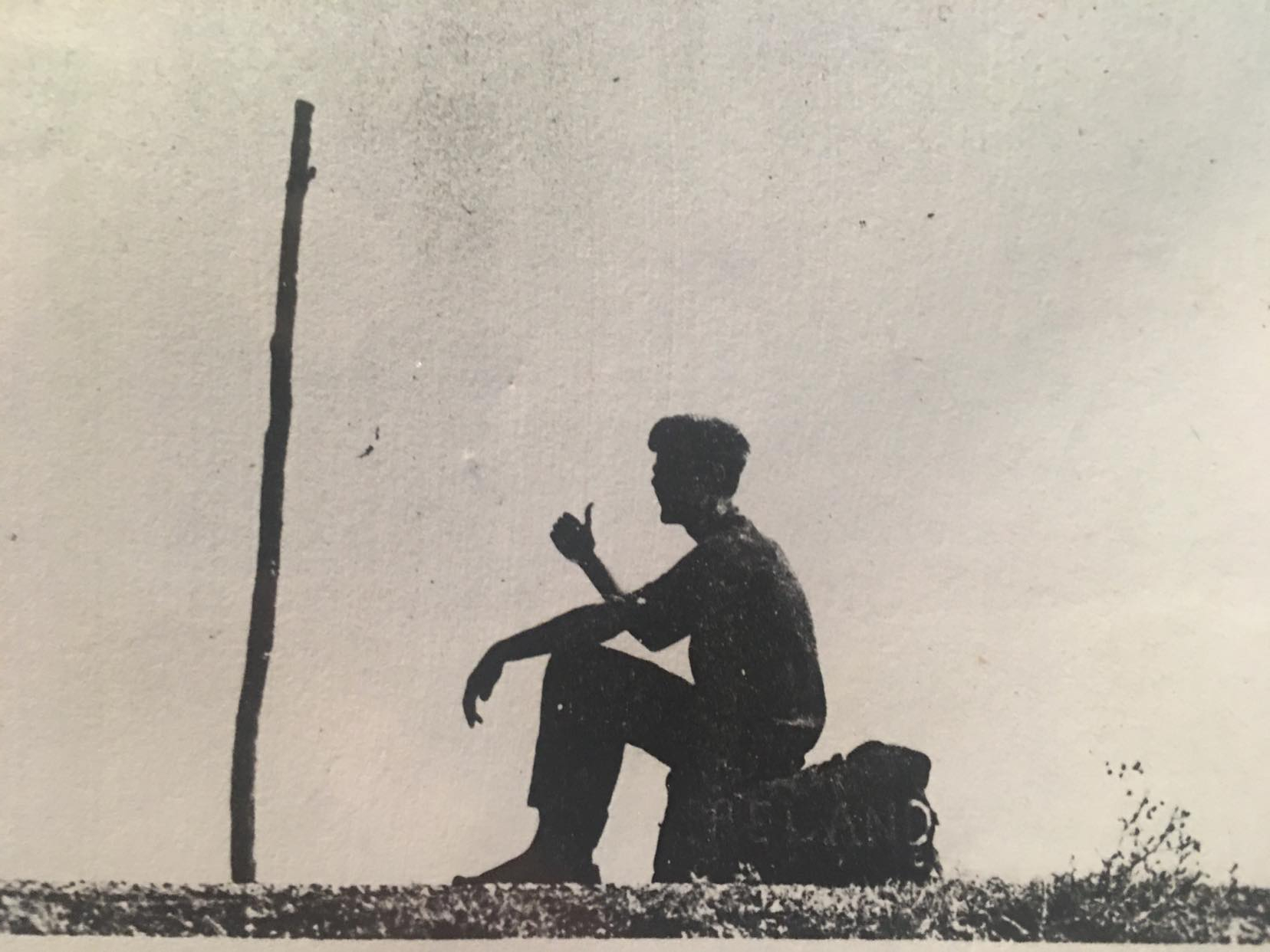
Recently my father found some old photos from that journey he set out on at the age of 18, one of which is depicted above, others show him working on a construction site in Kuwait, interacting with local workers. Not the same route followed as this overland novel depicts, much more of an intrepid journey.

Young Brits Abroad in a Land Rover

Three youth did an overland trip and on the first page of the novel, Joyce, who describes herself as a nobody, is looking back fifty years later after an otherwise uneventful life, recollecting the trip. There had been scandal and controversy at the time of their voyage and she had slipped under the radar. A recent visit to a car boot sale in the grounds of an old country house has awakened memories and now she is reliving the trip.

I saw Persia in the time of the Shah, and the sun set over Kabul and the sun rise at Taj Mahal. I was there too and this is my story.

Overland thus begins with an advertisement in a London newspaper in 1970.

Kathmandu by van, leave August

Share petrol and costs.

Joyce is just out of secretarial college and comes across the ad because she likes reading the miscellaneous section of the newspaper. She goes to Clapham to meet the two boys who are taking the Land Rover on the trip. Friends from boarding school Fred, whose aristocratic family own the vehicle, and Anton, son of an Egyptian Doctor and English mother, who has been supported by Fred’s family since a family tragedy.

From London to South Asia via Istanbul, Turkey, to Tehran, Iran to Kabul, Afghanistan to Pakistan, India, Nepal, Sri Lanka, Bangladesh to Thailand

The Aristocrat, The Son of an Immigrant, A Working Class Girl

It becomes clear that the three travellers are from different socio-economic backgrounds and being confined to a vehicle for a trip through foreign lands is going to bring out aspects of what each of them is either escaping or moving towards. When Anton asks Joyce why she wants to go, she can tell he’s looking for an intellectual response and sceptical of her motives. Reasons she keeps to herself (and from the reader) for a long while.

First impression: arrogant little twit. My face was burning with embarrassment at having been corrected, but he didn’t seem to notice. I might not have all your certificates, but I know about real life, I thought.

There’s No Place Like Home

The three of them go on the journey and have to overcome various challenges they confront in each country, whether cultural, mechanical or human. Over time their characters and back stories are revealed and in Fred’s case his father’s dark history, in one of the countries they will travel to. All of this plays into how they cope with the situations they encounter. And they come to consider their own destiny.

In a nutshell, if I could have articulated it, I’d have said that England was my destiny. Because by that point – although I liked those landscapes and those wild places that we drove through, don’t get me wrong – a realisation was growing in me, more and more, about the sheer beauty of the English countryside.

They will discover the consequences of acting or not acting on their instincts, who they can trust, who they should avoid and what to do when one of them starts experimenting in ways that threaten to derail them from their objective.

“We were all on pretty much the same route, there were only so many digs to stay in. So even though we were crossing the world, there was a small world on the overland, its own little bubble, the same faces and names and rumours recirculated and resurfaced.”

The Memory Trip

I enjoyed the novel for the way it depicted the journey and the places they stopped, mostly unfamiliar until they get to India, then it awakened my own overland journey, particularly the memory of taking the local night buses, with 3 people per seat (no headrest) and trucks/buses driving in the middle of the road in the dark of night. (We soon understood what “HORN PLEASE” on the back of the vehicle in front referred to). Yes, the all night loud music playing to keep the driver awake (ear plugs essential), stopping for sweet roadside chai, meeting young Indian astronomers on their way to view the total solar eclipse in Fatepar Sikri.

Ultimately, the overland is an opportunity to immerse in a culture, live for a period in a different way, encounter different ways of thinking and being, different perspectives, that much of this was missed in their journey taints the possibility of this experience having any meaning.

I enjoyed less the depiction of the dysfunctional character of Fred and the obsessive, slightly unreliable narrator Joyce. Anton was the more interesting character for me, due to his interest in the culture and languages and people, so without giving anything away, the ending was disappointing, but maybe that’s the message, about who in this life gets protected and who falls into the cracks.

So, there is the significance of the roles each of them played, their own histories, that of their families, the different social class they issued from and how that figured in the way they behaved and how they end up.

Alwynne, one of my Goodread’s friends articulates the themes succinctly here, in and extract from her review:

“Khan’s novel’s convincing, beautifully-observed and meticulously researched, making it hard sometimes to remember Joyce is a purely fictional creation. This isn’t a nostalgic glimpse at lost innocence, instead Khan’s narrative gradually constructs a damming portrait of a newly post-colonial world, casually racist, steeped in orientalist attitudes. A place where, for people like Joyce and Fred, nation, the myth of empire, class and identity are still tightly intertwined. Khan’s exploration of these connects to an oblique, underlying series of reflections on history, memory and the legacy of imperialist atrocities – and above all the failure to take responsibility or atone for the evils of the past. But despite the complexity of Khan’s themes, it’s highly readable. An absorbing, fluid piece.”

Highly Recommended.

Yasmin Cordery Khan, Author

Yasmin Cordery Khan is a novelist and historian. Her first book, The Great Partition: the Making of India and Pakistan (2007), won the Gladstone Prize for History from the Royal Historical Society. Her second book was The Raj At War: A People’s History of India’s Second World War (2015) followed by the novel Edgeware Road (2022).

She has written for the New Statesman and Guardian and appeared on BBC radio and television, and is an editor of History Workshop Journal and a trustee of the Charles Wallace India Trust. She lives in Oxfordshire.

Unearthing (2023) by Kyo Maclear

A Story of Tangled Love and Family Secrets

“But what is the point of writing if not to unearth things… Annie Ernaux

I chose to read Unearthing because it was the overall favourite read of 2023 of Shagafta who I follow on Substack and because it ties in to a theme I have been researching, exploring separation, kinship and the discovery of one’s identity.

Of Changing Seasons and Evolving Stories

Unearthing is a memoir of twenty four sekki (節気) or “small seasons” that offers a different way of thinking about the ever changing ground of our personal stories.

Three months after Kyo Maclear’s father dies, looking to know him at a deeper level and curious about his mother’s side of the family, she takes a DNA test.

When my father died and I was his grieving and wondering daughter, I thought of a word. The word, yugen, or what the Japanese call a state of “dim” or “deep” mystery, evokes the unsettled feeling I had at various points growing up as an only child. Our family was a tiny unit with strange ways. My parents acted like criminals on the lam – loading up moving vans, changing house every few years. I was four years old when we left England, shedding backstory and friends overnight. What made a family behave this way, like people drawn to erasure? Why were we always leaving like this, unceremoniously? I did not know. Growing up, I assumed that everyone was shaped and suffused by what they could not perceive clearly, the invisible and voiceless things imparted atmospherically within families.

Ask Your Father

Shocked, when she receives the results she learns that she is not biologically related to her father and that her mother refuses to speak on the subject.

She repeated it three times. Talk to your Dad. As if his death had been a hoax; her voice no longer blurry but brisk with fear.

Though her mother does not wish to talk about it, her daughter perseveres. She will weather this storm, waiting for it to calm, listening between the lines of conversation, picking up on the cues.

When one person leaves, the old order collapses. That’s why we were speaking to each other carefully. We were a shapeshifting family, in the midst of recomposing ourselves. What is grief, if not the act of persisting and reconstituting oneself? What is its difficulty, if not the pressure to appear, once more, fully formed?

Solving the Mystery of Your Life

Photo K. Kaboompics Pexels.com

Becoming a detective in her own life, Kyo assembles the story of her lineage, tied to the seasons and the making of a garden.

Digging was my way out. An impulse born of stubbornness and bred in me by a culture that loves stories of people discovering the truth of their paternity; that champions the idea that concealment is destructive and truth is freeing.

The way the Kyo Maclear takes her time unveiling the truth of her story, the various paths she follows, the thoroughness of her pursuit to know, makes this a thrilling read.

There is something about the long, slow seasons and the process of tending the soil, not trying to rush the end result that resonates in her writing, yet never slows the narrative.

Her observations of her mother, the nuanced noticing, are so well depicted, you can feel the resolution of the mystery getting warmer and warmer, as she regains her mother’s trust and nurtures her into revealing more.

Something

It was all being pulled from some shadowy room. The details she remembered. The broken chain of events. What she spoke arrived in fragments. But there was something else, a hitch and hesitance, that made me alert.

I did not yet understand the need to hold on to an invented story, even a falsified past, at all costs. I did not recognize her dissembling. Usually impervious, I thought she seemed out of sorts. Maybe a little distraught.

She does not want to tell me something, I thought.

Along the way larger questions arise: What exactly is kinship? What does it mean to be family? What gets planted and nurtured? What gets buried and forgotten? Can tending a garden heal anything?

I thought this memoir was brilliant, I highlighted so many thoughtful and thought provoking passages. I admired the way the revelations came slowly and the characters of her family were explored, her search for herself made her realise how little she knew of her own parents. They too, were a mystery to unravel and motivations to explore, before even embarking on the second exploration, the unknown aspect that her DNA revealed.

It also celebrates those that helped, guided and accepted her along the way, new relationships and a deeper understanding of aspects of the self, while never losing her essence.

Highly Recommended.

Kyo Maclear, Author

Kyo Maclear was born in London, England, and moved to Toronto at the age of four. She holds a doctorate from York University in Environmental Humanities.

Her most recent book, the hybrid memoir, Birds Art Life, was published in seven territories and became a Canadian #1 bestseller. It was a finalist for the Hilary Weston Writers’ Trust Prize for Nonfiction and winner of the Trillium Book Award.

Unearthing was an instant bestseller in Canada and winner of the Governor General’s Literary Award for Nonfiction. Her short fiction, essays, and art criticism have been published in Orion MagazineAsia Art PacificLitHubBrickThe MillionsThe GuardianLion’s Roar, The Globe and Mail (Toronto) and elsewhere. She has been a national arts reviewer for Canadian Art and a monthly arts columnist for Toronto Life. She is also a children’s author, editor, and teacher.

She lives in Tkaronto/Toronto, on the traditional territories of the Mississaugas of the New Credit, the Haudenosaunee, Métis, and the Huron-Wendat.

Tidal Waters by Velia Vidal (Colombia) tr. Annie McDermott

Women in Translation

Tidal Waters is my first August read for #WIT month. Reading Women in Translation.

What an original, good-hearted, open, vulnerable read. I’m not sure whether what I read was fictional or not, because much of what is described in the ‘letters to a close friend’ coincides with elements in the author bio inside the front cover of the book and the main character is Vel.

The Epistolary Novel

epistolary novel of letters, reading, literacy, poverty, Afro Colombian

An epistolary narrative, it is about the return to a place and finding new purpose, along with the motivation to pursue it and taking others with you – told through a correspondence that bears witness and though we don’t see the replies, we can tell that they encourage and support both the idea(s) and the woman pursuing it.

I don’t know if I mentioned this specifically, perhaps not in a letter, though maybe when we met up before I left to come and live here here for good, but part of what pushed me to make this radical life change was the need to feel that my existence had meaning, that I was spending each day doing something I cared about and could feel proud of at the end of my life. And that’s just what I found in being Seño Velia, the woman who has meetings with people about books, who tries to motivate children to love reading and books as much as she does, and who supports the teachers.

Finding Purpose and Motivation, In Community

The letters span 3 years from May 2015 and they track a significant change in Vel’s life as she decides to return to Choco (to the Afro-Colombian community she was raised in) to start a new venture to bring reading, literacy and a love of books to it. The correspondence exhibits the growth and expansion of her writing, the letter becomes a safe harbour and she tests it by taking her writing to another level, stretching into a more personal yet contained arena.

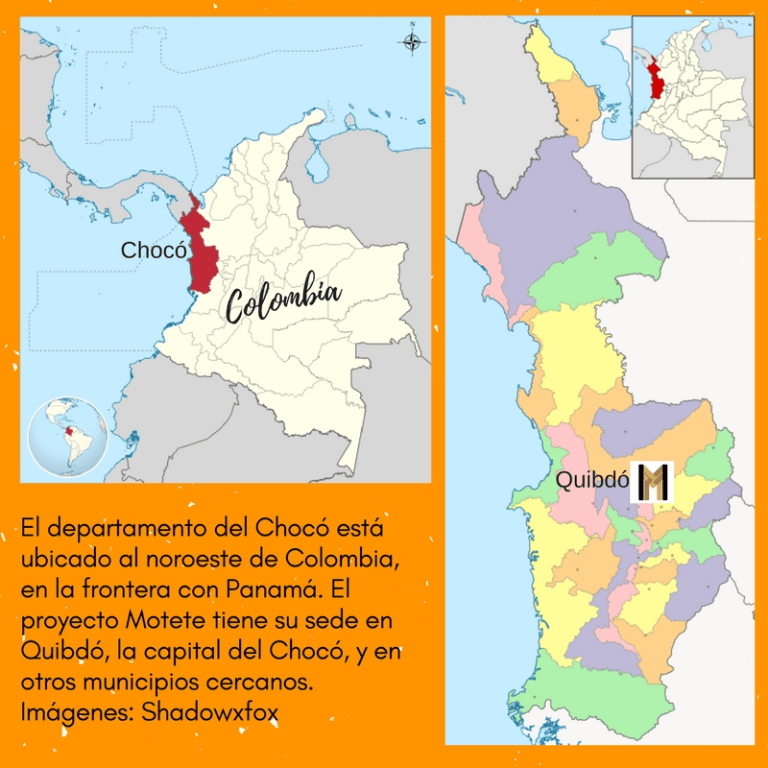
Tomorrow I start a diploma in reading promotion, and with it my project, Motete. We’ve chosen three areas of Quibdo where I’ll start running the workshops.

She is taking a risk starting a new venture, but believes in it and is surrounded by extended family and connections, which facilitate her ability to reach out even further into the community and invite everyone in, to be part of or benefit from her shared love of reading.

And so this project is coming together. This basket, this Motete, is filling up. The slogan for my project is ‘Contenidos que tejen’ – contents that weave – and every day I like it more. Every day I realise that these contents are weaving fulfillment and happiness within me…

The thing is, motetes have been used to carry food for the body: plaintains, bushmeat, fish. Our is to fill them with food for the soul: art, culture, books. And just as motetes are woven by hand, I thought these new contents would also form a fabric: the fabric of society, of community, the fabric of souls.

Letter Writing

Her unnamed friend that she writes to is someone she hasn’t known long, he occupies a space between the familiar and the unfamiliar that she claims as a freedom to express herself, to be vulnerable and open, someone who has mentored and shown her how to get funding. The range of things she will write to him of, span a wide spectrum.

We never see the replies but the continuation of her own correspondence displays her life, her dealing with health problems, the double bind of her wounding and love, of being raised by doting grandparents, while having complicated relationships with a teenage mother unable to mother her and an emotionally absent father. Her later sadness and depression, helped through therapy, tears and conversations, to ways of coping and healing. Her optimism for her venture, and the community connections she creates keep her going.

I grew a lot. I learned. But most of all I tried to weave a new way of relating to my father that hurt as little as possible.

The Sea, The Sea

One of the themes is the sea, the absence of sea, the way the river meets the sea and her relationship to it. She yearns for it when it has been absent for some time, just as she yearns for the letter writer and the relief that comes in the act of writing to him.

She describes herself in her current role as being like the sea at that place where it meets the river.

I’m like the Pacific Ocean, pressing at the river with its tides to make it flow the other way, or lapping at the land when its waters rise, when it feels like gaining inches of new ground. You need strong motivation to stick to this way of life, which isn’t exactly a fight against the world, but rather the certainty of forging your own path.

An Homage to Correspondence

I loved this slender book, it’s project and generosity, its intimate sharing and platform for expanding and learning and having the courage to venture into new areas. It made me think of an exquisite title I’d forgotten about, Leslie Marmon Silko’s slim book of correspondence The Delicacy and Strength of Lace: Letters Between Leslie Marmon Silko and James Wright.

That correspondence was written when Silko was 31 years old and Wright 51. They had planned to meet in the Spring of 1980, mentioned in letters of Oct/Nov of the previous year, not knowing he would be gone before then.

They discuss her novel, his poetry, language, his travels, her adventures with animals, their speaking engagements, their mutual challenges and experiences as university professors, and soon began to share more personal feelings, as she acknowledged the tough time she was having and he shared his own experience, expressing empathy.

Velia Vidal dedicates her book:

To my recipient,
simply for being there.

and when I read about her own projects in society, her love of the sea and shared readings and efforts to help move children and young adults out of poverty, it is all the more inspirational to read these letters, understanding the difference a letter can make, to see someone take a risk and pursue something that will help others from her community, while fulfilling her own dreams and aspirations.

Highly Recommended.

Velia Vidal, Author

Velia Vidal (Bahía Solano, Colombia, 1982) is a writer who loves the sea and shared readings. In 2021 she was a fellow at Villa Josepha Ahrenshoop, in Germany.

For her book Tidal Waters she won the Afro-Colombian Authors Publication Grant awarded by Colombia’s Ministry of Culture. She is the co-author of Oír somos río (2019) and its bilingual German-Spanish edition.

She is the founder and director of the Motete Educational and Cultural Corporation and the Reading and Writing Festival (FLECHO) in Chocó, one of the most isolated, complex and neglected regions in Colombia with the highest afro-descendant population density in the country.

Vidal graduated in Afro-Latin American Studies and has a Masters in Reading Education and Children’s Literature. She is also a journalist and specialist in social management and communication. In 2022 she was included in the list of 100 most influential and inspiring women in the world by the BBC.

She writes children’s literature, fiction and non-fiction, and poetry. Her work has been translated into German, English and Portuguese.

The Hand That First Held Mine (2010) by Maggie O’Farrell

And we forget because we must. Matthew Arnold

The Hand That First Held Mine by Maggie O’Farrell was the winner of the former Costa Novel Award in 2010.

I read and really enjoyed O’Farrell’s memoir I Am, I Am, I Am – Seventeen Brushes With Death, the first of her books I encountered and Hamnet, which won the Women’s Prize for Fiction (2020).

I have The Marriage Portrait still to read, however I was curious to discover more of her earlier work and decided to read this one next.

Dual Narrative, Dual Timeline

This novel is narrated as two stories of two couples, one set in 1950’s/60’s that centres around Lexie, a rebellious university graduate who has been asked to apologise for using a door for men, before receiving her degree.

At home in Devon with her parents, she is about to abandon them all, the academic institution and her family for London, after Innes, a 34 yr old sports car driving art dealer, journalist, critic and self-confessed hedonist, breaks down not far from the field where she is sulking.

Innes has been in St Ives, visiting the studio of an artist whose work he’d been hoping to buy. He had found the artist rather drunk and the work far from completion. The whole excursion had been a raging disaster. And now this.

Lexie will move to London, creating an unconventional life and career in 1950’s Soho guided by her pleasure seeking lover, but with the spiteful eye of one who wishes her harm. Inne’s past will come to haunt Lexie’s future, and she will throw herself into her career, doing what she can to maintain her independence.

His father, he tells her, was English, but his mother was a mestizo from colonial Chile. Half Chilean, half Scottish, he explains, hence his Hibernian Christian name and also his black hair.

There’s much more to Lexie’s story, but to share any more of it would spoil the discovery for new readers of this compelling mystery. It is one of those novels where you know the narrative threads are going to connect and so each revelation keeps you guessing, until it eventually becomes clear.

Present Day London, Forgetting

Photo S. Chai Pexels.com

In the present day (2010) Elina, a Finnish woman in London and her boyfriend Ted, have just had a baby boy and she recalls nothing about the birth or the 3 days spent in hospital.

She tests herself, scans her mind. Has she remembered anything? Has it come back to her while she was sleeping? The birth, the birth, the birth, she intones to herself, you must remember, you have to remember. But no. She can recall being pregnant. She can see the baby here, lying in her lap. But how it got there is a mystery.

Not only has their life been turned upside down, but Ted is having memory flashes of childhood, but the images he is seeing are not like what his parents have told him. He knows what happened to Elina, but for now he is not sharing it.

Four days ago, she’d almost died.

The thought has a physical effect on him. One of disorientation and nausea, like seasickness or looking down from a high building. He has to lean his head in his hands and breathe deeply, and he feels the earlier tears crowding into his throat.

Slowly, the two of them begin to piece together the missing elements from their stories. Ted confronts his mother and finds her unhelpful. But since the birth of his son, the flashes of scenes from the past revisit him with increasing frequency.

‘Do you remember…?’ he asks, then has to break off to think. ‘A man came to the house once. And you … you sent him away. I think. I’m sure you did.’

‘When?’

‘Years ago. When I was small. A man in a brown jacket. Sort of untidy hair. I was upstairs. You were arguing with him. You said – I remember this – you said, “No, you can’t come in, you have to leave.” Do you remember that?

When Traumatic Events Awaken the Past

Everyone is being confronted with challenges and O’Farrell deftly carries the reader through them all, and keeps us puzzling over the mysteries underpinning each of their lives.

There is a level of unease and intrigue that is present throughout the narrative, that quickens the pace of readings, as we realise that not all characters are being honest or have good intentions.

Secrets, lies, infidelities, manipulative jealousies, tragedy and the unconditional love of true motherhood. The novel has emotional depth and psychological insight, while keeping up a well thought our plot.

An absolutely riveting read with brilliant storytelling and just enough withholding to allow the slow reveal of mystery and deception.

Highly Recommended.

Further Reading

The Guardian/Observer review: The Hand That First Held Mine by Maggie O’FarrellElizabeth Day enjoys a compelling novel of memory and motherhood, 25 Apr 2010

NPR review: A Moving Look At The Bonds Of Motherhood by Jessa Crispin, 27 Apr 2010

Author, Maggie O’Farrell

Hamnet The Marriage Portrait Shakespeares Wife The Hand That First Held Mine

Maggie O’Farrell is a Northern Irish novelist, now one of Britain’s most acclaimed and popular contemporary fiction authors whose work has been translated into over 30 languages.

Her debut novel After You’d Gone won the Betty Trask Award and The Hand That First Held Mine the Costa Novel Award (2010). She is the author of Hamnet, winner of the Women’s Prize for Fiction 2020, and the memoir I AM, I AM, I AM, both Sunday Times no. 1 bestsellers.

Her novels include After You’d Gone, My Lover’s Lover, The Distance Betwees US, which won a Somerset Maugham Award, The Vanishing Act of Esme Lennox, The Hand That First Held Mine, which won the 2010 Costa Novel Award, Instructions for a Heatwave, This Must Be the Place and The Marriage Portrait, shortlisted for the Women’s Prize. She lives in Edinburgh.

Boy Swallows Universe (2018) by Trent Dalton

Boy Swallows Universe is the debut novel of Australian author and journalist Trent Dalton, who shared with audiences during the promotional tour of his novel (now a 7 episode Netflix series) that the book was semi-autobiographical, 50/50 fact and fiction.

Eli “does a lot of what I would have [done if I could]. It was all wishful thinking.”

While much of what occurs is true, it reads like a crime, suspense and thriller novel, with unforgettable characters. It is set in a suburb of Brisbane in 1985 and follows a boy through dark, dangerous and at times magical teenage years, intent on changing his family’s lives.

Coming of Age Amid Drug Wars, Corruption and Crim’s

Your end is a dead blue wren.

Boy Swallows Universe Trent Dalton debut novel semi autobiographical 7 part Netflix series based on true story of the authors life growing up in Brisbane Australia

Boys Swallows Universe begins with this cryptic opening line, one of many that appear throughout the text, clues that are eventually resolved in this unique family saviour mystery.

Eli Bell is the main character, he is 13 years old; his brother August, a year older does not talk, he spells words in the air with his finger. He has not spoken since something happened in the past that Eli doesn’t remember. To do with their father. Who he also does not remember.

I can see my brother, August, through the crack in the windscreen. He sits on our brown brick fence writing his life story in fluid cursive with his right forefinger, etching words into thin air.

Finding Meaning and Escape in the Details

Their occasional babysitter Slim, a man who spent a quarter century in jail for the alleged murder of a taxi driver, has taught Eli the importance of details. It’s how he survived the hole. Creating double meanings for here (in the jail) and there (the boundless universe in his head and heart).

When he grows up Eli wants to be a crime reporter for the local newspaper. Slim writes lots of letters to his mates still in prison (using a false name) and suggests Eli can practice by writing letters as well. He has a penpal Alexander Bermudez, once sergeant-at-arms of the Rebels outlaw motorcycle gang.

Slim says a good way for me to remember the small details of my life is to associate moments and visions with things on my person or things in my regular waking life that I see and smell and touch often. Body things, bedroom things, kitchen things. This way I will have two reminders of any given detail for the price of one.

A Stupid Plan, A Secret Plan and a Well Meaning Busybody

The boys live with their mother Frankie Bell and her boyfriend Lyle. The boys get on with Lyle, although Eli has not forgiven him for getting his mother addicted to heroin. Lyle wants to save them all and has a fast track, risky idea about how to do it.

When Lyle’s plan backfires, Eli and August are thrust into survival mode and Eli takes this further with his own big secret plan by going into full on rescue mode, investigative detective, naive peacemaker, all with the aim of trying to get his family back together and his future career on track. Ironically for all the calculated risks it requires, it is his schoolteacher getting too interested in their welfare that worries him.

Mrs Birkbeck leans in closer across her desk. There’s something pious in the way she sits.

‘What I’m trying to say, Eli, is that trauma and the effects of trauma can change the way people think. Sometimes it can make us believe things that are not true. Sometimes it can alter the way we look at the world. Sometimes it can make us do things we normally would not do.’

Sly Mrs Birkbeck. Woman wants to suck me dry. She wants me to throw her a bone about my missing bone.

‘Yeah, trauma is pretty weird, I guess,’ I say.

Eli’s experience of trauma results in him having a highly intuitive subconscious, that combined with a fearless instinct for asking straight up questions push him forward on his quest. The red telephone in the secret dugout room of Lyle’s house is something of an enigma, why does it always ring when he is in there and who is the voice that responds?

A Funny, Thoughtful, Hair-Raising Life Adventure

Boy Swallows Universe is an exceptionally well told tale of a young boy Eli Bell surviving a tumultuous childhood, exposed to the effect of adults involved in drug dealing, of violent school mates, an unusual babysitter and some other hopeful, inspirational characters that make it all worthwhile.

“All of me is in here. Everything I’ve ever seen. Everything I’ve ever done. Every girl I ever kissed on a wagged school day, every punch I ever threw, every tooth I ever lost in a Housing Commission street scrap and every flawed, conflicted, sometimes even dangerous Queenslander I’ve ever come across, as the son of two of the most incredible and beautiful and sometimes troubled parents a kid could ever be born to.” Trent Dalton

This is no story of misery, it is about solidarity between brothers and the tenacity of a boy who won’t accept the way things are, he questions everything and everyone, asking forbidden questions, training himself in observing the details and taking action. Never giving up.

He is trying to save his mother, his mute brother August and himself from the terrible trauma cycles they are all stuck in. He is determined to grow up and become a crime reporter for a local newspaper and to meet the enigmatic Caitlyn Spies.

“The key characters all draw on the people I love most in the world. The most beautiful and complex people I’ve ever known, and I never even had to walk out the door of my house to find them. I just wanted to give the world a story. To turn all these crazy and sad and tragic and beautiful things I’ve seen into a crazy, sad, tragic and beautiful story.”

Brilliantly told, unforgettable characters, a wonderful balance between grounded in the dark reality of a dysfunctional family, a seedy underworld and the ethereal escape of two boys with an ability to dream and imagine their way through the darkest moments of an unsettling childhood.

So many highlighted passages, one of the reading highlights of 2024 for me. Highly Recommended.

I am looking forward to reading his nonfiction book of short stories Love Stories, created when he sat on a busy street corner with a sky-blue Olivetti typewriter and asked the world a simple question: Can you please tell me a love story?

Further Reading

New York Times review: ‘Boy Follows Universe’ follows a Gritty Coming-of-Age in 1980’s Australia by Amelia Lester, May 2019

Trent Dalton on : Why I Wrote ‘Boy Swallows Universe’ Harper Collins

This book is for the never believers and the believers and the dreamers.  This book is for anyone around the world who has been 13 years old. This book is for a generation of Australians who were promised by their parents they would be told all the answers as soon as they were old enough. Well, now you’re old enough.

Here are my answers:

  1. Every lost soul can be found again. Fates can be changed. Bad can become good.
  2. True love conquers all.
  3. There is a fine line between magic and madness and all should be encouraged in moderation.
  4. Australian suburbia is a dark and brutal place.
  5. Australian suburbia is a beautiful and magical place.
  6. Home is always the first and final poem.

Author, Trent Dalton

Trent Dalton Australia author journalist Boy Swallows Universe Lola in the Mirror Love Stories

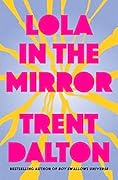
Trent Dalton is a two-time Walkley Award-winning journalist and the international bestselling author of Boy Swallows Universe, All Our Shimmering Skies, Love Stories and Lola in the Mirror.

His books have sold over 1.3 million copies in Australia alone. He lives in Brisbane, Australia, with his wife and two daughters.

Cairn (2024) by Kathleen Jamie

A Poet Writing Nature Essays

Kathleen Jamie is a poet and writer of creative nonfiction about nature. She has written three wonderful collections that I have adored. Findings (2005), my favourite, included essays about the Hebridean and Orkney Islands near her home in Fife and Peregrines nesting; Sightlines (2012) covers a fascinating archaeological dig, tales of more birds on lonely, windswept islands and a visit to the Arctic and finally Surfacing (2019) which I review here in Surfacing 1 and Surfacing 2.

Making Ripples at 60

creative non fiction essays poetry by Scottish poet and nature writer Kathleen Jamie

In Cairn, we find a collection of writings, fragments, observations and memories. Sometimes an individual observation and other times a collective witnessing of changes in the local environment. Of migratory patterns disrupted, of things once common on the horizon, now departed.

As she arrives at her 60th year, she begins to ask different questions, about the next generation and the one after that, if there will indeed be one as children question whether to bring another generation into this vastly changing world.

There is less a note of wonder and more a tone of trepidation at the precarious situation of the natural world and those being born into what will continue after we have left.

The Bass Rock and Bird Flu

It’s a while since we could turn to the natural world for reassurance, since we could map our individual lives against the eternal cycles of the seasons, our griefs against the consolation of birds, the hills. Instead there’s the sense that things are breaking, cracking like a parched field. There they are, the seabird people, among their beloved birds at the height of the breeding season, wearing hazmat suits as they pile corpses into bin bags.

Photo by Magda Ehlers on Pexels.com

Like a cairn, these short prose pieces are markers, memories, memorials or perhaps even metaphorical or literary burial mounds, tracking the thoughts and observations of an observer over the years of the natural environment, of change in both the natural surroundings and humanity. Testimonies.

‘Stones propose another sense of time, whereby the past, the deep past of the plant, proffers a meagre yet massive support to acts of human resistance…’ John Berger

A thought-provoking collection.

Further Reading

The Guardian: Cairn by Kathleen Jamie review – a wry SOS for the world

The Caught by the River Book of the Month: July 2024 Cairn by Kathleen Jamie With its bursts of beautiful brilliance, it is something akin to lightning, writes Annie Worsley

The Guardian: Scotland’s Bass Rock: world’s largest colony of northern gannets – in pictures

Author, Kathleen Jamie

Kathleen Jamie, Photo by Alan Young

Kathleen Jamie is one of Britain’s foremost writers. In 2021 she was appointed Makar, Scotland’s national poet.

Jamie resists being identified solely as a Scottish poet, a woman writer, or a nature poet. Instead, she aims for her poetry to “provide a sort of connective tissue”.  Influenced by Seamus HeaneyElizabeth BishopJohn Clare, and Annie Dillard, Jamie writes musical poems that attend to the intersection of landscape, history, gender, and language.

Her groundbreaking works of prose – Findings (2005), Sightlines (2012) and Surfacing (2019) – are considered pioneers and exemplars of new nature writing. She lives in Fife.

Daughters Beyond Command by Véronique Olmi tr. Alison Andersen

Daughters Beyond Command is a wide ranging chronicle of 1970’s France, seen through the eyes of the Malivieri Catholic family with three daughters, living in an apartment in Aix-en-Provence. It traverses issues of family, feminism, worker’s rights, class, animal rights, amid the rapid transformation of society in the 19070’s France.

Family saga set in France against social political context of May 68 to the May 81 election

While the story follows the changing lives and events, in particular of the daughters and the mother (we don’t learn too much about Bruno, the father), it also demonstrates the shifts in society and of generations that occur through the way these daughters seek their independence. It contrasts with the way their mother harbours secrets and makes other complicit when she does share what she would prefer to hide.

Regardless of their ages or circumstances, the country and the world is changing and attitudes and behaviours are shifting and everyone is forced to reckon with the changes as they impact them in different ways, raising consciousnesses and often unable to maintain previous ways of being .

Sabine, the eldest wants to work in theatre and acting and will do everything she can to pursue that dream in Paris. Fiercely independent, she has developed an irritation around comfort and conformity.

She watched as Maria set the table under Michelle’s authority. She looked at the framed photographs of her cousins who had not yet come home.Happy times on horseback, in cars, on boats. It was like a huge advertising campaign. It filled her with rage. There had to be something behind this publicity for the life she was being shown, both here and at home, in the silver frames of photographs, or poor people’s kitchens, behind the slogans like Moulinex Sets a Woman Free, the injunctions to promote progress, comfort, and the frenzied pursuit of happiness, luxury, and family life, there was something else. Which could be neither bought nor sold.

The second sister Hélène has been seduced by the trappings and comfort of this sophisticated Parisian family. Sabine can’t understand why she chooses to spend so much time with them, a family that lives in a way beyond anything they have ever experienced. Hélène spends most of her holidays with the family who don’t have daughters; the Uncle who has taken a particular interest in her. That regular proximity changes some of her habits, including the way she speaks.

It was a betrayal of the Malivieri clan, and Sabine was astonished that her sister could flaunt her bonds of dependence so naturally.

Hélène will also leave home early and pursue an education Paris, supported by her Uncle. She is less outspoken but equally passionate, affected by moral question around the protection and rights of animals.

As time passed, a breach had come between Hélène and her parents; adaptation upon her return required quickly taking stock of her loved ones. She saw her father, whose kindness and altruism for everything he could not lavish on his family financially. She saw her mother, hard-working and attentive, doggedly managing her household, and the rare moments she seemed to cast off her condition as a housewife, when she really seemed to be her true self, were when they visited Laurence on Saturday afternoons at her bastide.

Photo by Alotrobo on Pexels.com

The student riots of May ’68 had an impact on the nation and caused both fear and admiration in these adults trying to figure out how to parent their daughters, growing up surrounded by influences they could not control.

As the lives of the daughters changes, so too does the outside world. Simone de Beauvoir and Gisèle Halimi found the movement Choisir la cause des femmes (Choose the Cause of Women) in 1971 to decriminalise abortion in France, riot police storm the Lip watch factory that had been occupied by workers for three months, forcibly removing them; there is talk and images of the horrors of Vietnam, of the desire for freedom, respect for the proletariat, and the lyrics of the Bob Dylan song The Times Are A Changin’, the death of the President Georges Pompidou.

Sabine told her his name was Bob Dylan and that his song said, more or less, that the world was changing, you had to keep your eyes open,and the parents had better watch out, their sons and their daughters were beyond their command. It was a political song.

As time passes and events happen the sisters find a way to strengthen their bond despite their differences, separating from each other and then coming together in solidarity, while their parents seem stuck in time. Agnes, the mother is unable to stop changes happening to her, which will bring about a crisis, one the two older girls question but are again met with silence.

While the novel isn’t necessarily about resolving any of the issues presented, it encapsulates the impact of changing times on the various members of the family in a way that I found interesting, having lived in France for around 19 years, but not during the era mentioned. So much of the landscape was familiar, and some of the references, but many were not.

I appreciated the story for the depiction of what it might have been like to be part of an ordinary family growing up in this town in the 1970’s and learning about the significant events that challenged and affected people’s thinking, seen from the perspective of inside France. It is these changes in the background of the family lives and the adept writing that maintains the narrative pace.

It might be set in the 1970’s but it feels as relevant today in many respects as it did for that era of change.

Further Reading

My review of Véronique Olmi’s novella Beside the Sea (2015)

Listen to Bob Dylan’s The Times They Are A Changin

Kirkus Reviews: The personal is political for Olmi’s finely drawn characters.

Litro Magazine Review: Daughters Beyond Command by Monica Cadenas

Author, Véronique Olmi

Véronique Olmi was born in 1962 in Nice and now lives in Paris. She is an acclaimed French dramatist and her twelve plays have won numerous awards. Olmi won the Prix Alain-Fournier emerging artist award for her 2001 novella Bord de Mer (beside the Sea). It has since been translated into all major European languages.

The Axeman’s Carnival by Catherine Chidgey

The Axeman’s Carnival won the NZ Book Award for Fiction in 2023. I have enjoyed a few books by Catherine Chidgey, including Remote Sympathy (my review), The Transformation and most recently Pet.

Surviving the High Country

While the novel’s hero and narrator is a common magpie, The Axeman’s Carnival is a social commentary on the struggles of carrying on family farm traditions and tending to relationships on a remote high country farm, infused with magic realism and comic relief. The author acknowledges the use of diaries belonging to her late mother-in-law, who lived on a high country sheep station.

Strong Man Chops Wood

The Axeman’s Carnival refers to a wood chopping competition, which is one of the final scenes in the novel and an event that Marnie’s husband Rob judges himself by.

He runs a hill country sheep farm in Central Otago, in the South Island of New Zealand, land that his father in part cleared of stones making it more fertile for grass, but also land that was in part lost (including his childhood home) to flooding required to create a large dam. Though he doesn’t remember the home, images of it recur often in his dreams.

The farm is struggling, they are increasingly drowning in debt and despite Marnie’s working outside the home as well as helping on the farm, her husband is volatile and easily made jealous, quick to turn his rage against his wife. When he’s not outside tending to the farm, he watches one genre of crime show.

Later he watched his crime show about beautiful dead women found in alleyways, all rucked up and staring. The man who came to look at the beautiful dead women wore a gun strapped to his side and sunglasses that were also mirrors, and he said things like This was no suicide, Trent. See the spatter patterns and The perp’s taunting us. He’s dangling the victims as bait and we’re biting.

Separation from the Family of Origin

One day Marnie acquires a fledgling magpie chick and brings it inside, despite the threats from Rob. The entire novel is narrated from the perspective of Tama, including those first memories of being lifted into her pillowed palm.

My siblings cried out as she carried me away, calling from our nest high in the spiny branches: Father! Father! Where are you? Come back! My mother called for him too, her voice frantic and afraid – but he , hunting for food, had left us all unguarded.

Can Humans Be Trusted?

Photo by Boys in Bristol Photography on Pexels.com

The bird is named Tama, he survives and grows and when she releases him, he revisits his magpie family up in the pines, but realises they seem to have disowned him due to his association with humans.

Father magpie is an expert on the faults of humans and preaches lessons to the younger generations, warning of traps and lures. When he learns what happened to his mother ‘Death by car’ and his brothers ‘Death by cold‘, he makes up his mind.

Tama, who has learned to use the cat door, returns to Marnie and begins to speak his first words. Because Tama is the narrator, we also hear his thoughts on what he is observing and see how he tries to navigate between the worlds of the two species he is entwined with, his magpie family and his human one.

My father kept his eye on me, waiting or me to betray myself. Every day he told me another bad story about humans: they wrung our necks, they ran us down, they shot us, they poisoned us.

‘Doesn’t that bother you?’ he said.

‘Yes, Father,’ I said.

‘I don’t think it bothers you. I don’t think you believe me.’

‘I believe you, Father.’

‘You still reek of her.’

Bringing the Outside World In

While Marnie is amused by Tama’s antics, her husband is irritated by his attachment to her and encroachment into their lives. But every threatening line he utters adds to the increased repository of retorts that come out of the beak of the bird.

I suppose I should have tried to behave myself – and I was wary of him, don’t get me wrong. I saw the strength in his hard hands, and I knew it could lead nowhere good. I knew he’d had a gutsful. But I couldn’t keep quiet; I was my own worst enemy.

When she creates a twitter account for the magpie, it becomes popular while being another source of disapproval by her possessive husband. Until they discover he could be a source of income and help save the farm.

The story follows the family and the impact of the internet sensation and becoming known, however none of these changes to their life or fortune transform our characters in any way. Marnie continues to try and gain approval of her husband, he remains jealous of any contact she has with others, whether around them or online. While his behaviour is checked by the presence of webcams in the home, through Tama’s eyes, we witness the relaationship unravelling with mounting dread.

Champion or Brute

The narrative builds up to the carnival where he aims to become a 10 times ‘golden axes’ champion and Marnie and her sister have a surprise planned for their husbands, which she becomes increases nervous about whether it is a good idea or not.

The novel is full of clever wise-cracking moments, thanks to the mimicking retorts of the magpie, which lighten what is otherwise a threatening environment and a serious subject. Marnie is a victim of domestic violence and the only witness, Tama the talking magpie. He is the intelligent observer and hero of the novel, even if his own authenticity has been compromised by how the humans have turned him into a money making spectacle causing him to be spurned by his own.

While the theme is covered well, including the victims tendency to make excuses for the perpetrator and the constant critical comments of a mother, ceaselessly undermining her self-worth, I was disappointed that there wasn’t real transformation or growth in the human characters. There is resolution yes, but an opportunity missed, particularly given the serious nature of the crime.

As unsettling as it is entertaining, the brilliantly written voice and antics of Tama, carry the story forward, poking fun and provoking an already tense situation, until its splintering, scorching conclusion.

Highly Recommended.

Further Reading

The Conversation review: Catherine Chidgey’s revealing, uncomfortable novels bridge worlds by Julian Novitz, 25 Mar 2024

Financial Times review: The Axeman’s Carnival — when a magpie steals the limelight

Irish Times review: An imaginative and well executed novel

New Zealand Family Violence and Economic Harm Statistics

Author, Catherine Chidgey

Catherine Chidgey is an award-winning and bestselling New Zealand novelist and short-story writer whose novels have been published to international acclaim.

Her first novel, In a Fishbone Church, won the Betty Trask Award, and was longlisted for the Women’s Prize for FictionGolden Deed was Time Out’s Book of the year, a Best Book in the LA Times Book Review and a Notable Book in the New York Times Book Review. Her fourth novel, The Wish Child (2016) won the 2017 Acorn Foundation Fiction Prize, the country’s major literary prize. 

Remote Sympathy (2021) was shortlisted for the Dublin Literary Award and the Jann Medlicott Acorn Prize for Fiction, and longlisted for the Women’s Prize for Fiction. Her most recent novel Pet (2023) was longlisted for the Dublin Literary award.

N.B. Thank you kindly to Europa Editions for providing me with a copy of the book to read and review.

The Hypocrite (2024) by Jo Hamya

I came across The Hypocrite randomly and was intrigued firstly by the Sicilian setting and secondly by its premise of being a clash of generational perspectives.

I was also intrigued, having recently read Enter Ghost by Isabella Hammad, to discover another novel with a theatre setting. It is a thought provoking novel about the family dynamics of a daughter and her parents, played out one afternoon as she lunches with her mother, while her father watches the play downstairs. It is an awakening of sorts for them all.

A Daughter Creates

A young woman Sophia, has written a play. It is set in a summer holiday house on one of the Aeolian islands of Sicily, a place she spent a month with her father, typing his dictated novel, mostly hanging out alone, quietly observing the women he bedded nightly. That was 10 years ago.

The Father Watches

literary fiction a daughter writes a play about her fathers generation referencing a holiday in Sicily

Today, her father, the (in)famous author, attends a matinee showing of his daughter’s work for the first time. He knows nothing about the play prior to being seated in the theatre. He swiftly realises that much of the set and characters are familiar to him. This might even be about him. About that holiday. He begins to feel uncomfortable.

No stories are entirely imaginary, cherub, he’d said then. Everything is always a little bit real. Sometimes you steal things from other stories and change them until they work how you like.

He wonders if the people sitting either side of him know who he is. He begins to prepare defences in his mind. He decides to interact with the young woman who had been seated next to him.

He thinks, I have never been any good at arguing. I have only ever said what is on my mind. So he asks her, without malice, whether she dislikes him because of what they’ve both watched; does his best to keep his breathing steady in the interval between his question and her answer.

Round Glasses is blunt. She disliked him before, she says. And the play is no great shakes.

The Mother Bitches

a mother and daughter eat in a theatre restaurant
Photo by Rene Terp on Pexels.com

Upstairs in the theatre restaurant, the daughter dines with her mother. She spends most of the meal talking about her ex-husband. She has re-experienced living with him for a period during lockdown. Unaware, she begins to create a scene.

The narrative shifts between the father observing the play unfold, the daughter listening to the mother complain of him and that month long holiday in the past that inspired her to write the play.

In Sicily, Sophia had looked forward to spending the longest uninterrupted time with her father she had ever had. She did not realise that she would spend most of the time alone or in the company of Anto, the nephew of the woman who cleaned the house. Her father would be absent to her, except when dictating his chauvinistic novel. She would observe and learn things.

We Are all Products of Them and Ourselves

The novel explores the unmet expectations of each character in the family trio, their deafness to each other’s desire and the clash of generational perspectives.

The contradiction of the time had been the heightened moral obligation to consider other people as a means to keeping one’s own self-interest afloat. Showing other people care meant avoiding them.

theatre stage play audience in a theatre red curtain
Photo by Monica Silvestre on Pexels.com

The scenes pass in a kind of circumambulation, one after the other, progressing onward.

Revelation comes slowly to the father seeing himself from another’s perspective, through actor’s on a stage, where he cannot interrupt or change the narrative, he is forced to bear witness.

Held To Account, Punished and Portrayed

The mother is witnessed by both the daughter and the waiter, who forces her to account for her deteriorating behaviour. This is not the family home, no dsyfunction permitted.

The daughter equally will be challenged by a random stranger in a public place.

It is not quite a reckoning, but a challenge to each of them to see what they are not seeing, to pause from the habit of inflicting a perspective on others.

The novel puts on stage personal power, public perception and creative potential and asks it audience to consider the responsibility and ambiguity of creating art, mining lives and the sanctity or not (for art) of relationships.

So who is the hypocrite?

Everyone it seems.

Further Reading

The Guardian Review: The Hypocrite by Jo Hamya review – sharp generational shame game by Miriam Balanescu, 12 May, 2024

The Guardian Interview: Jo Hamya ‘Could I just write one massive grey area?’ by Hephzibah Anderson 20 Apr, 2024

Jo Hamya, Author

Jo Hamya was born in London. After living in Miami some years, she completed an English degree at King’s College London and a Masters in contemporary literature and culture at Oxford University. She has worked as a copyeditor for Tatler, edited manuscripts published by Edinburgh University Press and Doubleday UK.

She has written for the New York Times, Guardian and Financial Times. Currently, she works as an in-house writer and archivist for the Booker Prizes and its authors and is a PhD candidate at King’s College London.

Her debut novel was Three Rooms (2021). She lives in London.

James by Percival Everett

This was my third novel by Percival Everett, having very much enjoyed So Much Blue (2017) and Erasure (2001). I knew James would be quite a different premise because it is connected to the well known, classic adventure story of Huckleberry Finn.

I have a brief sense of familiarity with Tom Sawyer and Huckleberry Finn, I may have seen episodes of a television show when I was a child. I wasn’t sure if I had ever read the book it is based on. I don’t think so. Boy and the Sea Beast by Ann de Roo was more my kind of adventure story.

Set in the period just before the American civil war is about to break out, we meet Jim, a black slave, waiting outside for corn bread. Two boys, Tom and Huck are trying to play a trick on him and plan to steal something from the kitchen.

A Boy, A Young Man or an Adult

I admit that for the first 60 pages I thought Jim was a young boy too. When on page 62 he asks after his wife and child I shift my perspective. The way the two boys were interacting with him (pranking him) seemed appropriate towards another boy, not a man.

In a world where slavery exists, relationships have a perverse hierarchy, one that is demonstrated from the opening scene of the novel. When I go back and close read I see where there were signs I missed.

Jim helps collect wood and takes a risk by putting some aside (hidden) for different members of his family and community.

The weather remain unseasonably cold and I found myself pilfering wood for not only April and Cotton, but also my family and a couple of others. I was terribly concerned that the wood might be missed, and that fear worked its way into reality one Sunday afternoon.

He hears that the owner is planning to sell him to a man in New Orleans. Without waiting for morning Jim decides to escape, though he feels bad about leaving his family. He is determined to find a way to raise the funds to free his family from slavery.

“You can’t run,” Sadie said. “You know what they do to runaways.”

“I’ll hide out. I’ll hide out on Jackson Island. They’ll think I’ve run north, but I’ll be there. Then I will figure out something.”

He heads down to the river, the Mississippi, crosses to an island where he finds a safe place to rest a while. To his surprise he encounters the boy Huck, who is running from his abusive, drunkard father Pap. It is not good news, because Huck has left things in a way that people will believe him to have been murdered. And now Jim is missing.

Language and Expectations

Whenever Jim is around Huck, he speaks in a certain way, a kind of dialect. We know that Jim has had access to the house library in the past, that he can read, write and articulate, but he must suppress his ability to understand intellectually and more importantly hide his capable manner of his speech, in order to keep him safe from those whose racist ways of thinking will be threatened by a man showing superior comprehension.

When Jim gets bitten by a snake and spends a few nights in a fever, his dream time ramblings put him at risk. He starts having conversations with Voltaire and other French philosophers, a pattern that emerges whenever he enters dream state. (And typical of Everett to throw in French literary motifs – they add both comic relief and increase the danger surrounding the protagonist). His subconscious is unable to hide the knowledge he has acquired over the years.

François-Marie Arouet Voltaire put a fat stick into the fire. His delicate fingers held the wood for what seemed like too long a time.

On the inside cover there is a map of the river and the locations on his journey south where they will have different encounters, where they become separated for a while. Each time they are separated, sometimes for a significant period, they manage to find each other again.

How To Trust a Man

It is not easy for Jim to trust another man. The people he encounters may be slaves or white men, or men passing as white, or white men. Each encounter presents a situation he must navigate, an aspect of the society within which they live, how different people are.

He has withheld information from Huck that might have benefited him. He considers telling him, but fears he might be angry and betray him, causing his capture.

One of the most uncomfortable encounters he has is with a travelling minstrel show, a band of white men who put on a show and sing to people, songs that mock black people. While the man who runs that show says he does not believe in slavery, he “hires” Jim as a tenor for his show. This presents the farcical and most dangerous situation as he is be painted to be a black man as if he were a white man.

The most costly, traumatic episode for Jim comes following the help of four men he encounters at the riverside. They ask what they might bring him and he asks for a pencil. It is a most dangerous thing for an enslaved man to have on him or for another to source for him and the cost will be high. They also understand its power and want him to have it.

To Read and Write, A Subversive Act

The discovery of abandoned books and paper is one of the most significant discoveries Jim makes. It marks the beginning of a new stage in his life. He is going to write. About his life and its meaning. His first attempt is with a stick, the pencil he obsesses over and eventually acquires will bring further elucidation.

I really wanted to read. Though Huck was asleep, I could not chance his waking and discovering me with my face in an open book. Then I thought, How could he know that I was actually reading? I could simply claim to be staring dumbly at the letters and words, wondering what in the world they meant. How could he know? At that moment the power of reading made itself clear and real to me. If I could see the words, then no one could control them or what I got from them. They couldn’t even know if I was merely seeing them or reading them, sounding them out or comprehending them. It was a completely private affair and completely free and, therefore, completely subversive.

A Turning Point

There comes a point where Jim has had enough experiences and encountered sufficient people that his purpose becomes stronger and clearer and his fear dissipates. The mood is changing as groups of young people begin to amass to fight in the war. At this point he turns around and heads back north, from where he came. His purpose changes, becomes clear, his resolve strong.

It marks a shift in his relations with those around him, including Huck. He has encountered help and harm from different quarters, he has taken risks and overcome adversity. He moves from “running from” to “running towards”. His language changes and he begins to take on the character of a leader.

I thought it was an excellent novel and collection of encounters that confronted many of the issues and circumstances of the society they lived in at the time and the dangers a runaway slave had to navigate in order to seek freedom. How the journey changed him and the inevitability of violence taking a place in the life a man, not prone to violence, but brought to it by the oppression and injustice surrounding him.

I love that we are beginning to see a narrative shift in stories, in terms of the perspective from which stories are told and the nuance of character developed in those who have been sidelined or typecast.

From Book to Film, Writing Slant

I’m looking forward to what the partnership between Percival Everett and Taika Waititi will create, in bringing this story to the big screen, a creative partnership just announced this past week.

With my pencil, I wrote myself into being. James

Percival Everett, Author

author of James, Erasure, So Much Blue

Percival Everett is the author of over thirty books, including So Much BlueTelephoneDr No and The Trees, which was shortlisted for the 2022 Booker Prize and won the 2022 Bollinger Everyman Wodehouse Prize.

He has received the Hurston/Wright Legacy Award and the PEN Center USA Award for Fiction, has been a Pulitzer Prize finalist, and is Distinguished Professor of English at the University of Southern California. His novel Erasure was adapted into the major film American Fiction.

The novel James (a reimagining of Mark Twain’s The Adventures of Huckleberry Finn, told from the perspective of the enslaved Jim) was published on 11 April 2024. He lives in Los Angeles.