Georgia: A Novel of Georgia O’Keeffe by Dawn Tripp

I’ve loved Georgia O’Keeffe’s paintings since I stumbled across them one weekend in an art gallery in Chicago and felt the effect of them, rather than saw them as such, for they are indeed imbued with feeling and when you see one of her large canvases with its bold visual statement, well for me anyway, you can’t help but be moved by it, struck dumb by it, to stop and appreciate how this artist communicated something deep within you, without words or reality. I felt it almost like a punch, I didn’t quite understand what it was, but I wanted to know who is was that had created that effect on me.

Although I bought a beautiful book about her paintings, it was something less intellectual and more personal I was after. I found a very old, yellowed copy of Laurie Lisle’s Portrait of an Artist: A Biography of Georgia O’Keeffe.

It provided an excellent framework of her life, her childhood and introduction to art, her various shows, her marriage and need for solitude and her eventual move to that part of the world that most resonated with her, New Mexico.

However, O’Keeffe comes off as a rather distant, aloof character, seen from the outside, rather brusque, detached. The biography filled in her life, but left me still wanting to know who she was, sure there was much more to her that we would benefit from knowing.

One of the things that makes Georgia O’Keeffe such an interesting character is not just her work, but her essence, her self-knowledge and ability to act upon it, to ensure that she lived in a way that allowed her art to express itself in an authentic way. When she wasn’t able to do this, her mental health declined, however she knew how to resolve it and in acting accordingly, lived to the age of 98.

She married the well-known gallery owner and photographer, Alfred Stieglitz, something of a scandal as she was 25 years his junior and he left an unhappy marriage for her, but she never collapses into the relationship, they find a way of supporting each other, that also allows them be individuals and to pursue (most of) their own ambitions wholeheartedly.

Inevitably there would always be compromise, Stieglitz accepted that O’Keeffe needed to spend a portion of the year in New Mexico without him and O’Keeffe had to accept that Stieglitz did not want to become a father again.
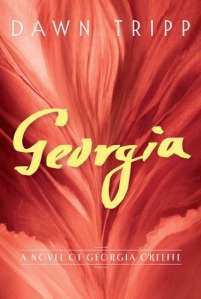
GeorgiaWhich all leads me on to say it was with quiet anticipation to learn that Dawn Tripp had the courage, respect and admiration for O’Keeffe to decide to venture into creating a work of fiction, that attempts to channel the voice of Georgia O’Keeffe. What might she have really been thinking if it was her voice relating the story of this life and not someone from the outside.

Georgia: A Novel of Georgia O’Keeffe does exactly that.

Dawn Tripp similarly came across her story through her art, after seeing an exhibition of her abstractions at the Whitney Museum of American Art in 2009. She had been aware of her work, but experienced something different that day.

As early as the fall of 1915, at twenty-nine-years old, she was creating radical abstract forms when only a handful of artists were bold enough to explore this new language of modern art. Her abstractions of that time – and those she continued to create throughout her life – were ambitious, gorgeous shapes of colour and form designed to express and evoke emotion, and they were stunningly original.

It provokes in the author, a desire to want to know this woman, the artist, the creator of these stunning works and why she was not recognised for the visionary power of these abstractions during her lifetime. There were excerpts from letters as part of the show:

The language of those letters was sharply intimate, vulnerable, complex. O’Keeffe’s letters revealed a woman of exceptional passion, a rigorous intelligence, and a strong creative drive. Her letters had a raw heat that felt deeply aligned with the abstract pictures I was seeing on the walls, but at odds with the image of O’Keeffe I’d grown up with: the aged doyenne of the Southwest, poised and cool, holding the world at arm’s length.

My Faraway OneWhen the novel was almost complete, the correspondence of O’Keeffe and Stieglitz was published, having been sealed for twenty-five years after her death.

It was a pleasure to read this novel that attempts to get inside that mind and share something that feels more genuine in terms of what her work intended, than the easy reference that so many of the male critics of the time jumped to, insinuating the sexual by responding to the visual elements of Stieglitz’s nude photos of her and the soft interior of her giant flowers, rather than the essence of life itself pushing forth.

This is the Georgia O’Keeffe I’ve wanted to know, and suspected existed, from someone who has tried to absorb her childhood, upbringing and place in the world, attempting to understand what she was trying to express and how it was both uplifted and repressed by the decisions she made.

To explore those initial choices, few of which were her own, the effect of Steiglitz managing and directing her career, their relationship, her need for a child, their life between New York and Lake George until the moment when she allows herself to visit New Mexico with her friend Beck and begins an annual pilgrimage to a place that will eventually consume her entirely and become her home, both physically and spiritually.

We see O’Keeffe as a young independent woman, learn about her family background, their vulnerability to TB, the shock of meeting Stieglitz’s wife and family, the abundance of material wealth and food, she so close to nature – and yet so attracted to him, his mind and his person.
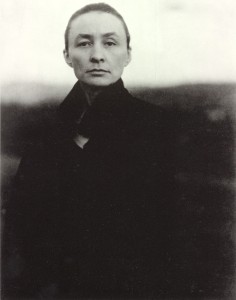
Georgia O'Keeffe, 1920

Georgia O’Keeffe, 1920

She resents her art being seen through his lens of her, by the critics, that association with gender, the feminine. The thing that builds her up, blinds them to the work as she sees it. She seeks solitude. She resists being photographed, unable to convince through other means. By the time Stieglitz divorces, Georgia is lacklustre on marriage.

Her mental decline from accepting it all, the inevitable, necessary turning point, turning away from her husband, though forever connected to him.

Dawn Tripp has us completely immersed in a perception of the life of Georgia O’Keeffe that feels as real as if it were the artist herself speaking, though we all know how private she was, and through this novel we understand that need even more so.

People can be sceptical of the fictional biography, but when it is well researched, and the author has found the appropriate voice, and treats the subject with respect and understanding, it brings history alive and makes it accessible to a much wider audience than the more traditional, detached form of narrative.

I highlighted so many paragraphs and sections in the book, it would make the review too long to show them. All the better to discover the words for yourself.

Absolutely brilliant, loved it.

Notes on the Paintings Depicted
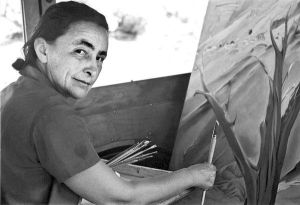
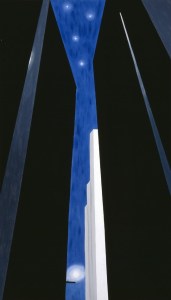
OKeeffe painting“Pink Tulip”, 1926, Georgia O’Keeffe, oil on canvas, 36” x 30”
The Baltimore Museum of Art, Bequest of Mabel Garrison Siemonn, in memory of her husband George Siemonn.
©Georgia O’Keeffe Museum

Georgia O’Keeffe, Untitled (City Night) (Untitled – Night city), Seventies © 2009 Georgia O’Keeffe Museum / © Georgia O

Georgia O’Keeffe White Iris, No. 7 (White Iris # 7), 1957 © 2009 by Georgia O’Keeffe Museum / © Georgia O

Georgia O’Keeffe, “Ram’s Head White Hollyhock and Little Hills,” 1935, Oil on canvas, 30 x 36 in. Brooklyn Museum, New York.

Click on the link to buy this book.

Buy Georgia: A Novel at Book Depository

Note: The book was an ARC (Advance Reader Copy) kindly provided by the publisher via Netgalley.

Human Acts by Han Kang tr. Deborah Smith

Han Kang AuthorHuman Acts is the author Han Kang’s attempt to make some kind of peace with the knowledge and images of the Gwangju massacre in South Korea in 1980.

Her family had left that city just one year before, she was 10 years old when the 10 day uprising occurred, but she became aware of it through the overheard, whispered conversations of her family and the silence that surrounded them speaking of the home where they used to live. She learned three young people from that household had lost their lives, one, a boy Dong-Ho probably shared the same room she had lived in for many more years than the short time he had.

What made the events sear into her mind and perhaps permanently affect her psyche, was the forbidden photo book that was given to her family, books circulated secretly to let survivors know what had really happened, a book her parents tried to hide, one she sought out, opening its covers to images she would forever be haunted by.

At night, though, when all the grown-ups were all sitting in the kitchen and I knew I’d be safe…I crept into the main room in search of that book. I scanned every spine until finally I got to the top shelf; I still remember the moment when my gaze fell upon the mutilated face of a young woman, her features slashed through with a bayonet. Soundlessly, and without fuss, some tender thing deep inside me broke. Something that, until then, I hadn’t even realised was there.

Asked why she felt motivated to write this book – which begins with the immediate after-effects of the massacre, the very real logistical management of the bodies, the bereaved, mass memorial rituals and the burials and goes on to enter the after death consciousness of one the victims, seeing things from outside his body – she responded that the experience of seeing those images left her scared, afraid of human cruelty, struggling to embrace human beings.

It left her with the two internal questions below, they became her motivation to enter into the experience and try to write her way out of it, spurred on by the events surrounding the 1980 massacre in her birthplace of Gwangju and then the more recent social cleansing that took place in the Yongsan area of Seoul in 2009:

1. How can human beings be so violent?
2. How could people do something against extreme violence?

Human ActsHuman Acts, which seems to me to be an interesting play on words, is divided into six chapters (or Acts), each from the perspective of a different character affected by the massacre and using a variety of narrative voices.

The opening chapter entitled The Boy, 1980 introduces us to Dong-Ho, but seen from outside himself, written in the second person singular narrative voice ‘You’. It is after the initial violence in the square and something has driven this boy, initially searching for the body of his friend who he witnessed being shot on the first day, to volunteer and help out, confronting him in a visceral way with so much more death and tragedy than he had escaped from on the day itself.

We meet the shadow of his friend in the second chapter, as he exits his body, but is unable to escape it, he tries to understand what is happening around him and observes his shattered body and others as they arrive, until something happens that will release him whereupon he senses the death of those close to him, his friend and his sister.

How long do souls linger by the side of their bodies?

Do they really flutter away like some kind of bird? Is that what trembles at the edge of the candle flame?

In another chapter, we learn one of the volunteers from the first chapter is an editor, we meet her again five years later in a short, violent episode, that is revealed in the seven days of healing that follow. Devastatingly brilliant, it delves into the cost of censorship and the risk of being anywhere near it.

She had no faith in humanity. The look in someone’s eyes, the beliefs they espoused, the eloquence with which they did so, were, she knew, no guarantee of anything. She knew that the only life left to her was one hemmed in by niggling doubts and cold questions.

The following chapters skip years, but never the prolonged effect of what happened, the events never leave those scarred by them. The narrative works its way back to the origins of the uprising, to the factory girl, the hard-working, little educated group of young women trying to improve their lot, to obtain fair wages and equal rights. They become bolder when they meet in groups and speak of protesting, they educate themselves and each other and feel part of something, a movement and a feeling they wish to express publicly, with the naive assumption they won’t be arrested or killed.

It brings us back to humanity’s tendency to group, to find common interests, to progress as a team with common interests, to support each other and to the tendency of those in power to feel angry, threatened and violent towards those who have an equal ability to amass support, regardless of the merits of their cause.

Deborah Smith’s translation with all the narrative changes and structural vagaries works so well, it’s only the names and the occasional script that remind us that this was a work written in a language, so very different in its structure and ability than English, a challenge Smith was very much aware of, but overcame in this stunning result. I can only imagine how it must feel to read it in the original language.

Han Kang so immersed herself in these stories and events, that it is as if we are reading the experience of a holocaust survivor, a torture sufferer; we know only a little of what it must be like to live with the memory and the reluctance to want to share it, the heavy price that some pay when they do.

Despite the suffering and proximity to events, I was riveted by this novel all the way through, reading it slowly, endeavouring to expand my awareness to try to comprehend where the artist is taking us, to try to receive the answers too to those questions that have haunted her for so long.

I was constantly racking my brains.

Because I wanted to understand.

Somehow or other, I needed to make sense of what I’d experienced.

I remember Primo Levi’s book If This is A Man: The Truce, a memoir, and his words, which could easily have been a guide for Han Kang herself, in the way she has approached this incredibly moving, heart-shattering novel. It seems a fitting note on which to conclude this review, to recall his words and his intention in setting things down on paper.

052812_1909_IfThisisaMa1.jpgI believe in reason and in discussion as supreme instruments of progress, and therefore I repress hatred even within myself: I prefer justice. Precisely for this reason, when describing the tragic world of Auschwitz, I have deliberately assumed the calm, sober language of the witness, neither the lamenting tones of the victim nor the irate voice of someone who seeks revenge. I thought that my account would be all the more credible and useful the more it appeared objective and the less it sounded overly emotional; only in this way does a witness in matters of justice perform his task, which is that of preparing the ground for the judge. The judges are my readers.
Primo Levi


Further Reading

Buy This Book

Click on the link to buy this book.

Buy Human Acts at Book Depository

Note: This book was kindly provided by the publisher Portobello Books.


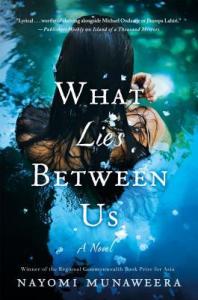
What Lies Between Us by Nayomi Munaweera

I came across this title on the Goodreads List below, Anticipated Literary Reads for Readers of Colour which is an excellent source for finding out books that are due to be published soon that might be written by authors from different cultures and traditions than those we generally find on the bestseller tables in bookshops.

GR Cultural Reads 2016

Nayomi Munaweera’s novel, at Number 2 on the list, stands out immediately with one of the most enticing covers I have seen for a long time and it lives up to that promise of an alluring appearance with a dark, mysterious reveal.

What Lies Between UsThe cover is an apt metaphor of the book, where water plays a significant role in multiple turning points in the novel and the image of a woman half-submerged, reminds me of that ability a person has of appearing to cope and be present on and above the surface, when beneath that calm exterior, below in the murky depths, unseen elements apply pressure, disturbing the tranquil image.

The prologue mentions the maternal instinct of a mother, to sacrifice for her young, describing the aptly named moon bear due to the white shape on its chest, an animal that is hunted for medicinal purposes and capable of going to extremes in order to protect its young.

Structured into five parts, the book is written in the first person by an unnamed narrator, and opens from within a cell. We understand the protagonist is a woman who for her crime often receives hate mail from mothers and marriage proposals from men. She mentions atrocities from the civil war in her home country, stories she says she was detached from, suffering that was not hers.

‘They think that maybe growing up in a war-torn land planted this splinter of rage within me, like a needle hidden in my bloodstream. They think that all those years later, it was this long embedded splinter of repressed trauma that pierced the muscle of my heart and made me do this thing.’

From here, she begins to narrate her story, her confession:

‘…in the beginning, when I was the child and not yet the mother…’

tropical gardenWe arrive in a hill city of Kandy in Sri Lanka where she recounts her solitary, yet idyllic childhood, among the scent of tropical gardens, a big old house, ‘sweeping emerald lawns leading down to the rushing river‘ overlooked by monsoon clouds.

Her father is a historian, her mother elegant, beautiful, prone to mood swings, making her feel awkward, tongue-tied and self-conscious, unlike when she is in the garden with Samson, or in the kitchen with Sita, domestic servants with whom she feels more like herself.

Lulled by lyrical descriptive prose into this dreamy, idyllic childhood, albeit with somewhat detached parents, there develops a feeling of something being not quite right, the child’s perspective clouds reality, something haunts her and the reader, a sense of unease.

Tragedy hits the family and the girl and her mother move to America to live with her cousin, Aunt and Uncle.

‘How can I leave this patch of earth that has been mine? Samson taught me once that the hydrangea blooms in a range of shades depending on the soil it sinks its roots into. From faintest pink to darkest night blue, the flower reflects the acidity of its patch of earth. How am I different? This person I am, will I be killed in the transition across the planet? What new person will emerge in that other soil?’

Having always looked towards her cousin as the epitome of modern, something she aspired to, it is a shock to learn of her upcoming arranged marriage, she agrees to be bridesmaid, despite strong feelings to the contrary, grateful that her mother, though troubled, knows better than to push her daughter in this direction.

‘I am grateful for this. Amma might throw plates, lock herself in the bathroom for hours, and cut her wrists. She might scream and yell, but this is something she could not do, this selling of a child to the highest bidder. For once we are united.’

She will fall into the way of life of those who surround her, reinventing herself, almost becoming like one who was born there, if not for that backwash of childhood, that sometimes pushes its way back into her life, threatening to sweep her out of domestic bliss like a freak wave, dumping her mercilessly on the foreshore. As strange memories resurface, her carefully created new world begins to fall apart at the edges as she frantically tries to keep all that is precious to her together.

Nayomi Munaweera by Nathanael F. Trimboli

Nayomi Munaweera by Nathanael F. Trimboli

What Lies Between Us is a powerful, accomplished novel of parts that could be stories in themselves. Munaweera’s deft, lyrical prose lulls and transports the reader into an idyllic childhood of sweet-smelling tropical scents and beauty, open vistas, an enchanted natural world, only to be pulled up short by signs of disturbance, until in an instant they become tragic.

Slowly mother and daughter adapt to the new way of life, except the past will never leave them, it haunts them, consciously and sub-consciously, destroying precious moments and threatening to derail their lives completely.

Like Toni Morrison’s God Help the Child it is a novel highlighting the effect of childhood on an adult, how the past continues to affect the present and can take everyone along with it. It blinds us, and like an invisible cloak with far-reaching tentacles, it can reach into every pocket of our lives, dampening and rotting the good.

Heartbreaking, compelling, so unfair, it is also a story representing the very real cost of ignoring mild disturbances of mental health, portraying how easily they can evolve and transform into horrific tragedy, when left untreated or ignored, not to mention how unforgiving and despicable humanity can be in dealing with those affected by it.

Highly Recommended.

Nayomi Munaweera’s debut novel, Island of a Thousand Mirrors was long-listed for the Man Asia Literary Prize and the Dublin IMPAC Prize. It won the Commonwealth Regional Prize for Asia. I’ve ordered a copy and plan to read it this year as well. She and her family left war-torn Sri Lanka when she was three years old and moved to Nigeria and eventually to America.

Island of a Thousand Mirrors


Brother, I’m Dying by Edwidge Danticat

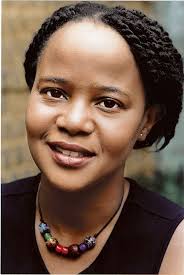
Brother Im DyingI first read Haitian author, Edwidge Danticat last summer, her novel Breath, Eyes, Memory (review linked below) about a young girl living with her Aunt in Haiti, while her mother lived in New York, a little like the life of the author herself, much of which is revealed in this non-fiction title, Brother, I’m Dying where we learn more about her life, though the primary focus is on her father Mira and in particular, her Uncle Joseph.
After having read a number of books in the Caribbean tradition recently, it is both unique and a gesture of deep reverence to read about the special connection between a daughter and her two fathers, for she sees both these men, and rightfully so, as her fathers.

The novel opens on the day of two discoveries, the author learns she is pregnant with her first child and hears that her father has been diagnosed with a terminal illness. The pulmonary disorder had required him to take medicine (containing codeine) resulting in his taxi licence being revoked. The medicine did nothing to alleviate his symptoms, worse it lost him his job and his dignity.

The chapters alternate between their present life in America and the author’s early life in Haiti, recounting the lives of the two brothers. We come to understand the lives they create from the choices they made, how they reinvent themselves, the obstacles they face, whether it’s family, work, the establishment, or navigating the political and legal demands of the countries they inhabit.

Mira leaves Haiti to create a better life in America for his family, a departure the author has no memory of, though her Uncle Joseph’s adopted daughter Marie Micheline shared stories with her, in a tradition common to people like her, anecdotes of poignant memories for those that have been left, to serve as reassurance that they were and are loved.

“Unfortunately I wasn’t told many stories like that. What I did often hear about was the future, an undetermined time when my father would send for my mother, Bob and me.”

Life was difficult for her mother and she often left the children with her brother-in-law to ensure the children had a decent meal. Then two years after her father left, when she was four and Bob was two, her mother’s visa was approved and she too departed, alone.

The two children became very attached to their Aunt and Uncle, while they waited out the nine long years before they too could make their eventual transition to join their parents in New York. Finally happening when Edwidge was twelve years old, it would be an even greater emotional challenge, not least because they had two younger brothers born in the US, one of whom believed he was the rightful, elder child of the family.

Back in Haiti, Joseph’s voice had begun to quiver, it worried him so he travelled to a hospital where US doctors were visiting, learning of a suspected tumour that would block his airways and suffocate him if not removed. It could be extracted in the US, but so too with it, would be his voice, reduced to a bare whisper, a death-knell for a pastor.

Almost like a miracle, on a subsequent visit for a check-up, he is shown a contraption he can use to amplify his whispers and allow people to hear him.

“My father took my uncle’s hand and led him to a lamp in a corner of the room, so he could better see the machine and its interaction with my uncle’s neck. This was their first two-sided conversation in many years and they both seemed to want to move it past the technicalities to a point of near normalcy.”

Edwidge Danticat

Edwidge Danticat

The one thing that remains constant throughout their long separation, is their love and respect for each other, as witnessed and shared through the eyes of their daughter and niece.

Edwidge Danticat writes in such an honest and compassionate way, you can’t help but become drawn into their story and feel concern at the various dramatic points that arise, willing things to turn out for the best – except that’s not what happens in real life – in reality, not everything will turn out as we will it to, but the memories will remain and the experiences contribute to forming the characters that we become.

It is a credit to the author to have chosen to share something of her life, her early childhood, without elevating herself as the main character of interest, it is both a story and a tribute to the extended family and the men who tried to lead them to live in safety.

The brothers chose different paths, one deciding to leave, the other to stay and though they were separated for 30 years their relationship remained strong, seeing each other as often as they could and keeping this strong connection between all the extended members of the family and their birth country.

As Cristina García, author of Dreaming in Cuban (one of my Top 5 Fiction Reads of 2015) put it:

“Edwidge Danticat’s moving tale of two remarkable brothers – her own father  and her beloved Uncle Joseph, separated for thirty years – is as compelling and richly told as her fiction. Politically charged and sadly unforgettable, their stories will lodge themselves in your heart.”

Breath Eyes Memory

A wonderful book, an honest portrayal of lives, where joy and struggle go hand in hand, where fear is never far from the front gate and sadness its companion, yet full of hope and spiritedness as an eighty-one-year old man refuses to let thugs take all that he has, and even though he risks his life, he will continue to pursue with righteousness, what is necessary in his own country to ensure justice. Which only serves to make what follows so immensely tragic.

A 5 star must read for me.

Further Links:

Edwidge Danticat, my review of Breath, Eyes, Memory

Cristina García, my review of Dreaming in Cuban

Fates and Furies by Lauren Groff

Delicate Edible BirdsIt feels like I have been watching Lauren Groff from the sidelines for a long time. One of my favourite bloggers Cassie*, wrote a passionate review about Groff’s book of short stories Delicate, Edible Birds which she gave the byline Dear Lauren Groff, I’m Obsessed With You – I loved her review and her twenty-something passion and thought I must read it.
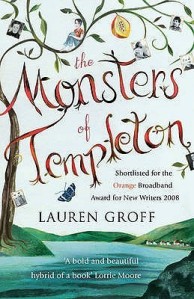
Monsters TempletonI even took her novel The Monsters of Templeton out from the library, yes, they had a copy on the few English shelves of the French library, it sounded like a fun read, sort of Lochness monster-ish – however I didn’t get around to reading, I returned it and I visit it often when I get the inclination to go to the library, not because I need any more books, but because it’s one of the best places to view books – you know like shoppers go window shopping – book nerds visit libraries and book shops just to be around them, without always needing to consume.
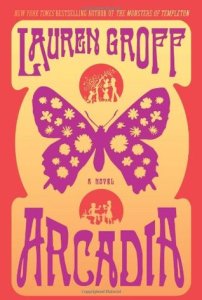
ArcadiaThen there was Arcadia, I have it on kindle and have been meaning to read that too – a hippy story from the 1960’s – that too languishes unread.
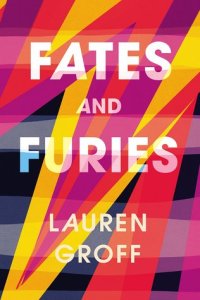
And finally Fates and Furies comes along and I think, maybe this time, I’ll read this one, it sounds interesting, look here’s the blurb from Goodreads:

Every story has two sides. Every relationship has two perspectives. And sometimes, it turns out, the key to a great marriage is not its truths but its secrets. At the core of this rich, expansive, layered novel, Lauren Groff presents the story of one such marriage over the course of twenty-four years.

But I’m suspicious, Cassie hasn’t read it, or if she has, she’s resting silent on the subject of Fates and Furies. So then President Obama goes and reads it. And tells everyone it’s his book of the year. Ok, it’s going to become a bestseller, I’ll read it. I will. So I do.

Fates and Furies

TheFates and Furies first half is about Lotto (nickname for Lancelot), a man cruising through life without looking back, the very few times he does, he realises how alone he really is. It is not a pleasant feeling, it is one he wishes to drown in whatever is to hand – in his boarding school that feeling nearly did kill him, but then he discovered girls, a never-ending supply of them, that worked – then he met Mathilde and she provoked in him such a strong feeling, he made her his wife, she was all the girl he wanted and needed and she appeared to need him as much as he needed her. She was hungry for him too.

He never acknowledges his own role in creating the circumstance that lead to his isolation, his mother in order to keep him out of trouble, after a serious incident in his early teens to do with a girl and a fire, sends him away to school. It’s a separation that will endure, for Lotto will never return, nor will he make any gesture or voice any words whatsoever towards his mother.

School is not good, as he lurches from suicidal to promiscuous to married at 22-years-old and pursuing a struggling acting career which morphs with Mathilde’s help into writing plays for theatre. Mathilde supports him, seemingly without complaint, he refers to her often physically, narrating his life as series of sexual encounters with his wife.

After all the parties, making up for his lack of professional success, he becomes absorbed by his writing and develops an obsession for a young musician, a turning point in the relationship between he and his wife.

And so to Furies, in which we encounter Mathilde and discover that this marriage seen through the lens of the wife, is something quite different, naturally she has had a different upbringing, raised in the north of France and separated from her family at a young age due to an unforgiveable act.

Mathilde eventually comes to America and lives under circumstances that ensure she must be damaged mentally, no one could live what she did without being affected by it, she learns at a young age to conceal her reactions and emotions.

Ultimately, the novel illustrates the secrets and lies and deceptions of marriage or of any relationship, the fact that as humans, we guard certain things about ourselves and we never truly know each other, or what each other is thinking, not just because of this propensity to conceal, but due to varying degrees of narcissism. Sigmund Freud believed that some narcissism is an essential part of all of us from birth, while Andrew Morrison claims that a reasonable amount of healthy narcissism allows the individual’s perception of their needs to be balanced in relation to others. So we all have it!

I enjoyed the first half because I started to imagine the big surprise we were going to get when we got inside Mathilde’s story. I didn’t care much for the character of Lotto, he wasn’t a creation that I could relate to, though I was easily able to put that aside, in anticipation of what was to come.

It’s a novel of marriage, but it’s no Anne Tyler, it’s not realism, they’re the stories of two characters, whose lives are far-fetched, and when they intersect, are used to illustrate a number of points. Unfortunately, I kind of lost interest in Mathilde’s story which drew me away from the kind of reflection I was imagining. It’s a book in which readers fall into two diametrically opposed camps.

Quite honestly, I don’t know what it was telling us, maybe something about the randomness or otherwise of who we hook up with, the dependency that develops. I just wish the characters had been a little more ordinary.

Barack Obama wasn’t the only one sharing his favourite read of 2015, his wife Michelle Obama The Lightalso chose a book about marriage, one I think might be more my cup of tea, it was the poet Elizabeth Alexander’s memoir The Light of the World, a woman writing about being at the existential crossroads after the death of her husband.

There is a short book/analysis of Fates and Furies written by BookaDay in which it is said:

Fates and Furies is not a story about a marriage – it is a story about two people and how their marriage determines the trajectory of their lives.

Notes

This book was an ARC (Advance Reader Copy) kindly provided by the publisher via Netgalley.

*Cassie may appear from the title to be a fangirl, however she understood and L O V E D and wrote a fabulous review of Keri Hulme’s The Bone People, not an easy feat – I’ve been following her reviews ever since. Here’s her favourite quote from the book:

“But there’s no compass for my disoriented soul, only ever-beckoning ghost lights.”

Happiness is an Inside Job by Sylvia Boorstein and the joy of reading books by The 14th Dalai Lama

Sylvia Boorstein’s Happiness is an Inside Job is an easy-reading distillation of the key components of Buddhist thought and practise shared through a lifetime of experiences.

The Dalai Lama

The Dalai Lama

“We’ll start as the Buddha did in his declaration of what is fundamentally true about life, with the premise that challenges in life are inevitable and that suffering, the mind in contentious mode with its experience, is the instinctive response of the untrained mind.

These premises are the first two of the famous Four Noble Truths regarded as the summation of the Buddha’s teaching.

The third truth is the definite promise that a peaceful mind, one not in contention with anything, is a possibility for human beings.

The fourth truth is the Buddha’s training program for developing that kind of mind.”

That training is basically about how to cultivate what we call ‘equanimity’, that ability to be in a situation and at the same time, be outside the situation observing it happening and our response to it, learning to use that ability to shape how we respond, from one of the great Buddhist intellects living today.

Boorstein’s book (reviewed below) talks us through the various components of developing and nurturing that wisdom, using examples from her and her friend’s lives. Before reviewing that text, and to give it context from my own personal reading, I share below a few enlightened books I’ve read over the years that penetrate this wisdom with clarity, insight and offer helpful and realistic suggestions for their practical application.

The 14th Dalai Lama

Some of my favourite books are those written by the 14th Dalai Lama, spiritual leader of Tibet, holder of the Nobel Peace prize, philosopher, intellectual, a genuinely altruistic man of great wisdom and compassion.

Many of them I pass on to others as they are too full of penetrating insights and ideas for changing our thinking in a positive way, to let waste away on a dusty shelf.  I thought I’d share three that come immediately to mind, because they each had a significant impact when I read them:

Transforming the MindTransforming the Mind: Teachings on generating compassion – this one is based on an edited series of lectures and is full of excellent practical advice and mind training on how to modify our perceptions to create a more compassionate view. This is his most important work in my opinion, it has some philosophical sections that are a little harder to grasp, but it is so worth persevering to get to the real wisdom within.
I remember when I read it, how well it resonated and how much I learned and was able to apply, it was quite a revelation the first time I read it. Such a gift.

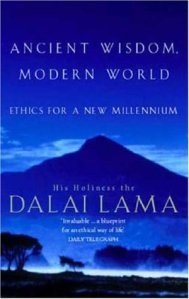
Ancient WisdomAncient Wisdom, Modern World Ethics for the New Millennium was published just before the millennium, a beautiful, small hard-cover book that reached out to all beings, not just those interested in Buddhism, addressing the spiritual void in a non-religious way and bringing attention to ethics and to finding new ways of living that avoid destroying nature and the environment, protecting our shared inheritance.

I remember that this was the first book of his, that I felt completely comfortable handing on to almost anyone, it surpassed belief and spoke to us all, no matter what our faith or spiritual inclination, this is an important and accessible message for humanity.

How to See YourselfHow to See Yourself As You Really Are – this book is a lighter, practical guide to understand the nature of self, examining how many of the things we currently believe to be solid are an illusion and that by appreciating this, we can learn how to minimise suffering.

His older books tend to be more philosophical and can at times be a challenge to understand the way of thinking, all of which is encouraged in Buddhist thought – that we should question in order to understand – however this book is more of a modern interpretation, written not for the scholar or practitioner but for anyone with an interest in self-improvement and understanding the mind.

By the time I read this one, I recognised much of the message, it wasn’t so new to me, I was already living it, but we always need reminding and encouraging, as the path is littered with obstacles!

Review: Happiness is an Inside Job

HappinessThis book was a delightful Christmas gift I was promised I would enjoy, described by Publishers Weekly as:
‘a small, polished gem of a book’

I had not heard of Sylvia Boorstein, one of the co-founding teachers at Spirit Rock Meditation Centre in California. She has written a number of books on Buddhist thinking, meditation, mindfulness and kindness.

In Happiness is an Inside Job, she shows how mindfulness, concentration, and effort–three elements of the Buddhist path to wisdom–can lead us away from anger, anxiety, and confusion, and into calmness, clarity, and the joy of living in the present.

Split into sections on equanimity, wise effort (and speech), mindfulness, and concentration it uses anecdotes and examples in everyday life to illustrate how to put this philosophy of compassion into practice.

It sounds like common sense and indeed it is, however the mind often loses track and imagines, worries, obsesses and does everything but choose the path of common sense and we often need to be reminded of the most simple observations to declutter it.

She reminds us that much that happens in our lives is external to us and beyond our control, but that our response to it is within our ability to manage and there is much we can do to help ourselves by learning how to respond in a way that will calm and nurture us, that we can choose to respond in a way that veers more toward the path of happiness.

‘Speech that compliments is, by definition, free from derision, which clouds the mind with enemies and makes it tense. Kind speech makes the mind feel safe and also glad.’

It’s a book to read a chapter at a time, not all at once, an alternative to the demands of fiction, more nourishing than television, food for the soul. Recommended as an introduction to Buddhist thought and the benefits of practising compassion.

“My practise is remembering that although whatever is happening, including my emotional response to it, is the lawful consequence of myriad causes that are beyond my control, the relationship I hold toward it all is within my control. I can choose on behalf of happiness.”

Two Serious Ladies (1943) by Jane Bowles

Bellezza who reviews at Dolce Bellezza (click on words or image below to visit) and reads a lot of interesting literary and translated fiction, recently invited me to join her and a few others to read Two Serious Ladies by Jane Bowles.

DolceBellezza

I didn’t know anything about the book, but I liked the idea of a January readalong, the last one I participated in was Pushkin’s Eugene Onegin in January 2014 and it became one of my Top Reads of 2014!

Background

Jane Bowles was married to the composer, writer and translator Paul Bowles (author of the 1949 classic, post-colonial alienation and existential despair novel The Sheltering Sky). They were part of avant-garde literary circles in their home town of New York and adopted homes of Paris, Mexico and Tangiers, known as well for their bohemian lifestyle as their literary success’.

Two Serious LadiesJane Bowles (born in New York City, Feb 1917) wrote one novel, a play and six short stories. The novel Two Serious Ladies, though panned at the time, (critic Edith Walton writing in the Times Book Review didn’t understand it, calling it ‘senseless and silly’), became regarded as a modernist, cult classic, helped when Tennessee Williams named it his favourite book.

She was famous as the enigmatic and entertaining half of a celebrated couple, for her near permanent writer’s block, her daring attitude to life, and her provocative relationships with women.

Both husband and wife, though dedicated to each other, indulged same-sex relations with others outside their marriage; notable was the relationship Jane Bowles developed with Cherifa, a Moroccan peasant, the only woman in Tangier to run her own market stand. They are photographed; Jane, wearing a white, sleeveless short dress walks on the arm of Cherifa, cloaked in a black niqab, wearing dark sunglasses (said to carry a knife beneath her robes for protection). See the photo in The New Yorker article linked below.

Review

Two Serious Ladies introduces us to two characters Christina Goering, daughter of a powerful industrialist, now a well-heeled spinster, adrift and bored with her comfortable, predictable existence and Frieda Copperfield, married to a man who pursues travel and adventure, dragging his wife (who funds this insatiable desire) out of her comfort zone, to the untouristed, red-lit parts of Panama, where she finds solace and digs her heels in, at the bar/hotel of Madame Quill, befriending the young prostitute Pacifica.

Christina, referred to as Miss Goering and Frieda, Mrs Copperfield, acquaintances, meet briefly at a party and will come together again briefly at the end, both having had separate life-changing adventures, driven by a latent, sub-conscious desire to radically change their situations, both of which come about in a random, haphazard way.

Miss Goering invites a companion Miss Gamelon, to move into her comfortable home and at the party where she encounters Mrs Copperfield, she meets Arnold. Though she doesn’t particularly like either of these characters, when she decides to sell her palatial home and move to a run-down house on a nearby island, they agree to come with her. Neither are enamoured of her decision, to remove them from her previous comforts, which they were quite enjoying.

“In my opinion,” said Miss Gamelon, “you could perfectly well work out your salvation during certain hours of the day without having to move everything.”

“The idea,” said Miss Goering, “is to change first of our own volition and according to our own inner promptings before they impose completely arbitrary changes on us.”

Once on the island, still restless, she abandons her invitees and takes the ferry to the mainland, opening herself up to whatever random encounters await her, as if seeking her destiny or some kind of understanding through a series of desperate and reckless acts.

Jane Bowles

Jane Bowles

Mrs Copperfield seems less to seek out the depraved, than be attracted by a perceived sense of belonging, she spurns the comfortable, pretentious trappings of the Hotel Washington, declines to go walking in the jungle with her husband and instead takes the bus back to the women she has met at the Hotel les Palmas whom she feels an affinity with, despite their lives of poverty and prostitution being so far removed from her own. She recognises they possess a kind of freedom and strength she lacks; in their presence, she begins to feel energised and empowered.

It is a strange book at first, it requires finishing and reflecting upon to figure out what it was all about. It is recounted in a straight forward style, we observe the actions of the two women without reflection on their part, making it necessary to unravel their intentions, which inevitably becomes a matter of reader interpretation, to find the meaning, if indeed there is any.

For me, it was clear the women lacked something significant in their lives, in their existence, even if they were unable to articulate it or even search appropriately for it, they sensed something missing in their lives of privilege and sought it among the downtrodden. They were experiencing an existential crisis.

In terms of style, the writing has been described as elliptical prose, a term I looked up, coined in 1946 by Frederick Pottle who used elliptical to refer to a kind of pure poetry that omits prosaic information, providing the possibility of intensity through obscurity and elimination.

@Jimthomsen on twitter asked the same question and got this response:

Meaning, there’s much that isn’t said or thought or written and more that might be implied, discovered between the lines. A form of literary diet perhaps? I do prefer plain language.

Bowles takes two female characters from a similar social class (similar to her own) dissecting a woman’s presence and existence in society in a form of confrontational daring that was liable to elicit both scorn and eye-brow raising in her own time and continues to provoke a certain amount of bemusement in our own.

“I know I am as guilty as I can be, but I have my happiness which I guard like a wolf, and I have authority now and a certain amount of daring, which I never had before.” – Mrs Copperfield

Reading it alongside the life of Jane Bowles, was a pleasure, I enjoyed reading it and taking the extra time to understand the context within which it was written.

Thanks Bellezza for the invitation, I look forward to reading everyone else’s reviews!

Links

The Madness of Queen Jane – Article in The New Yorker, by Negar Azimi June 12, 2014

A Short Biography of Jane Bowles by Millicent Dillon

Other Reviewers Reading & Reviewing Two Serious Ladies – Scott, Frances, Dorian, and Laurie

Charming Billy by Alice McDermott

Charming Billy was the last book I read, as 2015 came to a close and a fitting end it was, as it opens at the funeral and wake of a man called Billy, a man who over-comforted himself with drink, for reasons that everyone present was happy to speculate on, most of them coming to the conclusion , that he’d never got over the fiancée that returned to Ireland with his ring and a promise to join him soon.

Close friends and family come together to mourn and remember Billy, this man of Irish descent who fell for Eva one summer, who promised himself to her and sent her the money he’d borrowed from his new boss, so she could return to him after she went back to Ireland.

It had been a short romance, but one that everyone present at his wake had an opinion on, yet no one appeared to have known the full truth of what really transpired. This becomes even more clear as the novel progresses towards the memory of Billy’s trip to Ireland about 30 years later, truth confronting him in a way grief could not.

Charming BillyThe novel unfolds and weaves like threads in a tapestry, as characters share their understanding of Billy, their memories of his charm and inclinations and what they knew about the short-lived romance with the Irish girl Eva.

They debate whether Billy’s demise and descent into alcoholism was part of who he was or the consequence of the heartbreak he had endured over the years, despite his marriage to Maeve, the widow, like wallpaper adorning the kitchen, witnesses all, but sits quietly in the background of this narrative.

“There was tremendous affection in Billy’s eyes, or at least they held a tremendous offer of affection, a tremendous willingness to find whomever he was talking to bright and witty and better than most.”

Slowly it creates a picture of a life and all lives, how they are formed, changed, steered by certain events, fractured by grief, sustained by community, vulnerable to and comforted by addiction, driven by faith, seduced by deception.

‘In the arc of an unremarkable life, a life whose triumphs are small and personal, whose trials are ordinary enough, as tempered in their pain as in their resolution of pain, the claim of exclusivity in love requires both a certain kind of courage and a good dose of delusion.’

Much of the novel is narrated by the daughter of Dennis, Billy’s cousin. Dennis was close to Billy, they were together when that summer when they met the two girls Mary and Eva, at Dennis’s mother and stepmother’s holiday home, a place Billy would never return to, perhaps due to those memories, and a location that provides something of a twist near the end.

A nostalgic tale, imbued with sadness, post war expectations and a new world Irish charm, it carries a sense of stepping back in time, of being on the threshold of a new modern era, Billy, one of the last links to a bygone era.

It read like a tapestry, one story viewed through various perspectives, so we go over events again and again, as seen by numerous characters, like colourful threads in a tableau.

I picked this book up from the library after it had been highly recommended to me, I have another of her books on the shelf Someone, a 1920’s Irish-American coming-of-age portrait of a woman’s life through childhood, adolescence, motherhood and old age.

Have you read any of Alice McDermott’s work?

February by Lisa Moore

FebruaryFebruary is a novel constructed around a real and tragic historical event that occurred in Newfoundland, Canada just over thirty years ago, a tragedy that remains deeply felt in the area today. All Newfoundlanders of a certain age, remember where they were on the night the Ocean Ranger sank, a technological wonder that was supposed to be unsinkable, one that if safety procedures had been followed, indeed, may not have done so.

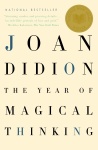
The book was longlisted for the Man Booker Prize in 2010. The cover doesn’t tell us much about the scope of this novel, I expect it represents the protagonist Helen, at about the age she must have been, in her 30’s when she learned she had lost her husband at sea.

From Wikipedia:

Ocean Ranger was a semi-submersible mobile offshore drilling unit that sank in Canadian waters on 15 February 1982. It was drilling an exploration well on the Grand Banks of Newfoundland, 267 kilometres (166 mi) east of St. John’s, Newfoundland, for Mobil Oil of Canada, Ltd. with 84 crew members on board when it disappeared. There were no survivors.

OceanRanger

‘Ocean Ranger Oil Rig’ – Licensed under Fair use via Wikipedia

It was the day after Valentine’s Day, Helen, received a card from her husband Cal, a day or so later. Cal’s mother phoned the Coast guard and shouted at them, saying they’d got it wrong. If the men were dead the company would have informed the families.

Helen knows in her heart it is true, but she needs the body of her husband. Her father-in-law convinces her that she doesn’t want to remember him that way.

‘There were people who went on hoping for months. They said there must be some island out there, and that’s where the survivors were. There was no island. Everybody knew there was no island. It was impossible. People who knew the coast like the back of their hand. But they thought an island might exist that they hadn’t noticed before.’

At night she dreams of him and believes he wishes her to join him.

‘How awful. Death has made him selfish.

Forget the children. This is what he means. Forget yourself. Come with me. Don’t you want to know what happened?

She feels as though she is betraying him by staying. It is relentless and exhausting, every time she says no him, she forgets him a little more.

The novel moves between the 1970’s when she and Cal were married to October, November 2008, the present, when Helen awaits the arrival of her son John, who has called from Tasmania, Australia to tell her he is going to become a father.

Helen is kept busy running her own dressmaking business and at the insistence of her sister Louise, is having her floors replaced by Barry. She doesn’t want the job to end, she becomes used to his presence, his ignorance of her. It makes her desire him.

John’s story also moves between 2008 and the mid 90’s when he makes a career change, becoming an engineer for the same industry that took the life of his father. He has had a high risk job and never wanted to become a father. The novel gives more space to John and the mother of his soon to be born child, Jane, while giving little space to the two daughters, who appear on the fringes, are not close to their mother, nor developed with much depth.

‘John has avoided being a father all his adult life. It has taken stealth and some underhandedness. It has taken clarity of purpose when the moment called for dreamy abandon. He has practised withdrawal. He has kept what he wants, what he actually wants for his life, in the centre of his thoughts, even while in the throes of orgasm. He’s kept a tight fist on the reins of himself.’

February is a brilliantly constructed  and thought-provoking vision of one woman’s grief in the wake of her husband’s death, leaving her pregnant and with three children to raise. It illustrates the way this event and the memories it triggers, return in waves from that point forward, that death is not really death, it is a form of ever-present, albeit fading memory.

While never overly melancholic, Helen’s recollections and reconstructions of what may have happened to her husband in those last minutes, her studying of the manuals to understand how to resolve the problem that caused the sinking, reminded me of Joan Didion’s study and reliving of her own husband’s death in The Year of Magical Thinking (2005).

However life continues on and around Helen and those quotidian narratives reminded me of the work of Anne Tyler as we see-saw between the practical elements of daily life and the introspection of a death that stays with someone their entire life and in those still moments, returns as potently, as if it were yesterday.

Moore lost her father a few years before the Ocean Ranger sank, she was 16 and her sister 12, giving her first hand experience of how grief works it way through a family, how it makes and shapes the lives of those left behind, an experience that enriches the novel and brings it alive, makes it feel authentic.

Quietly compelling, highly recommended.

‘I think the most important thing I’ve learned about grief – and coming through it – is that you don’t forget the person you’ve lost. Rather, the memories become sharper, gather new meaning, and are richer over time. The absent become more present, not less so, as time goes on.’ Lisa Moore, extract from an interview with Bookgroup.info


The Gift of Stones by Jim Crace

The Gift of StonesFrom whispering muse to the gift of stones, this was the second book I read in 2016, one of Jim Crace’s earlier philosophical works, telling the tale of a village of stone workers, who live a simple life working stone into weapons, which are then traded with passers-by for food and other essentials, which they are not able to provide for themselves, in the arid landscape within which they reside. It is a livelihood they think little about, it is all they know.

A boy’s destiny is changed after he is injured in the arm by an arrow. The arrow is a symbol of change and both opens and closes this short, though provoking novella.

The injury becomes a turning point for a boy, his arm partially amputated, making him unable to follow in the village tradition, he must find another way of contributing to his community. His predicament is a foretelling of what is to come, but first he alone must learn to adapt.

He ventures outside, further from the village than anyone has ever been, near the sea and the heath, bringing them tales of beyond, discovering the allure and power of imagination. Experiencing things and feelings he has never encountered.

Already an orphan living with his uncle in a stone age village of people who work with flint, his injury turns him into a storyteller, inspired by his walks along the coastline towards the heath where he meets a woman with her baby living alone in a hut. He discovers how to captivate and amuse an audience, to take their minds off their day-to-day torments.

‘The paradox is this – we do love lies. The truth is dull and half-asleep. But lies are nimble, spirited, alive. And lying is a craft.’

He brings the woman back to the village, however she isn’t welcomed by the villagers, set in their ways. She too symbolises the lessons they must learn, though they will realise this much too late. When he tells the villagers her history, a truth, they become bored and turn away.

‘Quite soon they found it far too dark and cold to listen to my father any lore. They peeled away before the tale was done, unmoved by my father’s portrait of the widow and her child on the heath, her struggles not to die, her hardships, grief and hunger, the slaughter of the geese, the crushing of her hut. Quite soon there were no cousins left to hear my father’s tale. His audience – excluding bats and mother – had crept away, unamused and angered by the venom in his voice.

My father stood alone and startled – for now he understood the power of the truth.’

flint arrow head

It is a philosophical tale of unrequited love, abandonment, survival and the heralders of change, how communities react to the necessity to adjust, and to those who are different, outsiders.

It touches on the role of imagination and storytelling, not just as entertainment and a craft, but as those who foresee change, create invention, imagine other ways of life.

Poignant and intriguing, given the era within which it is set and a kind of tribute to the greater importance of storytelling within society.