
 Astonishing, a work of art, an interwoven tapestry of stories that weave across the generations to create something so beautiful, so heartfelt, the thing that connects them is so strong, even when it isn’t known by its characters, somehow Yaa Gyasi conveys that to the reader, so that by the end when something quite magical happens, there is a feeling of grieving for all that has passed and of relief that something new has been found.
I love, love, loved this novel and I am in awe of its structure and storytelling, the authenticity of the stories, the three-dimensional characters, the inheritance and reinvention of trauma, and the rounding of all those stories into the healing return. I never saw that ending coming and the build up of sadness from the stories of the last few characters made the last story all the more moving, I couldn’t stop the tears rolling down my face.
How to give it justice in a review, it is so much more than story, we are so much more than our own personal experience and the place(s) we have lived.
Novels That Ask Questions
Just as Han Kang, the South Korean author of the novel Human Acts wrote in consideration of two fundamental questions about humanity, Yaa Gyasi tells us in an article for the New York Times (referenced below) that she too began to write with a vague but important question that she put at the top of her blank screen: What does it mean to be black in America?
She further explains her inspiration in an article for the Observer (also below)
I began Homegoing in 2009 after a trip to Ghana’s Cape Coast Castle [where slaves were incarcerated]. The tour guide told us that British soldiers who lived and worked in the castle often married local women – something I didn’t know. I wanted to juxtapose two women – a soldier’s wife with a slave. I thought the novel would be traditionally structured, set in the present, with flashbacks to the 18th century. But the longer I worked, the more interested I became in being able to watch time as it moved, watch slavery and colonialism and their effects – I wanted to see the through-line.
The Legacy of Generations
Homegoing begins with the image of a partial family tree, with two strands and the novel will follow just one family member down each strand, the first two characters who begin these family lines are the daughters of Maame, Effia and Esi.
Effia, whom the villagers said was a baby born of the fire, believed she would marry the village chief, but would be married to a British slave trader and live upstairs in the Cape Coast Castle.
‘The night Effia Otcher was born into the musky heat of Fanteland, a fire raged through the woods just outside her father’s compound. It moved quickly, tearing a path for days. It lived off the air; it slept in caves and hid in trees; it burned, up and through, unconcerned with what wreckage it left behind, until it reached an Asante village. There, it disappeared, becoming one with the night.’
Effia’s father, Cobbe would lose his crop of yams that night, a precious crop known to sustain families far and wide and with it, through his mind would flit a premonition that would reverberate through subsequent generations:
He knew then that the memory of the fire that burned, then fled, would haunt him, his children, and his children’s children for as long as the line continued.’

Cape Coast Castle (a slave trading castle), Ghana
Esi, whose father was a Big Man, in expressing her empathy for their house girl, would precipitate events that lead her to be captured and chained in the dungeons beneath that same castle, awaiting the slave trading ships that would transport them to their slave masters in America.
‘They took them out into the light. The scent of ocean water hit her nose. The taste of salt clung to her throat. The soldiers marched them down to an open door that led to sand and water, and they all began to walk out on to it.’
Symbolism
In these first two chapters of Effia and Esi, the recurring twin symbols of fire and water are introduced, something that each generation subconsciously carries with them and passes on, they will reappear through fears, dreams, experiences, a kind of deep primal scar they don’t even know requires healing, its origins so far back, so removed from anything that can be easily articulated.
Fire (yang) is like the curse of the slave trade, raging through the lives of each generation, even when they appear to have escaped it, as with Kojo’s story, a baby passed to the arms of a woman who helped slaves escape, whose parents are captured, but he will live freely, only to have one member of the family cruelly snatched, perpetuating the cycle yet again, orphaning another child, who must start over and scrape together a life from nothing.
‘They didn’t now about Jo’s fear of people in uniform, didn’t know what it was like to lie silent and barely breathing under the floorboards of a Quaker house, listening to the sound of a catcher’s boot heel stomp above you. Jo had worked so hard so his children wouldn’t have to inherit his fear, but now he wished they had just the tiniest morsel of it.’
Water (yin) to me is the endless expanse, the rootlessness, floating on the surface, feet never able to get a grip, efforts floundering. This symbol is carried throughout Essi’s family line, a cast of characters whose wheels are turning, who work hard, but suffer one setback after another.
The novel is structured around one chapter for each character, alternately between the twin sides of the family, the narrative perspective changing to focus on the new generation, through whom we learn something of what happened to the character in the previous generation, who’ve we left two chapters ago.
Importantly, because Yaa Gyasi decides not to write in the present with flashbacks, but writes from the perspective of each character in their present, the novel never falters, it doesn’t suffer from the idling effect of flashbacks, it keeps up the pace by putting the reader at the centre of the drama in every chapter. We must live all of it.
The irony of the structure is that we read an entire family history and see how the events of the past affect the future, how patterns repeat, how fears are carried forward, how strong feelings are connected to roots and origins, we see it, while they experience the loss, the frustration, the inability to comprehend that it is not just the actions of one life that affect that life’s outcome.
This book is like a legacy, a long legacy that revolves between the sadness of loss and the human struggle to move forward, to survive, to do better, to improve. And also a legacy of the feeling of not belonging that is carried within those who have been uprooted, who no longer belong to one place or another, who if they are lucky might find someone to whom they can ignite or perhaps even extinguish that yearning ‘to belong’.
‘We can’t go back to something we ain’t never been to in the first place. It ain’t ours anymore. This is.’ She swept her hand in front of her, as though she were trying to catch all of Harlem in it, all of New York, all of America.’
And in writing this novel, Yaa Gyasi perhaps achieves something of what her final character Marcus is unable to articulate to Marjorie as to why his research feels futile, spurning his grandmother’s suggestion that he perhaps had the gift of visions, trying to find answers in a more tangible way, through research and study.
“What is the point Marcus?”
She stopped walking. For all they knew, they were standing on top of what used to be a coal mine for all the black convicts who had been conscripted to work there. It was one thing to research something, another thing entirely to have lived it. To have felt it. How could he explain to Marjorie that what he wanted to capture with his project was the feeling of time, of having been a part of something that stretched so far back, was so impossibly large, that it was easy to forget that she, and he, and everyone else, existed in it – not apart from it, but inside it.
Yes, she achieves it through literature, through fiction. And this is literature at its most powerful and best.
This novel is going to win awards in 2017, undoubtedly.
*****
Yaa Gyasi
Yaa Gyasi was born in Ghana in 1989 and raised in the US, moving around in early childhood but living in Huntsville, Alabama from the age of 10. She is the daughter of a francophone African literature professor and a nurse and completed her MFA at the Iowa Writer’s Workshop, University of Iowa. She wrote this, her debut novel at the age of 26.
Further Reading
New York Times, Sunday Review – Opinion, June 18, 2016 – I’m Ghanaian-American. Am I Black?
Review, The Observer, January 8, 2017 – Yaa Gyasi: ‘Slavery is on people’s minds. It affects us still’


 Australia is in the midst of coping with an extremely hot summer, Sydney and Brisbane experiencing the hottest January on record, February looking even hotter with the arrival of a heat wave and increased fire risks in Victoria and New South Wales (where currently 49 fires are burning across the state, 17 of which are not contained and the fire rating is at the level of “catastrophic”).
 he story follows Aaron Falk, a police officer from Melbourne, who returns to the town he and father were run out of many years back, for the funeral of his childhood friend Luke. It is clear he wants the visit over and done with as soon as possible and is unwilling to engage with anyone.
 But Jo Malone the girl, wasn’t born into luxury. She was an ordinary girl raised in a family that struggled a bit on the good days, and a lot on the bad days, which were often brought on by her doting father’s gambling inclinations, her mother’s over-spending habit and the pressure to work long hours to keep the family afloat.
 When she really began to play around with fragrance, demand began to rise more than she could cope with, and Gary suggested they embrace the business, move it to its own premise and open a shop. Her business was beginning to overwhelm their living condition, he recognised the potential and offered to commit himself wholeheartedly it. That would be the beginning of Jo Malone, her signature brand.
 From there, a whirlwind of events follow and she will partner up with a perfume house in Paris, turning her instinct into a viable, enduring product. She tried to put into words her creative process and it is fascinating when she does, for it is something that can’t be copied or cloned, it is an insight into the pure magic of creativity, of how she uses image, colour and experience to create a scent.


 I absolutely loved this book, from it’s at times heartbreaking accounts of struggle in childhood, to the discovery of her passion, the development of her creativity and the strong work ethic that carried her forward, to finding the perfect mate and the journey they would go on together.
 Swimming Lessons is an evocative, thought-provoking novel that begins with an intriguing mystery, evolving into melancholy as the events before and during Ingrid’s marriage, the wife of Gil and mother of two young girls who disappeared 12 years before, are revealed.
 After Gil’s sighting, events bring the family together, highlighting their similarities and differences, exposing various family secrets and lies and all the while, each letter like a dripping tap, one by one revealing more of the relationship between Ingrid, the young Norwegian university student and Gil, her literature professor and the very different path her life would take once their lives intertwined.
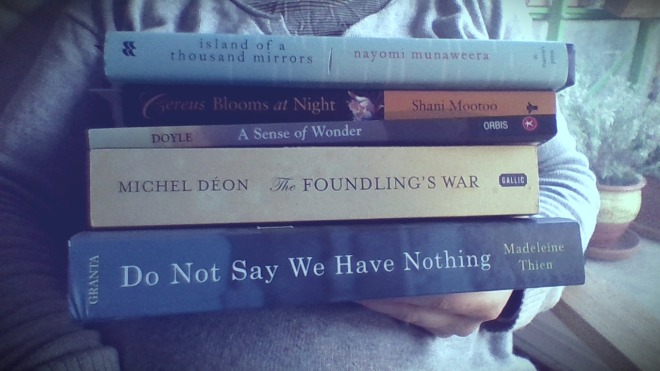
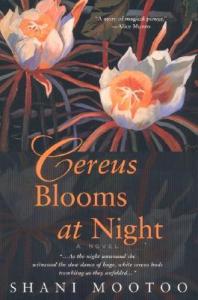 It is a novel narrated in parts, each part focusing on a character(s) who were influential in her life, including the young man who never knew her until this day, the one who became her confidant, perhaps the first man she ever trusted, after all that had passed beforehand. Much of it is told as Mala slips into memories of herself as child, reliving it.
 As Tyler gained her trust, Mala’s story is revealed to us through him and through the two visitors she received, who on her first day there, unable to see her, left a pot with a cutting of the fragrant night-blooming cereus plant, a gift that clearly delighted her, a symbol of fragrant, nurturing oblivion.

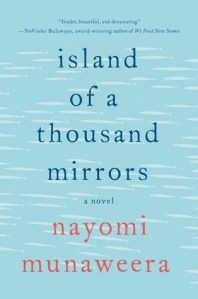 Island of a Thousand Mirrors similarly evokes the childhoods and family life of two families living in the same house. The house is owned by the matriarch Sylvia Sumethra and her husband The Judge, who are Sinhala people (an Indo-Aryan ethnic group originally from northern India, now native to and forming the majority (75%) of the population of Sri Lanka, mostly Buddhist) and upstairs they rent to an extended Tamil family (a culturally and linguistically distinct ethnic group native to Sri Lanka, mostly Hindu).


 Three Daughters of Eve
 Exit West
 The Good People
 Breaking Connections
 Train to Pakistan
 Written as a reflection on the death of her daughter at 39 years of age, the book begins as Didion thinks back to her daughter’s wedding seven years earlier, which then triggers other memories of her childhood, of family moments, of people and places, numerous hotels they have frequented.
 Although the main theme of the book is her daughter’s premature death, nowhere does she analyse or obsess about what actually happened in the way we vividly remember she did about her husband in My Year of Magical Thinking. Rather, the book appears to be as much an acknowledgement of her own ageing and decline, recognising and facing up to her own ‘frailty’, her obsession with her own health scares, recounting every little malfunction or symptom of a thing that never shows up on any of the numerous scans or tests she has. It is as if she writes her own denouement, to a death that never arrives, as the multitude and thoroughness of all the tests she has show how very much alive and in relative good health she is, despite herself.
 Word by Word