Train to Pakistan by Khushwant Singh

1947 Migration to Pakistan, wikipedia

There are so many tragic stories surrounding the independence of India and the formation of East and West Pakistan, or the 1947 partition, as it’s often referred to, sadly thousands that will never be told because there is no one left to tell them. It was a moment in history that demonstrated what happens to humanity when fear and panic take hold in the wake of political posturing and it is devastating.

Train to Pakistan was written in 1956, a mere nine years after the British drew a controversial line through India, sending Muslims to the newly named Pakistan and banishing Hindus and Sikhs from that territory.

The author, who died in 2014 at the age of 99, belonged to a Sikh family, with roots in the area that was to become Pakistan, was an outspoken critic of the establishment, intolerant of hypocrisy, who abandoned his studies in law and diplomacy to become a writer. Witness to killings on both sides of the India-Pakistan border, his novel is his reflection of events in that period in history, his frustration with various parties and people in positions of authority and a comment on the individual living in fear.
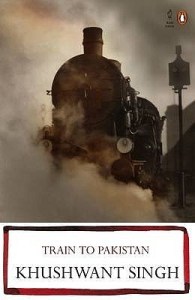
Khushwant Singh takes the Punjabi farming village of Mano Majra, a small village on the border between India and Pakistan, one of strategic importance to the railway system, and narrates the moment when news of this change arrives and shows how it affects this community.

The trains are symbolic to the story, portenders of what is to come; in the past they have run like clockwork and though they rarely stop, the lives of the villagers is intricately linked to their passing. When the trains become delayed, the rhythm of the village gets out of sync and worse when the trains begin to stop in Mano Majra, life will never be the same.

An educated young man named Iqbal arrives from Delhi, sent by his party to observe the impact of the news.

Well, Babuji,’ began the Muslim. ‘Tell us something. What is happening in the world?
What is all this about Pakistan and Hindustan?
‘We live in this little village and know nothing,’ the lambardar put in. ‘Babuji, tell us, why did the English leave?’

The villagers aren’t convinced by Iqbal’s idealistic view that freedom will follow Independence.

‘Why, don’t you people want to be free? Do you want to remain slaves all your lives?
After a long silence the lambardar (Headman/Revenue collector) answered: ‘Freedom must be a good thing. But what will we get out of it? Educated people like you, Babu Sahib, will get the jobs the English had. Will we get more land or more buffaloes?
‘No,’ the Muslim said. ‘Freedom is for the educated people who fought for it. We were slaves of the English, now we will be slaves of the educated Indians – or the Pakistanis.’

Iqbal and a young local man are wrongly arrested for a murder just as the village arrives as a point where it can longer deny what is happening elsewhere in the country. The town’s Muslims are told to leave and eerily quiet trains begin to arrive in the village, causing consternation and fear. The fate of the two young men becomes a political consideration, justice playing no role. It builds to a terrible climax and will leave them and generations to follow scarred by the experience.

Brilliant, a compelling read, and one that was relatively respectful to all who were affected and to readers with vivid imaginations, who don’t need certain scenes described in overly graphic detail.

Buy a Copy of The Train to Pakistan via Book Depository

Further Reading:

Obituary: Khushwant Singh by Reginald Massey

Partition: 70 years On – Authors consider its legacy and the crises now facing their countries

– featuring Kamila Shamsie, Mohsin Hamid, Tahmima Anam, Fatima Bhutto, Kiran Desai, Pankaj Mishra and others

All We Shall Know by Donal Ryan

Donal Ryan is the Irish author many of us remember for his debut The Spinning Heart, long listed for the Man Booker Prize in 2013 (won that year by Eleanor Catton’s, The Luminaries) and noted for perseverance in pursuing his dream to become a published author – his manuscript was rejected 47 times – before becoming a word of mouth sensation and setting him firmly on the track he knew he was destined for.

Since then he has published The Thing About December and A Slanting of the Sun: Stories and now this riveting novel, which was easily a five star read for me. I liked his debut, but this I loved and did not want to put down.

Similar in style to his earlier work, in which he zooms in on the minutiae of life and thoughts of a character(s) in the wake of a pivotal event, here he focuses on one character, Melody, a thirty-three-year woman, whose marriage has become like a habit she wants to kick, but rather than seek help to heal the cracks, she gives in to an impulse and finds herself pregnant to her 17-year-old private student, Martin Toppy, from a Traveller community.

Courageously, Ryan assumes the first person narrative voice of a pregnant woman, the first chapter labelled week twelve, finishing with Post-partum, though this is not a woman obsessed with what is going on inside her body, it’s a woman in the throes of needing to build a nest.  Alone with her thoughts, she thinks back over how she came to be where she is now, interrupted often by memories of her best friend Breedie.

“I’d look at Breedie’s long bare arms, and long legs, and I’d feel a fizzing mixture of admiration and love and terrible envy, that she could make my mother smile and wish she had a daughter like a swan.”

Into this isolation comes another Traveller, partially rejected by her family and community, whom Melody befriends and becomes attached to, picking up her teaching with Mary, where she left off with Martin. Here’s their encounter when they first meet:

You can come into town with me now, if you want.

I can’t. There’d be murder. I’m been watched every single second.

Why did your sisters leave you out?

I’m a shame to the family.

And she told me a story, and I listened, and I didn’t interrupt her once. Her name is Mary Crothery, and she’s nineteen years old.

The language, their way of speaking, the dialogue is raw, visceral and puts the reader right inside the story, it easily evokes a sense of place, you can sense the attitude of the characters around Melody as soon as they rap their knuckles on the door. Mostly they’re angry, except her father, he’s sad and in fear of disappointing him further, Melody stays away from where she’d be most welcome.

“Thinking now about the way I thought about things then, about how I let my mother’s anger towards him seep into me, I feel a desperate need to apologise, to mitigate the hurt I must have caused him as I drew away from him, as I let my perfect love for him be sullied, and eroded, and disintegrated, by the coldness of a woman I didn’t even really like, but whom I wanted more than anything to be like.”

The weeks pass leading to a crisis point as Melody’s life and that of the Traveller community intersects, highlighting family grudges, betrayals, their battles for redemption and overcoming guilt.

Irish Travellers

It is interesting that Donal Ryan chose to highlight characters from within the Irish Traveller community, as 2017 was a significant year in terms of identity for them. There are estimated to be between 29,000 – 40,000 Travellers in Ireland, representing 0.6% of the population. Recent DNA research has proven they are as genetically different from the settled Irish as they are from the Spanish and that this difference may have emerged up to 12 generations ago, as far back as 1657.

Irish Travellers, sometimes pejoratively referred to as tinkers or gypsies are a traditionally itinerant ethnic group who maintain a set of traditions, who after years of lobbying, finally gained recognition of their ethnic status from the government. It is seen as a momentous victory for the thousands of Traveller children who have long suffered from  exclusion and discrimination.

It’s an engaging story, beautifully rendered and while it doesn’t promise to address all the issues it raises, it does what for me the best novels do, puts the readers in the shoes of another in an attempt to see things from multiple perspectives.

Highly Recommended!

Further Reading

Article in Irish Times, Travellers as ‘genetically different’ from settled Irish as Spanish

Article in Irish Times, Historic Recognition of Ethnic Status for Irish Travellers

Buy a Copy of All We Shall Know via Book Depository

The Story of the Cannibal Woman by Maryse Condé, tr. Richard Philcox #WITMonth

Although she recommends you start with her book of essays Tales from The Heart: True Stories from My Childhood about growing up the youngest of eight children in a black bourgeois family in Guadeloupe, Maryse Condé cited The Story of the Cannibal Woman as her personal favourite of her works at a discussion I attended at our local library last year. It was translated by her husband Richard Philcox.

It was interesting to read this novel so soon after Yewande Omotoso’s The Woman Next Door, given certain points in common, both placing a black Caribbean woman in South Africa and observing her relations with others around her, in the post-apartheid context, it made me wonder if she had been aware of Condé’s earlier work.

As The Story of the Cannibal Woman opens, we learn Rosélie is a 50-year-old recent widow, living alone, without family connections and few friends in Cape Town, South Africa, after the brutal murder of her white British husband, a retired university professor, who nipped out after midnight one evening, allegedly to buy cigarettes and never returned home.
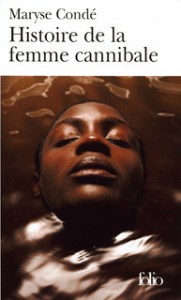
The police suspect it wasn’t a random encounter, something Rosélie refuses initially to acknowledge, completely ignoring her husbands study, a room she rarely ever ventured into, one strangely she is even less inclined to now.

“Aren’t you going to return home?”

Home? If only I knew where home was.

Chance had it I was born in Guadeloupe. But nobody in my family is interested in me. Apart from that, I have lived in France. A man took me to Africa, then left me. Another took me to the United States, then brought me to Africa, and he too left me stranded, this time in Cape Town. Oh, I forgot I’ve also lived in Japan. That makes for a fine charade, doesn’t it? No, my country was Stephen. I shall stay wherever he is.

Left alone without an income to support her (they’d never married though fortunately the house was in both their names), and having made only half-hearted attempts to exhibit her paintings, even then via the efforts of others willing her to succeed, rather than by her own initiative, she decides to offer her services and a healer/clairvoyant.

It is through these occasional appointments with clients that she encounters different members of the local population and the variety of issues confronting them, such as the former trade unionist, who’d languished for years in prison on Robben Island, now a tourist guide for the masses wishing to see where Nelson Mandela had been interned, “revisiting his abuse and torture day after day, describing it down to the last detail to the inquisitive hordes in an endeavour to satisfy their curiosity, the poor guy was losing his head”

10.00am, Patient No. 7, David Fagwela, Age: 73, Particularity: one of the few South African clients, Profession: retired miner

It is an intriguing dual mystery, the ongoing investigation and gradual uncovering of the motive behind the crime plays out at the same time as the intrigue mounts regarding the widow’s reluctance confront the truth about her husband, whose death has loosened the tongues of people close to her, they now freely express their disapproval of him and the way they perceive he treated Rosélie. She appears to be shocked by these revelations and thus retraces her memories of their lives together in London, New York, Tokyo and Cape Town.

It’s an astute medium through which to learn more of their back story, for in narrating those events Rosalie shares how she interpreted events, but the reader will create their own impression and begin to see the abyss between her perspective, Stephen’s and that of their friends.

The couple go on a safari soon after arriving in South Africa, Rosélie was terrified.

What did frighten her were the men. White men. Guides, game wardens, local visitors, foreign tourists. All wearing boots and safari hats, sporting double-barrelled guns, playing in a Western without a hint of a bison or an Indian now massacred or defeated, herded toothless into their reservations. Stephen, on the contrary loved dressing up in a bush jacket and canvas shorts in camouflage, a flask clipped to his waist and sunglasses perched on his nose.

“You don’t know how to enjoy yourself,” he reprimanded her, manly grabbing the wheel of the Land Rover.

Not her fault if she suffered from the complex of a victim and identified with those who are hunted.

At the same time Rosalie is going through her crisis, there is a well publicised case in the newspapers of a woman named Fiela, who allegedly murdered her husband. In court she refuses to speak, the public begin to turn against her, some calling her a witch, others a cannibal. The police officer on Stephen’s case wonders aloud whether she might open up to Rosalie, as many of her patients do. Rosalie has imaginary conversations with Fiela, the one personality to whom she feels able to ask questions (albeit in her dreams), that she can not utter to anyone else:
“Fiela, you’ve settled into my thoughts and dreams. No bother at all. As discreet as an alter ego. You hide behind everything I do, invisible, like the silk lining of a doublet. You must have been like me, a solitary child, a taciturn teenager….Fiela,  what have they got against him? He has always been by my side.Thoughtful.Considerate. Patient to my moods…Fiela, he always forgave me, I who was not beyond reproach, who, I confess, had been unfaithful before.”

Although there was the allegation against Fiela, this story wasn’t about her, it is about Rosélie, so after reading I didn’t understand the reference to the cannibal woman, so I looked it up to see what its symbolic meaning was and discovered that it is related to post colonisation and the loss of cultural memory, this post colonial world inevitably leading to a sense of spiritual devastation, it has even become in television series today, a symbol of self-awakening.

Rosalie is far from her roots and her culture and took shelter with a man, who further alienated her from that, even though he was relatively kind to her. His death has forced her to confront herself.

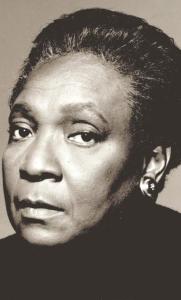
Maryse Condé

I thought this book was brilliant, it can be read superficially as a plot driven novel, or at a deeper analytical level, by looking at an outside view of post apartheid South Africa through the eyes of a bi-cultural, biracial couple, neither of whom come from there.

It’s techniques with flashbacks to fill in the story are typical of the Caribbean style which Maryse Condé does to great effect as are the dream sequences, where her subconscious self expresses itself openly, illuminating the reader. I understand why it is her favourite, she has accomplished a grand feat of literature in this one thrilling novel.

“The author demonstrates how one’s entire sense of self gets swallowed up by trauma and its dislocating aftermath.” – New York Times

Highly Recommended!

My Previous Reviews of Maryse Condé’s work:

Tales From the Heart: Stories From My Childhood

Victoire: My Mother’s Mother

Segu

A Season in Rihata

Buy a Copy of The Story of the Cannibal Woman via Book Depository

The Mountain In My Shoe by Louise Beech

Louise Beech is a unique author who I feel like I have a personal connection with, after the incredible experience of reading her debut novel How To Be Brave in October 2016, which for me included communicating with her as I endured a hellish experience on the 9th floor of Timone Hospital in Marseille. Twitter hashtags truly can bring incredible people into your lives at pivotal moments, both the living and those that have passed on. #LouiseBeech
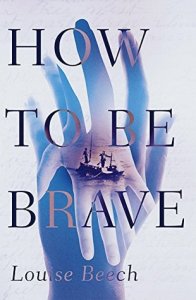
I originally bought her book because it was an intriguing fictional response, written by a mother whose daughter at the age of nine was diagnosed with Type-1 diabetes, as my daughter had been. Curious, I read that she had used fiction as a conduit for channelling her experience as a distraught mother and the roller coaster journey the two of them went through during those early months of the diagnosis, as it would change them irreversibly.

What made it all the more appealing was the difficulty they had endured, I’d been exposed to too many “good” stories, examples of where children had so readily adapted to this new routine of four injections a day for life, and gone on to do great things, I wanted to read about the opposite, I wanted to hear from those who had found it tough, those who’d rejected it, fought against it, mothers who’d almost been broken by it, and had found a way through; Louise Beech was that mother for me, she still is; an incredible role model, a fabulous writer, unique storyteller and a woman with a great sense of humour.

It was also the story of her grandfather who had been lost at sea for over 50 days when he was a young man.  Both the diagnosis and the story of the grandfather are true stories, however she used her creativity and imagination to write a novel that blends fact and fiction, taking the reader on an emotionally charged, high sea journey towards healing.

If you haven’t already read How To Be Brave, do read my review (linked) and better still buy the book, it is a courageous story and it coincided with a personal experience I will never forget.

But I digress, for this is a review of her second novel The Mountain in My Shoe beautifully prefaced by the wonderful Muhammad Ali quote displayed below.

The novel begins with a chapter entitled The Book and from then on each consecutive chapter is an extract from this book, which we learn is something called ‘A Life Book’ and as one of the inserts in the book explains:

Lifebook – Principles and Aims

Every Looked-After Child is entitled to an accurate and chronological account of his or her early life. It should have enduring value and can be given to them when they reach adulthood, or sooner if preferable.

It is a book that social workers and foster carers write notes and memories in, and can place mementos and/or photos of important people in their lives.

In chapter two a woman named Bernadette tells us that the book is missing. It is the day she has finally summoned the courage to leave her husband, she’s spent all day preparing and fretting about it, he is a man who values impeccable timing, expecting others to meet his standards, especially his wife Bernadette. She is waiting for him to walk through the door at 6pm like he does every evening before she intends to leave. Only he is late, more than late, he doesn’t come home at all.

Neither does Conor, the ten-year-old boy she has officially befriended for the past five years, whose Life Book she had hidden on the bookshelf, that document that should be preserved until he comes of age. And much to Bernadette’s horror, the book is missing too.

As the narrative progresses we follow Bernadette and Conor’s foster carer Anne on their journey to try to find Conor, we learn more about him from the pages of his Life Book that unfold between each chapter. It is a sad depiction of the inability to nurture, and the damage caused by those who think they can but are incapable, the yearning created by absence and neglect and the profound ability of unconditional love to heal and bring joy.

It’s a compelling, hair-raising read as we get closer to finding Conor and try to ignore that terrible feeling that somehow grows inside of being a little too late. In that respect, it reads like a psychological thriller as Beech cleverly leads the reader to a few false conclusions before the facts are revealed.

While nothing can match the experience of reading her debut How to Be Brave, The Mountain in My Shoe is equally compelling, a heart-felt read that I loved. Fortunately there is a third novel recently published called Maria in the Moon, I can’t wait to read that one too.

Click here to buy one of Louise Beech’s books at Kenny’s

Reading Women in Translation #WITMonth

August is the month when the annual reading challenge #WITMonth or Reading Women in Translation takes place, initially begun three years ago by Meytal at Biblibio.

I’m not a big fan or participant of reading challenges or lists, as I love changing my mind and being spontaneous about what I read next, however I do like to follow this one and read the reviews and keep up with what is being published as well as reading more of those I have discovered. And this is a challenge that is making a big difference in the reading and publishing world, so the more we read and demand books like these, the more expansive the selection will become.

I recently wrote an article about how I have become quite a fan of reading literature in translation, which was published by Tilted Axis Press in their lead up to WIT Month. If you haven’t read it already, you can do so by following the link here. At the end of the article I mention a number of titles I’ve really enjoyed, with links to my reviews. Reading in Translation, A Literary Revolution.

This year I’ll be reading a few titles from my current bookshelves and another title from one of my favourite authors Maryse Condé. Below is a summary of the author, translator, the language translated and what each book promises:

The Complete Claudine by Colette tr. Antonia White (French) – Colette began her writing career with Claudine at School, which catapulted the young author into instant, sensational success. Among the most autobiographical of Colette’s works, these four novels are dominated by the child-woman Claudine, whose strength, humour, and zest for living make her a symbol for the life force.
Selected Letters by Madame Sévigne (Marie de Rabutin-Chantal de Sévigné) tr. Leonard Tancock (French) –  One of the world’s greatest correspondents, Madame de Sevigne (1626-96) paints a vivid picture of France at the time of Louis XIV, in eloquent letters written throughout her life to family and friends. A significant figure in French society and literary circles, her close friends included Madame de La Fayette and La Rochefoucauld, she reflected on significant historical events and personal issues, and in this selection spanning almost 50 yrs, she can be humorous, melancholic, profound and superficial. Whether describing the new plays of Racine and Moliere, speculating on court scandals including the intrigues of the King’s mistresses or relating her own family concerns, Madame de Sevigne provides an intriguing portrait of the lost age of Le Roi Soleil.

Iza’s Ballad by Magda Szabó tr. George Szirtes (Hungarian) – When Ettie’s husband dies, her daughter Iza insists  her mother give up the family house in the countryside and move to Budapest. Displaced from her community and her home, Ettie tries to find her place in this new life, but can’t seem to get it right. She irritates the maid, hangs food outside the window because she mistrusts the fridge and, in her naivety and loneliness, invites a prostitute in for tea.  Iza’s Ballad is the story of a woman who loses her life’s companion and a mother trying to get close to a daughter whom she has never truly known. It is about the meeting of the old-fashioned and the modern worlds and the beliefs we construct over a lifetime.

Troubling Love by Elena Ferrante tr. Ann Goldstein (Italian) – Following her mother’s untimely and mysterious death, Delia embarks on a voyage of discovery through the streets of her native Naples searching for the truth about her family. A series of mysterious telephone calls leads her to compelling and disturbing revelations about her mother’s final days. I’m keen to try this after reading all about it in Ferrante’s nonfiction book Frantumaglia, which I read and reviewed earlier this year.

Maryse Condé

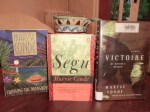
Ever since discovering Maryse Condé via the old style Man Booker International Prize, when it was a two yearly prize for an author’s entire works, I’ve been reading through her novels and stories, as suggested by the author I started with her Tales From the Heart: True Stories from My Childhood, Victoire: My Mother’s Mother, Segu,  and A Season in Rihata.

These are the books I still have on the shelf, and I’m already halfway into the novel the author said at a visit to our local library last year was the favourite of her novels, The Story of the Cannibal Woman, set in Cape Town, and centering on the life of a widow of a multicultural couple, reminding me of the character Hortensia in Yewande Omotoso’s excellent The Woman Next Door, which I just finished reading.

The Story of the Cannibal Woman – One dark night in Cape Town, Roselie’s husband goes out for a pack of cigarettes and never comes back. Not only is she left with unanswered questions about his violent death but she is also left without any means of support. At the urging of her housekeeper and best friend, the new widow decides to take advantage of the strange gifts she has always possessed and embarks on a career as a clairvoyant. As Roselie builds a new life for herself and seeks the truth about her husband’s murder, Conde crafts a deft exploration of post-apartheid South Africa and a smart, gripping thriller.

Crossing the Mangrove – Francis Sancher, a handsome outsider, loved by some and reviled by others, is found dead, face down in the mud on a path outside Riviere au Sel, a small village in Guadeloupe.  None of the villagers are particularly surprised, since Sancher, a secretive and melancholy man, had often predicted an unnatural death for himself.  As the villagers come to pay their respects they each, either in a speech to the mourners, or in an internal monologue, reveal another piece of the mystery behind Sancher’s life and death. Retaining the full colour and vibrancy of Conde’s homeland, Crossing the Mangrove pays homage to Guadeloupe in both subject and structure.

Children of Segu – Sequel to her masterpiece Segu, this fascinating story continues as brother fights brother and the powers of the globe threaten to change their world forever. If you enjoyed Homegoing By Yaa Gyasi, defintiely check out Segu.

Conversations With Maryse Condé by Françoise Pfaff– an exploration of the life and art of Maryse Condé, including conversations about Condé’s geographical sojourns and literary paths, her personality, and her thoughts. Their conversations reveal connections between Condé’s vivid art and her eventful, passionate life. In her encounters with historical and literary figures, and in her opinions on politics and culture, Condé appears as an engaging witness to her time. The conversations frequently sparkle with humour; at other moments they are infused with profound seriousness.

Maryse Condé was born in Guadeloupe, the youngest of eight children and her essays of childhood provide an excellent base for understanding the motivations that underpin much of her writing, firstly to get to know her family influences and aspirations and why she knew nothing of their origins (a past and ancestral pattern her mother was desperate for them to leave behind), her discovery of the turning points in the history of the Kingdom of Segu in Africa and the exploration of racial, gender and cultural issues in a variety of historical eras and locales, often focused on topics with strong feminist and political concerns. As she herself said:

“I could not write anything… unless it has a certain political significance. I have nothing else to offer that remains important.” extract from an interview with Rebecca Wolff

Further Reading

Who, What, When, Where: A Guide to #WITMonth 2017 – via WomeninTranslation.com

8 New or Forthcoming Books by Arab Women – via ArabLit.org

Have you read any of these?

What books have you decided to read for WIT Month?

Do you have a favourite to recommend as I’ll be topping up my shelf for next years reading!

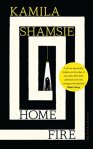
Home Fire by Kamila Shamsie #ManBookerPrize

I read Home Fire in two days, I thought it was brilliantly done, heartbreaking, tragic, essential. It’s been long listed for the Man Booker Prize 2017 and certainly makes my short list! I’m looking forward to reading more of the author’s back list.

Underpinning the novel is the premise of Sophocles’ 5thC BC play Antigone, an exploration of the conflict between those who affirm the individual’s human rights and those who must protect the state’s security.

Before reading Kamila Shamsie’s Home Fire, I downloaded a translation of Antigone to read, she acknowledges herself that Anne Carson’s translation of Antigone (Oberon Books, 2015) and The Burial at Thebes: A Version of Sophocles’ Antigone by Seamus Heaney were constant companions as she wrote, expressing gratitude too, for the children’s book version The Story of Antigone and its author Ali Smith.

In Ali Smith’s version there is a discussion at the end of the book about what stories are, which reads:

“Stories are a kind of nourishment. We do need them, and the fact that the story of Antigone, a story about a girl who wants to honour the body of her dead brother, and why she does, keeps being told suggests that we do need this story, that it might be one of the ways that we make life and death meaningful, that it might be a way to help us understand life and death, and that there’s something nourishing in it, even though it is full of terrible and difficult things, a very dark story full of sadness.”

Kamila Shamsie’s Home Fire is a contemporary retelling of the classic play, set in contemporary London. Even though I knew the premise of the story from having read the play, the story unfolded as if I had no prior knowledge of its likely outcome, it has its own unique surprises and insights, making it a compelling read.

We meet Isma, the eldest daughter of a family, who’ve been raised by their mother and grandmother, as she announces to her twin brother and sister Aneeka and Parvaiz that she is going to the US to complete her PhD studies that were put on pause after the death of their mother and grandmother within the space of a year, leaving her to become the mother to griefstruck twelve-year-old twins. She had briefly known her father, but the twins never.

The rigorous interrogation she is put through on leaving the UK reveal something in her family background that their entire family has tried to keep quiet, just wanting to move on with their lives, that their father had abandoned them and gone to fight as a jihadi in Afghanistan and had died en route to Guantanamo.

While in the US, Isma meets Eamonn, the son of a British politician she detests, setting in motion a litany of events that will have a catastrophic impact on both their families.

“Eamonn, that was his name. How they’d laughed in Wembley when the newspaper article accompanying the family picture revealed this detail, an Irish spelling to disguise a Muslim name – Ayman become Eamonn so that people would know the father had integrated.”

For Parvaiz, the only son, the lack of a father figure created a void, his grandmother had been the only family member willing to talk about him, but her stories were always of the boy, never of the man he became, a subject she was reluctant to be drawn into.

“He had always watched boys and their fathers with an avidity composed primarily of hunger. Whenever any of those fathers had made a certain gesture towards him – a hand placed on the back of his neck, the word ‘son’, an invitation to a football match – he’d retreat, both ashamed and afraid in a jumbled way that only grew more so as the years passed and the world of girls and boys grew more separate, so there were times he was not a twin to a twin but rather the only male in a house that knew all the secrets that women shared with on another but none that fathers taught their son.”

It’s a riveting, intense novel that propels the reader forward, even while something in us wants to resist what we can feel coming. It pits love against loyalty, family versus country, and cruelly displays how hard it is for families to distance themselves from the negative patterns of their ancestral past.

Kamila Shamsie was born in Karachi and now lives in London, a dual citizen of the UK and Pakistan. Her debut novel In The City by the Sea, written while still in college, was shortlisted for the John Llewellyn Rhys Prize in the UK and every novel since then has been highly acclaimed and shortlisted or won a literary prize, in 2013 she was included in the Granta list of 20 best young British writers.

Her novels are (linked to Goodreads):

Note: This book was an ARC (Advance Reader Copy) kindly provided by the publisher via NetGalley.

Click here to Purchase a copy of

Home Fire via Book Depository

The Woman Next Door by Yewande Omotoso

Loved it, this is my kind of popular summer read, it brought to mind the recent Alaskan classic I read and enjoyed immensely Two Old Women: An Alaskan Legend of Betrayal, Courage and Survival by Velma Wallis and another that I didn’t enjoy so much A Man Called Ove.

It’s a story of octogenarian women Hortensia and Marion who are neighbours in a suburb in Cape Town, South Africa. Marion is a white woman, born there, who has lived through political change, though not learned much from it, rather she has tried to keep as much distance as she possibly can from ever having to confront her deeply embedded, never dealt with ancestral shame.

Hortensia is a black woman, whose parents left Barbados for London, where she grew up and was educated, becoming a successful textile designer, and marrying an Englishman, with whom she moved to Nigeria and eventually (not sure why) to retire in South Africa.

Both women have had similarly successful professional lives, both run their own businesses, Marion as an architect, though the birth of her children brought her independence to an earlier close than Hortensia.

Now they are neighbours, on the same street committee and keep each other in check – they represent to the other things about themselves they would never admit, shame or hurt them, rather they take their bitterness out on each other, assuming the other wasn’t capable of understanding their perspective.

Here Marion contemplates her particular shame:
What Hortensia didn’t seem to understand was that sometimes we have to honour our ancestors and side with them. This meant we justified what was horrible and turned away from what needed scrutiny. This life of ignoring the obvious required a certain amount of stamina. The alternative to this was to set on a path to make rubbish of what had gone before us. This approach – of principles – activism and struggle – required stamina too. All the same, she’d chosen the other one.

While grumpy old Ove was just plain annoying and unpleasant to spend a whole book with, these two are actually good company, they have interesting back stories, that are drip fed throughout the narrative, they’re funny and although they are going to learn something when their lives inevitably come closer than they would have wished for, there’s not that sense of over the top, moral victory, I liked that while they overcome something by the end, they don’t change too much.


I picked this book up when it was long listed for the Baileys Women’s Prize for Fiction 2017 and while it didn’t make the short list, it definitely made my list of authors to continue to watch out for and read.

Yewande Omotoso was also born in Barbados, grew up in Nigeria and moved to South Africa where she writes and runs her own architectural practice. This is her second novel. Her debut novel Bom Boy was shortlisted for the 2012 Sunday Times Fiction Prize.

The Spiral Staircase, A Memoir by Karen Armstrong

Before I went to visit and spend two months in Bethlehem, Palestine some years ago, I wanted to read something about the history of the area, not a religious book, but something historical that went beyond the recent familiar history since the British abandoned those residing in these lands to their fate. I wanted to understand the wider context of how people came to be living here and what they’d had to endure to survive.
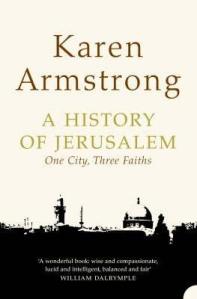
I chose to read Karen Armstrong’s A History of Jerusalem: One City, Three Faiths and read it while in situ. It was a history of multitudes of power shifts and massacres and when I finished it, I said to my husband (born in Bethlehem), somewhat in awe, “Congratulations, you survived,” and I wondered who these people really were, who had survived such a long, brutal history and come to be living in these towns of Jerusalem and Bethlehem today. One thing was for sure, they were survivors and most likely had traces of every people who had ever passed along the pilgrim trail within them.

Recently I was recommended a couple more Karen Armstrong books A History of God: The 4,000-Year Quest of Judaism, Christianity, and Islam and The Great Transformation as background to the conditioning that underpins much of humanity’s belief system of the past millenia, however I decided to add to this collection by first reading her memoir The Spiral Staircase, about her life after leaving the convent, where she spent seven years leading up to her becoming the well renowned author she is today.

I wasn’t interested in her life as a nun, or the details of her leaving the convent, I was interested in how she had used what she learned in rejecting her faith to inspire her towards immersing herself in the history and identifying that catalyst of humanity’s desire to embrace organised religion.

This memoir thus starts as she is trying to finish her university education and doctoral thesis, then her foray into becoming the partial carer of an autistic child, her teaching, her involvement with Channel 4 and the BBC in producing a series of programs on St Paul and then the crusades, and finally launching herself into a writing career when it appeared all other options were closed to her.

Every venture she went into, except the writing career, followed a similar trajectory, where she did the thing she’d convinced herself was what she should be doing, only to eventually lose hope, which became the turning point, or the spiral in the staircase, where she changed direction, it always seemed dramatic and quite often was, however my perspective on those turning points is that they were a course correction, she went along a path for as long at it had something to teach her and then she’d be literally thrown out of it – this kind of thing usually happens when we know we need to change a circumstance but we do nothing, and seven years in the convent had conditioned her to ignore any kind of inner guidance or intuition, making these changes when they did occur seem more dramatic than they might have been, had she transitioned earlier.

Boarding School

I loved reading about her journey and couldn’t help but remember the nuns from my secondary school education, apart from a couple who taught they were elusive figures on the periphery of our lives, we lived on the same premises, for us a boarding school, for them in a separate wing, it was more like a retirement home, they were very, very old and the only time we saw them was in the chapel on Sundays.

They were shadows of whoever they had been and we had no real interaction with them, except the ancient, tough 90 something Sister Conway who still worked in the scullery plunging her gnarled, arthritic hands into boiling hot water as if it were tepid, while we waited for the cutlery to cool before lifting it to dry.

Karen Armstrong took years to undo the conditioning of seven years in the convent and even then likely will never do so completely. An intellectual unsuited to academia, she eventually finds her place studying the great religious and spiritual practices looking for common threads, she’s less interested in differences than in commonalities.

As she researches and learns how to use empathy and compassion to inhabit the minds of those she seeks to understands, she comes closer to a spiritual experience than anything she experienced as a Christian. She has let go of God as objective fact and of belief as being a necessity, discovering instead ‘practice’ and compassion to be the one significant practice of all the faiths that succeeds in managing the ego sufficiently to create peace and harmony.

I enjoyed her honest, though often self deprecating account of this period in her life and particularly loved what she experienced when she visited Jerusalem, the cross cultural encounters and being told to drop the small talk and niceties:

“Karen! You are not in England now. There is no need to be a polite English lady here in Israel. We are not formal people. There is no point to speak if there is nothing to say.”

It becomes even more humorous when she is invited to do the same:

“Do not be a polite English lady. If you think I am unreasonable, tell me to get lost, to shut up- whatever you like!”

at which she surprises herself in doing after a particularly charged day when tensions were high and Joel had snapped at her rudely. His response is excellent, he is proud of her!

The other amusing experience in reading my second hand copy of this book, was the presence of the previous reader in the margins, who not happy to have merely marked up the pages, shared her thoughts more vociferously, clearly not nearly as impressed as I was with the work, deciding to rant and share snippets of her own experiences, which were mostly entertaining, often annoying, and ultimately unwelcome! Here are some of them, since no one else will have had this reading experience!

page 123 After speaking about how her years as a nun had broken something in her, and affected her eating habits, Karen Armstrong writes:

“And I did not want to nourish myself. What was the point of feeding my body, when my mind and heart had been irreparably broken?”

And my interlocutor writes:

“as I was after the divorce”

Armstrong mentions that she isn’t going to write about her failed love relationships, seeing no reason to dwell on episodes that didn’t develop into anything significant and writes:

“Just as I was prevented from becoming an academic, so too I have never been able to achieve a normal domestic existence, and this, like my epilepsy, had also ensured that I remained an outsider in a society in which coupledom is the norm”

to which my interlocutor responds:

“oh do stop feeling sorry for yourself!”

and even adds later on

“perhaps you are just unloveable”

which is a mild example of the kind of comportment (at different levels of societal power clearly) that nevertheless can lead to disharmony, conflict, war even, for if there is a conclusion to what Karen Armstrong has learned, it is a lesson she gifts to her readers, known as Hillel’s Golden Rule that all great leaders have taught, Confucius proclaimed it 500 years before him, Buddha and Jesus taught it, it is the bedrock of the Koran:

“Do not do to others as you would not have done unto you”

As one of her advisors Hyam Maccoby said

“It takes more discipline to refrain from doing/saying harm to others than to be a do-gooder and project your needs and desires onto other people.”

Exit West by Mohsin Hamid #ManBookerPrize

Exit West is Pakistani author Mohsin Hamid’s fourth novel and the first one I’ve read. It is on the Man Booker Prize 2017 longlist. When I read about it earlier in the year, I decided this would the one where I would get on board, and with its themes of refugees fleeing war and the challenges of emigration, it seemed pertinent.

It is a story of a young couple Nadia and Saeed who meet in their unnamed home country, which felt to me while reading as if I were reading about Syria, just before the conflict in their country escalates. They meet in the classroom, he with his “studiously maintained stubble”, she in”flowing black robe”. She brushes off his invitation to have coffee initially, eventually agreeing and slowly they develop a friendship, a relationship.

Interspersed with their narrative are brief snapshots of lives being lived at that moment elsewhere – an incident between and man and a woman happening in Australia, a man nursing his Irish whiskey drink in Tokyo. To be honest, I didn’t get what these intrusions into the story were about – perhaps just that life continues elsewhere, oblivious to the dramas of others?

Saeed lives at home with his parents, Nadia lives alone, her robe is her protection, allowing her to live more freely than the alternatives. However as war approached the city, their lives must change and after hearing about an escape route, the couple decide to flee and to create a life elsewhere.

While they are in their hometown it is a story of a young couple attempting to overcome the lack of trust that exists in a culture where independent women live in fear, once they leave it becomes something else, they lack family, friends and community, they try to recreate those things in an environment that is antagonistic towards them. Their memories of what they have left change shape as the are afflicted by nostalgia, regret, loss. They struggle to find their place and even their relationship morphs into something unrecognisable in foreign lands.

There is no voyage, the journey takes place through a door, a portal to another world, to an island in Greece, to London, San Francisco, but the places they travel to bear little resemblance to those places as you and I might know them. They are inaccessible, frightening, there is a sense of them being hunted, of needing to be ready to run, always, it is a fearful dystopian view of supposed freedom from terror; death may have been a more desired alternative after all. And the slow unwinding of their relationship.

The combination of the real and surreal was a bit much for me, somehow it’s easier to go with at the hand of Haruki Murakami, which in a way this reminds me a little of, but while Murakami feels more like pure fantasy, Moshin Hamid invites us to consider a subject that is very real in the modern world today and succeeds in making it disorienting to the reader. Perhaps that is the point.

I read Hala Alyan’s novel Salt Houses (click title to read review) this year, which was also a novel of displacement, centred around multiple generations of Palestinian refugees, who attempt to make new lives in Jordan, Kuwait, Lebanon and America and the challenges they face, even when they are able to retain certain family connections. It’s a cultural loss that is not apparent on the surface, that Alyan digs deep into to reveal the subtle layers.

It makes an interesting complement to Mohsin Hamid’s perspective of loss and dislocation.

For a more enlightened view of what this novel portends to show the reader, check out the following reviews:

Further Reading:

The AtlanticExit West and the Edge of Dystopia, by Sophia Gilbert

The GuardianMagic and violence in migrants’ tale by Andrew Motion

Note: This book was an ARC (Advance Reader Copy) kindly provided by the publisher via NetGalley.

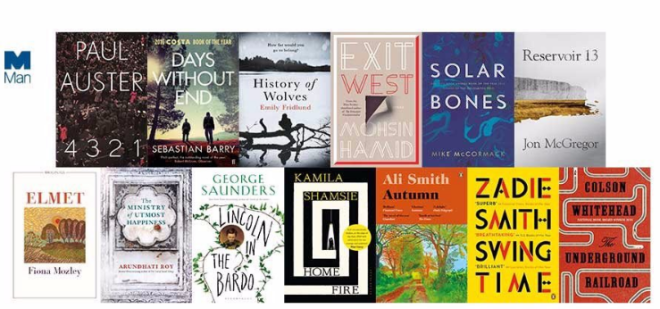
Man Booker Prize Long List 2017


Swing Time by Zadie Smith #ManBookerPrize

The original Swing Time is a film clip of Fred Astaire dancing on stage at a cabaret, with a giant screen behind him, in which three shadow versions of himself attempt to keep up with his energy, his footwork, his dance. In the end they give up and walk off leaving him alone to continue, enrapturing his audience.

In Zadie Smith’s opening to her Swing Time, the protagonist is sitting in London’s Royal Festival Hall on the South Bank of the Thames, having walked aimlessly from the apartment she’s been hiding out in, opposite Lord’s Cricket Ground in St John’s Wood into the city, crossed the river and spontaneously bought a ticket to an event.

During this “conversation with an Austrian film director” they show this clip, which she is very familiar with from her own childhood obsession, and watching it now, she realises how much she has been a shadow in the lives of others, never taking centre stage in her own life, despite the strong passion for music and dance she has had within her all along.

“I saw all my years at once, but they were not piled up on each other, experience after experience, building into something of substance – the opposite. A truth was being revealed to me: that I had always tried to attach myself to the light of other people, that I had never had any light of my own. I experienced myself as a kind of shadow.”

Structured in seven parts, from Early Days, Early and Late, Intermission, through Middle Passage, Night and Day, Day and Night to Late Days the novel shows the family life and friendship of the protagonist and her friend Tracey, two girls who take dance classes together when they are seven years old, who live on adjoining North London housing estates, with mothers who aspire for their children to have a different experience than their own and while some may judge them otherwise, they do the best they can to make that so.

“At this early stage Tracey and I were not friends or enemies or even acquaintances: we barely spoke. Yet there was always this mutual awareness, an invisible band strung between us, connecting us and preventing us from straying too deeply into relations with others.”

Tracey is outspoken, the more talented dancer and ambitious, she masks her curiosity and disappointments with malice, telling her friend, they had things “the wrong way around”.

“With everyone else it’s the dad” she says, and because I knew this to be more or less accurate I could think of nothing more to say. “When your dad’s white it means…” she continued, but at that moment Lily Bingham came and stood next to us and I never did learn what it meant when your Dad was white.

Jeni LeGon with Bojangles in a scene from the movie, Hooray for Love. [Merlin Archive]

Tracey’s dance ambitions take her to a special school where she can develop those skills, while her friend reluctantly follows the more academic route her mother has paved for her, ignoring her own passion for singing those old-time songs and the early days Fred Astaire and Jeni LeGon (see her in the video clip below) dance moves. She studies media and looks for admin jobs and for a short time is drawn back into Tracey’s world as a stagehand, when Tracey lands a role in a West End musical.

During her first media job, she has a chance encounter with an ambitious Australian pop star, who later requests her to work for her. The singer attempts to bring her out of her reservedness by taking her somewhere where she feels most herself, a bike ride to Hampstead Heath. Her life is thus viewed through the lens of a woman of extraordinary means, who has a certain kind of power to do and to have anything and anyone she wants, a life that is facilitated by those she employs to keep her from the untidy reality of real life.

It reminded me of Elena Ferrante’s My Brilliant Friend in its premise of the female friendship, two girls who’ve known each other since childhood, who are simultaneously attracted and repelled by each other, who separate but never entirely sever their precarious connection, toxic yet familiar, fulfilling an unhealed need to be witnessed in their entirety.

The plot takes our narrator out of London to New York and into an African country where the singer wishes to make a difference to girls’ lives by opening a school. Sending her in advance and on numerous occasions, she sees and experiences aspects of life there at greater depth than her employer and becomes increasingly frustrated by what others fail to see, that which she is unable to adequately communicate.

It has not been her place to be forthright (a weakness that while it stayed that way served her well), however she can’t ignore it, especially not since her mother began to realise her own aspirations, rising up out of her situation, educating herself as an adult and becoming a local politician/activist with strong views on West African dictatorships and celebrities that adopt babies from poverty-stricken countries.

If London was unreal, if New York was unreal, they were powerful stage shows: as soon as we were back inside them they not only seemed real but the only possible reality, and decisions made about the village from these locations always appeared to have a certain plausibility while we were making them, and only later, when one or other of us arrived back here, and crossed this river, did the potential absurdity of whatever it was become clear.”

It’s a rich, exciting, thought-provoking novel, even if being the employee of a pop star may sound unreal. In effect, it is more about whether escaping one’s roots and elevating oneself in or associated with fame or success equates to a sense of fulfilment, or whether one is empowered by finding and following one’s passion. Our narrator is attracted to those who appear to her to be true to themselves, focused and unafraid to express it.

As she did with NW, Zadie Smith creates a strong sense of place and community, and through her choice of characters shares many poignant insights and realities of mothers and daughters and the effect the past exerts on the choices they make in the future.

I admit, I do love this novel all the more for having lived in North London for eight years, and in the latter years, in an estate in Kilburn, so I remember these streets and this community from a period in the late 1990’s that brings it alive more so than if it were set in a city I’d never lived in. It’s not necessary to know it, but if you do, it’s like the icing on the cake! I’ve read all Zadie Smith’s novels except The Autograph Man and I’d say now that Swing Time is my favourite. I hope to see it make the shortlist of the Man Booker Prize 2017.

Brilliantly executed, highly recommended.