The Mother of All Questions by Rebecca Solnit

Rebecca Solnit writes reflective, thought-provoking essays, which often connect her intellectual curiosity with where she is in her life now. In an earlier work Wanderlust, she ponders the history of walking as a cultural and political experience; facing the unknown, in A Field Guide to Getting Lost; her mother’s Alzheimer’s, regression and how she spent that final year in The Faraway Nearby.

Now a new collection of essays, the title The Mother of All Questions, from an introductory piece on one of her pet frustrations, that all time irrelevant question that many professional women, whether they are writer’s, politicians or humble employees too often get asked.

But it is the timely and questioning opening essay ‘A Short History on Silence’ that  binds the collection together and should be the question being asked. It is an attempt at a history of silence, in particular the silencing of women, the effect of patriarchal power, the culpability of institutions, universities, the court system, the police, even families, their roles in continuing to ensure women’s silence over the continual transgressions of men.

Rebecca Solnit has been writing about this issue for many years, trying to create a public conversation on a subject that many continued to insist was a personal problem – yet another form of silencing.
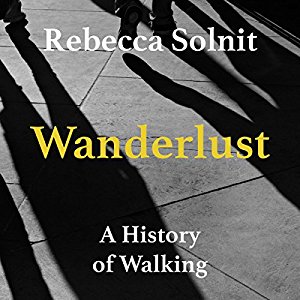
As she wrote in Wanderlust (2000)

“It was the most devastating discovery of my life that I had no real right to life, liberty, and pursuit of happiness out of doors, that the world was full of strangers who seemed to hate me and wished to harm me for no reason other than my gender, that sex so readily became violence, and that hardly anyone else considered it a public issue rather than a private problem.”

She makes a distinction between silence being that which is imposed and quiet being that which is sought.

What is left unsaid because serenity and introspection are sought is as different from what is not said because the threats are high or the barriers are great as swimming is from drowning. Quiet is to noise as silence is to communication. The quiet of the listener makes room for the speech of others, like the quiet of the reader taking in the words on the page…Silence is what allows people to suffer without recourse, what allows hypocrisies and lies to grow and flourish, crimes to go unpunished. If our voices are essential aspects of our humanity, to be rendered voiceless is to be dehumanized or excluded from one’s humanity. And the history of silence is central to women’s history’

The list of who has been silenced goes right back to the dawn of literature, it goes back millennia, classics scholar Mary Beard noted that silencing women begins almost as soon as Western literature does, in the Odyssey, with Telemachus telling his mother to shut up.

It continues through the years with the woman’s exclusion from education, from the right to vote, to making or being acknowledged for making scientific discoveries to campus rape and the introduction of sexual harassment guidelines as law and the unleashing of stories and the wave of voices coming out of silence that sharing on social media has spawned, generating a fiercely lively and unprecedented conversation.

80 Books No Woman Should Read is her response to a list published by Esquire magazine of a list they created of 80 books every man should read, a list of books, seventy-nine of which were written by men, with one by Flannery O’Connor. It speaks of the reader’s tendency to identify with the protagonist, only the books she mentions from this list that she has read, she often identifies, not with the protagonist but with the woman, noticing that some books are instructions on why women are dirt or hardly exist at all except as accessories or are inherently evil and empty.

Not surprisingly, her essay (first published at Lithub.com) elicited a significant online response, prompting a reply from Esquire, admitting they’d messed up, saying their article had rightfully been called out for its lack of diversity, and proactively inviting eight female literary powerhouses, from Michiko Kakutani to Anna Holmes to Roxanne Gay, to help them create a new list. You can see the list here.

And in the essay In Men Explain Lolita to Me she expounds further on empathy:

‘This paying attention is the foundational act of empathy, of listening, of seeing, of imagining experiences other than one’s own, of getting out of the boundaries of one’s own experience. There’s a currently popular argument that books help us feel empathy, but if they do so they do it by helping us imagine that we are people we are not. Or to go deeper within ourselves, to be more aware of what it means to be heartbroken, or ill, or ninety-six, or completely lost. Not just versions of our self rendered awesome and eternally justified and always right, living in a world in which other people only exist to help reinforce our magnificence, though those kinds of books and comic books and movies exist in abundance to cater to the male imagination. Which is a reminder that literature and art can also help us fail at empathy if it sequesters in the Boring Old Fortress of Magnificent Me.’
I haven’t read Men Explain Things to Me, although I heard Rebecca Solnit speak about the leading and infamous anecdote it retells when I went to listen to her at the Royal Festival Hall in London.

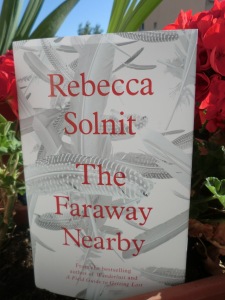
That talk coincided with the publication of  The Faraway Nearby (link to review) the book that traverses her uneasy relationship with her mother and how the approach of death forces her to contemplate it, how it may have shaped her. I liked the book, but I loved listening to the author in person, she has such an engaging presence, is a captivating speaker, a performer of the reflective and spontaneous.

The Mother of All Questions is a culmination of Solnit’s and many women’s frustrations in the world today, where being a woman living in a patriarchal culture, no matter which part of the world, brings challenges that must reach a breaking point. It is a conversation that is happening everywhere that hopefully will bring change for the better, as many voices come together in solidarity. It is an acknowledgement both of how far we have come and how much we have still to do, to change the culture of silence we have inhabited for too long, to safely be ourselves.

I highly recommend picking up one of her works, if you haven’t yet read her.
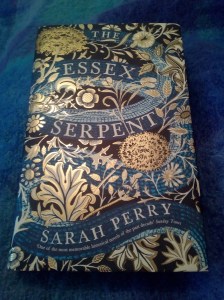
The Essex Serpent by Sarah Perry

A Victorian era historical novel (London 1893) set over a single year, that follows the footsteps of the young widow Cora Seaborne, in the months following the premature of her husband, a cruel man who’d become indifferent to her, but one who’d been her companion from such a young age, he’d moulded her into what he could tolerate.

She begins to shed the layers of that stifled London life, both physically and mentally, taking her son Francis and their companion Martha to Colchester, swapping gowns and stays for a man’s tweed coat and trousers. She steps out each day taking herself on long walks in search of anything unusual and in particular remnants and fossilised objects unearthed after a recent earthquake and subsequent landslides.

In London, she had befriended Dr Luke Garret, affectionately referred to as the Imp on account of his size. He is at the forefront of medicine at the time, something of a maverick surgeon, fascinated by the potential of yet unproven surgical procedures, assisted by his friend and colleague Spencer. He is fond of Cora and their friendship continues after the death of her husband.

Katherine and Charles Ambrose, frequent visitors to Essex, unwittingly encouraged Cora’s interest in the region and in fossil remains, through various introductions, one of whom recounts to her the life and work of Mary Anning, the English fossil collector and paleontologist, whose discoveries included the first ichthyosaur skeleton. Mary Anning is the protagonist of Lisa Chevalier’s excellent novel Remarkable Creatures.

Meeting her again in Colchester, the Ambrose’s introduce Cora to the Reverend William Ransome and his wife Stella and a unique friendship develops.

Much of the novel is narrated through letters between Cora and these new friends she’s made since her widowhood and one of the subjects that arises is talk of a creature, said to have reappeared since the land was disturbed by the quake, one they’ve dubbed the Essex Serpent. Local beggar Taylor fills her in on the details of the earthquake and the sleeping legend it has awakened.

‘It had come eight years back, by his reckoning, at eight minutes past nine precisely. It had been as fair an April morning as any could remember, which later was counted a blessing, since most were out-of-doors. The Essex earth had bucked as if trying to shake off all its towns and villages; for twenty seconds, no more, a series of convulsions that paused once as if a breath were being drawn and then began again. Out in the estuaries of the Colne and the Blackwater, the sea had gathered into foaming waves which ransacked the shore and reduced every vessel on the water to splinters.’

Cora is delighted to think that modest little Essex, with its Paleozoic rock beneath their feet, laid down five hundred million years before, shrugging its shoulders, creating waves and toppling church steeples and fantasizes about finding her own ichthyosaur.

Taylor feeds her mind with tales of a creature from 1669, when it was believed a serpent came out of the Essex waters into the birch woods and commons.

‘Those were the years of the Essex serpent, be it scale and sinew, or wood and canvas, , or little but the ravings of madmen; children were kept from the banks of the river and fishermen wished for a better trade! Then it was gone as soon as it came, and for night on two hundred years we had neither hide nor hair of it ’til the quake came and something was shook loose down there under the water – something was set free! A great creeping thing, as they tell it, more dragon than serpent, as content on land as in water, that suns its wings on a fair day.’

Away from the responsibilities and expectations of womanhood and motherhood, long walks reawaken Cora’s naturalist and philosophical interests.

‘It struck her that everything under that white sky was made of the same substance – not quite animal, but not merely earth: where branches had sheared from their trunks they left bright wounds, and she would not have been surprised to see severed stumps of oak and elm pulse as she passed. Laughing, she imagined herself part of it, and leaning against a trunk in earshot of a chattering thrush held up her arm, and wondered if she might see vivid green lichen stippling the skin between her fingers.

Had it always been here – this marvellous black earth in which she sank to her ankles, this coral coloured fungus frilling the branches at her feet? Had birds always sung? Had the rain always this light touch, as if she might inhabit it?’

As Cora pursues fossils and sea creatures, her companion Martha uses the opportunity of having contact with influential men to push her social activism, intent on bringing to light the plight of the working class housing conditions, dire accommodations and landlords who continue to raise rents, not to mention hypocritical attitudes.

‘She spread open the pages and showed him a map on which the poorest of London’s housing was overlaid with plans for new developments. They would be sanitary , she said, and spacious: children would have green spaces to play in and tenants would be free from landlord caprice. But (she flicked contemptuously at the paper) to qualify for housing, tenants must demonstrate good character. ‘They’re expects to live better than you or I ever did to deserve a roof over their children’s heads: must never be drunk or a nuisance to neighbours, or gamble, and God forbid too many children by too many fathers, and had too often. You, Spencer – with your estate and pedigree – you can drink yourself wretched on claret and port and no-one begrudges you any of your homes; but spend what little you have on cheap beer and the dogs and you’ve not enough moral standing to sleep in a dry bed.’

The novel provides a snapshot of the era, with its significant scientific progress and discoveries, its social issues among the classes and between the sexes, medical progress and the conflict between men of science and men of the cloth.

For the most part I enjoyed it immensely, however, if I were to fault it, I thought the seesawing between relentless soul-searching and denial on the part of the Reverend and Cora, in coming to terms with their relationship became a little tedious. It made the second half of the novel drag a little and I notice that all the passages I noted come from the first 200 pages. However the acute sense of place and era and that traversing of issues of the time within the framework of of an engaging story make it all worthwhile.

Granta 141: Canada – Mangilaluk’s Highway by Nadim Roberts

Granta 141 Canada

The first Granta journal of 2018, issue number 141 is focused on Canadian literature, whether it’s fiction, memoir, reportage, poetry or photography, each issue combines something of each of those categories, with new writing/work by known and little-known talent, around a common theme.

As guest editor and author of Do Not Say We Have Nothing, Madeleine Thien shares in the opening introduction, (and fellow guest-editor Catherine Leroux, writing in French), their only parameter for submissions was ‘What is being imagined here, now?’

Canada being a land with sixty unique Indigenous language dialects and more than two hundred languages reported as a mother tongue or home language, it was a wide-ranging brief.

Language becomes its own landscape in this issue of Granta. Language falls apart, twists, reformulates, shatters and revives itself. Animal and self, unfinished history, land and waterways, colonisation and dispossession, settlement and refuge – all these nouns are part of the truth of this place.

Apart from Leroux’s introduction, all the work is either in English or has been translated from English, however all work in translation is available to read on Granta.com in the original French.

It features writers such as Margaret Atwood, Lisa Moore (her novel February reviewed here), Alexander McLeod, Krista Foss, Naomi Fontaine, Kim Fu, Anosh Irani, Paul Seesequasis, Anakana SchofieldJohanna Skibsrud,  and many more…

I’m reviewing here the first story and may share other’s with you as I select randomly from the journal over the coming months.

Mangilaluk’s Highway

The opening story is a mix of reportage and a retelling of the story of Mangilaluk Bernard Andreason, who when he was 11 years old, slipped out of the Inuvik residential boarding school he’d been sent to, along with two friends Jack and Dennis, to avoid being punished for stealing a pack of cigarettes, and spotting newly hung power lines, decided to follow them home to Tuktoyaktuk.

Nadim Roberts writes about Bernard’s journey in the present, interspersed with narrative reports on his own visit to Tuk in June 2017, forty-five years after Dennis, Jack and Bernard began walking that 140 kilometre stretch home. Robert’s by contrast, completes the journey from Inuvik to Tuk in thirty minutes by plane.

He tells of successive attempts by the government to build a road across the Arctic Circle, to facilitate oil and gas exploration and a stretch of highway that would connect Inuvik to Tuk.

 From the plane I could see occasional glimpses of a new, near-finished road. This was the long awaited Inuvik-Tul all-season highway that would open in a few months.

Chief Mangilaluk

We learn that Tuk was a town founded by survivors from Kitigaaryuit, an Inuit settlement, that in 1902, after contact with whalers was cursed with a measles epidemic which drastically decimated their population. One young man, Mangilaluk, departed and went looking for a new place to live. His choice, a site on the edge of a harbour, would become what is now known as Tuk. He became chief and is still talked of today. Some believed he was a shaman who could shape shift into a polar bear.

In July 1961, two decades after he died, Mangilaluk’s granddaughter Alice Felix, was eight months pregnant. While home alone one evening, she heard a knock on the door. She wasn’t sure if she was awake or dreaming when the door swung open. A three-metre-tall polar bear stood in the doorway. It walked up to her, put its snowshoe-sized paw on her pregnant belly, and began to speak: ‘If it’s a boy, you name it after me.’

The story reminded me immediately of Doris Pilkington Garimara’s Rabbit Proof Fence, a tale of indigenous Aboriginal children removed from their parents (following an Australian government edict in 1931, black aboriginal children and children of mixed marriages were gathered up by whites and taken to settlements to be assimilated) and put in  a boarding school. The three girls in this true story followed a fence built to keep rabbits out of farming land, knowing that it passed close to their home.

Before 1955, fewer than 15 per cent of school-aged Inuit were enrolled in residential schools. Most children still lived on the land with their families, learning traditional skills and knowledge.

By 1964, more than 75 per cent of Inuit children attended residential schools. Their values, language and customs were supplanted overnight by a culture that saw itself as benevolent and superior, and saw the Inuit as primitive beings in need of sophistication.

Nadim Roberts interweaves Bernard’s story, his grandfather’s story and the current issues facing indigenous and local people in the region, in an evocative portrayal of one boy/man’s courage against the odds to make something better of his chance at survival.

Nadim Roberts Source: Author Provided

It’s an excellent piece of writing and combination of narrative and reportage, bringing attention to this one man’s story and the plight of both his people and the environment in which they live.

You can read Nadim’s story for free at Granta, just click on the link below:

Mangilaluk’s Highway by Nadim Roberts

Nadim Roberts is a journalist from Vancouver whose work has been published in Walrus, Maisonneuve and the Globe and Mail.

Further examples of his work can be viewed on his website NadimRoberts.com

Have you read any recommended works by any of the authors mentioned or others featured in Granta 141?

Raise Your Vibration – 111 Practices to Increase Your Spiritual Connection by Kyle Gray

Raise Your Vibration is a book I read in 2016, but hadn’t reviewed as I read over a long period of time. I’ve since read another book by him, his latest called Light Warrior.

Kyle Gray is an inspiring (and by his own admission, ‘flawed’ as we all are) Scottish, best-selling author. He is published by Hay House, an expert in archangels, ascended masters, goddesses and many other characters in mythology, religious stories and other enlightened souls of ancient wisdom traditions, as fields of spiritual energy in the universe.

I came across him, when I read Christiane Northrup M.D.’s book, Making Life Easy – A Simple Guide to a Divinely Inspired Life. In her book, she made a number of recommendations regarding authors and people whose work she is interested in and follows, and Kyle Gray was one of those who I followed up on, in particular because it was the period just over a year ago, when I was about to spend ten days in hospital with my daughter, who was undergoing surgery to straighten her spine, I was going to be bringing as many spiritual resources as I could muster with me, from the traditional to the more esoteric!

I’ve loved all Kyle Gray’s books, which I read little by little, he’s one of my preferred reading choices on public transport thanks to a few free ebook offers from Hay House.

I read this particular title over a number of months and I’m sure I have benefited from it significantly, and I know I will continue to do so as I use it in a more random fashion going forward, it’s one to keep nearby and dip in and out of.

With it’s 111 vibes or spiritual practices, it’s designed not to be read in one sitting, but daily or randomly. I found often that the vibe for the day was often something that really resonated with my day, it’s also like an energising, elevating pick me up or start to the day, it sets the tone for the rest of the day.

Originally I read an electronic version on my kindle, but then bought a physical copy so I could use it in a random way, and during the second reading, I was drawn to the practices relating to the seven chakras, which dovetailed perfectly with a 21 day meditation I was doing, by Deepak Chopra, called Finding Your Flow.

This particular meditation practice  was divided into three 7 day sections designed to activate the seven energy centres of consciousness, also known as chakras. In the first week, we find and become aware of them, week two we activate them and week three is focused on expressing them. Regardless of whether you relate to the system of chakras or not, it’s just about changing patterns of thoughts and behaviour that affect our energy, so listening to someone speak about how to do this, and/or reading, is beneficial to us all.

Kyle Gray’s work in this area, through this book extended the efficacy of the meditations and understanding of the energies in each of these areas.

I have since bought copies of this book as gifts for friends and family members who are open to a little spiritual inspiration and guidance. It’s one of the gems.

In conclusion, as I go back and reread my review on Christiane Northrup’s book, that lead me to Kyle Gray, I share this extract as it encapsulates much of my motivation for choosing this kind of reading input to accompany my other more literary tastes:

She also discusses thoughts and inputs, the effect of what we are constantly exposed to and how it should be managed in order to avoid overdosing on negativity and the toxic, fear-enhancing effect of the media for example. She discusses the positive power of affirmations, meditation, gratitude, the power of giving and receiving, connecting with nature, tapping and much more.

And in her own words:

“No human being has nervous, endocrine, and immune systems that were designed to process the negative news from all over the planet that’s being piped into their living room on a daily basis.”

“On a purely physical level, fear lowers our vibration and makes us far more susceptible to viruses and bacteria. The biochemical state that fear creates in our bodies adversely affects our immunity and increases our susceptibility to the pathological viruses and bacteria that are all around us.” Christiane Northrup M.D.

Buy Your copy of Raise Your Vibration via Book Depository

Note: This book was an Advance Reader Copy (ARC) kindly provided by the publisher.

P.S. I just tuned into Hay House Radio now, as I finish this review and, no surprise, Kyle Gray is speaking live!

Sightlines by Kathleen Jamie

The second volume of essays by Kathleen Jamie that I’ve read, more encounters with birds on lonely, windswept islands that have long been abandoned by humans, though traces remain of their earlier occupation.

If you have not yet read Kathleen Jamie, do check out my review of her first collection Findings, which I adored. It talks a little more about her writing and the difficulty her publisher had in describing her work, which defies categorisation, not exactly travel writing, not quite autobiography, a more accessible form of nature writing than we’ve seen before, seen through the eyes and in the prose of a poet.

In her trademark lyrical style, she travels with experts from whom she gleans bits of information, fascinating trivia, or alarming statistics that tell of a significant drop in population of certain species, but mostly she continues her mission of acute observation, of trying to see in the simplest terms something of the lives and patterns of behaviour of majestic winged creatures, who make long migrations each year and return to these islands to continue their heritage.

We learn more of her beginnings, of the archeological dig where she developed a fascination for uncovering secrets hidden beneath. She muses on microscopic observations in a science lab, writing about wind, light, the moon. We accompany her to the Arctic, witnessing giant icebergs on the move, the green lights of the aurora overhead. She visits to a museum in Norway where ancient whale bones dating from the mid 1800’s will be cleaned, restored, rehung, the melancholic weariness of their demise emitting an odour even after years of inhabiting this dusty dry interior.

The Gannetry

Jamie and friend take a picnic and visit a gannetry during mating season, they see much of what is expected, they’ve been there before, Jamie observes, looking for the unusual, she spots it in the sea, a straight line, something she doesn’t recognise until she does. A pod of orcas lead by the matriarch, she reflects on her role as mother, as her own children approach the age of leaving the nest.

The Woman in the Field

Jamie recalls being 17 years old, leaving school and rather than her mother’s suggestion of a library job or secretarial school, she delivers her to an archeological dig, to uncover a ‘henge’, a circle of stones seen from the air, where they’ll find a Bronze Age burial cist containing the skeleton of a woman and a well preserved pot, findings that will inspire a poem ‘Inhumation‘.

Aurora borealis
Source: Wikipedia M.Buschmann

Aurora

Polly asks Jamie what brings her to the Arctic north, to the freezing cold, to float alongside unleashed icebergs, watching green light phenomena in the sky.

It is the birds that lure Polly, though the geese have flown, that and an illness which awoke something that continues to push her to seek these experiences, while they remain possible.

For 30 yrs Jamie sat on cliff tops looking at familiar horizons.
Now she wishes to change her map.
Something is changing.

The Hvalsalen

The Bergen Natural History Museum in Norway houses the largest whale skeleton installation known. No one knows how they got there, whether they were hunted or stranded, they date from 1867.

About to close for 4 years for renovation and repair, Jamie is invited to return during the conservation work, she will spend hours sitting in the bones, smelling the still present odours, imagining, contemplating their previous majesty.

Pathologies

Musing in frustration on nature clichés: ‘nature takes it course’, (death of her mother) ‘reconnecting with nature’ (environmental activists) Jamie makes an appointment with a clinical consultant in pathology to observe the inner workings of the human body ‘nature’ and its mutations, tumours, cancer cells, infections, seen to the naked eye and under the microscope. She sees landscapes, shorelines, marshes. Looking at the lining of someone’s stomach, searching for bacteria, she notes the following:

Between the oval structures were valleys, if you like, fanning down to the shore. Frank wanted to show me something in one of those valleys and I couldn’t find it at first; it took several patient attempts – this microscope didn’t have a cursor device to point at things. It was a very human moment, a collusion of landscape and language when one person tries to guide the other’s gaze across a vista. What vistas I’d seen. River deltas and marshes, peninsulas and atolls. The unseen landscapes within. You might imagine you were privy to the secret of the universe, some mystical union between body and earth, but I dare say it’s to do with our eyes. Hunter-gatherers that we are, adapted to look out over savannahs, into valleys from hillsides. Scale up the absurdly small until it looks like a landscape, then we can do business.

‘There!’ said Frank. ‘Isn’t that a pastoral scene? They’re grazing!’

I had it: six or seven very dark oval dots, still tiny, despite the magnification, were ranged across the blue valley, like musk oxen on tundra, seen from far above.

Kathleen Jamie’s first collection of nature essays ‘Findings’

Her easy reading essays will also cover a lunar eclipse, three attempts to visit St Kilda, Neolithic caves and the passage of time in her own life, marked by the growth of her children into adolescence, on the threshold of young adulthood.

Fascinating and cosy reading to discover freezing cold, wind blown parts of the world that hold fascinating secrets that only the hardy voyager will venture to uncover. Enjoy reading them about from a more comfortable vantage point.

To buy one of her books, click the link below.

Kathleen Jamie’s essays via Book Depository

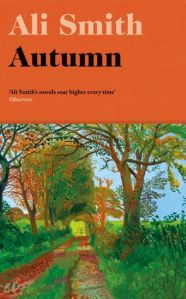
Autumn by Ali Smith

I have finally read a novel by Ali Smith and enjoyed it, though it is distracting to explain why with so many exuberant accolades and comments all over it saying how brilliant it is, I wish I could just read without the expectation this over abundance of blurbs brings. She is clearly the darling of British literary media and publishing, however all the superlatives are a little over the top in my opinion.

Autumn is the first in a series of books she has said she will write, named after the seasons. Winter has just come out and I’ve read some good reviews that suggest it is as good as, and some say even better than Autumn.

Autumn moves back and forth in time and is mostly narrated through the relationship of Elisabeth and her mother’s neighbour Daniel. For her homework, Elisabeth should interview a neighbour and ask certain questions, her mother doesn’t approve and suggests she makes it up. She does. A few days later the mother invites the neighbour to read what her daughter had written. This moment signals the beginning of what will become a special relationship between Daniel, a foreign octogenarian and the teenage Elisabeth.

As the novel opens Daniel appears to be hallucinating and while doing so philosophises about death. Elisabeth is 32 and a junior lecturer in London on a zero hours contract.  She is visiting Daniel Gluck in a home. Every aspect of life is in its Autumn.

In the background the country is changing, attitudes are changing, apathy is being replaced by protest. Seasons change as they always do, legacy’s are lost and forgotten, occasionally revived, survive.

“It’s all right to forget, you know” he said. “It’s good to. In fact, we have to forget things sometimes. Forgetting it is important.  We do it on purpose. It means we get a bit of a rest. Are you listening? We have to forget. Or we’d never sleep, ever again.”

The narrative skips back to her childhood and then forward twenty years to Daniel in the care facility. He is now 101 years old, Elisabeth visits him and reads to him, he is always asleep, but she talks to him anyway and remembers the things they used to talk about when she was young.

She hasn’t visited her mother for years, but now while she visits Daniel, she spends time with her mother, they are related but alien to each other. They don’t try to make each other understand. Something in Daniel nourishes Elisabeth and helps her to grow, to question, and eventually to understand.

Today he looks like a Roman senator, his sleeping head noble, his eyes shut and blank as a statue, his eyebrows mere moments of frost.

It is a privilege to watch someone sleep, Elizabeth tells herself. It is a privilege to be able to witness someone both here and not here. To be included in someone’s absence, it is an honour, and it asks quiet. It asks respect.

No. It is awful.

It is fucking awful.

It is awful to be on the literal other side of his eyes.

“Mr Gluck,” she says.

Pauline Boty by Lewis Morley, Sept 1963

Daniel describes images to Elisabeth, which years later she recognises, a painting by the British Pop artist Pauline Boty, introducing an element of mystery and intrigue to do with an old scandal and the premature deaths of two young women. We’re not give much detail, and I’m assuming most of us will never have heard of Pauline Boty or Christine Keeler, women whose art and stories were quickly forgotten, denied even.

It’s a cryptic read that enters into subjects, into the lives of a small group of characters without providing all the detail, enough to entice the reader, to hint at the depth of a connection and leaves it before we can entirely understand, we too must imagine, join the dots, make of it what we will, catch the leaves before the fall, but not worry if we don’t, they’ll come around again next season.


Top Reads of 2017

In 2017 I anticipated that I wouldn’t read as much as I had read in previous years, due to giving my reading time over to some personal studies and the reading that would accompany them and to the social visits I had from many of the men in my family, brother, Uncle, Fathers. As a result, less of my writing appeared here in Word by Word and more of it found its way in the old-fashioned long form between the pages of journals that I keep.

However, I did still manage to read 48 books from 21 countries (10 in translation) including Sri Lanka, Trinidad, Turkey, Ireland, Nigeria, Ghana, Palestine, Italy, Canada, Scotland, Pakistan, France, South Africa, Guadeloupe, Greece, Spain, Mauritius, Australia and of course the UK and the US.

Outstanding Read of 2017

The one stand out novel for me came very early in the year, in February and I knew as soon as I finished it, that it was likely to be my outstanding novel of 2017.

This novel came out with a lot of fanfare and so I was a little dubious to begin with, novels that arrive with great expectations have a tendency to disappoint avid literary readers, so I read with intrigue what other reviewers had to say. Some loved it, others saw it as a collection of stories, and then my very dear Aunt, who totally knows what kind of books I love sent it to me for my birthday. Of course I dove right in.

Here is what I had to say in my review:

“I love, love, loved this novel and I am in awe of its structure and storytelling, the authenticity of the stories, the three-dimensional characters, the inheritance and reinvention of trauma, and the rounding of all those stories into the healing return. I never saw that ending coming and the build up of sadness from the stories of the last few characters made the last story all the more moving, I couldn’t stop the tears rolling down my face.”

Yaa Gyasi was born in Ghana, but lived most of her life in the US. After revisiting Ghana, she began writing her novel by asking herself what it meant to be black in America today and through the lives and descendants of two sisters, her narrative will arrive eventually in the modern day. Here’s what she was trying to do and in my opinion totally succeeds. Read my review here.

I began Homegoing in 2009 after a trip to Ghana’s Cape Coast Castle [where slaves were incarcerated]. The tour guide told us that British soldiers who lived and worked in the castle often married local women – something I didn’t know. I wanted to juxtapose two women – a soldier’s wife with a slave. I thought the novel would be traditionally structured, set in the present, with flashbacks to the 18th century. But the longer I worked, the more interested I became in being able to watch time as it moved, watch slavery and colonialism and their effects – I wanted to see the through-line.

Top Reads 2017

Here in no particular order are a few books that have stayed with me long after I read them and the year has passed.

All We Shall Know by Donal Ryan is a slim novella, the third book by this young Irish writer and his best in my opinion.

The story is told in a way that pulls you inside the book and makes you feel it happening. Incredibly the author writes from the first person perspective of Melody, a 33-year-old woman who discovers she is pregnant to a young Traveller, a turning point that disrupts the confined world she has created and had been living in.

He has such penetrative powers of observation, that create a sense of foreboding and intrigue, it’s a book you’ll likely read in one sitting and then wonder in awe, how he did that. Just brilliant.

You can read my full review here.

Salt Creek by Lucy Treloar was published by Gallic Books new imprint Aardvark Bureau, I’ve loved all the books they’ve brought out under this imprint and Salt Creek might just be the best so far. It’s an historical novel, inspired by the events of the authors family, who immigrated to Australia from Britain, portraying one family trying to find success in farming in a harsh, unforgiving environment of South Australia.

This too is a book that gets under your skin, especially as a woman reading about the lives of other women and children (particularly daughters) who are at the mercy of the dreams and aspirations of men, men who have little empathy for how disruptive and out of the comfort zone, this life might be for a woman, and ironically, on the contrary, how quickly young children adapt, how easy it is for them to integrate and thus cross societal taboos when it comes to mixing with indigenous populations. It’s a novel richly populated with colonial issues of the time, that make you wish at times, that it could have a fantasy element, where it all might end differently.

Read my full review of Salt Creek here.

The Complete Claudine by Colette (translated by Antonia White) was my One Summer Chunkster for 2017, a French classic, relatively little known outside France among general readers, but an author who should be more widely read, especially by young adult readers, as it charts the young Claudine’s journey through her last year in school, then her adventures in Paris with her father, through marriage and into maturity.

The book includes an excellent introduction by Judith Thurman, which I devoted a full post to, as she was such a fascinating woman, so far ahead of the era in which she lived, being such a free spirit, determined to experience love, to live her artistic desires and be financially independent, wild and adorable!

Below are the links to the introductory piece and the four books that are contained in this one volume.

Sidonie Gabrielle Colette by Leopold Reutlinger

A brilliant choice for my one fat summer book of the year.

The Complete Claudine – An Introduction

Claudine at School

Claudine in Paris

Claudine Married

Claudine and Annie

Two Old Women by Velma Wallis is a quirky fable-like book I read about and was intrigued by, recommended by a fellow reader. It is an Alaskan legend of betrayal, courage and survival, one which features, as the title suggests, two old women.
This is one of those stories, like Najaf Mazari’s excellent collection The Honey Thief, handed down in the oral tradition from generation to generation and now finally, thankfully, someone has captured it in print, so it can endure and be discovered by an even wider audience than originally intended.

I loved it because it teaches us the value of paying attention to our (women) elders, who possess much wisdom, something that if ignored wastes away and can even be forgotten by those who possess it. Let not our elders sit too quietly, lest they believe they have creaky bones and limp minds! Read my full review here.

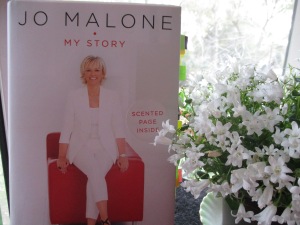
My Story by Jo Malone is one of the six memoirs I read in 2017 and the one that was the most intriguing and personal to me, not because I’m a fan of her perfumes, but because I too have a love of the aromas of plants, flowers, resins, herbs and like to create remedies from essential oils and mix them with other plant oils to use therapeutically.

Knowing Jo Malone to be a high-end luxury brand, I had little idea that she came from such fascinating and humble beginnings and was a woman of such incredible perseverance. As I say below, I loved it!

“I absolutely loved this book, from it’s at times heartbreaking accounts of struggle in childhood, to the discovery of her passion, the development of her creativity and the strong work ethic that carried her forward, to finding the perfect mate and the journey they would go on together.”

Read my full review here.

Worthy Mentions

I could go on, but rather I will just say that I also really enjoyed the excellent debut novel Stay With Me by Ayobami Adebayo, Swimming Lessons by Claire Fuller was an accomplished evocative novel, Nayomi Munaweera’s Island of a Thousand Mirrors was as exquisite, heart-breaking and lyrical as I expected after her brilliant What Lies Between Us I’d read in 2016.

The Woman Next Door by Yewande Omotoso and The Story of the Cannibal Woman by Maryse Condé were a brilliant pair to read together, both placing a black Caribbean woman in South Africa while observing her relations with others around her, in a post-apartheid era. And personally I thought Zadie Smith’s depiction of female friendship in Swing Time easily rivalled Elena Ferrante’s My Brilliant Friend, with her poignant insights and ever-present mastery of that sense of place and community, particularly in London. And though it didn’t reach the heights of Homegoing for me, Madeleine Thien’s Do Not Say We Have Nothing also left an equally strong impression:

“how living through Chairman Mao’s and the subsequent communist regime imprinted its effect on people’s behaviours forcing them to change, leaving its trace in their DNA which was passed on to subsequent generations, who despite living far from where those events took place, continue to live with a feeling they can’t explain, but which affects the way they live, or half-live, as something crucial to living a fulfilled life is missing. “

So did any of these books make your top reads for 2017? If not, what was your one Outstanding Read of the Year?

Happy Reading!

Order now via BookDepository 


Salvage the Bones by Jesmyn Ward

I’ve been meaning to read this novel for some time, I remember when it was first published it was widely read by  bloggers, it won a National Book Award in the US and it is covered in esteemed comments from reviews within many well-known media titles.

“Beautifully written … A powerful depiction of grinding poverty, where somehow, amid the deprivation, the flame of filial affection survives and a genuine spirit of community is able to triumph over everything the system and nature can throw at it.” DAILY MAIL

I decided to read it now before her new novel comes out in November, Sing Unburied Sing (already on the short list for the 2017 National Book Award for fiction) and because with all the hurricanes and storms acting out currently, a novel set in the twelve days leading up to Hurricane Katrina, seemed timely.

It’s a novel about a family struggling to stay together under already challenging circumstances, about to become even more trying with a grade 5 hurricane heading their way. It is set (as is the new novel) in a fictional, rural coastal town named Bois Sauvage, Mississippi.  Interestingly, the French edition of the novel is called Bois Sauvage, meaning Wild Wood, the author playing with the world savage and salvage, connected to the theme of survival.

It’s narrated from the point of view of fifteen year old Esch, the only girl in the family, their mother died after the long and difficult birth of Junior when she was eight years old. The children have adapted to living without their mother, though Esch is vulnerable in this all male environment which attracts other males, despite the protection of her brothers. She is becoming a woman, without another to guide her, and men who don’t know how to. Her only female reference is within the romantic tragic classic she is reading, referred to often throughout the text, the tragic anti-heroine Medea. Esch too is blinded by love and fearful of its outcome.

“In Mythology, I am still reading about Medea and the quest for the Golden Fleece. Here is someone I recognize. When Medea falls in love with Jason, it grabs me by my throat. I can see her. Medea sneaks Jason things to help him: ointments to make him invincible, secrets in rocks. She has magic, could bend the natural to the unnatural. But even with all her power, Jason bends her like a young pine in a hard wind; he makes her double in two. I know her.”

The father is an alcoholic and although that seems dire, the children are familiar with his habits and behaviours and seem to manage to keep out of his way when they need to and to care for him when he is a danger to himself.

For most of the novel the father is unable to do anything, he is either absent, asleep or suffering from an accident that  further reduces his ability to manage his role as father. Despite this, he pays attention to the preparations for the hurricane and even if he can’t do things himself, he doesn’t give up giving instructions to his children, the one thing he won’t fail at is to keep them safe.

The other main narrative concerns the plight of one of the son’s Skeetah’s prize pit bull China, who has given birth to pups that are extremely valuable, though nothing is more valuable to him than her, he rarely leaves her side, except to get food or medicine for her or her pups. It is a struggle for him to care for them all and the approaching hurricane will test his loyalty.

In all, the strongest feeling I am left with in reflecting on this novel is the effect of the mother and of the attempt by nearly all in this situation to act like her. The children prepare food and Esch’s thoughts often linger to nurturing thoughts, a sense that magnifies as her body begins to respond to the life she carries within it.

Although the mother is never present, her memory is held strong by Esch and fiercely through Skeetah, in his protection of China and her pups, Junior clammers for attention and affection, never having known her. They hold strong to how she made them feel and recognise that after the devastation, they can salvage what’s left and continue.

Medea is both the maiden and the mother, tender and vulnerable to love, fierce in her protection, loyal to her siblings and devastating in her revenge, she is the storm. She is the anti-thesis to the mother Esch remembers, but important for her survival, a warning against falling too far, while recognising how destabilising the emotions can be. Ward isn’t trying to recreate a version of Medea’s story, she uses it as reference, one that causes Esch to contemplate what is happening around her, even if it doesn’t always modify her behaviour, the emotions are too strong. Ultimately Medea will guide her.

As Esch, Randall and Junior walk through the debris after the hurricane has passed Esch picks up a piece of coloured glass, marbled blue and white and another that is red and a pink brick stone, remnants in the aftermath. Their friend Big Henry reminds her that he too will be there for them and it is a poignant moment for Esch, who squeezes the remnants tight in her hand:

“I will tie the glass and stone with string, hang the shards above my bed, so that they will flash in the dark and tell the story of Katrina, the mother that swept into the Gulf and slaughtered. Her chariot was a storm so great and black the Greeks would say it was harnessed to dragons. She was the murderous mother who cut us to the bone but left us alive, left us naked and bewildered as wrinkled newborn babies, as blind puppies, as sun-starved newly hatched baby snakes. She left us a dark Gulf and salt-burned land. She left us to crawl. She left us to salvage. Katrina is the mother we will remember until the next mother with large, merciless hands, committed to blood, comes.”

Though it took me a while to read it, this is a book that stays with you, that continues to work on the reader long after the water has receded. It is a lament to the lone motherless adolescent and her siblings, to the courage of victims of natures destructive forces, to the ability of survivors to regroup, find solidarity, to continue, to the destabilising highs and lows of young love. And to universal themes and heroines of the classics, the stories we turn to, that ask and answer life’s questions, challenge us, inspire us. I’m looking forward to reading her next book.

Have you read any of Jesmyn Ward’s works?

Man Booker Prize 2017 Winner #GeorgeSaunders

Yesterday the winner of the Man Booker 2017 was announced, and the prize went to:

Of the shortlisted titles, I’d only read one Exit West and I keep promising to finally read a book by Ali Smith,but that hasn’t happened yet. I was a little intrigued by Lincoln in the Bardo, but put off by the hype and an air of assuredness in the media of it winning; it was the British bookies favourite and although it is his first full length novel, he is an accomplished, bestselling author in the US.

Having listened to Baroness Young speak about how they came to their decision in this video, I am back in ‘intrigue’ mode and thinking, I really would like to know this one from the inside. It’s worth listening to the video, as she also mentions the obstacles some readers might encounter, an admirable admission, as not all award winning literary fiction is as accessible to the reader as one might imagine.

Comments below are extracted from the Man Booker website:

Lola, Baroness Young, 2017 Chair of judges, comments:

‘The form and style of this utterly original novel, reveals a witty, intelligent, and deeply moving narrative. This tale of the haunting and haunted souls in the afterlife of Abraham Lincoln’s young son paradoxically creates a vivid and lively evocation of the characters that populate this other world. Lincoln in the Bardo is both rooted in, and plays with history, and explores the meaning and experience of empathy.’

Lincoln in the Bardo focuses on a single night in the life of Abraham Lincoln: an actual moment in 1862 when the body of his 11-year-old son was laid to rest in a Washington cemetery.

Strangely and brilliantly, Saunders activates this graveyard with the spirits of its dead. The Independent described the novel as ‘completely beguiling’, praising Saunders for concocting a ‘narrative like no other: a magical, mystery tour of the bardo – the “intermediate” or transitional state between one’s death and one’s next birth, according to Tibetan Buddhism.’

Meanwhile, the Guardian wrote that, ‘the short story master’s first novel is a tale of great formal daring…[it] stands head and shoulders above most contemporary fiction, showing a writer who is expanding his universe outwards, and who clearly has many more pleasures to offer his readers.’

Saunders told TIME magazine that he didn’t really want to write about Lincoln,
‘but was so captivated by this story I’d heard years ago about him entering his son’s crypt. I thought of the book as a way of trying to instil the same reaction I’d had all those years ago.’

So have you read this novel, or if not, are you tempted by it? Did you have another favourite to win?

Salt Creek by Lucy Treloar

Salt Creek is a powerful and riveting account of a family struggling to make a living in the harsh environment of coastal South Australia, depicting the pioneering patriarchal entrepreneur and his devoted but long-suffering wife, and the children that will grow up with both an attachment to the place and an instinct to escape it. This story gets inside you and makes you feel the struggle and the dilemma, and wish that it could have been different.

We meet Hester Finch, in Chichester, England in 1874 where she lives as a widow with her son Joss, in the house where her mother spent her childhood, remembered from the stories her mother used to tell, in a place so far from this new reality, of that life in Salt Creek, South Australia.

Hester takes us back to her childhood in the Coorong, narrating the family story throughout the period she lived with them at Salt Creek from 1855 to 1862. Her father was an entrepreneurial businessman, who could never settle to one thing, without always having his eye on the next great idea, the thing that was going to make him rich, a success. For a while the family had lived in Adelaide, while he ran a successful dairying business, but not content to stick with that he would borrow against the things that seemed solid to invest in the next thing. He’d bought land at Salt Creek, but the sheep he’d hoped to farm were lost at sea while being transported, causing the entire family to be uprooted as the family home required selling to pay the debts.

The family find themselves leaving their grandparents, friends and familiar town environment behind to live on an isolated peninsula in rural South Australia. They must rely on each for company, schooling and help their parents out to run the farm and household.

Hester’s mother becomes melancholy and withdrawn from the moment she views her future home, requiring Hester to have to step into a more encompassing role than just that of eldest daughter. To add to her woes, their mother whose youngest Mary is only three years old, discovers she is again with child, and the nearest neighbour not company she can bring herself to indulge.

Mrs Robinson was no comfort to her and never would be; she was the measure for Mama of how far she had fallen.

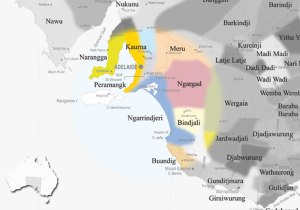
The family discover indigenous Ngarrindjeri people camping not far from their property, and become interested in a boy named Tully, who is able to speak a little English and seems keen to learn more. Slowly he slips into their lives, though without ever letting go of his ways, his disappearances, his unassuming manner, his sharing of old knowledge about which trees can and shouldn’t be cut, which ducks to avoid, much of it disregarded particularly by the two eldest sons and the father as superstitions to be ignored.

“Do you know what that boy told me today? That we shouldn’t have chopped that tree down and then showed me which ones we should use, can you believe it? Didn’t have all the words but did very well making his thoughts known. I told him we would use the wood that we saw fit since it was ours, not his, and did not trouble to conceal my feelings.”


Although the father believes himself to have an enlightened view, that all men are created equal and seen by the Divine as being equal, his beliefs are challenged when it comes to his own family, both in the example he sets for his son (in relation to indigenous women) and the restrictions he places on his daughters (including his desire to use matrimony as business negotiating device).

It is the younger siblings who grow into and live his more open minded view, and who will force to the surface his deep conditioning, which is unable to embrace those beliefs at all. Hester recalls the first day they set eyes on indigenous people and is filled with remorse:

When I think of what they became to us and how long I have been thinking of them I would like to return to that day and stop the dray and shout at our ghostly memories and the natives: ‘I am sorry. I am sorry for what is to come.’

While the older boys rebel by going off to try their luck in the goldfields, the younger sibling Fred stands his ground and resists his fathers efforts to use him as a form of payment, he spends a lot of time drawing plants in his notebook and is fascinated by the work of Charles Darwin.

“Watching Fred, I began to wonder if it was something other than interest and curiosity alone that drove his actions. He was so purposeful in what he did. Self doubt did not occur to him; he was able to look only at the thing, the task before him. I wished that I could do the same. My own self was mysterious to me. Oh, I knew what I did, but other than that I was invisible to myself…I did not know or see the difference that I made, the space I occupied in this world.”

Hester stays and stays, witness to all that occurs, as the challenges of Salt Creek and the rigid attitude of their father begin to wear everyone down. Hester is warned more than once, that she should not hesitate should there be an opportunity for her to escape. Mrs Robinson comments ‘Hard for girls like you’ to Hester and when questioned why, tells her:

I know, my dear, I know. It’s the expectations that hold you back. They’ll kill you in the end, if you’re not careful, suck the life right out of you. Run, I say. Run whenever you should have the chance, don’t spare a glance back or you’ll turn to salt or stone.”

The arrival of European settlers, their desire to own and restrict land, to create boundaries, while beneficial to their capitalist desires, becomes increasingly detrimental to the way of life of the indigenous people, as they pollute their fresh water access, introduce sickness and disease and contemplate removing their children.

Brilliantly conceived and heartbreaking to read, Salt Creek opens itself wide for discussion on the many issues related to the impact of colonial idealism, whether it’s how it affects women and children, how it impacts and impedes the native population, the imposition of solutions by one group on the other, the inherent disrespect and disregard for a different way of life.

I’m interested to read these accounts yet I am repelled by what transpires, knowing there is little possibility for an alternative ending, it is and always be a kind of clash of civilisations, which annihilates the ancient view, and will only accept its input when it has been turned it into a version of itself.

Lucy Treloar speaks of the considerable unease she felt and continues to feel two years on from its initial publication  in Australia, at telling the story, which was partly inspired by her ancestors attempt to set up a farm in the Coorong region. Compelled to share the experience and uncomfortable in the role they played. – Lucy Treloar on writing about indigenous Australians

The short video below gives voice to the Ngarrindjeri people and some hope that we might learn something from their more sustainable way of living in harmony with the natural elements around us.

Note: This book was an ARC (Advance Reader Copy) kindly provided by Aardvark Bureau, an imprint of Gallic Books. It is published in the UK in September 2017.