Top Reads 2014

It’s tough to have to choose one, and all the books below have been excellent reads, but the one standout for me was Prayers for the Stolen, because I haven’t stopped thinking about it all year,  it’s always top of mind when anyone asks me about a good book I’ve read recently, just as I still recommend Caroline Smailes The Drowning of Arthur Braxton from 2013 and Eowyn Ivey’s The Snow Child from 2012, all outstanding reads.

The Stats

This year I read 57 books, basically one book a week, 79% of my reads were fiction, 16% non-fiction and 5% poetry. I managed to read books by authors from 18 different countries and this year 40% of what I read was translated from another language. 54% of the books I read were printed books and 46% I read on a kindle. 63% were written by a female author.

Outstanding Read of the Year 2014

Prayers For The Stolen by Jennifer Clement

prayers for the stolen This book had a huge impact on me at the time of reading,  a fictional account of a girl named Ladydi growing up in a part of Mexico where it is dangerous to be a girl, so the mother’s disguise them as boys, from the moment of their birth.

An insightful read, about a tragic issue, told with empathy and humour and helping to raise awareness of the plight of so many women and girls unable to speak out for themselves. A must read.


And in no particular order, My Top Reads for 2014!

Top Fiction

1.Eugene Onegin by Alexander Pushkin (translated from Russian by James E. Falen)

Eugene Onegin 7 8The epic book length poem Eugene Onegin was my surprise read of the year and pure delight. I avoided reading it for years and years thinking it would be inaccessible. It was hilarious and a riveting read.

I read it two chapters at a time in a read along and was thoroughly entertained by that cad Eugene Onegin and bemused by that reader of far too many romantic novels Tatiana, and broken-hearted at the fate of the poet. Absolutely brilliant and I would quite like to read another translation after some of the comparisons other readers made as we read, what turns out to be not quite the same version. More Pushkin definitely.

2. Nada by Carmen Laforet (translated from Spanish by Edith Grossman)
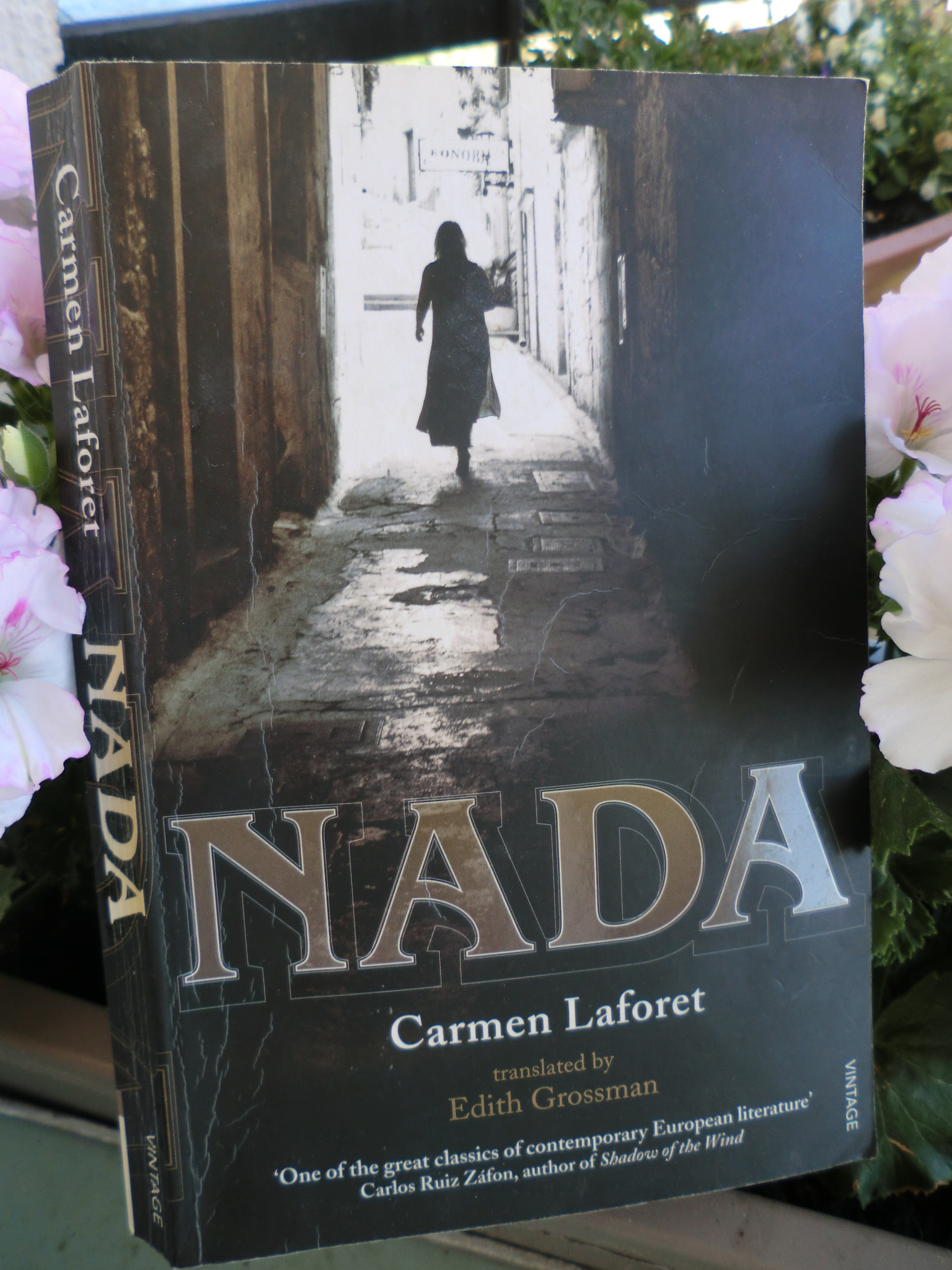
Nada (2)Nada was being passed around friends all exclaiming its wonder, a book written by the author when she was 23 years old and based on her own similar experience as a young woman moving to Barcelona to study. It takes place in the shadowy aftermath of a traumatic civil war, its effect hanging over her family. Andrea, now an orphan, arrives to stay with relatives, however her stay is not as she’d imagined it, the family are full of eccentricities and Andrea finds more refuge in the gloomy streets and with her new friends than in the oppressive atmosphere of the apartment among her strange relatives. A feverish, coming of age classic.

3. We That Are Left by Juliet Greenwood
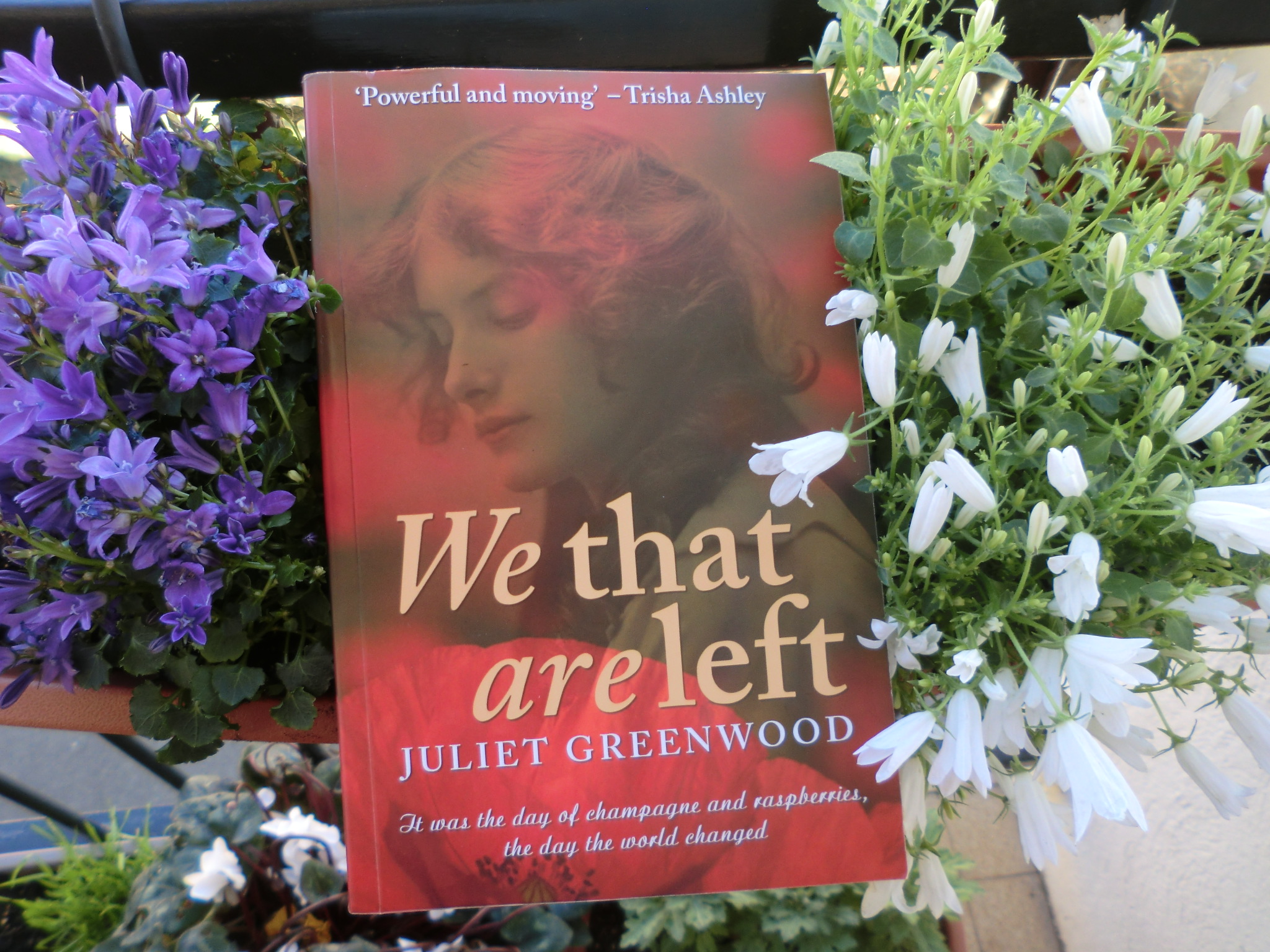
We That Are Left (2)A title I was waiting for, having loved Eden’s Garden and this promised to be just as good, set in World War One and featuring a cast of women characters who are changed by the war in ways that will continue long after.

From Cornwall to Wales to France, we follow Elin as her husband leaves for the war and she must assume responsibility for the family estate and is propelled into a dangerous mission to rescue her friend in the thick of fighting. It concerns the changes thrust upon women during the war and their refusal to go back to the more submissive role that was expected of them before the war. They prove they are just as capable of handling a crisis and if necessary will manage on their own. Brilliant, thrilling and unputdownable.

4.The True Deceiver by Tove Jansson (translated from Swedish by Thomas Teal)

True DeceiverThe True Deceiver is the first novel I have read by Tove Jansson, having read three collections of her short stories (The Summer Book,  A Winter Book and Art in Nature) all of which I enjoyed, so this was an interesting departure to stay with the same characters throughout and it is quite a thrilling read, clearly inspired in part by her own experience, facing up to the artist struggle.

It is the perfect winter read, set in the snow bound winter months, while they await the thaw. Anna is an aging artist who lives alone and is content for it to be that way, her contact with the outside world through the many letters from her fans. But someone in the village has other plans and slowly makes herself indispensable to the older woman, preying on her vulnerabilities. And the true deceiver? That is the question that reading the novel reveals.

4. My Brilliant Friend by Elena Ferrante (translated from Italian by Ann Goldstein)

My Brilliant FriendIf you haven’t yet succumbed to #FerranteFever keep an eye out for this book and the two that follow it, The Story of a New Name and Those Who Leave & Those Who Stay. They narrate a friendship between Elena and Lila, set in an impoverished neighbourhood of Naples, one tries to escape  her place in society via a university education and a marriage that will elevate her status while the other uses her intelligence in a relentless, fearless and  often ruthless quest to survive. The books are compelling and may be semi-autobiographical, however the author remains an enigma, using a pseudonym and not ready to own up to his/her identity – believing that if a book has any merit, it will find its audience.

5. The Dead Lake by Hamid Ismialov (translated from Russian by Andrew Bromfield)

The Dead Lake

This is why I wait until the end of the year before creating my list, because who knows what special book gems we might discover before the final curtain call. The Dead Lake is part of the Peirene Press coming-of-age series published in 2014 and tells the story of Yerzhan, a boy growing up at a remote railway siding in Kazakhstan, an area where atomic weapon testing is carried out.

There are only two communities where he lives and he adores the neighbour’s daughter and it is to impress her that he walks into that lake at 12-years-old and stops growing. It is a stunning and unforgettable novella and an insightful glimpse into a nomadic culture, that we are privileged to be able to read thanks to the passionate endeavours of our friends at Peirene Press.

6. The Bees by Laline Paull

Bees2

The Bees is an extraordinary feat of the imagination, narrated from the point of view of Flora 717 a sanitation worker bee. It is about life in an orchard hive and the threats both internal and external to the hive. Totally convincing, the Hive is like a cult and each bee knows its place, its role and responds by instinct and receives energy from the Hive Mind, the Queen and the collective conscience of the Hive. Flora is different and as we discover why, we begin to fear for her life. A stunning, original work, I was enthralled but the story and love that the author was inspired by a Bronze Age Minoan palace in translating a real beehive into a fictional landscape.


Top Non-Fiction

Ex Libris1. Ex Libris: Confessions of a Common Reader by Anne Fadiman

This was the very first book of the year I read and a special read for booklovers. It contains 18 bookish essays from the bibliophile Anne Fadiman, written over a period of four years, in which she talks about how she became so book obsessed and shares many often hilarious anecdotes. It was also recommended and gifted to me by the talented blogger and world-wide reader VishyThe Knight.

Arctic dreams2. Arctic Dreams by Barry Lopez

First published in 1986 and winner of the National Book Award for non-fiction in the US, Artic Dreams is a compilation of poetic nature essays written by a compassionate, scientific, nature loving mind, as he observes those creatures whose natural habitat is the arctic, whether they are polar bears, seals or Arctic people. Some of my best recommendations, as was the case with this book, come from Valorie at Books Can Save a Life.

Vera Brittain3. Testament of Youth by Vera Brittain

I planned to read this right from the beginning of 2014 when it was republished as an anniversary edition to commemorate the beginning of World War one. Vera Brittain was an intellect and despite it being seen as a waster of time by many ion the provinces where she came from she set of for Oxford to compete with the boys, whom most of her friends were.

One by one, her friends, her brother, her fiance went off to fight and not able to concentrate on something that seemed meaningless in the face of war, she volunteered as a nurse. Testament of Youth is taken from her journals and is an insightful, at times heartbreaking insight into a lost youth, and an attempt to understand humanity and to prevent us from repeating the same mistakes. A brilliant book, about to be released as a feature film.
H is for Hawk4. H is for Hawk by Wendy Macdonald

There haven’t been so many non fiction titles that called out to me this year, but this one did immediately and I pushed it to the top of the pile to read and was riveted by Helen Macdonald’s grief stricken, obsessive encounter with Mebel, he Goshawk she raises, spurning human company and comfort in the aftermath of her father’s death. Great to see it then win the Samuel Johnson prize.


Brown Girl Dreaming5. Brown Girl Dreaming by Jacqueline Woodson

What a delightful memoir in free verse from a well-known children’s writer, writing of her childhood spent between South Carolina and Brooklyn, NY tales of family members, a new brother, her passion for words, being Jehovah Witness and making a great friend. Reminds me of the equally talented Margarita Engle and her collection of novels in verse.


Voila!

So what was your outstanding read(s) for 2014?
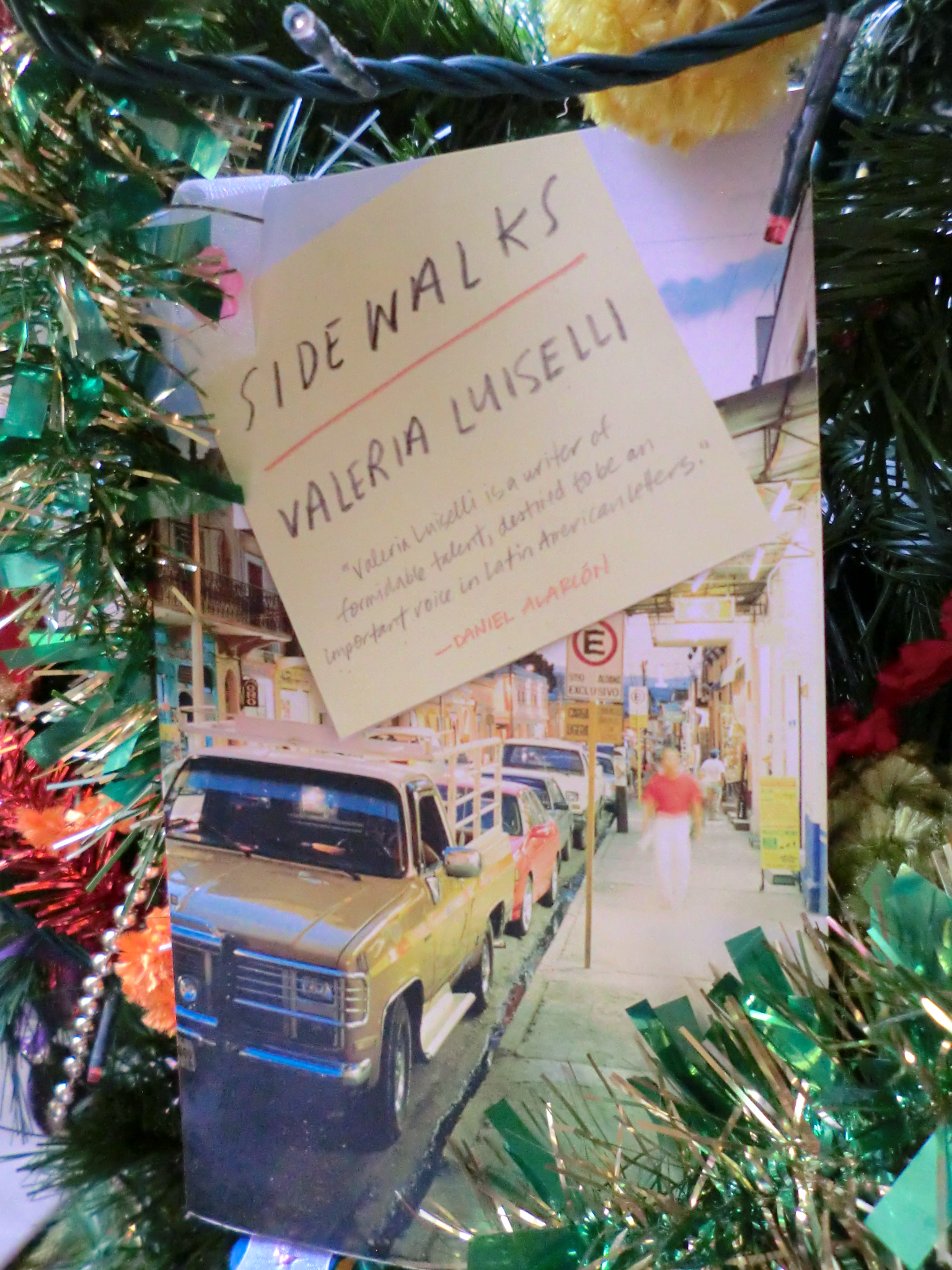
Sidewalks – Essays by Valeria Luiselli translated by Christina MacSweeney

SidewalksValeria Luiselli is a philosophical meanderer whose roving thoughts bring her to a cemetery in Venice in search of Russian poet,  Joesph Brodsky’s tomb and wandering that alluring city’s streets so late at night she is locked out of the one room she managed to find in a convent.

She ponders the map with the slow-moving icon of a plane on the screen as she flies home and thinks about the layout of the land beneath and later will find a connection between a photo of cartographers in the Mexican Map Library and  Rembrandt’s The Anatomy Lesson of Dr. Nicolaes Tulp.

Sidewalks sees her leaving the four walls of her apartment late at night for a last cigarette outside the front door, seeking escape and encountering the advice and wisdom of a doorman who shares his own long life views on how one best comes to know thyself.

“If there still exists a gaze blessed with liminal wisdom, it is the gaze of night-shift doormen. They are the only true free-thinkers – generous men capable of conversing intelligently at midnight; empathetic accomplices, offering the consolation of a companionship replete with the same reprehensible vices you yourself have and defend.”

She laments the age of the individual computer, the window inside the window that has all but eliminated household drama and made high-rise voyeurism unexciting if not nonexistent.

“It is clear that the personal computer is the great modern attack on good old-fashioned voyeurism. From the moment these machines were installed in our homes, the irreversible process of the degeneration of character began and ruled out the possibility of anyone doing anything interesting for the delight of their voyeuristic neighbour.”

Papelos

Original Spanish version

She is interested in spaces, voids, the edge of things, she tries to make sense of her home town in Mexico, a city whose first plan was allegedly scratched into sand and has continued to sprawl out of any recognisable or logical shape ever since.

Her essays reference other essayists as things she observes in her meandering bring back lines once read and remembered, passages of long dead authors become an old-fashioned, enjoyable distraction for a young woman, those words from the past arising unbidden while out walking sidewalks, no electronic media in sight.

In an essay on the river Spree, in Berlin, Fabio Morabito writes:

“A river tends to contain the city it crosses and to curb its ambitions, reminding it of its face; without a river, that is, without a face, a city is abandoned to itself and can become, like Mexico city, a blot.”

It is a slim volume and many of the essays are split into titled paragraphs, the first essay littered with the names and dates of the dead inhabiting the same resting place as Brodsky, although it wasn’t clear to me whether there was a link between the content and the named.

It feels as though there could well be much more to this collection than is picked up on first reading, especially given the original work was written in Spanish and many of the named places are foreign.

Intelligent, introspective essays that delight in being out and about and an appreciative and noteworthy introduction by the Dutch author and translator Cees Nooteboom. An author to watch out for.

Brodsky Luiselli

Joseph Brodsky & Valeria Luiselli


H is for Hawk by Helen Macdonald

Winner of Samuel Johnson Prize, Costa Prize

H is for Hawk and for Helen Macdonald, and her Hibernation from Humanity in coping with her father’s untimely death and her own pending transition, as her Cambridge University fellowship is coming to an end and she must soon leave the comfortable country cottage that came with it.

H is for HawkResponding to an instinctive need to escape reality she obtains a goshawk, retreats into her cottage, unplugs her telephone and focuses on training the raptor at the same time observing her own behaviour which begins to resemble the bird’s.

“The kind of madness I had was different. It was a madness designed to keep me sane. My mind struggled to build across the gap, make a new and inhabitable world. The problem was that it had nothing to work with. There was no partner, no children, no home. No nine-to-five job either. So it grabbed anything it could. It was desperate, and it read off the world wrong.”

In all her years as a falconer, she had never wanted to fly a goshawk, she feared them and comes to realise she has taken on the attitudes of those who glorified falcons, bird of nobility, of aristocracy, men of privilege, those who mocked the humble goshawk. But times and perceptions had changed, and getting to know and train a goshawk was the challenge she set for herself.

“Goshawks were ruffians: murderous, difficult to tame, sulky, fractious and foreign.”

She waits on a Scottish pier for the Belfast ferry, which is transporting a man and his goshawk, soon enough she will become the owner of the bird she names Mabel.

One Woman’s Obsession

The days pass and her focus must be with Mabel, she spurns human company, spending her free time in the company of T.H White, rereading The Goshawk, a book she had read as a child when her passion for birds was in its formative stages. White wrote about his failed attempt to train a goshawk, his account wrapped up in childhood fears and inclinations. Helen Macdonald reads around the life and writings of this man in order to understand him, as if to explain to her childhood self, why he did what he did.

“I understood why people considered it a masterpiece. For White made falconry a metaphysical battle. Like Moby-Dick or The Old Man and the Sea, The Goshawk was a literary encounter between animal and man that reached back to Puritan traditions of spiritual contest: salvation as a stake to be won in a contest against God.”

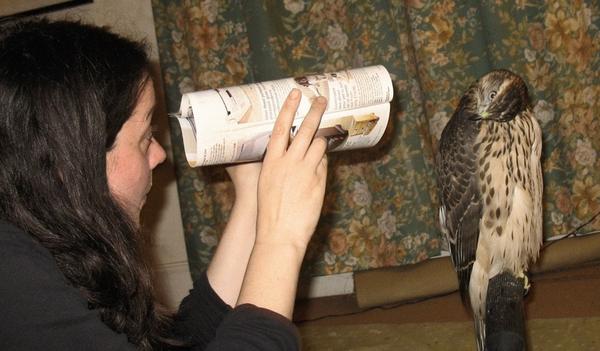
Mable and Helen playing with a paper telescope Photo by Christina McLeish @_Xtin_

Mable and Helen playing with a paper telescope
Photo by Christina McLeish @_Xtin_

It is a fascinating and insightful read as the author shares her commitment to an obsessive need to tame the hawk and exposes her vulnerability in coping with all that she wishes to avoid. Writing about the training of a goshawk is also a way of avoiding talking about herself.

We must read outside the narrative of the book to know more about Helen’s previous experience and expertise with hawks, we can tell she is no amateur, however she avoids looking back or enlightening the reader too much about her past, we are kept very much in the present, as unnerved as she is by her descent into hawk-like behaviours and instincts.

Nature Writing Memoir

I love nature writing that stimulates the imagination, that offers more than just an observation of what the author sees, but describes the environment and what an observer brings to it, one that provokes us to think about our own relationship to birds, animals and nature. Helen Macdonald comes to her goshawk challenge with fixed ideas about the need to escape all, she sets herself up like a scientific hypothesis, begins her transformation into a hawk like creature and then slowly deconstructs it, coming back to the realisation of her own humanity.

“Hands are for other human hands to hold. They should not be reserved exclusively as perches for hawks. And the wild is not a panacea for the human soul; too much in the air can corrode it to nothing.”

Falconry_sport_of_kings_(1920)

Falconry, the sport of Kings Source: wikipedia

She reminds us of the place and symbolism of falconry within humanity, its association with the hunt, with death, war, power and subservience.

It is unique in being a woman’s perspective within a heritage that has long been the domain of men, nobility, landowners, gentry, medieval lords.

It is refreshingly alive, honest and knowledgeable, exhibiting how our weaknesses and our strengths advance and recede in unison as naturally as the ebb and flow of tides.

Note: This book was an ARC (Advance Reader Copy) kindly provided by the publisher via NetGalley.

Testament of Youth by Vera Brittain

Vera BrittainThat Vera Brittain chose to name her autobiography a Testament, at first seems like an assertion of her intellectual inclinations, particularly in light of the decision she made to pause her hi-brow Oxford University studies when the First World War began as her closest friends, her fiancé Roland and brother Edward all signed up to participate, one by one departing for France.

She had fought hard to be accepted into Oxford, at a time when women were not exactly welcome, her own family and many of their social peers thought it a waste of time. It remained important, but while those she was closest to were sacrificing everything, it felt indulgent to be pursuing anything intellectual. She volunteered to become a VAD (Voluntary Aid Detachment) nurse as she sought the diversion of physically demanding work to lessen the idle hours of mental anguish concerning her male contemporaries at war.

Testament is more than one woman’s intellectual account, it is evidence of a generation’s stunted youth, a youth stolen by war and loyalty, one that for the men who participated, would continue to be acknowledged and remembered, their efforts appreciated and honoured. For Vera Brittain it would bring grief, disappointment and disillusionment.

She recalled one of her last bittersweet moments, punting up the river in Oxford with her friend Norah, whom she would not see again after the end of that term.

‘No evening on the river had held a glamour equal to that one, which might so well be the last of all such enchanted evenings. How beautiful they seemed – the feathery bend with its short, stumpy willows, the deep green shadows in the water under the bank, the blue, brilliant mayflies which somersaulted in the air and fell dying into the water, gleaming like strange, exotic jewels in the mellow light of the setting sun.

I had meant to do such wonderful things that year, to astonish my fellows by unprecedented triumphs, to lay the foundations of a reputation that would grow ever greater and last me through life; and instead the War and love had intervened and between them were forcing me away with all my confident dreams unfulfilled.’

Malta Vera Brittain

Vera Brittain, 3rd from left, in Malta, WWI

Her nursing efforts took her out of the northern provinces of England for good, away from her studies at Oxford to a military hospital in London, until events would propel her to volunteer for a foreign assignment, taking her to Malta and then close to the front line in France for the remaining years of the war.

Her account is all the richer for the journals she kept from 1913 to 1917 and rather than present them in full, she selects extracts to bring the era to life, sharing the angst and idealism of her youth, simultaneously looking back and narrating from the wisdom of early middle age, for she was 40 years old before she would finally see the much revised autobiography in print.

The book contains snippets of letters to and from Vera and her fiancé Roland and her brother Edward, they were her life blood, her motivation to face the relentless days in the hospital, where their work offered so much and yet did so little to stem the flow of blood and severed limbs, pain and hopelessness.

The letters that pass between Vera and Roland reveal the slow loss of hope, optimism and valour as they struggle to find meaning in war. Despite the often depressing content, they are fortunate to have each other, writing letters prolifically, drawing each other deeper into a love that they knew could be destroyed on any day.

After the war, Vera returns to Oxford and finds herself isolated. She has difficulty articulating her experience in a way that is understood and instead invites scorn and derision. A new generation of youth has swept up behind her and they have little time for the lessons that might be gleaned from a mature student who forsook her youth for volunteer nursing abroad. She gets involved in the debating society, and in one of the more excruciating passages in the book, valiantly tries to prove her point only to discover it will be she who is taught the lesson.

‘In the eyes of these realistic ex-High-School girls, who had sat out the war in classrooms, I was now aware that I represented neither a respect-worthy volunteer in a national cause nor a surviving victim of history’s cruellest catastrophe; I was merely a figure of fun, ludicrously boasting of her experiences in an already démodé conflict. I had been, I suspected, largely to blame for my own isolation. I could not throw off the War, nor the pride and the grief of it; rooted and immersed in memory, I had appeared self-absorbed, contemptuous and ‘stand-offish’ to my ruthless and critical juniors.’

Vera’s hope and her life purpose after the war, was to try to understand and then participate in any action that could prevent humanity from making the same terrible mistakes that caused the loss of so many lives. She changed her focus from Literature to History and searched for proof of anything that had been put in place to prevent such destructive hostilities from wiping out a generation of youth. She found what she was looking for in treaties and agreements and became an international speaker for the League of Nations attempting to advance understanding and awareness among the common population.

The book impressed me with its honesty, particularly as Vera Brittain was not afraid to portray her flaws; through the extracts from her journals we have a real sense of the character she was in her twenties and though she is the same person after the war and we recognise her inclinations, her direction in life is permanently altered by the experiences of those years.

The combination of experiencing the present through her diary and letters and her observations from the maturity of having survived war and gained some distance from it, from which to observe her former self, provides the reader a unique insight into humanity.

For me, it was a gripping read and although we learn much of the story in the opening introduction, it does nothing to lessen the effect as we witness Vera receiving news she has dreaded from the beginning and more than the individual events, the observation of emotional ups and downs and the effect of war on a generation seen from a young woman’s perspective is more insightful than any rendition of battles or victories I have ever read.

If the prospect of reading a 600 page book seems daunting, look out for the movie coming out in 2015!

Good Morning, Mr Mandela by Zelda la Grange #Memoir #Giveaway

Good Morning

Thanks to the publisher Viking, Penguin-Random House, one lucky US reader can win a copy of Zelda la Grange’s memoir Good Morning, Mr. Mandela, an in-depth account of her 20-year dedication to her employer Nelson Mandela.

Win a Copy!

To enter the draw, leave a message below or on the book review post here. Only US readers with a valid postal address are able to enter sorry. Entries close Sunday 3 August.

An Additional Entry!

Share one of your favorite quotes from Nelson Mandela to gain an additional entry.

You can find a list of quotes here on Goodreads.

Bonne Chance!


Good Morning, Mr Mandela by Zelda la Grange

Mandela Day

Today, 18 July is Nelson Mandela Day, it was the date of his birthday and the day he married his wife Graça Machel. I discovered this yesterday as I was nearing the end of Zelda la Grange’s memoir Good Morning, Mr Mandela as she helped with the plan to advocate to the UN to try to make 18 July International Nelson Mandela Day, after receiving a letter of congratulations from Bono for Mandela’s ninetieth birthday celebrations held in Hyde Park, London. He wrote:

“Happy Birthday Madiba. I am working to make July 18th a public holiday in every country that acknowledges that the struggle of Nelson Mandela is not over until every individual who yearns for freedom has the chance to grasp it. I believe your birthday should be an occasion around the globe to honour those who still struggle.” Bono, U2

Good MorningWhen I saw this memoir was due for release I didn’t know anything about Zelda la Grange, but after reading this interview by John Carlin in The Guardian from 2008, I decided to find out more and finished reading it today.

Zelda la Grange was born in 1970 in East Johannesburg, South Africa to a white Afrikaans family. Her father worked in construction and her mother was a teacher. The family wasn’t rich, but being white, they enjoyed the privileges of their race, benefiting from the apartheid regime through access to health, education and a strong sense of entitlement. It wasn’t something she ever thought about, it was the way they lived, they accepted it and had little knowledge of how these policies affected black and coloured people. They were racist.

“As a child it is easy to follow when you grow up in an environment that is safe. Perhaps if I had been oppressed, didn’t have access to a decent school, a proper house, electricity and water, I would have asked different questions, and my brain would have developed into being more inquisitive about injustice at an early age.”

Not knowing what she wanted to do with her life, she enrolled in a course to become an Executive Secretary. When Mandela was voted President she was working in a government Human Resources Department and heard there was a job opening in the administrative department of the President’s office.

It was to be the beginning of a twenty-year career working for Nelson Mandela, first in his capacity as President and then when he left the government, she would be the one person he chose to take with him, to maintain in his employ for life.

Zelda la Grange served Nelson Mandela for around 20 years and you could say she gave her life to him as she had little personal existence outside her working life, so loyal was she to the man who handpicked her to be that loyal employee. Ever the strategist, he chose a woman whose skills complimented his own, she compensated for his weakness and allowed him to continue to focus on his strengths by taking care of all the things that needed to go on behind the scenes to ensure safe passage and no surprises. She was a perfectionist, though she doesn’t admit that in the book, working often through the night than have anything go wrong and was completely obsessed with every little detail.

Zelda owns up in the opening pages that this book is her story and so doesn’t contain great political insights into South Africa or its policies, nor does she ever break the trust she had with Nelson Mandela and say anything he wouldn’t have approved of. One gets the impression that she could have said so much more and perhaps even did, but any excesses have been cut from the first draft and what we read here is a clean, if somewhat lacking version of the events of those twenty years they worked together.

The book reads like a diary of events, which can become tedious, especially as the language is quite prosaic, just as the job must have been, however she is clearly passionate and dedicated to serving the man she referred to as Khulu or Grandfather and he referred to her as Zeldini. Their relationship was extremely close, but always with a respectful and appropriate distance, as was inherent in both their natures.

It is an incredible record of those years and the many voyages they made, people met and funds raised for various humanitarian projects they launched, even if we miss the perspective of the man himself.  In telling her story, she pays tribute to her boss and has created a record of her great respect and need to ensure that all those associated with him, from friends to celebrities to politicians were adequately taken care of. She never stoops to gossip, takes care not to say anything negative about the family, although you can sense the unspoken tension underneath, after all they did bar her from the funeral activities and if it wasn’t for the generosity of Mandela’s wife, Mrs Machel, she would not have attended at all.

An interesting account and makes me even more curious to read Mandela’s own words and gain an insight into what was going on inside his mind during these years.

Today's Google Doodle

Today’s Google Doodle

Note: This book was an ARC (Advance Reader Copy) kindly provided by the publisher via NetGalley.

Signed, Sealed, Delivered – Celebrating the Joys of Letter Writing by Nina Sankovitch

Signed SealedHow could I not pick this book up, a non-fiction tribute to the dying art of letter writing. A pastime that makes the young at heart feel like they have entered old age, because so few people do it any more, it has become old-fashioned!

I am a letter writer from so far back that I didn’t realise how early it began until reacquainting with people from the past via Facebook resulted in some reminding me of letters I had written when I was younger than 10-years-old.

I know I wrote letters when I was at boarding school (from 13), we all did, it was a matter of survival and a tactic to avoid that dreadful feeling at midday as we lined up the staircase waiting to retrieve our lunch to take outdoors, listening to the boarding school mistress read aloud the names of those who had received a letter today, and when your name wasn’t read out – inevitable really – it invoked a sense of disconnect, reminding you that you didn’t live at home, that you couldn’t just visit a friend, a neighbour, your family whenever you wanted, you had to wait for them to write a letter to be in contact.  Four years of listening to names being read out is enough of a sentence to instill a habit of letter writing into anyone surely.

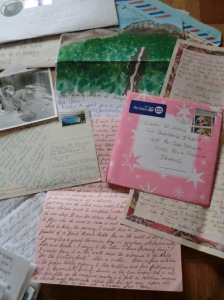
LettersNina Sankovitch has a more romantic view of letters and letter writing and the word joy in the title is a clue. She doesn’t speak of the suffering of not receiving letters, she speaks of the joys of connection.

She gives her son a table and pen and he pens his first postcard letter at thirteen months old, fast forward to the present when he is eighteen and off to Harvard, now she is hankering for more than the brief text messages, tweets and occasional telephone calls, this more disposable form of communication that dominate life today but do not endure. She wants a letter and that desire makes her wonder what it is about a letter that means so much.

Will she convince her son to write to her, the kind of letters she has appreciated herself? Whether she does or not, that desire and the discovery of an old trunk containing letters dating back to the 1800’s that she inherits when she and her husband buy a new house, the seller wanting nothing to do with an old rotting trunk or its contents, send her on a quest of her own through the history of letters and her own personal correspondence, to discover and celebrate what is special about the handwritten letter.

“There have been times when I have needed the reassurance that I am not floating out there alone in the universe, that I am tethered to people who will keep me secure. The letters offer that reassurance. Even if those people are gone, the bond endures through the tokens of connection we passed back and forth, the written manifestation of our relationship.”

The author lost her oldest sister to a fast and brutal bile duct cancer, she has photos and memories of the times they shared, but it is the letters, postcards and birthday cards that keep her most alive within, just as the hundreds of letters written by James Bernheimer Seligman that she inherited in that trunk, a young man she never knew, but came to know through his correspondence created in her imagination, a vision of a person that almost seemed real.

From the ancient Egyptians to the medieval lovers Abelard and Heloise, from the letters received by President Lincoln after his son’s death to the correspondence of Edith Wharton and Henry James, Nina Sankovitch attempts to divine the allure of the letter. She takes us on journey through a stack of published letters that have been preserved and published, introducing those interested in letters and the epistolary form, to a long list of references that speak of great love, erotic fantasy, a mother’s love, a son’s last words from the front and much more.

I enjoyed the book and its introduction to some of the great literary correspondences, including the one found in her own backyard. I did find it overly sentimental in parts and despite the great introduction to those letter writers in history, there were too many examples of short encounters with little depth that had the effect of being easily forgotten.

It may have been better to highlight fewer, more memorable examples than some of the less engaging examples that pad out the book. On the other hand, readers have varied interests. I know I could easily have been swept away by a more in-depth discovery of fewer pairs of letter writers.

Samuel Steward 1957 Source: Wikipedia

Samuel Steward 1957
Source: Wikipedia

The relationship between Gertrude Stein, Alice B.Toklas and Samuel Steward (a poet and novelist I had never heard of) was one of the sets of correspondence that stood out for me. Steward wrote a letter to Gertrude Stein that was to become the beginning of a lifelong friendship, (interspersed with trips to Paris to see the two women), much of it conducted through letters and when Gertrude died he and Alice continued to write for another 20 years until her death.

Steward also wrote a journal, religiously writing notes every evening of all that had happened during the day, from which he penned his memoir Dear Sammy. A character in his own right, Steward left the world of academia to become a tattooist and pornographer remaining committed to the lifelong friendship he developed with Gertrude and Alice.

Ultimately, by referring to so many pairs of correspondence, we find something here for everyone, whether it hails from the present, our more recent history, or medieval characters like Heloise, the cloistered nun writing to her lover Abelard in the early 1100’s.

Madame Sévigné3I have moved Madame De Sévigné’s Selected Letters to within reach and feel inspired to become acquainted with one of the world’s greatest correspondents, a prominent figure in French society and literary circles in the 17th century, her letters continuing to enchant readers 300 years after they were written.

And do I still write letters? Absolutely, I just wrote one last week to an Irish poet!

So when did you last write a letter?

A timely and nostalgic reference to a dying form of communication and literary art form.

*

Note: This book was an Advance Reader Copy (ARC) kindly provided by the publisher via NetGalley.

Tove Jansson Anniversary 100 years #TOVE100

TOVE 100 © Moomin Characters™

TOVE 100
© Moomin Characters™

2014 is TOVE100, 100 years since the birth of the Finnish artist and writer Tove Marika Jansson.

I have read a few of her books (the adult books translated by Thomas Teal), discovering her about a year ago and I have become a little obsessed with her work since then.

To celebrate her 100 years, I plan to read a few more books by or about Tove Jansson and invite you to join me if you wish.

Books Read

A Winter Booksee my review here

A quiet, honest collection of stories, containing evocative black and white photos that add to the atmosphere the author evokes making the reader experience life on the island and all its challenges, right up to the final story, Taking Leave, the last visit, when the nets have become too heavy to pull, the boat too difficult to handle, the sea too unpredictable for two aging women.

The Summer Booksee my review here

An elderly artist and her six-year-old grand-daughter spend a summer on an island in the gulf of Finland. Gradually, the two learn to adjust to each other’s fears, whims and desire for independence, coming to an understanding, teaching each other something along the way.

The True DeceiverSee my review here 

An aging women artist living alone on the outskirts of a village is befriended by a younger woman, who after faking a break-in moves in with her brother, allegedly to provide companionship. It is a relationship that peels back the layers of both women, bringing their inclinations and bugbears to the surface, a face-off between truth and kindness, both containing elements of deception.

Art in Nature – See my review here

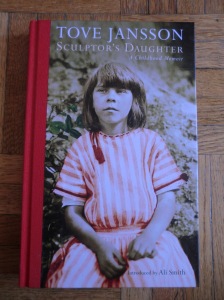
Sculptors daughterStill To Read

The Sculptor’s Daughter by Tove Jansson

Fair Play by Tove Jansson

Tove Jansson Life, Art, Words: The Authorised Biography, Written by Boel Westin, Translated by Silvester Mazzarella

The Moomintroll Books

Tove Jansson with her brother Per Olov © Moomin Characters™

Tove Jansson with her brother Per Olov
© Moomin Characters™

She wrote and illustrated children’s books and later in life began to write for adults as well. She was close to nature and spent nearly every summer on a family island in the Pellinge archipelago, in the Gulf of Finland, an environment that features often in A Winter Book and The Summer Book.

Born on 9 August 1914 to a family of artists, her mother was a graphic designer and her father a sculptor. An artist before anything, she was multi-talented, painting, illustrating and writing, not confined to any one genre. Her first book for adults was part fiction, part memoir, The Sculptor’s Daughter, written 10 years after her father’s death.

Although I admit to never having read any of them, she is most well-known for nine children’s books that grew out of her family of characters, little white trolls living in Moominvalley named Moomintroll, Moominmamma and Moominpappa along with other creative creatures such as the Hattifatteners, Mymbles and Whompers. She also illustrated other classic children’s books including versions of Alice in Wonderland and The Hobbit.

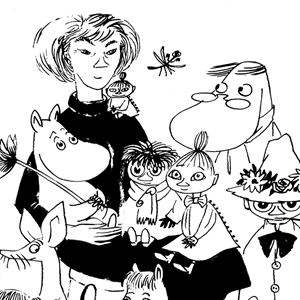
Tove Jansson and Her Moomintrolls © Moomin Characters™

Tove Jansson and Her Moomintrolls
© Moomin Characters™

Her career started early, drawing for a liberal satire magazine Garm at the age of 15, the title where her large nosed character Moomintroll made its first appearance. I think she may have been filling in for her mother, based on a comment I read in The New Yorker, but I’ll find out more when I read the biography. Her first book Sara and Pelle and the Octopuses of the Water Sprite – was published when she was just 13.

Her books have been translated into more than 40 languages, making her one of the most well-known Finnish artists, remembered by many from their own childhood and continuing to gain new audiences today.

“I didn’t realise it was set in a real place. I thought she’d made Finland up. Finland was like Narnia, with these incredible characters that were so strange but instantly recognisable because you had met lots of them – noisy Hemulens or neurotic, skinny Fillijonks.” Frank Cottrell Boyce

Events

There are numerous events happening worldwide and the national gallery of Finland, Ateneum Art Museum in Helsinki is holding an exhibition of all oeuvres of Jansson’s career, her surrealistic paintings of the 1930s, modernist art of the 1950s and more abstract works in the 1960s and ’70s, as well as her satirical anti-war illustrations for the magazine Garm, her murals created for public spaces, and illustrations of her Moomin characters and stories. I’m unlikely to make it to Helsinki, but was pleased to discover the audio presentations linked below, 2 minute descriptions (in English) of 12 of her paintings which you can view while listening.

Further Reading, Listening

Two Minute Audio Descriptions of 12 of her Paintings, via the Finnish Art Museum, Ateneum

TOVE100 – website with events happening internationally, resources

The Hands That Made the Moomins – An article in the New Yorker


Have you read any of Tove Jansson’s books? Are you planning to read any of them this year?

Scattered Dreams by Karin Crilly

On March 4th I sent an email to Karin Crilly about a competition being run on The Good Life France. I saw this competition mentioned on twitter  @lifefrance and thought of Karin as I knew she was writing a memoir about her year in Aix-en-Provence and I thought it would be a good idea for her to send something out into the world.

The Good Life France is an independent online magazine that celebrates life in France and attracts a number of writers and contributors who write on a wide range of subjects, keeping visitors and residents informed about France and all things French. The competition was to celebrate the 2nd anniversary since their inception and they invited contributions of work up to 1000 words on France or French related.

Good Life

Karin replied and said she would be very interested in entering the competition and asked if I would like to read the extract she had chosen, from the first chapter of her book.

Unbeknown to us both at the time, it was the beginning of the two of us working together. I read her work, made some suggestions and she polished her already excellent prose into a shape resembling 1000 words of an evocative experience in Paris that did indeed wow the judges, moving some of them to tears yet uplifting them at the same time.

Earlier this week, to our great joy, we learned that Karin had won the competition, ahead of more than 100 other entries and her story Scattered Dreams in Paris has now been published on The Good Life France.

You can read the story here by clicking on the title.

Winner of 2014 Writing Competition The Good Life France!

Scattered Dreams in Paris by Karin Crilly

CIMG2976


Congratulations Karin and  Bonne Continuation!

Update: Karin’s memoir has now been published, you can find out more by reading my review here: The Blue Satin NightGown by Karin Crilly.

Daphne’s Dilemma – Part II

Click here To Read Daphne’s Dilemma – Part I first

Annie was my first horse. No thoroughbred, she was what some might call an ‘old nag’, not tall enough to be called a horse, just an unexceptional, somewhat lazy pony.

Chocolate brown and rotund, she liked to spend her days grazing in the paddock getting fatter and fatter. She was slow and patient and a good pony for my sister and I to ride on, though she did have a couple of stubborn habits. Sometimes she would turn her head when we put our foot in the stirrup and try to nip us on the backside.

She also had a habit of pulling her head down quickly to eat grass if we paused for a few seconds. Knowing this, we kept a firm grip on the reins to prevent her from eating, to which she would retaliate by throwing her head forward with a sudden jerk, flinging the reins out of our hands. Sliding down her neck to rest behind her ears, the reins then became impossible to reach without dismounting. We had to climb off, lead her alongside a log to give us extra height so our feet could reach the stirrup, or find a sheep track on a steep part of the hillside so we could jump back on, hoping she didn’t move while we attempted such daredevil tactics.

Annie had been pregnant and due to give birth. We had stopped riding her and Dad had put her in a different paddock from where she was usually kept. Every day she would come up to the fence so she could see the other horses in the adjoining paddocks, until that day she stopped coming.

“That’s strange” Dad had said, “I haven’t seen Annie. Perhaps she has had her foal and moved away from the fence-line to be nearer water.” Steep limestone cliffs lay beyond the trees where the soil was damp from underground water springs. It is a dangerous area, my father later agreed, but animals have good instincts he’d said.

Limestone CliffsImages of water, slippery rock and a pregnant horse left me with a sick feeling in my stomach and that racing heart. A heavy black cloud descended as we waited for Dad to return from his search, one we were forbidden to participate in. He returned alone. He had found Annie lying bloated and very dead at the foot of one of the cliffs. She had been about to give birth, he said.

I wished I had gone searching for her the day before, I wished we could have anticipated the risk, I wished so hard that we could rewind those days and she would be back up at the fence-line neighing to the other horses. I did not mind that she was bad-tempered, ate too much and tried to bite us, I just wanted her back and to remove forever that terrible helpless feeling in the pit of my stomach.

*

I walk up to the cottage when I see the distant figures of cow, man and dog disappear out of sight behind the trees between the airstrip and the shepherd’s cottage. When I arrive, there is Daphne, fat as ever but no calf. Dad leads her to the steel gate that opens into the main paddock in front of the house. Opening the gate right back on its hinges, he sandwiches her into the space between the gate and the fence. There is no chance of her bolting.

Now that she is standing still, I can see a tiny pair of hooves emerging from the much swollen, pink, fleshy area beneath her tail. I am told she is having difficulty and seems to have given up pushing. Dad rolls up his sleeves just like he would on a lambing beat, to lend a helping hand. Literally. He puts his hand inside that swollen, pink, fleshy area and tries to get a grip further up the protruding legs to assist the calf to come out. The legs emerge a little further but nothing more.

“It’s a big calf alright” he says as he tries again, “but she doesn’t wanna budge.” I walk to the corner where the gate meets the fence to check out Daphne’s face. She has an angry look, I struggle to find any glimmer of recognition in those big frowning, brown eyes.

She is flicking her tail down the other end, back and forth like a fly swat. It is easy to see she is not impressed with her captivity or the interference with her private cow parts. She will get used to it though, this is to become a familiar setting, to be locked in a tight holding area while my father sits on his small wooden stool in front of her hind leg to commence with the ritual morning teat pulling,  ‘milking the house-cow’ as we say.

After a few more attempts at hand assisted birth, Dad comes up with the idea to tie a rope around the calf’s ankles and pull it out. He knows he must be careful not to pull too quickly, as this could endanger Daphne’s reproductive equipment. He must be careful in case those contracting muscles suddenly give way, that could land him and the calf on the ground with a heavy thump, another scenario he wishes to avoid. He pulls as carefully and as strongly as he dares, but still nothing more than the front legs emerge. Daphne is beginning to protest. She starts to bellow loudly and tries to sit down. She has had enough.

“Get up you old bitch” Dad bellows back, thumping his hand on her rump. I cast him my own angry look but keep silent. I know she has to stay standing and the calf has to get out, we could lose them both if she gives up.

“Come on Daphne, you can do it” I say under my breath, just like I did two years ago while leading her around the obstacle course at the agricultural calf club day at school.

Finally Dad announces that he is going to get the tractor. The tractor! What is he going to do with the tractor?

He comes back with his old Massey Ferguson tractor and parks it in front of Daphne’s rear end. He ties the rope to the tractor, puts it in its lowest gear and very slowly inches it forward until the head of the calf emerges, followed by a loud bellow from Daphne.

Leaving the tractor running in neutral, he pulls on the hand brake, jumps out of the seat and returns to the calf just in time to catch it as it makes its first tumble into the outside world.

The calf is covered in a light, greasy film and as Dad moves the tractor away, I close the gate to let Daphne move from her confined position. She immediately turns around, puts her head down, sniffs her new-born calf and begins licking it.

The calf puts its front legs forward and tries to lift itself off the ground. The first attempt is unsuccessful; he is a little unsteady on his feet. But with the second attempt he manages to stand and begins to butt at his mother, searching for that universal elixir of life, ‘mother’s milk’.

The End

Daphne's Calf

Daphne’s Calf