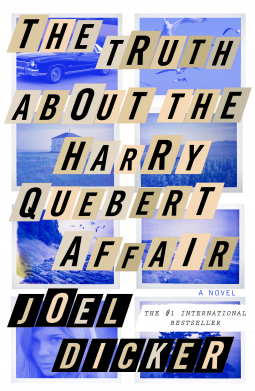
The Truth About the Harry Quebert Affair by Joël Dicker

Ok a few truths.

TruthAboutHarryThe Truth About the Harry Quebert Affair was originally written and published in French. The Swiss author, 28-year-old Joël Dicker’s first novel wasn’t a big hit, but he followed it up by writing this 600 page satire of  a young American man (his age) who writes one bestseller and then can’t write anything else.

His pushy agent and publisher threaten law suits and ruin unless he meets a deadline on his next big thing. Rather than write, he visits his ageing writing professor in New Hampshire, who was once a young man who wrote a bestseller and then didn’t write anything else. He gives him advice that prefaces many of the chapters:

“Books are interchangeable: People want a story that excites them, relaxes them, entertains them. And if you don’t give them that, someone else will – and you’ll be history.”

More truth.

Harry QuebertYesterday I was in the popular French bookstore FNAC (a kind of WH Smith equivalent) in Lyon and saw La Vérité sur l’Affaire Harry Quebert is still in the Number 1 slot. I saw it the day before in the giant supermarket Carrefour in the same position. It’s been a bestseller for over a year in France.

I do love watching a book become a runaway success and don’t always read them, but this is a book in translation, double victory –  the rights sold to 35 countries and translated into 37 languages and it won two prestigious French book awards.

The Harsh Truth.

However despite all the accolades, I have to be honest and say that I did not enjoy the read, it offered very little in terms of what I like to get from a book and worse, it annoyed me immensely in parts.

Maybe Not Your Truth Though.

But first the story, because it is a somewhat compelling read which many have and still may enjoy; full of twists and turns, a disappearance,a cold case reopened, concerning teenage girls, older men, appearances not what they seem, everyone with something to hide and more twists than an old-fashioned telephone cord. So many twists in fact, I can’t remember who did it. No, everyone did it, didn’t they? Well, Dicker certainly has a skill in making you think they’re all capable of murder.

So Marcus Goldman is living the life of a rich and famous writer in New York on the strength of a debut bestseller, when his writers block starts to have menacing consequences and he has to come up with a solution, quickly. He visits his old university professor Harry Quebert, whom he had kind of forgotten while he was busy being famous and pursued by actresses and other celebs. Not long after his visit, Harry is accused of the murder of Nola Kellergan (Nola, Lola, Lolita?), a 15-year-old girl who disappeared 30 years ago, whose remains are discovered, implicating Harry Quebert.

Marcus returns to Harry’s home when he is arrested and makes the investigation of his innocence his new purpose in life, he meddles in police affairs, interviews locals and even receives his own menacing threats penned by someone who wants him to leave town. The case might well provide him with the solution he requires, as his publisher asks him to write The Truth about what went on between Harry Quebert and Nola Kellergan.

Joel Dicker

Joël Dicker speaking in FNAC bookstore

A Consuming Truth

Viewing the wall of bestsellers is the first thing you see when you enter major supermarkets in France like Geant Casino and Carrefour; it says a lot about local culture that people are being enticed to grab a book at the very first moment they enter a supermarket! I don’t think I have seen that in any other country, I have listened to experts talk about enticing customers with fresh healthy fruit at the entrance, but not literature.

Too Many Additives

For me, although I get the requirement of a modern social satire to exaggerate, the Harry Quebert story carried too many characters that were inflated caricatures of American stereotypes, with insufficient humour to make it work. Trying to be a satire, a pastiche and a murder mystery with its innumerable twists made it for me, like a cocktail made by an unsupervised teenager  who, rather than combining two ingredients, like a mature pre-adult can’t resist adding a little of everything on offer until ultimately it becomes unpalatable.

I viewed it as an outsiders attempt at making a comment on modern American society, media, publishing, the sensationalism and obsession with broadcasting the trials of celebrities. That a 28-year-old writer could enter into a police murder investigation and  didn’t ring true enough for me to be able to read it without the constant presence of low-level annoyance at its flaws. Perhaps if I had saved it for a summer read when my expectations are lower, I may have enjoyed it more.

I do love that a French bestseller was picked up by international publishers and translated into English, the author interviewed in The Observer and elsewhere, but sadly, this award-winning novel wasn’t my cup of tea.

Great Gatsby2And in a twist of Great Gatsbyish irony, it seems that thousands of the English translation books are languishing in storage, waiting for a boom that has yet to arrive. Will it take a generation to be revered as an apt indictment of the times or will it languish in obscurity as a publishers costly mistake?

Further Reading:

The Observer Article – Joël Dicker: ‘I lost a bit of control of my life’

Note: This book was kindly sent to me by the publisher via NetGalley.

The Expedition to the Baobab Tree by Wilma Stockenström

Baobab Tree CoverI came across this book by chance, first published as Die kremetartekspedisie in its original Afrikaans in 1981, it was translated into English by Nobel Prize winner J.M. Coetzee, initially in 1983 and again in 2014.

I had never heard of Wilma Stockenström, but after a little digging, I find:

“For the past four decades Wilma Johanna Stockenström has been enriching Afrikaans literature with her satirical, obstinate and compassionate voice. Along with Elisabeth Eybers, Sheila Cussons, Ina Rousseau and Antjie Krog, she remains one of the most important women writers in Afrikaans.” © Johann de Lange

After recently reading Sue Monk Kidd’s The Invention of Wings, a story narrated by a female slave, I was interested to read this more literary novel, set in the harsh interior of South Africa.

It is a quiet, compelling, stream of consciousness narrative of a slave woman who finds refuge in the hollow of a baobab tree, attempting to survive following the death of her third master, finding herself abandoned in an often hostile wilderness.

“I was sold off a second time on the square near the sea where even then the raggedy castor-oil trees were standing. Was sold secondhand. I was a damaged plaything, my bundle of baby and myself bid for separately and disposed of separately. Simply playthings. Useful, certainly. My owner thought he had wasted his money.”

The Baobab Tree

The Baobab Tree

Embracing this newfound freedom of her body, mind and time, she thinks back over the years, reflecting on what her existence thus far has meant, the role of her three masters, moments shared with a friend, the loss of her children and the inclinations of man, something she has witnessed both in captivity and in this solitary freedom, where she finds a kind of disturbed though preferable peace.

“I know the interior of my tree as a blind man knows his home, I know its flat surfaces and grooves and swellings and edges, its smell, its darknesses, its great crack of light as I never knew the huts and rooms where I was ordered to sleep, as I can only know something that is mine and mine only, my dwelling place into which no one ever penetrates. I can say: this is mine. I can say: this is I. These are my footprints. These are the ashes of my fireplace. These are my grinding stones. These are my beads. My sherds.”

She is viewed by a tribe of small people who make a pilgrimage to the tree and recognise her as some kind of deity. It is their generosity and ritual of giving alms that aids her survival.

She notices everything, she appreciates her surroundings and tunes into small changes and disturbances in it. She becomes it.

Haunting, lyrical, this work is unlike any other narrative of the life of a slave woman I have ever encountered.


Note: This book was an Advance Reader Copy (ARC) kindly provided by the publisher via NetGalley.

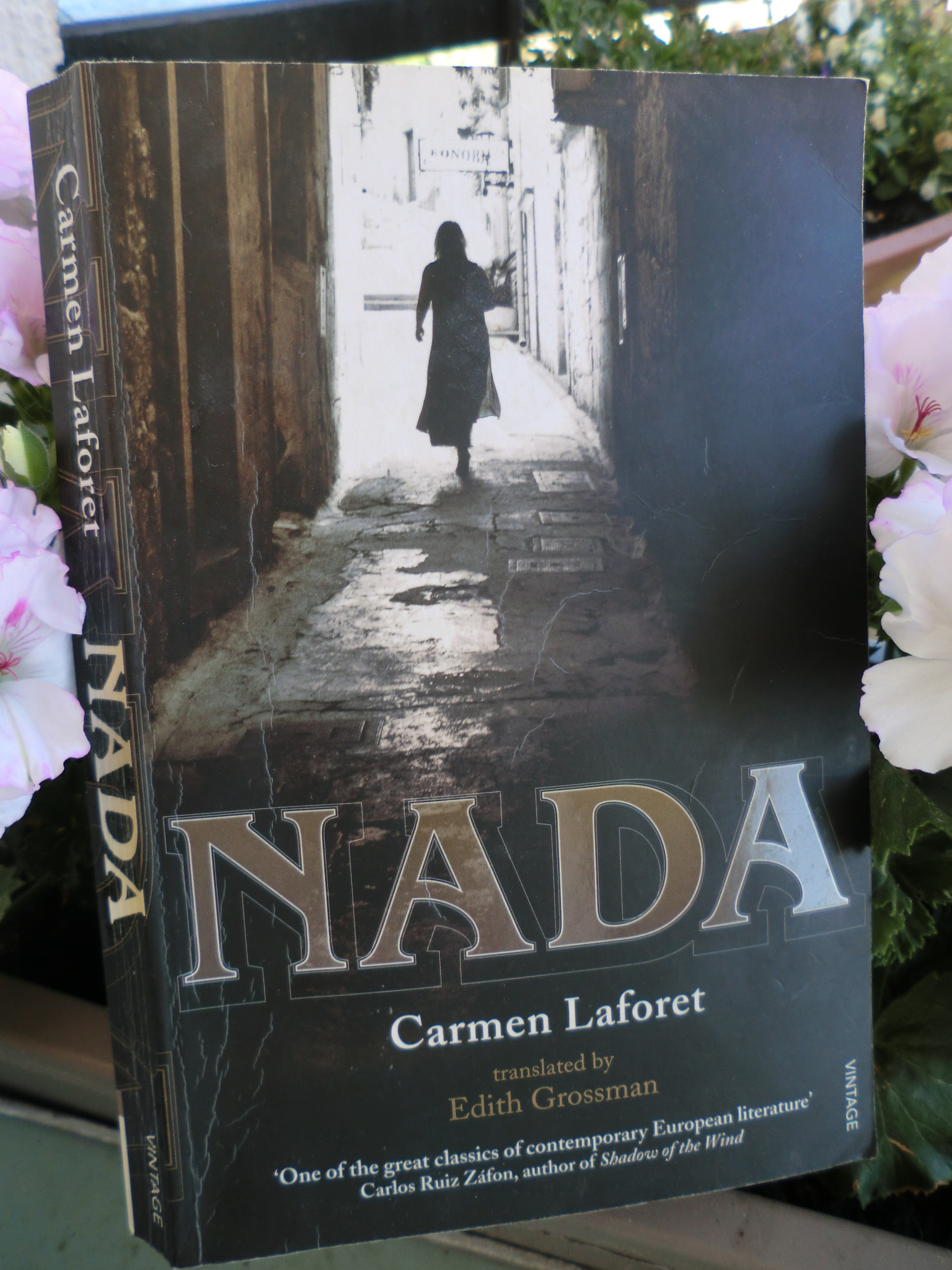
Nada by Carmen Laforet

Nada (2)On a recent visit to London, my Uncle was handing this book back to the friend who lent it to him and I listened intrigued as they discussed its merits. “Isn’t it brilliant?” she said.

Book envy hardly had time to rear its head before my Uncle said “but Claire, you must read this too” and rather than it returning to its owner, this book came home with me, delighted to be off the shelf once more, this time travelling closer to the territory where it was conceived.

Nada was written by Carmen Laforet when she was 23 years old and first published in Spanish in 1945. Born in Barcelona, she moved to Las Palmas in the Canary Islands when she was 2 years old and like her protagonist Andrea, moved to Barcelona when she was 18 to study literature and philosophy.

Edith Grossman, who also translated Gabriel Garcia Marquez and Mario Vargas Llosa (who writes a brilliant introduction in the opening pages) puts Nada into English in what Alberto Manguel describes as “a fluid translation”, one that I read as if it has been written in English as its first language. The book was finally published in 2007, three years after the death of its author.

Andrea has spent a dreamy summer in her hometown, looking forward to coming to Barcelona to study and spend time with her family she hasn’t seen in years and barely remembers. She arrives three hours late and thus finds her way to the Calle de Aribau alone in the dead of night, arriving at the dilapidated apartment to be met by an apparition, a strange gathering of eccentric characters.

gothic barcelonaHer family, weathered by years of neglect, corruption and psychological torment, live in a claustrophobic environment that causes Andrea to develop her own eccentric behaviour in an effort to escape theirs. The house is inhabited by her two uncles, Juan and Roman, her aunt Angustias, the maid Antonia, and Juan’s wife, Gloria, plus a menagerie of cats, an old dog and a parrot.

“That illuminated twinkling of stars brought back in a rush all my hopes regarding Barcelona until the moment I’d entered this atmosphere of perverse people and furniture. I was afraid to get into the bed that resembled a coffin. I think I was trembling with undefinable terrors when I put out the candle.”

Though never mentioned, the city and its people are in the shadow of the recent civil war which has pushed the population to its extremity, people are either starving or drowning in excess, oblivious to the plight of the depleted middle class, who grasp onto whatever they can, the more practical selling the candelabra and curtains no longer given occasion to flaunt their long-lost beauty.

“The memory of nights on Calle de Aribau comes to me now. Those nights that ran like a black river beneath the bridges of the days, nights when stagnant odours gave off the breath of ghosts.”

Carmen Laforet 1921 - 2004

Carmen Laforet 1921 – 2004

Carmen Laforet writes in a way that makes the reader experience the brutality of each encounter, while instilling in us something of the toughness of Andrea, we seem to know she will handle it all, despite her growing thinner by the day as she observes the decline into madness of her extended family.

The depth of the prose is extraordinary and intriguing, the kind of work that makes a reader want to listen to the writer talk about what inspired them and what was going through their mind when these words flowed onto the page.

Carmen Laforet has created a heroine who is witness to a decline, who is oppressed by it and at the same time somewhat oblivious to it, captured it with an intensity that causes us anguish, the story sits uncomfortably with the reader but compels us to turn the pages ravenously. An utterly absorbing and spellbinding read, what a treasure that took so long to be shared with the English reading world.

“She achieved this, and half a century after it was published, her beautiful, terrible novel still lives.” Mario Vargas Losa


Further Reading

Elena’s Books and Reviews – an excellent review by Spanish blogger, Elena Adler. Studying literature and humanities, her insights add much value to our reading and comprehension of the underlying tensions and dysfunction of society post the civil war.

The GuardianAlberto Manguel hails the first appearance in English of the modern Spanish classic Nada.


The People in the Photo – Eux sur la photo by Hélène Gestern

Belgravia BooksI have been patiently waiting for this book to be published since discovering it at the same time I learned of the existence of Gallic Books, francophile publishers based in London specialising in bringing a varied collection of excellent French titles across genres to the English reading world. You can buy their books online or at Belgravia Books which specialises in books in translation (5 mins walk from Victoria train station).

I had something of a French literature binge in December, reading Philippe Claudel’s Brodeck’s Report, Alain Fournier’s classic The Lost Domain, Faïza Guène’s young adult novel Just Like Tomorrow and a couple of Albert Camus essays in commemoration of his 100th anniversary. And I am set to continue this theme in 2014, perhaps even venturing into reading a few in the original language!

The People in the Photo is Hélène Gestern’s debut novel and centres on 40-year-old Parisian archivist Hélène’s personal endeavour to learn more about her mother Nathalie, who died when she was four-years-old and about whom no-one would ever speak, not her father, nor her step-mother or any other person and she never understood why.

Gestern

Her father has passed away and now her stepmother, the last living connection between her and her mother is seriously unwell, an event that prompts her into action.
Hélène has only one photo of her mother alongside two unknown men and places an advertisement to try to find anyone who might recognise them.

It marks the beginning of a correspondence and indeed much of the novel is in epistolary form, made up of letters and emails, with the exception of extracts that describe the various photos that are uncovered by Hélène and Stéphane, a Swiss biologist, who recognises one of the men in the photo.

The letters add more than just their content to the narrative, they are an adept device for creating pace and intrigue, their length and dates are significant measuring the time that passes, the pauses, the urgency of an occasional email and yet there is an unwillingness to let go of the controlled structure and single dialogue of the letter, their preferred medium; the revealing sign-off salutations a clue to the developing relationship between the two protagonists.

LettersIt is a revelatory journey of two people into the past of their parent’s lives. Inherent in delving into the past, no matter how necessary it may seem, is the risk of deception, disappointment, even horror in enlightenment.

Hélène Gestern deftly captures the seesaw of emotions as both characters experience waves of exhilaration in their search and periods of retreat from the insinuations of discovery, suggestions they aren’t always ready to face the implications of.

At times the characters seemed extraordinarily restrained, upon receiving a box likely to contain pertinent information, Hélène leaves it unopened for days, her excuse – no time or inclination, yet there is always sufficient to write the correspondence. It is understandable in a sense, the fear of what the revelation will bring, then Stéfane does the same, after developing a set of photos, has no time to look at them, yet has time for a 2 hour walk and his correspondence as well.

Perhaps the lure of corresponding with the living, that ever-present possibility of a future still to be enjoyed, sometimes overwhelms the need to continue digging into a dusty, forgotten past that holds little promise of joy. Or it might just be the sign of a compelling read, and our impatience with characters, living or between the pages of a book, who don’t act as we might, were we in their shoes.

It is a captivating read, intensely thought-provoking and intricately plotted, revealing little by little clues to lives lived in a distant era, yet which explain much of the more recent past for two young people allowing them greater understanding and the potential for forgiveness of those who, until their truth was revealed, were to them like shadows of their former selves.

Note: Thank you kindly to Gallic Books for sending me a copy of the book to read and review.

What Do We Read?

Photo0652

Recently there has been discussion in the media, on twitter and on various blogs about how books written by women are represented with respect to published reviews and the #readwomen2014 campaign launched as a result.

The annual survey carried out by VIDA – The Count continues to show them as  being under represented in most of the major publications that provide reviews and in translated fiction.

It made me wonder what I do read. I don’t think I have a bias towards male or female authors, but I do have a preference for cross-cultural fiction and I like to read translations, so I decided to look back over the last year and see how I fared.  As you can see below, I definitely read more female than male authors and slightly more than 2012 when 62% of the books I read were by women.

Gender 2013

In total, during 2013 I read 70 books, slightly more than the one book a week I have as an intention and 10 books more than I read in 2012.

As those who read this blog may know, I like to read cross-cultural, contemporary literature, so I read more modern than classics and I like to read around the world. What I hadn’t realised was that last year I read books by authors from 22 countries! Check out this fabulous pie chart.

Country 2013

Compared to 2012 when I only read books from 17 countries! From the US and the UK, I read exactly the same number of books (19) and a visit to Istanbul in May prompted an increase in Turkish literature (5) and three books in December helped my French literature (4) to increase, but I hope that will improve in 2014.

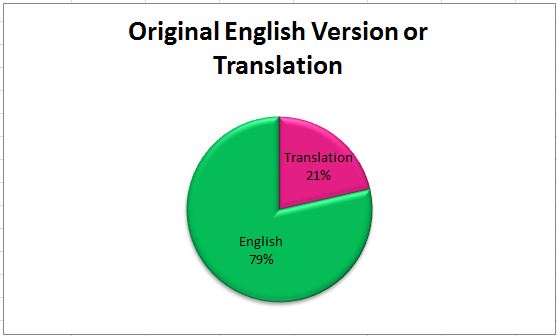
To read that widely, it is necessary to read translated work and 15 of the books I read or 21% were translated compared to only 10% in 2012. I’ve certainly travelled the world through books, I may have to start checking the globe to see which continents are missing.

Translation 2013

And what kind of books do I read? Well mostly fiction, a hefty 76% compared to 23% non-fiction and only 1% poetry, but less than 2012 when 82% of my reading was fiction and 16% non-fiction. I did read some excellent non-fiction in 2013 and hope to do the same this year.

Genre 2013

And lastly, how do I read? Yes, I have a kindle and in 2012 I read 25 books or 41% of them electronically. In 2013 that has increased to 46%, that’s 32 books on the kindle, almost half my reading! That’s thanks mostly to NetGalley who send me ARC’s (Advance Reader Copies) from the publishers that I request, which I am immensely grateful for.

E Book 2013

So now I know what I read and I think I shall just keep on doing the same, which is to be as spontaneous as possible, to engage with others who read for recommendations and keep reading around the world!

Ashes in my Mouth, Sand in My Shoes by Per Petterson

This is Per Petterson’s first book, though only recently translated (by Don Bartlett) into English following the success of his novel Out Stealing Horses (translated into 40 languages) and the sequel to this novel , my personal favourite I Curse the River of Time.

Ashes in My MouthThis book provides a literary snapshot of a childhood growing up in the outskirts of Oslo, Norway in the early 1960’s. His father works in a shoe factory and his Danish mother used to work in a chocolate factory (in the good old days) and now works as a cleaner.

Arvid is six and a half years old and doesn’t always feel secure in the various environments he inhabits, whether at home or at school, or out fishing his Father and his Uncle, where there is no nagging voice to still their hand when they overindulge their mind altering beverage and revert to discussing childhood jealousies, a dialogue that descends into the physical.

His Grandfather has died and this alters things, even though they appear on the outside to be the same.

Arvid listens to the raised voices at night, hears the kitchen door slam and watches his mother tread the same long walk, out there to the dark and back, a walk with no destination, one she makes in the icy cold of night without wearing a coat.

One day he realises his mother is getting older, that time is moving on, and that it is also happening to him.

“He held his hands to his face as if to keep his skin in place and for many nights he lay clutching his body, feeling time sweeping through it like little explosions. The palms of his hands were quivering and he tried to resist time and hold it back. But nothing helped, and with every pop he felt himself getting older.”

I Curse

This is a quiet book whose observations cut deep, a sensitive child with a tough father who likes to remind those around him of his achievements, a boy who admires his father but lives in quasi-fear of not being able to live up to his expectations. It is an author getting into his stride, not as good as the work that will follow, though showing signs of the great work that was to come.

In the sequel, I Curse the River of Time, it is 1989 and Arvid Jensen is 37 years old,  in the throes of a divorce and has discovered that his mother is battling cancer.  It might sound grim, but it I remember it as an astonishing read and I shall make sure to reread it again in 2014, because I think this one could be one of my all time favourite reads.

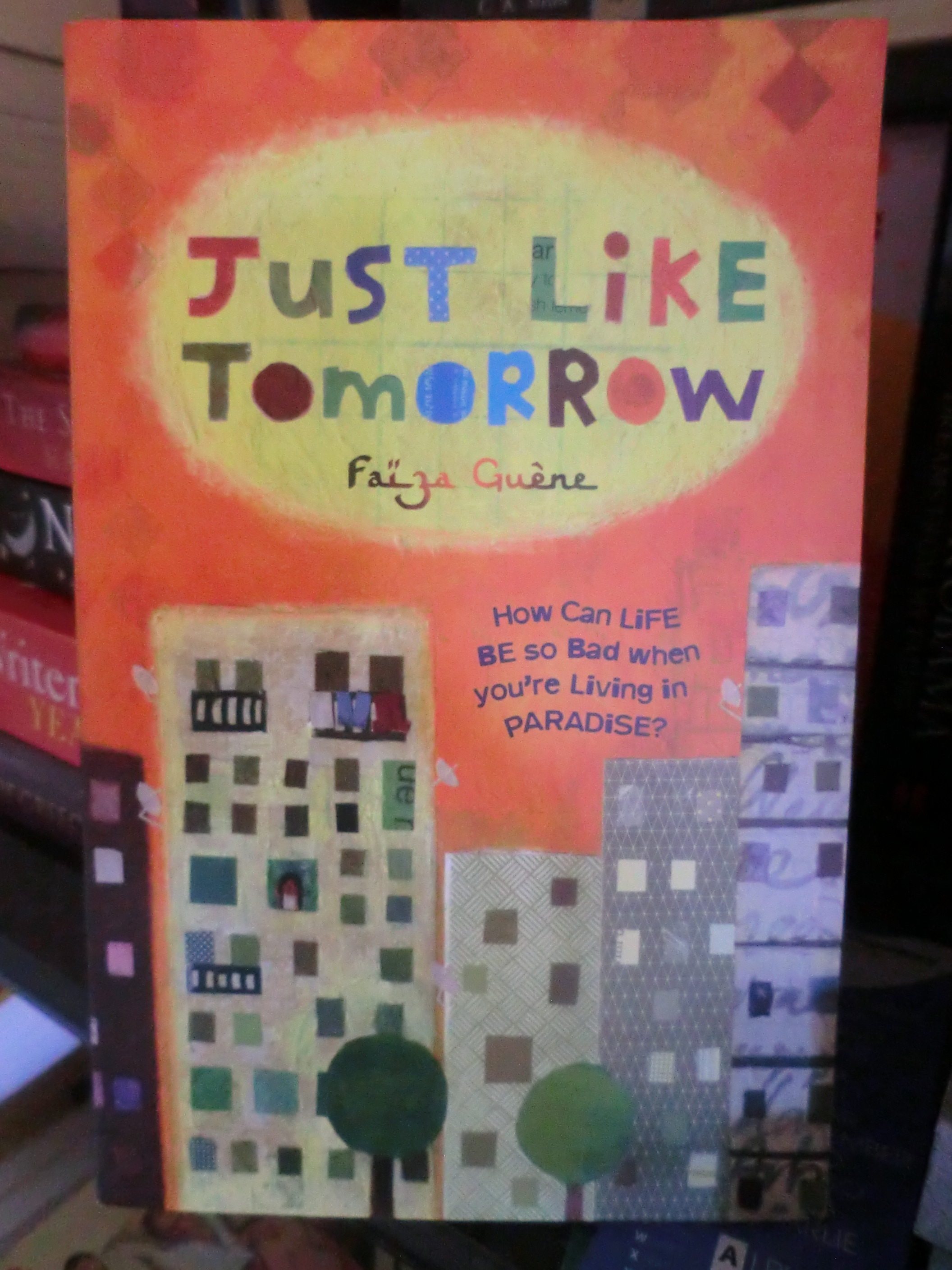
Just Like Tomorrow by Faïza Guène

How Can Life Be So Bad When You’re Living in PARADISE?

Kiffe kiffeI came across Faïza Guène’s  Kiffe kiffe demain translated as Just Like Tomorrow by Sarah Ardizzone, a french contemporary novel for young adults, via a wonderful blog A Year of Reading the World that is being turned into a book*.

Ann Morgan, inspired by the arrival of the multitude of athletes who came to London for the Olympics, decided to read a book from every one of 196 independent countries.

Each country presented a challenge, with only 3% of books in the UK being translated, she had to call on the help of her network and followers to find an English translation for many locations.

Faïza Guène

Faïza Guène

Faïza Guène is a young screenwriter who, after being involved in a local community project, began directing her own films. Born in France of Algerian parents, and growing up in a northern suburb of Paris, she writes from the heart of a challenging suburb, in a part of the city that few from the outside know about and about which little is written in literature.

Fifteen-year-old Doria lives alone with her illiterate mother, abandoned by a father who is seeking a younger, more fertile wife in his birthplace, Morocco. The story follows Doria’s unadulterated thoughts, which for most of the narrative are quietly despondent yet noisy with attitude. She is not prone to drama, although she observes it around her, as if from within a bubble and provides a running commentary on everything in her mind,and on the page.

Peppered with teenage slang, suburban Franco-Arabic dialect, the voice is unique and easily conjures an image of what life must be like for Doria, as she waits to be thrown out of school and pushed into a career she has no desire for. Her low expectations of life make the small gains she and her mother make all the more pronounced and the humour all the funnier.

What Mum really likes watching on telly in the evenings is the weather forecast. Specially when it’s that presenter with brown hair, the one who tried out for the musical The Birdcage but didn’t get it because he was over the top…So there he was, talking about this huge cyclone in the Caribbean, and it was like oh my days, this crazy thing getting ready to do loads of damage. Franky, this hurricane was called. Mum said she thought the western obsession with giving names to natural disasters was totally stupid. I like it when Mum and me get a chance to have deep and meaningful conversations.

It is a slice of life, coming of age story, of a second generation teenage immigrant living her life far from the images of the city of Paris that come to mind for most of us. It is a book that has been widely translated into other languages and offers a unique insight into teenage life for those on the fringe and an excellent alternative to the more well-known French literature out there.

*Reading the World: Postcards from my Bookshelf will be published by Harvill Secker in 2015.

Are Prize Winning Novels an Indication of Readership or a Nation’s Literary Heritage?

After the BBC’s journalist in Paris Hugh Schofield asked the question about Why French books don’t sell abroad, the Cultural Attaché to the US Embassy in New York, Laurence Marie responded with an extensive list and discussion of a list of French titles that are selling abroad. She also mentions how widely French literature is being translated into other languages and her article makes fascinating and insightful reading. I have collected book covers of some of the works mentioned, plus others, below.

Sometimes we hear about literature from another country when the author wins a major literary prize. However:

Are Prize Winning Novels Really Indicators of a Nation’s Readership?

French Books That Are Selling Abroad!

French Books That Are Selling Abroad!

I don’t think so.

Literary prizes usually have an agenda, if not multiple agendas.

In the case of the UK’s Booker Prize it was set up to try to bring more literary works into the mainstream.

It is known that the prize doesn’t actually influence the reading habits of avid readers. It is targeted at those for whom books are competing against other forms of entertainment.

I like the literary prize season, not so much in anticipation of a winner, but for the longlist, where we are more likely to find something new that might appeal to our taste, because of the variety offered and the number of works screened.

So what are the French literary prizes?

Le Prix Goncourt

I don’t know the French literary prizes well, and Schofield mentions in his article that there are over 2,000 of them, but the Le Prix Goncourt is well-known and has been around over 100 years since 1896.

The last recipient was Pierre Lemaitre, whose thriller Alex  (reviewed here by Savidge Reads who said of it: “a thriller that almost made ‘Gone Girl’ look tame”), was a bestseller last year and his prize-winning novel Au revoir là-haut looks set to be the same.

Nancy, a blogger in the Netherlands whom I admire enormously, tasked herself to read only French novels last year, as an interesting way to learn the language and not only has she succeeded in learning the language, but she has not given up, she continues to read novels in French. You can read her review (in English) of Le Maitre’s Au revoir là-haut here.

The prize was established by Edmond de Goncourt, a successful author, critic, and publisher, who bequeathed his estate to establish an academy and the prize was initially created to allow talented writers the opportunity to write a second book. The prize is seen as being SO prestigious, the prize money has not changed since the early 1900’s and remains something around €10.

Le Prix Femina

Leonora MianoTen members of the Goncourt academy are responsible for the judging of Le Prix Goncourt, and in protest against this all male jury, le Prix Femina was inaugurated, an equivalent literary prize open to all sexes, however the jury is all female.

This year the prize was won by Léonora Miano, a Cameroonian author who has lived in France since 1991, for her 7th novel La Saison de l’ombre (The Shadow Season).

There is also a Prix Femina étrangere for foreign books which was won in 2013 by Richard Ford for Canada and Le Prix Femina essai, a popular genre in France, the essay; this year won by father and son duo Jean-Paul Enthoven and Raphaël Enthoven for le Dictionnaire amoureux de Marcel Proust (Marcel Proust’s Love Dictionary).

2013 Pric FeminaThere are certainly no shortage of prizes here in France (other major literary prizes are the Grand Prix du Roman de l’Academie Francaise, the Prix Renaudot, the Prix Interallie and the Prix Medicis), and their lists make interesting reading, for their longevity and breadth and for that fact, that they are so little known by readers in the English language.

Although prize-winning literature might be translated into English, it may also create a false perception of readership, being skewed towards that overly intellectual perception of literature that Schofield refers to as being elitist, which can alienate the average English language reader (and perhaps also the average French reader).

Every nation is proud of their literary culture and achievements and like to endow their icons of that tradition with prestigious titles, however down here at the ordinary people reading level, there is a whole other canon of literature being read, whether it is in the English language or any other.

CIMG3882To know more about what ordinary readers are immersing themselves in, it is necessary to speak to people like us, those who don’t often have a voice in the media or on a jury, they are the voices that are worth hearing from, even if what they provide is anecdotal evidence.

I am speaking to some of the French people I encounter in everyday life who are passionate readers, to find out what they think about French literature and what they are reading, to be featured in future posts.  And to find out more about all that translated fiction they love to read here.

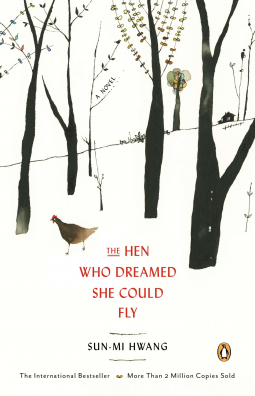
The Hen Who Dreamed She Could Fly by Sun-mi Hwang tr. Chi-Young Kim

This book is proof that it is not just reviews and the recommendations of friends that help us choose which book to read next, that an excellent cover and title coupled with an alluring blurb can suffice to motivate that impulse.

The HenThe cover made me pause and the promise of an inspiring fable in a short piece of internationally acclaimed translated fiction sounded enticing enough, but the discovery that the author Sun-mi Hwang had herself overcome the obstacle of childhood poverty and found a way to educate herself to achieve her dream to read and write sealed it.

Like Margarita Engle’s novel in verse The Wild Book and Tove Jansson’s Summer and Winter Book’s, sometimes a mood enhancing book is just what we need to bring ourselves back to life’s simple values for encouragement and reassurance.

The story revolves around ‘Sprout’, a battery hen frustrated with her caged life laying eggs in a sloping wire cage which causes her eggs to roll away, enabling the farmer to conveniently collect them to sell. She hatches a plan to escape, seeking a life outside the barn where others animals appear to roam free and where she feels it most likely to be able to achieve her dream of nurturing an egg to life.

Along the way we meet the old dog that guards the barn, the rooster who crows in the morning, the yard hen, a community of ducks and the lone hungry weasel.

“Whenever she saw the yard hen, Sprout couldn’t stand it – she felt even more confined in her wire cage. She too wanted to dig through the pile of compost with the rooster, walk side by side with him, and sit on her eggs.”

010113_1257_AMonthinthe2.jpgSprout escapes the coop and directs all her energy into survival. She learns who her friends are and who to be wary of.

She discovers the perceptions that govern the role each animal is set to play.

“Yes, you’re both hens, but you’re different. How do you not know that? Just like I’m a gatekeeper and the rooster announces the morning, you’re supposed to lay eggs in a cage. Not in the yard! Those are the rules.”

No fairy tale, this is fable at its best, confronting the reality of stepping outside the role society has dictated (even if nature has not divined) and showing that while achieving the goal can be possible, it is a route fraught with challenges. Reminiscent of Orwell’s Animal Farm or Adams Watership DownSun-mi Hwang brings us her perception of society through characters that we recognise with our own interpretation and reminds us that even the most far-fetched dreams are worth pursuing, no matter what the odds.

We read with trepidation and a strong desire, not so much for Sprout to succeed in her quest, but to survive. It is a delightful and touching story, deserving of its success.

Note: The book was an ARC (Advance Reader Copy) provided by the publisher via NetGalley.

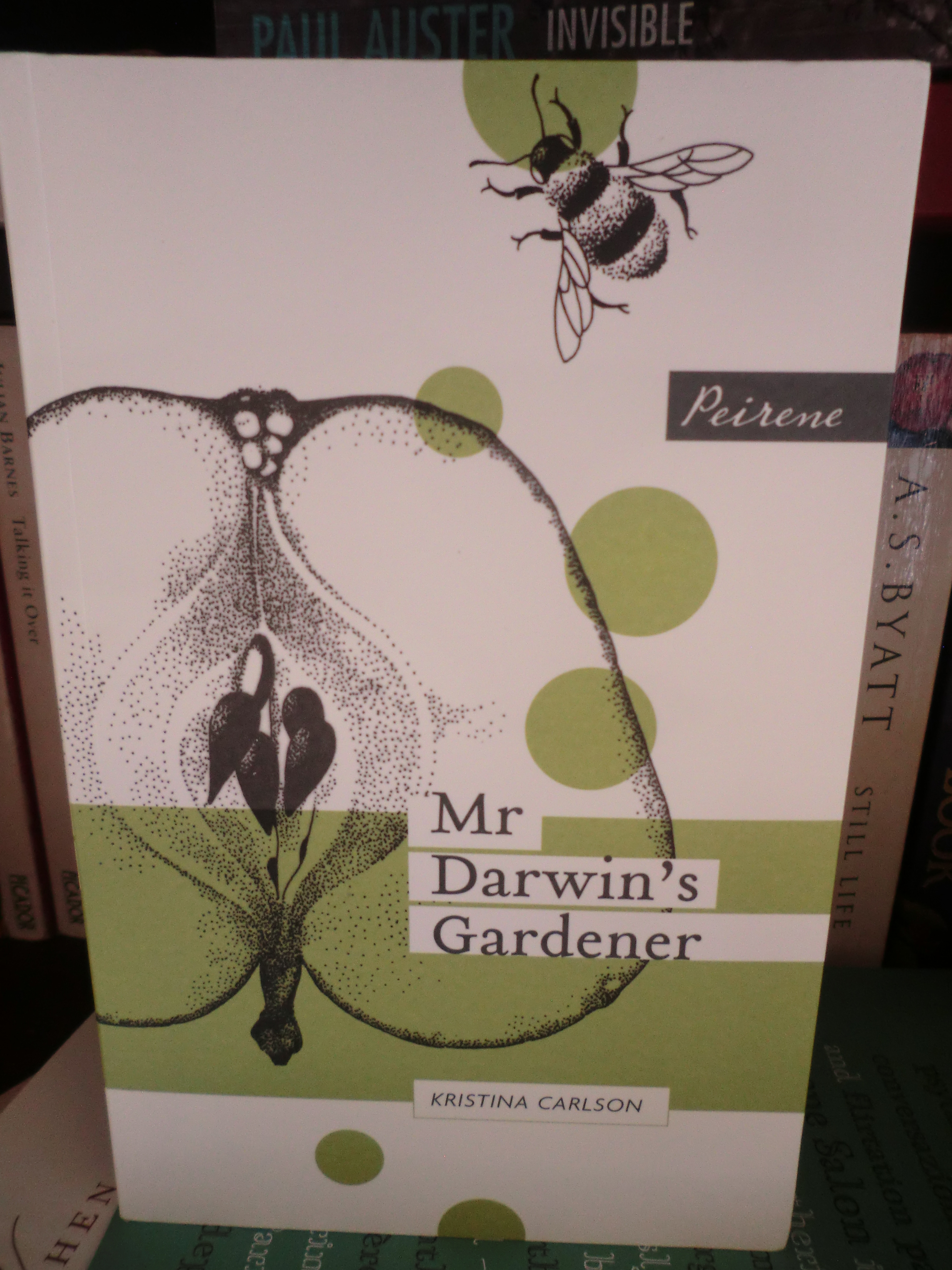
Mr Darwin’s Gardener is Also a Thinker, Kristine Carlson

Darwins GardenerKristina Carlson is a native of Finland and has published 16 books there. Like Tove Jansson, whose work I love, she is known for her children’s stories, but also has a wide adult readership. We are fortunate to be reading the recently published and translated work Mr Darwin’s Gardener thanks to Peirene Press, who describe it as “Peirene’s most poetic book yet“.

“Carlson evokes the voices of an entire village, and through them, the spirit of the age. This is no page-turner, but a story to be inhabited, to be savoured slowly.” Mieke Ziervogel

Less a story than a series of thoughts and observations, though there is one alarming event, it is set in the late 1870’s in the Kentish village of Downe, where Thomas Davies, widower, father of two and the gardener of Charles Darwin, reflects on the dilemma of his life and stays away while the rest of the villagers gather in church.

Just as Mieke Ziervogel suggests, it is a not a book to be absorbed quickly and even when read slowly, it warrants turning back to the beginning and starting over, which is what I did. I read it through twice because once was insufficient for a book whose depth and layers become clearer when we reacquaint with it. To read it once was to see the words on the page and meet the villagers for the first time. To read it again was to begin to understand the collective consciousness of a community and one man who stands outside them, working for another man who is completely out of their reach or comprehension.

Charles Darwin, Author of 'Origin of the Species' Source: wikipedia

Charles Darwin Source: wikipedia

Plants grow, flowers sway, a ray of light streaks through a gap in the clouds, a gardener thinks, women talk, men drink, jackdaws caw, bells ring, a stranger visits and a man writes an article in the newspaper. Like an invisible character hovering over the town, we observe each villager in a random moment just before we inhabit their mind, see what they are thinking and watch what they do, as if we are they. We repeat this sequence from one home to the next and at The Anchor, the local pub where a stranger visits and stays overnight.

The Anchor clinks, clanks, seethes, smokes, susurrates.

The gardener has taken on the role of the village sage,

Though as a rule he barely says good morning.

The tongue is a sort of red carpet. One has to watch what hurries along it.

A gloomy and unhappy man.

But Thomas Davies sits neither in a church pew nor at the bar and he is more often the subject than the purveyor of thoughts, though these are some of his:

Garden at Down House, Darwin's home

Garden at Down House, Darwin’s home

The most beautiful thing about plants is their silence. The second most beautiful thing is their immobility, I wrote when Gywn died. I am reading now, it is evening.

I wrote unscientifically.

Even condolences thundered then, and goodwill would not leave me in peace.

Grief is weighty but it is a stone I bear myself.

Victims of revenge and victims of mercy are in the same position, I believe; other people make their affairs their own.

I may have to read it a third time.