Sometimes, these are the only books that will do. That rare breed of literature that entertains, uplifts and demands little in return, the books we read when we are fed up with thinking and wondering why certain things are the way they are.
Sara has always been seen by her family as wanting, harbouring a mild disapproval of her predilection for staying in and reading, her acceptance of a job in a quiet bookstore. Now that she is doing something out of the ordinary, leaving their sleepy Swedish town to travel to small town Iowa, they’re still not happy.
“It wasn’t clear which was worse, the tediousness or the risk of bumping into one of the many serial killers hiding in every nook and cranny… Honestly though, what do you know about people? If you didn’t have your nose in a book all the time…”
The bookshop Sara worked in has closed down and her world seems to have diminished to books and the lives within them.
“Her little sister Josefin worked as a trainee lawyer for the district court on Södertälje. Eventually, she would be a solicitor, a socially viable profession carried out in suitability expensive suits. Sara, on the other hand… A bookshop. In a suburban shopping centre. That was only marginally better than being an unemployed former bookshop assistant like she was now. And now that she had finally gone abroad? She had chosen to go to a little backwater in the American countryside, to stay with an elderly lady.”
Sara has been writing letters to Amy for the last two years, they are bookish pen pals who share a love of literature and enjoy the uninterrupted conversation of a letter. Amy invites Sara to visit, she arrives in the small, dilapidated town of Broken Wheel, most-likely it first and only ever tourist, only to find that the person who invited her didn’t tell her something VERY important that will affect her two month stay.
The Readers of Broken Wheel Recommend takes a melancholic bunch of characters from a declining town in Iowa and puts the introverted, bookish Sara into its midst.
Though it is a small town, with not much going for it, it is an adventure for Sara to leave Sweden and travel to meet her bookish friend.
She discovers the important thing that Amy left out of her letters on her very first day and it will have an effect on the rest of her 2 month stay, where we meet a cast of fabulous, quirky characters and observe the transformation of a depressing little town.
The residents of Broken Wheel are not avid readers, they are not readers at all and don’t see things the way Sara sees them.
‘People are better in books,’ she muttered. She said it so quietly she didn’t think he could have heard her, but when she stole a glance at him, she thought she could see one of his eyebrows twitch. ‘Don’t you agree?’ she asked defensively?
‘No,’ he said.
Sara decides to convert Amy’s empty shop in the deserted town of Broken Wheel despite the fact the residents claim not to be readers. Slowly the wheel begins to turn…
A light-hearted, uplifting story that should be in the section of the bookstore or library entitled “guaranteed to lift or lighten your mood”.
It reminded me of that same feeling created by the author Antoine Laurain in The Red Notebook and was an absolute delight, just what I needed, a literary, bookish pick me up!
Note: This book was an ARC (Advance Reader Copy) kindly provided by the publisher.
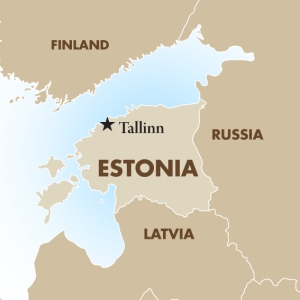
Purge by Sofi Oksanen is set in a rural village in the region of Läänemaa, west Estonia. The book is translated from Finnish by Lola Rogers.
It is a novel of two histories, one in the late 1930’s and 1940’s when Aliide and her sister Ingel were adolescents, spanning the changes in their lives after Estonia was annexed by the Soviet Union and renamed Estonian Soviet Socialist Republic (ESSR) and the other in the early 1990’s when a Russian-Estonian girl Zara, turns up unannounced seeking refuge.
At the time of the political occupation in 1944, those who failed to do their ‘political duty’ of voting Estonia into the USSR were condemned to death and mass deportations occurred (half perished, the rest unable to return until the 1960’s).
The novel of five parts opens with a letter written by Hans Pekk, son of Eerik, an Estonian peasant entitled Free Estonia! Each of the five parts begins with one of his letters, which date from June 1949 until September 1951 and then the chapters alternate between 1992 (post-independence), when the dishevelled young woman Zara arrives at Aliide’s home and the past, revealing Aliide’s youth and the years she lived through the Soviet occupation, from 1944 until 1951.
Zara’s story flips back occasionally to 1991 in Vladivostok, Russian Federation and to Berlin the same year, before her arrival at Aliide’s home. Zara is escaping brutal captors, men involved in sex slavery, human trafficking, for whom violence is an acceptable form of discipline and retribution and sex a currency of payment.
Aliide too has her secrets, having harboured a yearning for one man for many years, an obsessive, unrequited love that lead her to make decisions and live a life of repression and lies, to trust no one and operate continuously behind a mask to protect herself and the one she loved.
As the novel progresses and switches between era’s, the stories of the two women are revealed, we move closer to learning what happened to Aliide’s sister Ingel and the letter writer, Hans Pekk.
It is a compelling read whose slow revelations fasten the pace of reading, countered by the need to pay attention to the dates, as Oksanen flips back and forth in time.
Against a volatile and dangerous political backdrop, the idealism, obsessive love and risk taking characteristic of youth is played out and repeated across the generations, leaving one to wonder if anything ever really changes with time. In particular, the burden, degradation and abuse of women during war and conflict and the strategies pursued by them for survival.
‘Aliide went toward the road and tried to find the man that the voice had come from, and she found him. He was marching like a leader toward the dairy, and three or four men were following him, and Aliide saw how the tails of his coat thrust out like they were going to take off into the wind and how the others turned toward him when they spoke, but he didn’t turn to them when he answered, , he just looked straight ahead, his brow raised, looking toward the future. And then Aliide knew he was the man to rescue her, to safeguard her life.’
Wanting to visualise where the region of Läänemaa in Estonia was, I found it was connected to a somewhat ironic slogan, “Your safe nesting place,” a reference to the areas wetlands and meadows, providing a protective habitat to its wildlife.
It is a thought-provoking metaphor in relation to the novel, where civilians required a safe place to be protected from a different kind of predator. Is that nature? To require protection from the human predator? Is there safe refuge for those persecuted by the more brutal aspects of human power seeking? If we found ourselves living in such circumstances, how would we react?
Sofi Oksanen speaking about the title:
“When I was a child,” says Oksanen, “no one talked about deportations. People ‘went to Siberia’. Certain things were so dangerous to mention that people used a lot of expressions to circumvent the actual issues.”
“When I started the play and was thinking about the title, I was thinking about the traumatic reaction people can have after they’ve experienced violence or been raped,” she says. “People always try to clean themselves. So that was the first meaning – cleansing.”
Purge was a bestseller in Finland, winning numerous literary prizes and has been translated into 38 languages. The Finnish-Estonian author Sofi Oksanen, was born in Finland and spent her summers in Estonia, visiting her grandmother on a kolkhoz, a Soviet collective farm, giving her an insight into a life not many outside it had access to. The story appeared as a play before the author wrote the novel.
2666 was the last novel written by Chilean author Roberto Bolaño before his untimely death at the age of 50 years due to liver failure, he was near the top of the list for a liver transplant, but sadly didn’t survive long enough to be a recipient.
Knowing of his precarious existence and wishing to be able to support his family for as long as possible, he embarked on the grand oeuvre that would become 2666. He had planned to publish it as five separate volumes, which is no doubt in part responsible for it being such an exceptionally long novel at 900 pages.
Born in Chile, he spent much of his childhood and youth in both Chile and Mexico before moving in 1977 to Spain where he married, settled and eventually would die. His literary success came late in life and with death looming, he appears to have been in somewhat of a rush to pen this last grand tome. It wasn’t until after his death, that his work became known to readers in the English language, though he was widely perceived as the most important Latin-American writer since Gabriel García Márquez.
2666 is structured into five parts, which would have been the five books, though they are meant to be read as a whole. Four of the five parts are reasonable in length and content and intrigue while Part4. The Part About The Crimes is long, arduous and was for me in parts sickening. It recounts hundreds of crimes against predominantly young women that occur in Santa Teresa, the one location that connects all 5 parts of the story. It is largely based on the mostly unsolved and still ongoing serial murders that took place in the MExican town of Ciudad Juárez (Santa Teresa in the novel).
In order to try to make sense of the sum of parts, I created the diagram below after reading, in its entirety it depicts the global, interconnected horrors that have infiltrated and usurped parts of 20th century society, while on the surface story level, it shows the connections between characters, locations and subject, with that Mexican town of Santa Teresa taking centre stage, the one place all these characters are at some time drawn to.
Trying to Make Sense of Roberto Bolaño’s Five Parts of 2666
The five parts briefly are as follows:
Part 1: The Part About the Critics introduces us to 4 critics from 4 European countries who specialise in the literature of a German writer, they travel to conferences around the world, presenting, discussing his work, seeing each other, pursuing reports of the disappeared writer named Archimboldi, until Mexico. They too become more or less interconnected and though supposedly intellectuals and above the debased actions of the lesser educated, we see that they are no better than the rest and perhaps even worse.
Part 2: The Part about Amalfitano, his daughter Rosa, his wandering wife Lola and the poet in the asylum in San Sebastian, his move from Barcelona to Mexico and the beginning of hearing that voice in his head.
Part 3: The Part About Fate, the political/social journalist, his dead mother, her neighbour,writing up Barry Seaman’s speech, the death of a sportswriter, the fight he covers in Santa Teresa, the Mexicans, the gun, Rosa Amalfitano, Guadalupe Roncal and the albino German singing prisoner.
Part 4: The Part About the Crimes mentioned above, this reader begins to suffer fatigue from the pages and pages of repetition, another young woman, raped a certain way, strangled, the long hair, dumped on a highway or in a dump, the lack of police investigation, that lack of interest, as if to be woman is to warrant such a fate. The reader too starts to become as bored as the police seem to this endless, sordid situation. They have a job to do, but for what reason are we succumbed to having to absorb these hundreds of heinous crimes taking place in one city.
I was relieved when this part was behind me, all those murders in Santa Teresa, the inept investigations, the scapegoat, the media, the Congresswoman, the cause/effect of money.
Part 5: The Part About Archimboldi, in wartime Germany with a man named Hans Reiter. And finally we catch up with Bonno von Archimboldi, the writer pursued in Part 1.
Overall, it was a marathon read, that fatigued me, in a similar way to Orhan Pamuk’s lengthy novel of obsession The Museum of Innocence, a book that became a kind of effigy, that morphed into an actual museum displaying a collection of items evocative of everyday life and culture of Istanbul during the period in which the novel is set. Bolaño collected murders and experiences, Pamuk everyday objects and obsessions.
It is a novel highly regarded by many, however I would be reluctant to recommend it without the potential reader reading a variety of reviews to discern whether or not it is something that corresponds to their interest.
I chose to read it as my summer chunkster for 2015 and can relate to the following question raised in the Guardian review I’ve linked to below:
But why would you want to encounter “an oasis of horror in a desert of boredom” in the leisurely days of summer? Because you’ll have time to immerse yourself, for one thing. There’s never a bad time to read a great book, however dark, however dangerous.
Bravo to the late Roberto Bolaño, I believe he achieved his aim, to continue to support his family long after his own demise.
By bringing scents of a Latin American culture more fitful, pop-savvy and suspicious of earthy machismo than that which it succeeds, Bolaño has been taken as a kind of reset button on our deplorably sporadic appetite for international writing, standing in relation to the generation of García Márquez, Vargas Llosa and Fuentes as, say, David Foster Wallace does to Mailer, Updike and Roth.
The President’s Hat is the first book of Antoine Laurain’s that was translated from French into English by Gallic Books. It appears that three translators were used for the different voices.
Daniel Mercier voiced by Louise Rogers Lalaurie
Fanny Marquant and Bernard Lavallière voiced by Emily Boyce
Pierre Aslan voiced by Jane Aitken
In February, Gallic Books sent me a copy of his second translation The Red Notebook, which I devoured immediately and adored. Click on the link to read my review.
Thanks to that review where I indicated a wish to read The President’s Hat, Owen at The Carrot Cake Diaries sent me his copy and I returned the favour by sending him one my all time favourites, Martin Booth’s The Industry of Souls.
The President’s Hat is just as brilliant in its light-hearted uplifting way. It is the story of what happens to the people beginning with Daniel Mercier who encounter a black hat with the letters F M embossed in gold lettering inside the rim, when it is left on a restaurant seat by the former French President François Mitterand. Daniel is the first person seized by a compulsion to covet the hat and wear it until he too will leave it behind and the adventure moves on to the next person.
Each person who encounters the hat, is touched by it sufficiently to act in a way that will have a significant impact on their lives, thus taking the reader on an entertaining journey across France and into Venice in the eighties via gifted storytelling.
Although he appears only very briefly in the story, it is in a way a tribute to the man who was a popular President in the 1980’s, who ruled from 1981 to 1995 and in his last address to the people said:
“I believe in the forces of the spirit, and I won’t leave you.”
He died one year later.
Impossible to put down, uplifting and a joy to read, it is wonderful to come across one of those ‘turn-to’ authors when in need of a literary pick-me-up or just a fun read!
Today the winner of The Man Booker International Prize was announced.
This prize recognises one writer for his or her achievement in fiction. It is awarded every two years to a writer whose work has been published in English or is generally available having been translated into English.
Unlike the Man Booker Prize for Fiction, there are no submissions from publishers, it is a decision left solely to the judging panel, who must consider a writer’s body of work and not just their latest novel.
The 2013 winner was short story writer and translator Lydia Davis (America).
The finalists for 2015, alongside a quote made by one of the judges were:
Alain Mabanckou (Republic of Congo) ‘His voice is vividly colloquial, mischievous and … outrageous’
Amitav Ghosh (India) ‘In Ghosh’s hands the contemporary historical novel is transformed’
César Aira (Argentina) ‘A performance on page’
Fanny Howe (US) ‘[her] care for words matches her care for characters’
Hoda Barakat (Lebanon) ‘The unrivalled bride of the Mediterranean
László Krasznahorkai (Hungary) ‘What strikes the reader above all are extraordinary sentences’
Marlene van Niekerk (South Africa) ‘The author of two immense masterpieces‘
Mia Couto (Mozambique) ‘His pages are studded with startling images’
Maryse Condé (Guadeloupe) ‘A monumental body of work that acts against forgetting’
Ibrahim al-Koni (Libya) ‘Reading al-Khoni is a transcendental experience’
to describe their work to someone unfamiliar with it
which of their books they’d recommend to a first time reader
whether as a writer, they felt a distinction between local and international readers
who their literary heroes were
whether it was the duty of a novelist to engage with the political issues of the day
to share something new about themself
After reading this article, I could tell immediately that I would love to read the work of Guadeloupean author Maryse Condé. I have ordered a few of her books already. I recommend reading it if you are interested in knowing which of these authors might appeal to you.
One of the judges, New York Review Classics editorial director Edwin Frank had this to say:
“It would be pretentious to say we wanted to survey the world, but we wanted to be mindful of the wider world of literature. For me, I’ve learned all sorts of things about authors I’d never read especially in Arabic literature, which is still woefully underrepresented in English. And we have various writers from Africa, writing in very different languages and literary traditions.”
And so the winner of the Man Booker International Prize 2015 is…..
A village high in the Pyrenees, mostly in ruin, houses one last ageing male resident who imagines those who will eventually discover him and all that has passed.
“Yes, that is probably how they will find me, still dressed and staring straight at them, much as I found Sabina amid the abandoned machinery in the mill. Except that, then, the only other witnesses were the dog and the grey moan of the mist as it caught and tore on the trees by the river.”
Julio LlamazaresThe Yellow Rain is an elegy to a forgotten village, a way of life, for a man who meets death long before it invites him to join it.
Ainielle is a village in the Spanish Pyrenees that has become abandoned and derelict, no one lives there any longer except this one man who refuses to let go of the past and will experience his last years, months, days in a kind of slow, yellowing reality.
“Solitude, it is true, has forced me to come face to face with myself. But also, as a consequence, to build thick walls of forgetting around my memories. Nothing so frightens a man as another man especially if they are one and the same – and that was the only way I had of surviving amid all this ruin and death, the only way of withstanding the loneliness and the fear of madness.”
A snake bite almost relieves him of his solitary existence, but even then he can’t help but fight against death’s shadows of invitation that sit uninvited next to his bedside.
“The panic and cold of death have long since ceased to frighten me. Before I discovered its black breath inside me, even before I was left all alone in Ainielle, like one more shadow amid the shadows of the dead, my father had already shown me by his example that death is only the first step on that journey into silence from which there is no return.”
Throughout the book, images of yellow and yellowing pervade, as everything succumbs to oblivion, a consequence of time passing and soon we are not sure if it is merely nature or the natural deterioration of an old man’s eyes, tainting everything he sees.
Source: Melancholy Morning by Vizibil
“But suddenly, at around two or three in the morning, a gentle breeze came up the river, and the window and the roof of the mill were suddenly covered by a dense, yellow rain. It was the dead leaves from the poplars falling; the slow, gentle autumn rain was returning once more to the mountains to cover the fields with old gold and the roads and the villages with a sweet, brutal melancholy. The rain lasted only a matter of minutes. Long enough, though, to stain the whole night yellow, and, by dawn, when the sunlight fell once more on the dead leaves and on my eyes, I understood that this was the rain which, autumn after autumn, day after day, slowly destroyed and corroded the plastered walls, the calendars, the edges of letters and photographs, and the abandoned machinery of the mill and my heart.”
Written in the future, the past and the present, in a lyrical style that for me never depresses though we might think it bleak, this ode to a changing landscape that is reverting back to its true nature is haunting, gripping, colourful and soul destroying all at the same time.
Even as it gets a little repetitive towards the end, it is all part of the slow degeneration of mind, body, house, village, life, with no witness but himself, the last inhabitant. Another 5 star read for me.
The author Julio Llamazares, was born in the now vanished town of Vegémian, which he left at the age of 12 to go to a boarding school in Madrid. He is one of Europe’s most celebrated writers. Hundreds of these villages have disappeared in recent decades as their inhabitants leave for the cities.
Maria Barbal’s Stone in a Landslide tells a similar story, only she traverses the entire life of her female protagonist Conxa, while Llamazares focuses on the end and on one who refused to leave.
Kamchatka is a novel by the Argentinian writer Marcelo Figueras set in 1976, one year during a disturbing era of Argentinian history under military dictatorship, often referred to as The Dark Ages, a time when speaking out against the establishment gave rise to a terrible number of “Disappeared”.
Ordinary people vanished without trace, neither arrested nor imprisoned, there was no record of their detainment, they simply disappeared, believed to have been disposed off.
In an interview with Stu a huge reader of translated fiction who reviews at Winston’s Dad, Marcelo Figueras said this about his own experience as a child growing up in those years, words that are clearly an inspiration for the novel he has written:
“On the one hand, I was the typical boy on the verge of adolescence: shy, introspective, living in a bubble made of books ,music, comics, TV and movies. I played Risk a lot. I watched The Invaders. I enjoyed Houdini, the movie with Tony Curtis and Janet Leigh, but rejected its sad, sad ending. I fell in love every day. I danced alone.
But on the other hand, I lived in fear. I knew nothing about what was happening, my family had always been apolitical. In spite of that, I sensed something awful was going on: it was everywhere, even in the air, atoms of fear mixed with oxygen and nitrogen.
That was one of the main ingredients of the military Junta’s perversity: they tried to keep the appearance of normality, Buenos Aires’ streets were calm and orderly (and filled with policemen), as if nothing out of the ordinary was really happening. But people were being kidnapped in the dark, locked in dungeons, tortured and killed, and their bodies hidden in massive, anonymous graves or dropped into the sea. So something wicked was indeed happening. And my nose picked it up somehow.”
The author goes on to say that the subject has been written about by many authors and in his opinion many of those stories follow a similar trajectory of a romantic young man or woman, their involvement in politics, a kidnapping occurs, torture, death and the law courts follow.
He wanted to do something different, to write about what those who were not kidnapped endured, a different horror. By making a 10-year-old the narrator of his novel, he puts the reader right into this fearful and confusing situation of sensing being in danger and yet understanding nothing about where that fear is coming from.
Early on in the novel, our narrator and his younger brother, whom he affectionately refers to as The Midget, are pulled out of school abruptly by their mother and they go on what she describes as a holiday, to stay in a safe house.
The boys are told to choose a name for themselves, to change their identity and after finding a book about Harry Houdini on top of a cupboard, our narrator calls himself Harry and decides he wants to become an escape artist, something he goes to great lengths to tell us is very different to being a magician.
“Since the uncertainties of the present weighed heavily on me, I had been spending a lot of time thinking about my future. The idea of becoming an escape artist struck me as clearly as a vision: once the notion was firmly planted in my brain, all my worries disappeared. Now I had a plan, something that would, in the near future, make it possible to tie up the loose ends of my circumstances. I imagined that Houdini himself had done much the same thing. ”
The ‘Risk’ Map of the World
The stay doesn’t feel like a holiday to Harry, however he passes his time doing the things he enjoys, playing Risk with his father, a post colonial game of strategy to take over the territories of the world. Harry wants to conquer but he never does, his father believes it is important he learns how to win through continual practice, not to have victory handed to him.
Finally the match occurs where Harry begins to win, he pushes his father back, gaining all but one last territory, that last bastion of strength, Kamchatka. He fails to take it and from that moment on his fortune turns. Kamchatka is this place on the map that few have heard of, but it contains a hidden strength and it is both a figurative place Harry will return to in later years and a physical landscape of extraordinary elements that he will also visit.
Our Harry is very curious and intelligent and the book is structured into sections like lessons from a day at school. In each of these parts he reflects on philosophical ideas, covering subjects the book is divided into, biology, geography, language, astronomy and history. These reflections were one of the magical parts of the book for me, I recognise that beautiful curiosity of a young mind, trying to make connections between what he knows and what he thinks might be, growing his brain on the page.
“Sometimes I think that everything you need to know about life can be found in geography books. The result of centuries of research, they tell us how the Earth was formed…They tell us about how successive geological strata of the planet were laid down, one on top of the other, creating a modem which applies to everything in life. (In a sense too, we are made up of successive layers. Our current incarnation is laid down over a previous one, but sometimes its cracks and eruptions bring to the surface elements we thought long buried.)”
Most of the narrative takes place in this suburban exile for the period that the two boys are with their parents, during that time they invite their Grandmother to visit, a formidable woman who doesn’t get on with her daughter and whom The Midget plays a deathly trick on.
There is a swimming pool and often the boys find a dead toad floating within it, so they devise a method for the toad to escape, hoping to improve the genetic selection of toads, as only the intelligent will figure out how to escape. It is a child’s game invested with hope.
And Kamchatka?
“The last thing Papa said to me, the last word from his lips, was ‘Kamchatka’.”
I thought this book was incredibly well told, the voice of the child narrator was so authentic and believable, his curiosity, frustrations and fear penetrate the pages and make the reader feel it all. You can’t help but read the book with a certain amount of tension, not knowing what the outcome will be. I was left wanting to read a sequel, to know how Harry coped and lived in the teenage years that would have followed, when life must have been so different to everything he and The Midget had known up until then.
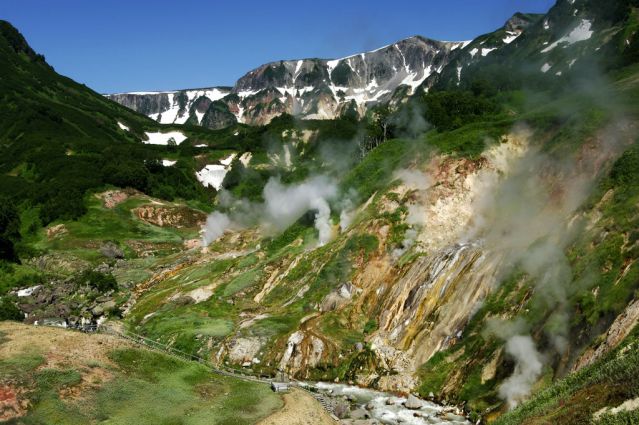
In the easternmost region of Russia, eight time zones from Moscow, closer to Japan than most of Russia lies the region and peninsula of Kamchatka. A land of legends and a kingdom of bears. The region is stunning to look at and sees all the elements come together, snow topped hills, ramblings brooks, luscious greenery and volcanic vapours, yes there are frequent volcanic eruptions and earthquakes.
I realised some days after finishing this wonderful book that I knew about Kamchatka because some months ago my son made me go with him to see a stunning documentary at the cinema called ‘Terre des Ours’ which is set right on the heart of Kamchatka, a territory that is the home of brown bears, who only come out of hibernation for 3 months of the year and during that time they leave the snow topped mountainous regions and traverse the lava fields and go down to the river and lakes which are heaving with salmon. They must eat enough to get them through the next hibernation and the female bears have an even more challenging role as they have to catch enough for themselves and their offspring, while fending off the attentions of the lone male bears.
Below is a one minute trailer that show you a little of that magical world. The film is brilliant, sadly I don’t think it is available in English, the voice over is done by Marion Cotillard. But do watch this snippet, its magic.
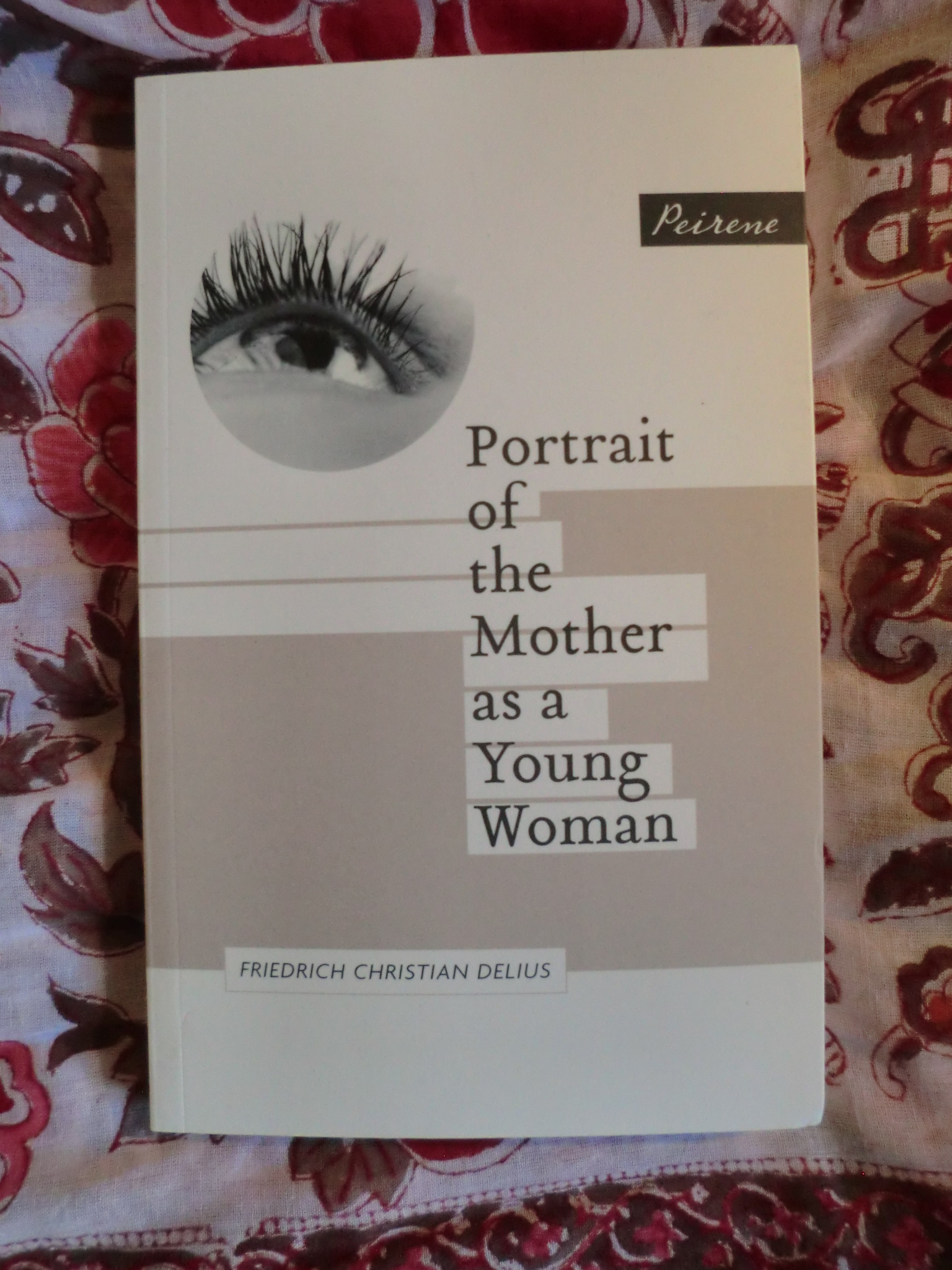
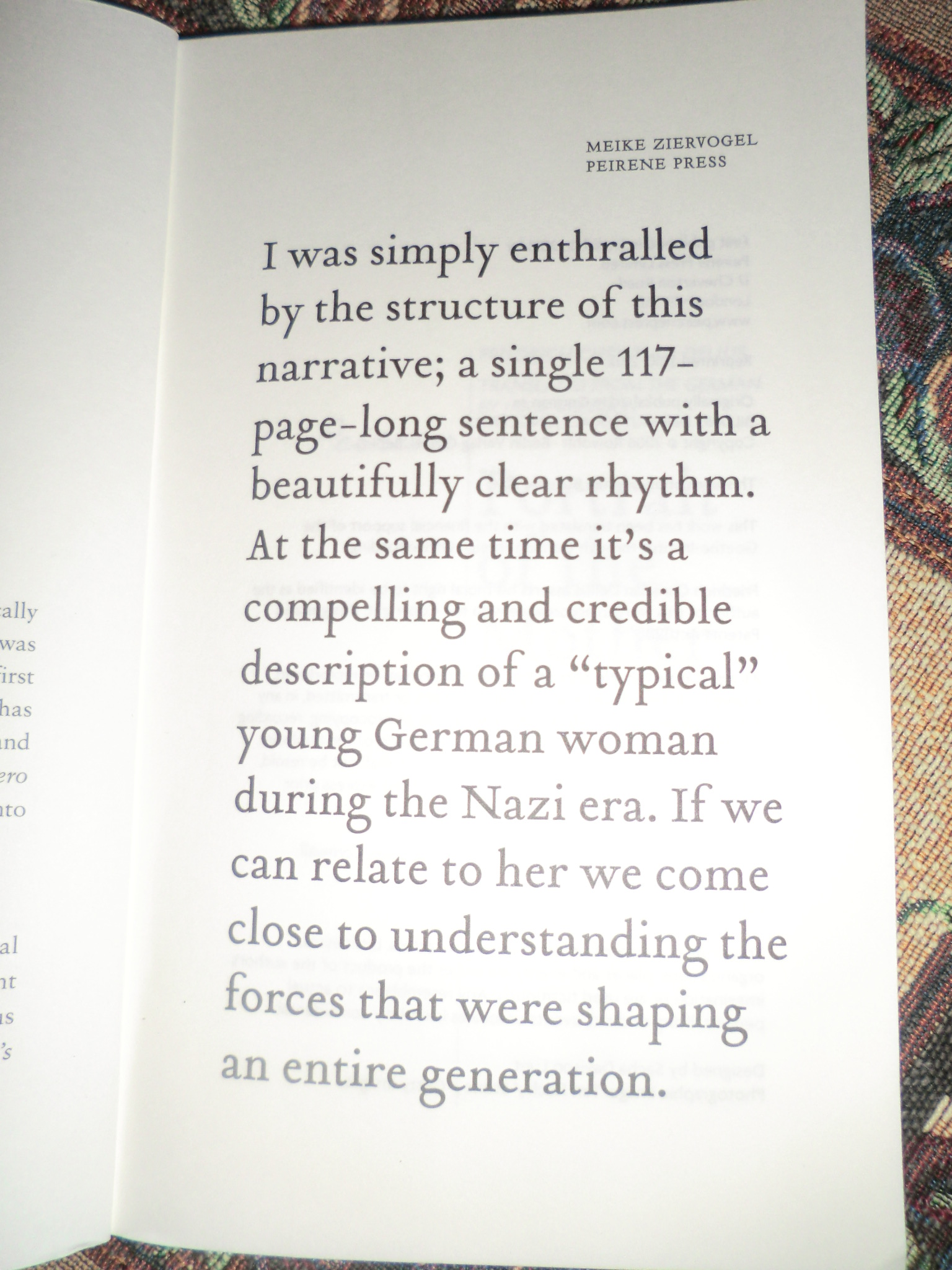
This 117 page long single sentence in a novella, is the third and final book in the Peirene Press series entitled Female Voices: Inner Realities.
If you missed the first two, you can read my reviews here:
Beside the Sea by Véronique Olmi (translated from French by Adriana Hunter)
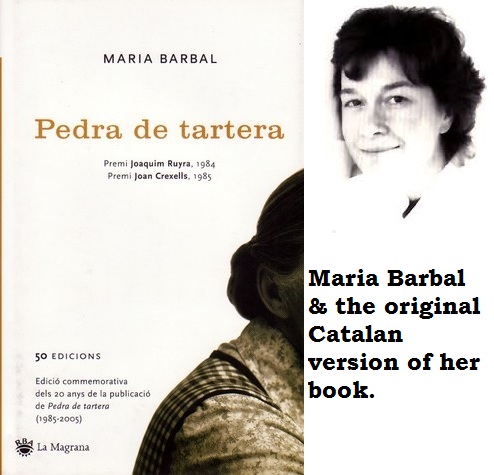
Stone in a Landslide by Maria Barbal (translated from Catalan by Laura McGloughlin and Paul Mitchell)
In my previous review I mention the enticing page at the beginning of all Peirene books where publisher Mieke Ziervogel shares what drew her to choosing this book for translation into English.
Here is a glimpse at what she says about this book:
The book is set in Rome in 1943 when Italy and Germany remain allies during the second world war. The narrative takes place during an afternoon stroll as our young woman on the brink of becoming a mother is walking towards a Lutheran church where she will attend a classical concert.
Eight months pregnant, she is the young wife of a German solider and had been waiting for him to join her in Rome; after briefly reuniting, one day later he is redeployed to Tunisia. Alone again so soon, she walks to the Bach concert thinking about how her life has changed now as a married woman and how distant she feels from everything around her. She recalls recent memories of the short time spent with her husband wondering whether he will return to her safely or not.
Being outside her own country, without her husband and not yet active in her role as mother, it is as if she becomes more acutely aware of who she is, there is little to distract her and she often prefers to keep to herself.
Even the friendship that naturally developed with her room-mate Ilse, she keeps in check, worrying about the implications of being associated with those whose views are more vociferous than her own, she who wishes for a quiet life.
she worried about Ilse, who rarely had a good word to say about authority that was
invested by God, about Hitler and Mussolini, only a few days ago she had said Hitler always demanded that people show no weakness, but human beings were not made like that, and Mussolini always demanded that people had to hate the enemy, but the Italians that she knew were not fond of hatred, why should they hate the English and the Americans,
fortunately Ilse had broken off at this point, perhaps out of consideration for her, because she,
the younger woman, who was always silent when national and political questions were discussed, had just for a second wondered why it was necessary to hate the British and Americans, and in the same instant this forbidden thought made her feel guilty, confused and horrified,
She is not despondent for she has a deep faith and whenever her thoughts turn towards herself she recalls that war is God’s most difficult trial, lamenting:
“God, who is love, delivers this all to us, that it may benefit us in the end,
for it was un-Christian to shed tears for one’s own misfortune and to forget the far greater misfortunes of others, the joys of life were limitless”
Her thoughts enable the reader to understand her reluctance to do anything that might jeopardise what slim chance she may have at a normal life, she dislikes that by virtue of being foreign she already stands out, the opposite of what might give her peace of mind.
Portrait of the Mother as a Young Woman is a spellbinding portrayal of one woman’s internal conversation, her method of coping with the strangeness of her environment, talking herself into maintaining a calm state of mind, rationalising why they have found themselves in this situation. Though it is a trial for her, it is not enough to prevent her dreaming of the life she wishes they were living, something that seems increasingly like a fantasy, as the probability of her husband’s return grows slimmer as each day passes.
Poignant in its simplicity, expressing that universal feminine desire for love in a safe, nurturing environment.
This is the second in the Female Voices: Inner Realities series from Peirene Press.
Publisher, Mieke Ziervogel introduces each of their books with one or two sentences in extra-large font on the second page and it’s a page that you find yourself looking forward to whenever you pick up one of their books.
She shares what attracted the team to selecting that title as one of the Peirene books to translate into English and share with readers.
For Stone in a Landslide, she had this to say:
“I fell in love with Conxa’s narrative voice, its stoic calmness and the complete lack of anger and bitterness. It’s a timeless voice, down to earth and full of human contradictory nuances. It’s the expression of someone who searches for understanding in a changing world but senses that ultimately there may be no such thing.”
We meet Conxa as a 13-year-old girl living in the Catalan Pyrenees, Spain at the beginning of the last century, though she narrates the story from the other end of her life, reflecting back on her journey as an old woman.
One of six children, the opening lines tell us how she came to live with her childless aunt and uncle, leaving her family, home, village and mountain behind at such a tender age.
“Anyone could see that there were a lot of us at home. Someone had to go. I was the fifth of six children – Mother used to say I was there because God had wanted me to be there and you have to take what He sends you. The eldest was Maria, she, more than Mother, ran the house. Josep was the son and heir and Joan was going into the church. We three youngest were told a hundred times that we were more of a burden than a blessing….So it was decided that I, who was level-headed and even-tempered, would be sent to help my mother’s sister, Tia.”
She remembers going to school and how fortunate she was to be able to, on account of having older sisters who stayed home to do the work. Three winters she went to school, until she joined the family of her aunt and uncle and then had to help them with the outdoor work.
In short chapters of around two pages, we observe the change in Conxa’s life, her new duties, how people perceive her initially as an outsider and how that perception begins to change, she has become an heir to land thus her marriage prospects have increased. She suffers silently from being separated from her family, but in time accepts her new role and life.
“Time passed and no one spoke of home. Of my family. In five years I had seen Mother and Maria only once, when they came for the Festa Major during my first year at Pallarès….My aunt and uncle said nothing about going back and I didn’t dare mention it. Was I happy there? I had no idea. I’d lived with my heart in my mouth a bit, worried about what they might throw back in my face. Maybe the poverty of my family…But I’d got used to them and their way of doing things. And it’s true, the thought of leaving Pallarès to return to Ermita became stranger every day.”
We learn through Conxa’s experiences how people were perceived, eldest sons were destined to be the heir, a second son may have had to learn a trade and were therefore seen as lesser prospects. Ownership of land accrued status, men who earned a wage were less desirable.
“They knew him to be hard-working and quick-witted but, because of the nature of his work, he appeared to be a drifter and freer than most men, who only looked at the ground to work it or the sky to figure out what the weather will bring. I realised that they saw him as an outsider, someone who’d managed to earn himself a living, but this had more or less divided him from his family.”
Falling in love with a tradesman is about as rebellious as Conxa gets, her aunt and uncle soon realise that Jaume is a good match, and as with her life as the adopted daughter Conxa becomes as accepting of her new circumstances in her life with Jaume, who must by necessity travel a lot for his work. He is more outspoken and for this Conxa will experience hardship as the Spanish Civil War impacts even the quietest villages.
Stone in a Landslide is such an apt metaphor for Conxa and yet she was not like the others. She doesn’t complain, she loves genuinely, she accepts her circumstances and only at the end when she is physically removed from her natural surrounding does she come close to realising how much a part of that landscape she is as a person. She coped with many changes, from daughter to adopted daughter, lover, mother within her natural environment, but the final move puts her somewhere beyond reach, beyond comprehension of how to be who she really is.
“Perhaps I had turned into a living stone, or it was just that I had never known how to rebel…. I felt that I was going to need to be strong, but I had no idea why.”
Another excellent addition to the collection and discovery of another wonderful writer.
Maria Barbal, born in 1949, is considered the most influential living Catalan author. The clarity with which she presents human relations and the passage of time has earned her critical acclaim and a wide readership. She lives in Barcelona.
Next Up: Portrait of the Mother as a Young Woman by Friedrich Christian Deluis.
A single mother of two boys wants to take them on a little holiday near the sea. That might sound simple enough, but for this mother, it is a major life event and a challenge, as she suffers from some kind of mental affliction that normally requires her to take daily medication.
This trip is out of the ordinary and we experience it from inside the mind of the mother, the stream of consciousness narrative is so effective here, it gets inside our mind as we read. We feel her sense of anxiety acutely and become almost as sensitive as she is to the threatening hostility of the outside world, that place from which she wishes to protect her children.
She wants them to experience the wonder of the seaside, she takes them for hot chocolate and they visit a funfair, all of which present certain challenges. She observes and reflects on aspects of their characters with a poetic clarity that all mothers will relate to.
“I stopped on the sea wall, my two kids holding my hands, I wondered how to do it, how to say hello to the sea. It was making a hellish noise, really angry, and the children cowered. I stayed there, not moving a muscle, watching it…I’d been waiting for it such a long time!”
It is an incredible novella and I appreciated it all the more, ironically, after following recent discussion on Vishy’s review of Nabakov’s Lolita . They discuss that dilemma many readers have when they recognise an exceptional prose style but feel uncomfortable with the subject or the perceptions of the protagonist. It makes it hard to share an opinion and it takes time to understand our reactions. We observe them first and then try to understand them.
What I found most interesting in those subsequent comments actually came from the more experienced readers, those who had read it more than once and they describe what changed in terms of their own perceptions with subsequent readings. In the first read we react more to the story and character, in subsequent readings it seems the reader has greater insight into the intentions of the writer/artist, beyond surface character and plot.
Those comments made me think more about Beside The Sea and wonder if I might appreciate it more coming to it for a second time. I was in admiration of the style but uncomfortable with the journey. I would recommend it to the curious, thinking reader who isn’t quick to judge and it’s not one to read when you’re feeling fragile.
The author does an incredible job in making the reader empathise with the mother, even though I didn’t particularly enjoy going into that state and arriving at its inevitable conclusion.
I also couldn’t help thinking about these kind of stories in the media, the short versions which usually focus on the result and not what leads people to where they end up. I don’t want to spoil the read, so you’ll just have to read it to find out what I mean by that. I think the enjoyment of this book will also be dependent on where one is on the ‘potential for empathy’ scale.
It is an interesting challenge, that an author would choose to travel inside the mind of someone like this and write in the stream-of-consciousness form. I am sure this was one of the works that the publisher and writer Mieke Ziervogel read as background research in writing her own debut novella ‘Magda‘.
Poignant and thought-provoking given the issues that lie beneath its surface, this is the story that is almost never told and rarely understood by the public, who often only see that end result favoured by the media and judge it far too easily.
This is the first book in the Peirene Press Female Voices: Inner Realities series, all of which I am reading in January 2015.

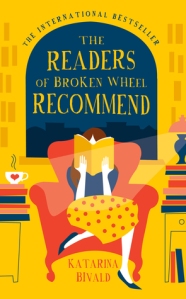 Sometimes, these are the only books that will do. That rare breed of literature that entertains, uplifts and demands little in return, the books we read when we are fed up with thinking and wondering why certain things are the way they are.
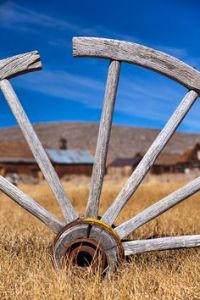 Sara has been writing letters to Amy for the last two years, they are bookish pen pals who share a love of literature and enjoy the uninterrupted conversation of a letter. Amy invites Sara to visit, she arrives in the small, dilapidated town of Broken Wheel, most-likely it first and only ever tourist, only to find that the person who invited her didn’t tell her something VERY important that will affect her two month stay.
 A light-hearted, uplifting story that should be in the section of the bookstore or library entitled “guaranteed to lift or lighten your mood”.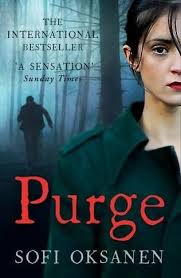
 Wanting to visualise where the region of Läänemaa in Estonia was, I found it was connected to a somewhat ironic slogan, “Your safe nesting place,” a reference to the areas wetlands and meadows, providing a protective habitat to its wildlife.








 Word by Word