A Regular Fix of Contemporary European Literature

While no slave to social networking, I do appreciate those needle in a haystack gems of information that twitter occasionally throws out. It’s a little like a child knowing that there is a lolly scramble going on behind a door that opens once a day and if you stand in one spot with your hand out, you might just catch something. Much of it passes us by, but the one that lands in the hand, is appreciated all the more for the scant chance it had of being captured.

Which is what this little tweet I caught in late May did.

I remembered that when I wrote about Deborah Levy’s Booker short-listed novel Swimming Home and mentioned the subscription based publisher And Other Stories, that @MarinaSofa mentioned Pereine Press. I looked at their website and started following them on twitter.

CIMG4717Pereine Press publish contemporary European literature, in the form of novellas, a new book coming out every 3 months. So they provide an opportunity to introduce readers to new authors, outside what we might normally read in English and a book that doesn’t require a long time to read, each book can supposedly be read in an afternoon. No 400+ page tomes here.

So the tweet reminded me that I did want to read their books and there’s nothing like the threat of a price increase to motivate one to act. So now I am a Pereine Press subscriber and I have the first two books from this years series on the shelf.

Mussel FeastEach year has a theme, in 2013 it is Revolutionary Moments and the first book is the German classic The Mussel Feast by Birgit Vanderbeke which I have now read and will tell you about very soon. Very well-known in Germany I am sure and a gripping read, I devoured as hungrily as I would moules frites.

Not only does this subscription mean there will be European literature arriving regularly, but subscribers are invited to participate and attend literary events with the authors whose books have been published, including the revival of a literary salon, which sounds intriguing. The events take place in London and I hope one day I might coincide a visit to be able to attend one. I love that this type of event is coming back into vogue.

So more contemporary European literature reviews coming here soon…

Fetish or Inspiration, Uplifting Shoe Art

manolo blahnok drawings

I mentioned in my recent review of Deborah Batterman’s Shoes Hair Nails that it had reminded me of a book lurking on my daughter’s shelf, a gift from a family member who is a designer.

The book is manolo blahník’s drawings, a small pocket-book of 120 original sketches and quotes that create a visual history of the talent of one of Spain’s most creative and alluring shoe designers. Being a book full of hand drawn images, there isn’t much to say about the content, because it just must be seen and appreciated.

Manolo Blahník

Born in the Canary Islands, he has been sketching shoes since the age of seven and had hopes of becoming a set designer, before fashion editor Diana Vreeland suggested he concentrate on shoes. No surprise that there is a theatricality to his designs and a sense of the artist at work.

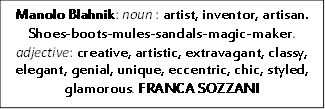
One of the best quotes, this definition of Manolo Blahník, expressed by Franca Sozzani, Editor-in-Chief of Vogue Italia:

Manolo Blahnik

Manolo Blahník

While I am not a great fan of shopping for and trying on shoes, I do love looking at and admiring them and these designs are pure inspiration, going beyond any practical requirement and into the realm of art which is more likely the reason I was so keen to visit the Shoe Gallery when it opened in London a couple of years ago.

These are some of my favourite images from the book.

Manolo speaks through his shoes. For him, the foot, the shoe, implies the whole nature of a person, and expresses a story. ANNA PIAGGI

The day we bought the book (from Liberty’s in London) was also the day of the opening of the Shoe Gallery in Selfridges in London.  A gallery of shoes and in 2010, while the middle class were keeping a low profile in the gardened suburbs due to the recession, it seems the creative younger generation of London were being inspired to flaunt shoe art!

Selfridges Shoe Gallery

Designed by the architect Jamie Fobert and the largest shoe department in the world, it contains 6 salons, 11 brand boutiques and more than 4,000 pairs of shoes. And what an outrageously joyous wander around that was, a gallery with none of the pressure of a shoe shop, one is free to wander around and admire the masterpieces of the many diva’s of shoe design. There was even a Shoe Booth, where you could have a photo taken with your favourite pair, how generous is that!

Instead of one large department, you enter six different zones, each space a character in itself. The line of Spanish alabaster plinths modelling their shoes in regal splendour, give it a real feeling of a gallery, the shoe taking pride of place and unlike in a gallery or museum, all available to buy. The architects only managed to convince Selfridges to go with concept of plinths, having proven that sales of shoes displayed on them, far outstripped sales all other pairs. It seems we all aspire to the pedestal, no matter who or what sits on top of it!

Shoe Cerise

So does anyone own a pair of Manolo’s and is it true that some like Anna Wintour will wear no other?

Man Booker Prize Longlist 2013

Man Booker 2013 logoToday judges announced the Man Booker Dozen that have made it onto the long list for 2013. Last year Hilary Mantel won it for the second time and with a sequel, Bring Up the Bodies, which is the 2nd book in the Thomas Cromwell trilogy.

StetI have just finished reading Diana Athill’s excellent book Stet, An Editor’s Life arguably the person with the longest active memory of the history of books and publishing today, she won the Costa Prize for her most recent memoir Somewhere Near the End in 2009, when she was 93 years old. Stet, she wrote at the sprightly age of 80 shortly after retiring.

In the book she mentions the launch of the Booker Prize, mentioning that in the sixties, it was becoming more and more costly and less profitable to publish books and to compete against the bigger publishing houses. It was becoming difficult to sustain a publishing house that appealed to the more literary reader. She describes the two kinds of reader that existed, still relevant today:

People who buy books, not counting useful how-to-do-it books are of two kinds. There are those who buy because they love books and what they can get from them, and those to whom books are one form of entertainment among several. The first group, which is by far the smaller, will go on reading, if not for ever, then for as long as one can forsee. The second group has to be courted. It is the second which makes the best-seller, impelled thereto by the buzz that a particular book is really something special; and it also makes publishers’ headaches, because it has become more and more resistant to courting.

The Booker Prize was instigated in 1969 with the second group in mind: make the quality of a book news by awarding it an impressive amount of money, and hoi polloi will prick up their ears.

WBN 2013It worked for the books named, but the underlying aim to convert more people to reading did not. Not much has changed. The latest attempt to convert the population into reader, we could say is World Book Night, where publishers print thousands of books for free and they are given out on one night in the year, to people who don’t really read. Has that worked? Unlikely I think.

But onto the prize for 2013, this year’s long listed titles and authors are:

Eleanor Catton, The Luminaries

Jim Crace, Harvest

Eve Harris, The Marrying of Chani Kaufman

Jhumpa Lahiri, The Lowland

ColmTóibín, The Testament of Mary

Colum McCann, TransAtlantic – my review here

Donal Ryan, The Spinning Heart – my review here

NoViolet Bulawayo, We Need New Names – my review here

Tash Aw, Five Star Billionaire

Richard House, The Kills

Alison MacLeod, Unexploded

Charlotte Mendelson, Almost English

Eve Harris, The Marrying of Chani Kaufman

Ruth Ozeki, A Tale for the Time Being

Congratulations to all those authors and good luck to anyone hoping to read the list, I’ve only read one and I do have The Spinning Heart, so I guess that will next.

The shortlist will be announced on 11 September and the winner on 16 October.

Time to get reading!

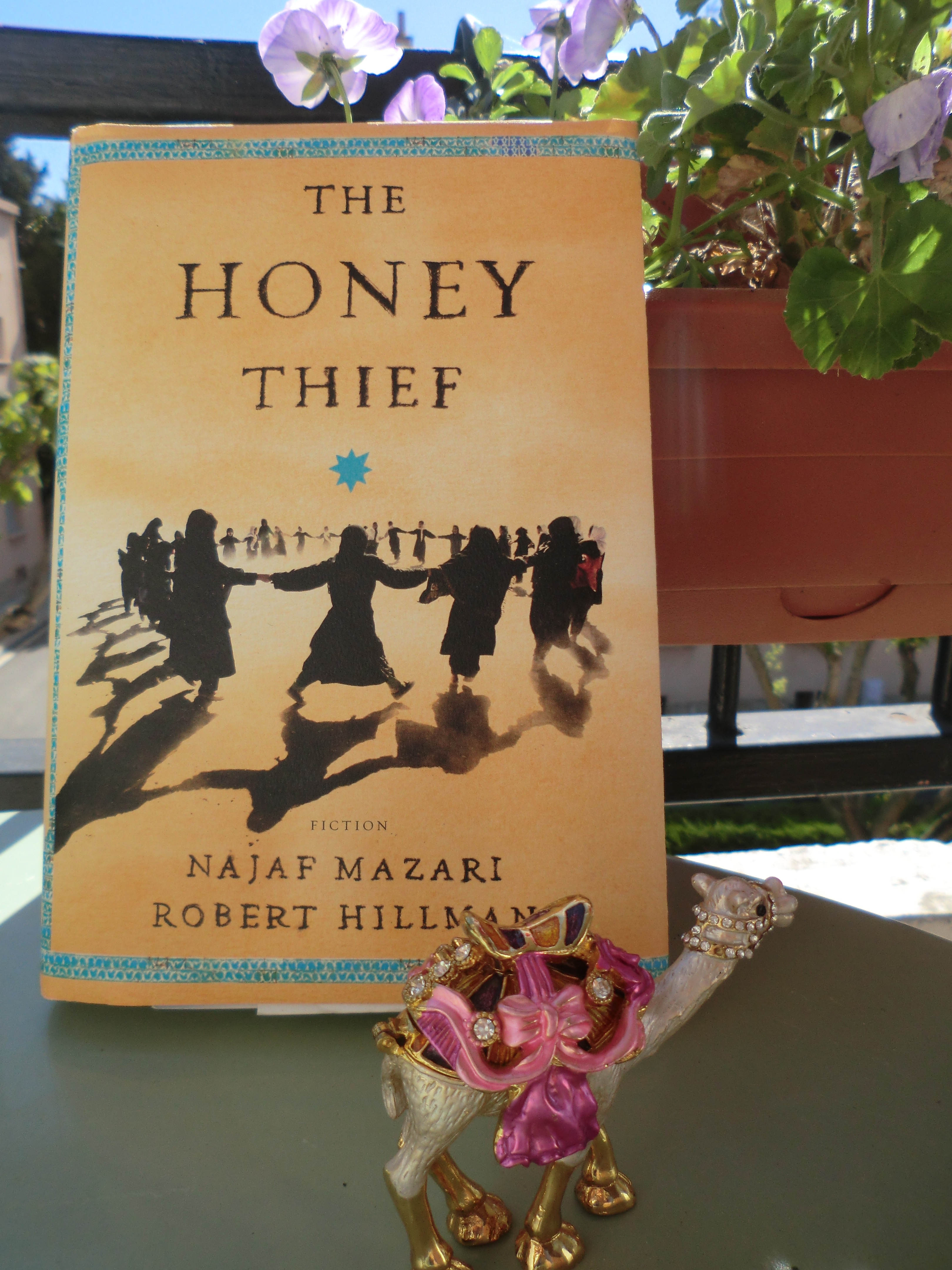
The Honey Thief Stories and Recipes by Najaf Mazari, Robert Hillman

I requested The Honey Thief to read because it appeared to offer a unique insight into a culture we know little about and about which we see and read far too much negative press.

The Honey ThiefThe book promised an alternative perspective, not because the author had lived an extra-ordinary life, but because as part of his upbringing he and others like him listened to these stories passed down and sometimes relived from one generation to the next. They are not about war, oppression, the Taliban, terrorists or western women living in a foreign culture, they are about sharing the wisdom and perspective of a people who have only experiences to share, wisdom to offer and guidance as their intent.

Sometimes stories are all that is left to be passed on to the younger generation and we are fortunate to be given this glimpse into these gifts of an ancient culture and tradition.

Ethnolinguistic map of Afghanistan ex wikipedia

Ethnolinguistic map of Afghanistan ex wikipedia

Najaf Mazari was born in Afghanistan, though he only refers to his homeland as that since he left it, because before anything he is Hazara, one of the many peoples of that vast and mountainous tract of land surrounded by six countries, Pakistan, China, Tajikistan, Uzbekistan, Turkmenistan and Iran and inhabited by more than 14 ethnic groups, separated socially and geographically.

Rather than an affinity with what we casually call Afghanistan, his loyalties are to his people and the area they have inhabited for at least 800 years, Hazarajat, although due to its’ long history of domination, they have often fled their spiritual home for the sanctuary of the mountains or other lands. But loyalty remains deep within them all, no matter where they find themselves.

Living as a refugee in Australia, Mazari with the aid of his friend Robert Hillman, shares these stories that are part of the fabric of Hazara life, stories of an oral tradition, keeping their bonds and culture alive, giving them courage and hope to continue to endure the many challenges that will face them, from family expectations to foreign visitors, to facing an enemy and offering forgiveness.

snow leopardThey know the mountains and rocks are loyal and must be respected, they read the wind and interpret the moon and understand that wars can last 100 years. We see their relationship to the mountains in the poignant story The Snow Leopard, where a visiting English photographer wishes to track and photograph the elusive creature. His first visit is unsuccessful, no one will guide him to those dangerous parts of the mountain where it is believed the snow leopard resides, as there is more than just the mountain to fear. On his second visit, he finds a guide and though unsuccessful, their journey is filled with insight, learning and a renewed respect for the mountain.

The stories share something of the way the Hazara see the world and the story The Honey Thief  brilliantly encapsulates their relationship with nature, animal life and shows how good can sometimes come from bad. The narrator shares with a boy how he became a beekeeper, caught red-handed stealing the honey, his captor observing that he wasn’t stung – thus finding his future apprentice.

Similarly this boy, whose grandfather is a wise man whom the villagers consult daily, discovers that even wise men have something to learn from young boys who like to ask lots of questions in The Wolf is the Most Intelligent of Creatures and learns that what might appear to be ill advice may in fact be the correct advice to give. This story, the very first, is sure to immediately challenge your own perceptions, something I adore in travel and delight in finding in a great tale.

Almost like fables and yet not, because all of these stories, while offering the seduction of a fable, are rooted in a realism that convinces the reader they tell of lives actually lived and not conjured up or given magical powers, a device that the common fable sometimes utilises.

The author Najaf Mazari

The narrator Najaf Mazari

And when the stories finish, we discover perhaps the greatest gift of all, one that can be referred back to and shared at home ourselves, a small collection of mouth-watering recipes with names and ingredients like Lamb Qorma, Sabzi Gosht, (lamb with spinach), Kofta Nakhod (beef & chickpeas), Boulanee (like Cornish pasties) and Chelo Nakhod (chicken & chickpea stew); surely living proof of the richness and diversity of their culinary culture and the trade that has passed between these boundaries of peoples for hundreds of years.

If you are interested in learning more, or considering reading the book, I highly recommend checking out these two excellent reviews:

  • Richard Marcus at BlogCritics – a beautiful, sensitive and concise review, how he packs so much into so few words, I’m still trying to figure out.
  • Elise Bauer at Simply Recipes – check out this short but flavoursome review and the recipe with pictures, she not only read the book, but cooked that first recipe with astounding success!

Note: This book was provided by the publisher Viking, a member of the Penguin Group US, in return for an honest review.

TransAtlantic Journeys, Real and Imagined

Colum McCann’s latest novel did well to live up to my raised expectations and has now become a symbol of a path on the journey of this blog itself. I was always keen to read McCann’s next novel, after the hype of Let the Great World Spin, which I enjoyed although I wouldn’t class it as one of my all-time favourites. TransatlanticHowever, TransAtlantic became a “must read” after I received a hardback copy in the post, in recognition of one of my reviews being profiled on The Guardian’s online book pages, where I occasionally post extracts of reviews and comment under the pseudonym RedBirdFlies. The review that was acknowledged, was Zadie Smith’s NW and you can read what the Guardian had to say about it here.
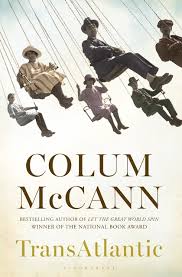
So thank you to The Guardian Books team for sending me a copy of TransAtlantic, a welcome surprise and wonderful to know that a few of these “word by words” have flown the page and landed elsewhere to an appreciative audience.

Vickers Vimy with Alcock and Brown aboard departs-Newfoundland 14 June 1919

Vickers Vimy with Alcock and Brown aboard departs Newfoundland 14 June 1919

TransAtlantic is a hybrid novel (is that an oxymoron?), in which McCann takes real historical figures, all of whom made a transatlantic journey which subsequently had a bearing on the story of Ireland and re-imagines a part of their story, interspersing the narrative with fictional characters.

He starts with Alcock and Brown in 1919, who ditched their bomb carriers, modifying the Vickers Vimy by taking war out of flight and adding more fuel than had ever been strapped to an aircraft in their attempt to cross the Atlantic non-stop.

The names sounded familiar, but I didn’t know as I began to read who they were, so looked them up and was startled to see Alcock’s date of birth and then death, the same year in which he makes this attempt – are they going to make it I asked? And is it cheating to look up a historical figure in the midst of reading a novel? Brown dies many years later, so I settle back into reading, content they are going to make it. Until I read that Alcock couldn’t swim.

Their preparation and journey are captured by a journalist Emily Ehrlich and her photographer daughter Lottie, who reappear in later chapters, two women whose family have made the crossing many times, the first family member to do so Lily, inspired by meeting Frederick Douglass, who we meet in the second chapter. In a chance encounter with Brown, Lottie asks if he will carry a letter written by her mother to an address in Cork. A letter that survives this entire novel.

Frederick Douglass 1847 by Samuel J Miller (wikipedia)

Frederick Douglass 1847 by Samuel J Miller (wikipedia)

Frederick Douglass visits Ireland while in the throw of becoming a free man, he is spreading the word against slavery, a young abolitionist, a charismatic presence, in awe of how he is received, as an equal, yet disturbed by what he sees outside the warm, accepting rooms of his well-off hosts, the onset of famine in Ireland, people living in more dire conditions, than what he has left, though they are free. It is a humbling experience, as it is for anyone meeting those worse off than they, no matter how tragic one’s own circumstance.

“He thought he knew now what had brought him here – the chance to explore what it felt like to be free and captive at the same time. It was not something even the most aggrieved Irishman could understand. To be in bondage to everything, even the idea of one’s peace.”

A young maid, Lily Duggan is inspired by his presence to abandon her employ and take a ship to America, where she meets mixed fortune, her descendants equally inspired to search for new shores, leading them back full circle to that island of her birth Ireland. It is through the women characters that the threads of narrative are interwoven and connections are made across the years, witness to, or affected by the consequences of those significant events that the men of those first three chapters represent.

These characters might represent us, the population, those that stay in a country generation after generation, some harbouring seeds of revenge, and those who leave, immigrate, seeking utopia, hoping that there does exist, a place where men and women of any race, class, religion or persuasion have an equal chance at bettering their lives.

And as McCann himself says in the interview with Jeffrey Brown:

“Women, as we know, get the short shrift in history.

It’s been largely written and dictated by men, or at least men believe that we own it, and women have really been in those quieter moments at the edge of history. But, really, they’re the ones who are turning the cogs and the wheels and allowing things like the peace process to happen.”

There is something alluring in the novelist who takes on a historical figure and imagines their past, it can bring the past to life in a more animated way; in the present when the media delves into the personal life of an important political or scientific or literary figure, it is deemed an invasion of their privacy, the cult of the celebrity. When a novelist looks back and intertwines the narrative of their accomplishment and the context of their life, their loves, and their thoughts beyond the significant reason that they have become known, it makes them whole and they become characters that we might even relate to.

Entrance to Titanic Museum, Northern Ireland

Past in the Present
Entrance to Titanic Museum, Northern Ireland

“I am partial, still, to the recklessness of the imagination. The tunnels of our loves connect, coming to daylight at the oddest moments, and then plunge us into the dark again. We return to the lives of those who have gone before us, a perplexing Möbius strip until we come home, eventually, to ourselves.”

Whist many authors safely inhabit the lives of historical figures from a distance, many years or centuries after their death, dwelling in the safety of already published and authenticated research, McCann goes one step further by taking as his third character the US Senator, George Mitchell, effectively channeling his thoughts during the day that he journeys to Northern Ireland to broker the Good Friday Peace Agreement. Clearly, this was no mean feat, as the interview comments quoted attest, but he succeeds in creating the man behind the politician, without it seeming like an invasion of his privacy.

McCann’s prose style often reduces to the minimum, he sometimes dispenses with conventions of grammar, reducing his phrases to only the words that describe or evoke the scene or emotion and it is compelling reading. He doesn’t strip beauty from language; if anything he accentuates it by removing the accessories.

I don’t wish to make comparisons, but the only other writer whose prose has that kind of addictive effect on my reading is Cormac McCarthy. They don’t strum their words in the same way, but if they were musicians, they’d both be on my playlist. They possess talent worth dwelling within.

“It is one of their beauties, the Irish, the way they crush and expand the language all at once. How they mangle it and revere it. How they colour even their silences.”
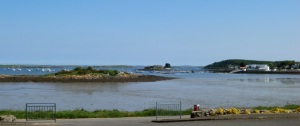
Strangford Lough, Northern Ireland

Strangford Lough, Northern Ireland

London Literature Festival #londonlitfest

Late last week I was working in London and had a free Saturday to enjoy the delights of the city.

Providores

The Providores + Tapa Room

I was meeting a friend for brunch in Marylebone High Street, ironically it is London’s French quarter, many of the shops and cafés and boulangeries are very familiar; however we weren’t heading for a French café, we couldn’t help but be tempted by one of New Zealand’s greatest exports, chef Peter Gordon and his restaurant The Providores with its excellent downstairs Tapa Room, the all-day restaurant, café and wine bar.

London's South Bank Centre

London’s South Bank Centre

Before heading out, a quick google search “literary events London” informed me that the London Literature Festival was on, I couldn’t believe it!

So after a terrific brunch, off I went to the South Bank Centre and the Royal Festival Hall, always a hive of activity at the weekend, and hive  an apt metaphor, as the festival was using the image of a bee and honeycomb in its publicity.

Don’t you just love those sun loungers outside Foyles bookshop. Bliss!

To my delight and surprise, the American essayist and writer of non-fiction Rebecca Solnit, was speaking in the late afternoon, so I avoided the pull of Foyles to buy a ticket and then decided to check out The Spectacular Translation Machine, a collaborative attempt to translate an entire book from French into English.

CIMG4524The book On Les Aura! was the private diary of a French solider written in 1914 , which the renowned illustrator Barroux discovered and published in France, adding his line drawings to bring the story to life. It has never been translated into English, so each illustration along with the short paragraph of text was hung on a line around a room in the Royal Festival Hall and members of the public invited to choose an image and attempt the translation.

I chose an illustration of the solider lying in bed and a steaming cup of coffee beside him. The paragraph underneath the illustration read:

Je m’éveille après une bonne nuit de sommeil et je trouve un bol de café fument. Quel changement ! J’écris a ma chère femme pour la rassurer et lui envoyer mon adresse. Vers 10 heures, le Major passe la visite.

Along with children, a couple of students, a woman who could speak 15 languages and anyone else wanting to give it a go, we sat at the table and worked on our translations in a wonderful community approach. Such fun!

From there, a quick scout of the bookshop Foyles where I picked up a copy of Chinua Achebe’s Things Fall Apart and a copy of The Artist’s Way.

CIMG4528Then on to the Queen Elizabeth Hall for an inspiring talk by Rebecca Solnit, author of The Faraway Nearby, hosted by the literary critic Alex Clark. Solnit’s book was already on my list and downloaded to the kindle to read, but jumped to the top of the pile after an engaging talk about apricots, Alzheimer’s, Iceland and the significance of stories in our lives. A very poised and engaging speaker with scores of anecdotes and quotes that she repeats without hesitation.

It must be the season for book readings, because I am back in Aix and today we have had Jonathan Coe participating in an excellent and well hosted and translated discussion. More on that soon!

*

CIMG4522

Portrait of a Turkish Family by Irfan Orga

The last of my collection of Turkish literature either brought back from Istanbul or lying on the shelf unread, Portrait of a Turkish Family was hailed as a masterpiece and I have to agree, a timeless classic, capturing a changing way of life as a consequence of war and fire, two of Turkey’s most fearsome destroyers of many families life of peace and tranquility that preceded them.

Orga IrfanIrfan Orga was born in 1908 in Istanbul, his mother only 15 years old, his father 20 and a younger brother Mehmet born two years later. His sharing of the family story really starts at age 5 when he remembers certain events with an amazing clarity, although many memories and conversations are clarified in greater depth later on to him by his mother. His curiosity and gift for eavesdropping apparent early on and perhaps those memories are so clear because life was soon to change dramatically.

By 1913, war was imminent and it was clear that Irfan’s father and only uncle were going to be called up. He sold the family business which hadn’t been doing too well, against his mother’s wishes, before being sent to war, in the hope that there might be something to come back to, a fresh start.

Ottoman uniforms WWI

Imperial Army workshop making uniforms

Once the men left for war, the family, raised and assisted by servants, continued largely in ignorance of what was to come, until food became scarce and their roles began to change.  As time went on, war forced everyone to adapt without realising that life would never again be as it had been before.

As change burrowed permanently into their lives, each would suffer in their own way, the coping mechanism of one often causing suffering in another.  Mother, mother-in-law, and the two boys were forced to move houses, downsizing significantly and rebelling against this change Irfan’s mother ripped the kafes from the windows of the house, insisting on letting the light in.

Kafes are the closely latticed harem shutters always used in Ottoman times to prevent passing males from catching glimpses of the women who moved within the house, not so much in evidence today, due to the neglect that makes them a significant fire risk. As back then, even today many families struggle to afford the upkeep required to take care of these houses, thus they crack, peel, rot and deteriorate into an unlivable state, when not consumed by fire first. We were fortunate to see this excellent restored house near Topkapi Palace and its equally neglected counterpart on Heybeliada Island below.

Without giving anything away, because it is so much better to experience the book, Orga captures the events and dramatic turning points of his family life with insight and brutal honesty. It is heart breaking at times, in particular the relationship between the mother and her sons, of which there is more focus than with his younger sister, born later and not always sharing the same experiences as the two boys.

The Orga Family

The Orga Family

Orga left Istanbul in his 30’s after a period in the Air Force to come to England and eventually married his Norman-Irish wife, amid controversy, not least of which it being deemed an illegal act in Turkey at the time, thus apart from one return visit, he was forced to remain living in exile in England.

His son Ateş Orga contributes a heartfelt afterword, sharing something of his father’s life outside the scope of his book, which focuses on those first 30 years of his life in Turkey.

A brilliant read, full of insight into life in a liberal Muslim family at the beginning of the 20th century and their challenges in coping with the effects of war and devastation.

It seems timely to be reading this as contemporary events overshadow historical reflections, provoked by the seizure of one of the last remaining urban parks in central Istanbul, it is being reclaimed to build a shopping mall and the citizens begin to revolt against what they perceive as authoritarian rule.

Ironically, on our last day in the city 2 weeks ago, we tried to find Taksim Square and Gezi Park, but all we found was a corrugated iron fence and a sea of humanity traversing the great shopping street between Taksim and Tunnel. It had been said that you haven’t seen Istanbul if you have not visited this area, but I was at a loss as to what I was supposed to find, all trace of restive beauty hidden and on the verge of replacement.

I am reminded of Pamuk’s Istanbul Memories of a City and the many pages of hüzün, that sense of melancholy that has hung over the city since Ottoman times and can’t help but wonder if the time for silent brooding is erupting into a new age of outspoken demonstration.CIMG4470

And all down the Bosphor, down, down to the Black Sea, ran the tall trees and the old wood houses that suit the skyline so well. If I turned my head to the left there on the hilltop, I could see Dolmabahçe Saray white and artificial as a wedding cake in its peaceful setting. Miniature mosques front the water’s edge and there at the end of all the shining palaces lay Istanbul – my Istanbul that will forever hold something of my heart. Grey it would look from this hill and the smoke from the boats would lie over it like a soft veil and tall and tapering are the minarets that enchant the skyline, and from my hill I would see, being the Mosques, the Marmara like a faint line of thread. Irfan Orga

The Dervish by Frances Kazan

DervishSo what is a dervish you might ask? And why does Frances Kazan use it as her book title?

“Are the Sufis and the dervishes the same?” I asked.

“The two are like the threads on a loom. She replied. “Different colours, varying textures interwoven together to make a single carpet of immeasurable beauty.”

Perhaps it symbolises the unknown aspect, that thing just beyond our rational ideas, the reason we do certain things that can’t be explained. Not quite insanity, but on the way towards it and yet it is also that part of our nature that makes us feel most alive, that promises to make life interesting. When we choose not to indulge it, our lives, in consequence are more predictable, more balanced and much less exciting.

The protagonist of Frances Kazan’s novel Mary is an artist who lives in New York and is looking back on that period in her life just after she became a young widow, her husband was killed in France in WWI in the Battle of the Somme. Restless in New York, she responds to her sister’s invitation to join them in Istanbul where Connie’s husband works for the American consulate. In the last days of her time in Istanbul, the dervish becomes her sole subject to draw and paint, something about these mystical humanists resonating within her psyche and manifesting in her drawings.

220px-Edib_Halide

Halide Edib

The story is set in the dying days of the Ottoman Empire post World War I, the country is occupied by the British which has spawned the establishment of the Turkish Nationalist movement. While the Americans are Allies of the British, they aren’t directly involved and therefore must exercise cautious diplomacy with whom they make friends. They have tentative relations with Turkish nationalists, but political tensions in the city are high and the two sisters have been warned to stay close to the consulate.

Unlike her sister who listens to that advice, Mary refuses to stay behind the protective walls of the embassy; a new city that embraces so many languages and cultures beckons her. These daring excursions result in her becoming witness to the murder by a British officer of the young son of Turkish Nationalist and to her being wanted for questioning by the British Army.

This encounter is a turning point in her visit, after which she befriends the Turkish novelist and feminist political leader Halide Edib Adivar who supported Mustafa Kemal (later Ataturk) in the resistance against the occupation of their country by a foreign power and she will also meet and more than befriend the father of the young man who was killed.

“I was born in the harem, in the same room as my mother and her mother before her. Once upon a time we felt safe within those old walls; I fear we dwelt in illusion.”

Mary’s is with Halide and her husband Dr. Adnan, who has been appointed as Minister of Health in recent elections, when they hear there is to be a coup d’etat, which put them all in danger and forced them to flee. It also resulted in a warrant for Mary’s arrest and set her off on an overland adventure with her friends.

Mustafa Kemal Ataturk

Mustafa Kemal Ataturk

France Kazan has written this story around a subject that is clearly one of her passions in life, the history of the Ottoman Empire and many of the characters are real historical figures themselves. Not just a scholar of Turkish studies and an admirer of Halide Edib, but her late husband the film-maker Elia Kazan, was born in Istanbul. In his book and film by the same title, America America, he tells how, and why, his family left Turkey and moved to America.

It is an entertaining read, not too burdened with political and historical recounting. I found it a little difficult to believe the somewhat complicated relationship between Mary and Mustafa Pasha, and her decision to stay when her sister and husband decided to leave. Perhaps grief makes us less sensitive to risk and more inclined to reckless adventure.

And those whirling dervishes? I will leave the last words to Rumi:

Rumi, the founder of the Mevlevi Order in the 13th century said the dancing dervishes represent the solar system and the planets that revolve around the sun. At the same time that they are immersed in their own microcosmos, they create new worlds and make contact with eternity.

The fact that humans can join the choreography of the cosmos by dancing to its rhythm is an awareness that humanity has had since ancient times. One can say that all dance, in a certain way, is yielding the body to the earth’s movement. Slowly, as the body sways and the blood rhythm changes, consciousness also changes. With the revolution paralleling that of the cosmos, the mind assumes a freedom from the earthly bondage. It would be as though the mind begins to concentrate on the depth of existence on its own, while the body has been given away to the earth.

Note: This book was an Advance Reader Copy (ARC) provided kindly by the publisher via NetGalley.

Patasana: Murder at an Archaeological Dig by Ahmet Ümit tr. Amy Spangler

Patasana

Visiting another country is an opportunity to be introduced to new authors, to read outside one’s preferred genre and to gain new historical perspectives.

So while I am already a fan of the more well-known in the English language writers, Orhan Pamuk and Elif Shafak, Ahmet Ümit was completely unknown to me and while mystery isn’t my preferred genre, a book that introduces us to new places and offers insights into other cultures and their way of life is certainly appealing.

Books from the Basement

I asked in the bookshop in Istanbul for A Memento of Istanbul, another book written by Ahmet Ümit, but it wasn’t available. The only book they had in English by him, had to be retrieved from the basement. I’m not sure if that is significant or not, although having got to the end of the book and knowing the controversy surrounding the treatment of the Armenian population within Turkey, allowing his characters to thrash out their opposing views, may have courted controversy.

In 2012 France tried to make denial of the Armenian Genocide a criminal offence, souring relations between the two countries, however the draft law was struck down.

Review

HIttites
Ancient Hittites

Patasana was the son and grandson of a palace scribe, who wrote his story and that of his father and grandfather onto tablets that were then sealed and are now being uncovered 2700 years later.

Each alternate chapter is a translation of one of the tablets, so while we follow the contemporary story of the archaeological dig of an antique Hittite settlement in southeast Anatolia and it’s team members, we also learn what Patasana lived through, the confessions of a young scribe, his life, love and regrets.

The Hittites

Hittite Chariot
Hittite Chariot

“He was the chief scribe of the palace, a very important government position among the Hittites. These men were extremely well-educated. They knew several languages. Their duty was to compose texts as dictated by the king, not to write down their own feelings, thoughts and memories. But that didn’t keep the scribe Patasana from writing down his own story. That’s why the tablets are so important….We believe what we have here is the earliest documentation of humankind’s non-official history….We think he’s telling the story of the ancient city’s final days. And together with the history of the city, his own personal history as well.”

Unsure whether it is related to the dig or not, a local elder is discovered dead, having fallen, or been pushed from the minaret of the mosque, a man in monks clothes seen fleeing the scene. Esra, the leader of the team is paranoid about upsetting locals and having her first dig cancelled before they have uncovered all the tablets and participated in an important press conference being held to satisfy their funders. Her insistence on knowing everything and getting close to the police captain makes her just as suspicious as virtually every character who at one time or other she imagines as a suspect.

Euphrates River, Anatolia

Whilst it could have done with some editing down, it is an enjoyable and I believe popular book.

It is interesting that the author was born in Gaziantep, southern Antolia and while on a family picnic near the Euphrates River saw an excavation site, an old Hittite city, prompting him to immerse himself in researching the area, its people and customs and then write this book.

Ahmet Ümit, Author

Ahmet Ümit himself sounds like an interesting character straight from a novel and it is clear that his own life has inspired many of the stories and characters he has written. As a young man he was a revolutionary political activist and a member of the Turkish Communist Party and he illegally attended the Academy for Social Science for a while in Moscow.

In an interview with Maria Eliades in Time Out Istanbul in 2011 he said:

“In this land, there’s a problem with history. The Turks came here 1,000 years ago but the land has a history that is 200,000 years old. Generally, the government believes that history began 1,000 years ago. They do not count the history of people who were not Muslim. In my novels, I’m trying to show how these people influenced the history and where their position was. I’m trying to emphasize how the Hittites, the Romans, the Byzantines, the Armenians, Greeks and all the different groups affected it. Turkey needs this: an independent view of people, regardless of their race or religion. That’s the basis of my books. The detective part of the story is a catalyst for explaining the untold part of the stories.”

Istanbul Memories of a City by Orhan Pamuk

IstanbulAlthough I carried the book  to Istanbul and back, there was no inclination to read it while I was there, I started it on the return plane journey, the appropriate occasion to do so, for Pamuk’s Istanbul is laced with more melancholy than the city I visited and I realise with hindsight, the importance of constructing my own unfettered impressions, free of this philosophical consequence of the decline of a grand empire and the inclination of its progeny to feel somewhat bereft at missing out on an era when their prominence was that much greater than it is today.

However, I remain as intrigued about the author now as I did before I started the book, it is a unique form of memoir, more of a nostalgia trip through selective memories of his childhood and his city, sharing anecdotes from both that formed him into the writer he is today.

The imagination features large in Pamuk’s  life from a very young age, when he was five-years-old he was sent to stay with an Aunt on his own and she used to point at a picture of a child and say it was him. He came to know him as the other Orhan and while he knew it was not him, this shadow of himself never left him behind. Neither did he ever leave the city of Istanbul in the fifty years up to writing this book.

CIMG4275“But the ghost of the other Orhan in another house somewhere in Istanbul never left me. Throughout my childhood and well into adolescence, he haunted my thoughts.”

Though he never left the city, he read many works by writers and poets who published impressions of Istanbul, Gustave Flaubert, the poet Gérard de Nerval, Théophile Gautier, Pierre Loti, Edmondo de Amici and laments that in the same period they were writing about the city,  little was written or painted by its own artists and writers, therefore, whilst the work of others is familiar, it remains an outsiders perspective and does not quite capture the essence of how the Istanbullus see themselves.

Pamuk often visualises the city in black and white and throughout the book on nearly every page are photographs depicting the city in monochrome. He spends an entire chapter describing Hüzün, the Turkish word for melancholy explaining how if differs from sadness and finishes by almost convincing the reader that it is something close to a virtue, absorbed with pride and shared by a community.

“the hüzün of Istanbul is not just the mood evoked by its music and its poetry, it is a way of looking at life that implicates us all, not only a spiritual state, but a state of mind that is ultimately as life affirming as it is negating.”

“… hüzün brings us comfort, softening the view like the condensation on a window when a tea kettle has been spouting steam on a winter’s day.”

CIMG4331

Entrance to the Grand Bazaar

I did not come to Istanbul expecting to see sultans, dervishes or crystal chandeliers, though there are traces of them all if you seek them out. I came to see a city that comfortably exists while straddling two sides of a significant divide.

Bosphorus

The Bosphorus with the Castles of Europe and Asia by Thomas Allum

The Bosphorus, that deep channel of powerful surging water and current that separates two continents is deceiving. The reasonably short distance from one side to the other, only 2 to 3 kilometres, the fact that it embraces one city reminds us that there is less than we might think between the people who inhabit each continent.

A deep and powerful separation of continents, yet humanity passes across it with ease. Great divides can indeed be overcome.  The streets of shops and the Grand Bazaar attest to that passage of traders and pilgrims who have entered and passed through the city over hundreds of years.

It takes until the very last chapter before we meet the more mature Orhan who will become a writer, because unlike many born to write, his first love was painting and he shares much through his observation and study of artists who painted his city, something he practiced prolifically in his youth. The demise of this early calling occurred not long after his teenage muse was packed off by her family to Switzerland, his mother’s relentless cautions against pursuing the life of an artist transforming his rebellion against completing his architectural studies into announcing:

“I don’t want to be an artist.” I said. “I am going to be a writer.”

CIMG4495

“I was, as I had begun to discover even then, the sort who could always wear the same clothes and eat the same things and go for a hundred years without getting bored so long as I could entertain wild dreams in the privacy of my imagination.”

A treat for admirers of Orhan Pamuk’s work and those who have had the good fortune to visit his wonderful city, which is not nearly as melancholic to the visitor as it is to a philosophical resident.

Next up, murder at an archaeological dig! Time to leave Istanbul and travel inland with Ahmet Umit.