Unsettled: A Search for Love and Meaning by Neelima Vinod

Neelima Vinod is a poet whose work I have enjoyed reading online at Neel The Muse for a while, so I was intrigued to read her novella when learning that she had been published, wondering how a poet might fill the page when the words and sentences were required to touch both margins of the page continuously. Curious too, as it delves into the supernatural within the context of the story telling heritage of southern India, not quite the same as that contemporary foray into what is we refer to as the paranormal.

UnsettledBeing a novella, it is a relatively quick read and starts out as a love story, or its anti-thesis as it is clear that the relationship between the couple is being threatened by perceived jealousy. To heal their relationship Divya and Raghav seek out the services of Dr Ray, a yogi.

The Doctor sends them on a quest, to retrieve the ancient Scrolls of Love from an old abandoned house about which many stories have been told and which no one wishes to enter, in fear of what it is said to be possessed by. The Doctor’s motives do not appear to be entirely altruistic, a twist in the story that was almost too subtle and had me rereading passages to observe him more closely than I did the first time through.

house-next-door“It is in the one hundred-roomed mansion at Cherakad that the Scrolls of Love were buried during the terrible floods. It nearly wiped the village off the map centuries ago. No one has confirmed it though.

Archaeologists I have talked to have told me that the house lies abandoned. Any one in possession of the Scrolls would understand love’s true secret-folklore at its best.”

Parallel to the contemporary love story, we read a tale of the Royal Court poet Shankara, banished from the kingdom of Cherakad five centuries ago after falling out of favour with one of the King’s concubines Meenakshi. Shankara roams the land in confusion and without purpose until he encounters a woman in white, Thathri, the same woman Divya has been dreaming of, whose story she had been told by her Grandmother when she was a child.

As the book progresses, connections between the tales arise as the mystery unravels, the past and the present become entwined as the couple attempt to conquer their quest and resurrect their struggling relationship.

storytellerWell written, it’s an enjoyable read and one that requires careful attention in order to make the connections clear. I am sure there are things I was not aware of, I even wondered if Shankara was based on a real poet and whether this fable  had connection to stories already told and passed down through families and villages. Sadly, it is a dying art, the gift of oral story telling, threatened more than ever by the technology of today’s modern world.

Its title might suggest romance, but the dark and foreboding cover and spectre like presence within suggest it may be more of an alternative ghost story. Unsettling indeed.

Thank you Neelima for sending me a copy of your e-book.

If you are interested in reading it, you can find a copy at the Indireads Book Store.
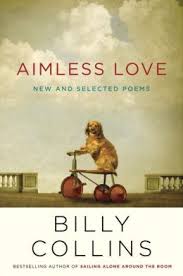
Aimless Love by Billy Collins

Aimless LoveI am a relative newcomer to the poetry of Billy Collins, but thanks to an admiring fan, I was lent a copy of his collection Sailing Alone Around the Room which was an extremely readable, entertaining and at times even hilarious read and so when I saw this new collection was coming out I requested it.

Who even knew that one could study for a PhD in Romantic Poetry? Does that make him of Doctor of Love I wonder?

His poems speak of ordinary things but steer clear of cliché, and Aimless Love as a title for this collection of collections as well as some new poems, seems perfectly apt for all manner of common things he appreciates and shares with us.

Aimless Love brings together selected poems from previous collections as well as some new poems

Here are a few extracts from moments of pure joy in reading Billy Collins Aimless Love:

The Country

I wondered about you

when you told me never to leave

a box of wooden, strike-

anywhere matches

lying around the house because

the mice

might get into them and start a fire.

But your face was absolutely

straight

when you twisted the lid down

on the round tin

where the matches, you said, are

always stowed.

Who could sleep that night?

Artwork by our Allia

Artwork by our Allia

Who could whisk away the thought

of the one unlikely mouse

padding along a cold water pipe

behind the floral wallpaper

gripping a single wooden match

between the needles of his teeth?

And who could not be tempted to read and understand more of this familiar relationship between the poet and his parents in:

No Time

In a rush this weekday morning,

I tap the horn as I speed past the

cemetery

where my parents lie buried

side by side under a smooth slab

of granite.

And this line from a poem called

Monday

Just think –

before the invention of the window,

the poets would have had to put on a jacket

and a winter hat to go outside

or remain indoors with only a

wall to stare at.

There are other fabulous poems like The Great American Poem, Horoscopes for the Dead, and Ode to a Desk Lamp.

But just as good as reading his poetry is listening to him read aloud, he has a melodic voice that lulls the listener into a kind of warm familial comfort, his words caress like a gentle tide of steaming bath water with the scent of Cedarwood. Well, perhaps if you close your eyes while listening, like I do.

Here he is reading just a few days ago, the title poem to this collection Aimless Love, so sit back, close your eyes, listen and be soothed:

Note: This book was an Advance Reader Copy, provided by the publisher via NetGalley.

Helium by Jaspreet Singh

I doubt this book would have crossed my path, had it not been sent to me by The Guardian in recognition for an extract quoted from my review of Caroline Smaile’s The Drowning of Arthur Braxton, one of my outstanding reads of 2013.

Helium2However, I am glad that it did, as it is an example of important fiction that crosses between cultures and provides us with insights into other worlds and perspectives, lessening our ignorance of events which often account for the unspoken attitudes and undercurrents present in countries that visitors, travellers and outsiders rarely gain access to. We are seeing more novels written in English from immigrants written from outside their country, alluding often to tragic events that have happened in their home country; for many, the reason they have fled.

Last year one of my favourite reads was one such book, Vaddey Ratner’s In the Shadow of the Banyan, based on a true story of the survival of seven-year-old girl of royal descent under a despotic regime in Cambodia and fictionalised as a tribute to those who were lost, in particular her own father. It is a stunning portrayal seen through the eyes of a child with both a chilling and hopeful view of humanity.

Indira Gandhi

Indira Gandhi

Helium centres around one man, Raj, a scientist who was an only child; we learn he left India 25 years before and will discover the reason why, along with his continuous fascination for science, the periodic table and memories. One memory in particular influences his journey and decisions, the attack of his college professor, a Sikh, who along with thousands of others in 1984 are targeted and killed in revenge for the assassination of the Prime Minister Indira Gandhi (daughter of India’s first Prime Minister Jawaharlal Nehru), in what was believed to be a government assisted genocide.

“How wrong Professor Singh was that day on the train when he said that the three most important questions for us concerned the origin of the universe, the origin of life and the origin of the mind. He forgot to add other questions or shall I say he forgot to ask the three really significant ones: Why do people respond differently to traumatic events? How do we remember the past? Why when ‘meaning’ collapses in our lives, do some of us seem to locate a new ‘meaning’?”

Rashtrapati Niwas, built 1888  Source: Wikipedia

Rashtrapati Niwas, built 1888
Source: Wikipedia

Raj, who faces his own challenges as a husband and father back in the United States, returns to India and unable to face his father, whom he suspects of being involved in those events, looks for the wife and children of his Professor and finds her working in an archive at Rashtrapati Niwas, formerly the Viceregal Lodge in Shimla, Himachal Pradesh.

“Clara has her romantic ideas of India and she clings to those ideas and I am a personification of those ideas. I am not allowed to narrate the dark side of that romance – how ugly the collective consciousness of a nation can be.”

Singh references Primo Levi’s The Periodic Table, a novel of science and memory and a man who survived persecution in the concentration camps of WWII and who wrote that outstanding, compassionate masterpiece If This Is A Man: The Truce which I was fortunate to read last year. And the black and white photos throughout the text are a sure reference to W.G.Sebald, another author he admires and relates to. They have the effect of making the reader almost forget that this is a work of fiction, and are a more than subtle reminder that the background events certainly did.

Jaspreet Singh’s character Raj is conflicted, being neither victim nor perpetrator of any crime, except perhaps ignorance, he reads Levi but can’t embrace his humanity or gift for forgiveness. He is angry, as much with himself as anyone else, and must live with the knowledge and acceptance of his role as bystander.

It is a novel that addresses the attempt to escape the past through distance, both physical and cultural and is a reminder that even as many as 25 years will not keep the past from affecting the present when confronted with people, places, books and reminders of that past, that without facing up to our inner demons, they will likely continue to possess and haunt us.

Halloween, The Day of the Dead & The Secret Recipe Book of Frida Kahlo

Ironically, today marks the first day of the Mexican celebration The Day of the Dead, three days in which family and friends gather in many parts of the world, but especially traditional in Mexico, to acknowledge those that have died. Traditions include building an altar or shrine using sugar skulls, marigolds and the favourite foods and beverages of those who have passed, but are still remembered.

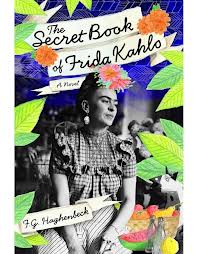
Frida KahloThe Day of the Dead has a special significance in the Mexican writer Francisco Haghenbeck’s novel The Secret Book of Frida Kahlo. Upon learning that several notebooks were found among Kahlo’s belongings, he imagines that one of them was given to Frida by her friend Tina Modotti and in it will capture recipes, memories and ideas that are inspired and connected to some of the noted people she spends time with.

“Among Frida Kahlo’s personal effects, there was a black book called “The Hierba Santa Book”. It contained a recipe collection for offerings on the Day of the Dead. According to tradition, on November 2 the departed have divine permission to return to earth, and they must be received with altars filled with Aztec marigolds, sweet pastries, photographs from long ago, religious postcards, mystically scented incense, playful sugar skulls and votive candles to illuminate their path to the next life.”

Frida Kahlo’s life story, her tomboyish, rebellious youth, her not so blind and yet all-embracing obsession with Diego Rivera, her accident, her art, her circle of friends both at home in Coyoacán, Mexico and those she fraternised with in the US and Europe are fascinating from almost any point of view, whether it’s the film Frida with Salma Hayek’s convincing role or Barbara Kingsolver’s fictional account of her in The Lacuna or this latest account with its superstitious bent.

The book started slowly, covering familiar ground and read a little like a summary of her early life, each chapter culminating in a recipe, like a tribute to the character who inhabited that episode. What makes it engaging and unique are Frida’s encounters with Death, who manifests as a man riding a horse and who visits her in the first few pages, before we even know who he is.

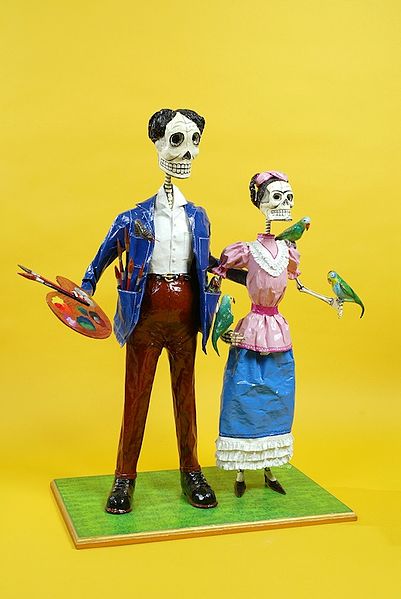
Kahlo Rivera Day of the Dead sculpture by Miguel Linares Source: Wikipedia

Kahlo Rivera Day of the Dead sculpture by Miguel Linares
Source: Wikipedia

As well as this apparition of the carrier of death, it’s warning manifests through the presence of a woman she refers to as the Godmother, Empress of the Dead, one with whom Kahlo makes a pact, after the trolley-bus accident that almost kills her. She will live, but with a constant reminder of that which she has circumvented – death. She will extend her life and avoid death but must embrace pain. And thus she becomes even more superstitious than she might have been, carefully marking the annual Day of the Dead with her shrine and offerings, keeping that man on the horse from her door until she is ready for his presence.

“The pact she had with her Godmother had given her the courage to tell stories. She liked to joke about Death. She dared it, taunted it, knowing that somewhere, Death was listening.”

She possessed a fearless personality, though susceptible to pain and expressed it in her artwork with an intensity that some would find disturbing.

Pain is the recurring metaphor in Kahlo’s life, sometimes it was so physically present it disabled her for periods of time when painting was her only release. When it wasn’t physical pain she experienced, it was emotional, for even her husband Diego, the love of her life was a manifestation of pain, one she tried to eliminate, briefly divorcing him for a year, despairing of his continuous infidelities and then just as she accepted physical pain, she accepted her flawed husband and remarried him, deciding it was better to live with than without him.

Suicide of Dorothy Hale by Frida Kahlo  Source : Wikipedia

Suicide of Dorothy Hale by Frida Kahlo
Source : Wikipedia

Channelling her experiences onto canvas, she developed a unique style and following. She became as well-known and sought after as Diego, from New York to the surrealists in Paris, meeting people such as Georgie O’Keefe, Salvador Dali and back home in Mexico, she and Diego would become hosts to the exiled Leon Trotsky and his wife.

Each encounter in the book leads to a favourite dish she might have made for or shared with her friends and it is as if each dish is also a sacrifice to the Godmother, constantly fulfilling her pact to keep Death from her door.

An excellent addition to the collection of work that exists, with its unique focus on local tradition, superstition and Frida Kahlo’s pact with Death, remembered every year when she and Diego come visiting, as they will perhaps this November 2nd.

Note: This book was an Advance Read Copy (ARC) provided by the publisher via NetGalley.

Mr Darwin’s Gardener is Also a Thinker, Kristine Carlson

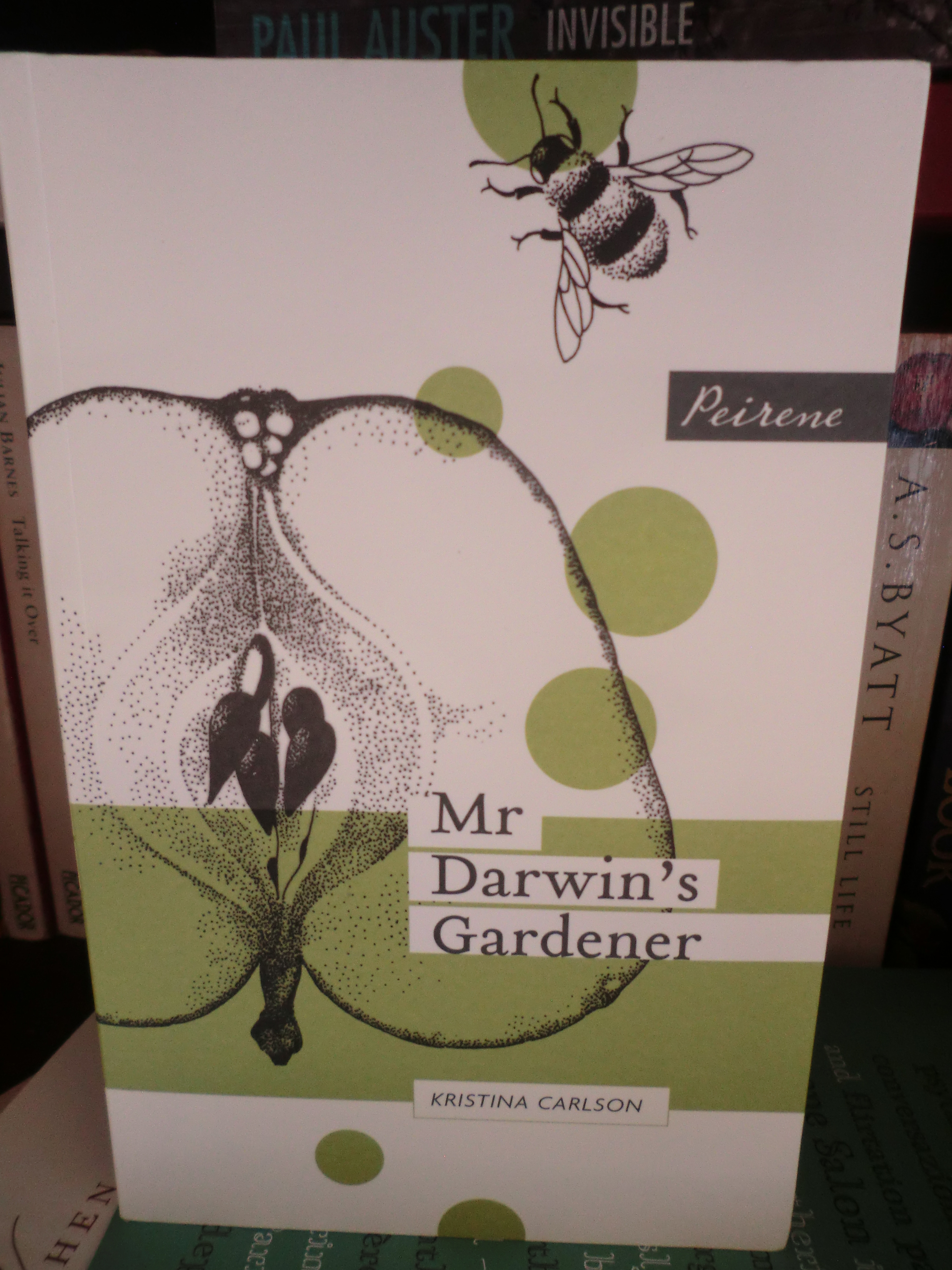
Darwins GardenerKristina Carlson is a native of Finland and has published 16 books there. Like Tove Jansson, whose work I love, she is known for her children’s stories, but also has a wide adult readership. We are fortunate to be reading the recently published and translated work Mr Darwin’s Gardener thanks to Peirene Press, who describe it as “Peirene’s most poetic book yet“.

“Carlson evokes the voices of an entire village, and through them, the spirit of the age. This is no page-turner, but a story to be inhabited, to be savoured slowly.” Mieke Ziervogel

Less a story than a series of thoughts and observations, though there is one alarming event, it is set in the late 1870’s in the Kentish village of Downe, where Thomas Davies, widower, father of two and the gardener of Charles Darwin, reflects on the dilemma of his life and stays away while the rest of the villagers gather in church.

Just as Mieke Ziervogel suggests, it is a not a book to be absorbed quickly and even when read slowly, it warrants turning back to the beginning and starting over, which is what I did. I read it through twice because once was insufficient for a book whose depth and layers become clearer when we reacquaint with it. To read it once was to see the words on the page and meet the villagers for the first time. To read it again was to begin to understand the collective consciousness of a community and one man who stands outside them, working for another man who is completely out of their reach or comprehension.

Charles Darwin, Author of 'Origin of the Species' Source: wikipedia

Charles Darwin Source: wikipedia

Plants grow, flowers sway, a ray of light streaks through a gap in the clouds, a gardener thinks, women talk, men drink, jackdaws caw, bells ring, a stranger visits and a man writes an article in the newspaper. Like an invisible character hovering over the town, we observe each villager in a random moment just before we inhabit their mind, see what they are thinking and watch what they do, as if we are they. We repeat this sequence from one home to the next and at The Anchor, the local pub where a stranger visits and stays overnight.

The Anchor clinks, clanks, seethes, smokes, susurrates.

The gardener has taken on the role of the village sage,

Though as a rule he barely says good morning.

The tongue is a sort of red carpet. One has to watch what hurries along it.

A gloomy and unhappy man.

But Thomas Davies sits neither in a church pew nor at the bar and he is more often the subject than the purveyor of thoughts, though these are some of his:

Garden at Down House, Darwin's home

Garden at Down House, Darwin’s home

The most beautiful thing about plants is their silence. The second most beautiful thing is their immobility, I wrote when Gywn died. I am reading now, it is evening.

I wrote unscientifically.

Even condolences thundered then, and goodwill would not leave me in peace.

Grief is weighty but it is a stone I bear myself.

Victims of revenge and victims of mercy are in the same position, I believe; other people make their affairs their own.

I may have to read it a third time.

Hemingway’s Paris – A Moveable Feast

Hemingway makes me think of the debate streaming though comment threads on Goodreads.  The debate centres on the issue of discussing an author in book reviews, Goodreads suggesting that reviews focus only on the content of a book and not stray into opinions about the personality or character of the author. Hemingway

Being a book review site, it may not seem like an unreasonable request, except that the site has allowed five years of historical reviews to build up without comment, guidance or reprimand against reviews that may have crossed this line and in the meantime a strong community of reviewers has developed, spreading its roots and reviews deep into the site. Unsurprisingly, the community is now rebelling against wilful deletions of reviews. Some are threatening to abandon the Goodreads ship while its Captain is said to be sailing on oblivious to mutiny in its hold.

I think of Hemingway because in A Moveable Feast, he writes not just about himself, he reflects on writers he was acquainted with in Paris and about life in that city after the First World War. He shares exactly the kind of opinions that are forbidden to reviewers today. However, he is not writing a book review, he is writing about life.

Apart from the delightful short story A Clean Well-Lighted Place, I have not read Hemingway since the trauma of having to study The Old Man and The Sea at school. I am sorry to say that I detested this novel and although nothing of the prose has stayed with me, a kind of nausea, akin to sitting in a rocking boat with no means of rowing it, engulfs me when remembering it. I didn’t understand at the time why I reacted like this, worse than boredom, it was bereft of literary merit according to my 13-year-old standards.

Knowing now of Hemingway’s deliberate intention to strip his prose bare and understanding my love of the metaphor and habit to underline and admire the more descriptive linguistic passages, I see that we are not a good pair. But having met the writer again through the lives of Hadley Richardson in The Paris Wife and Zelda Fitzgerald in Z, I was intrigued to read his non-fiction account of life in Paris.

Ernest Hemingway,1923 Source: Wikipedia

Ernest Hemingway,1923 Source: Wikipedia

The chapters read like a series of vignettes, encapsulating the many aspects that made up his life during that time. He writes about the cafes he frequented and in particular the plight of two waiters, whom when the new management of the café decides it wants to attract a higher calibre of client, insists his employees shave their mustaches and wear a uniform. Hemingway and friend are poured overfull whiskeys by the waiter and they drink them in protest.

“They’re changing the management.” Evan said. “The new owners want to have a different clientele that will spend some money and they are going to put in an American bar. The waiters are going to be in white jackets, Hem, and they have been ordered to be ready to shave off their mustaches.”

“They can’t do that to André and Jean.”

“They shouldn’t be able to, but they will.”

Jean has had a mustache all his life. That’s a dragoon’s mustache. He served in a cavalry regiment.”

“He’s going to have to cut it off.”

He reflects on his habits as a writer and here we meet a man who was dedicated to his métier above all. He writes about his deliberate strategy to eliminate the adjective, to let the words stand alone without any qualifiers or modifiers, the naked verb. His aim is like the writing equivalent of meditation, de-cluttering the page instead of the mind. He would not have made a great meditator, as he was fearful of emptying the mind.

“I had learned already never to empty the well of my writing; but always to stop when there was still something there in the deep part of the well, and let it refill at night from the springs that fed it.”

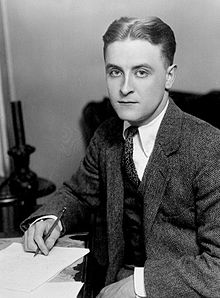
F.Scott.Fitzgerald,1921 Source: Wikipedia

F.Scott.Fitzgerald,1921 Source: Wikipedia

F.Scott Fitzgerald was a good friend. Both chapters that describe events with Fitzgerald show just how erratic his behaviour was and Hemingway suffers from having his writing discipline disrupted on a trip back to Paris from Lyon having recuperated a convertible car Scott and Zelda had abandoned due to the rain.

“I was getting tired of the literary life, if this was the literary life I was leading, and already I missed not working and I felt the death loneliness that comes at the end of every day that is wasted in your life.”

A Moveable Feast is an excellent read, sharing moments of life in Paris, we are introduced to some of Hemingway’s favourite cafés to write in, his conversations with Gertrude Stein and others about writing, up until he fell out of favour after publishing a mockery of another author’s work which she and others disapproved of, perceiving his act as disloyal to a fellow writer. He becomes a regular at the famous English bookshop Shakespeare & Co, where he is able to lend books, having no money to buy them and reads his way through Turgenev, D.H.Lawrence and Dostoevsky as well as striking up a friendship with the owner Sylvia Beach, a pleasant source of gossip as well as books.

An Auspicious Ascendancy – The Luminaries, Eleanor Catton

LuminariesEleanor Catton’s The Luminaries is an engaging, avant-garde novel, not to be read with the traditional expectations of the form, for it will entertain, intrigue, provoke, infuriate and keep you thinking about why it works, when certain aspects we know and love about stories, suggest that it shouldn’t. The allure of the new.

The Luminaries is a 19th century narrative, set in the gold –digging community of Hokitika ‘place of return‘, on the west coast of New Zealand’s South Island.

In 1866, when the story takes place, it was a thriving community, expanding in the golden glint of its anticipated resource and one of the most populous towns in New Zealand, a far cry from it’s just over 3,000 inhabitants today. While it remains possible for visitors to try their luck at gold panning today, they are more likely to be cycling the West Coast wilderness trail or to taking a helicopter over the Fox and Franz Joseph glaciers.

Hokitika township 1870s

Hokitika township 1870s – source Wikipedia

The story focuses on a group of people living in Hokitika, attracted by the prospects of finding gold or its associated business opportunities. It opens with the newest arrival, a distressed Thomas Moody, who has just disembarked from the barque Godspeed and after checking into the Crown Hotel, happens upon a gathering of 12 men in a bar of the hotel that had been closed for the evening. Already in the hotel, he had not been prevented from entering the room and thus becomes witness to a discussion of events that had occurred two weeks prior, the death of the hermit Crosbie Wells, the disappearance of the gold prospector Emery Staines, the arrest of a whore Anna Wetherell and the discovery of a cache of retorted gold bars.

As any 12 prominent men summoned to a room for a discussion might attempt to garner attention, so too does Catton give over chapters which allow those men to stand in their own limelight and this gathering will invoke a long and divergent narrative of stories, encounters and sharing of perspectives by each of the men present.

Their stories span the first half of the book, introducing a structural device Catton uses to divide the book into 12 parts, each successive part half the length of that before it, where the sequence of events moves about so that we reach the end only to discover we are at the beginning. We realise this is not a plot heading towards its climax, nor a beginning working towards its end, it is a series of revelations that unmask illusions of our own imagination as well as that of the characters portrayed and by the time we reach those last pages, the actual dramatic events that unfold will occupy fewer lines on the pages of this book than the mass of 400 plus ages that has allowed this community of men to discuss, analyse, reveal, conceal and pontificate on what might have occurred.

110611_1523_TheForestfo1.jpgAs fast as one mystery unravels, there arises another as Catton introduces one twist after another and slowly reveals the encounters and connections between characters, including those not present at the meeting.

The use of an omniscient narrator means that no one character plays a lead role, just as the lack of a detective precludes it from unravelling like a conventional mystery. Instead, it reads almost as a series of dramatic episodes, where the various interactions and focus on certain characters help the viewer/reader understand their ambitions and motivations, though like a jigsaw, the whole picture will not become clear until all the missing pieces are joined together.

The IdiotI was reminded at times of reading Dostoevsky’s The Idiot, a novel that is without comparison when it comes to penetrating character analysis, itself a complex web of relationships and associations. Catton’s insights into her characters perhaps owe more to her reading of Jung than Dostoevsky, as she penetrates the psychological depths of each character using lyrical prose. While these insights make pleasant reading, it is the actual interactions and actions of the characters that more ably create a lasting impression. As a consequence, we perceive the entire cast at a slight distance and may yearn for something more from some of them.

Much has been written elsewhere about the astrological structure and intention behind Catton’s writing, and it would be easy to turn this into as essay and begin to analyse twin hemispheres, yin and yang, predestined forces and those luminaries that represent our innermost and outermost selves whom she literalises in characters, however I have chosen to write more on the experience of reading the book, without focusing on the forces at play in their interactions. It is possible to listen to Eleanor Catton speak more on this at the Southbank reading here and in numerous articles in The Guardian and elsewhere.

It is an entertaining read, that despite its length I never wanted to put down and actually found myself wondering about other members of the community that don’t appear in the book, like the families of these characters and other inhabitants of this gold loving town. Perhaps we might get to meet them in a future TV adaptation, since I hear the rights have already been bought by a British production company.

Luminaries Cloud

and the Man Booker Prize winner is…

Catton2

The Luminaries by Eleanor Catton

I have just put it aside on page 508 to watch the presentation and I could not be more pleased!

Congratulations to our young and so talented novelist, from whom we will no doubt see much more.

The book is still alive and rather than cower under the threat of the alternative entertainment available to people today, they are taking the book to the masses.

According to the Man Booker Prize website, there is to be a free event at London’s Regent Street Apple Store, where Eleanor Catton will discuss her book and what it means to win the prize.

I hope Apple are offering the books for sale and not just their own devices to read them.

Ok, a big event is about to take place in the book too, so I’m off back there to find out what’s happening.

#ManBookerLive at the SouthBank Centre

Listening to Six Shortlisted Authors Read

Last night the six shortlisted authors of the Man Booker Prize came together at the SouthBank Centre in London’s Royal Festival Hall and thanks to seeing a tweet from someone present I discovered that it was streaming live from the Man Booker website.

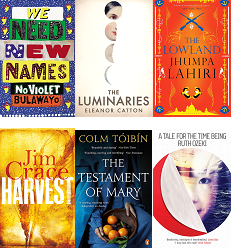
So instead of reading another 200 pages of Eleanor Catton’s The Luminaries, I listened to her, NoViolet Bulawayo, Jim Crace, Jhumpha Lahiri, Ruth Ozeki and Colm Tóibín read from their books and answer questions from the host Mark Lawson and the audience.

2013

It was a wonderful evening and risks making us want to read all the books, to see the writers presenting their works and sharing their private anecdotes about the journey to publication.

Today the live event has been uploaded to YouTube, so if you are interested to hear more about these excellent books, before tomorrow evenings announcement of the winner, here is the link to watch it yourself.

The event starts at 28 minutes 20 seconds.

Don’t expect it to help you decide, I think they are all winners and have no idea who the judges will choose. The bookmakers and the BBC are backing  Jim Crace, the quintessential English vote.

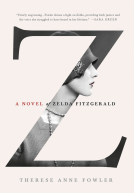
Z: A Novel of Zelda Fitzgerald by Therese Anne Fowler

Zelda_Fitzgerald_portrait

Zelda Sayre

Born with an exotic name that lent itself to bright lights and a spirit that loved nothing more than to dwell under them, it is not surprising that Zelda Sayre’s life was illuminated and became of interest to so many who were less daring themselves but fascinated with her life and antics.

But just as light cannot exist without shadow, she would discover the darker underside of a life lived in the shadow of her husband, when she dared to pursue her own desire to be recognised as a professional in her own right.

ZZ: A Novel of Zelda is an excellent companion novel to The Paris Wife and one of an expanding collection that gathers around that group of artists, writers, wives and hangers-on of the “lost generation“, a term coined by a young French mechanic who was reprimanded for giving insufficient priority to repairs on Gertrude Stein’s Model T Ford and thus complained to his patron that they were all a “generation perdue“, those young people who served in the war, respected little and indulged themselves to immoderate excesses.

Hemingway’s A Moveable Feast is a logical follow on read, having now read the fictionalised accounts of the two wives of these well-known writers and great friends who were in the midst of that post WWI group that sought a kind of writing utopia in Paris.

scott and zelda

Zelda and F.Scott Fitzgerald

While the utopia may have eluded them, their experiences would provide rich material for their writing, even if at the expense of some of their friends and loved ones. It is interesting to note that while their output during those early years was largely even, the Hemingways‘ lived quite frugally with an awareness of their financial struggle, while the Fitzgeralds‘ lived hedonistically in complete denial of theirs.

Zelda was reluctant to be lured away from Montgomery, Alabama by a complete dreamer and in the early days of their courtship actually threatened to dump F.Scott Fitzgerald unless he proved himself worthy and obtained his first serious publishing contract.

“I was so sure of our love then, so determined to prove to Mama and Daddy that we weren’t doing things wrong, just differently. There was no way to know that certainty  would one day become a luxury too.”

save me the waltzWhen Fitzgerald succeeds in getting that commitment  from his publisher to publish This Side of Paradise, she is ready to join him in New York and their life of adventure will begin.

From New York to Paris and the south of France, where Zelda throws herself into her own professional dance ambitions and is rewarded with an offer, which makes this reader wonder, what might have happened if…

“Scott and I both were awed by how cultured all these folks appeared to be, how intact they all were. For a change, Scott listened more than he talked. They spoke of painting and music and dance – their own work as well as other artists’ – with knowledge and candor and passion. If they felt rivalries, they expressed the situations as challenges, not jealousies.”

I came to this novel with no idea about Zelda or the role she played among the writing set of Paris and while much has been written in personal letters and hospital records documenting her mental health challenges and treatments, I find Therese Anne Fowler’s depiction of the character Zelda to be both realistic and sensitive  and portrayed in a way that is compelling to read. It has made me interested to read more about Zelda Fitzgerald and that period in history she was a part of; she was one of, if not the first young women referred to as a “flapper” of the 1920’s, a kind of “it girl” whose rise in society came about alongside a public contempt for prohibition and was described by Dr. R. Murray-Leslie, who criticized

“the social butterfly type… the frivolous, scantily clad, jazzing flapper, irresponsible and undisciplined, to whom a dance, a new hat, or a man with a car, were of more importance than the fate of nations.” Times 5 Feb 1920, p 9

They were a significant step away from accepting the lives of their mothers before them and while they accepted the lesser role in support of their husbands and were not quite suffragettes, they developed an awareness that women could be more outgoing and present in the relationship and even pursue a career, something that usually required marriage to be forfeited for.

highland hospitalThe sad truth was that all that freedom and lack of  meaningful purpose was not good for their mental health and whereas today one might be prescribed medication for depression, bi-polar disorder or spend time in rehab, in the 1920’s/1930’s it was off to the psychiatric asylum for electric shock treatments and a prognosis of hysteria or even worse schizophrenia, if  one showed signs or symptoms of not coping with it all.

If you enjoyed The Paris Wife or A Moveable Feast, this book should certainly be on your list to read. A riveting read and a thought-provoking insight into an exciting and turbulent period of cultural history.

Note: This book was an Advance Reader Copy (ARC) kindly provided by the publisher via NetGalley.