The Secret Chord by Geraldine Brooks

Secret Chord

In 2012, Geraldine Brook’s wrote a fascinating book Caleb’s Crossing (review here), about Bethia, the fictional daughter of a Minister and two Wôpanâak tribe members, Caleb Cheeshahteaumauk and Joel Iacoombs, all inhabitants of the 200sqkm island of Noepe, (Martha’s Vineyard). Caleb and Joe were the first Native Americans to attend Harvard College, their story so fascinating, it left this reader wanting to know more about them.

So I was looking forward to Geraldine Brook’s next book, for when she inhabits certain characters, her stories can really carry you away while teaching you something of the historical era they inhabit. And here it is, her next book:

The Secret Chord is an imagined narrative of the biblical figure King David, told mostly from the perspective of a shepherd boy whose father David has had murdered in front of the lad; one who becomes his near constant companion, the prophet Natan. He can foresee the future though isn’t always able to share what he knows will unfold. For this he has few friends, no loves and is a dispassionate observer of events.

‘I have had a great length of days, and been many things. A reluctant warrior. A servant, a counselor. Sometimes, perhaps, his friend. And this, also, have I been: a hollow reed through which the breath of truth sounded its discordant notes.’

David is the youngest of a large family of brothers, rejected by his father and siblings over a perceived betrayal that occurs between his parents. His father can’t bear the sight of him and banishes him to the hills where he is easier to forget. He is recalled some years later when his Uncle Shaul, calls for all his nephews to appear before him, wishing to identify and anoint the one he believes will become the future King. It is a turning point for young David, as will be his encounter with the giant Goliath.

David_Playing_the_Harp_1670_Jan_de_Bray

David Playing the Harp, 1670 Jan de Bray

Sadly, his early years of solitude don’t prevent him from becoming another seeker of power and prowess through murder, mayhem and the sublimation of women.

Lover of Yonatan, David marries his sister Michal, both children of Shaul. Killed in battle,  the father intervenes and marries his daughter off to another man, David is not yet King, he is exiled for a while during this period, he seems to forget Michal, who eventually falls in love with the man forced upon her and will have children with him, only to be summoned by David when he becomes King, as if she would then welcome him. He is unforgiving when he discovers that is not the case.

There will be many more wives and children, and little tolerance for criticism of his protege, whose lives run unchecked by discipline or ressect. David also errs when he observes the wife of his loyal warrior Uriah the Hittite, Batsheva, and calls for her, thus provoking a prophecy the King uttered himself in response to a tale Natan told him of a man who suffered a grave injustice, trying to illustrate how wrong he had been in his behaviour. Upon hearing the story of a rich man who stole a poor man’s favourite ewe to slaughter and serve to a guest, David shouts:

‘That man deserves to die! Tell me his name! I’ll see to it that he pays for that lamb four times over, because he was greedy and had no pity.’

‘His name?’ I said quietly. ‘You really want to know who he is, that greedy, pitiless man? That man who has everything?’

‘As the Name lives, so do.’

‘That man is you.’

Statue King David by Nicolas Cordier

Statue King David by Nicolas Cordier

And so the four deathly, dishonourable events that follow are seen in that context of retribution for what happened to Uriah. A daughter raped and dishonoured by her older brother, a revenge killing one brother against the other, a banishment and betrayal by the son leading to his death. The sole light in all this darkness being the son born to Batsheva named Shlomo who after a vision of the boy’s promising future, one he keeps to himself, comes under Natan’s protectorate, inheriting none of the destructive qualities of his

I have to admit, I almost put this down after reaching halfway, the first half was so full of battles, murder, horror, the callousness of men who seek power, who kill or appropriate anything and everything they want or which stands in their way, ruthlessly dispatching the innocent, acquiring wives and concubines like commodities, and without the balance that can be created in a narrative that observes things from the perspective of the main character or one of his great loves.

The second half is redeemed through the character of Shlomo, the youngest son, who shares none of the attributes of his siblings or father and to spend time on his story provides the reader a little reprieve from the rest.

Of course there are novels based on history and legend full of violence, however I believe this novel failed for me due to the choice of narrative perspective. It may have been a missed opportunity not to have shown us the perspective from one of the characters who had something to gain or lose, a character who was emotionally invested in an outcome, male or female – a perspective the reader might try to comprehend or empathise with. Rather, we must observe from the outside, through a character who abandoned his own grieving mother to follow the murderer of his father, one who will develop no close relationships, save David. Instead of being enraptured by it, I was just constantly sickened by the history and behaviours of people.

Note: This book was an ARC (Advance Reader Copy) kindly provided by the publisher via NetGalley.

Under the Udala Trees by Chinelo Okparanta

Under the Udala TreesIjeoma was living with her parents in their yellow painted home surrounded by rose and hibiscus bushes,  immersed in the aroma of orange, guava, cashew and mango trees, in the village of Ojoto, where vendors lined the street and life had a slow, amiable pace when war broke out between Biafra and Nigeria.

She was just eleven years old when this catastrophe struck, provoking a sequence of other catastrophes in their lives, resulting in her being sent away for her own safety for a year, to a neighbouring village to stay with a childless couple.

‘We moved about in that unhurried way of the butterflies, as if the breeze was sweet, as if the sun on our skin was a caress. As if slow paces allowed for the savoring of both. This was the way things were before the war: our lives, tamely moving forward.’

The 1967 war barged into their lives and all over everything, the quiescent ambiance of Ojoto replaced by the noise and brutality  of the war machine, armoured cars, bomber planes, men with guns and machetes, war chants disturbing the evening air.

Before the war, her father told candlelit stories, folktales about talking animals and old kingdoms, spoke of kings and queens, magic drums, scheming tortoises and hares.

In the second year of war, her Mama sent her off, when bold talk of Biafra beating Nigeria had dwindled, supplanted by:

‘collective fretting over what would become of us when Nigeria prevailed: Would we be stripped of our homes, and of our lands? Would we be forced into menial servitude? Would we be reduced to living on rationed food? …Would we recover?’

Chinelo Okparanta

Author, Chinelo Okparanta

As a consequence of war, Ijeoma is sent to stay with the grammar school teacher and his wife, in the neighbouring village of Nnewi.

It is here, she crosses paths with Amina, a Hausa girl who follows her home from the shop one day.

‘I found a large rock near where an udala tree stood and sat down there. I waited on the rock, hoping the shadow would continue along, but it did not. Instead, it sat across from me, on another rock, eyes brght, like a pair of light bulbs. She was no longer a shadow.’

Ijeoma is Igbo, but she is far from home and the grammar school teacher and his wife though initially disapproving, become used to her new homeless friend, who helps out and doesn’t cause trouble. They decide she hardly even looks like those they consider the enemy.

“Actually she is more Fulani-looking than Hausa-looking. Which means she could pass for Igbo.”

The grammar school teacher considered his wife’s words. “It’s true,” he said. “Some Igbos and Fulanis do have a certain similarity in their features. Their complexion for one thing.”

“And she appears to be a hard worker.”

Part 2 of the novel displays the changed relationship with her mother after the events of Nnewi. The first week she is back her mother does not speak to her, a week passes without a word between mother and daughter. Her mother then resumes speaking, as if the silence had not been. She informs her daughter that now she is settled in, they will make a schedule, to begin the important work of cleansing her soul. No more folktales or stories of Kings and Queens, her mother’s preferred teachings come straight from the Bible and will be poured into her like medicine.

LEVITICUS 18.

Thou shalt not lie with mankind, as with womankind: it is an abomination.

Udala African Star Apple

“Udala” Ibo for white star apple is a feminine symbol of fertility and generosity.

Chinelo Okparanta’s Under the Udala Trees is a journey of self discovery, a coming-of-age tale of a girl experiencing a sexual awakening in defiance of her mother’s and society’s expectations, one she half heartedly attempts to suppress, only to experience an even worse suffering. Ancient folklore, biblical interpretations, all is summoned and used by parents to guide the daughter towards the righteous path.

It is a courageous story to tell in modern-day Nigeria, a country that has criminalised same-sex  relationships. It also adds significantly to the growing literary works that use the Biafran conflict as their historical context and brings our attention to an interesting and outspoken literary talent.

Chimamanda Ngozi Adichie broke the mould in terms of writing about the Biafran conflict with Half of A Yellow Sun and then more recently it was addressed in the autobiographical work of Chinua Achebe There Was A Country: A Personal History of Biafra, the book he published not long before his death, finally speaking out about what has long been considered a taboo subject in Nigeria’s past, one that the generations who lived it had seemed to wish to remain silent on.

Note: This book was an ARC (Advance Reader Copy) kindly provided by the publisher via NetGalley.

Foster by Claire Keegan

Foster‘Early on a Sunday, after first Mass at Clonegal, my father, instead of taking me home, drives deep into Wexford towards the coast where my mother’s people came from.’

She wears light, worn clothing and brings nothing with her. The girl is left with the Kinsella family, the father returns to her mother, soon to give birth again. There is no goodbye or word of when he might return. This is Ireland. Remember Nora Webster and all that is unspoken?

So begins Claire Keegan’s long, short story Foster, a vivid telling of the period following a girl being fostered into a family in rural Ireland. In the stranger’s home she finds an atmosphere unlike that which she is used to, one she enjoys and becomes used to, though always there is the presence of that feeling that it might soon all be taken from her.

‘When I follow the woman back inside, I want her to say something, to put my mind at ease. Instead, she clears the table, picks up the sharp knife and stands in the light under the window, washing the blade under the running tap.’

Seen and heard from the perspective of the girl, we learn the circumstances of both families that led to this situation. They fall into a regular routine, life settles in this new family and nothing appears to happen to destroy the ease with which the girl has come to know.

There is a strange atmosphere throughout the book, it is the anticipation of something, we, like the girl, are wondering and waiting for it to happen. For she seems like the pawn on the chess board, her parents on one side having handed her over, the foster parents on the other having received her. Each move, every event that is outside the daily routine, ignites in the girl heightened powers of observation, developing an acute awareness of even the most subtle changes in those around her.

‘Kinsella looks at me and smiles a hard kind of a smile then looks over to the window ledge where a sparrow has come down to perch and readjust her wings. The little bird seems uneasy – as though she can scent the cat, who sometimes sits there. Kinsella’s eyes are not quite still in his head. It’s as though there’s a big piece of trouble stretching itself out in the back of his mind. He toes the leg of a chair and looks over at me.’

Author, Claire Keegan

Author, Claire Keegan

A touching and yet eerie telling of a story that begs to be read and reread, the writing is exquisite in its depiction and ability to create a taut atmosphere without significant plot, it showcases an author with an immense talent for the short story and makes the reader want more.

Claire Keegan is an Irish writer highly regarded for her award-winning short stories, she has published two collections Antarctica (1999) and Walk the Blue Fields (2007) which I have read excellent reviews of.

Have you read any of Claire Keegan’s work?

The Story of the Lost Child by Elena Ferrante tr. Ann Goldstein

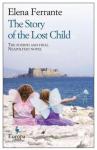
The final book in the Neapolitan Novels tetralogy that began with Elena Ferrante’s My Brilliant FriendThe Story of the Lost Child continues the saga of two compelling woman, Elena and Lila, childhood friends and now single mothers, back living in the neighbourhood of their humble origins.

At the end of Book 3 Those Who Leave and Those Who Stay, Elena was in the midst of a crisis, unable to think or act in anyone’s best interests, rather, she was lead by the wild palpitations of a lust driven heart and appeared to be prepared to risk all she had fought so hard and for so long to rise above and gain.

Now with everything collapsing around her, she returns to her roots, where things are as likely to be in disorder and chaos, but in a place where she feels safe, it is familiar, known.

Elena’s daughters must adapt to a less pampered life, although their mother wishes that they, like her, acquire sufficient education to allow them choices about where and how they might live. Elena and Lila’s children present them both with significant challenges, causing them to move closer together in some respects and further apart when tragedy strikes hard.

As with the previous books, Elena is never quite sure of Lila’s intentions, questioning her motives when she appears helpful and suspicious of her intentions when she informs her of gossip. It is a characteristic of their friendship that has existed since the beginning, an aspect Elena never fully unravels and keeps her always on guard.

‘I went home depressed. I couldn’t drive out the suspicion that she was using me, just as Marcello had said. She had sent me out to risk everything and counted on that bit of fame I had to win her war, to complete her revenge, to silence all her feelings of guilt.’

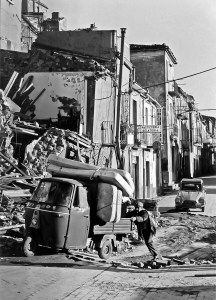
Naples Earthquake 1980It is the 1980’s and one of the turning points in Lila’s deterioration is the earthquake that occurred on November 23, 1980 killing 3,000 and rendering 300,000 of Naples inhabitants homeless. It is used as a powerful metaphor for the destabilisation that occurs in Elena and Lila’s lives.

‘It expelled the habit of stability and solidity, the confidence that every second would be identical to the next, the familiarity of sounds and gestures, the certainty of recognising them. A sort of suspicion of every form of reassurance took over, a tendency to believe in every prediction of bad luck, an obsessive attention to signs of the brittleness of the world, and it was hard to take control again. Minutes and minutes and minutes that wouldn’t end.’

Elena has always sought her independence and intended to create a career as a writer, it is only when she moves back to the neighbourhood that she realises with greater urgency that she must be autonomous.

‘It was then that a part of me – only a part – began to emerge that consciously, without particularly suffering, admitted that it couldn’t really count on him. It wasn’t just the old fear that he would leave me; rather it seemed to me an abrupt contraction of perspective. I stopped looking into the distance, I began to think that in the immediate future I couldn’t expect from Nino more than what he was giving me, and that I had to decide if it was enough.’

Book Four brings the girls full circle into the adult world where the relationships of childhood and dramas of their youth play out in a more dangerous playground, where boyhood pranks have evolved into criminal activities and the annoying habits of children transform into the damaging actions of adults with far-reaching and destructive consequences.

They are no longer observers of the world around them, they are perpetrators of events and circumstances that will affect the next generation, their children. Though they never wanted it and put all their energy into trying to prevent it, in many ways, they have begun to resemble the already departed, those they worked so hard not to become.

Book Four brings Elena and Lila’s stories back to where it all began, reacquainting us with the story’s beginning, of memories and possessions that have endured, that contain within them that sense of unease alongside the familiar, the two coexist and can not be separated, even in maturity. It is a conclusion of sorts, as thought-provoking as we have come to expect previously, not quite giving in to that alternative literary tradition of tying things up neatly.

I read the first three books in close proximity, each volume adding to the compulsion to want to re-enter their lives and discover what would happen next.  The longer gap in awaiting this final novel meant it took a little longer to pick up the pace, suggesting it might be a series best read consecutively.

If you haven’t read Elena Ferrante yet, here are links to reviews of the first three books in this series:

The Neapolitan Novels Reviewed

Book 1: My Brilliant Friend

Book 2: The Story of a New Name

Book 3: Those Who Leave and Those Who Stay


Note: This was an Advance Reader Copy (ARC) thank you to the publisher Europa Editions for kindly providing me with a review copy.


The Pollen Room by Zoë Jenny tr. Elizabeth Gaffney #GermanLitMonth

The Pollen Room was written by the Swiss writer Zoë Jenny when she was 23-years-old and became an international bestseller, translated into more than 27 languages and invitations to speak to readership audiences in Japan, China and the US among others.

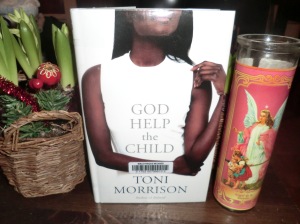
Pollen RoomIt is interesting to write about this story after having just read Toni Morrison’s God Help the Child, this novella yet another version of what Morrison demonstrates.
It is the memory of childhood without maternal love and its after-effect. It is not dramatic, nor a traditional story, it is a narrative that sets the reader up to feel something of the isolation and vulnerability of the protagonist and follow her forward as she tries to plug the gap, looking for that nourishment as if it were something tangible she could use to plug the abyss it created by its absence.

Jo stayed with her father when her mother left. There is no explanation, just significant and detailed memories of insignificant events, noises that communicate the beginning of her father’s daily routine, signals that provoke anxiety, nameless visitors, the one he married Elaine, who eventually left too.

‘At night I would fall into a restless slumber. Fractured dreams floated past my sleeping eyes like scraps of paper in the raging torrent of a river. Then I would hear a clatter and find myself wide awake. I looked at the spiderwebs on the ceiling and knew that my father was in the kitchen…

There came a series of muffled rustling noises and a moment of quiet. My breath quickened. A lump rose in my throat and swelled to enormous proportions as I watched my father put on his leather jacket and pull the door quietly closed behind him.’

After initial weekly visits, her mother soon moves on to a new life and there is no contact for 12 years. Eventually Jo goes in search of her, however being reaquainted doesn’t bring her companionship or stability, it brings responsibility, creates concern, disquiet. She seeks solace in the company of others, those who appear to live in the semblance of a home, acquaintances short-lived, consequences that won’t leave her.

 Author Zoë Jenny

Author Zoë Jenny

The prose is spare, observant, it infiltrates your mood and makes the reader suffer alongside the protagonist.

Brilliantly conceived, it is not a book to read if you are feeling sad or vulnerable. There is dialogue, interaction, and a great swathe of stream-of-conscious thought as Jo observes each encounter and responds in her inward-looking, sensitive way to it all.

Unfortunately I read this without realising that and so didn’t appreciate it’s best qualities as much as I might have done, had I read it at another time. I read it at a time of being acutely aware of the fragility and vulnerability of youth and couldn’t see past the neglect and narcissism of those around Jo and spent the entire book worrying that something even more terrible was going to happen to her and just felt great relief when it was all over and we were safe.

I was recommended this title by Vishy and I would highly recommend reading his review, which celebrates the beauty and artistic merit of the novella, showing us just how great it can be, when we choose the right time to read it. It was one of his favourite reads of 2015.

Vishy’s Review of The Pollen Room

And it’s German Literature Month, thanks to Caroline at Beauty Is a Sleeping Cat and Lizzy at Lizzy’s Literary Life

Follow the hashtag #GermanLitMonth on twitter, or click on the links to see what they’ve been reading, and what great works in translation there are out there for us!

German Literature Month


God Help the Child by Toni Morrison

Toni MorrisonBride is young, in her twenties, but has learned early the importance of a word, a gesture, a look that can change people’s perception of you, as long as you stick to it, you become known for it, unforgettable, and that one thing can change your world.

God Help the Child is mostly told through the life experience of Bride, a name she chose for herself as she launched herself into a successful and glamorous career in the perfume/fashion world.

It is far from the memory of neglect and disapproval that was her constant companion throughout childhood, channeled through the eyes, words and gestures of a mother unable to move beyond the disappointment of the blue/black tone of her daughter’s skin.

‘I told her to call me “Sweetness” instead of “Mother” or “Mama”. It was safer. Being that black and having what I think are too-thick lips calling me “Mama” would confuse people. Besides, she has funny-coloured eyes, crow-black with a blue tint, something witchy about them too.’

Before her second interview for the job she covets, she consults a designer called Jeri, who convinces her to only ever wear white, accentuating both her new name and because of the effect it had on what he described as her licorice skin.

‘At first it was boring shopping for white-only clothes until I learned how many shades of white there were: ivory, oyster, alabaster, paper white, snow, cream, ecru, Champagne, ghost, bone.’

Bride waits in a prison parking lot for a convicted felon to emerge on the last day of their sentence. She comes with a gift and a different form of naivety than that she possessed when her testimony put this person away for 20 long years.

Her current boyfriend Booker has just left her, and now this. She excels in acquiring knowledge to help her scale the ladder of success, but there is a gaping hole within that pushes her to put all else aside and find answers to questions she can barely articulate to herself.

On a whim, she tries to track down the man who disappeared without a goodbye and after a car accident and injury, finds herself living with a couple and a girl in self-imposed poverty; a stark contrast to her lifestyle. As she pursues those unclear questions, strange but noticeable things begin to happen to her body, as if it is regressing towards childhood.

Each subsequent part tells of an encounter of someone she meets or has met previously and although their stories differ there is a common thread that ties them all and demonstrates in various ways the effect these childhood experiences have on a person subsequently, how they shape who we become, how we react to things, how they affect one’s perception.

Toni Morrison

Toni Morrison

The characters enthrall, each one introduced fleetingly, intriguing and hinting at the depths that their own stories have led them to become. Morrison makes us wait and slowly reveals those experiences for the select few deemed important to the narrative. It is perhaps through this hinting at and omission, that much is left to the reader to contemplate, but then Morrison isn’t known for having to spell it all out or writing sagas, and there is enough divulged to create a balance and equal contribution between the four parts of the novel.

It is a thought-provoking, evocative novel that deserves more than one reading, demonstrating the ease with which Toni Morrison and her narrative skill are able to skate into the 21st century, to pick up and explore the nuances of another of society’s dysfunctional aspects, that the things you do and say to children in their early years really matter and will impact their adult perceptions, actions and relationships. However, there are moments, that if grasped, can and do lead one out of that.

Brilliantly told, subtle and yet powerful, Morrison’s final words at the end of the book, reminded me of the closing words of Maya Angelou in an interview she gave to the BBC near the end of her life, after a lifetime of addressing issues that manifest throughout life, her final words too, speak of children.

“Exercise patience with yourself first, so you can forgive yourself for all the dumb things you do. Then exercise patience with your children.” Maya Angelou

All Our Names by Dinaw Mengestu

All Our NamesFinding a book like this on the English language shelves of our local French library, is one of life’s small pleasures in a world that offers few escapes these days from tragic reality.

A book like this, by an author named Dinaw Mengestu, winner of the Guardian First Book Prize for his debut novel Children of the Revolution, chosen as one of the 20 best writers under 40 by The New Yorker in 2010, born in Ethiopia and raised in the suburbs of Chicago – well I cast all other reading plans aside and jumped right in, relishing the feel of the hardback, admiring the simplicity of such a striking cover and anticipating a joyous, literary ride.

The title All Our Names, reminded me immediately of Zimbabwean author NoViolet Bulawayo’s  We Need New Names, hers a reference to the move to America, while Mengestu delves further back and makes us realise just how deep and far-reaching the naming ritual is.

“On the bus ride to the capital, I gave up all the names my parents had given me. I was almost twenty-five, but by any measure, much younger. …I tried to think of myself as a revolutionary in the making, though I had come to the capital with other ambitions.”

Library Entrance

The Library Where This Book Lives

Ill-prepared for the world that awaited him, he assumed the few Victorian novels he had read would prepare him for studying literature, having been inspired by reading of a conference of a group of African writers and scholars in a newspaper that had belatedly arrived in his village.

“No one I met believed I was a revolutionary, and I didn’t have the heart to claim I wanted to be a writer.”

Right from the opening pages, when he meets the young man who tells him his name ‘for now is Isaac’, we are made aware of the significance and dispensability of names.

“Isaac” was the name his parents had given him and, until it was necessary for us to flee the capital, the only name he wanted. His parents had died, in the last round of fighting that came just before independence. “Isaac” was their legacy to him, and when his revolutionary dreams came to an end, and he had to choose between leaving and staying, that name became his last and most precious gift to me.

UgandaThe story is narrated in alternate chapters, one entitled Isaac, the other Helen. Isaac takes place during a short period in the life of the male protagonist after he has left the family village somewhere in Ethiopia, planning never to return, arriving in Kampala, a city in Uganda where he hopes to study at the university.
It is there he meets the young man named Isaac, recognising in him a similar ambition and humble origins, though in his presence he is also aware of an undercurrent of fear and trepidation, not yet realising, but intuiting the dangerous depths Isaac is capable of descending  into in order to achieve that ambition.

The Helen chapters take place in a small midwest town in the US, Helen is the social worker assigned to him when he arrives from Africa; she installs him in accommodation and helps him to adjust to the new life as a foreign exchange student.

The relationship becomes complicated when boundaries are breached, as the two offer each other something of an escape from their very different pasts.

It is a simple story possessing its own undercurrent that pulls the twin narratives along, the emotional pull in Helen’s story, her struggle to navigate the space between her feelings for him and society’s expectations and in the Isaac chapters, a mounting tension as student protests and harmless revolutionary activities turn sinister and violence becomes the shortest and most effective negotiating tool to obtaining power.

Set in the 1970’s during the Ugandan post-colonial revolt, this novel was hard to put down and offered a unique insight into one example of the kind of experience that might have occurred to any refugee fleeing a violent uprising. Equally, it aptly depicts the discomfort of even the most liberal, unjudging character, raised in a quiet, conservative town, whose wavers between ignoring and following her instinct to abandon all she knows in order to follow her heart.

“I wonder whether, if before meeting Isaac I had tried to challenge the easy, small-time bigotry that was so common to our daily lives that i noticed it only in it extremes. I might have felt a little less shame that evening. It’s possible that I might have been able to release some of it slowly over the years, like one of those pressure valves that let out enough steam on a constant basis to keep the pipes from bursting. It’s also equally possible that such relief is impossible, that, regardless of what we do, we are tied to all the prejudices in our country and the crimes that come with them.”

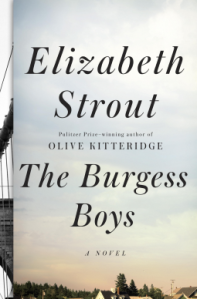
The Burgess BoysIt reminded me a little of Elizabeth Strout’s The Burgess Boys (read and reviewed in 2013), which I was a little disappointed by, this is the kind of book I was expecting, but understandably, she wrote it from the perspective of the Burgess boys, whereas Dinaw Mengestu gives us both perspectives and the story is all the more powerful for it.
Mengestu writes in an engaging and flawless style, his storytelling and insights are enough to convince me I will definitely be reading more of his work soon.


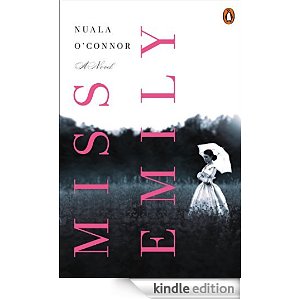
Miss Emily by Nuala O’Connor

Nuala O’Connor is the Irish author I discovered in 2014 thanks to the Irish Times Book Club.

You may remember last year, I read and reviewed her novel The Closet of Savage Mementos which she wrote under her Irish name Nuala Ní Chonchúir. That novel was about an Irish girl who left Dublin for a Scottish seaside town after the death of her boyfriend and to escape her mother’s dramas. In Scotland she encountered her own drama and was forced to make a life-changing decision.

Emily Dickinson and an Irish Maid

Now, writing as Nuala O’Connor for US and UK  readers, she pens the story of another Irish woman, the feisty but hard-working Ada, who also leaves Dublin, destined to become housemaid to the Dickinson family. It is a fictional account of the friendship between the Irish maid and the poet Emily Dickinson.

Ada Concannon, the eldest of 7 children, possesses an energetic zest for life that was unappreciated by her previous employer; upon being demoted to scullery maid she decides to seek her fortune elsewhere, taking a passage on the boat to New England where her Aunt Mary, Uncle Michael and a couple of not too friendly cousins reside.

She lands on her feet with the job at the Dickinson household, a family of four with their spinster sisters Vinnie and Emily, neighbours to their gruff brother Austin and his wife Sue, whom Emily appears to (not very convincingly) pine for.

The American Frugal Housewife

The Frugal Housewife

Emily is reluctant to leave the house, preferring words to company and attaches herself to Ada, the kitchen being one of her preferred refuges, thus friendship with the housemaid most important.

Her friendship with the maid flouts convention and is a kind of quiet rebellion within the home that the poet rarely steps out of.

“When I talk too much, everything I think and feel is wrung from me. I have nothing to write about when all is spent. It takes me so long to restore myself. It is as if I must heal a wound after each party where all is chitchat and glances and fun.”

Ada is adept in the kitchen, devoted to the family and the book The Frugal Housewife that Mrs Dickinson has lent her.

“Think of this as your second Bible,” she said.

Ada is charmed by the quiet and unassuming Daniel Byrne, her stay marred only by the creepy presence of the nephew of Daniel’s boss, Patrick Crohan.

Chapters alternate between Miss Emily’s and Ada’s perspective to reveal brief but eventful encounters in the kitchen and rooms of the Dickinson home, between Ada, Miss Emily and those around them.

Although Ada is outgoing and attractive, she still has something of the Irish reserve and tendency to silence when there is trouble. And trouble there will be. Ada and Emily must attempt to navigate the narrow space between their classes to deal with the trouble, without compromising their reputations.

Miss Emily is a lively, charming read, she brings her characters to life, especially the Irish and creates a world we can quickly imagine and inhabit. There is something comfortable and reassuring in her prose and novels that makes you want to abandon all else until the last page is turned. Just as she did with Savage Mementos, so too she achieves with Miss Emily. My only regret is that it all ends too soon, I’m still wondering about Ada and could easily follow after her into a sequel.

“For now I need the solace of words. Words bracket silence. That quiet gives propulsion to the words and all that they say. Words smoulder, they catch fire, they are volcanic eruptions, waiting to explode. I like to start small. With the fewest words I can manage. If the words run away, I trip them up and pull them back – they are elastic. If they do not cooperate, I obliterate them.”

Miss Emily audio

The Readers of Broken Wheel Recommend by Katarina Bivald, tr. Alice Menzies

Readers of Broken WheelSometimes, these are the only books that will do. That rare breed of literature that entertains, uplifts and demands little in return, the books we read when we are fed up with thinking and wondering why certain things are the way they are.

Sara has always been seen by her family as wanting, harbouring a mild disapproval of her predilection for staying in and reading, her acceptance of a job in a quiet bookstore. Now that she is doing something out of the ordinary, leaving their sleepy Swedish town to travel to small town Iowa, they’re still not happy.

“It wasn’t clear which was worse, the tediousness or the risk of bumping into one of the many serial killers hiding in every nook and cranny… Honestly though, what do you know about people? If you didn’t have your nose in a book all the time…”

The bookshop Sara worked in has closed down and her world seems to have diminished to books and the lives within them. 

“Her little sister Josefin worked as a trainee lawyer for the district court on Södertälje. Eventually, she would be a solicitor, a socially viable profession carried out in suitability expensive suits. Sara, on the other hand… A bookshop. In a suburban shopping centre. That was only marginally better than being an unemployed former bookshop assistant like she was now. And now that she had finally gone abroad? She had chosen to go to a little backwater in the American countryside, to stay with an elderly lady.”

Broken Wheel SierraSara has been writing letters to Amy for the last two years, they are bookish pen pals who share a love of literature and enjoy the uninterrupted conversation of a letter. Amy invites Sara to visit, she arrives in the small, dilapidated town of Broken Wheel, most-likely it first and only ever tourist, only to find that the person who invited her didn’t tell her something VERY important that will affect her two month stay.

The Readers of Broken Wheel Recommend takes a melancholic bunch of characters from a declining town in Iowa and puts the introverted, bookish Sara into its midst.

Though it is a small town, with not much going for it, it is an adventure for Sara to leave Sweden and travel to meet her bookish friend.

She discovers the important thing that Amy left out of her letters on her very first day and it will have an effect on the rest of her 2 month stay, where we meet a cast of fabulous, quirky characters and observe the transformation of a depressing little town.

The residents of Broken Wheel are not avid readers, they are not readers at all and don’t see things the way Sara sees them.

‘People are better in books,’ she muttered. She said it so quietly she didn’t think he could have heard her, but when she stole a glance at him, she thought she could see one of his eyebrows twitch. ‘Don’t you agree?’ she asked defensively?

‘No,’ he said.

Sara decides to convert Amy’s empty shop in the deserted town of Broken Wheel despite the fact the residents claim not to be readers. Slowly the wheel begins to turn…

Broken WheelA light-hearted, uplifting story that should be in the section of the bookstore or library entitled “guaranteed to lift or lighten your mood”.

It reminded me of that same feeling created by the author Antoine Laurain in The Red Notebook and was an absolute delight, just what I needed, a literary, bookish pick me up!

Note: This book was an ARC (Advance Reader Copy) kindly provided by the publisher.

Agaat by Marlene Van Niekerk tr. Michiel Heyns

Marlene Van Niekerk was one of the ten nominees for the Man Booker International Prize 2015, before this prize joined forces with the IFFP (International Foreign Fiction Prize). The newly created prize will retain the name Man Booker International Prize, but will follow the format of the IFFP, which was to nominate a book published in the year of the prize, not an author’s oeuvre of work.

Finalists

I have been reading the work of Maryse Condé, one of the ten nominees and I chose Marlene Van Niekerk’s Agaat after reading Rough Ghosts excellent and enticing review, linked below.

Agaat is the name of the adopted daughter/maidservant, taken into Milla’s home at 4-years-old, in a state of neglect, her arm disabled, rescued from an abusive, dysfunctional existence that might fill the vacuum inside a barren woman allowing her to create a useful child/companion, trained in all aspects of family and farming life.

Milla is the only child of a farming family and set to inherit and work her own farm, she is poised to marry Jak as the book opens. The novel explores the growing tension in their relationship through Milla’s diaries and the effect of Milla bringing Agaat into their (at the time) childless marriage. Twelve years into that bereft marriage she gives birth to a son.

AgaatThe chapters alternate between life as it was on the farm and the present, when Agaat, now a mature woman is caring for dying 67-year-old Milla, as her body shuts down, paralysed, infirm, communicating only through her eyes with this character she “tamed” whom she is now dependent on for everything.

Agaat is set on a the farm Milla inherited from her mother in South Africa, from the early years of apartheid until its dying days, just as Nelson Mandela and the African National Congress come into power. Milla takes over the farm when she marries Jak, the couple seem well-suited on the surface, though cracks and resentments appear early in the marriage, deepening to suggest otherwise.

Agaat is witness to, victim of and in many ways, moulded by this relationship, the family and the farm itself. She will learn everything from Milla, all that is required to run the home, the farm ; she will  help raise the son and establish a unique bond with him, passing to him her own knowledge, a consciousness more rooted in the land and its culture than any colonising people are ever capable of embracing. Rarely rebellious, it is in small but important ways that Agaat subverts the intentions of her masters, she who will ultimately inherit all.

The novel is narrated from Milla’s shifting point of view, the present tense, first person (I) view, a stream of consciousness narrative, in the latter weeks of her life when she lies bedridden, almost paralysed, in advanced stage motor neurone disease; the past tense, second person (you) view as she remembers episodes from the past, no doubt prompted by Agaat’s reading to her from the bundle of diaries she has kept over the years, both the original entries and annotations written in at a later time. The novel is bookended by a prologue and epilogue that give voice to the estranged son, something of a mystery and strangely absent from much of the narrative.

Agaat has become Milla’s specialist nurse and caregiver, tending to her needs with a detached, precision-like efficiency, communicating through the eyes, blinking an intuitive, telepathic like conversation, the result of a lifelong, if at times acerbic intimacy, command and control. The roles are now reversed, the landscape has changed and we are uncertain whether these actions are driven by love, hate, a sense of duty, a learned, stalwart independence, revenge or the imagined interpretations of a dying, guilt-ridden patroness.

French Version Cover

French Version Cover

We never enter into Agaat’s perspective, we view her through her mistress’s interpretation and the more we come to know about their relationship, the less sure we are of Agaat’s motives and feelings, unsettled by all that has come before, as we become aware that Milla’s present day view has to a certain extent rewritten the past into a more easily digested form.

There is something that Milla wants from Agaat and it is this minor battle of wills that provides a dramatic thread throughout Milla’s dying days. Agaat avoids fulfilling the request, bringing her mistress everything but the things she wants, a set of maps of the farm, like her body, the thing she is losing control of and the maps represent her last effort at retaining some form of control.

For a long time after finishing Agaat, I was not able to adequately express what I thought of it, I found it very disturbing. It is a story that stays with the reader a long time and reviewing it required a lengthy incubation period.

I read reviews in the New York Times and Rumpus (see links below) where critics referred to it as an allegory, convinced that these characters represented an abstract idea, that of apartheid, that it was there to teach or explain some kind of moral lesson. Sarah Pett, in her academic article refers to it as an ‘unruly text’, something that upends and disturbs the reader and here I find more resonance, along with these words proffered by the author herself, suggesting that these characters and this story should invite questions:

“…novels are texts of structured ambiguity that enable many readings. My reading of the text is no more valid than yours at this or any other point.  What I am mainly interested in as an author is to complicate matters…in such a densely patterned way that the text will not stop eliciting questions and that it will refuse to provide any definite answers to questions such as the ones you (and I) might ask.” Marlene Van Niekerk

In my reading of the story, the focus isn’t as much an indictment of apartheid, as a portrayal of that aspect of humanity, in which people attempt to enslave, train and/or control the other for a selfish purpose, as with slavery, as we know of the past and now of the present, often disguised as something else, it can be what an employer asks of an employee, a parent of a child, a human trafficker of its victims, a husband of a wife and it can occur in the reverse, the victim becomes the oppressor.

UK Cover Version of Agaat

UK Cover Version of Agaat

What is portrayed between Milla and Agaat seems to me something other than South Africa’s political policy of the 1940-1980’s, for that would be to limit it, it is born of it for sure, it shows what we are all capable of, depending on what we are born into, what we are influenced by and how we respond to those things. It is about how we think things through, with whom we share, discuss and listen, igniting and strengthening those neural parts of the brain whose inflammation will solidify that thinking, strengthening the belief and justification in our resultant behaviours.

I disliked being witness to it, to the playing along with the way things were for Milla on the farm, fulfilling her familial and societal expectations, flaunting them by taking in Agaat and exploiting her, with ignorant, self-righteous justification. However I couldn’t help wondering if Agaat was equally capable of the same. Disturbing and difficult to write about.

The allegory, if it is so, lacks any moral message, true the victim may eventually inherit the earth, however she too seems as likely to become the oppressor, for it is not the colour of one’s skin that dictates moral or good, all are capable of the same, we are weights on the end of the pendulum and depending on which way it is currently swinging, and where we are positioned, we could all too easily become either victim or oppressor.

Do read Rough Ghosts’ review, his will convince you to read it.

Further Reading:

Rough GhostsAnd Her Name Was Good

Liesl Schillinger, New York Times: Truth and Reconciliation

Luke Gerwe, Rumpus: Agaat

Sarah Pett, University of YorkThe via dolorosa in the Southern hemisphere: Reading illness and dying in Marlene van Nieker’s Agaat (2006)