
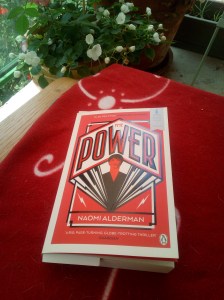
 I’ve been aware of this novel and reading about it for a long time, watching it come through and finally win the 2017 Baileys Women’s Prize for Fiction and I love that this will ensure it is widely read, because perhaps the greatest value to this story is to provoke readers to discuss it, not so much the actual story, but the theoretical constructs behind it and how it exposes the way we think and accept things as they are today and yet when twisted on their head as Naomi Alderman has done in The Power, we become ever more acutely aware of the gravity and depravity of that thinking.
The Power is the story of a manuscript sent from one friend to another, thus it’s bookended by their correspondence, before and after we, along with Naomi (the recipient of the manuscript) read Neil’s historical novel ‘The Power’.
The story follows a period in (and looking back on) the lives of four characters, the first part is entitled Ten Years to Go, finishing with the final part Here It Comes. The characters come from different parts of the world; Roxy, the daughter of a British crime boss, traumatised by the accidental witnessing of her mother’s murder, who finds the safest place to be is among those whom she most fears; Allie, an abused foster child who escapes and changes her identity, guided by an inner voice and destined to lead, who will become the religious leader Mother Eve; Tunde, a Nigerian youth who discovers his calling as the witness and recorder of events as they unfold, leaves his country and follows the rise of women as they assume The Power in one of the most extreme locations, where leadership is more akin to dictatorship and the population becomes more and more extreme in response to the fear and punishments generated by an increasingly corrupt leadership; and finally Margot, an ambitious American politician who is well placed for the transition, whose troubled daughter Jocelyn becomes the recipient of some of her initiatives.
Rather than finding ourselves in the midst of a society already run by women, the story takes place as women are beginning to assume control and the reason they can do so is because of their unique ability to inflict pain, in a way men can not.
Through the experiences of these characters, we witness what happens as power shifts, their narratives coming together in the newly declared kingdom in Moldova, where the President has been deposed by his wife Tatiana.
“And there she declares a new kingdom, uniting the coastal lands between the old forests, and the great inlets and thus, in effect, declaring war on four separate countries, including the Big Bear herself. She calls the new country Bessapara, after the ancient people who lived there and interpreted the sacred sayings of the priestesses on the mountaintops.
It’s a book that keeps the reader guessing, wondering what the impact of this shift in power will be, will we see something different from what we know, or will women turn out to be as similarly corrupted by power as men?
As the path the author has chosen plays out on the page, the reader encounters thought provoking reactions to how they perceive what happens when roles are reversed, for as Naomi Alderman shared when her novel made the shortlist of the Bailey’s Prize:
“I didn’t start from the idea of making a matriarchal society. But the idea did come from a particular moment in my life. I was going through a really horrible breakup, one of those ones where you wake up every morning, have a cry and then get on with your day. And in the middle of all this emotional turmoil, I got onto the tube and saw a poster advertising a movie with a photograph of a beautiful woman crying, beautifully. And in that moment it felt like the whole of the society I live in saying to me “oh yes, we like it when you cry, we think it’s sexy”. And something just snapped in me and all I could think was: what would it take for me to be able to get onto this tube train and see a sexy photo of a *man* crying? What’s the smallest thing I could change? And this novel is the answer to that question, or at least an attempt to think it through for myself. …I just had this idea about women developing a strange new power.”
Overall, I liked the book for its provocation and the conversation it generates, but the story itself and the inner landscapes it explores, the places it takes us, aren’t states of mind or dwellings I prefer to inhabit in literature and because equally in addition to there being a perceived rise in rhetoric against equality for women today, there is simultaneously, depending on what information channels and voices we expose ourselves to, a rise in empathic consciousness – so yes, we are in a time of critical transition and equally many are rejecting the conditioning of the past, embracing a more compassionate, altruistic way of being.

 Home Fire by Kamila Shamsie (UK-Pakistan) (Bloomsbury) –

 I bought a second-hand copy of Two Old Women, after it was recommended by someone whose reading I follow as one of her favourite books, I remember it being an interesting list of books that I had never heard of and this small book, an Alaskan legend of betrayal, courage and survival intrigued me enough to get it.
 The People Velma Wallis writes about in this legend, roamed the land and rivers around the area she was born, following trails that ensured they had access to the necessary resources to survive the changing seasons. They depended on the annual salmon runs and large game as well as small animals, using their skins for warmth.
 In the group there are two old women whom the People care for, Ch’idzigyaak and Sa’, younger men set up their shelters, younger women pull their possessions, however they are both known for constantly complaining of their aches and pains. One day, the chief makes a sudden announcement, one that the group has heard of from their stories, but never witnessed within their own band.
 And so begins a challenging journey, a reawakening and discovery of talents that had lain dormant from lack of use, as the two women set out to prove their People wrong and more, to set an example, though no one is there to witness it.
 Ladivine, written by the Senegalese-French writer Marie NDiaye, known for her 2009 Prix Goncourt award-winning Trois Femmes Puissantes (Three Strong Women) came to my attention when it was longlisted for the Man Booker International Prize in 2016.
 “NDiaye’s novels frequently feature biracial couples, absent or distant fathers, and strained filial relationships. Her characters often feel ill at ease within their communities, and struggle with doubts that they are not who they believe or wish themselves to be.” New Republic, The Metamorphoses of Marie NDiaye by Jeffrey Zuckerman
 Salt Houses is a novel that eventually comes full circle, as it follows the female members of a Palestinian family as they flee, move, marry and cope with constantly being and feeling outside where they belong, including between generations and even between siblings.
 “The porcelain surface of the teacup is white as salt; the landscape of dregs, violent.”
 Hala Alyan is a Palestinian-American author, poet and practicing clinical psychologist living in Brooklyn, who spent her childhood moving between the Middle East and the US. Salt Houses is her debut novel and is inspired by some of her own extended family experiences.


 Eva Sleeps is a thought-provoking novel that takes the reader on multiple journeys, as the narrative slowly unravels the mystery that connects Eva, her mother Gerda and Vito.

 The dual narrative follows firstly the journey of a young woman recovering from her role as a volunteer in World War I, who decides in 1921 to leave England and follow in her French grandfather’s footsteps to Cambodia. Afflicted by strange dreams that seem to relate to the area she is visiting, she tries to unravel their mystery and some of the things written in her grandfather’s journals that don’t initially appear to make sense.
 The Last Gods of Indochine was nominated for the The Man Booker Asian Literary Prize, an award that sadly, has also disappeared.
 A quick look up tells me that noir fiction has its roots in hard-boiled fiction ( a tough, unsentimental style American of crime writing) where the protagonist is often an outcast, alienated. However, Kim Fay from LA Review of Books, when reading noir, used to preparing herself for ‘bleak cynicism and uncomfortable moral ambiguity’ is pleasantly surprised, referring to De Giovanni’s Pizzofalcone precinct series and empathetic characters as ‘tender noir’:
 He is new to Naples, he has a teenage daughter he is worried about, a pizza waitress who is eyeing him up and a high-ranking magistrate whom he daydreams inappropriately of.
 Maurizio de Giovanni was born in Naples in 1958 and for many years worked in a bank, though not a natural vocation, his colleagues attest he always had his nose in a book and it was in fact they who entered him in a short story competition in 2005 for ‘giallo novelists’ (a 20th-century Italian mystery, thriller or horror genre of literature and film) that was the catalyst to his becoming a successful crime writer.
 Word by Word