
A Haitian Trilogy – Introduction by Edwidge Danticat
 Originally published in French as Amour, colère et folie, this trilogy of novellas was originally suppressed upon its initial publication in 1968. Seen as a scathing response to the struggles of race, class and sex that had occurred in Haiti, this major work became an underground classic, would send its author into exile and would finally be released in an authorised edition in France in 2005 (this English version in 2009).
Considered by Edwidge Danticat as the cornerstone of Haitian literature, she opens her introduction telling us that “Fewer than a handful of Haitian writers have, both while alive and dead, inspired as much adulation, analysis, and discussion as Marie Vieux-Chauvet.”
Born in Port-au-Prince in 1916, Marie Vieux-Chauvet was a member of the “occupation generation”, that is, born a year after the United States invaded Haiti, an occupation that would last 19 years. She would use the turmoil of that rebellion as the back-story for Love, the first novella of the trilogy.
“We have been practicing at cutting each other’s throats since Independence,” she writes of the country we Haitians like to remind the world was the first black republic in the Western Hemisphere, home to the only slave revolt that succeeded in producing a nation. What we would rather not say, and what Claire Clamont and Marie Vieux-Chauvet are brave enough to say, is that this same country has continued to fail at reaching its full potential, in part because of foreign interference and domination, but also because of internal strife and power struggles.
In three distinct novellas it unflinchingly manages to condemn totalitarianism and tyranny, with little care of the consequences, an act of courageousness or recklessness, but one that would make a significant and permanent mark in the chronicles of Haitian literature.
Love
The narrator of Love, Claire Clamont, is the eldest of three daughters, of a landowning upper-class family. She is the son her father never had and he wishes her to runs things as he would have them done. However, he hasn’t reckoned on her stubbornness and refusal to affiliate with some of the old ways he indulges, having raised her to think of them as superstitious. As a result she is neither feared nor respected by the workers, whom he had sold parcels of land to fund his political campaigns, a futile effort that has left the family near penniless.
The three sisters of this aristocratic family live together, all coveting the same man, Felicia’s husband. Annette succeeds in seducing him, Claire silently, voyeuristically encouraging her.
Meanwhile, a man sent to reform Haiti is known to use violent, torturous means to get his message across, preying on the innocent.
The love this elder daughter practices is tinged with jealousy, revenge and resentment, laying blame at the feet of an ancestor with dark skin. She resents this ancestor who made her so, resents her father for trying to turn her into the son he never had, resents one sister for marrying a man she loves and the other for having seduced him.
Anger
Anger centres around a family and the day a group of black uniformed paramilitary seize their land, putting stakes in the ground, the grandfather and the young disabled grandson are indignant, the son and his wife wary and afraid, their older daughter Rose is practical, the young adult son Paul going crazy, desires revenge.
Men arrive and plant stakes in the ground of land belonging to a family, they wear black uniforms and invoke fear. Each of the family inside react. Then the concrete arrives. They’re seizing the land and building a wall.
The family is observed, tries to address the injustice, is compromised.
The mother got up slowly, put down her needlework, walked over to the old man and spoke into his ear.
“Look at him, Grandfather,” she whispered, “just look at him.”
The child was clenching his fists and grinding his teeth.
“Who will flog those who have taken our land?” he said without paying any attention to the mother. “Is there no longer a steward who can do it?”
“Alas, no!” the grandfather answered.
“Why not?”
“Because there are ups and downs in the life of a people. As the arrow rises, it gives birth to heroes; when it falls, only cowards come into the world. No steward would agree to stand up to those who have taken our land.”
He told himself that his crippled and sickly grandson was the faint beginning of the next era of heroes and that the arrow had begun its slow ascent only eight years ago. Hundreds more must have come into the world the same time he did, he thought, and with feet and legs as well as a brave soul. A day will come when they will grow up and the birds of prey will have to account for their deeds to every last one of them.
Madness
Madness is narrated by René, a lower class mulatto poet hiding inside his shack, paranoid about what’s going on outside his door and inside his mind, finding solace in a bottle, in rituals to do with voodoo beliefs that most of his life he has rejected and the poet friends he fearfully opens his door to, to offer them refuge. Unclear, what is real and what is the projection of a man’s fearful mind, we read on, aware that under oppression anything is possible.
A thought provoking read that invites the reader to understand more about the historical and present situation in Haiti.
 Marie Vieux-Chauvet was a Haitian novelist, poet and playwright, the author of five novels including Dance on the Volcano, Fonds des Negres, Fille d’Haiti and Les Rapaces.
Her works focus on class, color, race, gender, family structure and the upheaval of Haitian political, economic and social society during the United States occupation of Haiti and the dictatorship of François Duvalier. She died in New York in 1973.
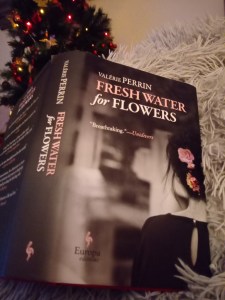 What a refreshing read to end 2020 with, a novel of interwoven characters and connections, threaded throughout the life of Violette Touissant, given up at birth.
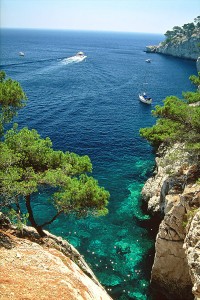 Every summer she stays in the chalet of her friend Célia, in the calanque of Sormiou, Marseille. A place of refuge and rejevenation, that Perrin too brings alive, eliciting the recovery and rehabilitation this nature-protected part of the Mediterranean offers humanity.
 Tituba existed, she was accused and ultimately set free, however, despite the shelves of history books about the Salem witch trials, there is little factual information about her, who she was, who freed her, or her life after release from prison.
 And so Tituba is given a past, skills and knowledge and might have remained in that life, had she not grown into a young woman with desires herself and fallen for the man who would become her husband John Indian.
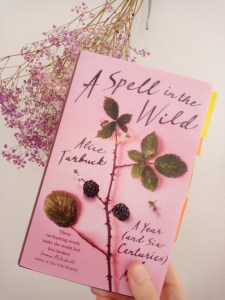 Like Condé, who said she knew nothing of witchcraft, I have decided to read a contemporary book next, published in 2020, to see what’s going on in the world of witchcraft today.
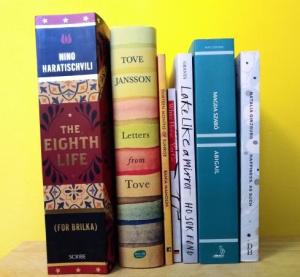 Seven titles were shortlisted for the annual Women in Translation award from 132 eligible entries, 16 titles made the initial longlist:
 Abigail by Magda Szabó (Hungary), translated by Len Rix (MacLehose Press, 2020)
 Happiness, As Such by Natalia Ginzburg (Italy) translated by Minna Zallmann Proctor (Daunt Books Publishing, 2019)
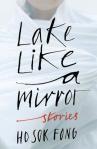 Lake Like a Mirror by Ho Sok Fong (Malaysia) translated from Chinese by Natascha Bruce (Granta Publications, 2019)
 Letters from Tove by Tove Jansson (Finland) edited by Boel Westin & Helen Svensson, translated from Swedish by Sarah Death (Sort of Books, 2019)
 The Eighth Life by Nino Haratischvili (Georgia/Germany), translated from German by Charlotte Collins and Ruth Martin (Scribe UK, 2019)
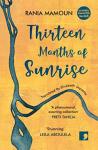 Thirteen Months of Sunrise by Rania Mamoun (Sudan), translated from Arabic by Elisabeth Jaquette (Comma Press, 2019)
 White Horse by Yan Ge (China), translated from Chinese by Nicky Harman (HopeRoad, 2019)
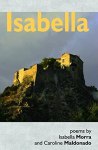 Isabella (Smokestack Books, 2019), a collection of fiercely feminist poems by the Italian Renaissance writer Isabella Morra translated by Caroline Maldonado
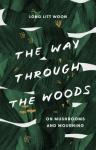 the extraordinary memoir about mushrooms and grief, The Way Through the Woods (Scribe UK, 2019) by Malaysian-born Long Litt Woon, translated from Norwegian by Barbara Haveland
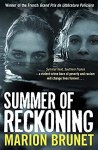 and the pacey young adult thriller set in a small French town rife with racism and rage Summer of Reckoning (Bitter Lemon Press, 2020) by Marion Brunet, translated from French by Katherine Gregor.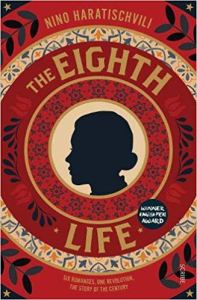
 From the opening pages, as Giovanna overhears a random comment from her father, it expands in her mind and overtakes her physically and mentally like a disease, affecting her mind, causing her to act in certain ways.

 Word by Word