Eugene Onegin Read Along – Chapter’s One & Two Alexander Pushkin

Eugene OneginWell, this is a first for me, a read along!

Alexander Pushkin’s Eugene Onegin has long been on my list of books to read, since it was gifted to me by husband many years ago. I don’t know why it seemed to intimidate me, since I loved long prose poems as a teenager, especially that other Alexander – Alexander Pope.

The book is a verse novel and I’m reading the Penguin Classic version translated by Charles Johnston with an introduction by the novelist and literary critic  John Bayley (husband of the late Iris Murdoch).

So I’m a little late finishing, but I have read the first two chapters and have a few basic impressions, though not much idea of the story, without reading outside the text.

So, I’ll follow Tanglewood’s lead (hosting this read-along) and try to answer her questions:

First impressions of Eugene?

A bit of a dandy? Son of a lavish spender who clearly didn’t instill much of a work ethic into his son. Then thanks to the legacy of a rich Uncle, he will spend more time in a dressing room, than any character I’ve ever read of.

Eugene turned countryman. He tasted

the total ownership of woods,

mills, lands and waters – he whose goods

till then had been dispersed and wasted –

and glad he was he’d thus arranged

for his old courses to be changed.

Not interested in history or politics or activism, he possesses a wealth of well polished stories to offer at the many social engagements he attends. Hates the Greek heros and prefers the theories of economics. Something of a chameleon, a charmer, dare I suggest, a manipulator, seducer? Prefers balls to ballet, the city to the countryside, yet tolerates boredom, cynicism suits him.

Chapter One introduces Eugene while chapter two introduces the characters he meets when he moves to the countryside, descriptions of Eugene are superficial, he lacks depth, something he may encounter soon perhaps.

What do you make of the narrator’s commentary?

I find the commentary more accessible than I thought, certainly it’s easier to interpret than Shakespeare and mildly humorous with its frequent drift into French words and an “I’ll write how I like” attitude, although it’s difficult to know when reading a translation, fortunately the French isn’t translated, so we have a better appreciation for the play with words intended.

Thoughts on the characters in Chapter 2?

Chapter Two begins to broaden the range of characters and they provide a welcome contrast to Onegin and the possibility of assisting him perhaps to see things through different eyes.  He is charmed by his friend, the poet Vladimir Lenksy and enjoys listening to his outpourings of emotion:

EugeneHe roamed the world, his lyre behind him;

Schiller and Goethe had refined him,

and theirs was the poetic flame

that fired his soul, to burn the same;

Olga, the subject of the poets verses since boyhood, the loved one and her elder sister Tatyana, the dreamer, the loner, living vicariously through her books.

I can see why it’s good to read and reread, even going back and reading earlier passages from yesterday seem to enlighten the story further. So forgive my ignorance as I trundle forward for the first time, slowly discovering what it is I am reading.

Click here to read the follow up review of Eugene Onegin Chapters 3 & 4
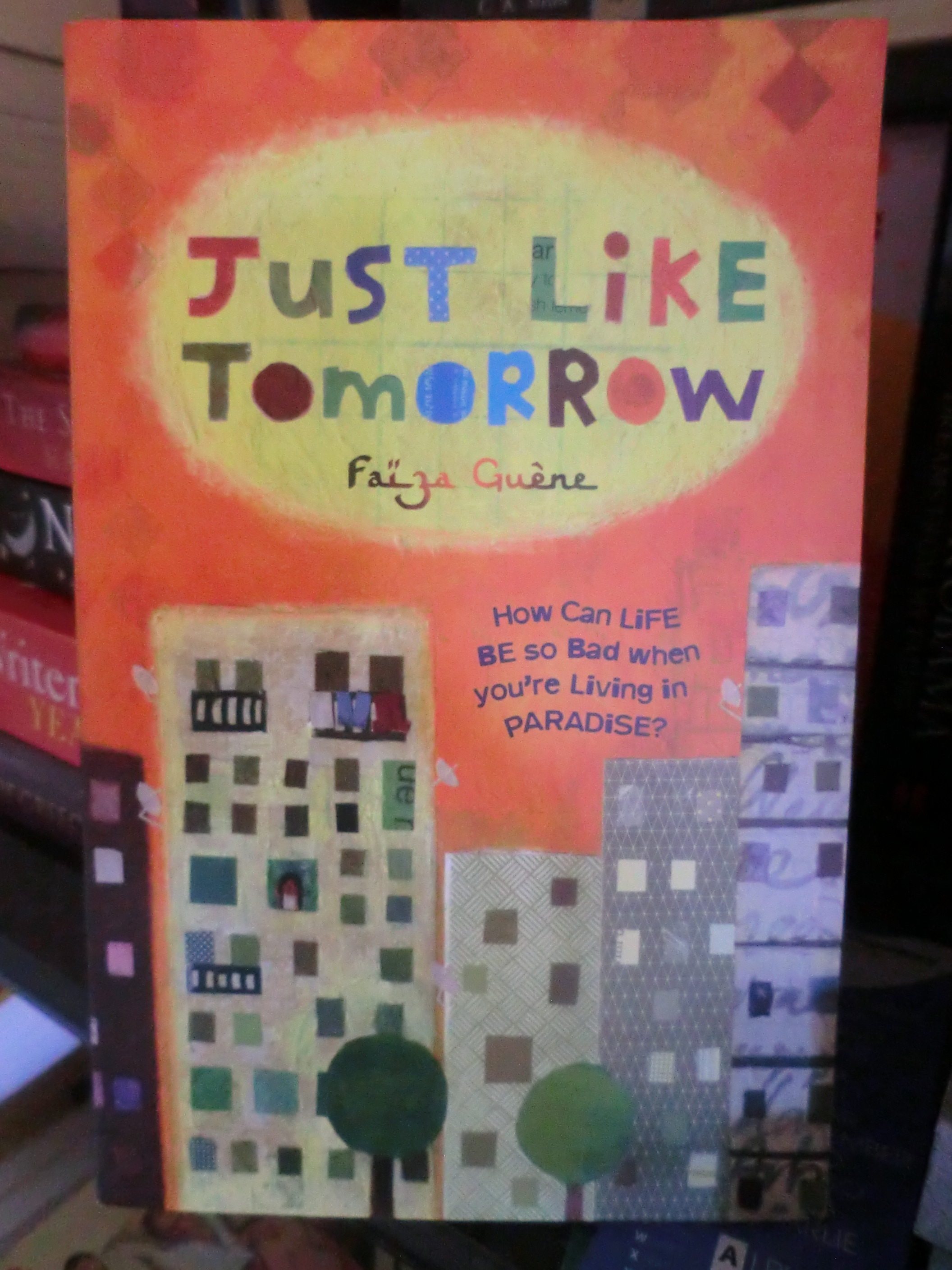
Just Like Tomorrow by Faïza Guène

How Can Life Be So Bad When You’re Living in PARADISE?

Kiffe kiffeI came across Faïza Guène’s  Kiffe kiffe demain translated as Just Like Tomorrow by Sarah Ardizzone, a french contemporary novel for young adults, via a wonderful blog A Year of Reading the World that is being turned into a book*.

Ann Morgan, inspired by the arrival of the multitude of athletes who came to London for the Olympics, decided to read a book from every one of 196 independent countries.

Each country presented a challenge, with only 3% of books in the UK being translated, she had to call on the help of her network and followers to find an English translation for many locations.

Faïza Guène

Faïza Guène

Faïza Guène is a young screenwriter who, after being involved in a local community project, began directing her own films. Born in France of Algerian parents, and growing up in a northern suburb of Paris, she writes from the heart of a challenging suburb, in a part of the city that few from the outside know about and about which little is written in literature.

Fifteen-year-old Doria lives alone with her illiterate mother, abandoned by a father who is seeking a younger, more fertile wife in his birthplace, Morocco. The story follows Doria’s unadulterated thoughts, which for most of the narrative are quietly despondent yet noisy with attitude. She is not prone to drama, although she observes it around her, as if from within a bubble and provides a running commentary on everything in her mind,and on the page.

Peppered with teenage slang, suburban Franco-Arabic dialect, the voice is unique and easily conjures an image of what life must be like for Doria, as she waits to be thrown out of school and pushed into a career she has no desire for. Her low expectations of life make the small gains she and her mother make all the more pronounced and the humour all the funnier.

What Mum really likes watching on telly in the evenings is the weather forecast. Specially when it’s that presenter with brown hair, the one who tried out for the musical The Birdcage but didn’t get it because he was over the top…So there he was, talking about this huge cyclone in the Caribbean, and it was like oh my days, this crazy thing getting ready to do loads of damage. Franky, this hurricane was called. Mum said she thought the western obsession with giving names to natural disasters was totally stupid. I like it when Mum and me get a chance to have deep and meaningful conversations.

It is a slice of life, coming of age story, of a second generation teenage immigrant living her life far from the images of the city of Paris that come to mind for most of us. It is a book that has been widely translated into other languages and offers a unique insight into teenage life for those on the fringe and an excellent alternative to the more well-known French literature out there.

*Reading the World: Postcards from my Bookshelf will be published by Harvill Secker in 2015.

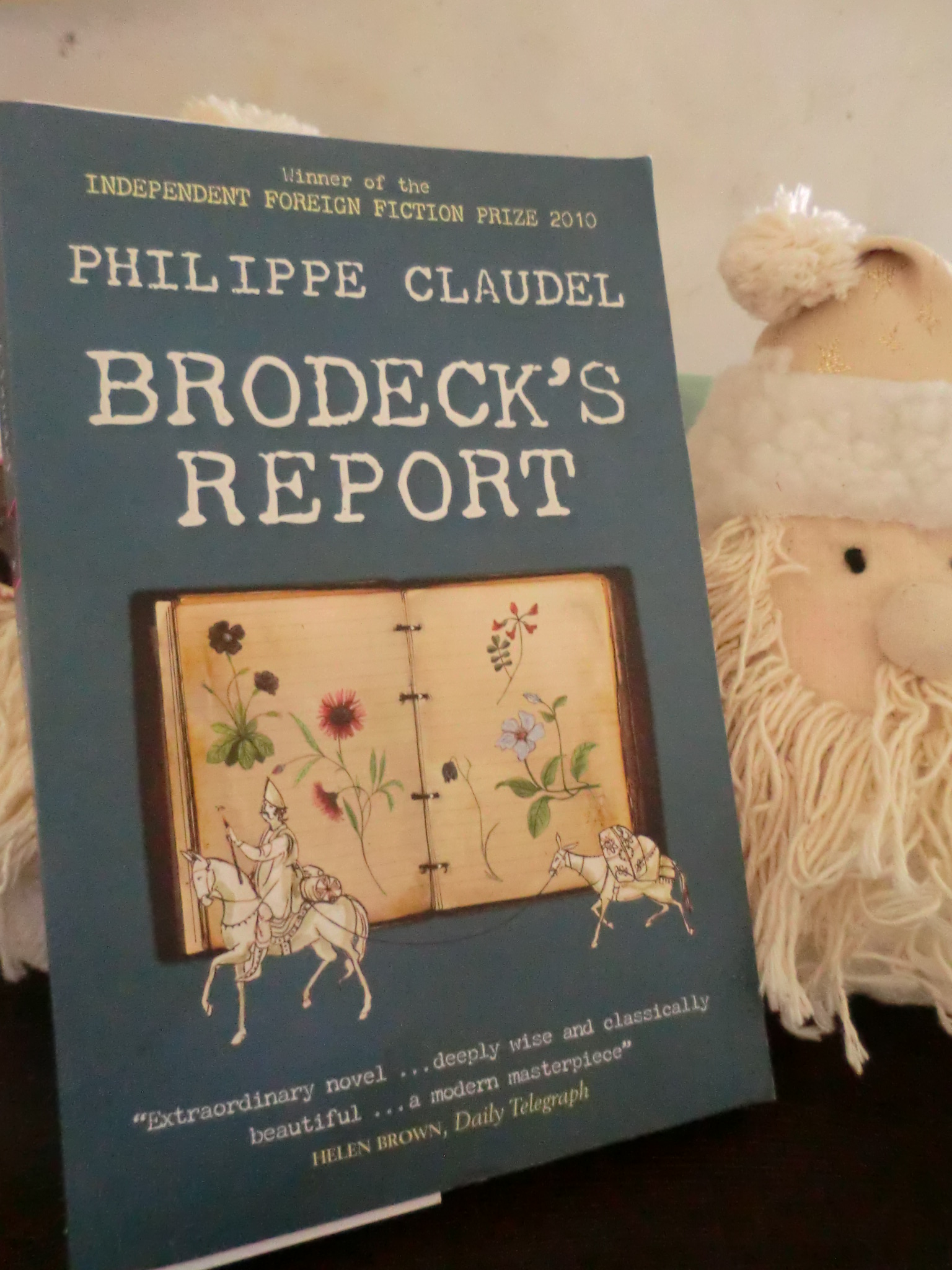
Brodeck’s Report by Philippe Claudel, tr. John Cullen

BrodeckThis book has been on my radar since I read Le Petite Fille de Monsieur Linh by Philippe Claudel last year. That was the first book I had read by Philippe Claudel and our book club decided we should read it in French. I remember at the time, one of my twitter followers mentioned Brodeck’s Report as being her favourite, and on a recent visit to West End Lane Bookshop in London, I found this copy.

Brodeck’s Report is the story of the young man Brodeck, who as a child arrived in a French village with an old woman who had taken pity on him, finding him sitting alone in the ruins of a house fire.

He becomes a protégé of the village, who save enough to send him to university with the intention of him making an important contribution to village life, as it was clear he had the capability. Their plans are thwarted by unrest in the city and Brodeck flees to the village with a young woman who will become his wife. The village soon becomes occupied, resistance is taught a harsh lesson and the community are encouraged to ‘cleanse the village’. Brodeck and one other who came from elsewhere are sent away.

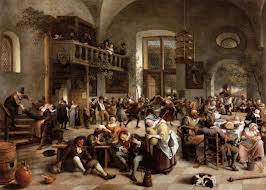
InnWhen the story begins, Brodeck is home, having survived the camp and after stepping out to find butter, stumbles into the midst of a village gathering at the Schloss Inn, where those grouped have decided he will write a report about the unknown, nameless stranger who came to visit, who had now met his end.

The novel is quiet, devastating and yet brilliant. Claudel takes one village which happens to be near the border – and what is a border but an imagined, even a painted line on paper – of an occupying country, and uses the village and its resident to portray humanity and its many inclinations, including its inability to learn from mistakes – which manifest when a stranger rides into town, installs himself at the local inn and goes about his business, without letting anyone know what that is. Many of the events portrayed in the novel are the result of illusory thought, of man’s inclination to create a story when there is none and to punish the outsider, the one who has inspired their dark imagination.

BrodeckBrodeck is tasked with writing an account of the events that do take place and as he does so, he simultaneously writes another account, his own narrative of what is occurring and what has happened in the recent past. He writes to try to make sense of it, as is his nature and to know what he must do.

Reading Primo Levi adds to an understanding of Claudel’s work and having read this novel so soon after Aminatta Forna’s The Hired Man, it illuminates something more of that work as well, it is as if they write about the same people, only Claudel dares to take the reader deeper into the heart of his villagers forcing us to open our eyes.

“It is a strange time of day. The streets are deserted, the encroaching darkness turns them into cold, grey blurs, and the houses become shifty silhouettes, full of menace and innuendo. Night has the curious power of changing the most everyday things, the simplest faces. And sometimes it does not so much change them as reveal them, as if bringing out the true natures of landscapes and people by shrouding them in black.”

Stunning.

Are Prize Winning Novels an Indication of Readership or a Nation’s Literary Heritage?

After the BBC’s journalist in Paris Hugh Schofield asked the question about Why French books don’t sell abroad, the Cultural Attaché to the US Embassy in New York, Laurence Marie responded with an extensive list and discussion of a list of French titles that are selling abroad. She also mentions how widely French literature is being translated into other languages and her article makes fascinating and insightful reading. I have collected book covers of some of the works mentioned, plus others, below.

Sometimes we hear about literature from another country when the author wins a major literary prize. However:

Are Prize Winning Novels Really Indicators of a Nation’s Readership?

French Books That Are Selling Abroad!

French Books That Are Selling Abroad!

I don’t think so.

Literary prizes usually have an agenda, if not multiple agendas.

In the case of the UK’s Booker Prize it was set up to try to bring more literary works into the mainstream.

It is known that the prize doesn’t actually influence the reading habits of avid readers. It is targeted at those for whom books are competing against other forms of entertainment.

I like the literary prize season, not so much in anticipation of a winner, but for the longlist, where we are more likely to find something new that might appeal to our taste, because of the variety offered and the number of works screened.

So what are the French literary prizes?

Le Prix Goncourt

I don’t know the French literary prizes well, and Schofield mentions in his article that there are over 2,000 of them, but the Le Prix Goncourt is well-known and has been around over 100 years since 1896.

The last recipient was Pierre Lemaitre, whose thriller Alex  (reviewed here by Savidge Reads who said of it: “a thriller that almost made ‘Gone Girl’ look tame”), was a bestseller last year and his prize-winning novel Au revoir là-haut looks set to be the same.

Nancy, a blogger in the Netherlands whom I admire enormously, tasked herself to read only French novels last year, as an interesting way to learn the language and not only has she succeeded in learning the language, but she has not given up, she continues to read novels in French. You can read her review (in English) of Le Maitre’s Au revoir là-haut here.

The prize was established by Edmond de Goncourt, a successful author, critic, and publisher, who bequeathed his estate to establish an academy and the prize was initially created to allow talented writers the opportunity to write a second book. The prize is seen as being SO prestigious, the prize money has not changed since the early 1900’s and remains something around €10.

Le Prix Femina

Leonora MianoTen members of the Goncourt academy are responsible for the judging of Le Prix Goncourt, and in protest against this all male jury, le Prix Femina was inaugurated, an equivalent literary prize open to all sexes, however the jury is all female.

This year the prize was won by Léonora Miano, a Cameroonian author who has lived in France since 1991, for her 7th novel La Saison de l’ombre (The Shadow Season).

There is also a Prix Femina étrangere for foreign books which was won in 2013 by Richard Ford for Canada and Le Prix Femina essai, a popular genre in France, the essay; this year won by father and son duo Jean-Paul Enthoven and Raphaël Enthoven for le Dictionnaire amoureux de Marcel Proust (Marcel Proust’s Love Dictionary).

2013 Pric FeminaThere are certainly no shortage of prizes here in France (other major literary prizes are the Grand Prix du Roman de l’Academie Francaise, the Prix Renaudot, the Prix Interallie and the Prix Medicis), and their lists make interesting reading, for their longevity and breadth and for that fact, that they are so little known by readers in the English language.

Although prize-winning literature might be translated into English, it may also create a false perception of readership, being skewed towards that overly intellectual perception of literature that Schofield refers to as being elitist, which can alienate the average English language reader (and perhaps also the average French reader).

Every nation is proud of their literary culture and achievements and like to endow their icons of that tradition with prestigious titles, however down here at the ordinary people reading level, there is a whole other canon of literature being read, whether it is in the English language or any other.

CIMG3882To know more about what ordinary readers are immersing themselves in, it is necessary to speak to people like us, those who don’t often have a voice in the media or on a jury, they are the voices that are worth hearing from, even if what they provide is anecdotal evidence.

I am speaking to some of the French people I encounter in everyday life who are passionate readers, to find out what they think about French literature and what they are reading, to be featured in future posts.  And to find out more about all that translated fiction they love to read here.

They’re Reading Thousands of Great Books Here, Cité du Livre – A Local French Cultural Centre and Library

Yesterday via a link on twitter, I read a provocative article in BBC News Magazine by Hugh Schofield entitled Why don’t French books sell abroad? It was an interesting, if superficial article, that made a few observations without going into any depth to understand the contemporary literary scene in France. It asked questions, reminded us of some old provocative stereotypes and did little to enlighten us on the subject of what excites French readers and why the English-speaking world aren’t more aware of their contemporary literary gems.

Kate from BooksKateRates, reads and blog about French literature and wrote an interesting blog post in response to the article and I have been scribbling notes since reading the original article. I plan to share them here, as it is a fascinating subject if one takes the time to research and understand it.

But firstly, I wanted to show you the library, as it offers a glimpse into  how the French absorb literature and culture and it’s one our favourite local hangouts.

Situated in what was a 14,500 sqm match factory, the library, La Bibliothèque Mèjanes, is part of the Cité du livre, a centre for the arts and culture which includes an auditorium for lectures and readings, rooms for more formal lectures, a small cinema showing themed films for 3 week periods (currently Humphrey Bogart films), a music and film lending room, adult and children’s libraries, a press room, an exhibition space (currently celebrating the centenary of Albert Camus), a café and plenty of space for research and study.

Library Press Room

Library Press Room

As we walk in through the enormous sculptures of the covers of Camus’s  L’etranger on one side and Saint-Exupéry’s Le Petit Prince and Molière on the other, we arrive in a long corridor and the reception area for borrowing and returning books.

Turn left and we head towards the reading library where outside the door is a display of books for adolescents. A quick glance at these books shows us that half of them are translated fiction, from South African, German and Hispanic authors.

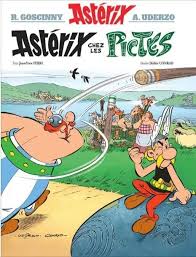
AsterixInside, we walk past displays of translated literature originating from South Africa, a tribute to Nelson Mandela, then the stacks of Bande Dessinée, the very popular hardcover graphic novels, which even today remain at the top of the French bestsellers list, right now its Asterix chez les Pictes, visiting the people of ancient Scotland!

And here are the novels, in French called romans. Rows and rows of books and you might notice something they all have in common, well, in fact, something they all lack. Colour.

Compare it to the shelf opposite which contains the English language novels. It certainly removes that whole likelihood of an impulse buy based on an intriguing cover.

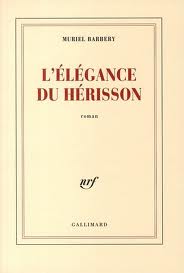
The Elegance of the Hedgehog

The Elegance of the Hedgehog

Most French literary novels are published without fancy colourful covers and while in the bookshop you might find first editions with promotional covers, there are many more with pale or cream covers without images and a black or red text title.

However, after looking around a little more, I discover that there is colour in some sections. Science Fiction and Fantasy are full of dark colours and the books covers in the section entitled Policiers (Crime) are mostly black. However, novels and poetry, even the section called American Literature pale into insignificance among a sea of white. It reminds me of one of the three principles of France l’égalitié and certainly here, all books have the same chance of being found, whether it’s from the library or in the bookshop, not just due to their bland covers, but also due to a government policy called le plan livre and the fixed price of books.

It costs €17.50 to join the library (adult) and its free for children, there is no cost for lending and no fees for late returns. 16 items (books and CD’s) and 3 DVD’s can be borrowed at any one time for a period of 3 weeks and the first renewal can be done online. The library is also full of computers providing free internet access to all members. My only complain is that its closed on Sunday and Monday. C’est la vie en France!

So what kind of books do French people read today? And is it true that nearly half of the fiction read is translated foreign fiction? And why don’t we see more books by French authors in English bookshops?  These questions and more I will talk about in the next post Reading Contemporary French literature.

PeopleIn the meantime, if you want to know what’s popular in France and available now to read in English, check out Gallic Books, who offer the best of what’s available in French translated in English with new titles coming out every month.

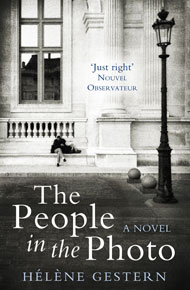
I’m looking forward to reading The People in the Photo by Hélène Gestern due out in English in February 2014.  If you wish to read it in French, it’s already available with the title Eux sur la photo.

The Hen Who Dreamed She Could Fly by Sun-mi Hwang tr. Chi-Young Kim

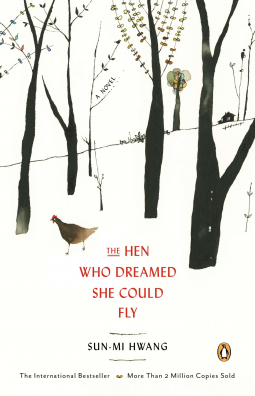
This book is proof that it is not just reviews and the recommendations of friends that help us choose which book to read next, that an excellent cover and title coupled with an alluring blurb can suffice to motivate that impulse.

The HenThe cover made me pause and the promise of an inspiring fable in a short piece of internationally acclaimed translated fiction sounded enticing enough, but the discovery that the author Sun-mi Hwang had herself overcome the obstacle of childhood poverty and found a way to educate herself to achieve her dream to read and write sealed it.

Like Margarita Engle’s novel in verse The Wild Book and Tove Jansson’s Summer and Winter Book’s, sometimes a mood enhancing book is just what we need to bring ourselves back to life’s simple values for encouragement and reassurance.

The story revolves around ‘Sprout’, a battery hen frustrated with her caged life laying eggs in a sloping wire cage which causes her eggs to roll away, enabling the farmer to conveniently collect them to sell. She hatches a plan to escape, seeking a life outside the barn where others animals appear to roam free and where she feels it most likely to be able to achieve her dream of nurturing an egg to life.

Along the way we meet the old dog that guards the barn, the rooster who crows in the morning, the yard hen, a community of ducks and the lone hungry weasel.

“Whenever she saw the yard hen, Sprout couldn’t stand it – she felt even more confined in her wire cage. She too wanted to dig through the pile of compost with the rooster, walk side by side with him, and sit on her eggs.”

010113_1257_AMonthinthe2.jpgSprout escapes the coop and directs all her energy into survival. She learns who her friends are and who to be wary of.

She discovers the perceptions that govern the role each animal is set to play.

“Yes, you’re both hens, but you’re different. How do you not know that? Just like I’m a gatekeeper and the rooster announces the morning, you’re supposed to lay eggs in a cage. Not in the yard! Those are the rules.”

No fairy tale, this is fable at its best, confronting the reality of stepping outside the role society has dictated (even if nature has not divined) and showing that while achieving the goal can be possible, it is a route fraught with challenges. Reminiscent of Orwell’s Animal Farm or Adams Watership DownSun-mi Hwang brings us her perception of society through characters that we recognise with our own interpretation and reminds us that even the most far-fetched dreams are worth pursuing, no matter what the odds.

We read with trepidation and a strong desire, not so much for Sprout to succeed in her quest, but to survive. It is a delightful and touching story, deserving of its success.

Note: The book was an ARC (Advance Reader Copy) provided by the publisher via NetGalley.

Halloween, The Day of the Dead & The Secret Recipe Book of Frida Kahlo

Ironically, today marks the first day of the Mexican celebration The Day of the Dead, three days in which family and friends gather in many parts of the world, but especially traditional in Mexico, to acknowledge those that have died. Traditions include building an altar or shrine using sugar skulls, marigolds and the favourite foods and beverages of those who have passed, but are still remembered.

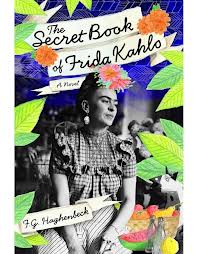
Frida KahloThe Day of the Dead has a special significance in the Mexican writer Francisco Haghenbeck’s novel The Secret Book of Frida Kahlo. Upon learning that several notebooks were found among Kahlo’s belongings, he imagines that one of them was given to Frida by her friend Tina Modotti and in it will capture recipes, memories and ideas that are inspired and connected to some of the noted people she spends time with.

“Among Frida Kahlo’s personal effects, there was a black book called “The Hierba Santa Book”. It contained a recipe collection for offerings on the Day of the Dead. According to tradition, on November 2 the departed have divine permission to return to earth, and they must be received with altars filled with Aztec marigolds, sweet pastries, photographs from long ago, religious postcards, mystically scented incense, playful sugar skulls and votive candles to illuminate their path to the next life.”

Frida Kahlo’s life story, her tomboyish, rebellious youth, her not so blind and yet all-embracing obsession with Diego Rivera, her accident, her art, her circle of friends both at home in Coyoacán, Mexico and those she fraternised with in the US and Europe are fascinating from almost any point of view, whether it’s the film Frida with Salma Hayek’s convincing role or Barbara Kingsolver’s fictional account of her in The Lacuna or this latest account with its superstitious bent.

The book started slowly, covering familiar ground and read a little like a summary of her early life, each chapter culminating in a recipe, like a tribute to the character who inhabited that episode. What makes it engaging and unique are Frida’s encounters with Death, who manifests as a man riding a horse and who visits her in the first few pages, before we even know who he is.

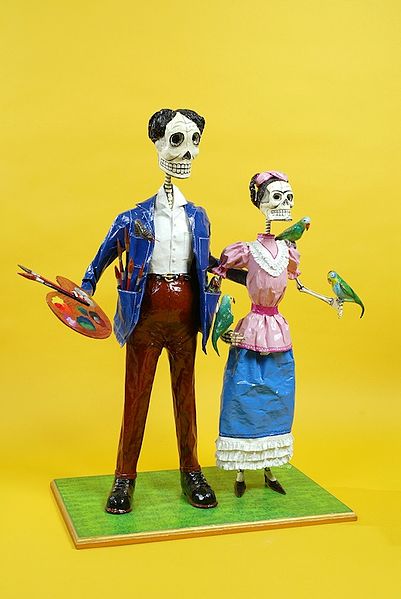
Kahlo Rivera Day of the Dead sculpture by Miguel Linares Source: Wikipedia

Kahlo Rivera Day of the Dead sculpture by Miguel Linares
Source: Wikipedia

As well as this apparition of the carrier of death, it’s warning manifests through the presence of a woman she refers to as the Godmother, Empress of the Dead, one with whom Kahlo makes a pact, after the trolley-bus accident that almost kills her. She will live, but with a constant reminder of that which she has circumvented – death. She will extend her life and avoid death but must embrace pain. And thus she becomes even more superstitious than she might have been, carefully marking the annual Day of the Dead with her shrine and offerings, keeping that man on the horse from her door until she is ready for his presence.

“The pact she had with her Godmother had given her the courage to tell stories. She liked to joke about Death. She dared it, taunted it, knowing that somewhere, Death was listening.”

She possessed a fearless personality, though susceptible to pain and expressed it in her artwork with an intensity that some would find disturbing.

Pain is the recurring metaphor in Kahlo’s life, sometimes it was so physically present it disabled her for periods of time when painting was her only release. When it wasn’t physical pain she experienced, it was emotional, for even her husband Diego, the love of her life was a manifestation of pain, one she tried to eliminate, briefly divorcing him for a year, despairing of his continuous infidelities and then just as she accepted physical pain, she accepted her flawed husband and remarried him, deciding it was better to live with than without him.

Suicide of Dorothy Hale by Frida Kahlo  Source : Wikipedia

Suicide of Dorothy Hale by Frida Kahlo
Source : Wikipedia

Channelling her experiences onto canvas, she developed a unique style and following. She became as well-known and sought after as Diego, from New York to the surrealists in Paris, meeting people such as Georgie O’Keefe, Salvador Dali and back home in Mexico, she and Diego would become hosts to the exiled Leon Trotsky and his wife.

Each encounter in the book leads to a favourite dish she might have made for or shared with her friends and it is as if each dish is also a sacrifice to the Godmother, constantly fulfilling her pact to keep Death from her door.

An excellent addition to the collection of work that exists, with its unique focus on local tradition, superstition and Frida Kahlo’s pact with Death, remembered every year when she and Diego come visiting, as they will perhaps this November 2nd.

Note: This book was an Advance Read Copy (ARC) provided by the publisher via NetGalley.

Mr Darwin’s Gardener is Also a Thinker, Kristine Carlson

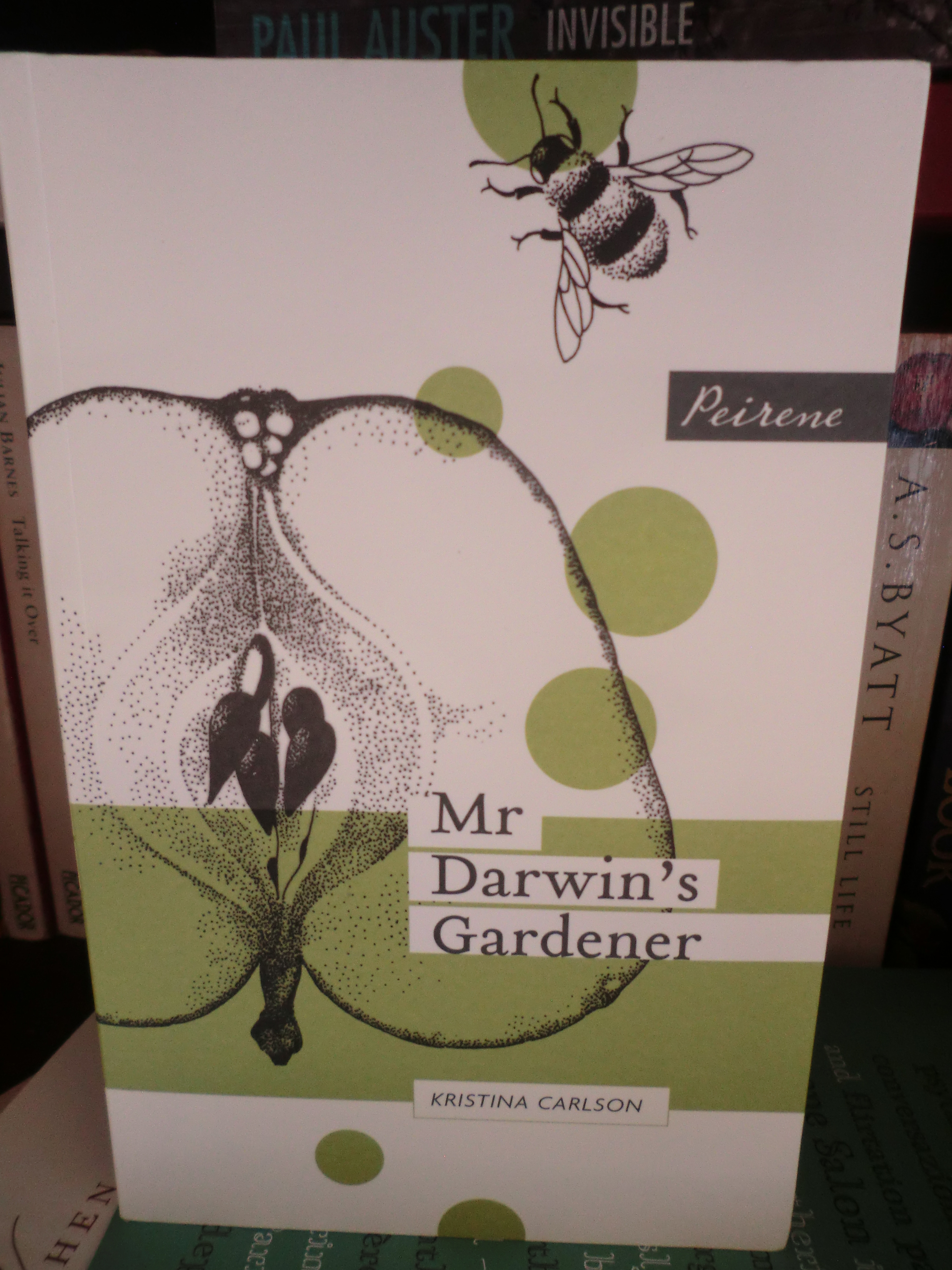
Darwins GardenerKristina Carlson is a native of Finland and has published 16 books there. Like Tove Jansson, whose work I love, she is known for her children’s stories, but also has a wide adult readership. We are fortunate to be reading the recently published and translated work Mr Darwin’s Gardener thanks to Peirene Press, who describe it as “Peirene’s most poetic book yet“.

“Carlson evokes the voices of an entire village, and through them, the spirit of the age. This is no page-turner, but a story to be inhabited, to be savoured slowly.” Mieke Ziervogel

Less a story than a series of thoughts and observations, though there is one alarming event, it is set in the late 1870’s in the Kentish village of Downe, where Thomas Davies, widower, father of two and the gardener of Charles Darwin, reflects on the dilemma of his life and stays away while the rest of the villagers gather in church.

Just as Mieke Ziervogel suggests, it is a not a book to be absorbed quickly and even when read slowly, it warrants turning back to the beginning and starting over, which is what I did. I read it through twice because once was insufficient for a book whose depth and layers become clearer when we reacquaint with it. To read it once was to see the words on the page and meet the villagers for the first time. To read it again was to begin to understand the collective consciousness of a community and one man who stands outside them, working for another man who is completely out of their reach or comprehension.

Charles Darwin, Author of 'Origin of the Species' Source: wikipedia

Charles Darwin Source: wikipedia

Plants grow, flowers sway, a ray of light streaks through a gap in the clouds, a gardener thinks, women talk, men drink, jackdaws caw, bells ring, a stranger visits and a man writes an article in the newspaper. Like an invisible character hovering over the town, we observe each villager in a random moment just before we inhabit their mind, see what they are thinking and watch what they do, as if we are they. We repeat this sequence from one home to the next and at The Anchor, the local pub where a stranger visits and stays overnight.

The Anchor clinks, clanks, seethes, smokes, susurrates.

The gardener has taken on the role of the village sage,

Though as a rule he barely says good morning.

The tongue is a sort of red carpet. One has to watch what hurries along it.

A gloomy and unhappy man.

But Thomas Davies sits neither in a church pew nor at the bar and he is more often the subject than the purveyor of thoughts, though these are some of his:

Garden at Down House, Darwin's home

Garden at Down House, Darwin’s home

The most beautiful thing about plants is their silence. The second most beautiful thing is their immobility, I wrote when Gywn died. I am reading now, it is evening.

I wrote unscientifically.

Even condolences thundered then, and goodwill would not leave me in peace.

Grief is weighty but it is a stone I bear myself.

Victims of revenge and victims of mercy are in the same position, I believe; other people make their affairs their own.

I may have to read it a third time.

The Summer Book by Tove Jansson

I promised myself to read this in summer, after a series of other seasonal reads like Susan Hill’s In the Springtime of the Year,  Tove Jansson’s A Winter Bookand Edith Wharton’s Ethan Frome. I seem to have skipped autumn, so perhaps that will next, maybe Irene Nemirovsky’s Snow in Autumn or Albert Camus’ Fall.

The Summer BookThe Summer Book is a novel that reads more like non-fiction, an invocation of the spirit of its author Tove Jansson, who like the Grandmother and Sophia the grand-daughter in her book, spent all her summers on the small family island off the coast of Finland, doing just the kind of things young Sophia does and eventually feeling the constraints of the older woman, so that she herself comes of age (at 77) and no longer has the strength nor confidence to brace the unpredictable sea after a storm destroys their boat, she sensibly retires to the mainland for the rest of her days.

Esther Freud writes a captivating foreword, including sharing parts of her own visit to the island to meet the real life Sophia, who is Tove Jansson’s niece. She visits both the island of Jansson’s childhood and Klovharun, a place of pilgrimage today (see the video below), the island she later moved to with her partner when their own island became too crowded with relatives and friends.  Freud ponders:

“What kind of person could live here? Someone so fuelled by their imagination, so stimulated by the sea, so richly creative that they could find solace and inspiration in what to others might seem a barren rock.”

This short video clip helps us imagine just what it might be like.  As for me, I could well imagine living like this for the summer.  And you?

In the book, we meet Sophia, who has prematurely lost her mother and so with her father will spend spring and summer on the island with her grandmother. While the father is present, whenever he is mentioned, even when in the same room, he is working or busy and so given background status, though in reality on such a small island, his existence would no doubt be more noticeable, however in the story he is a reassuring but not interfering presence, just like the island itself.

Sophia on the island with her grandmother (Tove's mother) in 1968

Sophia on the island with her grandmother (Tove’s mother) in 1968

The pages turn like days of summer, governed by the moods of the elements, the creatures that inhabit its shores and the occasional visitor. Underneath or implicit within all that passes is the perplexity of death, that absence, prematurely confronted by a young girl and sensitively explained by her older companion. The chapter entitled Playing Venice is especially poignant, the loss of the hand-made palace necessitates Grandmother staying up all night to replace it, Sophia unable to cope with another loss of something so special and close to her heart, even if it is only a small sculpture.

In both the chapter Berenice, which is about Sophia’s friend who comes to stay for a while and The Cat, Sophia has to deal with the paradox of really wanting something, then discovers she no longer does and finally must learn to appreciate both her friend and the cat, just as they are.

“If only she were a little bigger, Grandmother thought. Preferably a good deal bigger, so I could tell her that I understand how awful it is. Here you come, head-long into a tight group of people who have always lived together, who have the habit of moving around each other on land they know and own and understand, and every threat to what they’re used to only makes them more compact and self-assured.

An island can be dreadful for someone from the outside. Everything is complete, and everyone has his obstinate, sure and self-sufficient place. Within their shores, everything functions according to rituals that are hard as rock from repetition, and as the same time they amble through their days as whimsically and casually as if the world ended at the horizon.”

Like A Winter Book, this is not a volume to be rushed, it is best savoured and enjoyed slowly, it reminds us of the joy of simple things, that there is value even in those things that sometimes irritate us and above all that we ought to respect and pay attention to natures elements. This is one you’ll want to gift to another or even read again. A literary gem.

Further Reading:

A Biographical Essay on Tove Jansson

The Mussel Feast

Revolutionary Moments

Mussel FeastThe first novella of the Peirene Press 2013 collection is Birgit Vanderbeke’s The Mussel Feast, a reference to an evening meal of a family for whom a mussel feast signifies a special celebration and provokes a familiar family ritual.

This evening however, is a an event (or a non-event) of angst-ridden anticipation, as the mother and her teenage son and daughter prepare the feast and wait for their father to return from work with news that was supposed to have been a given.

There is little action or plot, though much is revealed throughout the course of the evening via the reflections of those present, who, as the minutes and hours pass, become emboldened in their thoughts as they are allowed to run on unchecked and unchallenged by he who normally acts as judge.

Just observing how the words fill up entire pages of this novella, creating a seamless run of sentences without pause or paragraph is admirable and makes me pause in my reading to check if every page is formatted the same, And it is. The constant stream of words is synonymous with an outpouring of frustration, the way the words are presented on the page like a revolutionary act itself. No dialogue, no action, a stream of consciousness charting the psychological passage of a family through the familiar acts of a routine that will manifest in wilful rebellion.

The Mussel Feast should be a cause for celebration when the routine is adhered to. When a crack opens in the routine and the feast is spoiled, who knows what uncharacteristic behaviour may follow.

An original and thought provoking read, one I devoured easily, as promised by Peirene, it is unique in its ability to keep the reader engaged while using a narrative style that is less popular today and yet succeeds in captivating its audience.

The first of her 17 novels, I look forward to reading more of her work and would love to hear any recommendations from others who have read her work.

“I wrote this book in August 1989, just before the fall of the Berlin Wall. I wanted to understand how revolutions start. It seemed logical to use the figure of a tyrannical father and turn the story into a German family saga.” Birgit Vanderbeke

Next up in Peirene’s Revolutionary Moments series is Mr Darwin’s Gardener  by Kristina Carlson, which from the reviews I have read, already sounds just like my kind of book…

CIMG4717