A Truce That is Not Peace by Miriam Toews

Life and Death So Far, A Search for Meaning

“…we might remember the dead without being haunted by them, give to our lives a coherence that is not ‘closure,’ and learn to live with our memories, our families, and ourselves amid a truce that is not peace.” – Christian Wiman

A truce that is not peace Life and Death So Far memoir by Miriam Toews

I’ve been tempted but never read any of Miriam Toews novels, so this might not be the best place to start, this being the first time she has written about her own life in non-fiction (Swing Low: A Life she wrote about her father in 2000). Hoever, I was intrigued and it was available to read on Netgalley so I jumped in to learn more about the source(s) of her inspiration.

While her novels are not autobiographies, they address the emotional, spiritual, and political terrain of her life – her Mennonite upbringing and their lack of voice, her family’s struggles with mental illness and the burden of communal silence. 

A Truce That Is Not Peace makes those long-standing concerns fully explicit, acknowledging the reality behind those themes in her novels, exploring the writing life, family tragedies and day to day obsessions with grace, humour and bite.

Fragments of Memory, Flashes of Reality

The memoir is written in a fragmented journal entry style, one that continued to visit and revisit a number of current obsessions and memories she kept going back to, things from the past that haunted her, her father and sister’s suicides, their long periods of silence, their incessant need to write, her conversations and the questions asked by a Jungian therapist, who she reassures each visit that she is not suicidal (having read that is the greatest fear therapists have of their clients), though it is all she talks about.

It then switches into current desires, a wind museum idea, how to negotiate getting her royalties back from her ex-husband, and repeated attempts to answer the question Why Do I Write?, as the Conversación Comité who invited her to respond to that question, in anticipation of participating in a conversation in Mexico City, keeps rejecting her submissions as being not altogether what they were looking for, while attempts to rewrite it have her dreaming about her Wind Museum.

Creativity, the Messiness and Musings of Lives

Various quotes, letters, emails, dreams, nightmares; musings and memories litter the text as the author grapples with what presents itself in her life, and then the words of others arrive as if to provide validation or a way to get to that truce she seeks.

“Punishment, perhaps, or some contagion of fate, finds her here, her hair shorn, both wrists wrapped, her eyes open, pondering the parable of perfect silence.” – Christian Wiman
Photo by Mat Brown on Pexels.com

The text is interrupted by grandchildren activities, worries about biting habits, by questions she asks her mother, by the antics of family gatherings, of things falling apart in the house, the river that runs beneath it, a skunk with distemper that keeps trying to return to the now renovated back deck and falling into the window well. A close encounter with a plane in a blizzard on a highway, all while trying to find a way to navigate this life, this ‘truce that is not peace’.

It reminded me of reading Terry Tempest Williams When Women Were Birds: Fifty-four Variations on Voice, another memoir that circles a writer’s many obsessions as she struggles to find a connection. Her list of things she wrote of were: Great Salt Lake, Mother, Bear River Bird Refuge, Family, Flood, Cancer, Division of Wildlife Resources, Mormon Church, subjects that resided within her, evolving and changing shape like a murmuration.

When Miriam Toews makes her list she writes: Wind Museum, Deranged Skunk, North-west quadrant with ex, Conversacion in Mexico City, Neighbours.

I found the style confusing at first, but then because she returns to the same subjects, I started seeing the pattern. She mixes heavy subjects with the mundane of everyday life, and shares pockets of humour and tenderness amid the pain. The presence of children and noise and problems that need to be dealt with keep them all grounded and present and observant, there is inspiration everywhere, even in the most mundane.

While it may have helped had I read her other work, it is not necessary.

“When I started writing, the work was an act of rebellion. An act of subversiveness. But also a philosophical one. The humor, the writing, the taking note of absurdity. A rebelliousness against life. That’s how Camus felt too. That it is absurd. That there is no meaning. That there’s no reason to this crazy place of pain and ridiculousness. And yet, it’s what we have. So let’s be in it.” Miriam Toews

Further Reading

The Yale Review: Shakespeare & Company interview Miriam Toews on how writing resembles loss, Adam Biles

The Guardian: ‘My sister, my God. It’s a visceral pain that never goes away’: Miriam Toews on a memoir of suicide and silence by Hannah Kingsley-Ma

Author, Miriam Toews

Miriam Toews is a Canadian novelist and writer born in 1964 in Steinbach, Manitoba, a small, conservative Mennonite town that profoundly shaped her life and work.

Toews is best known for her darkly comic, deeply compassionate novels that explore themes of Mennonite culture, female autonomy, family bonds, mental illness, and the struggle for personal freedom. Her internationally acclaimed books include A Complicated Kindness (2004), All My Puny Sorrows (2014), and Women Talking (2018), the last of which was adapted into an Oscar-nominated film.

Much of Toews’s writing is informed by her own experiences, including the suicides of her father and sister, and her complicated relationship with the Mennonite community in which she was raised. Her memoir, A Truce That Is Not Peace, addresses these influences directly. She lives in Toronto.

“The book is about my attempt to find connection, to really meet my sister, in the spaces between words, in the silence. And my inability to do that, my reluctance to go there. There’s just such a huge abyss between the pain of the feelings and the articulation of that pain, whether it’s manifested in silence or whether it’s manifested in writing a story. It’s that time in between. I think that’s where I can maybe meet her in my mind.” interview with Adam Biles, Shakespeare & Company, Paris

N.B. This book was an ARC kindly provided by the publisher, 4th estate, via NetGalley.

Unearthing (2023) by Kyo Maclear

A Story of Tangled Love and Family Secrets

“But what is the point of writing if not to unearth things… Annie Ernaux

I chose to read Unearthing because it was the overall favourite read of 2023 of Shagafta who I follow on Substack and because it ties in to a theme I have been researching, exploring separation, kinship and the discovery of one’s identity.

Of Changing Seasons and Evolving Stories

Unearthing is a memoir of twenty four sekki (節気) or “small seasons” that offers a different way of thinking about the ever changing ground of our personal stories.

Three months after Kyo Maclear’s father dies, looking to know him at a deeper level and curious about his mother’s side of the family, she takes a DNA test.

When my father died and I was his grieving and wondering daughter, I thought of a word. The word, yugen, or what the Japanese call a state of “dim” or “deep” mystery, evokes the unsettled feeling I had at various points growing up as an only child. Our family was a tiny unit with strange ways. My parents acted like criminals on the lam – loading up moving vans, changing house every few years. I was four years old when we left England, shedding backstory and friends overnight. What made a family behave this way, like people drawn to erasure? Why were we always leaving like this, unceremoniously? I did not know. Growing up, I assumed that everyone was shaped and suffused by what they could not perceive clearly, the invisible and voiceless things imparted atmospherically within families.

Ask Your Father

Shocked, when she receives the results she learns that she is not biologically related to her father and that her mother refuses to speak on the subject.

She repeated it three times. Talk to your Dad. As if his death had been a hoax; her voice no longer blurry but brisk with fear.

Though her mother does not wish to talk about it, her daughter perseveres. She will weather this storm, waiting for it to calm, listening between the lines of conversation, picking up on the cues.

When one person leaves, the old order collapses. That’s why we were speaking to each other carefully. We were a shapeshifting family, in the midst of recomposing ourselves. What is grief, if not the act of persisting and reconstituting oneself? What is its difficulty, if not the pressure to appear, once more, fully formed?

Solving the Mystery of Your Life

Photo K. Kaboompics Pexels.com

Becoming a detective in her own life, Kyo assembles the story of her lineage, tied to the seasons and the making of a garden.

Digging was my way out. An impulse born of stubbornness and bred in me by a culture that loves stories of people discovering the truth of their paternity; that champions the idea that concealment is destructive and truth is freeing.

The way the Kyo Maclear takes her time unveiling the truth of her story, the various paths she follows, the thoroughness of her pursuit to know, makes this a thrilling read.

There is something about the long, slow seasons and the process of tending the soil, not trying to rush the end result that resonates in her writing, yet never slows the narrative.

Her observations of her mother, the nuanced noticing, are so well depicted, you can feel the resolution of the mystery getting warmer and warmer, as she regains her mother’s trust and nurtures her into revealing more.

Something

It was all being pulled from some shadowy room. The details she remembered. The broken chain of events. What she spoke arrived in fragments. But there was something else, a hitch and hesitance, that made me alert.

I did not yet understand the need to hold on to an invented story, even a falsified past, at all costs. I did not recognize her dissembling. Usually impervious, I thought she seemed out of sorts. Maybe a little distraught.

She does not want to tell me something, I thought.

Along the way larger questions arise: What exactly is kinship? What does it mean to be family? What gets planted and nurtured? What gets buried and forgotten? Can tending a garden heal anything?

I thought this memoir was brilliant, I highlighted so many thoughtful and thought provoking passages. I admired the way the revelations came slowly and the characters of her family were explored, her search for herself made her realise how little she knew of her own parents. They too, were a mystery to unravel and motivations to explore, before even embarking on the second exploration, the unknown aspect that her DNA revealed.

It also celebrates those that helped, guided and accepted her along the way, new relationships and a deeper understanding of aspects of the self, while never losing her essence.

Highly Recommended.

Kyo Maclear, Author

Kyo Maclear was born in London, England, and moved to Toronto at the age of four. She holds a doctorate from York University in Environmental Humanities.

Her most recent book, the hybrid memoir, Birds Art Life, was published in seven territories and became a Canadian #1 bestseller. It was a finalist for the Hilary Weston Writers’ Trust Prize for Nonfiction and winner of the Trillium Book Award.

Unearthing was an instant bestseller in Canada and winner of the Governor General’s Literary Award for Nonfiction. Her short fiction, essays, and art criticism have been published in Orion MagazineAsia Art PacificLitHubBrickThe MillionsThe GuardianLion’s Roar, The Globe and Mail (Toronto) and elsewhere. She has been a national arts reviewer for Canadian Art and a monthly arts columnist for Toronto Life. She is also a children’s author, editor, and teacher.

She lives in Tkaronto/Toronto, on the traditional territories of the Mississaugas of the New Credit, the Haudenosaunee, Métis, and the Huron-Wendat.

Women’s Prize Fiction & Nonfiction Winners 2024

The 29th winner of the Women’s Prize for Fiction has been announced from the shortlist of six novels and on the same evening the inaugural winner of the Women’s Prize for Nonfiction from the shortlist of six books.

2024 Fiction Winner

The Women’s Prize for Fiction was won by American author, V. V. Ganeshananthan, for her deeply moving, powerful second novel, Brotherless Night (my review), which depicts a family fractured by the Sri Lankan civil war.

‘Brotherless Night is a brilliant, compelling and deeply moving novel that bears witness to the intimate and epic-scale tragedies of the Sri Lankan civil war. In rich, evocative prose, Ganeshananthan creates a vivid sense of time and place and an indelible cast of characters. Her commitment to complexity and clear-eyed moral scrutiny combines with spellbinding storytelling to render Brotherless Night a masterpiece of historical fiction.’ Monica Ali, CHAIR OF JUDGES FOR THE WOMEN’S PRIZE FOR FICTION

2024 NonFiction Winner

The Women’s Prize for Non-Fiction was awarded to Canadian bestselling writer, global activist and film-maker, Naomi Klein, for Doppelganger: A Trip into the Mirror World; her urgent, illuminating examination of our polarised society.

‘This brilliant and layered analysis demonstrates humour, insight and expertise. Klein’s writing is both deeply personal and impressively expansive. Doppelganger is a courageous, humane and optimistic call-to-arms that moves us beyond black and white, beyond Right and Left, inviting us instead to embrace the spaces in between.’ Professor Suzzanah Lipscomb, CHAIR OF JUDGES FOR THE WOMEN’S PRIZE FOR NON-FICTION

Further Reading

The Guardian Article: Judges praised Klein’s Doppelganger for its ‘courageous’ study of truth in politics and called Ganeshananthan’s Brotherless Night a ‘masterpiece’ of historical fiction by Lucy Knight

Have you read either of these books? Let us know what you thought of them in the comments below.

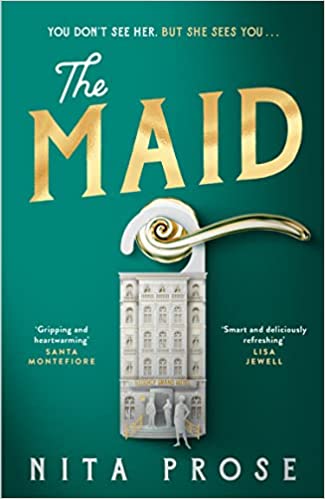
The Maid by Nita Prose #20booksofsummer23

Another #20booksofsummer23 read for me, this was an airport purchase, left with me by a friend. I was intrigued that it won the Goodreads Mystery of the Year 2022, a genre I rarely read, but decided I would do so, to see what mystery readers are currently appreciating.

This is popular locked-room mystery fiction, featuring badly behaved hotel guests, errant staff and one young woman who appears to only see good in everyone.

Canadian literature mystery

It quickly became obvious that this is another novel that centres around a character that doesn’t pick up too well on social cues and is not able to interpret subtle meaning – it feels demeaning to use that term “on the spectrum”, however it seems that creating a character that has certain quirks, allows an author to create situations that wouldn’t otherwise seem realistic.

The truth is, I often have trouble with social situations; it’s as though everyone is playing an elaborate game with complex rules they all know, but I’m always playing for the first time. I make etiquette mistakes with alarming regularity, offend when I mean to compliment, misread body language, say the wrong thing at the wrong time.

So now, we can add The Maid to that group that includes Eleanor Oliphant Is Completely FineBig Girl, Small Town and Lessons in Chemistry.

Molly the Maid is possibly the least perceptive in terms of judging other human’s intentions of all these characters, but her obsession with cleanliness, in part thanks to her Grandmother’s habits, and her observation skills and recall are second to none.

Gran used to say, ‘If you love your job, you’ll never work a day in your life.’ And she’s right. Every day of work is a joy to me. I was born to do this job. I love cleaning, I love my maid’s trolley, and I love my uniform.

Photo by Martin Pu00e9chy on Pexels.com

25 year old Molly works in a posh hotel, as a maid and is excellent at her job, she has recently lost her grandmother and now she has discovered a dead body in one of the hotel rooms. It becomes clear that whoever is involved is trying to frame her and she is at a bit of a loss as to how to shift blame away from her. She needs to upskill quickly in discerning who she can trust and who is undermining her, before she finds herself on the wrong side of the law.

…existing in plain sight while remaining largely invisible. That’s what I’ve learned being a maid. You can be so important, so crucial to the fabric of things and yet be entirely overlooked. It’s a truth that applies to maids and to others as well, so it seems.

Photo by Pixabay on Pexels.com

One of the best parts I liked about the book, was that whenever Molly felt alone or unsure, one of her grandmother’s sayings would pop into her head, and it was always pertinent advice. It might have been a little cliché, but it was also reassuring, given her still present grief and lack of trustworthy colleagues or friends.

‘Gran,’ I say to the empty room, ‘I think I’m in trouble.’ I arrange the photos on top of the curio cabinet. I polish each of Gran’s treasures and stow them safely behind the glass. I stand in front of the cabinet looking at everything inside. I don’t know what to do.
You’re never alone as long as you have a friend.
I’ve been managing alone though all of this, but perhaps it really is time to call for help.

When she begins to ask for help, she discovers who really is there for her and how connecting with these people also helps her continue to learn and grow.

As I finished this, I saw that there is a Molly the Maid #2 sequel coming out soon, a famous mystery writer drops dead in the Grand Hotel tea room and Molly appears to have known them previously!

People are a mystery that can never be solved.

A very light-hearted, easy read with a rewarding conclusion, not too many twists. Ideal summer read if you like a cosy mystery.

The Son of the House by Cheluchi Onyemelukwe-Onuobia

Described as a compelling novel about two women caught in a constricting web of tradition, class, gender, and motherhood and set in Nigeria, I requested this novel via NetGalley earlier this year immediately attracted by the premise and the setting.

Scotiabank Giller Prize 2021, Canada’s Literary Award

Scotiabank Giller Prize shortlist Nigerian literary fictionCoincidentally, the day I started reading it, I became aware it was one of the five shortlisted novels for the Canadian literary award, the Scotiabank Giller Prize on the same day the winner was to be announced.

It didn’t win – that award went to journalist/novelist Omar El Akkad for What Strange Paradise, a novel that examines the current refugee crisis and the lengths to which people will go to find home, safety and belonging – however The Son of the House is already an award winning novel and one that addresses important contemporary issues and one I highly recommend reading.

Review

I really enjoyed The Son of the House right from the opening pages; the intrigue set up by the fact that two women have just been kidnapped from within their car on a residential street, we know nothing about who they are or why this has happened. However, it is not the drama that takes centre stage, it is the lives of the characters, who we will come to know.

These two do know this kind of thing can happen and the woman who drove castigates herself for having taken that particular road.

We did not entertain the idea that the police might save us, guns blazing, as happened in the movies. The police themselves, people said, would sometimes tell the family of kidnapped persons to go pay the ransom so that harm would not come to their loved one. They had neither the resources nor the serious desire to pursue kidnappers. There was even speculation that the police might be complicit in some kidnappings. So our only hope, like many kidnapping victims in this country, was that our people would come up with the money.

Since they are going to be spending time together, they decide to share their stories. And thus the reader must wait while getting to know these two women and the circumstances that lead to this intersection of their lives.

Their lives are very different, and both equally fascinating and riveting to read about.

Nwabulu, Orphan, Housemaid, Mother

gender women expectations motherhood The Son of the House

Photo by Breston Kenya on Pexels.com

Nwabulu, lost her mother when she was born and her father remarried soon after.

From that day, the peace and joy of our home moved somewhere else; peace and joy could not stay in the same room as Mama Nkemdilim’s jealousy.

Her stepmother resents her and at the first offer, sends her away to serve for a family. Innocent, yet she seems to go from one terrible situation to another, no adult looking out for her, she is vulnerable to the outside world, even within the supposed confines of an employer’s home.

I had been a housemaid for nearly half my life when I met Urenna. My first sojourn as a housemaid began when I was ten.

She finds a situation finally that suits her, only to be disgraced and sent back again to the village. The situation that occurs is the first instance we become aware of the presence and significance of ‘the son of the house’.

I was a housemaid. He was the son of the house. He would not really know what it was like to work in a place and live and sleep there but still know that it was not home. He would not know and I could not put it into words.

Back in the village, an older woman who has lost her son, appears to offer solace to Nwabulu, but her life too revolves around this traditional symbol, and the lengths to which she will go to fulfill it are devastating.

Although this is a story of women, it is also about the intersection of women and the importance, presence and success of this symbol, ‘the son of the house’ to their society and how it impacts their lives as girls, sisters, young women, and as mothers.

Julie, Sister, Unmarried daughter, Second wife

parental authority expectations gender The Son of the House

Photo by Monstera on Pexels.com

The second woman Julie is single and contentedly having an affair with a married man. She has one brother and he is supposed to be the example and support of his family, according to how their father has raised them.

“By joining the church and getting an education,” he continued, “I brought light to my family. It is the duty of each new person in the line to bring something good to the family, to keep the family going.”

However, due to her brother’s problems, her father makes this her responsibility, on his death bed, that she will work to ensure the success of her brother in meeting his familial duties – here again we realise that these stories, these women’s lives revolve in some way around maintaining the tradition, the status of the patriarchy, in the elevation of and presence of ‘the son of the house’.

I would make a better son of the house, I sometimes thought. But what fell to me was not carrying on the family name but ensuring that the one who was to do so succeeded.

Unexpected Friendships, Synchronicity’s

Cheluchi OnyeMelukwe Onubia Europa Editions UKAs their stories unfold, we also discover the importance of these women’s friendships, both of them have been helped by their best female friend at a turning point in their lives and the mystery gradually unfolds as to what has brought these unexpected allies together.

It’s a riveting read and an insight into Nigerian culture and classism, into how two very different women navigate a traditional patriarchal society and not only survive, but the lengths to which they will go to both meet those cultural/societal expectations, to develop resilience, how they find ways to rise beyond it.

I loved the book and thought the characters were realistic and intriguing and the sense of place evocative.

Here’s the fabulous UK cover version, it was published in the UK by my favourite publisher, Europa Editions in May 2021. Highly Recommended.

Further Reading

Review, Brittle Paper: Cheluchi Onyemelukwe-Onuobia’s The Son of the House reviewed by Ikhide Ikheloa

Interview, Olongo Africa: I am a child of the 80’s an interview with Uchechukwu Umezurike

Cheluchi Onyemelukwe-Onuobia, Author

The Son of the House Nigerian LiteratureCheluchi Onyemelukwe-Onuobia is a Nigerian-Canadian lawyer, academic and writer.

She holds a doctorate in law from Dalhousie University and works in the areas of health, gender, and violence against women and children.

Cheluchi divides her time between Lagos and Halifax.

The Son of the House was shortlisted for Canada’s Scotiabank Giller Prize 2021, winner of the Nigeria Prize for Literature 2021, and winner of the Best International Fiction Book Award, Sharjah International Book Fair 2019.

A Town Called Solace by Mary Lawson

I came across this author by chance having seen another of her books reviewed and after a period of not reading, her novel(s) sounded like something I’d quite enjoy as a way back in to reading. There were comparisons made to Anne Tyler, of whom I’ve read and reviewed a couple of novels here Ladder of Years and A Blue Spool of Thread, however having now finished I would say this offers much more beneath the surface of plot.

Booker Prize 2021 Mary Lawson CanadaWhat I wasn’t expecting was to then see this novel long listed for the Booker Prize a short while after I requested it. Doubly intrigued, as this is the only book on that list I have, I began to read.

I loved it.

Not only was it the good choice I had expected for my own personal reasons, it exceeded my expectations in so many ways.

The title is both intriguing and promising and the cover, the way it zooms in on the house in a way that shows little else around it, is such an apt metaphor for the three lives it focuses on, those three windows into their worlds, and the three time sequences it immerses in to portray them.

A character driven mystery that explores boundaries and trust, the characters and their voices are superbly portrayed, they are like closeups, snapshots of little action, complex inner worlds, all of whom have been tilted in some way and are in the process of finding their upright, their wings even; yet there is a clear, interlinked story that ties them together keeping the reader engaged and the plot moving forward at a good pace.

I came to think of these three characters, Mrs Orchard (Elisabeth), the grown up child and previous neighbour of Mrs Orchard, now adult (Liam), and 8 year old current neighbour of Mrs Orchard (Clara), as depicting narratives of past, present and future, that overlap.

When the story begins we meet Clara standing at the window of her house, watching obsessively, waiting for her sister Rose (16) who has run away from home. She is waiting for any sign of her return and is disturbed to see a strange man carrying boxes into Mrs Orchards home next door.

The Inner Journey (Anti-hero)

Rose having gone missing may appear to some as the central drama, however each of the three characters are embarking on their own inner quest that this drama brings to light. Rose and her parents are not central characters, and the mystery of Rose’s disappearance is not allowed to take over the narrative.

This may prove to frustrate some, so tuned in are we to the more dramatic story pushing in to take centre stage. Here, the larger than life character, though involved in the more dangerous narrative, is made into a secondary character, kept at a distant. It’s the Penelope versus Odyseuss dynamic again, as recently depicted in Brenda Lozano’s excellent Loop.

More than disturbed, Clara is anxious because she has the keys to the house to enable her to feed the cat Moses while Mrs Orchard is in hospital. She’d promised she wouldn’t be gone long. Through Clara’s perspective we observe how confusing childhood can be when adults put so much effort into lying and withholding truth from them. In reality, they are extra sensitive to everything outside of and beyond words, cues that enable them to feel truths, therefore making them mistrust adults, whose words deny their truth.

But she had been away long, she’d been away weeks and weeks. Clara had run out of cat food several times and had to ask her mother for money so that she could go and buy some more. (This was before Rose disappeared, when everything was normal and Clara could go wherever she liked.) She’d expected Mrs Orchard to be more reliable, and was disappointed in her. Adults in general were less reliable than they should be, in Clara’s opinion, but she’d thought Mrs Orchard was an exception.

The Lying Life of Adults

wood rooftop building construction

Photo by Renato Rocca on Pexels.com

Clara doesn’t know this yet, but Liam remembers what it was like to be that child and he is the one adult who doesn’t lie to her. But in order to gain her trust, he will be required to step outside his own comfort zone and finds himself getting involved in a community and the lives of people he had no intention of knowing. In the midst of his own mid-life crisis, this unexpected event had given him a welcome distraction, however he had planned to stay 2 weeks and leave.

By six in the evening, nightmarish northern roads notwithstanding, he was walking up the steps of Mrs Orchard’s porch, with Toronto, his career and his marriage behind him.
And now, not much more than twelve hours later, somewhat dazed and very short of sleep, he was sitting in a strange house, which he happened to own, trying to explain it all to a cop.

In an entertaining subplot to his story, his effort to fix a leaking pipe under a sink miraculously leads to him to become the builder’s labourer, in on of those familiar scenarios of “well in order to fix that, first we’re going to have to fix the roof and unfortunately…”

‘How much is all this going to cost?’

‘Materials and labour. Biggest cost is labour, but with you working for free I’ll knock a third off that.’

Liam’s narrative happens ahead of Mrs Orchard’s and Clara’s narrative occurs ahead of Liam’s. It is so subtle and yet so clever as it creates a kind of mystery within the individual story of each character. So we sometimes read of the same event later from a different perspective.

Angelic Attendants

Elisabeth is in hospital (in the past because in the present we know she has already passed away) and her narrative uses the second person (You) as she is speaking to her dead husband (of many years now), who is very present for her, a sign to the reader of how close to her own passing is likely to be. As she speaks to her husband, she is recalling a period many years ago when the boy Liam lived next door with his family. Little clues drop indicating that something happened, something only Elisabeth now remembers.

Times without number I have asked myself how it could have come to that. Now, from a distance thirty years I can see the answer clearly: little by little.

The writing is superb and atmospheric, the structure is sophisticated and yet flows with ease you could read this and be completely unaware of it. The individual voices of the characters are pitch perfect and atmosphere created, remarkable. The drama is understated yet palpable and the mundane slowly gets filled with intrigue and curiosity was the layers are revealed. And it made me laugh out loud – often, little surprises and a fabulous last laugh for the closing scene.

I don’t know if this will make the shortlist but I totally understand why it has been nominated. I’m excited to read more of her work, because this was brilliant.

Highly Recommended.

Mary Lawson, Author

Mary LawsonMary Lawson was born and brought up in a small farming community in southwestern Ontario and moved to England after graduating from McGill University with a degree in psychology.
She is the author of three previous nationally and internationally bestselling novels, Crow Lake, The Other Side of the Bridge, and Road Ends. Crow Lake was a New York Times bestseller and was chosen as a Book of the Year by The New York Times and The Washington Post, among others. The Other Side of the Bridge was longlisted for the Booker Prize.

Further Reading/Listening

Q & A Interview: In conversation with novelist Mary Lawson by Kobo

Video Interview: Reader Meets Writer, Wiley Cash interviews Mary Lawson on A Town Called Solace

N.B. Thank you kindly to the publisher Random House UK for providing a copy for review via Netgalley.

shallow focus photography of gray cat in box

Photo E.Grossgasteiger on Pexels.com

The Party Wall by Catherine Leroux (2016)

translated by Lazer Lederhendler (from French-Canadian into English).

Reading Women in Translation

French Canadian literature in translationMy final read of August for WITMonth was The Party Wall, French Canadian author Catherine Leroux’s third novel. It was shortlisted for the Scotiabank Giller Prize, which annually recognizes the best in Canadian fiction – and has just announced its 14 strong long list for 2020. The translation by Lazer Lederhendler won the Governor General’s Literary Award for translation (French to English).

This novel is told in chapters about paired characters; mother and son, brother and sister, husband and wife; so it stops and starts as we leave one pair and move to the next. There doesn’t initially appear to be a connection (although there is) between the lives so the stories are quite different, creating the effect of reading short stories with the expectation that the threads will come together to reveal the tapestry.

The novel opens with Madeleine (actually it doesn’t but it’s the more memorable opening chapter), a woman who has lost her husband; she visits the spot where his ashes lie beneath a tree and talks to him often. Her son has left home and she hears of him through the many travellers who arrive looking for a bed for a night, people he has given her address. There is a sadness of loss of the other in her, an affliction which is given a bizarre (but true) cause when she is told she is not a biological match for her son, when at last he does return.

The Party Wall Catherine Leroux lighthouse

Photo by Kristina Gain on Pexels.com

From the window of her office, Madeleine looks at the watchman doing his rounds. This is what she does when her eyes need a rest. There’s the sea, of course, but it isn’t at all restful. It’s a struggle, a call, a mystery whispered with every rising tide. The watchman, on the other hand, is calm and predictable. Afflicted by gout, he has never taken a day off. He circles around the lighthouse like a grey satellite; his hobbling in no way diminishes his reassuring presence.

As their lives move forward, the theme of separation becomes apparent, its inherent wounding manifesting in different ways in each pair of lives.

Oddly enough, it was a long time before they realised they had both been adopted. Marie, haunted by her origins, preferred to wait before broaching the subject and kept the truth sealed inside her chest. As for Ariel, his sense of belonging to the Goldstein family was so powerful that he rarely gave any thought to the fact he had been born elsewhere, welcomed into the world by unknown hands, which had passed him on to someone else like a baton in a relay race that was to lead to as yet unseen heights.

Silence as a Familial Weapon

graveyard shift cemetery ghostly presence

Photo by Pixabay on Pexels.com

Carmen and Simon are siblings and we meet them around their mother’s deathbed, a woman who never revealed to her children who their father was, controlling them through withholding, keeping them attached through the sliver of possible revelation. Carmen runs marathons to forget, while Simon tries to avoid witnessing his marriage fall apart, removing himself by choosing to work the graveyard shift.

The term “graveyard shift” is perfectly apt: the darkness and silence of a cemetery always mask a ghostly existence, the invisible dramas of the dead and their mourners.

It’s a thought provoking and cleverly constructed novel, however the disjointed stories inevitably expose the weaknesses of one against the strengths of another, and so writing about it a week after reading highlights that which was memorable and that lost to the river of stories who are lost in the current.

Ultimately, what stays with the reader is the importance of the connections we do make, those we choose and those we pursue, for better or worse. A couple of the stories could have evolved into novels in their own right.

The Party Wall has its own logic and its own internal structure and systems: four stories that become intertwined as the book progresses. Three of those came about from extraordinary news stories I had come across. Catherine Leroux

Further Reading

Article CBC/Radio Canada: Catherine Leroux on the literary value of loose ends

Article: How Catherine Leroux ripped fiction from the headlines in The Party Wall

Article: 14 Canadian books make the 2020 longlist for $100k Scotiabank Giller Prize, 8 Sept 2020

Granta 141: Canada – Mangilaluk’s Highway by Nadim Roberts

Granta 141 Canada

The first Granta journal of 2018, issue number 141 is focused on Canadian literature, whether it’s fiction, memoir, reportage, poetry or photography, each issue combines something of each of those categories, with new writing/work by known and little-known talent, around a common theme.

As guest editor and author of Do Not Say We Have Nothing, Madeleine Thien shares in the opening introduction, (and fellow guest-editor Catherine Leroux, writing in French), their only parameter for submissions was ‘What is being imagined here, now?’

Canada being a land with sixty unique Indigenous language dialects and more than two hundred languages reported as a mother tongue or home language, it was a wide-ranging brief.

Language becomes its own landscape in this issue of Granta. Language falls apart, twists, reformulates, shatters and revives itself. Animal and self, unfinished history, land and waterways, colonisation and dispossession, settlement and refuge – all these nouns are part of the truth of this place.

Apart from Leroux’s introduction, all the work is either in English or has been translated from English, however all work in translation is available to read on Granta.com in the original French.

It features writers such as Margaret Atwood, Lisa Moore (her novel February reviewed here), Alexander McLeod, Krista Foss, Naomi Fontaine, Kim Fu, Anosh Irani, Paul Seesequasis, Anakana SchofieldJohanna Skibsrud,  and many more…

I’m reviewing here the first story and may share other’s with you as I select randomly from the journal over the coming months.

Mangilaluk’s Highway

The opening story is a mix of reportage and a retelling of the story of Mangilaluk Bernard Andreason, who when he was 11 years old, slipped out of the Inuvik residential boarding school he’d been sent to, along with two friends Jack and Dennis, to avoid being punished for stealing a pack of cigarettes, and spotting newly hung power lines, decided to follow them home to Tuktoyaktuk.

Nadim Roberts writes about Bernard’s journey in the present, interspersed with narrative reports on his own visit to Tuk in June 2017, forty-five years after Dennis, Jack and Bernard began walking that 140 kilometre stretch home. Robert’s by contrast, completes the journey from Inuvik to Tuk in thirty minutes by plane.

He tells of successive attempts by the government to build a road across the Arctic Circle, to facilitate oil and gas exploration and a stretch of highway that would connect Inuvik to Tuk.

 From the plane I could see occasional glimpses of a new, near-finished road. This was the long awaited Inuvik-Tul all-season highway that would open in a few months.

Chief Mangilaluk

We learn that Tuk was a town founded by survivors from Kitigaaryuit, an Inuit settlement, that in 1902, after contact with whalers was cursed with a measles epidemic which drastically decimated their population. One young man, Mangilaluk, departed and went looking for a new place to live. His choice, a site on the edge of a harbour, would become what is now known as Tuk. He became chief and is still talked of today. Some believed he was a shaman who could shape shift into a polar bear.

In July 1961, two decades after he died, Mangilaluk’s granddaughter Alice Felix, was eight months pregnant. While home alone one evening, she heard a knock on the door. She wasn’t sure if she was awake or dreaming when the door swung open. A three-metre-tall polar bear stood in the doorway. It walked up to her, put its snowshoe-sized paw on her pregnant belly, and began to speak: ‘If it’s a boy, you name it after me.’

The story reminded me immediately of Doris Pilkington Garimara’s Rabbit Proof Fence, a tale of indigenous Aboriginal children removed from their parents (following an Australian government edict in 1931, black aboriginal children and children of mixed marriages were gathered up by whites and taken to settlements to be assimilated) and put in  a boarding school. The three girls in this true story followed a fence built to keep rabbits out of farming land, knowing that it passed close to their home.

Before 1955, fewer than 15 per cent of school-aged Inuit were enrolled in residential schools. Most children still lived on the land with their families, learning traditional skills and knowledge.

By 1964, more than 75 per cent of Inuit children attended residential schools. Their values, language and customs were supplanted overnight by a culture that saw itself as benevolent and superior, and saw the Inuit as primitive beings in need of sophistication.

Nadim Roberts interweaves Bernard’s story, his grandfather’s story and the current issues facing indigenous and local people in the region, in an evocative portrayal of one boy/man’s courage against the odds to make something better of his chance at survival.

Nadim Roberts Source: Author Provided

It’s an excellent piece of writing and combination of narrative and reportage, bringing attention to this one man’s story and the plight of both his people and the environment in which they live.

You can read Nadim’s story for free at Granta, just click on the link below:

Mangilaluk’s Highway by Nadim Roberts

Nadim Roberts is a journalist from Vancouver whose work has been published in Walrus, Maisonneuve and the Globe and Mail.

Further examples of his work can be viewed on his website NadimRoberts.com

Have you read any recommended works by any of the authors mentioned or others featured in Granta 141?

Do Not Say We Have Nothing by Madeleine Thien

Tomorrow begins from another dawn,
when we will be fast asleep.
Remember what I say: not everything will pass.

I like the saying “this too shall pass”, it’s a way of being in the difficult moment, of realising that it will be replaced by something else, it represents a sliver of hope, a reminder of gratitude, that thoughts are not reality, they can be changed. So this quote that “not everything will pass” evokes a kind of heartfelt stab for me, for it pierces that hope and reminds us that some things stay, that they are not seeds of hope, they are reminders of a sadness that endures.

‘Do Not Say We Have Nothing’ felt to me like a novel of ancestral DNA and how living through Chairman Mao’s and the subsequent communist regime imprinted its effect onto people behaviours forcing them to change, leaving its trace in their DNA which was passed on to subsequent generations, who despite living far from where those events took place, continue to live with a feeling they can’t explain, but which affects the way they live, or half-live, as something crucial to living a fulfilled life is missing. This reminds me of what Yaa Gyasi achieves so successfully in her extraordinary novel Homegoing, spanning an even longer historical trajectory of 300 years.
The novel is presented through dual narratives, in Canada today Marie lives alone with her mother, her father Ba, died in Hong Kong far from them both in circumstances they don’t understand, a kind of double abandonment. The alternate narrative is set in her father’s time, with his extended family during the time of and following China’s Cultural Revolution.

We will come to understand that mystery as the daughter of one of her father’s friends Ai-Ming, comes to stay with them and recognises the calligraphy of her father in a box of books under the kitchen table, the first encounter we have with a manuscript called ‘The Book of Records’ a narrative by an unknown author, one that has been added to and copied and left as a message for various characters who became lost over the years.

The title of the manuscript is an allusion to China’s most celebrated work of history, Sima Qian’s Historical Records, completed in 91BCE but kept hidden for fear of the wrath of an emperor who had its author castrated. The telling of history in China was always a dangerous occupation.

We are taken back to China to the home of Ai Ming’s father who is referred to as Sparrow, a composer at the music conservatory, one of his students Kai and his young cousin Zhuli, whose parents are the first to come under the harsh judgement of Mao’s philosophy, because they were landlords, denounced, beaten, thrown from their homes, accused and sent to labour camps for unsubstantiated crimes. The young daughter is deposited with her Aunt and Uncle miles away in the city, under the protection of her Uncle who works for the regime.

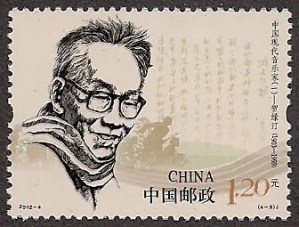
He Luting, Composer (1903 – 1999) China

The story follows these three musicians who are passionate about music (which will become the wrong kind of music) and to survive they must suppress their desires, their passion and compromise, the three of them each make different choices, that will affect those around them.

The narrative around the musicians and some of the characters closely mirrors actual events that occurred in the Shanghai Conservatory of Music, the main concert hall now renamed He Luting Concert Hall, after the Director who “in 1968, after two years of violence and humiliation, was dragged before television cameras by Red Guards to be threatened and physically abused”

In the following quote, Ai-ming listens to what she learns is her father’s music for the first time, music that was destroyed before it could ever be played, recalled from the recesses of the mind of the composer, after 20 years of silence.

“Ai-ming sat on a chair in the corner as her father played the piano, she had never heard him do so before, had not quite realised he was even capable. His entire body, the way he moved, changed. Most of the pieces she recognised from the records (Bach’s Partita No. 6, Couperin, Shostakovich) but there was another piece, a complex figure that seemed to disassemble as she listened, a rope of music,  a spool of wire. It seemed to rise even as it was falling, to lift in volume even as it diminished, a polyphony so unfathomably beautiful it made the hairs on the back of her neck stand up. When it stopped tears came abruptly to her eyes.”

This is a tragic novel whose characters spirits are oppressed by a philosophical regime, which mutates into something equally oppressive after the death of Chairman Mao, for a while the younger generation without the memory of the era their parents generation suffered under (and somewhat judging of their inability to challenge the circumstances forced upon them), appear to revolt against the lack of freedom to choose their paths, until they too are brutally crushed in the events of Tiananmen Square in 1989, ensuring the new generation understand the power and reach of an authoritarian regime, that no-one is immune to.

Madeleine Thien had originally intended to write a novel about the 1989 demonstrations in Tiananmen Square, events she vividly remembered watching unfold on television during her teenage years, however over time she began to ask herself more about what had motivated the one million Beijing citizens to come out onto the streets, especially the older generation.

“What gave them the courage to stand up to the government? And, what made them come into the streets to want to protect, in many ways, their children, and another generation? So I think that’s why it ended up going backwards into the Cultural Revolution. I’d been writing about Cambodia before that – the Cambodian genocide – and one thing I’d been thinking a lot about were the musicians. I started thinking about what was it about music that could be so threatening. We often know about the writers who are targeted by totalitarian regimes but looking at musicians is another way in to thinking about what’s threatening to this consolidation of power.” Madeleine Thien, Granta Conversation

Madeleine Thien

This is a must read novel if you wish to reflect on how recent Chinese history affects the present generations, how regimes affect generations of their populations and how even though subsequent generations may not have experienced the past, they continue to feel its effect in their lives today.

It was short listed for the Baileys Women’s Prize for Fiction 2017.


Further Reading:

Article by Madeleine Thien: After the Cultural Revolution: what western classical music means in China, The Guardian, 8 July 2016

Madeleine Thien Interview : on a solitary childhood in Canada and daring to question the Chinese regime, ‘In China, you learn a lot from what people don’t tell you’, The Guardian, 8 Oct 2016

Conversation with Madeleine Thien: On translating the sensation of music for a reader, the importance of writing about women of colour, and the Chinese conceptual framework of time, Granta Magazine, 3 Oct 2106

Buy a copy of ‘Do Not Say We Have Nothing’ here


Cereus Blooms at Night by Shani Mootoo

 Cereus Blooms at Night is the partially told story of one woman’s life, beginning when she is admitted to an alms house, suspected of having murdered her father and slowly unravelling back to the turning points, the highs and lows which brought her to be in the state she is in on arrival.

cereusIt is a novel narrated in parts, each part focusing on a character(s) who were influential in her life, including the young man who never knew her until this day, the one who became her confidant, perhaps the first man she ever trusted, after all that had passed beforehand. Much of it is told as Mala slips into memories of herself as child, reliving it.

It is set on the fictional Caribbean island of Lantanacamara, in a town called Paradise, the Ramchandin patriarch arriving there from India, trading a life of indentured servitude for little more than the promise of a karmic upgrade for his son, Chandin, who would be taken under the wing of the Reverend in the hope of improving the family prospects.

The young male nurse, Tyler accepted his first job in the alms house and although well-trained and qualified, his employers had yet to extend their generosity towards giving him actual nursing duties. The arrival of the controversial patient Mala Ramchandin, provided him with the first opportunity to exercise his skills.

I hardly had opened my mouth to explain that Miss Ramchandin was too frail to inflict even a bad thought when Sister screamed at me for being insolent and blatantly disregarding her authority.

No one else wanted to go near her, she was bound and believed to be mad and dangerous. Tyler was delighted to be given the opportunity and responsibility and treated his patient with the same compassion he might have offered any patient given the chance. Sensing her distress, he acted to alleviate it regardless of instructions to do otherwise.

cereusAs Tyler gained her trust, Mala’s story is revealed to us through him and through the two visitors she received, who on her first day there, unable to see her, left a pot with a cutting of the fragrant night-blooming cereus plant, a gift that clearly delighted her, a symbol of fragrant, nurturing oblivion.

The novel is full of contrasts, moments of delight and anticipation alongside the growing recognition of impending horrors, abuse and neglect. It taunts the reader into a state of hope, as the potential for things to have been otherwise is so close at times, only for the illusion of escape to become shattered by the reality of a situation that holds tight to those who are caught in its web.

The novel is unique in its portrayal of characters whose sexual identity is unclear, exploring hybridity and sexual minorities within a cultural context, in an intriguing, accepting way.

By the time Ambrosia was five, her parents were embroiled in their marital problems to the exclusion of all else, including their child. They hardly noticed that their daughter was slowly transforming herself into their son.  Ambrose slept right through the month, undisturbed until the first Saturday of the next, and Elsie, hungry for a male in the house, went along with his (her) strong belief that he (she) was really and truly meant to be a boy. Else fully expected that he (she) would outgrow the foolishness soon enough.  But the child walked and ran and dressed and talked and tumbled and all but relieved himself so much like an authentic boy that Elsie soon apparently forgot she had ever given birth to a girl. And the father, in his few waking episodes, seemed not to remember that he had once fathered one.

Despite the harrowing nature of Mala’s experiences, the luminous storytelling and unique characters bring light to otherwise dark places, and show that perseverance and allowing space for love, can overcome all manner of tragedy.

I came across the author Shani Mootoo in my search for other women authors, writing in the Caribbean tradition, authors who may have lived and been educated elsewhere, but whose writing evokes a clear connection to roots from elsewhere. Mootoo was born in Ireland, raised in Trinidad and moved to Canada as a young adult.

Trinidad and Tobago literature is rooted in the oral storytelling of African slaves, the European literary roots of the French creoles and the religious and folk tales of the Indian indentured immigrants.