Sister Outsider, Essays and Speeches by Audre Lorde (1984)

Audre Lorde was a poet, academic, speaker, feminist activist, sister and mother of two, who grew up in 1930’s Harlem. She wrote 12 books and tragically passed away at the age of 58 from cancer in 1992.

I’ve had her collection of essays Sister Outsider on my list of books I wanted to read for a few years, I came across it after reading an article or blog post that put it at or near the top of books one should read if interested in feminism, gender, equality. They are the kind of books that those who studied the humanities and perhaps took women and/or gender studies will have had an awareness of and the rest have to dig a little to find out about. All that is made easier today as we are able to follow readers, writers who share articles, lists, books of interest via twitter or online reading groups etc.

And while some of Lorde’s experience will be unique to her and those who relate to her experience as a black lesbian poet and academic in America, it is both the differences and the universality of her message that interests me, her lucid prose carries the telltale markings of a poet set free from that form, of a woman with an elevated consciousness whose reflections teach us something, break through common misconceptions. She invites us to listen and learn.

The collection both begins and ends with essays that focus on her travelling outside the US, a literal perception of her as an outsider, however the main body of work centers around issues within her country of birth, where that feeling of ‘outsider’, arrives because of the way we relate to others, or how they relate to our race, identity, gender, sexual orientation, class.

TRIP TO RUSSIA

I loved this opening essay, what an amazing opportunity to travel to Moscow for a conference, an experience that affected her so deeply, she dreamed about it every night for weeks after her return. We read this and sense how little we really know about life in a country where most of what we see, read and hear is a form of propaganda our respective country’s wish us to believe, not the lives of ordinary people going to work, or the little things that might impress us, different from our own normal.

Her first observation begins with the woman in the seat in front of her on the plane, travelling alone. She assists her, noticing she wears three medals.

“Hero of the Republic medals, I learned later. Earned for hard work.

This is something I noticed all over: the very old people in Russia have a stamp upon them that I hope I can learn and never lose, a matter-of-fact resilience and sense of their place upon the earth that is very sturdy and reassuring.”

She doesn’t say much about the conference, it is the everyday differences and similarities she is interested in and notices. One evening before dinner she walks outside and enters a Metro station just to watch the faces of people coming in and out. The strangest thing she notices is that there are no Black people and the ticket collector and station manger are all women.

The station was very large and very beautiful and very clean – shockingly, strikingly, enjoyably clean. The whole station looked like a theatre lobby – bright brass and mosaics and shiny chandeliers.

And then on to Tashkent, a place of contrasts, a people, Uzbeki who are Asian and they are Russian, people she senses are warm-blooded, familiar, engaging. The old part looks to her like a town in Ghana or Dahomey, African in so many ways. She meets a woman who enlightens her on the history of the women of Uzbekistan, women who fought to who their faces and go to school, and they died for it. Different struggles, hard-earned progress, both inspirational and cautionary.

POETRY IS NOT A LUXURY

A mini four page essay full of light that I read and reread, because it ignites one’s inner creativity, I search for a passage to share and find it almost too restricting to condense her flow of thoughts into one phrase. It is this essay that demonstrates Lorde’s evolved consciousness and connection to a women’s sense of power that comes from some ancient, deep place, something that cries out to be illuminated.

It is poignant to reread this again now, in the days that follow the passing of another great woman poet, Mary Oliver, whose collection A Thousand Mornings, I recently read and I am reminded of when I read Lorde’s thoughts on the power and benefit of poetry, whether we are writing it or reading it.

For women, poetry is not a luxury. It is a vital necessity of our existence. Poetry is the way we help give name to the nameless so it can be thought. It forms the quality of the light within which we predicate our hopes and dreams towards survival  and change, first made into language, then into idea,  then into more tangible action. The farthest horizons of our hopes and fears are cobbled by our poems, carved from the rock experiences of our daily lives.

Poetry provides new ways of making ideas felt, it allows symbolism to replace that which can’t often be articulated, and it is that ancient connection to divine feminine energy that puts us back in touch with our ability to see through signs and symbols.

THE TRANSFORMATION of SILENCE into LANGUAGE and ACTION
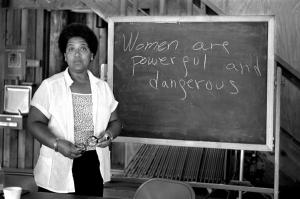
Lorde begins to address the complicit silence of women in this essay and will return to it in subsequent essays, leading up to The Uses of Anger where she challenges them into action, even if that means active listening, reading and learning, to become more aware.

In this essay she speaks of the fear of coming out of silence, because that transformation is an act of self-revelation, that seems fraught with danger.

In the cause of silence, each of us draws the face of her own fear – fear of contempt, of censure, or some judgement, or recognition, of challenge, of annihilation. But most of all, I think, we fear the visibility without which we cannot truly live.

In MASTER’S TOOLS she confronts our differences and speaks of the arrogance of discussing feminist theory without examining these and input from poor women, Black and Third World women, and lesbians, that as women we have been taught either to ignore our differences or see them as causes for separation and suspicion rather than forces for change.

It is learning how to stand alone, unpopular and sometimes reviled, and how to make common cause with those others identified as outside the structures in order to define and seek a world in which we can all flourish. It is learning how to take our differences and make them strengths.

In THE USES OF ANGER: WOMEN RESPONDING TO RACISM, though she speaks within the context of racism towards Black women, giving examples of how implicit this can be in the language of white women who don’t consider themselves racist (unconscious bias and privilege have been embedded in our societies for centuries), her dissection and exploration of the transformative power of anger goes beyond racism and has been applied to feminism and the voice of women trying to progress in other areas.

She likens anger and fear as spotlights that can be used for growth, rejecting guilt and defensiveness, pushing women to strive for better than that.

Every women has a well stocked arsenal of anger potentially useful against those oppressions, personal and institutional, which brought that anger into being. Focused with precision, it can become a powerful source of energy serving progress and change. If we accept our powerlessness, then of course any anger can destroy us.

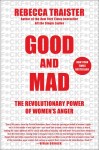
Dr Brittany Cooper, in her book Eloquent Rage takes her work further on behalf of Black women suggesting that ultimately feminism, friendship, and faith in one’s own superpowers are what we need to turn things around, while Rebecca Traister’s Good and Mad tracks the history of women’s anger from the past to the present. She deconstructs society’s and the media’s condemnation of female emotion (notably, rage) and the impact of their resulting repercussions. These two authors, recently came together in conversation to discuss the common ground between their books, you can read more about that or listen to them by visiting this post How Sister Outsider Lead to a Chat Between Eloquent Rage and Good and Mad.

The collection ends with another visit, this time to a place that was always referred to as home, the birthplace of her mother, GRENADA REVISITED. She remembers the first time she visited in 1979, children in their uniforms carrying their shoes as they walked along the busy seafront, the main thoroughfare to school; the woman cooking fish in the market, the full moon. It was just eleven months before the political coup that ousted a 30 year regime, ‘wasteful, corrupt and United States sanctioned’.
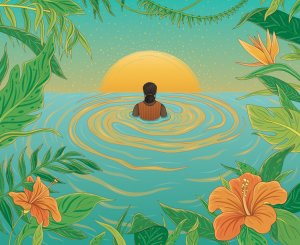
Dawn After the Tempests, created by © Gaby D’Alessandro

The second time (1983) she came in mourning following the invasion by the United States, ‘the rationalisations which collapse under weight of the facts’ details of which are shared in this piece, subtitled  ‘An Interim Report’.

Haitian writer Edwidge Danticat, (see reviews Breath, Eyes, Memory and Brother I’m Dying) visited Grenada in 2017 and though familiar with Lorde’s essay, read it afresh before landing. Her essay Dawn After the Tempests published in the New York Times pays tribute to Lorde’s visit and is a fitting follow-up.

Overall, it’s a diverse and thought-provoking collection, that continues to inspire readers and writers alike.

“[Lorde’s] works will be important to those truly interested in growing up sensitive, intelligent, and aware.” New York Times

Further Reading

Edwidge Danticat, Dawn After the Tempests, New York Times

Audre Lorde – short bio, menagerie of authors – by Juliana Brina, The [ Blank] Garden

How Sister Outsider Lead to a Chat Between Eloquent Rage and Good and Mad

Sister Outsider is something of a classic collection of essays that I first heard about some years ago, a collection that if you have any interest in issues of gender, feminism, or equality should be near the top of the list.

Audre Lordre was a poet, academic, speaker, feminist activist, sister and mother of two, who grew up in 1930’s Harlem. She wrote 12 books and tragically passed away at the age of 58 from cancer in 1992.

I have long wished to read it and was reminded of that recently, when a Goodreads Group I was invited to join and now belong to, Our Shared Shelf, a Feminist Book club created by Emma Watson, inspired by work with UN Women (dedicated to gender equality and the empowerment of women) posted a link to a video (linked below) of a conversation between two writers who have recently published books that reference Audre Lorde’s work, in particular pertaining to women, anger, and race.

Here was an invitation to listen to and participate in a dialogue about the power and consequence of women’s rage, both personal and political, a conversation across race, across cultural contexts, across the things that make us both different and the same

The conversation was in response to the three books chosen for the Book club’s Nov/Dec 2018 reads and online discussion, they’d chosen Sister Outsider and two recent publications Dr. Brittany Cooper’s Eloquent Rage, A Black Feminist Discovers Her Superpower and Rebecca Traister’s Good and Mad: The Revolutionary Power of Women’s Anger.

Audre Lorde was one of the foremost thinkers on the importance of understanding anger, suggesting that most women had not developed tools for facing anger constructively, except to avoid, deflect or flee from it. She wrote about women’s anger transforming difference through insight into power, how it could birth change, that the discomfort and sense of loss it often caused was not fatal, but a sign of growth.

“every woman has a well-stocked arsenal of anger potentially useful against those oppressions, personal and institutional, which brought that anger into being. Focused with precision it can become a powerful source of energy serving progress and change.”

With the rise of hard right authoritarian regimes around the world, many determined to roll back human rights – the very freedoms previous generations of angry women worked to achieve – women today are again being called to embrace their rage – its force, its potential, its messy complications.

To that end, and just as crucial as the call to angry, eloquent expression, is the responsibility – instilled by Lorde – to listen and learn, with curiosity and respect to the rage of the women around us.

On Rebecca Traister’s book:

Rebecca’s book Good and Mad will give you a deep and engaging (and sometimes enraging) historical deep dive into the way that women’s anger has been used throughout history to drive social movements, as well as how rage at the inequalities replicated within those social movements has worked to both slow them and make them stronger.

The stories will make you mad but they’ll also inspire you.


On Dr. Brittany Cooper’s book:

Brittney’s book invites the question of what it takes to meet Audre Lorde’s challenge: how do we focus our anger with precision? Through a range of personal stories about becoming a feminist, navigating friendships and romance and the white-washed shoals of pop culture, as well as contending with the limits of white feminists and the legacy of white feminism, Brittney demonstrates what it means to harness anger as a superpower.

Eloquent rage keeps us all honest and accountable with her provocative, intelligent thinking.

Unlikely to be able to read all three in the time frame, I decided I’d slow read Lorde’s essays and read the other two when paperback versions came out. In the meantime, I entered a competition asking readers who’d watched the interview between these women discussing their books, to answer the following question:

QuestionWhat surprised you about this conversation around anger and how it’s perceived differently depending on who is expressing it?

My Response: First of all I was surprised to be given the opportunity to listen to such a high calibre conversation from within the comfort of one of my favourite online dwelling places – Goodreads!

The whole conversation around the perception of anger depending on who is expressing it surprised me as it articulated what so many of us have felt, experienced, witnessed and NOT been able to articulate, and I loved that they addressed that question of voice and gave kudos to listening and learning.

It just made me want to share this with all women and read both their books! Thank you so much for bringing this opportunity to those of us far, far away to listen, I hope there will be many more.

And since I now find that I am indeed one of the winners and will eventually be receiving copies of the two books mentioned above, I am doing what I said I would do and sharing this enlightening conversation between two eloquent writer’s voices and look forward to being able to share more when I’ve read their works.

Please do have a listen to the brief conversation below that inspired this post, and if you’re interested, join in with me to read their books over the coming months. My attempt to review Audre Lorde’s essays to follow.

Click Below to Buy a Copy:

Audre Lorde’s Sister Outsider

Dr. Brittany Cooper’s Eloquent Rage

Rebecca Traister’s Good and Mad


Refuge by Terry Tempest Williams

An Unnatural History of Family and Place

Terry Tempest Williams is a writer with a deep and active interest in environmental education and conservation, Refuge is both a memoir of a period in her life when she accompanied her mother through the illness that would claim her life, and shortly after her grandmother, leaving her the matriarch of the family at the age of thirty-four.

Although this is the book she is most well-known for, I first read and reviewed her writing and encountered her mother in a more recent, and equally extraordinary book, When Women Were Birds, Fifty-Four Variations on Voice, which was written twenty years later (when the author was 54) in 2012. It was also the age her mother was, when she succumbed to the illness written about in Refuge.  I recommend it equally, they are a unique pair, in their insights, their confusion, their ultimate compassion and understanding.

Throughout the memoir, she spends time with her mother, and equally has concerns for the Great Salt Lake, which sits on their doorstep, it is the place she grew up in, a landscape and wildlife she is obsessed with, one I knew nothing about, but became increasingly intrigued by, this enormous, terminal lake with no outlet to the sea.

Great Salt Lake: wilderness adjacent to a city; a shifting shoreline that plays havoc with highways; islands too stark, too remote to inhabit; water in the desert that no one can drink. It is the liquid lie of the West.

Natives of the area speak of the lake in the shorthand of lake levels, it’s not deep, but it is vast, so it doesn’t take much precipitation for significant rises to occur. In the mid 80’s when she was writing this book (it was first published in 1991) talk on the streets of Salt Lake City was of the lake’s rapid rising, everyone had concerns, the airport, the farms, the railroad, survival.

My interest lay at 4206′, the level which, according to my topographical map, meant the flooding of the Bear River Migratory Bird Refuge.

She writes about her family history, her genealogy with its deep roots in the American West her Mormon culture has preserved and their connection to the natural world, infused with spiritual values.

The birds and I share a natural history. It is a matter of rootedness, of living inside a place for so long that the mind and imagination fuse.

As the author shares the drama unfolding within her family of which she is the eldest child and only daughter, there is always the metaphor of the lake, the simultaneous restlessness of its birds, as if they too sense change coming; she wonders if they are better adapted to it than humans.

The thirty-six short chapters each carry the name of one of the bird species that inhabits the lake environment, they may only be mentioned in one sentence, but they are all listed, noted, observed over time, throughout the pages, they represent the life cycle of species, moving on, migrating, adapting to change, dying, making way for the young.

William’s both observes beauty and dissects suffering as she observes her mother’s and her own and tries to make sense of it, through nature and her current philosophical understanding.

Tonight I watched the sun sink behind the lake; The clouds looked like rainbow trout swimming in a lapis sky. I can honour its beauty or resent the smog in this valley which makes it possible. Either way, I am deceiving myself.

Birds are entwined with local folklore, the Californian gull rescuing the Mormons in 1848 from losing their crops to crickets. They still gather to tell this story.

How the white angels ate as many crickets as their bellies would hold, flew to the shore of Great Salt Lake and regurgitated them, then returned to the field for more. We honour them as Utah’s state bird.

It’s a book where you could highlight a passage on each page, one you can open on a random page and find some meaningful, reflective passage on life, an interesting bird fact or a brief history lesson.

The writing is at times poetic, sometimes scientific, passionate and honest. There’s a perfect balance between the personal and the environment that makes it a compelling read, but also one that you’ll want to savour.

The mother and daughter get their astrology charts done and read each other’s.

“I liked the part about Terry being neat and meticulous,” teased Mother. “I remember standing in the middle of your bedroom when you were about thirteen years old. Everything in your closet was on the floor, art and school papers were piled high on your desk. I remember thinking, I have two choices here – I can harp on her every day of her life, making certain her room is straight – or I can close the door and preserve our relationship.”

As the Great Salt Lake continues to rise, a deep sadness washes over her that all has been lost.
I am not adjusting. I keep dreaming the Refuge back to what I have known: rich, green bulrushes that border the wetlands, herons hiding behind cattails, concentric circles of ducks on ponds. I blow on these images like the last burning embers on a winter’s night.

There is no one to blame, nothing to fight…Only a simple natural phenomenon: the rise of the great Salt Lake.

There is also refuge in poetry, in other writers and the book is interspersed with memorable quotes from those whose words soothe her during this period of grief, as her mother goes into decline. And so I leave this sharing of thoughts on the book here with her reading her Mother a poem one afternoon by Wendell Berry:

T H E   P E A C E  O F   W  I L D   T H I N G S

When despair for the world grows in me

and I wake in the night at the least sound

in fear of what my life and my children’s lives may be,

I go and lie down where the wood drake

rests in his beauty on the water, and the great heron

feeds.

I come into the peace of the wild things

who do not tax their lives with forethought

of grief. I come into the presence of still water.

And I feel above me the day-blind stars

waiting with their light. For a time

I rest in the grace of the world, and am free.

Highly Recommended.

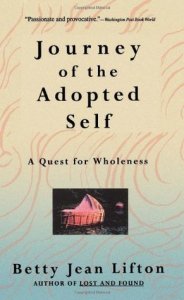
Journey Of The Adopted Self: A Quest For Wholeness by Betty Jean Lifton

I haven’t read an adoption book in many years, and in fact I have only ever read one,  one that is considered a classic in adoption literature Nancy Verrier’s The Primal Wound.

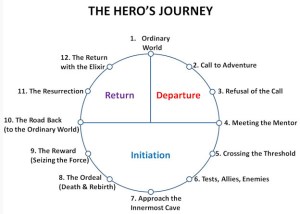
I decided I should increase my awareness and familiarity with the issues, as I’m writing down the story of – as the author, scholar and mythologist Joseph Campbell would put it – my ‘hero’s journey‘, learning who I was ‘born to‘, which is necessary if we wish to learn more about who we were ‘born to be‘, something which is neither about the family we are raised by, nor the one we are biologically related to, but that in-between place, where we carry influence from each, which once unravelled, allows us the space to detach from them both, to pursue a life we can truly claim as our own.

Journey of the Adopted Self, follows that traditional quest, and for each element in the journey, the responding to the call (the decision to search), the departure (actively seeking), meeting the mentor (finding help) crossing the threshold (making contact), the challenges + the ordeal (dealing with the aftermath), the reward (unravelling the mystery), the road back (the new ordinary life) and the elixir (the transformation and the life lesson) the authors discusses a range of issues that can arise and gives examples in brief snippets from the many case studies she has had access to as an adoption counsellor.

Each person has a unique experience, so in the journey there are many reactions likely to be encountered, but the one thing that all adoptees have in common, is that they have experienced what is referred to as the ‘pre-verbal trauma’ of separation from the mother. That may have been immediately after birth or soon after, some babies may never have been held by the mother who carried them for those nine months, others may have been for a few hours or days, or even a few months.

According to the Austrian psychoanalyst and contemporary of Freud, Otto Rank in his book The Trauma of Birth, everyone experiences significant trauma at birth and that trauma or separation from the safety of the womb is healed over time by the bond created and the physical proximity and nurturing provided by the mother, whose heartbeat, smell, voice and very being are a comfort to the baby, who has known these things without seeing them from within.

Adoption adds another layer to the trauma, as the bond with the mother who gives birth is severed and the nurturing is to be provided by another, who has not been infused with the maternal hormones of pregnancy that nature creates to ensure the mother mothers her child. The adoptive mother in her head and heart wills herself to be and provide that role and is a good substitute, but that doesn’t avoid the fact that the baby will have experienced that initial double trauma of separation, first from the womb and then from the human it was connected to that birthed it.

Because this experience happens so early in the life of a baby, it is possible the trauma can lie so deep that for some it may not rise to the surface until very much later, or it may be possible to live without realising or recognising the behaviour patterns that are a common thread to those who have experienced this at birth.

How well adoptees overcome the traumas inherent in adoption and the additional ones they encounter in their specific families will be determined by their genetic susceptibility to stress – some children have more than others – and their ability to find an empathic teacher, friend or mentor to give them emotional support.

The author describes a range of different responses her clients (adult adoptees) experienced in the many aspects of the journey. Any adoptee who reads it, is likely to resonate with a number of passages, which may relate to their own experience in navigating the triad of adoptive parents, birth parents and siblings and the adoptee themselves, in particular if they have been involved in the closed adoption system, where all ties with the biological family are severed, the child’s name changed, legally becoming another person in another family.

This book then, is about the search for the adopted self. It is not the literal search in the material world, where one sifts through records and archives for real people with real names and addresses; but rather about the internal search, in which one sifts through the pieces of the psyche in an attempt to understand who one was so that one can have a sense of who one is and who one can become. It is the quest for all the missing pieces of the self so that one can become whole.

Essentially it is a healing journey, although that may not be something consciously embarked upon, and inevitably in any kind of healing journey, there are likely to be disruptive elements as we realise and confront aspects of ourselves that we haven’t been aware of.

At a psychiatric meeting in Ireland I was asked by a young doctor whether an adoptee must search in order to heal, or whether there were other ways.
It was a very good question and one for which there is no definitive answer. “There are other ways to heal, of course,” I replied. “But if possible, finding one’s heritage is the best, for it enables the adoptee to become grounded in biological and historical reality. The very difficulty of the search is a commitment to the transformation of the self.”

It suggests that adoptive parents should also familiarise themselves with the potential issues before considering adopting a child and that it is a responsible idea to also seek help/therapy while raising an adopted child. This seems so obvious and yet, in the era my siblings and I were raised, society and the system considered us ‘a blank slate’, so old-fashioned parenting would suffice, and everything was dealt with “as if” you were an ordinary child and parents were just expected to get on with it, as if they too had not been through their own trauma that might need healing, prior to the appearance of a child. Adoption was seen as a cure-all, with no healing required.

There are so many passages I could share, however it is a book that will be personal to each reader, depending on their role, perspective and experience. I found it an insightful and helpful read, leaving me with much to reflect on.

I’ll be reading a few books on this subject in the coming months, as part of my research and writing, which is why there have been less reviews and reading of fiction. It’s not easy to read fiction while writing, even though I feel the lack, but I’ll try to keep posting, as I travel the writing path.

Buy a copy of this book via Book Depository here


Excellent Books About Unforgettable Women #WomensHistoryMonth on #WorldBookDay

Today I saw the twitter hashtags #WorldBookDay and #WomensHistoryMonth prompting some interesting references to notable women, so I decided to look back at books I have read and reviewed here at Word by Word and show you a selection that highlight a few important women in our recent history, some you may not have heard of, all of whom have made significant contributions to our world. Click on the headings to read the reviews and share your recommendations.

Unbowed, One Woman’s Story, Wangari Maathai

The first woman who came to mind and whose book I want to recommend is Wangari Maathai’s Unbowed, One Woman’s Story. Kenyan and one of a group of young African’s selected to be part of the ‘Kennedy Airlift’ , she and others were given the opportunity to gain higher education in the US and to use their education to contribute to progress in their home countries. Maathai was a scientist, an academic and an activist, passionate about sustainable development; she started the The Greenbelt Movement, a tree planting initiative, which not only helped save the land, but empowered local women to take charge of creating nurseries in their villages, thereby taking care of their own and their family’s well-being.

“We worried about  their access to clean water,  and firewood,  how they would feed their children,  pay their school fees,  and afford clothing, and we wondered what we could do to ease their burdens. We had a choice: we could either sit in an ivory tower wondering how so many people could be so poor and not be working to change their situation, or we could  try to help them escape the vicious cycle they found themselves in. This was not a remote problem for us. The rural areas were where our mothers and sisters still lived. We owed it to them to do all we could.”

She won the Nobel Peace Prize in 2004, which motivated this story to be written thanks to others who pushed her to share it, thankfully, for she was an extraordinary and inspirational woman, who sadly passed away from ovarian cancer in 2011.

The Immortal Life of Henrietta Lacks, Rebecca Skloot

Henrietta Lacks is perhaps one of the most famous women we’d never heard of, a woman who never knew or benefited from her incredible contribution to science and humanity. A young mother in her 30’s, she was diagnosed with an aggressive form of cancer and despite being eligible for and receiving medical care at the John Hopkins hospital in Baltimore, a medical facility funded and founded to ensure equal access no matter their race, status, income or other discriminatory reason, she died soon after.
Before treatment, samples of her healthy and cancerous cells were taken, part of a research initiative in search of ‘immortal cells’ that could be continuously replicated. It had never been done before, until now – the newly named HeLa cells would become one of medicine’s significant advances.

Rebecca Skloot heard about the HeLa cells in biology class in 1988, became fascinated by them, she focused her research on finding out about the woman behind this important advance in medical science. This book tells her story and rightly attributes her a place in history.

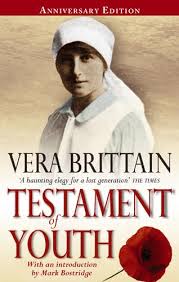
Testament of Youth, Vera Brittain

Vera Brittain was a university student at Oxford when World War 1 began to decimate the lives of youth, family and friends around her. It suspended her education and resulted in her volunteering as a VAD (Voluntary Aid Detachment) nurse. Initially based in a military hospital in London, events would propel her to volunteer for a foreign assignment, taking her to Malta and then close to the front line in France for the remaining years of the war.

Her memoir is created from fragments of her diaries, sharing the angst and idealism of youth, and later looking back from the wisdom of middle age, for she was 40 years old before her tome was published.

War changed her, she could no longer tolerate the classrooms of Oxford and the contempt of a new youth.

‘I could not throw off the War, nor the pride and the grief of it; rooted and immersed in memory, I had appeared self-absorbed, contemptuous and ‘stand-offish’ to my ruthless and critical juniors.’

She changed her focus from literature to history, in an effort to understand and participate in any action that might prevent humanity from making the same terrible mistakes that had caused the loss of so many lives. She became an international speaker for the League of Nations.

The book was made into a dramatic film of the same name in 2014.

Mom & Me & Mom, Maya Angelou

Maya Angelou is best known for her incredible series of seven autobiographies, beginning with I Know Why the Caged Bird Sings (1969), narrating her life up to the age of 17. She became a writer after a number of varied occupations in her youth.

This book was her last memoir, not one in the series, but one that could only be written from afar, from the wisdom of 80 years, when she could look back at a torturous youth, at a neglectful mother and see her with love, compassion and forgiveness.

‘Love heals. Heals and liberates. I use the word love, not meaning sentimentality, but a condition so strong that it may be that which holds the stars in their heavenly positions and that which causes the blood to flow orderly in our veins.’

Stet, An Editors Life, Diana Athill

Diana Athill OBE (born 21 Dec 1917) is someone I think of as the ordinary made extraordinary. She was a fiction editor for most of her working life, forced into earning a living due to circumstance, for while her great-grandparents generation had made or married into money, her father’s generation lost it. She clearly remembers her father telling her ‘You will have to earn your living’ and that it was something almost unnatural at the time.

War removed her chance at marriage and she appeared to reject it after that, revelling in her freedom and independence, though others suggest she was scarred by the intensity and pain of her first relationship. While the first part of the book focuses on her life, the second half recalls some of the relationships she developed with writers over the years, Mordecai Richler, Brian Moore, Jean Rhys, Alfred Chester, V.S.Naipul and Molly Keane.

The more extraordinary era of her life was still to come, for in her 80’s she began to write memoir, and achieve notable success, her book Somewhere Towards The End won the Costa Prize for Biography in 2008. Now 100 years old, she hasn’t stopped writing yet.

Further Reading:

The Guardian: Diana Athill: ‘Enjoy yourself as much as you can without doing any damage to other people’
The former editor on regrets, the advantages of old age and why she’s still writing at 100

***

Have you read any good books about notable women we might remember for #WomensHistoryMonth?

Buy a copy of one of these books via BookDepository

The Mother of All Questions by Rebecca Solnit

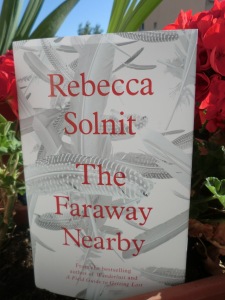
Rebecca Solnit writes reflective, thought-provoking essays, which often connect her intellectual curiosity with where she is in her life now. In an earlier work Wanderlust, she ponders the history of walking as a cultural and political experience; facing the unknown, in A Field Guide to Getting Lost; her mother’s Alzheimer’s, regression and how she spent that final year in The Faraway Nearby.
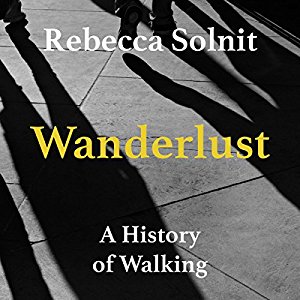
Now a new collection of essays, the title The Mother of All Questions, from an introductory piece on one of her pet frustrations, that all time irrelevant question that many professional women, whether they are writer’s, politicians or humble employees too often get asked.

But it is the timely and questioning opening essay ‘A Short History on Silence’ that  binds the collection together and should be the question being asked. It is an attempt at a history of silence, in particular the silencing of women, the effect of patriarchal power, the culpability of institutions, universities, the court system, the police, even families, their roles in continuing to ensure women’s silence over the continual transgressions of men.

Rebecca Solnit has been writing about this issue for many years, trying to create a public conversation on a subject that many continued to insist was a personal problem – yet another form of silencing.

As she wrote in Wanderlust (2000)

“It was the most devastating discovery of my life that I had no real right to life, liberty, and pursuit of happiness out of doors, that the world was full of strangers who seemed to hate me and wished to harm me for no reason other than my gender, that sex so readily became violence, and that hardly anyone else considered it a public issue rather than a private problem.”

She makes a distinction between silence being that which is imposed and quiet being that which is sought.

What is left unsaid because serenity and introspection are sought is as different from what is not said because the threats are high or the barriers are great as swimming is from drowning. Quiet is to noise as silence is to communication. The quiet of the listener makes room for the speech of others, like the quiet of the reader taking in the words on the page…Silence is what allows people to suffer without recourse, what allows hypocrisies and lies to grow and flourish, crimes to go unpunished. If our voices are essential aspects of our humanity, to be rendered voiceless is to be dehumanized or excluded from one’s humanity. And the history of silence is central to women’s history’

The list of who has been silenced goes right back to the dawn of literature, it goes back millennia, classics scholar Mary Beard noted that silencing women begins almost as soon as Western literature does, in the Odyssey, with Telemachus telling his mother to shut up.

It continues through the years with the woman’s exclusion from education, from the right to vote, to making or being acknowledged for making scientific discoveries to campus rape and the introduction of sexual harassment guidelines as law and the unleashing of stories and the wave of voices coming out of silence that sharing on social media has spawned, generating a fiercely lively and unprecedented conversation.

80 Books No Woman Should Read is her response to a list published by Esquire magazine of a list they created of 80 books every man should read, a list of books, seventy-nine of which were written by men, with one by Flannery O’Connor. It speaks of the reader’s tendency to identify with the protagonist, only the books she mentions from this list that she has read, she often identifies, not with the protagonist but with the woman, noticing that some books are instructions on why women are dirt or hardly exist at all except as accessories or are inherently evil and empty.

Not surprisingly, her essay (first published at Lithub.com) elicited a significant online response, prompting a reply from Esquire, admitting they’d messed up, saying their article had rightfully been called out for its lack of diversity, and proactively inviting eight female literary powerhouses, from Michiko Kakutani to Anna Holmes to Roxanne Gay, to help them create a new list. You can see the list here.

And in the essay In Men Explain Lolita to Me she expounds further on empathy:

‘This paying attention is the foundational act of empathy, of listening, of seeing, of imagining experiences other than one’s own, of getting out of the boundaries of one’s own experience. There’s a currently popular argument that books help us feel empathy, but if they do so they do it by helping us imagine that we are people we are not. Or to go deeper within ourselves, to be more aware of what it means to be heartbroken, or ill, or ninety-six, or completely lost. Not just versions of our self rendered awesome and eternally justified and always right, living in a world in which other people only exist to help reinforce our magnificence, though those kinds of books and comic books and movies exist in abundance to cater to the male imagination. Which is a reminder that literature and art can also help us fail at empathy if it sequesters in the Boring Old Fortress of Magnificent Me.’

I haven’t read Men Explain Things to Me, although I heard Rebecca Solnit speak about the leading and infamous anecdote it retells when I went to listen to her at the Royal Festival Hall in London.

That talk coincided with the publication of  The Faraway Nearby (link to review) the book that traverses her uneasy relationship with her mother and how the approach of death forces her to contemplate it, how it may have shaped her. I liked the book, but I loved listening to the author in person, she has such an engaging presence, is a captivating speaker, a performer of the reflective and spontaneous.

The Mother of All Questions is a culmination of Solnit’s and many women’s frustrations in the world today, where being a woman living in a patriarchal culture, no matter which part of the world, brings challenges that must reach a breaking point. It is a conversation that is happening everywhere that hopefully will bring change for the better, as many voices come together in solidarity. It is an acknowledgement both of how far we have come and how much we have still to do, to change the culture of silence we have inhabited for too long, to safely be ourselves.

I highly recommend picking up one of her works, if you haven’t yet read her.

Sightlines by Kathleen Jamie

The second volume of essays by Kathleen Jamie that I’ve read, more encounters with birds on lonely, windswept islands that have long been abandoned by humans, though traces remain of their earlier occupation.

If you have not yet read Kathleen Jamie, do check out my review of her first collection Findings, which I adored. It talks a little more about her writing and the difficulty her publisher had in describing her work, which defies categorisation, not exactly travel writing, not quite autobiography, a more accessible form of nature writing than we’ve seen before, seen through the eyes and in the prose of a poet.

In her trademark lyrical style, she travels with experts from whom she gleans bits of information, fascinating trivia, or alarming statistics that tell of a significant drop in population of certain species, but mostly she continues her mission of acute observation, of trying to see in the simplest terms something of the lives and patterns of behaviour of majestic winged creatures, who make long migrations each year and return to these islands to continue their heritage.

We learn more of her beginnings, of the archeological dig where she developed a fascination for uncovering secrets hidden beneath. She muses on microscopic observations in a science lab, writing about wind, light, the moon. We accompany her to the Arctic, witnessing giant icebergs on the move, the green lights of the aurora overhead. She visits to a museum in Norway where ancient whale bones dating from the mid 1800’s will be cleaned, restored, rehung, the melancholic weariness of their demise emitting an odour even after years of inhabiting this dusty dry interior.

The Gannetry

Jamie and friend take a picnic and visit a gannetry during mating season, they see much of what is expected, they’ve been there before, Jamie observes, looking for the unusual, she spots it in the sea, a straight line, something she doesn’t recognise until she does. A pod of orcas lead by the matriarch, she reflects on her role as mother, as her own children approach the age of leaving the nest.

The Woman in the Field

Jamie recalls being 17 years old, leaving school and rather than her mother’s suggestion of a library job or secretarial school, she delivers her to an archeological dig, to uncover a ‘henge’, a circle of stones seen from the air, where they’ll find a Bronze Age burial cist containing the skeleton of a woman and a well preserved pot, findings that will inspire a poem ‘Inhumation‘.

Aurora borealis
Source: Wikipedia M.Buschmann

Aurora

Polly asks Jamie what brings her to the Arctic north, to the freezing cold, to float alongside unleashed icebergs, watching green light phenomena in the sky.

It is the birds that lure Polly, though the geese have flown, that and an illness which awoke something that continues to push her to seek these experiences, while they remain possible.

For 30 yrs Jamie sat on cliff tops looking at familiar horizons.
Now she wishes to change her map.
Something is changing.

The Hvalsalen

The Bergen Natural History Museum in Norway houses the largest whale skeleton installation known. No one knows how they got there, whether they were hunted or stranded, they date from 1867.

About to close for 4 years for renovation and repair, Jamie is invited to return during the conservation work, she will spend hours sitting in the bones, smelling the still present odours, imagining, contemplating their previous majesty.

Pathologies

Musing in frustration on nature clichés: ‘nature takes it course’, (death of her mother) ‘reconnecting with nature’ (environmental activists) Jamie makes an appointment with a clinical consultant in pathology to observe the inner workings of the human body ‘nature’ and its mutations, tumours, cancer cells, infections, seen to the naked eye and under the microscope. She sees landscapes, shorelines, marshes. Looking at the lining of someone’s stomach, searching for bacteria, she notes the following:

Between the oval structures were valleys, if you like, fanning down to the shore. Frank wanted to show me something in one of those valleys and I couldn’t find it at first; it took several patient attempts – this microscope didn’t have a cursor device to point at things. It was a very human moment, a collusion of landscape and language when one person tries to guide the other’s gaze across a vista. What vistas I’d seen. River deltas and marshes, peninsulas and atolls. The unseen landscapes within. You might imagine you were privy to the secret of the universe, some mystical union between body and earth, but I dare say it’s to do with our eyes. Hunter-gatherers that we are, adapted to look out over savannahs, into valleys from hillsides. Scale up the absurdly small until it looks like a landscape, then we can do business.

‘There!’ said Frank. ‘Isn’t that a pastoral scene? They’re grazing!’

I had it: six or seven very dark oval dots, still tiny, despite the magnification, were ranged across the blue valley, like musk oxen on tundra, seen from far above.

Kathleen Jamie’s first collection of nature essays ‘Findings’

Her easy reading essays will also cover a lunar eclipse, three attempts to visit St Kilda, Neolithic caves and the passage of time in her own life, marked by the growth of her children into adolescence, on the threshold of young adulthood.

Fascinating and cosy reading to discover freezing cold, wind blown parts of the world that hold fascinating secrets that only the hardy voyager will venture to uncover. Enjoy reading them about from a more comfortable vantage point.

To buy one of her books, click the link below.

Kathleen Jamie’s essays via Book Depository

The Spiral Staircase, A Memoir by Karen Armstrong

Before I went to visit and spend two months in Bethlehem, Palestine some years ago, I wanted to read something about the history of the area, not a religious book, but something historical that went beyond the recent familiar history since the British abandoned those residing in these lands to their fate. I wanted to understand the wider context of how people came to be living here and what they’d had to endure to survive.
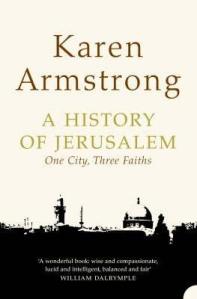
I chose to read Karen Armstrong’s A History of Jerusalem: One City, Three Faiths and read it while in situ. It was a history of multitudes of power shifts and massacres and when I finished it, I said to my husband (born in Bethlehem), somewhat in awe, “Congratulations, you survived,” and I wondered who these people really were, who had survived such a long, brutal history and come to be living in these towns of Jerusalem and Bethlehem today. One thing was for sure, they were survivors and most likely had traces of every people who had ever passed along the pilgrim trail within them.

Recently I was recommended a couple more Karen Armstrong books A History of God: The 4,000-Year Quest of Judaism, Christianity, and Islam and The Great Transformation as background to the conditioning that underpins much of humanity’s belief system of the past millenia, however I decided to add to this collection by first reading her memoir The Spiral Staircase, about her life after leaving the convent, where she spent seven years leading up to her becoming the well renowned author she is today.

I wasn’t interested in her life as a nun, or the details of her leaving the convent, I was interested in how she had used what she learned in rejecting her faith to inspire her towards immersing herself in the history and identifying that catalyst of humanity’s desire to embrace organised religion.

This memoir thus starts as she is trying to finish her university education and doctoral thesis, then her foray into becoming the partial carer of an autistic child, her teaching, her involvement with Channel 4 and the BBC in producing a series of programs on St Paul and then the crusades, and finally launching herself into a writing career when it appeared all other options were closed to her.

Every venture she went into, except the writing career, followed a similar trajectory, where she did the thing she’d convinced herself was what she should be doing, only to eventually lose hope, which became the turning point, or the spiral in the staircase, where she changed direction, it always seemed dramatic and quite often was, however my perspective on those turning points is that they were a course correction, she went along a path for as long at it had something to teach her and then she’d be literally thrown out of it – this kind of thing usually happens when we know we need to change a circumstance but we do nothing, and seven years in the convent had conditioned her to ignore any kind of inner guidance or intuition, making these changes when they did occur seem more dramatic than they might have been, had she transitioned earlier.

Boarding School

I loved reading about her journey and couldn’t help but remember the nuns from my secondary school education, apart from a couple who taught they were elusive figures on the periphery of our lives, we lived on the same premises, for us a boarding school, for them in a separate wing, it was more like a retirement home, they were very, very old and the only time we saw them was in the chapel on Sundays.

They were shadows of whoever they had been and we had no real interaction with them, except the ancient, tough 90 something Sister Conway who still worked in the scullery plunging her gnarled, arthritic hands into boiling hot water as if it were tepid, while we waited for the cutlery to cool before lifting it to dry.

Karen Armstrong took years to undo the conditioning of seven years in the convent and even then likely will never do so completely. An intellectual unsuited to academia, she eventually finds her place studying the great religious and spiritual practices looking for common threads, she’s less interested in differences than in commonalities.

As she researches and learns how to use empathy and compassion to inhabit the minds of those she seeks to understands, she comes closer to a spiritual experience than anything she experienced as a Christian. She has let go of God as objective fact and of belief as being a necessity, discovering instead ‘practice’ and compassion to be the one significant practice of all the faiths that succeeds in managing the ego sufficiently to create peace and harmony.

I enjoyed her honest, though often self deprecating account of this period in her life and particularly loved what she experienced when she visited Jerusalem, the cross cultural encounters and being told to drop the small talk and niceties:

“Karen! You are not in England now. There is no need to be a polite English lady here in Israel. We are not formal people. There is no point to speak if there is nothing to say.”

It becomes even more humorous when she is invited to do the same:

“Do not be a polite English lady. If you think I am unreasonable, tell me to get lost, to shut up- whatever you like!”

at which she surprises herself in doing after a particularly charged day when tensions were high and Joel had snapped at her rudely. His response is excellent, he is proud of her!

The other amusing experience in reading my second hand copy of this book, was the presence of the previous reader in the margins, who not happy to have merely marked up the pages, shared her thoughts more vociferously, clearly not nearly as impressed as I was with the work, deciding to rant and share snippets of her own experiences, which were mostly entertaining, often annoying, and ultimately unwelcome! Here are some of them, since no one else will have had this reading experience!

page 123 After speaking about how her years as a nun had broken something in her, and affected her eating habits, Karen Armstrong writes:

“And I did not want to nourish myself. What was the point of feeding my body, when my mind and heart had been irreparably broken?”

And my interlocutor writes:

“as I was after the divorce”

Armstrong mentions that she isn’t going to write about her failed love relationships, seeing no reason to dwell on episodes that didn’t develop into anything significant and writes:

“Just as I was prevented from becoming an academic, so too I have never been able to achieve a normal domestic existence, and this, like my epilepsy, had also ensured that I remained an outsider in a society in which coupledom is the norm”

to which my interlocutor responds:

“oh do stop feeling sorry for yourself!”

and even adds later on

“perhaps you are just unloveable”

which is a mild example of the kind of comportment (at different levels of societal power clearly) that nevertheless can lead to disharmony, conflict, war even, for if there is a conclusion to what Karen Armstrong has learned, it is a lesson she gifts to her readers, known as Hillel’s Golden Rule that all great leaders have taught, Confucius proclaimed it 500 years before him, Buddha and Jesus taught it, it is the bedrock of the Koran:

“Do not do to others as you would not have done unto you”

As one of her advisors Hyam Maccoby said

“It takes more discipline to refrain from doing/saying harm to others than to be a do-gooder and project your needs and desires onto other people.”

Frantumaglia, A Writer’s Journey by Elena Ferrante tr. Ann Goldstein

A fabulous collections of correspondence and essay like responses to interview questions over a period of twenty-five years since the publication of her first novel Troubling Love.

The title ‘Frantumaglia‘, a fabulous word left to her by her mother, in her Neapolitan dialect, a word she used to describe how she felt when racked by contradictory sensations that were tearing her apart.

She said that inside her she had a frantumaglia, a jumble of fragments. The frantumaglia depressed her. Sometimes it made her dizzy, sometimes it made her mouth taste like iron. It was the word for a disquiet not otherwise definable, it referred to a miscellaneous crowd of things in her head, debris in a muddy water of the brain. The frantumaglia was mysterious, it provoked mysterious actions, it was the source of all suffering not traceable to a single obvious cause…Often it made her weep, and since childhood the word has stayed in my mind to describe, in particular, a sudden fit of weeping for no evident reason: frantumaglia tears.

And so for her characters, this is what suffering is, looking onto the frantumaglia, the jumble of fragments inside.

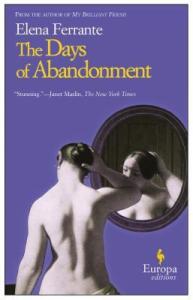
The first half chiefly concerns communication around Troubling Love and The Days of Abandonment, the latter written ten years after her debut, although other stories were written in between but never published, the author not happy with them as she so piercingly reveals:

I haven’t written two books in ten years, I’ve written and rewritten many. But Troubling Love and The Days of Abandonment seemed to me the ones that most decisively stuck a finger in certain wounds I have that are still infected, and did so without keeping a safe distance. At other times, I’ve written about clean or happily healed wounds with the obligatory detachment and the right words. But then I discovered that is not my path.

The second half implies a delay in the publication of the collection to include interviews and question-responses around the Neapolitan Quartet, beginning with the renowned My Brilliant Friend.

Readers ask poignant questions, while the media tend to obsess about her decision to remain absent (as opposed to anonymous) from promotional activity, to which she has many responses, one here in a letter to the journalist Goffredo Fofi:

In my experience, the difficulty-pleasure of writing touches every point of the body. When you’ve finished the book, it’s as if your innermost self had been ransacked, and all you want is to regain distance, return to being whole. I’ve discovered, by publishing, that there is a certain relief in the fact that the moment the text becomes a printed book it goes elsewhere. Before, it was the text that was pestering me; now I’d have to run after it. I decided not to.

Perhaps the old myths about inspiration spoke at least one truth: when one makes a creative work, one is inhabited by others-in some measure one becomes another. But when one stops writing one becomes oneself again.

…I wrote my book to free myself from it, not to be its prisoner.

She shares her literary influences (works of literature about abandoned women) from classic Greek myths, Ariadne to Medea, Dido to the more contemporary Simone de Beauvoir’s The Woman Destroyed, referring to recurring themes of abandonment, separation and struggle. She mentions literary favourites, Elsa Morante’s House of Liars.

One interviewer asks why in her early novels, her characters depict women who suffer, to which she responds:

The suffering of Delia, Olga, Leda is the result of disappointment. What they expected from life – they are women who sought to break with the tradition of their mothers and grandmothers – does not arrive. Old ghosts arrive instead, the same ones with whom the women of the past had to reckon. The difference is that these women don’t submit to them passively. Instead, they fight, and they cope. They don’t win, but they simply come to an agreement with their own expectations and find new equilibriums. I feel them not as women who are suffering but as women who are struggling.

And on comparing Olga to Madame Bovary and Anna Karenina, who she sees as descendants of Dido and Medea, though they have lost the obscure force that pushed those heroines of the ancient world to such brutal forms of resistance and revenge, they instead experience their abandonment as a punishment for their sins.

Olga, on the other hand, is an educated woman of today, influenced by the battle against the patriarchy. She knows what can happen to her and tries not to be destroyed by abandonment. Hers is the story of how she resists, of how she touches bottom and returns, of how abandonment changes her without annihilating her.

In an interview, Stefania Scateni from the publication l’Unità, refers to Olga, the protagonist of The Days of Abandonment as destroyed by one love, seeking another with her neighbour. He asks what Ferrante thinks of love.

The need for love is the central experience of our existence. However foolish it may seem, we feel truly alive only when we have an arrow in our side and that we drag around night and day, everywhere we go. The need for love sweeps away every other need and, on the other hand, motivates all our actions.

She again refers to the Greek classics, to Book 4 of the Aeneid, where the construction of Carthage stops when Dido falls in love.

Individuals and cities without love are a danger to themselves and others.

The correspondence with the Director of Troubling Love (L’amore molesto), Mario Martone is illuminating, to read of Ferrante’s humble hesitancy in contributing to a form she confessed to know nothing about, followed by her exemplary input to the process and finally the unsent letter, many months later when she finally saw the film and was so affected by what he had created. It makes me want to read her debut novel and watch the original cult film now.
Frantumagli is an excellent accompaniment to the novels of Elena Ferrante and insight into this writer’s journey and process, in particular the inspiration behind her characters, settings and recurring themes.

Note: Thank you to the publisher Europa Editions, for providing me a copy of this beautiful book.

Buy a copy of any of Elena Ferrante’s novels via Book Depository here.

Worthy by Nancy Levin

“And the day came when the risk to remain tight in the bud was more painful than the risk it took to blossom.” Anaïs Nin

Nancy Levin is an author, speaker and coach/mentor who used to be an Events Organiser for Hay House until one day she decided she wanted to re-orient her life and fortunately had such a good relationship with her boss, she was able to be open and honest about the need for a change and given the time to prepare for doing so.

He advised her not to do anything rash straightaway, to go away and research what she wanted to do and then when she was ready and prepared for the transition, she could do so with less fear and with their support. Thus she went from being the organiser to being a coach herself, for people who could identify with where she had been, the kind of constraints she had confronted and were ready for her to inspire them to do the same.

That transition she made and the mentoring she received became the subject of her first book Jump…and your life will appear – an inch by inch guide to making a major change in your life.

I haven’t read this earlier book, I came across Nancy Levin via the intuitive coach I regularly listen to Colette Baron Reid whose book Uncharted, I read and reviewed in 2016. As a part of the lead up to reading Colette’s book, I listened to a lot of her ‘real and raw’ conversations she had with people whose work she admired, unscripted conversations talking about their perspectives on spirituality, the universe and the things that were helping them to navigate life, that they shared. All these conversations are really interesting and we find that some resonate more than others.

Nancy Levin’s conversation was particularly interesting because she had been in quite a traditional realm prior to making this jump, so I think she attracts quite a few followers who are not quite ready to jump, who are dependent on an unfulfilling job, their spouse, their family, their home, but who have that feeling that they not entirely fulfilled by what they are doing in their lives and would like some tools or resources to help them make the shift.

During the conversation, they explore how people often put their worth in the hands of others, that worth isn’t related to what we do or do not do, it’s about coming into the right relationship with ourselves first, the subject explored in her new book.

In WorthyBoost Your Self-Worth to Grow Your Net Worth, she takes the jump a step further and analyses what might be behind the reluctance, or resistance as she likes to call it, to change. She tells the story behind the story of her own life, of how she rarely spent money on herself, but often on her husband because she was trying to make him happy. Through coaching, she was able to have greater awareness of her own patterns and see how she was getting in her own way of achieving what she wanted.

However, just having this knowledge isn’t enough to make a change, so in the new book, she takes the reader through a number of exercises to discover our own patterns, habits and inclinations and how they might be limiting our ability to move into that life that we would prefer to be living.

She refers to them as shadow beliefs, a term introduced by her mentor Debbie Ford, beliefs formed when we were so young, they hide outside our conscious awareness. They are nourished by thoughts and situations that confirm their existence, providing further resistance against any desire to change.

Having identified those beliefs (or excuses), she then invites us to prove them wrong, to find the counter belief and phrase it.

“Excuses are actually just well packaged resistance. But our resistance has a lot to do with our self-worth. When we feel worthy, we don’t resist what’s good for us. We feel we deserve what we want, so we find it much easier to step right over our fears and go for it. That’s the blessing of worthiness. If we don’t feel we deserve what we want, we let resistance keep us down.”

She dissects a number of the more common excuses and beliefs and uncovers the real reason for the resistance beneath it, using case studies of clients she has worked with and her own personal story.

The book moves further on, into defining what you want most and how to move from excuses to action, to taking back your power, taking responsibility, practising self-trust and self-respect.

A lot of the messages relate to financial empowerment and how this connects to other aspects of our lives and ability to make decisions. It ends with an exercise to create a list of 50 desires, five of which must be altruistic desires for other people, readying the reader for taking action, getting ready to do the impossible.

It’s a thought-provoking read that’s likely to be uncomfortable at times, digging into one’s own limiting beliefs, but rewarding by allowing us a way to explore the shadow side and then express the opposite, the things that you want to do, that you may not have ever taken seriously or even expressed and daring you to take action and allow those desires to manifest.

“What is now proved was once only imagined.” William Blake

To Buy a Copy of Worthy, Click Here

Note: This book was an ARC (Advance Reader Copy) kindly provided by the publisher (Hay House) via NetGalley.