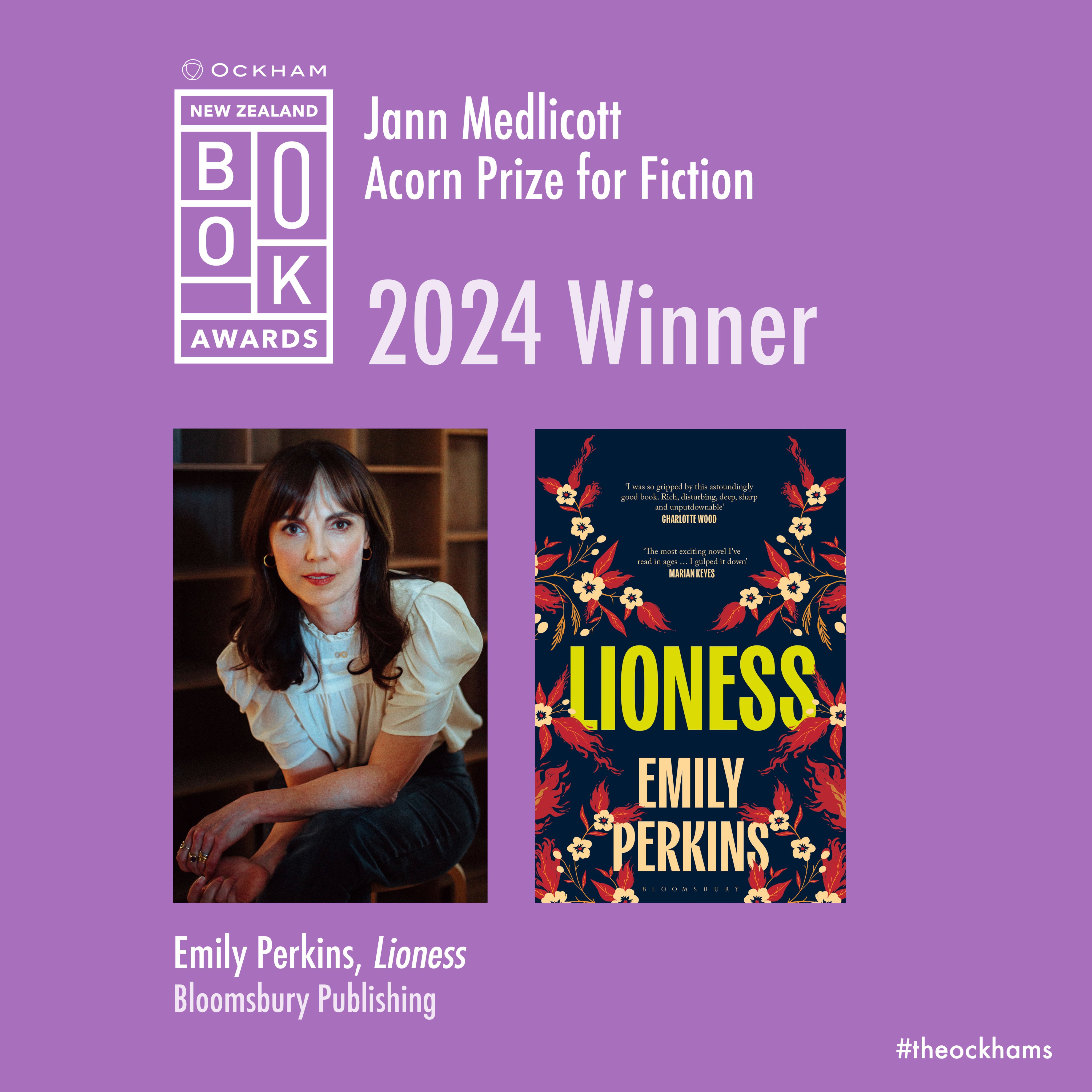
Today the New Zealand Book Awards 2024 announced their winners. Known as The Ockham’s they are regarded as the country’s premier literary honours for books written by New Zealanders.
Awards are given for Fiction (the Jann Medlicott Acorn Prize for Fiction), Poetry (the Mary and Peter Biggs Award for Poetry), Illustrated Non-Fiction (the Booksellers Aotearoa New Zealand Award for Illustrated Non-Fiction) and General Non-Fiction.
There are also four awards for first-time authors (the Mātātuhi Foundation Best First Book Awards) and, at the judges’ discretion, Te Mūrau o te Tuhi, a Māori Language Award.
Auckland Writer’s Festival | Waituhi O Tāmaki 2024
The announcement of the winners, hosted by Jack Tame coincided with the beginning of the annual Auckland Writer’s Festival, running from 14 – 19 May, 2024.
A searing and urgent novel crackling with tension and intelligence, Lioness starts with a hiss and ends with a roar as protagonist Therese’s dawning awareness and growing rage reveals itself.
At first glance this is a psychological thriller about a privileged wealthy family and its unravelling. Look closer and it is an incisive exploration of wealth, power, class, female rage, and the search for authenticity.
Emily Perkins deftly wrangles a large cast of characters in vivid technicolour, giving each their moment in the sun, while dexterously weaving together multiple plotlines. Her acute observations and razor-sharp wit decimate the tropes of mid-life in moments of pure prose brilliance, leaving the reader gasping for more. Disturbing, deep, smart, and funny as hell, Lioness is unforgettable.
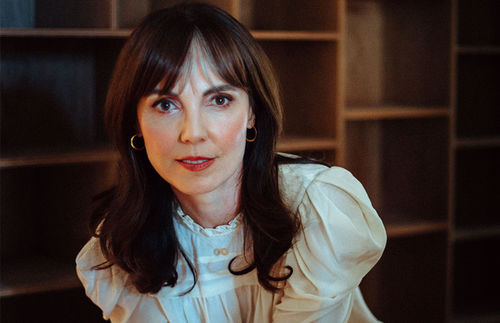
Author, Emily Perkins
Emily Perkins is an award-winning writer living in Aotearoa, New Zealand. Her books include the Women’s Prize longlisted The Forrests, Novel About My Wife, winner of the Believer Book of the Year Award and the Montana Medal for Fiction, and the short story collection Not Her Real Name, winner of the Geoffrey Faber Memorial Prize.
She also writes for theatre, film and television, including the original play The Made and an adaptation of Henrik Ibsen’s The Doll’s House, both with Auckland Theatre Company. With director Alison Maclean, she co-wrote the feature film The Rehearsal, adapted from Eleanor Catton’s novel.
Emily has taught creative writing and was the host of TVNZ’s books programme The Good Word. She is a member of the UK’s Folio Academy, an Arts Foundation Laureate, and a Member of the New Zealand Order of Merit for services to literature.
Other Category Winners
The winner of the Booksellers Aotearoa New Zealand Award for Illustrated Non-Fiction was Gregory O’Brien for Don Binney: Flight Path, an illustrated account of the life and work of one of NZ’s most iconic artists.
The Mary and Peter Biggs Award for Poetry went to Grace Yee for her fusion of Cantonese-Taishanese and English collection that moves between old newspaper cuttings, advertisements, letters, recipes, cultural theory, and dialogue, evoking the unsettledness of migration, Chinese Fish.
The General Non-Fiction Award went to Damon Salesa for An Indigenous Ocean: Pacific Essays and the Maori Language Award went to Tā Pou Temara (Ngāi Tūhoe) for Te Rautakitahi o Tūhoe ki Ōrākau.
I read Lioness in the summer of 2023 and found it a compelling thought provoking read, where there is as much going on beneath the surface of scenes depicted, in the spaces its protagonist inhabits, observing those around her, as there was in their reality. While reading, it felt like I hadn’t read anything that had done this before, it provoked hyper-vigilant observations, readers will likely have strong opinions about the characters, it’s almost impossible not to.
I’m happy to see Emily Perkins‘ work being celebrated, there is often a frisson of excitement around one of her novels coming out, her readership extending much beyond NZ.
This is the first Anne Tyler novel I ever bought and it sat on the shelf for 19 years, finally read thanks to #20booksofsummer23 where I try to shift some of these titles that have been sitting years on the TBR (to be read) shelf. It was longlisted for the Women’s Prize for Fiction 2004.
Why hadn’t I picked it up before now? Something about the cover, the title and the blurb – Tyler is a master in writing domestic fiction and perhaps it is no coincidence, that it is now possible to read this from a greater distance than the past 19 years allowed.
I was initially a little skeptical as the opening chapters are a somewhat clichéd account of what seems like a perfect couple getting together, only it turns out they are not ideal matched at all, and that is what makes the novel interesting.
Hasty Marriages at the Outbreak of War
The story begins in 1944 in the Polish quarter of Baltimore, an area that hasn’t quite forgotten it’s Irish roots and associated prejudices.
America has just entered the war and Michael, the son of the grocery store owner is caught up in the whirlwind of enlisting while catching the eye of Pauline in her red coat, a girl from the other side of town (and life).
“Pauline was wearing read again. Red seemed to be her colour. A red sweater over a crisp white shirt with a rounded collar. It was known by now that she came from a neighbourhood north of Eastern Avenue; that she wasn’t even Catholic; that she worked as a receptionist in her father’s reality office.”
Once they are connected, the colours Pauline wears are toned down, a metaphor of the adjustment she makes to try and conform to what is expected.
…she’d changed her colours just at the very time when she was changing in people’s opinions. From dangerous and dramatic red to gentle, soft pastels, she’d gone.
Each chapter skips a few years and we see the effect of this mismatched couple that stay together, how each of their three children navigate that dysfunctional environment and the long term consequences of it.
“Pauline believed that marriage was an interweaving of souls, while Michael viewed it as two people travelling side by side but separately.”
Tyler explores the nuances of the relationship, seen from each parents’ perspective, though rarely from the point of view of the children, we see the consequence and observe how they choose to live their lives, in the wake of their parents marriage.
We are left to wonder about the impact of generational attitudes and how the institution of marriage moulds everyone around it, for better, worse or otherwise.
Looking ahead, March is Reading Ireland month over at Cathy746Books, so I’m putting together what is currently on my shelf and what is lurking in the depths of my kindle, which I seem to have been more reluctant to read from lately, so a month of focusing on Irish literature should help.
Cathy has set out a program below for the five weeks that focuses on classics, contemporary works (where most of my titles sit), short stories and non fiction.
Eager Anticipation
I had been looking forward to reading Sara Baume’sSeven Steeples, having read her excellent nonfiction title Handiwork, and two other novels, Spill Simmer Falter Wither and A Line Made by Walking – however I couldn’t wait and read it earlier this month. Highly recommended literary fiction, with a strong tendency toward poetic prose.
Intro Week: 1 – 5 March
I’m going to try and read the Edna O’Brien trilogy The Country Girls in the first week, which I have in one volume, but I will post as the three separate books. Originally published in 1960, 1962 and 1964, they are a portrait of youth, marriage, friendship, love and loss and I’m very excited to read this author for the first time and to begin here. She is hailed as one of the great chroniclers of the female experience in the twentieth century.
I managed to acquire a hardback of her 1994 novel, House of Splendid Isolation, which would be great to read if time allows.
Irish Classics Week: 6 -12 March
I have the novella A World of Love (1954) by Elisabeth Bowen, which should be possible to read in week 2.
I’m putting Brian Moore into this category, I have 3 of his novels on my shelf, a continuation, having read five of his novels for the 100th centenary in 2021. A previously neglected Irish author, he lived most of his adult life in Canada and the U.S., thus his literary output was created from the perspective of an outsider, looking back at his own culture, and occasionally at other cultures where he spent time, such as The Statement (1995), a political thriller set in France and The Magician’s Wife (1997), historical fiction set in France and Algeria, both of which take an aspect of French history that he found fascinating, turning them into compelling stories.
I have The Temptation of Eileen Hughes (1981), a Belfast love triangle, Black Robe (1985), a Jesuit missionary in North America in the 17th century, and The Mangan Inheritance (1979), a recently widowed man in Canada journeys to track down an Irish ancestor.
Contemporary Irish Week: 13 – 19 March
In this 3rd week, I shall attempt one or two of these novels from the kindle.
Trespasses by Louise Kennedy – this novel has garnered much praise since publication, set in Northern Ireland during the Troubles, a shattering novel about a young woman caught between allegiance to community and a dangerous passion.
Factory Girls by Michelle Gallen – I loved her novel Big Girl, Small Town and this latest has just been shortlisted for the Comedy Women in Print Award 2022/23 UK/Ireland. This is a definite, she makes me laugh out loud!
The Quiet Whispers Never StopOlivia Fitzsimons – a dual narrative set in 1982 & 1994 Ireland, exploring the mother-daughter relationship; described as “A story of love, obsession and escape, an uncompromising, lyrical tour-de-force that marks the arrival of an extraordinary new voice in Irish fiction”.
Listening StillAnne Griffin – her debut When All is Said was a runaway international success, a book I enjoyed about a man who toasts 5 friends of importance to him. Her second book is about a young woman who can hear the last words of the dead, though it hasn’t made the same impact on readers; she has a new book due out on 27 Apr 2023 The Island of Longing about the disappearance of a daughter and a mother’s difficulty in accepting her loss, not knowing whether she is alive or dead. This latest is getting many 5 star reviews (from those reading an advance copy), one to watch.
A Traveller at the Gates of WisdomJohn Boyne – an unknown man leads the reader through 2000 years of human and family history, slipping through time and space with slightly different identities, continuing on the same path, from Palestine in AD 1 to the year 2080 in a space colony. An ambitious and epic concept, a story that has had mixed reviews.
Short Story Week: 20 – 26 March
I have this one collection that I shall try to get to read:
Dance Move by Wendy Erskine – stories set in Northern Ireland, where we meet characters looking to wrest control of their lives, only to find themselves defined by a moment in their past that marked them. In these stories – as in real life – the funny, the tender and the devastating go hand in hand. Full of warmth, the familiar and the strange, they are about what it means to live in the world, how far you can end up from where you came from, and what it means to look back.
Non- Fiction Week: 27 – 31 March
I don’t have any Irish nonfiction left unread on my shelf, but I have noted that creative nonfiction author Kerri ní Dochartaigh, whose debut Thin Places I read in 2021 and enjoyed immensely, has a follow up book due out in April 2023, Cacophony of Bones.
It maps the circle of a year – a journey from one place to another, field notes of a life – from one winter, to the next. It is a telling of a changed life, in a changed world – and it is about all that does not change, that which simply keeps on – living and breathing, nesting and dying – in spite of it all.
If you are looking for inspiration, check out Cathy’s blog, where she shares a list of 100 Irish Novels from Gulliver’s Travels by Jonathan Swift (1726) to Here Are The Young Men by Rob Doyle (2014) and 100 Novels by Irish Women Writers from the Memoirs of Miss Sidney Bidulph by Frances Sheridan (1761) to Conversations with Friends by Sally Rooney (2017).
Have you read and enjoyed any of the titles here? Are you planning on reading any Irish literature in March? If so, what are you looking forward to reading? Do you have a favourite Irish author or book? Let me know in the comments below.
And another welcome tradition on International Women’s Day is the announcement of the longlist for the Women’s Prize for Fiction, which though it generally doesn’t influence my reading intentions, I do enjoy seeing what’s made the list, the familiar and the unfamiliar and becoming acquainted with them, whether read or not.
It looks like a real mix this year, with familiar names of authors I’ve read before, like Louise Erdrich, Elif Shafak and Ruth Ozeki and the titles that have been appearing often in reviews and then the lesser known surprises!
The only book I have read from the list, and likely to be one of the lesser known is New Zealand author Catherine Chidgey’s excellent historical fiction novel Remote Sympathy (reviewed here), published by Europa Editions.
This 4 minute video below gives very brief mini descriptions of the sixteen novels chosen:
Or if you prefer to read about them; the sixteen longlisted books are as follows:
Build Your House Around My Body by Violet Kupersmith – (Debut historical fiction, set in Vietnam)(US/Philadelphia, lived in Vietnam for 2 years, her mother’s family fled Vietnam in 1975)
Two Vietnamese women go missing decades apart. Both are fearless, both are lost. And both will have their revenge. The fates of both women are linked, bound together by past generations, ghosts and ancestors, by the history of possessed bodies and possessed lands. This heart-pounding fever dream of a novel hurtles through the ghostly secrets of Vietnamese history creating an immersive, playful, unforgettable debut.
Careless by Kirsty Capes – (debut contemporary fiction) (UK) (inspired from being inside the care system)
Sometimes it’s easy to fall between the cracks… At 3.04 p.m. on a hot, sticky day in June, Bess finds out she’s pregnant. She could tell her social worker Henry, but he’s useless. She should tell her foster mother, Lisa, but she won’t understand. She really ought to tell Boy, but she hasn’t spoken to him in weeks. Bess knows more than anyone that love doesn’t come without conditions. But this isn’t a love story…
A new narrative of the care experience by a writer who grew up in foster care herself. Already snapped up by the makers of BBC One’s Call The Midwife.
Creatures of Passage by Morowa Yejidé – (Fantasy/Paranormal) (US/Washington DC)
Nephthys is a taxi driver in DC, ferrying ill-fated passengers in a haunted car, with a ghost in the trunk. Endless rides and alcohol help her manage grief over the death of her twin brother, Osiris.
Unknown to Nephthys, her estranged great-nephew, ten-year-old Dash, is drawn to the banks of the same river, where he talks with a mysterious “River Man.” When Dash arrives at Nephthys’s door bearing a cryptic note, she must face the family she abandoned and what frightens her most.
Threading stories of the living and dead it shows us an unseen Washington filled with otherworldly landscapes, flawed super-humans and reluctant ghosts, bringing together a community intent on saving a boy in order to reclaim themselves.
Flamingo by Rachel Elliott – (UK/Bath) (contemporary fiction)
A novel of love, homelessness, and learning to be fearless. In the garden, there were three flamingos, gateways to a time when life was impossibly good. They were mascots, symbols of hope.
A novel about the power of love, welcome and acceptance, a celebration of kindness. Set in 2018 and the 80’s, it’s a song for the broken-hearted and the big-hearted, a book full of wild hope.
Great Circle by Maggie Shipstead – (US/California) (historical fiction)
From days as a wild child in prohibition America to wartime London, from the rugged shores of NZ to a lonely iceshelf in Antarctica, Marian Graves is driven by a need for freedom and danger. Determined to live an independent life, she resists her childhood sweetheart, burning her way through a suite of glamorous lovers. An obsession with flight consumes her. As she is about to fulfil her greatest ambition, to circumnavigate the globe, Marian crash lands in a perilous wilderness of ice.
Half a century later, troubled film star Hadley Baxter is drawn to play the enigmatic pilot on screen. It is a role that will lead her to an unexpected discovery, throwing fresh light on the story of the unknowable Marian Graves.
Remote Sympathy by Catherine Chidgey – (Historical fiction set in Germany) (New Zealander who lived some years in Germany)
Moving away from their Munich apartment isn’t as bad as for Frau Greta Hahn feared. The new villa is beautiful and life in Buchenwald seems idyllic. But beyond the forest is the looming presence of a work camp. Her husband, SS Dietrich Hahn has been assigned as the camp’s new administrator.
When Frau Hahn’s health leads her into a friendship with one of Buchenwald’s prisoners, Dr Weber, her ignorance about what is going on is challenged. A decade earlier Dr Weber invented an electrotherapy machine to cure disease, until politics interfered with progress. Did it really work? Might it save a life?
A tour de force about the evils of obliviousness, Remote Sympathy compels us to question our continuing and wilful ability to look the other way, in a world in thrall to the idea that everything – even facts and morals – is relative.
Salt Lick by Lulu Allison – (Visual artist/UK/Brighton) (Science fiction/Dystopia)
Britain is awash, the sea creeps into the land, brambles and forest swamp derelict towns. Food production has moved overseas and people are forced to move to the cities for work. The countryside is empty. A chorus, the herd voice of feral cows, wander this newly wild land watching over changing times, speaking with love and exasperation.
Jesse and his puppy Mister Maliks roam the woods until his family are forced to leave for London. Lee runs from the terrible restrictions of the White Town where he grew up. Isolde leaves London on foot, walking the abandoned A12 in search of the truth about her mother.
Sorrow and Bliss by Meg Mason – (NZ’er living in Australia) (Contemporary fiction/humour)
Everyone tells Martha she’s clever and beautiful, a brilliant writer loved by her husband Patrick. A gift, her mother once said, not everybody gets. So why is everything broken? Why is Martha – almost 40 – friendless, near jobless and so sad? Why did Patrick leave?
Maybe she is too sensitive, someone who finds it harder to be alive than most. Or maybe – as she has long believed – there is something wrong with her. Something that broke when a little bomb went off in her brain at 17 leaving her changed in a way that no therapist has been able to explain.
Returning to her childhood home to her dysfunctional, bohemian parents, Martha has one last chance to find out whether a life is too broken to fix, or by starting over, to write a better ending for herself.
The Book of Form and Emptiness by Ruth Ozeki – (Japanese American) (literary fiction/magic realism)
After the tragic death of his father, 14-year-old Benny begins to hear voices. The voices belong to the things in his house and sound variously pleasant, angry or sad. As his mother develops a hoarding problem, the voices grow louder. When ignoring them doesn’t work, Benny seeks refuge in the silence of a public library. There he meets a mesmerising street artist with a pet ferret; a homeless philosopher- poet who encourages him to find his own voice; and his very own Book, who narrates Benny’s life and teaches him to listen to the things that truly matter.
Blending unforgettable characters with everything from jazz to climate change to our attachment to material possessions, this is classic Ruth Ozeki – bold, humane and heartbreaking.
The Bread the Devil Knead by Lisa Allen-Agostini – (Trinidad & Tobago) (contemporary feminist fiction)
Alethea is turning 40. Fashionable, feisty and fiercely independent, she manages a boutique, but behind closed doors she’s covering up bruises from an abusive partner and seeking solace in an affair. When she witnesses a woman murdered by a jealous lover, the reality of her own future challenges her.
Bringing us her truth in an arresting, unsparing Trinidadian voice, Alethea unravels memories repressed since childhood and begins to understand the person she has become. She must now decide the woman she wants to be. An engrossing, atmospheric novel with a strong feminist message at the heart of a page-turning plot.
The Exhibitionist by Charlotte Mendelson – (British) (Contemporary fiction)
The Hanrahan family gather for a weekend as artist and notorious egoist Ray prepares for a new exhibition of his art – the first in many decades – and one he is sure will burnish his reputation for good.
His three children will be there: beautiful Leah, always her father’s biggest champion; sensitive Patrick, who has finally decided to strike out on his own; and insecure Jess, who has her own momentous decision to make.
And then Lucia, Ray’s steadfast and selfless wife, also an artist, who has always put her roles as wife and mother first. What will happen if she decides to change? For Lucia is hiding secrets of her own, and as the weekend unfolds and the exhibition approaches, she must make a choice.
The Final Revival of Opal & Nev by Dawnie Walton – (US/Florida) (Contemporary fiction)
Opal is a fiercely independent young woman pushing against the grain in her style and attitude, a Black punk artist before her time. Despite her unconventional looks, Opal believes she can be a star. So when the aspiring British singer/songwriter Neville Charles discovers her one night, she takes him up on his offer to make rock music together.
In early 70’s New York City, as she’s finding her niche in a flamboyant creative scene, a rival band signed to her label brandishes a Confederate flag at a promotional concert. Opal’s bold protest and the violence that ensues, set off a chain of events that will not only change the lives of those she loves, but be a reminder that repercussions are harsher for women, especially Black women, who dare to speak their truth.
The Island of Missing Trees by Elif Shafak – (British Turkish living in London) (Contemporary fiction)
In 1974 Cyprus, two teenagers, from opposite sides of a divided land meet at a tavern in the city they both call home. The tavern is the only place that Kostas, Greek/Christian and Defne, Turkish/Muslim, can meet in secret hidden beneath the blackened beams from which hang garlands of garlic, chilli peppers and wild herbs. It is where the best food, music and wine in town is. But there is something else to the place: it makes one forget, even if for just a few hours, the world outside and its sorrows.
In the centre of the tavern, growing through a cavity in the roof, is a fig tree. This tree witnesses their hushed, happy meetings, their silent, surreptitious departures; and it will be there when war breaks out, when the capital is reduced to rubble, when the teenagers vanish and break apart.
Years later in London, 16-year-old Ada has never visited the island where her parents were born. Looking for answers, she seeks to untangle years of secrets, separation and silence. The only connection she has to the land of her ancestors is a Ficus Carica growing in the back garden of their home.
The Paper Palace by Miranda Cowley Heller – (US/New York) (Contemporary fiction)
On a perfect August morning, Elle heads out for a swim in the pond below ‘The Paper Palace’ – her family’s holiday home in Cape Cod. As she dives beneath the water she relives the passionate encounter she had the night before, against the side of the house that knows all her darkest secrets, while her husband and mother chatted to their guests inside.
So begins a story that unfolds over 24 hours and 50 years, as Elle’s shocking betrayal leads her to a life-changing decision – and an ending you won’t be able to stop thinking about.
The Sentence by Louise Erdrich – (Native US/Minnesota) (Contemporary fiction)
The Sentence asks what we owe to the living, the dead, the reader and the book. A small bookstore in Minneapolis is haunted by the store’s most annoying customer. Flora dies on All Souls’ Day, but won’t leave the store. Tookie, who has landed a job selling books after years of incarceration that she survived by reading ‘with murderous attention,’ must solve the mystery of this haunting while trying to understand all that occurs during a year of grief, astonishment, isolation and furious reckoning.
The Sentence begins on All Souls’ Day and ends a year later. Its mystery and proliferating ghost stories during the year propel a narrative as rich, emotional and profound as anything Erdrich has written.
This One Sky Day by Leone Ross – (British/Jamaican) (Fantasy/Magic realism)
Dawn breaks across the archipelago of Popisho. The world is stirring awake again, each resident with their own list of things to do: A wedding feast to conjure and cook, an infidelity to investigate, a lost soul to set free. As the sun rises two star-crossed lovers try to find their way back to one another across this single day. When night falls, all have been given a gift, and many are no longer the same.
The sky is pink, and some wonder if it will ever be blue again.
* * * * *
The judging panel will announce the shortlist of six novels, on April 27th. The winner of the 2022 Women’s Prize for Fiction will be announced on Wednesday 15th June.
The Dublin Literary Award longlist is nominated by public libraries in capital and major cities throughout the world and this year contains 79 titles. Titles are nominated on the basis of ‘high literary merit’ as determined by the nominating library.
Now in its 27th year, this award is the world’s most valuable annual prize for a single work of fiction published in English, worth €100,000 to the winner. Last year, the award was won by Valeria Luiselli for Lost Children Archive. See previous winners here.
Translated Fiction
Nominations this year include 30 novels in translation, spanning 19 languages, with works nominated by 94 libraries from 40 countries across Africa, Europe, Asia, the US & Canada, South America and Australia & New Zealand. 16 are debut novels. If the winning book has been translated, the author receives €75,000 and the translator receives €25,000.
Of the novels in translation below, I have read two: Fresh Water for Flowers (my review) by French author Valérie Perrin tr.Hildegarde Serle which made my top 10 fiction reads in 2020, and Voices of the Lost by Lebanese/French author Hoda Barakat, an epistolary novel of letters by the displaced, living in exile.
International Judges
The international panel of judges who will select the shortlist and winner, features Dubliner Sinéad Moriarty, a writer and books ambassador for Eason’s Must Reads book club; Alvin Pang, from Singapore, a poet, writer, editor, anthologist, translator and researcher; Cork-born, Clíona Ní Ríordáin who lives in Paris and is a Professor of English at Université de la Sorbonne Nouvelle; Professor Emmanuel Dandaura, a creative writer, literary critic, festival curator, scholar, and multiple award winning playwright based in Abuja, Nigeria and Victoria White, a graduate with an M.Litt in English Literature of Trinity College Dublin, who has worked as a writer and journalist with the Irish Times and the Irish Examiner.
The Longlist
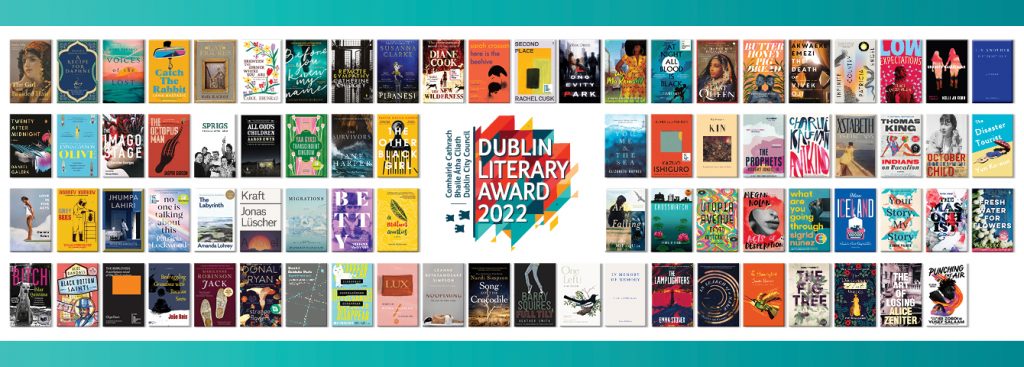
The entire list of 79 titles follows, click on the title to read a description of the novel and the comment by the nominating library(s).
I have read 10 of these books (in pink), you can find my reviews next to the book description :
A Million Aunties by Alecia McKenzie (Jamaican author, based in France) A Recipe for Daphne by Nektaria Anastasiadou (lives in Istanbul writes in Greek Istanbul dialect, debut) Acts of Desperation by Megan Nolan (Irish author living in London, debut) All God’s Children by Aaron Gwyn (Oklahoma author, historical fiction) Antkind by Charlie Kaufman (American Screenwriter, postmodern, debut) At Night all Blood is Black by David Diop (Senegalese/Parisian, major award winning war novel) Barry Squires: Full Tilt by Heather Smith (Newfoundland author living in Ontario, Young Adult) Bedraggling Grandma with Russian Snow by João Reis (Portuguese writer/philosopher, literary comedy) Before You Knew My Name by Jacqueline Bublitz (NZ author, debut) Betty by Tiffany McDaniel (Ohio author/visual artist, coming-of-age novel) Black Bottom Saints by Alice Randall (Detroit author lives in Nashville, biographical novel) Brighten the Corner Where You Are by Carol Bruneau (Halifax/canadian author, historical fiction) Butter Honey Pig Bread by Francesca Ekwuyasi (Nigerian/Canadian writer/multidisciplinary artist) Catch the Rabbit by Lana Bastašić (Serb/Croatian author lives in Belgrade, Young Adult) Crooked Hallelujah by Kelli Jo Ford (Cherokee Nation of Oklahoma author, debut) Crossmatch by Carmel Miranda (Sri Lankan author, , social justice novel, debut) Disappear Doppelgänger Disappear by Matthew Salesses (Asian American author, magic realism, existential) Fresh Water for Flowers by Valérie Perrin (French author/screenwriter, literary fiction) (my review here) Grey Bees by Andrey Kurkov (Leningrad/Ukranian author, war novel) Here is the Beehive by Sarah Crossan (Irish author, debut) I is Another: Septology III-V by Jon Fosse (Norwegian author, 2nd of 3 volumes existential novel)
Jack by Marilynne Robinson (US author, 4th Gilead novel) Kin by Miljenko Jergović (Bosnian/Croatian author/journalist, historical novel) Klara & the Sun by Kazou Ishiguro (British author, science fiction dystopia) Kraft by Jonas Lüscher (Swiss/German author, literary satire) Lay Figures by Mark Blagrave (Canadian author, arts community/cultural history, war novel) Longevity Park by Zhou Daxin (Chinese author, humanitarian novel) Love in Five Acts by Daniela Krien (German author, Social novel of 1989/90 East Germany) Low Expectations by Stuart Everly-Wilson (Australian author, black humour suburban novel) Migrations by Charlotte McConaghy (Australian author, environmental change novel) (my review here) Miss Iceland by Auður Ava Ólafsdóttir (Icelandic author, dark humour, award winning feminist novel) No One is Talking About This by Patricia Lockwood (US author, internet irony novel, award winning debut) Noopiming: The Cure for White Ladies by Leanne Simpson (Michi Saagiig Nishnaabeg indigenous author, response to English/Canadian settler/author Susanna Moodie’s 1852 memoir Roughing It in the Bush) October Child by Linda Boström Knausgård (Swedish author, autofiction) Olive by Emma Gannon (UK author, contemporary fiction) One Left by Kim Soom (Korean author, war stories of ‘comfort women’ Japanese colonisation) Piranesi by Susanna Clarke (UK author, fantasy) (my review here) Punching The Air by Ibi Zoboi & Dr. Yusef Salaam (Haitian/US author & Prison reform activist YA novel) Ramifications by Daniel Saldaña París (Mexican author, literary novel set in ’94 Mexico) Remote Sympathy by Catherine Chidgey (NZ author, historical fiction, Germany WWII) (my review here) Second Place by Rachel Cusk (UK author, contemporary fiction) Song of the Crocodile by Nardi Simpson (Yuwaalaraay/Australian author, generational debut novel) Sprigs by Brannavan Gnanalingam (Sri Lankan/NZ author, crime fiction) Strange Flowers by Donal Ryan (Irish author, contemporary fiction) (my review here) The Art of Falling by by Danielle McLaughlin (Irish author, character drive literary fiction, debut novel) The Art of Losing by Alice Zeniter (French/Algerian author, historical fiction) (on the TBR!) The Bitch by Pilar Quintana (Colombian author, Contemporary fiction)
The Death of Vivek Oji by Akwaeke Emezi (NIgerian author, contemporary fiction) (my review here) The Dictionary of Lost Words by Pip Williams (British/Australian author, historical fiction) (my review here) The Disaster Tourist by Yun Ko-eun (Korean author, feminist, eco-thriller) The Employees A workplace novel of the 22nd century by Olga Ravn (Danish author, contemporary fiction) The Fig Tree by Goran Vojnović (Slovenia author, multigenerational family saga, historical novel) The Girl with Braided Hair by Rasha Adly (Egyptian author, historical fiction) The Hummingbird by Sandro Veronesi (Italian author, contemporary fiction) The Imago Stage by Karoline Georges (French-Canadian author, contemporary fiction) The Labyrinth by Amanda Lohrey (Tasmanian/Australian author, contemporary fiction) The Lamplighters by Emma Stonex (British author, Mystery) The Last Queen by Chitra Banerjee Divakaruni (Indian author, historical fiction) The Masochist by Katja Perat (Slovenian author/poet, debut novel) The New Wilderness by Diane Cook (US author, science fiction, dystopia) The Octopus Man by Jasper Gibson (UK author, psychological novel) The Other Black Girl by Zakiya Dalila Harris (US author, contemporary novel) The Prophets by Robert Jones (US author, historical fiction, slavery narrative) The Survivors by Jane Harper (Australian author, crime fiction) Transcendent Kingdom by Yaa Gyasi (US author, contemporary fiction) (my review here) Twenty After Midnight by Daniel Galera (Brazilian author, contemporary fiction) UtopiaAvenue by David Mitchell (British author, historical fiction) Voices of the Lost by Hoda Barakat (Lebanese/French author, epistolary immigrant novel) (my review here) What Are You Going Through by Sigrid Nunez (US author, existential fiction) Whereabouts by Jhumpa Lahiri (US author writing in Italian, autofiction) Who is Ma Kemah? by Sianah Nalika DeShield (Liberian author, Romance drama) Women Dreaming by Salma (Tamil Indian author, contemporary fiction) Xstabeth by David Keenan (Glasgow/Scottish author, transcendent contemporary fiction) You, Me & the Sea by Elizabeth Haynes (UK former police intelligence analyst/author, contemporary fiction) Your Story, My Story by Connie Palmen (Dutch author, historical fiction)
The shortlist will be unveiled on 22nd March and the winner on 19 May 2022.
Have you read any of these novels that you recommend?
Though it was announced at the end of July I wasn’t paying attention during my busy summer, but before the short list is announced on September 14, I wanted to share the long list and short summaries of the titles, as this is often where we might find something that appeals.
The panel of judges this year includes historian Maya Jasanoff (Chair), writer and editor Horatia Harrod, actor Natascha McElhone, twice Booker-shortlisted novelist and professor Chigozie Obioma, and writer and former Archbishop Rowan Williams.
I haven’t read any of the titles but I do have a copy of Mary Lawson’sA Town Called Solace, which I thought looked like a light read that I might enjoy.
“Readers of every taste and every kind of interest will find something on this list. What we tried to do was hear what the books had to say to us. We find what marks all of these books is a really distinctive voice. Some of them are very lyrical, some of them are very spare, but there is a kind of deliberate quality and attention to the writing in each of these books that makes them really distinct and special.” Maya Jasanoff, Chair of Judges
Below are the 13 novels long listed.
A Passage North, Anuk Arudpragasam (Sri Lanka) (Granta Books)
A Passage North begins with a message from out of the blue: a telephone call informing Krishan that his grandmother’s caretaker, Rani, has died under unexpected circumstances. The news arrives soon after an email from Anjum, an impassioned yet aloof activist Krishnan fell in love with years before while living in Delhi, stirring old memories and desires from a world he left behind.
As Krishan makes the long journey by train from Colombo into the war-torn Northern Province for Rani’s funeral, so begins an astonishing passage into the innermost reaches of a country. At once a powerful meditation on absence and longing, and an unsparing account of the legacy of Sri Lanka’s thirty-year civil war, this procession to a pyre ‘at the end of the earth’ lays bare the imprints of an island’s past, the unattainable distances between who we are and what we seek.
Written with precision and grace, Anuk Arudpragasam’s novel attempts to come to terms with life in the wake of devastation, a poignant memorial for those lost and those still alive.
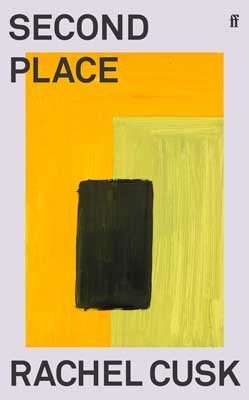
Second Place, Rachel Cusk, (UK/Canada) (Faber)
A woman invites a famed artist to visit the remote coastal region where she lives, in the belief that his vision will penetrate the mystery of her life and landscape. Over the course of one hot summer, his provocative presence provides the frame for a study of female fate and male privilege, of the geometries of human relationships, and of the struggle to live morally between our internal and external worlds.
With its examination of the possibility that art can both save and destroy us, Second Place attempts to affirm the human soul, while grappling with its darkest demons.
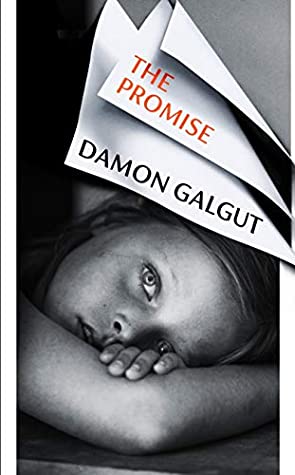
The Promise, Damon Galgut, (South Africa) (Chatto & Windus)
The Promise charts the crash and burn of a white South African family, living on a farm outside Pretoria. The Swarts are gathering for Ma’s funeral. The younger generation, Anton and Amor, detest everything the family stand for, not least the failed promise to the Black woman who has worked for them her whole life. After years of service, Salome was promised her own house, her own land… yet somehow, as each decade passes, that promise remains unfulfilled.
The narrator’s eye shifts and blinks: moving fluidly between characters, flying into their dreams; deliciously lethal in its observation. And as the country moves from old deep divisions to its new so-called fairer society, the lost promise of more than just one family hovers behind the novel’s title.
In this story of a diminished family, sharp and tender emotional truths hit home.
The Sweetness of Water, Nathan Harris (US) (Tinder Press)
In the dying days of the American Civil War, newly freed brothers Landry and Prentiss find themselves cast into the world without a penny to their names. Forced to hide out in the woods near their former Georgia plantation, they’re soon discovered by the land’s owner, George Walker, a man still reeling from the loss of his son in the war.
When the brothers begin to live and work on George’s farm, tentative bonds of trust and union begin to blossom between the strangers. But this sanctuary survives on a knife’s edge, and it isn’t long before the inhabitants of the nearby town of Old Ox react with fury at alliances being formed a few miles away.
Conjuring a world fraught with tragedy and violence yet threaded through with hope, The Sweetness of Water is a debut novel unique in its power to move and enthrall. An Oprah pick for her July book club and on Barack Obama’s summer reading list.
Klara and the Sun, Kazuo Ishiguro (UK) (Faber)
From her place in the store, Klara, an Artificial Friend with outstanding observational qualities, watches carefully the behaviour of those who come in to browse, and those who pass in the street outside. She remains hopeful that a customer will soon choose her, but when the possibility emerges that her circumstances may change for ever, Klara is warned not to invest too much in the promises of humans.
In Klara and the Sun, Kazuo Ishiguro looks at our rapidly-changing modern world through the eyes of an unforgettable narrator to explore a fundamental question: what does it mean to love? Also on Barack Obama’s summer reading list.
An Island, Karen Jennings (South Africa) (Holland House Books)
Samuel has lived alone for a long time; one morning he finds the sea has brought someone to offer companionship and to threaten his solitude…
A young refugee washes up unconscious on the beach of a small island inhabited by no one but Samuel, an old lighthouse keeper. Unsettled, Samuel is soon swept up in memories of his former life on the mainland: a life that saw his country suffer under colonisers, then fight for independence, only to fall under the rule of a cruel dictator; and he recalls his own part in its history. In this new man’s presence he begins to consider, as he did in his youth, what is meant by land and to whom it should belong. To what lengths will a person go in order to ensure that what is theirs will not be taken from them?
A novel about guilt and fear, friendship and rejection; about the meaning of home.
A Town Called Solace, Mary Lawson (Canada) (Chatto & Windus)
Clara’s sister is missing. Angry, rebellious Rose had a row with their mother, stormed out of the house and simply disappeared. Eight-year-old Clara, isolated by her distraught parents’ efforts to protect her from the truth, is grief-stricken and bewildered. Liam Kane, newly divorced, newly unemployed, newly arrived in this small northern town, moves into the house next door – a house left to him by an old woman he can barely remember — and within hours gets a visit from the police. It seems he’s suspected of a crime.
At the end of her life Elizabeth Orchard is thinking about a crime too, one committed thirty years ago that had tragic consequences for two families and in particular for one small child. She desperately wants to make amends before she dies. Set in Northern Ontario in 1972, A Town Called Solace explores the relationships of these three people brought together by fate and the mistakes of the past. By turns gripping and darkly funny, it uncovers the layers of grief and remorse and love that connect us, but shows that sometimes a new life is possible.
No One is Talking About This, Patricia Lockwood (US) (Bloomsbury Circus)
A woman known for her viral social media posts travels the world speaking to adoring fans, her entire existence overwhelmed by the internet — or what she terms ‘the portal’. Are we in hell? the people of the portal ask themselves. Who are we serving? Are we all just going to keep doing this until we die?
Two texts from her mother pierce the fray: ‘Something has gone wrong,’ and ‘How soon can you get here?’ As real life and its stakes collide with the increasing absurdity of the portal, the woman confronts a world that seems to contain both an abundance of proof that there is goodness, empathy and justice in the universe, and a deluge of evidence to the contrary.
Sincere and profane, No One Is Talking About This is a love letter to the infinite scroll, a meditation on love, language and human connection from an original voice of our time.
The Fortune Men, Nadifa Mohamed (Somalia/UK) (Viking, Penguin)
Mahmood Mattan is a fixture in Cardiff’s Tiger Bay, 1952, which bustles with Somali and West Indian sailors, Maltese businessmen and Jewish families. A father, a chancer, a some-time petty thief, he is many things but not a murderer.
So when a shopkeeper is brutally killed and all eyes fall on him, Mahmood isn’t too worried. It is true that he has been getting into trouble more often since his Welsh wife Laura left him. But Mahmood is secure in his innocence in a country where he thinks justice is served.
It is only in the run-up to the trial, as the prospect of freedom dwindles, that it will dawn on Mahmood that he is in a terrifying fight for his life — against conspiracy, prejudice and the inhumanity of the state. Under the shadow of the hangman’s noose, he begins to realise that the truth may not be enough to save him.
Bewilderment, Richard Powers (US) (Hutchinson Heinemann)
Theo Byrne is a promising young astrobiologist who has found a way to search for life on other planets dozens of light years away. The widowed father of an unusual nine-year-old, his son Robin is funny, loving and filled with plans. He thinks and feels deeply, adores animals and spends hours painting elaborate pictures. On the verge of being expelled from third grade for smashing his friend’s face with a metal thermos, this rare and troubled boy is being recommended psychoactive drugs.
What can a father do or say when his son wants an explanation for a world that is clearly in love with its own destruction? The only thing for it is to take the boy to other planets, all the while fostering his desperate campaign to help save this one.
China Room, Sunjeev Sahota (UK) (Harvill Secker)
Mehar, a young bride in rural 1929 Punjab, is trying to discover the identity of her new husband. She and her sisters-in-law, married to three brothers in a single ceremony, spend their days hard at work in the family’s ‘china room’, sequestered from contact with the men.
When Mehar develops a theory as to which of them is hers, a passion is ignited that will put more than one life at risk. Spiralling around Mehar’s story is that of a young man who in 1999 travels from England to the now-deserted farm, its ‘china room’ locked and barred. In enforced flight from the traumas of his adolescence — his experiences of addiction, racism, and estrangement from the culture of his birth — he spends a summer in painful contemplation and recovery, finally finding the strength to return home. Partly inspired by the author’s family history it explores how systems of power affect individual lives and the human capacity to resist them.
Great Circle, Maggie Shipstead (US)(Doubleday)
In 1920s Montana, wild-hearted orphan Marian Graves spends her days roaming the rugged forests and mountains of her home. When she witnesses the roll, loop and dive of two barnstorming pilots, she promises herself that one day she too will take to the skies.
Years later, after a series of reckless romances and a spell flying to aid the British war effort, Marian embarks on a treacherous flight around the globe in search of the freedom she craves, never to be seen again.
More than half a century later, Hadley Baxter, a troubled Hollywood starlet beset by scandal, is drawn to play Marian Graves in her biopic, a role that leads her to probe the deepest mysteries of the vanished pilot’s life.
Light Perpetual, Francis Spufford (UK)(Faber)
Lunchtime on a Saturday, 1944: the Woolworths on Bexford High Street in South London receives a delivery of aluminum saucepans. A crowd gathers to see the first new metal in ages—after all, everything’s been melted down for the war effort. An instant later, the crowd is gone; incinerated. Among the shoppers were five young children.
Who were they? What futures did they lose? Inspired by real events, written in luminous prose, the author reimagines the lives of five souls as they pass through the extraordinary changes of the twentieth-century London.
* * * * *
That’s it, the 13 books that make up the Booker’s dozen, chosen from 158 submissions. Are there any that jump out at you, that look interesting?
I’m intrigued by Sri Lankan author Anuk Arudpragasam’s novel, I’m always going to be more interested in stories that are set within another culture and I recall wishing to read his first novel, though I never did. Bewilderment seems to be receiving unanimously high praise by those who’ve had the chance to an early copy, but I really have no idea what will make the short list, watch this space to find out!
“Many of them consider how people grapple with the past—whether personal experiences of grief or dislocation or the historical legacies of enslavement, apartheid, and civil war. Many examine intimate relationships placed under stress, and through them meditate on ideas of freedom and obligation, or on what makes us human.”
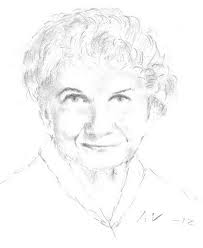
She was a favourite to win the prize, but appears not to have been aware of being nominated, no doubt she has been enjoying her retirement from writing fiction announced earlier this year.
Alice Munro is the 13th women to have won the Nobel Prize for Literature, news to which according to the Guardian, she is said to have responded “Can this be possible? Really? It seems dreadful there’s only 13 of us.”
Not just a resounding win for a short but growing list of women writers finally being recognised, but a victory for readers and writers of the short story, Munroe’s strength and preference.
Could it be a sign that the short story is making a comeback? It is something I wonder about in one of my very first blog posts entitled Why People Don’t Read Short Stories which is a tribute to the form and a reminder of the joy short story collections can bring.
Alice Munro
Born: July 10 1931, Wingham, Ontario, Canada
Educated: 1949-51 University of Western Ontario
Books: 1968 Dance of the Happy Shades
1971 Lives of Girls and Women
1974 Something I’ve Been Meaning to Tell You
1978 Who Do You Think You Are?
1983 The Moons of Jupiter
1986 The Progress of Love
1990 Friend of My Youth
1994 Open Secrets
1996 Selected Stories
1998 The Love of a Good Woman
2001 Hateship, Friendship, Courtship, Loveship, Marriage
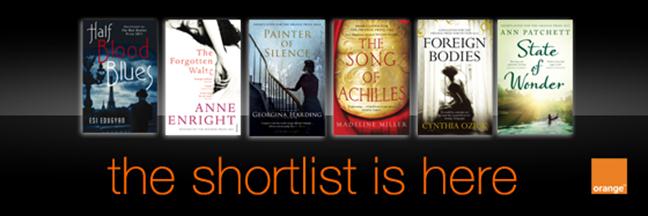
From the longlist of 20 books, today a shortlist of five has been announced, for the 17th annual Orange Prize for women’s writing.
Set up to acknowledge and celebrate women’s contribution to storytelling the Award celebrates excellence, originality and accessibility in women’s writing throughout the world. It is awarded to a novel written by a woman in the English language.
Last year the award was won by Téa Obreht for The Tiger’s Wife and previous winners have included Barbara Kingsolver for The Lacuna, Andrea Levy’s A Small Island and Chimamanda Ngozi Adichie for Half of a Yellow Sun, which is currently being made into a film.
This year the shortlist includes:
Esi Edugyan ‘Half Blood Blues’ Canadian 2nd Novel
Anne Enright ‘The Forgotten’ Irish 5th Novel
Georgina Harding ‘Painter of Silence’ British 3rd Novel
Madeline Miller ‘The Song of Achilles’ American 1st Novel
The winner will be announced at an awards ceremony to be held at the Royal Festival Hall in London on 30 May 2012.
I haven’t read any on the list yet, but I have Ann Patchett’s ‘State of Wonder’ on the shelf and I have been eyeing up ‘Half Blood Blues’ for some time.
And you? Have you read any of the titles from either the short or the long list yet, or planning to?







 I don’t have any Irish nonfiction left unread on my shelf, but I have noted that creative nonfiction author Kerri ní Dochartaigh, whose debut
  If you are looking for inspiration, check out Cathy’s blog, where she shares a list of
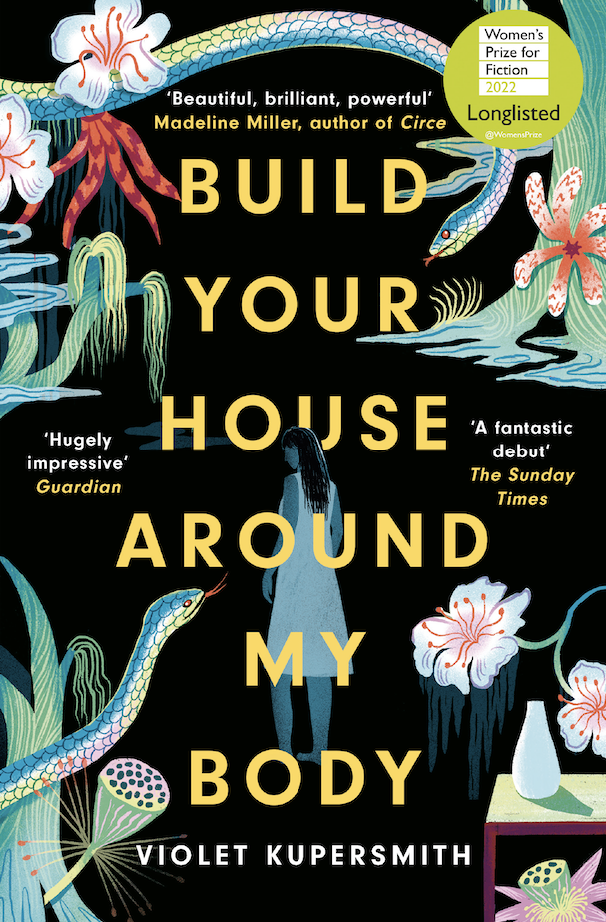 Two Vietnamese women go missing decades apart. Both are fearless, both are lost. And both will have their revenge. The fates of both women are linked, bound together by past generations, ghosts and ancestors, by the history of possessed bodies and possessed lands. This heart-pounding fever dream of a novel hurtles through the ghostly secrets of Vietnamese history creating an immersive, playful, unforgettable debut.
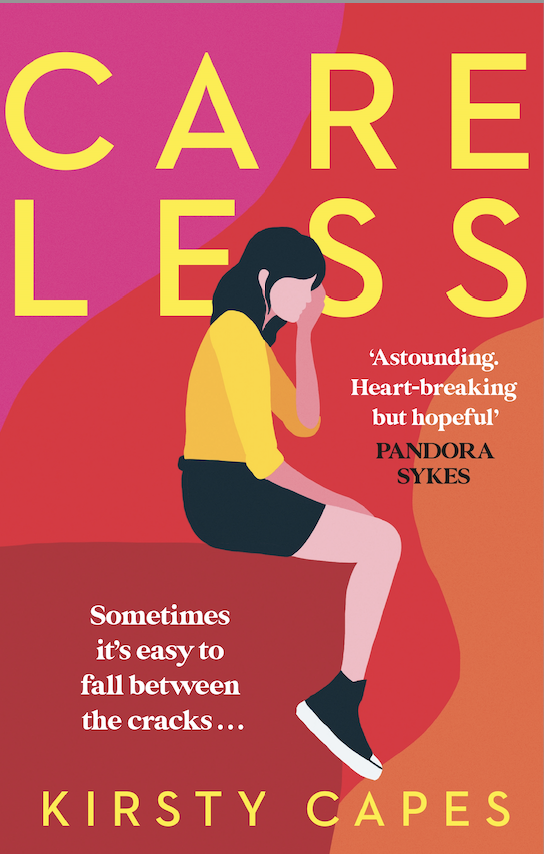 Sometimes it’s easy to fall between the cracks… At 3.04 p.m. on a hot, sticky day in June, Bess finds out she’s pregnant. She could tell her social worker Henry, but he’s useless. She should tell her foster mother, Lisa, but she won’t understand. She really ought to tell Boy, but she hasn’t spoken to him in weeks. Bess knows more than anyone that love doesn’t come without conditions. But this isn’t a love story…
 Nephthys is a taxi driver in DC, ferrying ill-fated passengers in a haunted car, with a ghost in the trunk. Endless rides and alcohol help her manage grief over the death of her twin brother, Osiris.
 A novel of love, homelessness, and learning to be fearless. In the garden, there were three flamingos, gateways to a time when life was impossibly good. They were mascots, symbols of hope.
 From days as a wild child in prohibition America to wartime London, from the rugged shores of NZ to a lonely iceshelf in Antarctica, Marian Graves is driven by a need for freedom and danger. Determined to live an independent life, she resists her childhood sweetheart, burning her way through a suite of glamorous lovers. An obsession with flight consumes her. As she is about to fulfil her greatest ambition, to circumnavigate the globe, Marian crash lands in a perilous wilderness of ice.
 Moving away from their Munich apartment isn’t as bad as for Frau Greta Hahn feared. The new villa is beautiful and life in Buchenwald seems idyllic. But beyond the forest is the looming presence of a work camp. Her husband, SS Dietrich Hahn has been assigned as the camp’s new administrator.
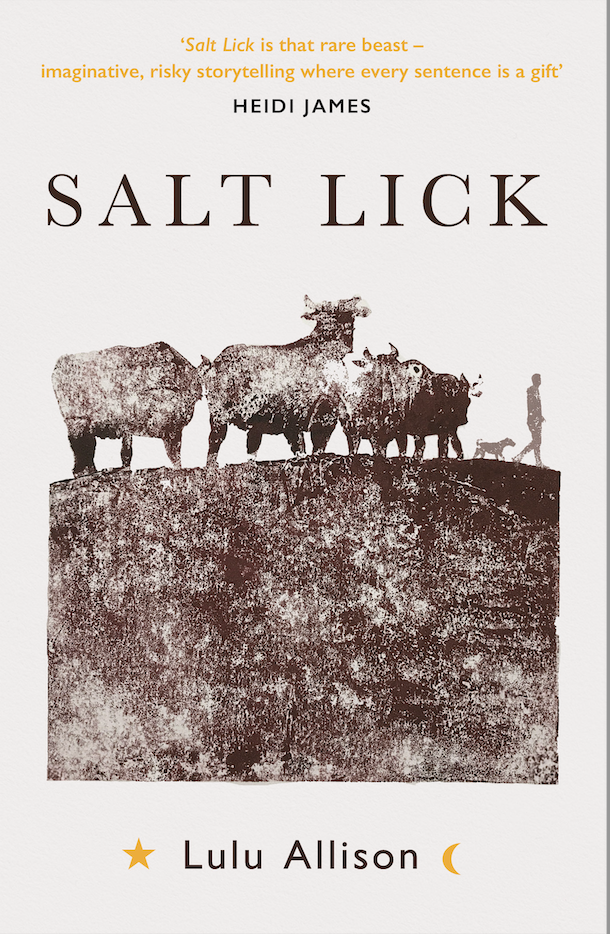 Britain is awash, the sea creeps into the land, brambles and forest swamp derelict towns. Food production has moved overseas and people are forced to move to the cities for work. The countryside is empty. A chorus, the herd voice of feral cows, wander this newly wild land watching over changing times, speaking with love and exasperation.
 Everyone tells Martha she’s clever and beautiful, a brilliant writer loved by her husband Patrick. A gift, her mother once said, not everybody gets. So why is everything broken? Why is Martha – almost 40 – friendless, near jobless and so sad? Why did Patrick leave?
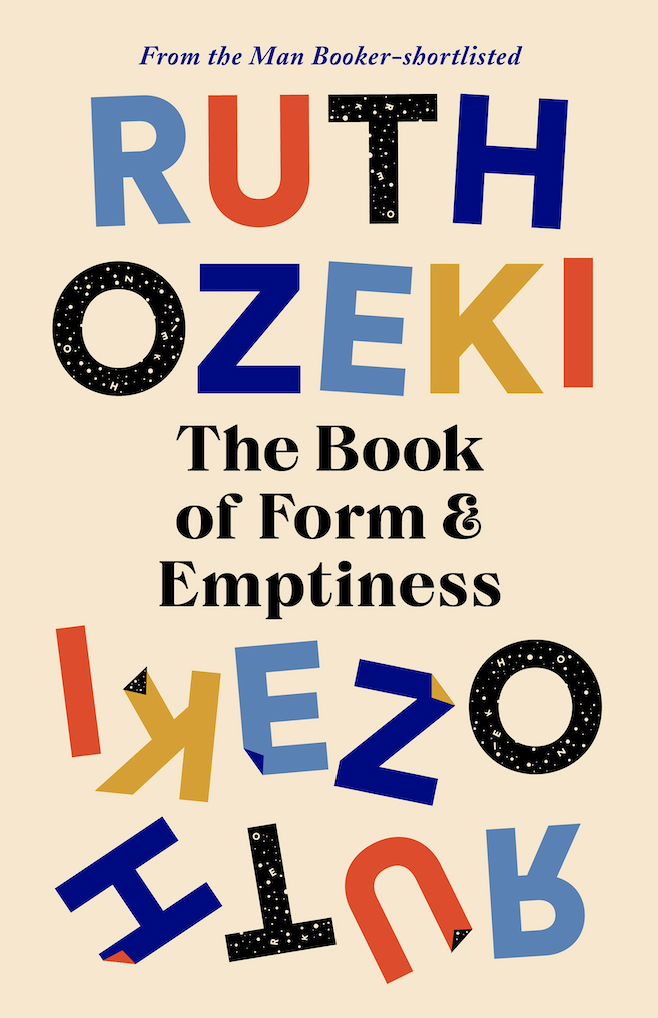 After the tragic death of his father, 14-year-old Benny begins to hear voices. The voices belong to the things in his house and sound variously pleasant, angry or sad. As his mother develops a hoarding problem, the voices grow louder. When ignoring them doesn’t work, Benny seeks refuge in the silence of a public library. There he meets a mesmerising street artist with a pet ferret; a homeless philosopher- poet who encourages him to find his own voice; and his very own Book, who narrates Benny’s life and teaches him to listen to the things that truly matter.
 Alethea is turning 40. Fashionable, feisty and fiercely independent, she manages a boutique, but behind closed doors she’s covering up bruises from an abusive partner and seeking solace in an affair. When she witnesses a woman murdered by a jealous lover, the reality of her own future challenges her.
 The Hanrahan family gather for a weekend as artist and notorious egoist Ray prepares for a new exhibition of his art – the first in many decades – and one he is sure will burnish his reputation for good.
 Opal is a fiercely independent young woman pushing against the grain in her style and attitude, a Black punk artist before her time. Despite her unconventional looks, Opal believes she can be a star. So when the aspiring British singer/songwriter Neville Charles discovers her one night, she takes him up on his offer to make rock music together.
 In 1974 Cyprus, two teenagers, from opposite sides of a divided land meet at a tavern in the city they both call home. The tavern is the only place that Kostas, Greek/Christian and Defne, Turkish/Muslim, can meet in secret hidden beneath the blackened beams from which hang garlands of garlic, chilli peppers and wild herbs. It is where the best food, music and wine in town is. But there is something else to the place: it makes one forget, even if for just a few hours, the world outside and its sorrows.
 On a perfect August morning, Elle heads out for a swim in the pond below ‘The Paper Palace’ – her family’s holiday home in Cape Cod. As she dives beneath the water she relives the passionate encounter she had the night before, against the side of the house that knows all her darkest secrets, while her husband and mother chatted to their guests inside.
 The Sentence asks what we owe to the living, the dead, the reader and the book. A small bookstore in Minneapolis is haunted by the store’s most annoying customer. Flora dies on All Souls’ Day, but won’t leave the store. Tookie, who has landed a job selling books after years of incarceration that she survived by reading ‘with murderous attention,’ must solve the mystery of this haunting while trying to understand all that occurs during a year of grief, astonishment, isolation and furious reckoning.
 Dawn breaks across the archipelago of Popisho. The world is stirring awake again, each resident with their own list of things to do: A wedding feast to conjure and cook, an infidelity to investigate, a lost soul to set free. As the sun rises two star-crossed lovers try to find their way back to one another across this single day. When night falls, all have been given a gift, and many are no longer the same.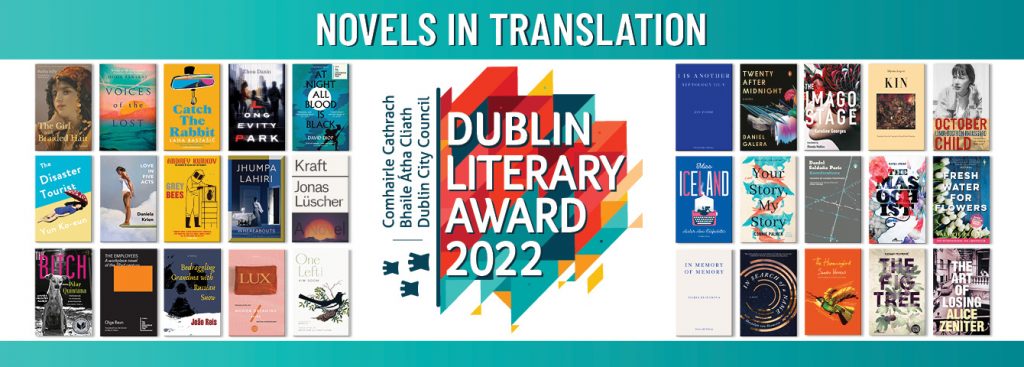
 A Passage North begins with a message from out of the blue: a telephone call informing Krishan that his grandmother’s caretaker, Rani, has died under unexpected circumstances. The news arrives soon after an email from Anjum, an impassioned yet aloof activist Krishnan fell in love with years before while living in Delhi, stirring old memories and desires from a world he left behind.
 A woman invites a famed artist to visit the remote coastal region where she lives, in the belief that his vision will penetrate the mystery of her life and landscape. Over the course of one hot summer, his provocative presence provides the frame for a study of female fate and male privilege, of the geometries of human relationships, and of the struggle to live morally between our internal and external worlds.
 The Promise charts the crash and burn of a white South African family, living on a farm outside Pretoria. The Swarts are gathering for Ma’s funeral. The younger generation, Anton and Amor, detest everything the family stand for, not least the failed promise to the Black woman who has worked for them her whole life. After years of service, Salome was promised her own house, her own land… yet somehow, as each decade passes, that promise remains unfulfilled.
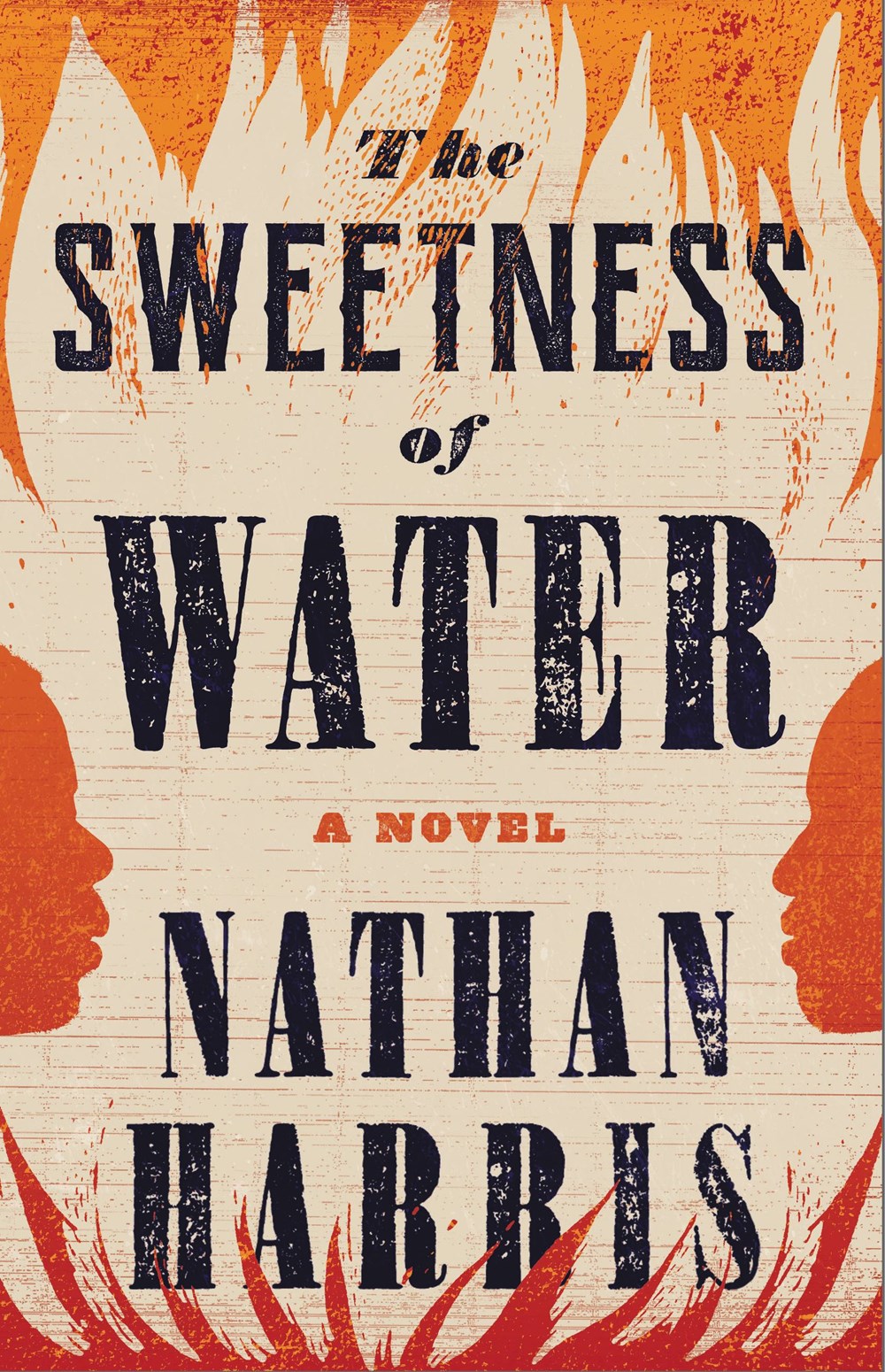 In the dying days of the American Civil War, newly freed brothers Landry and Prentiss find themselves cast into the world without a penny to their names. Forced to hide out in the woods near their former Georgia plantation, they’re soon discovered by the land’s owner, George Walker, a man still reeling from the loss of his son in the war.
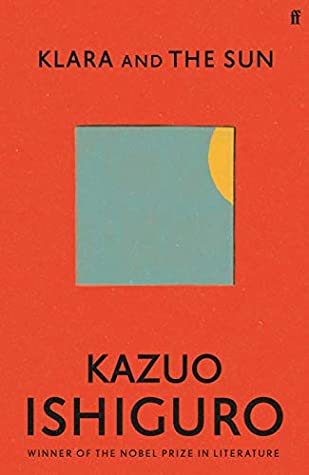 From her place in the store, Klara, an Artificial Friend with outstanding observational qualities, watches carefully the behaviour of those who come in to browse, and those who pass in the street outside. She remains hopeful that a customer will soon choose her, but when the possibility emerges that her circumstances may change for ever, Klara is warned not to invest too much in the promises of humans.
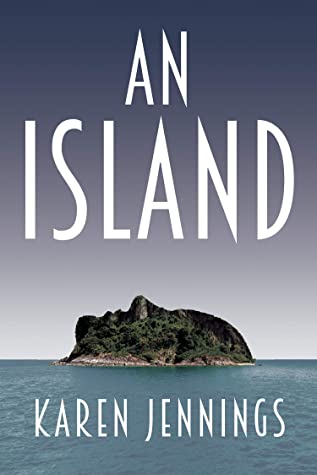 Samuel has lived alone for a long time; one morning he finds the sea has brought someone to offer companionship and to threaten his solitude…
 Clara’s sister is missing. Angry, rebellious Rose had a row with their mother, stormed out of the house and simply disappeared. Eight-year-old Clara, isolated by her distraught parents’ efforts to protect her from the truth, is grief-stricken and bewildered. Liam Kane, newly divorced, newly unemployed, newly arrived in this small northern town, moves into the house next door – a house left to him by an old woman he can barely remember — and within hours gets a visit from the police. It seems he’s suspected of a crime.
 A woman known for her viral social media posts travels the world speaking to adoring fans, her entire existence overwhelmed by the internet — or what she terms ‘the portal’. Are we in hell? the people of the portal ask themselves. Who are we serving? Are we all just going to keep doing this until we die?
 Mahmood Mattan is a fixture in Cardiff’s Tiger Bay, 1952, which bustles with Somali and West Indian sailors, Maltese businessmen and Jewish families. A father, a chancer, a some-time petty thief, he is many things but not a murderer.
 Theo Byrne is a promising young astrobiologist who has found a way to search for life on other planets dozens of light years away. The widowed father of an unusual nine-year-old, his son Robin is funny, loving and filled with plans. He thinks and feels deeply, adores animals and spends hours painting elaborate pictures. On the verge of being expelled from third grade for smashing his friend’s face with a metal thermos, this rare and troubled boy is being recommended psychoactive drugs.
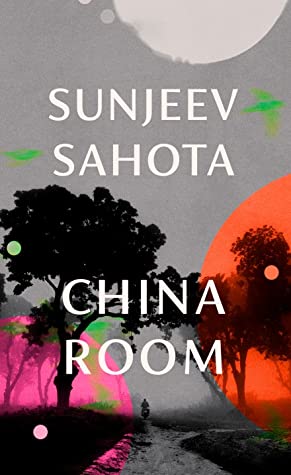 Mehar, a young bride in rural 1929 Punjab, is trying to discover the identity of her new husband. She and her sisters-in-law, married to three brothers in a single ceremony, spend their days hard at work in the family’s ‘china room’, sequestered from contact with the men.
 Lunchtime on a Saturday, 1944: the Woolworths on Bexford High Street in South London receives a delivery of aluminum saucepans. A crowd gathers to see the first new metal in ages—after all, everything’s been melted down for the war effort. An instant later, the crowd is gone; incinerated. Among the shoppers were five young children.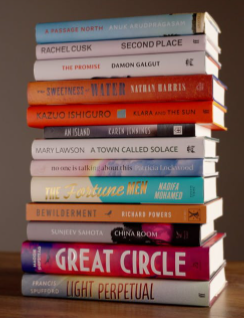


 From the
  Word by Word