
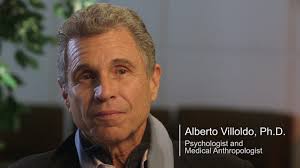
 I’ve been listening to Alberto Villoldo through some of his Hay House connections, in conversation with Intuitive, Colette Baron-Reid (see my review of her book Uncharted here) and recently watched a documentary featuring he and his wife Marcelo Lobos explaining certain rituals of the shamans, explaining them and showing them as they occurred.
Most recently I’ve been following his year long Living a Sacred Life Webinar Series, monthly hour long conversations between himself and leading shamans, mystics and contemporary spiritual teachers of the 21st century from a variety of the ancient wisdoms.
I looked at his range of books and decided that this was the one I wanted to begin with, I also have his book Shaman, Healer, Sage and although it was written earlier, it seemed more appropriate to read about the insights before diving into the healing practices. Again, I highlighted many passages in the book, but it’s so good, I passed it on immediately!
I’m attracted to his field of study because he works with energy medicine. I’ve studied the philosophy of traditional chinese medicine, in learning how to practice Acupressure and to understand the body and its disharmonies, when it is in and out of equilibrium, and the research Alberto Villoldo has done reveals something similar, a knowledge discovered by another group of people, that complements it.
The wisdom of these medicine men and women was under threat and they disappeared for a long time, only re-emerging in the 20th century to pass it on to those who could learn and share it. His methods are now being used by many therapeutic practitioners, as a complement to their existing methods of healing.
“For millennia, secret societies of Native American medicine men & women carefully guarded their wisdom teachings and acted as stewards of nature. They existed in many nations, known under different names, in the Andes and Amazon, they were “Laika”. In 1950 a group of them appeared, attending a gathering of shamans, to share their wisdom, recognising it was time, their people would need it to birth a better world.”
The four insights was an excellent read for me, for where I am at in my understanding, I absolutely loved it and all its insights, I was already familiar with the shamanic levels of perception, of serpent, jaguar, hummingbird, eagle, which correspond, to body, mind, soul, spirit and their associated languages.
This book expands on those themes and provides deeper explanations of how we perceive at each of these levels, what we need to understand about how we are responsible for creating the reality of each of those levels, and that we can only change our own inner perception and try to uplevel, we can never change another’s perception, except through being the role model that they might perceive and respond to without influence.
At each level of perception, different insights are shared, below are just a few phrases that relate to the large body of work that describes them in much more detail, their essence can be encapsulated in a few words, as mentioned below:
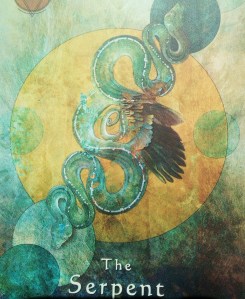
- The Way of the Hero (serpent) body – the senses – physical reality, physical solutions – language = molecular and chemical – survival, self-preservation – reptilian brain
- The Way of the Luminous Warrior (jaguar) mind – curious, inquisitive – mammalian brain – language = words – to express ideas, beliefs, feelings – look for cause to resolve problems, reflect
- The Way of the Seer (hummingbird) – soul – language = image, music, poetry, dreams – neocortex – reason, visualise, create
- The Way of the Sage (eagle), spirit – consciousness – prefrontal cortex – dreaming a new reality
There are four practices shared within each of these “Ways”, suggestions as to how we can alter our own reality, by shifting our perception into a higher realm, learning how to move up a level when necessary, to see things from that elevated perspective. It doesn’t mean we have to stay there, just to become aware of it and hopefully learn how to do it, to embrace the wisdom.
It is a practical book, so exercises are offered at each level, to take the reader through a practice to begin to become aware of the energy field and other concepts mentioned. Not everyone gets it first time, but he insists that anyone can learn how to do this, if they are interested or inclined. Having a teacher is preferable, but it can also be learned independently.
When we get stuck, particularly at the level of serpent (physical reality) and jaguar (intellectual/analytical reality), we spend a lot of time struggling with issues, yet when we succeed to shift our perception to a higher level, and practice seeing things from that perspective, we suffer less. We still have to deal with issues, but we are no longer tormented or traumatised by them, we have the opportunity – if we practice – to no longer get triggered by patterns of the past, or patterns inherited.
All levels have their place and use, and we don’t necessarily want to stay at one level, but by becoming aware of them and the gifts they offer us, we can heal aspects of ourselves and learn how to emit more light, like the luminous beings that we are.
Further Listening
Inspire Nation: Michael Sandler interviews Alberto Villoldo on How to Upgrade Your Energy Field
 I’m glad The Open Door was brought back into publication, it was a landmark work in woman’s writing in Arabic when it was first published in 1960, an important commentary on the challenges women and girls in so many societies face, a consequence of patriarchy; an effect that is being busted wide open today, forcing transparency, offering support, healing and with hope, gradual change in many countries today. It seems timely to revisit this, or to read it for the first time, as will likely be the case for many.
 About her novel, she had this to say:

 The narrating of family stories, taking us back as far as her great-grandfather Montazemolmolk with his harem of 52 wives, serves to provide context and an explanation for why certain family members might have behaved or lived in the way they did, helping us understand their motives and actions.

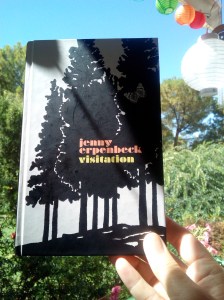 I’ve attempted to read Visitation about four times and never succeeded in getting past the first few chapters, but this year I persevered as I felt I hadn’t given it a fair chance.
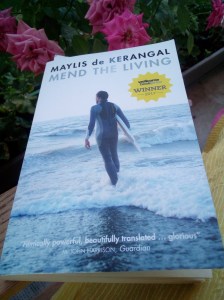 Although I’ve read reviews and seen this book appear often over the last year, and knew I really wanted to read it, I couldn’t remember what is was about or why.
 The British translation (by Jessica Moore) is entitled Mend the Living, broader in scope, it references the many who lie with compromised organs, who dwell in a twilight zone of half-lived lives, waiting to see if their match will come up, knowing when it does, it will likely be a sudden opportunity, to receive a healthy heart, liver, or kidney from a donor, taken violently from life.
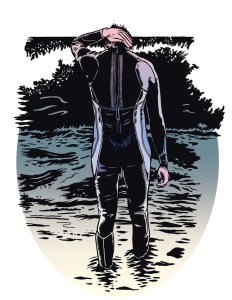 The translator Jessica Moore refers to her task in translating the authors work, as ‘grappling with Maylis’s labyrinthe phrases’, which can feel like what it must be like to be an amateur surfer facing the wave, trying and trying again, to find the one that fits, the wave and the rider, the words and the translator. She gives up trying to turn what the author meant into suitable phrases and leaves interpretation to the future, potential reader, us.



 Anthony Peardew is a man who has suffered a great loss and he is also a man who obsessively collects, labels and keeps things he’s found on his wanderings, noting where he was, what time and anything else of note about the thing he has found. It is a kind of antidote to the two precious things he has lost. But there remains unfinished business, which is where the kind and unsuspecting Laura comes in.
 This morning I read an article by Jenni Ogden, neuropsychologist and author of
  Songs From the Violet Café novel begins and ends with chapters set in 2002, with independent events that take place on the same night, near each other. In Part One, an old boat laden with personal items, private notes and other paraphernalia is set alight and pushed out onto the lake, providing a spectacle for the family and their friends gathered for the occasion.

 A friend lent me this book and I recognised immediately that it was a Europa Editions book, but not one I had heard of Europa Editions are one of my favourite publishers, they always have something that will appeal to me in their annual catalog. Many of the books are of Italian origin, or translated from other European languages.




 Both Billy’s father Jack and his best friend Harlow, also bear and have borne the hardship of the return from war, they cope in their own way, as has Marion, Jack’s wife, waiting out the long semi-recovery, which in the early years, tests every man who dares survive war’s dark parasitic claim to their sanity. Now they must watch Billy go through the same test.
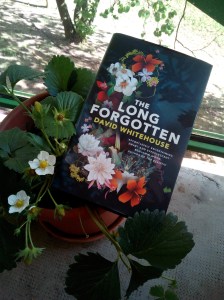 Apart from being a brilliant, unputdownable read, I continuously referred back to that image on the cover with total pleasure trying to deduce which flower it was we were tracking down next.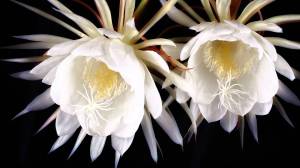

 Word by Word