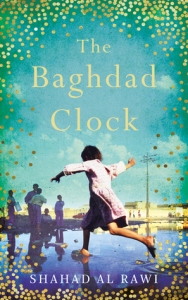
The Baghdad Clock by Shahad Al Rawi tr. Luke Leafgren

Slightly surreal, nostalgic and deeply philosophic portrayal of a neighbourhood in Baghdad, of a childhood and early youth lived under the shadow of war, shared by a girl, (our unnamed narrator) who refuses to depict her childhood through the lens of suffering and devastation.

She shares their humanity, their connections, their hopes, and when she comes close to anything that might be traumatic, lifts off into dreams and the imagination, into other realms, soothed by the souls of the departed, the wisdom of her intuition creating metaphors and fantasy in her mind, an alternative way of seeing the world.

Her resilience isn’t defiant, it’s like a hardy shrub that wants to bloom even in the harshest environment and finds refuge in the imagination. One of her recurring dreams that she enters is the idea that they are living on a ship, one evening the Captain tries to answer her many questions. The fantasy world she creates when she closes her eyes, whether she is sleeping or awake, helps her cope, keeping childhood a place of both safety and wonder.

Listen my dear. The ship is an idea in your head and I am an idea in the head of the ship. Small ideas usually have delicate wings and when they lose their value on the earth, they fly up into space. The world we live in is just an idea made by the imagination of an inventive creator, and when he found it to be complicated, he began explaining it by means of other, smaller ideas…

We are prisoners of our imaginations, and our experiences in the world of reality consist only of ideas.
And don’t tell anyone, because people only believe things that come independently to their minds. Yet they don’t know where the mind is to be found.

She doesn’t understand the captains words, but knew he was telling her the truth.

Sometimes there are things we do not understand, and we know their meaning, not through words but rather, the meaning is already inside us before others talk to us about it. Some meanings exist inside us but are sleeping. Then words that we understand come and wake us up.

Memories are narrated through her friendship with Nadia, the girl she meets and sleeps next to in the air raid shelter in 1991, they tell each other stories and comfort each other in what is the beginning of a long and deep friendship that sustains them through the things that bring discontent, the sanctions, another war, the threat of separation.

We get to know the families who live and have lived in this neighbourhood, watching them grow and evolve, sharing those moments when they grow out of girlhood and begin to blossom. We are drawn into their lives until the black Chevrolet arrives and one by one they depart for elsewhere.

News from the outside and their fates isn’t shared by the usual channels, instead it comes in the form of a stranger entering the neighbourhood, a fortune teller. He warns them:

‘None of you have a future in this place. Sooner or later this ship will sink with all of you on board.’

One of the women dismisses him as a spy, but he has sown a seed of fear in them and the slow exodus begins. Uncle Shawkat becomes protector of abandoned homes, keeping away unwanted racketeers, writing names of the departed on the doors, the dates they lived there and the words, This House is Not for Sale.

It’s an unusual novel in its determination to not resort to pessimism, despite the suffering and loss that is around them, it clings to its memories of childhood and growing up, of friendship and budding love, of mother’s sitting around listening to the stories of the soothsayer, with only rare glimpses at the politics of their discontent.

Nadia and I were born during the war with Iran. We got to know each other during Desert Storm. We grew up in the years of the sanctions and the second Gulf War. George Bush and his son George W. Bush, took turns firing missiles and illegal weapons at our childhood, while Bill Clinton and that old woman Madeleine Albright were satisfied with starving us. And when we grew up, hell sat in wait for us.

It is a lament for days gone by, remembered by the young not the old, who know their children will grow up in other lands, other cultures, with little knowledge of their forebears, of their ways, their neighbourhood, the friendships that shaped them.

We are the last teardrop aboard the ship, the last smile, the last sigh, the mast footstep on its ageing pavement. We are the last people to line their eyes with its dust. We are the ones who will tell its full story. We will tell it to neighbours’ children born in foreign countries, to their grandchildren not yet born – we, the witnesses of everything that happened.

Shahad Al Rawi
Source: Kareem El Deeb

It’s a beautifully written, poetic novel that won the hearts of readers in Edinburgh clearly, giving a unique insight into a culture, as lived by its children, its families, the lives impacted by foreign politics that no-one cares to share, the loss, not just in terms of human lives, but in an ancient, peaceful way of living that is no more.

Shahad Al Rawi was born in Baghdad and left there with her family for Syria. She now lives in Dubai and is currently pursuing a PhD in Anthropology. The Baghdad Clock is her debut novel, it won the Edinburgh First Book Award and was shortlisted for the International Prize for Arabic Fiction.

Buy a Copy Via Book Depository

N.B. Thank you to the publisher One World Publications for providing a copy of the book.

Teethmarks on My Tongue by Eileen Battersby

Eileen Battersby (1958-2018) was a renowned literary critic and reviewer, my favourite, probably the only one I knew by name, reputation and avidly followed. It wasn’t just for her excellent reviews, it was because she read so much further outside of the English language and culture than any other, and because she might as easily refer back to ancient myths and classics as she would to contemporary translations in her far-reaching analysis and commentary on literature.

Sadly, tragically, two days before Christmas, at the age of 60, she died following a freak road accident in Ireland, a terrible loss to her family, friends and all those who’d come to respect and enjoy her thoughts on literature. As the author John Banville wrote,

“she was a champion of the overlooked and undervalued…a shining light in the world of letters”

Her last two reviews for The Guardian linked below, a testament to that diversity, were novels by writers from elsewhere, one of them also a translation; Tommy Wieringa’s (one of the most important Dutch literary writers of the last decade) novella, The Death of Murat Idrissi (translated by Sam Garrett) and rising literary star, Nigerian author Chigozie Obioma’s latest An Orchestra of Minorities.

Having so recently separated from the Irish Times she was at the beginning of a new era, she’d begun writing reviews for the FT, one of her last the English translation of Walter Kempowski’s Homeland and the LARB (Los Angeles Review of Books), and was working on a literary Western, a genre it is said she was fascinated by.

No doubt she was wary of putting her own writing out there to be judged, just as many authors she interviewed had been wary of her unforgiving yet erudite turn of phrase. When Teethmarks on My Tongue was first launched in Ireland in 2016, Prof. Jennny Williams praised Battersby’s literary criticism, which had an international impact, acknowledging:

It was a special author who could cross the “shark-infested waters” between being a literary critic and a novelist.

Battersby was awarded honorary membership of the Irish Translators and Interpreters (ITIA) group in 2016 for her work raising awareness of translated novels and of translation in general, which plays an essential role in ensuring access to the work of novelists in other languages.

Though Californian by birth she came to Ireland with her family as a teenager and stayed, studying English literature at University College Dublin, working many years for the Irish Times, living most of her adult life in Ireland. She was known for her love of animals, especially horses and dogs, a significant feature in her novel and her long, engaging telephone conversations, always delighted to share her literary thoughts to a willing listener.

Review

Teethmarks on My Tongue is a coming-of-age story about teenage Helen, the only child of a wealthy Southern family, who in the opening pages witnesses her mother’s death broadcast on television, shot by a mentally ill lover.  Living on an esteemed property in Richmond, Virginia, she passes her free time in the company of horses or immersing herself in her intellectual passion, the science of astronomy, the solar system.

Father and daughter though shocked, are relatively unmoved by this death, their lack of empathy makes for bizarre reading, they seem somewhat removed from reality, making me wonder if is it supposed to be satire, particularly as the story around the murderer quickly becomes farcical and the media’s indifferent treatment of the family seems almost pointed, given the author’s years of proximity to that profession, I do wonder.

I imagine the reporters busy at their desks, yanking and pulling at the stuff of people’s lives. Making up stories that exaggerated the wrung-out facts and then just ruthlessly leaving the truth for dead, along with the raw and tender feelings of those who had been left behind.

In Part 2, now 18, she departs for Europe alone. Her father, a vet and breeder, sold the horse she called Galileo to a French buyer, reminding her it had never been hers. He denied she was a scientist, saying her interest was the history of science not quite the same as being a physicist. She lived among them, had access to everything, but the valuable animal was denied her and so too it seemed her association with science. Galileo was sent to France, and so she sends herself there too, depriving her father of them both.

I wanted to show Father that I was not content with simply taking whatever I wanted as it had apparently seemed to him. No, it was vital to prove, to him and to me, that I was capable of rational thought and had revised my old notion of who I was, now that Father had destroyed all of that for me.

In Paris she indulges her love of art, spending hours observing paintings, has a ghastly experience with an older man and is catapulted into the next experience by her foolish, misguided courage. Rescuing a stray dog she names Hector sets her on a mission to find a job in the countryside. Finally, an animal she can care for and own, despite the complications he brings to her uncertain future.

Mother always maintained that my “gray matter” as she called it would compensate for my physical shortcomings, my peculiar eyes … I am sure she had never meant to hurt my feelings and instead had given me a kind of confidence; no a resilience. That is what I had in abundance, resilience, very useful when balancing my standard issue face and ill-matched eyes, and, hopefully the dreams Father had belittled but which I would salvage.

In Part 3 she is working on a horse farm in the Loire valley with Hector in tow, riding horses to earn her keep, trying to figure out the characters who live there, blind to the relationships between people, somewhat aloof. We too are blind and slow to realise these connections, limited to seeing through her dual-coloured eyes that discover too late the reality.

It’s a voyage through late youth, and through the unknown countries and cultures of France and Germany (with the exception of their art, of which she has significant intellectual knowledge and insight), the novel and its main character observe well, comfortable analysing experiences yet it lacks emotional depth, things happen which surprise the reader because Helen doesn’t exhibit much emotion except in relation to Hector; human connections are stilted, surprising; she figures things out rather than feels them.

On realising she may be loved, or in love with one of the employees, Mathieu:

Delightful as it all was, a part of me still felt wary. It’s in my nature, always was; the doubts along with my stupid habit of putting everything said or done of any significance under the imaginary microscope in my mind.

Wanderer Above the Sea of Fog

The cryptic title finally appears near the end and I wonder if it might be a metaphor for the author writing a book, since she was more renowned for her criticism than her creativity.

In the novel it is ‘Wanderer above the sea of Fog’, a painting by Caspar David Friedrich she seeks, the German Romantic painter of loneliness; she follows a trail of his works from Paris to Hamburg to Berlin.

“Had I missed out on seeing the picture I would have sobbed, bitten down hard, teethmarks on my tongue, and then would have devised an alternative plan.”

While reminiscing on the paintings she views, we see how well informed and sensitive she is to finding solace and understanding through art, even if lacking it in life, it is here she seems able to reach inside and feel. When she finally locates the painting, she wonders:

What was going through the mind of the wanderer as he gazed out over the abyss? His life, his future … eternity, or was he just realising how far he had climbed?

A quintessential Romantic artwork, it was a reaction against pre-revolutionary European values of logic, rationality and order, as writers, artists and musicians turned towards emotion, imagination, and the sublime for inspiration. To nature. Battersby’s protagonist ponders her own life’s meaning as she hovers between those two perspectives and leads us towards the novel’s shocking denouement.

It’s a novel that makes you think because of that aspect of her character that is missing, still evolving, nowhere is that more alarming than with its surprising ending, as she reaches the end of another phase of her journey, as much in her head, if not more, than when she began.

In this respect, it’s almost the anti-thesis of the hero’s journey, an anti-myth, suggesting that sometimes humans don’t learn from their experiences, don’t evolve, they become more entrenched in their own way of being, of perceiving and then life comes along and slaps them.

Further Reading

Remembering Eileen Battersby by Neil Belton, Editor in chief, Head of Zeus

Remembering Eileen Battersby, by Susan Curtis, LARB (Los Angeles Review of Books)

The Death of Murat Idrissi by Tommy Wieringa – review

An Orchestra of Minorities by Chigozie Obioma review – a stunning leap forwards

Buy a Copy via BookDepository

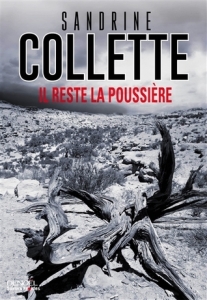
Nothing But Dust by Sandrine Collette (France) tr. Alison Anderson

As soon as I saw the cover of Sandrine Collette’s Nothing But Dust I wanted to read this book. I didn’t know what genre it was, but it was published by Europa Editions; all the books they choose to publish that I have read have been excellent.

From the description, a family of four boys working a farm after their father’s departure, ruled by a tyrannical mother, lived out on an arid, lonely Patagonian steppe, mounting family tensions…

And comparisons like these:

Reminiscent of Coetzee’s Disgrace, Chatwin’s In Patagonia, the Dust Bowl novels of Steinbeck, the writing of Cormac McCarthy, and the southern gothic of William Faulkner, Nothing But Dust is a gripping, unsentimental, ultimately majestic story about life in one the most inhospitable places on Earth.

Now I haven’t read Chatwin or Faulkner, and I don’t often agree with book comparisons, however reading this book did remind me of Cormac McCarthy’s excellent Border Trilogy, in particular his coming of age novel All the Pretty Horses, which I loved.

We know how tough and relentless life is, and is going to continue to be from the opening pages as the elder twin brothers carry out their favourite cruel tricks on the youngest brother Raphael; they’re fearful of the mother, but know she won’t intervene, her ideas on how to raise boys doesn’t include protecting or consoling them. Young Raphael becomes the son the reader will sympathise with and wish things for, throughout this thrilling novel.

Because he was the youngest, his brothers had gotten into the habit of chasing him around the house on horseback when their mother wasn’t watching. As soon as the twins had grown strong enough to grab him by the collar and lift him up at a gallop from astride their criollos, it became their favourite pastime.

It’s a novel of survival, not just the physical hard work, the long days but the need of the two younger brothers to always be on alert, Steban they call the half-wit, silenced by what he has seen, not trusting anyone, his allegiances drift knowing he is unable to stand up to any of them.

He realises that for as long as he can remember, he has always been flanked by anxiety. The apprehension of the next blow, the insults. And everything else.

We become immersed in this life on a sheep farm with The Mother, her four sons, a dog named Three and the Criollos they ride, on the arid, infertile steppe they live on in Patagonia. All they’ve known and grown up with is harsh and menacing, reliably so; all they know is work, for her.

There are evenings when she reminds herself that she came from a family of wretches with neither land nor fortune, and that everything seemed to point to a future of working herself to the bone in the service of others, and she grumbles and ruminates, finds a thousand things wrong with the steppe she’s been left with – well, that was the least she was owed, after all the misery she endured year after year. There is no room for gratitude in the mother’s life: what she has, she deserves.

When The Mother makes her first mistake, it opens a crack in her tight-fisted way of ruling the way they live, a slipway through which things might be different, we are lead out of the plateau towards the forest, towards the light with a deft, atmospheric thrill and underlying dread.

When Raphael must track down two missing horses, he is lead out of the steppe towards lands that are unfamiliar, encountering new terrain. While Sandrine Collette has demonstrated a talent for creating unforgettable characters, here she excels in depicting the landscape as it changes from the dry, dusty, harshness of the plateau to the lush, fertile, freedom of the forest.

The change of landscape leaves him stunned; all he has ever known is the treeless steppe. He looks up at the magnificent boughs, the changing hues of entire regions where the rain has ventured…

Goes and sits down.

If he was at the farm he would never do this, but solitude and freedom propel him.

As the mother exhibits weakness, loosening her indomitable control over the boys, the rage of the elder twin begins to rise. It is that Lord of the Flies moment, that human impulse towards savagery no longer contained by the mother’s warped rules supposed to keep it in check. The mother and the elder son embrace that savagery and as long as they are in unison, they rule. The younger sons represent civilisation, violence is not their instrument. They observe, learn, they seek a different way.

It’s a fantastic, compelling novel of the human condition, in an original setting and family dynamic. Thought provoking, atmospheric, charged with tension, it will stay with you long after reading.

Highly Recommended.

N.B. Thank you to Europa Editions for providing me with a review copy.

***

Buy? Book Depository

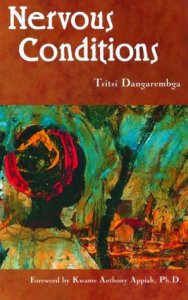
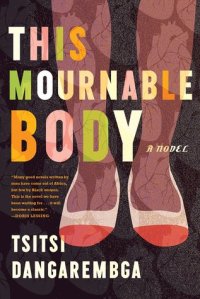
Nervous Conditions by Tsitsi Dangarembga

I came across this promising book on a Goodreads group called 500 Great Books by Women  a reference to a book published in 1994 that lists works by women considered notable and influential under different themes such as Art, Heritage, Identity, Ethics, Conflicting Cultures, Choices, Growing Old, Growing Up, Power and more.

Daughters of Africa

The group also includes a list developed from a similar compilation called Daughters of Africa by Margaret Busby an anthology of words and writings by women of African descent, with titles from the 1830’s to 1990.

In an effort to read more widely, writers from different countries and cultures, and in particular the lesser known great books from women, it’s a fabulous resource and members of Goodreads, if they’ve read and reviewed any of these books provide links to their comments/thoughts on them, helpful in discerning whether a book is of interest.

Nervous Conditions was written by the Zimbabwean author Tsitsi Dangarembga in 1988, it was the first book published by a black woman from Zimbabwe in English. It was awarded the Commonwealth Writer’s Prize in 1989 and has been translated into a number of languages. It is recognized as a major literary contribution to African feminism and postcolonial literature.

If that wasn’t enough of a promise of something rewarding, this quote in the excellent foreword by Kwame Anthony Appiah confirmed it.

“Each novel is a message in a bottle cast into the great ocean of literature from somewhere else (even if it was written and published last week in your home town); and what makes the novel available to its readers is not shared values or beliefs or experiences but the human capacity to conjure new worlds in the imagination.”

I thought it was absolutely brilliant, one of the most interesting characters I’ve come across in my cross cultural journey, portrayed with such raw honesty, I’m in awe and immensely relieved there is another book to follow, because I’m not ready to leave it there.

Review

It’s a coming of age story of Tambu, a teenage girl, who in the beginning lives in a small village with her parents and siblings and their days are hard, especially the women, who work in the fields all day, do the laundry at the river, transport water to and fro and cook in a kitchen that lacks modern conveniences and requires skill and tenacity to manage. Despite the hard work Tambu loves her village and even the work and chores equally provide moments of pleasure and companionship.

Her Aunt and Uncle return from five years in England furthering their education so he can become headmaster of the mission school. Tambu is disappointed that her cousin isn’t as friendly towards her as she once was, the “Englishness” has changed her cousins. Her brother is offered the opportunity of an education where her Uncle is headmaster.

It had been my uncle’s idea that Nhamo should go to school at the mission. Nhamo, if given the chance, my uncle said, would distinguish himself academically, at least sufficiently to enter a decent profession. With the money earned this way, my uncle said, Nhamo would lift our branch of the family out of the squalor in which we were living.

Tambu forced to quit her education for financial reasons, sets about implementing a plan to earn her own school fees, determined that she shall rise up too. She appears to have the best of both worlds, the grounding, practical, connected upbringing of village life, a work ethic, practical skills in the kitchen and a tenacity that purchased her an extended education, growing her own crop and finding someone to help her sell it, despite efforts by her brother to sabotage her intention and her parents complete lack of faith in her ability to succeed.

A Colonial Education

Thus she too sets off on the path of an education informed by “English influences” though she retains deep family and village values. However, being around and observing her cousin and how her behaviour has changed, and becoming aware of the frustrated ambitions of her aunt, her world view begins to shift , despite dedicating herself to being the most diligent pupil and the most respectful niece possible.

The subtle way her character transitions to greater awareness is adeptly portrayed, her feelings of ambition and regret as she realises it may be impossible to achieve all that she aspires to without losing something of what she had. She observes her cousin rebel and then accept that middle ground, fall victim to it, unable to go back to who she was, becoming alienated from her own, entering into self-destructive territory.

All her characters are multi dimensional, portrayed in a way that even though they inflict suffering on one another, we are made to understand their point of view and realise the dilemmas and complexities they face. There are no villains, or heroes, just humans trying to improve their lot or that of others, sometimes making significant achievements, and at other times grave mistakes.

In an interview the author was asked why she was so generous to her characters, giving them this chance to explain or be explained, she responded:

I employ this strategy so that many different categories of people can find something to identify within the book – also because the situation of the characters is very complex.  One can hold a person responsible for reacting to a situation in a certain way, but the situation that exerted the pressure to behave in that way must also be addressed.

I’m so glad I’ve read this early on, so I can get to the next two books in the trilogy The Book of Not and This Mournable Body. Have you read this modern classic or any other books by Zimbabwean authors?

My Reviews of Zimbabwean Literature

The Book of Not (Book 2) by Tsitsi Dangarembga

This Mournable Body (Book 3) by Tsitsi Dangarembga

House of Stone by Novuyo Rosa Tshuma

We Need New Names by NoViolet Bulawayo (shortlisted for Booker Prize & the Guardian First Book Award, 2013)

Buy a Copy via BookDepository

Top Reads of 2018

Top Reads of 2018

A Few Reading Statistics

Goodreads Statistics

In 2018 I read 47 books, just under one book a week. Three quarters of them were by women authors and 25% by men. 76% of the books were fiction and 24% non-fiction (poetry, essays, memoir, spiritual).

I like literature from around the world, I read authors from 18 different countries, including Argentina, Taiwan, Uganda, Senegal, India, Turkey, Egypt, Iran, Germany, Sweden, Japan, Burundi, NZ, Australia and Ireland.

Despite this apparent diversity, half the books I read were by British or American authors, an imbalance I hope to address through more conscious reading in 2019.

It requires more of an effort to find books from other countries that fit my reading inclination, but I will continue to have that as my lead reading intention.  I read 12 books translated from other languages (23%) and I read one in the original French language. 80% of the books I read were physical books and 20% were e-books.

Although I read so many books from the US/UK, as I consider those stories that stood out for me, I find they are predominantly narratives from elsewhere recounting tales of experience and perspective other than the anglo-american one.

Outstanding Read of 2018

Again, my outstanding read of the year came early in the year, one of the most underrated novels of the year, that should have been given more attention, in my opinion.

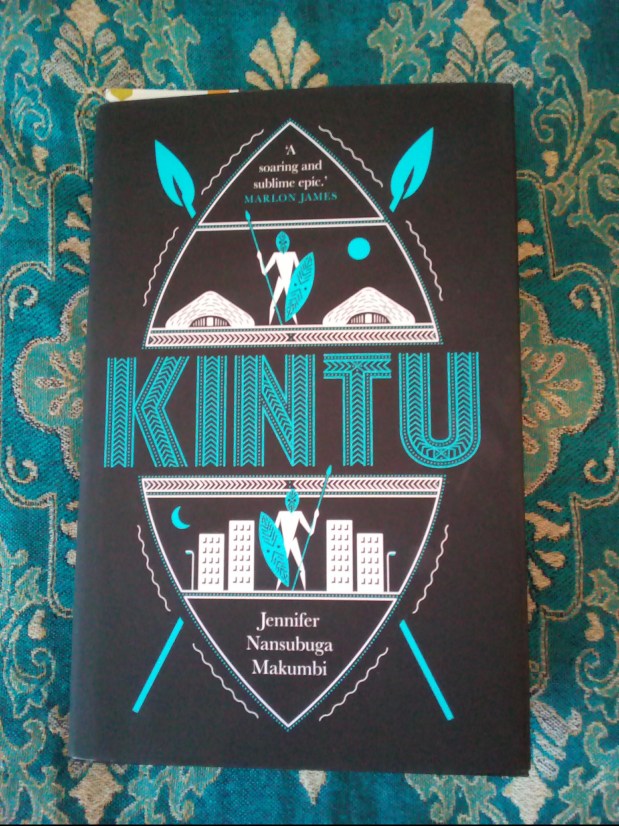
The historical novel Kintu by Jennifer Nansubuga Makumbi is set in 1700’s Buganda ( the largest of the traditional kingdoms in present-day Uganda, comprising all of Uganda’s Central Region, including the capital Kampala) and modern Uganda.

Kintu is a family name, the thread that runs through the six parts that make up the story, beginning with a curse put on the family name and following it throughout the years and generations. It is a combination of excellent storytelling and insight into a culture, its beliefs and traditions. Here’s an excerpt from my review:

It’s brilliant. We traverse through the lives of these families, witness their growth, development, sadness’s and joys, weaving threads of their connections together, that will eventually intersect and come to be understood and embraced by all as the clan is brought together to try to resolve the burden of the long-held curse that had cast its long shadow over this clan for so many generations.

Top Reads 2018

In no particular order here are the other books that made a significant impression and have stayed with me throughout the year, click on the title to read my review, or the book cover image to purchase a copy:

Petit Pays by Gaël Faye  was the one book I read in it’s original language (French) but which I classify as coming from the Republic of Burundi, where the story takes place. It’s a short novel with a significant impact, that has since been translated into English as Small Country’. It is the story told from the perspective of an 11 year old boy, the son of a French father and Rwandan mother in the year of his life when everything changed. It’s a novel of cultural differences, of being an outsider, of trying to belong, of understanding the motivations and fears of people, of life at the intersection of those things, of having to choose sides. From my review:

It is beautifully told, a simple story to follow, with many beautiful, descriptive passages, even though we know that this time will be short-lived. It opens our eyes to the tensions that escalate into hatred and violence with little sense, the many victims and the many wounded by loss, destroyed by it.

So Long a Letter by Mariama Bâ, tr. Modupé Bodé-Thomas was the shortest novel I read, and the only epistolary novel, but it was one that had a significant impact, as timeless classics are warrant to do. It’s a brilliant and unforgettable story narrated through a letter by a middle age Senegalese widow writing to her friend who is about to visit. It contains more than she is able to say face to face, an uninterrupted discourse, as letters always must be, the recipient forced to read until the end, the narrator never interrupted, the message allowed to gain momentum and arrive at it’s intended conclusion.

Throughout the narrative she expresses shock, outrage, anger, resentment, pity until her thoughts turn with compassion towards those she must continue to aid, her children and to those who have supported her, including the friend due to arrive, who chose a different path when she was confronted with similar issues to that which the widow is now facing. It’s absolutely brilliant, highly recommended. From my review:

It is a testament to the plight of women everywhere, who live in sufferance to the old ways of patriarchy, whose articulate social conscience has little outlet except through their children, whose ability to contribute so much more is worn down by the age-old roles they  continue to play, which render other qualities less effective when under utilised.

Mend the Living or The Heart by Maylis de Kerangal, different titles and translators for the UK and US editions, I read the UK version translated from French by Jessica Moore. This is an extraordinary and original novel that follows a young man’s heart from its healthy teenage introduction through to its successful transplant into a patient waiting for a donor. Rather than focus on the medical procedure, it highlights all the characters involved and connected to the journey of this heart, from the parents of the boy, to the female intern, demonstrating the changing perspectives of all those touched by these sets of events.  From my review:

This is one of those novels that unleashes the mind and sends it off in all kinds of directions, thinking about the impact events have on so many lives, the different callings people have, the incredible developments in medical science, how little we really know and yet how some do seem to know intuitively and can act in ways that restores our faith in humanity.
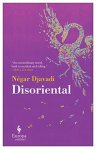
Disoriental by Négar Djavadi tr. Tina Kover was another translated work of fiction I read in August during #WIT(Women in Translation) month. Translated from French where the author now lives, it is a dual narrative, set in present day France, where a woman sits in a fertility clinic thinking back over her life, both in the present (daughter of parents exiled from their native country and culture Iran) and the past, her own childhood, what she remembers of the circumstances that lead them away from their home and right back to her great-grandfather and his harem of 52 wives.

Spanning a changing, turbulent time in Iranian history, it travels the highs and lows, for while the passionate intellectual freely expresses their opinion and brings no harm, they can continue to live within their culture, family, an active part of society. But when freedom of expression endangers the individual, the sacrifices that must be made stifle and silence them and doesn’t necessarily ensure their safety. Life in exile, without connections to friends, family and like-minded neighbours, reduces them to shadows of their former existence, unable to truly be themselves, to be seen, in a foreign culture. From my review:

I absolutely loved it, I liked the slow drip revelation of what this young woman’s life had become, having been severed from her country and community of origin and the colourful, abundant richness of the family history and culture, which while separate from her life today, existed somewhere deep in her psyche, in her genes, and in those non-genetic aspects we inherit from previous generations even without knowledge of what has passed.

The Heart’s Invisible Furies by John Boyne is a book I bought for my brother last Christmas, so I decided to read it myself early in the New Year, so we could discuss it. It was on a lot of top reads lists for 2017, and deservedly so. It’s the story of the life of Cyril, from the circumstances of his birth and adoption in conservative Ireland through four periods of his life, including time in Amsterdam and New York before his return to Ireland. Cyril encounters many challenges in his life, many of them as a result of failing to live up to perceived societal expectations. From my review:

Boyne peels back the layers of Irish inclinations and attitudes in the 20th century and shows how destructive this closed mindedness is on the lives of anyone who crosses an imaginary line of acceptable ‘being’. This astonishing novel is a courageous, honest attempt to show how the way we conform to society and culture’s expectations, against our own nature’s can be so harmful to so many and it makes us wonder how life might be, if we lived in a more utopian world, where tolerance reigned supreme.

Little by Edward Carey is another outstanding and original work of historical fiction and a book that left a deep impression, not just for the excellent storytelling and illustrations, but because it tells the story of a woman everyone had heard of yet knew nothing about, she was a trailblazer extraordinaire. Her name as most of us know it today is an illusion, for it tells nothing of the full life she lived before she became Madame Tussaud.

It is the story of the incredible life and survival of a servant girl Anne Marie Grosholt who lost her parents at a very young age and through a series of serendipitious connections, came to be apprenticed to a Swiss medical wax sculptor, whose popularity lead him to flee to Paris, where he resided with the widow of a tailor, another set of skills the young servant girl would acquire, before a chance encounter resulted in her spending eleven years in the palace of Versailles as tutor (Maitresse de Cire) to the princess, until her confidence and boredom combined to get her in trouble, banished back to the widow and her master.

The novel tracks her life and beside it the growing unrest in Paris, as the people rebel against those who ‘have’, against those who ‘rule’, and a frenzy of imprisonments and executions pervade the city, where no one is safe from denunciation and possible death. These stories and the historical references bring the novel alive, in animated prose that explores the noble alongside the grim and ghoulish, for the public of the time desired to see and know it all.
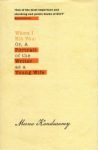
When I Hit You: Or, A Portrait of the Writer as a Young Wife    This is an incredible work of creativity, a writer working through the post-trauma of domestic violence, living through and escaping an abusive marriage, using her writing to narrate the story of her marriage, seeing it as if she is playing a role in a drama. I avoided this title for a while until it was nominated for the Women’s Prize for Fiction 2018 and started to receive enticing reviews. It is a ‘tour de force’ and well worth overcoming any inhibitions you might have about reading it.

And in some ways, that is how I think of it: it is easier to imagine this life in which I’m trapped as a film;  it is easier when I imagine myself as a character. It makes everything around me seem less frightening; my experiences at a remove. Less painful, less permanent. Here, long before I ever faced a camera, I became an actress.

The Four Insights – Wisdom, Power and Grace of the Earthkeepers by Alberto Villoldo I couldn’t write about my top reads without mentioning Alberto Villoldo, as I read three of his books this year and loved them all, but this one was the best and was the first I read, because it gives the background and explanations behind the philosophy of shamanic energy medicine in an accessible way.

I absolutely loved it and all its insights, I was familiar with the shamanic levels of perception, of serpent, jaguar, hummingbird, eagle, corresponding to body, mind, soul, spirit and their associated languages. The book expands on those themes and provides deeper explanations of how we perceive at each of these levels, what we need to understand about how we are responsible for creating the reality of each of those levels, and that we can only change our own inner perception and try to uplevel, we can never change another’s perception, except through being the role model that they might perceive and respond to without influence.

And that’s it for 2019, did you have an outstanding read for the year? Or a few? Let me know in the comments below what your favourite(s) were.

Thanks for reading and following and commenting and happy reading to you all for the year ahead.

Just Like February by Deborah Batterman

What is February? A wonderful metaphor for the unpredictable, of opposites, a reminder to live without expectation while also appreciating ritual and traditional when it is gifted.

“It was the only way I could make sense of something that seemed so arbitrary to me. I soon began noticing things I’d never noticed in February. A sudden whiff of early spring one day, followed by a snowstorm the next. A certain restlessness in the air.”

Just Like February by Deborah Batterman is a novel that is immersed in nostalgia for the past, for the innocence of childhood and the reluctant awakening of the adolescent, of the fragility of love, the need for forgiveness, the pain of judgement.

When it opens Rachel is 5 years old, remembering the on again, off again nature of her parents commitment to getting married. She finds solace in her Uncle Jake, when he is around and through his postcards and letters, as he voyages around.

There is a longing in her that only Jake can appease, however there is mystery around him that is slow to be revealed though often hinted at throughout the text, a reminder in the way of it being written of traditional attitudes of skirting subjects, keeping up appearances, of that lurker, denial.

Once it becomes clear to the reader what’s happening to Jake, I couldn’t help but think of similar decisions that were made by the producers in consultation with band members of the rock group Queen (amid plenty of controversy), in the extraordinary film Bohemian Rhapsody a wonderful tribute to their creative music making and to their lost lead singer Freddie Mercury.

They highlighted family tension as well as tenderness, an unrequited love that endured despite all the pain, creativity born out of frustration and conflict. It was not necessary to over indulge the audience with the misery of the slippery slope, that temporary gratification, hedonism lured him into. It was hinted at, respectfully.

“I didn’t want to write an AIDS movie, to be honest with you. And then, I just looked the period – It’s sort of where he rejects [his bandmates] and comes back to them. It’s sort of like a family movie. It’s sort of like ‘I hate my family, I want to be independent, and then I come back’.” Screenwriter, Peter Morgan

And so too I wonder about the stories behind the story, what would this story be if Jake had been the protagonist, or if Rachel had been more forthcoming earlier on. In a way the novel experiences that secrecy of the eighties, for despite what it says in the blurb, it doesn’t confront the issue of AIDS, it waits until nearly the end before revealing it, thereby creating in the reading experience that same feeling of something being held back, not addressed.

John Boyne also does this exceptionally well through his character Cyril Avery in The Heart’s Invisible Furies. And ultimately though it took years in the making, with a change of cast and direction, Rami Malek, the Egyptian-American actor that took on the role of Freddie, gets to the truth of his character when he reflects:

“I think if you don’t celebrate his life, and his struggles, and how complicated he was, and how transformative he was – and wallow instead in the sadness of what he endured and his ultimate death – then that could be a disservice to the profound, vibrant, radiant nature of such an indelible human being.”

It’s a novel that makes you want to peel back the layers and find out why, the reason perhaps he avoided those family gatherings that are known to get to the heart of issues, when families can no longer keep up appearances and combust. I could feel myself wanting to leave that table. Just like February.

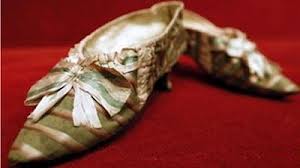
Marie Antoinette silk slippers

Knowing others is intelligence;

knowing yourself is true wisdom.

Mastering others is strength;

mastering yourself is true power.

Tao Te Ching: The Classic Book of Integrity and the Way

I have also read and reviewed Deborah Batterman’s excellent collection of short stories Shoes Hair Nails which the author sent me after I forwarded her a picture of a pair of Marie Antoinette silk slippers that were put up for auction on the 100 anniversary of her execution.

Further Reading

Independent Article: Bohemian Rhapsody: How the new Queen biopic almost never happened

N.B. This book was provided to me kindly by the publisher.

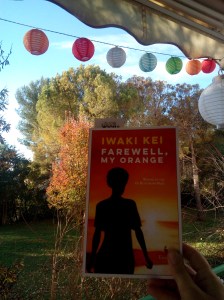
Farewell, My Orange by Iwaki Kei, tr. Meredith McKinney

Farewell, My Orange is an immigrant story set in Australia, centering around the new life of a young African migrant, now a single mother.  Alternative chapters are in the form of letters written by her friend, a young married Asian mother, to her English teacher, and in both narratives we encounter an older European woman whom the younger women  come to know.

For the first fifty pages, I was unsure who was really in the story, I found the blurb a little disconcerting (and still do) because it didn’t seem to tie up with the names in the story I was reading, which distracted from the read. The two women use different names to refer to the same characters and one of the names in the blurb is never mentioned at all in the novel. I couldn’t figure out what the author was doing by this and actually read most of the novel thinking it was a mistake, albeit a consistent one. Of course, being a prize-winning novella, it isn’t a mistake but it was mildly annoying. The book almost needs a message to tell the reader to forget about what appear to be inconsistencies, all shall be revealed, two pages from the end.

The novella introduces Salimah, who found herself a job in the supermarket after her husband left her and her two sons as soon as they arrived in this foreign country. She attends an English class for learners of a second language where she meets a Japanese woman named Echnida who brings her small baby to class, an older Italian woman Olive, a group of young Swedish ‘nymphs’ and her teacher. She makes observations about her classmates and her own life, as she learns the language that is her entry into this foreign place.
The letters her friend writes to her English teacher reflect on details of her new life, with what seem to be the same people, except the names are different.

The woman, whose letters are signed ‘S’ has sent her manuscript entitled ‘Francesca‘ to the teacher, she thanks her for her input and updates her on her life. Following her academic husband around has meant suspending her own university studies, something the teacher encourages her to continue with. In the first letter, she expresses hope to find a teacher like her in this new town and reflects on learning a foreign language:

“While one lives in a foreign country, language’s main function is as a means of self-protection and a weapon in one’s fight with the world. You can’t fight without a weapon. But perhaps its human instinct that makes it even more imperative to somehow express oneself, convey meaning, connect with others.”

In the next letter she has found the ESL class and mentions the older woman with three grown up children itching to look after her baby and a woman she thinks might be a refugee from Sudan or Somalia, who works in a supermarket and is a single mother. Then there is her neighbour, the illiterate truckie, she reads Charlotte’s Web to him on the communal stairs while he holds the baby, an arrangement they have come to, related to the unwanted noise of another neighbour whose incessant drumming has turned them into unlikely allies.

Salimah is asked by the teacher at her son’s primary school to give a presentation on growing up in ‘her African village’, it becomes a significant project for her, that the ESL teacher and Echidna help her with. She reads to the children about her life, narrating it with the simplicity of a children’s story, an oratory that enraptures the younsters, if not the teacher.

When Salimah finished reading, the children sat in silence. The teacher frankly thought that the story was too personal to be much use for the children’s projects. But it was certainly ‘an Africa you could never learn about from the class material.’ What’s more, after hearing the story the children were extremely quiet, and young though she was, she had learned from experience that when children are truly surprised or moved they forget how to express themselves and say nothing, so she waited for them to slowly begin to talk again.

As time passes, new developments replace old situations, opportunities arise, Salimah’s son begins to be invited to play with a school friend, a pregnancy brings the three women together and it is as if they begin to create a community or family between them.

Suddenly everyone in the room was laughing. With her own bright laughter, Salimah felt a great gust of air that had long been caught in her throat come bursting forth, and was aware of something new approaching within her as she drew fresh breath.

It is a unique insight into the intersection of lives that are so foreign to each other and to the culture within which they now live, the old familiar references of little help or comfort, how new connections are slowly born without expectation and can ultimately delight. It is about the common thread of humanity that can be found, when we let go of the familiar and are open to new experiences, helping each other without judgement.

Ultimately, apart from the confusion of names that interfered with my initial reading experience, I loved this novella. After page 50 I highlighted so many pertinent passages and felt the story grow and expand as the lives of these three women did too on the page.

It gave a unique insight into the lives of women from three different cultures and countries and their experience of living in a foreign country where they didn’t have a complete handle on the language, their struggles, their independence, their initial reluctance and inability to engage.

It isn’t a novel about the new culture or interacting with its people, it’s more about their own subtle transformation and the incremental support they eventually find in other foreigners, sharing their experiences, helping each other in small ways that grow their tentative friendship and hint at a hope that perhaps they might find happiness in this place after all.

Over the period they know each other, something changes in their lives, they have the opportunity to grow a little closer and develop something of a new friendship, connection. We see how this human contact and care helps them overcome the adversity of their individual situations. It’s farewell to one shade of orange and its shadow, only to welcome another brighter one they are becoming used to.

I absolutely loved it and was reminded a little of my the experience of sitting in the French language class for immigrants, next to women from Russia, Uzbekistan, Cuba and Vietnam, women with whom it was only possible to converse in our limited French, supported by a teacher who spoke French (or Italian). So many stories, so many challenges each woman had to overcome to contend with life here, most of it unknown to any other, worn on their faces, mysteries the local population were unconcerned with.

Iwaki Kei was born in Osaka. After graduating from college, she went to Australia to study English and ended up staying on, working as a Japanese tutor, an office clerk, and a translator. The country has now been her home for 20 years. Farewell, My Orange, her debut novel, won both the Dazai Osamu Prize (a Japanese literary award awarded annually to an outstanding, previously unpublished short story by an unrecognized author) and the Kenzaburō Ōe Prize (another literary award, the winning work selected solely by Ōe.).

Buy Farewell, My Orange

via Book Depository (free shipping)

N.B. Thank you to Europa Editions for sending me a copy of this book.

Milkman by Anna Burns

As you may know, Milkman by the Northern Irish author Anna Burns was the winner of the Man Booker Prize 2018

Kwame Anthony Appiah, 2018 Chair of judges, had this to say:

‘None of us has ever read anything like this before. Anna Burns’ utterly distinctive voice challenges conventional thinking and form in surprising and immersive prose. It is a story of brutality, sexual encroachment and resistance, threaded with mordant humour. Set in a society divided against itself, Milkman explores the insidious forms oppression can take in everyday life.’

On finishing it I was left with a similar feeling as when I completed another Booker prize-winning novel, Marlon James, A Brief History of Seven Killings, that is, a feeling of exhaustion and of wonder, how could an author sustain this kind of writing, stay with this voice, day after day for as long as it took to write this? And what must it be like to live in or imagine living in a community as stifling as this. Just astounding.

I am in awe. It is no easy read, for it is written in a kind of double, triple speak, depicting a life and set of circumstances that is constantly in check, a circumventing of self. It describes from the inside how one young woman navigates daily life in a community that has drawn so many convoluted, coded lines of behaviour, that lives by so many unspoken, rigidly enforced violent rules, that has morphed into something so far from authenticity, that only the very ‘different’, appear able to, or indeed risk, living life true unto themselves, except those who left the country forever, their tale not told here, those that got away.

All this is told through the stream of consciousness narrative of an 18-year-old girl, as she observes her community and family insinuate a dramatic story onto her about a 40 something married man they call ‘Milkman’ (not to be confused with “the milkman”), a narrative trussed up by rumour, assumption, gossip, anything uttered or speculated on, except what the young woman has to say.

It doesn’t help that the one time she comes out of her silence and decides to share the boring truth, that there is and has never been anything going on between her and this man, she tells this to her pious mother, the one place she might find support.

During this ma looked at me without interruption but when I finished, and without hesitation she called me a liar, saying this deceit was nothing but a further mockery of herself. She spoke of other meetings then, between me and the milkman, besides the two to which I admitted. The community was keeping her abreast, she said, which meant she knew I met him for immoral trysts and assignations, knew too, of what we got up to in places too indecent even to give the ‘dot dot dot’ to. ‘You’re some sort of mob-woman,’ she said. ‘Out of the pale. Lost your intrinsic rights and wrongs. You make it hard, wee girl, to love you and if your poor father was alive, certainly he’d have something to say about this.’ she said. I doubted it.

‘Middle sister’ as she is referred to, thinks in a kind of coded language full of uttered phrases that substitute for a more succinct opinion, so that even the reader must enter into this “insinuating” talk to understand her thoughts, for nothing is stated plainly, just as nothing is observed or clarified as it really is. And we get good at it, at this revealing what is really being said, even beginning to see the humor in it, when none of it really is funny, there’s too much death, tragedy, sadness, ridiculousness. It’s not a life, it’s a trap.
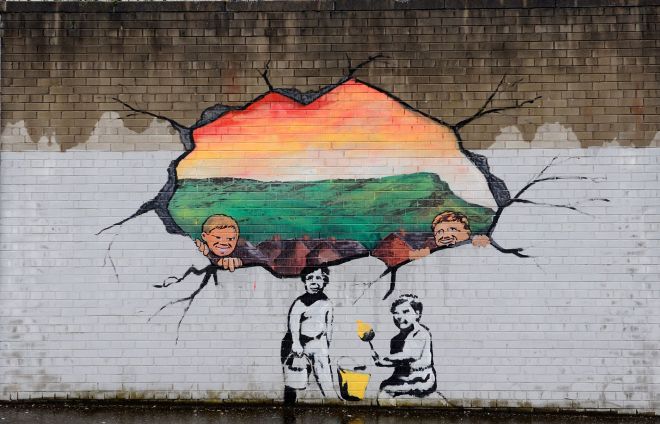
It is a kind of prison that she manages temporarily to escape from or live with by going running with third brother-in-law, taking French lessons and ‘reading while walking’ literature from other, older centuries. But trying to remain separate and invisible to all the categories, has put her in the worst possible position, ‘beyond the pale’, her longest friend since primary school informs her.

‘Even you must appreciate, that as far as they’re concerned you’ve fallen into the difficult zone.’ She meant the ‘informer-type’ zone – not that I was an informer. It was that miscellany territory where, like the informer, you’re not accepted, you’re not admired, you’re not respected, not by one side, not by the other side, not by anybody, not even really by yourself. In my case though, seems I’d fallen into the difficult zone not only because I wouldn’t tell my life to others, or because of my numbance, or because of my suspiciousness of questions. What was also being held against me was that I wasn’t seen as the clean girlfriend, as in, he didn’t have other attachments. He did have other attachments. One was his wife. So I was the upstart, the little Frenchwoman, the arriviste, the hussy.

And then it is so much more as Dr Dawn Miranda Sherratt-Bado shares in her brilliant essay in the Dublin Review of Books Gender in Conflict where she describes Anna Burns writing as exploring “the impact in Northern Ireland of a level of violence that has become ordinary and has turned into the cultural norm” in particular that gendered violence is everywhere and unacknowledged.

Burns’ use of surrealism is a highly effective method whereby the author defamiliarises dominant (and often misrepresentative) narratives of the conflict and its legacy that circulate within the media and popular culture. The surrealist mode allows her to represent the psychological effects of trauma – registering what she calls “the feeling reality, rather than necessarily what happened”

“In an unstoppable torrent of words, she gives voice to the women who endured unspeakable violence during the Troubles, making a powerful and necessary feminist intervention into the literary legacy of the conflict.”  Dawn Miranda Sherratt-Bado

It’s an original, thought-provoking, cathartic read that stays with you long after reading, it puts the reader in total sympathy with the character of middle sister and creates a feeling of there being no way out, seeing her almost as the anti-hero for succeeding at least in losing herself through literature and a foreign language, gone momentarily from this nightmare, despite never being safe from the ever-present unwanted attention.

Highly recommended, if you want a more literary read and insight into the difficulty of living within a fraught political community.

The Author

Anna Burns was born in Belfast, Northern Ireland, 1962. She is the author of two novels, No Bones and Little Constructions, and of the novella, Mostly Hero. In 2001 she won the Winifred Holtby Memorial Prize, and was shortlisted
for the 2002 Orange Prize for Fiction. She lives in East Sussex, England.

Buy a Copy of Milkman

via BookDepository (affiliate link)

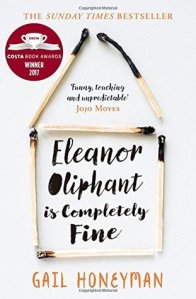
Eleanor Oliphant is Completely Fine by Gail Honeyman

A popular book in 2017, it won the Costa Book Award and has gone on to become a bestseller and will become a film starring Reese Witherspoon (who acquired the film rights), an incredible success for the debut novel of Gail Honeyman. To be honest, it hadn’t been on my radar, however when a friend lent me her copy, insisting I read it and a rainy day beckoned, I turned the page…

The book begins with an interesting quote from Olivia Laing’s book The Lonely City:

“…loneliness is hallmarked by an intense desire to bring the experience to a close; something which cannot be achieved by getting out more, but only by developing intimate connections. This is far easier said than done, especially for people whose loneliness arises from a state of loss or exile or prejudice, who have reason to fear or mistrust as well as long for the society of others.”

Eleanor Oliphant has been in the same office job in Glasgow, Scotland for almost eight years, she’s in her late twenties, intelligent, observant and diligent, she likes and needs routine and copes fine with her lack of social engagement, lack of friends, lack of family – with the exception of a weekly conversation with her mother on Wednesdays – and seems not to feel anything even when she overhears her colleagues speaking unkindly behind her back.

So used to her self imposed isolation and predictable life is she, that she seems shocked when a new employee Raymond from IT, whom she calls when her computer freezes one morning, initiates conversation with her outside the office, speaking to her as if she might be just like the others.

In this introduction to Eleanor, we aren’t sure of her, though her obvious intelligence and comfort in routine, he slight air of superiority despite the comments of her colleagues, suggest some kind of cognitive difference and her lack of a filter or self-censoring ability make her abject honesty a cause of surprise to some. Her habit of consuming vast amounts of vodka at home alone at the weekend, suggest something more dire lurks in her past.

Over the course of the novel, more of her early life is revealed and we learn that she has been through some kind of childhood trauma, which might explain some of her behaviours. This really sets up what for me was the main question, was this a case of nature, nurture (lack of) or trauma or a combination of them all. Honeyman leaves it to the reader to decide, but regardless of what influences made Eleanor the way she is, she is ripe for transformation. And she seems to have realised it herself, albeit, lead by a new obsession.

For, at the same time, and from the opening pages, she believes she may have met the perfect man, or is about to meet him, she obsesses about this man and builds him into her image of perfection, as had been defined by her absent mother, and prepares to improve herself physically in preparation of meeting him.

Meanwhile, through Raymond, her actual social connections begin to widen and they awaken something familiar in her, feelings that go with being invited to be part of a community, small acts of kindness, of inclusiveness, and Raymond helps her navigate these interactions, as might a friend.

It is a well written, engaging and thought provoking read, partly because of what is not known and slowly revealed, but the dialogue gives the story pace and there are plenty of new activities and social interactions Eleanor participates in, providing the space for her to grow and develop within.

“I wondered how it would feel to perform such simple deeds for other people. I couldn’t remember. I had done such things in the past, tried to be kind, tried to take care, I knew I had, but that was before. I tried, and I had failed, and all was lost to me afterwards. I had no one to blame but myself.”

I did find the character of Eleanor a little difficult to believe in, the long years of solitude followed by a relatively sudden transformation seem to occur too easily and quickly, however if I were to suspend judgement on the authenticity of the character and the speed of her life change, which wasn’t hard to do, then it becomes a kind of coming-of-age novel about a young woman overcoming a traumatic past and demonstrates (a little too conveniently) the healing that can come from genuine friendship and being part of a family and community and a functional workplace (if there is such a thing).

The introduction of a therapist also allows for the conversations that explore the difference between the fulfillment of physical needs and emotional needs, neatly tying things up and rounding off Eleanor’s late education and self development.

And while it’s not exactly a romance, there are elements of the ambiguity of her friendship with Raymond that certainly are likely to make this a popular film.

An entertaining, light read, that leaves you with more than a few questions.

Buy a copy of this book via Book Depository

Little by Edward Carey

I read a sample of the first few pages of Little by Edward Carey (see the link below) and immediately wanted to read more.

Gallic Books translate and publish French novels under their Gallic imprint. I could see why this historical novel, written by the English novelist and playwright Edward Carey, set in the late 1700’s France, would be a worthy addition to their collection. Before finishing it, I was recommending it to friends, thanks to its excellent characterisation and sense of place.

A wonderful read, it follows the extraordinary life of Anne Marie Grosholtz, born in 1761 in a small country village in Switzerland. Forced to move to the city of Berne with her fragile, recently widowed mother, they will work for a young, reclusive, eccentric Doctor Curtius, a home-based medic obsessed with anatomy and the physiology of the body, who created replica body parts copying those that the hospital delivers him, reproducing them in wax.

Her mother being too faint-hearted to cope with assisting him, it is left to six-year-old Marie, to be the strong one, to learn the required skills. She becomes his servant and his first model, for a complete head; a plaster mould filled with wax. When the wax heads are sought out by men who desire to see themselves on display, the hospital who employed him turns against him and they flee to Paris. A journalist who had once visited them befriends them and finds lodgings with an overbearing tailor’s widow and her meek son Edmond.

At first their work has no connection, but the widow is an astute businesswoman and soon takes control of the Doctor’s affairs moving them to larger premises on a main boulevard where their business will become a leading attraction in Paris. They recreate both the noble and demons of the city, the murderers, whose image they put on show to show people what they ought to avoid.

Marie is not liked by the widow and is banned from the workshop as the widow inserts herself into the life and work of the Doctor, but secretly she has been making a few mini wax models of her own. Her fate will soon change again, when the reigning King Louis XVI’s sister Elisabeth comes knocking unannounced and it is Marie who answers the door.

She will spend eleven years in the palace of Versailles as tutor (Maitresse de Cire) to her princess friend, until her confidence and boredom combine to get her in trouble and she is banished, back to the widow and her master. This transgression may well have saved her life, given what was to come with French royalty.

The novel tracks her life and beside it the growing unrest in Paris, as the people rebel against those who ‘have’, against those who ‘rule’, and a frenzy of imprisonments and executions pervade the city, where no one is safe from denunciation and possible death. These stories and the historical references bring the novel alive, in animated prose that explores the noble alongside the grim and ghoulish, for the public of the time desired to see and know it all.

Marie is a survivor, and through all kinds of circumstances, she not only survives, she adds to her skills and is destined to thrive, despite the inordinate amount of suffering and tragedy she witnesses and bears.

Never entirely safe, being a foreigner in a land where favour swings swiftly and justice had a penchant for heads, she eventually leaves Paris and an ill-chosen husband Tussaud, taking one of her sons, to live out her thriving middle and old age in London, creating there, what was no longer sustainable in Paris, a wax museum of the rich, famous and infamous. At the age of 81, eight years before her death, she created her own wax self-portrait, which continues to reside in the museum today.

Edward Carey was terrified by her wax museum as a child, worked there as an adult, and has now written a novel about Tussaud, who survived the bloody French Revolution and built her own myth in London. The Guardian

With so many changes occurring in their lives, and so many characters of varying class and esteem entering their premise and the inevitable difficulties of being the unwanted additional child in an already complex household, it’s no wonder the chapters and years fly by, full of intriguing accounts of the lives of all those who had cause to come within Marie’s purview.

A brilliant, absorbing read of an incredibly resilient child, who becomes a skillful, industrious, entrepreneurial woman, with the addition of many pencil drawings throughout, just as we imagine she might have done them. Highly recommended for those who enjoy excellent historical fiction about women raising themselves up despite immense challenges in their social status and background.

‘In an age in which historical female figures have gained more posthumous recognition, Little is a perfectly weaved story of a woman who has captured the imagination of many, but has been written about by few. From Marie’s perspective, the difficulties 18th Century women faced in order to achieve recognition or success are illuminated for the modern reader.’ — Culture Trip

Read a Sample from Little

Click Image to Read Sample

Buy ‘Little’ from Kenny’s here