Two Serious Ladies (1943) by Jane Bowles

Bellezza who reviews at Dolce Bellezza (click on words or image below to visit) and reads a lot of interesting literary and translated fiction, recently invited me to join her and a few others to read Two Serious Ladies by Jane Bowles.
DolceBellezza

I didn’t know anything about the book, but I liked the idea of a January readalong, the last one I participated in was Pushkin’s Eugene Onegin in January 2014 and it became one of my Top Reads of 2014!

Background

Jane Bowles was married to the composer, writer and translator Paul Bowles (author of the 1949 classic, post-colonial alienation and existential despair novel The Sheltering Sky). They were part of avant-garde literary circles in their home town of New York and adopted homes of Paris, Mexico and Tangiers, known as well for their bohemian lifestyle as their literary success’.

Two Serious LadiesJane Bowles (born in New York City, Feb 1917) wrote one novel, a play and six short stories. The novel Two Serious Ladies, though panned at the time, (critic Edith Walton writing in the Times Book Review didn’t understand it, calling it ‘senseless and silly’), became regarded as a modernist, cult classic, helped when Tennessee Williams named it his favourite book.

She was famous as the enigmatic and entertaining half of a celebrated couple, for her near permanent writer’s block, her daring attitude to life, and her provocative relationships with women.

Both husband and wife, though dedicated to each other, indulged same-sex relations with others outside their marriage; notable was the relationship Jane Bowles developed with Cherifa, a Moroccan peasant, the only woman in Tangier to run her own market stand. They are photographed; Jane, wearing a white, sleeveless short dress walks on the arm of Cherifa, cloaked in a black niqab, wearing dark sunglasses (said to carry a knife beneath her robes for protection). See the photo in The New Yorker article linked below.

Review

Two Serious Ladies introduces us to two characters Christina Goering, daughter of a powerful industrialist, now a well-heeled spinster, adrift and bored with her comfortable, predictable existence and Frieda Copperfield, married to a man who pursues travel and adventure, dragging his wife (who funds this insatiable desire) out of her comfort zone, to the untouristed, red-lit parts of Panama, where she finds solace and digs her heels in, at the bar/hotel of Madame Quill, befriending the young prostitute Pacifica.

Christina, referred to as Miss Goering and Frieda, Mrs Copperfield, acquaintances, meet briefly at a party and will come together again briefly at the end, both having had separate life-changing adventures, driven by a latent, sub-conscious desire to radically change their situations, both of which come about in a random, haphazard way.

Miss Goering invites a companion Miss Gamelon, to move into her comfortable home and at the party where she encounters Mrs Copperfield, she meets Arnold. Though she doesn’t particularly like either of these characters, when she decides to sell her palatial home and move to a run-down house on a nearby island, they agree to come with her. Neither are enamoured of her decision, to remove them from her previous comforts, which they were quite enjoying.

“In my opinion,” said Miss Gamelon, “you could perfectly well work out your salvation during certain hours of the day without having to move everything.”

“The idea,” said Miss Goering, “is to change first of our own volition and according to our own inner promptings before they impose completely arbitrary changes on us.”

Once on the island, still restless, she abandons her invitees and takes the ferry to the mainland, opening herself up to whatever random encounters await her, as if seeking her destiny or some kind of understanding through a series of desperate and reckless acts.

Jane Bowles

Jane Bowles

Mrs Copperfield seems less to seek out the depraved, than be attracted by a perceived sense of belonging, she spurns the comfortable, pretentious trappings of the Hotel Washington, declines to go walking in the jungle with her husband and instead takes the bus back to the women she has met at the Hotel les Palmas whom she feels an affinity with, despite their lives of poverty and prostitution being so far removed from her own. She recognises they possess a kind of freedom and strength she lacks; in their presence, she begins to feel energised and empowered.

It is a strange book at first, it requires finishing and reflecting upon to figure out what it was all about. It is recounted in a straight forward style, we observe the actions of the two women without reflection on their part, making it necessary to unravel their intentions, which inevitably becomes a matter of reader interpretation, to find the meaning, if indeed there is any.

For me, it was clear the women lacked something significant in their lives, in their existence, even if they were unable to articulate it or even search appropriately for it, they sensed something missing in their lives of privilege and sought it among the downtrodden. They were experiencing an existential crisis.

In terms of style, the writing has been described as elliptical prose, a term I looked up, coined in 1946 by Frederick Pottle who used elliptical to refer to a kind of pure poetry that omits prosaic information, providing the possibility of intensity through obscurity and elimination.

@Jimthomsen on twitter asked the same question and got this response:

Meaning, there’s much that isn’t said or thought or written and more that might be implied, discovered between the lines. A form of literary diet perhaps? I do prefer plain language.

Bowles takes two female characters from a similar social class (similar to her own) dissecting a woman’s presence and existence in society in a form of confrontational daring that was liable to elicit both scorn and eye-brow raising in her own time and continues to provoke a certain amount of bemusement in our own.

“I know I am as guilty as I can be, but I have my happiness which I guard like a wolf, and I have authority now and a certain amount of daring, which I never had before.” – Mrs Copperfield

Reading it alongside the life of Jane Bowles, was a pleasure, I enjoyed reading it and taking the extra time to understand the context within which it was written.

Thanks Bellezza for the invitation, I look forward to reading everyone else’s reviews!

Links

The Madness of Queen Jane – Article in The New Yorker, by Negar Azimi June 12, 2014

A Short Biography of Jane Bowles by Millicent Dillon

Other Reviewers Reading & Reviewing Two Serious Ladies – Scott, Frances, Dorian, and Laurie

Under the Sea-Wind by Rachel Carson

Under the Sea-Wind (1941) was Rachel Carson’s literary debut and the first title in her Sea Trilogy, three books she wrote about the sea, the second The Sea Around Us (1951) and finally The Edge of the Sea (1955).

I discovered Under the Sea-Wind one day because I felt sure someone must have written a creative non-fiction book about the sea, someone with an affinity for the sea and an ability to bring it alive in the way I was imagining.

I like to read page-turning, lyrical nature writing, the kind of prose written by poets, though not poetry; authors like Kathleen Jamie who wrote Findings (my review here) and Sightlines, Barry Lopez and his Arctic Dreams (review here), Annie Dillard’s Pilgrim at Tinker Creek. They are all books that fascinate, entertain and enthrall on the subject of nature, in a way that traditional, factual texts about those subjects rarely inspire.

So I asked myself, well who has written in this form, about the sea? Because the sea is my muse, my resting place, that living, moody, playful, dangerous place that I never tire of and rarely get enough of and I wanted to read something that attempted to articulate the essence of it. So I could bring the sea nearer to me, when I can’t go to her. In that search I discovered Rachel Carson’s literary debut, her personal favourite book of all those she wrote, a book all about the sea, invoking its mystery and wonder.

The book started out as an assignment she completed in 1936, when she was an unemployed zoologist and freelance writer for the U.S. Bureau of Fisheries. Asked to write an introduction to a brochure on marine life, she submitted an essay entitled “The World of Waters” neatly typed by her mother, as all her manuscripts would be.

The next day Carson sat in Higgins’s Washington D.C. office waiting for his verdict.The government ichthyologist knew at once that it was unsuitable. What he was reading was a piece of literature. Carson never forgot the conversation: ‘My chief…handed it back with a twinkle in his eye. ‘I don’t think it will do,’ he said. ‘Better try again. But send this one to the Atlantic Monthly.’

The essay was a narrative account of the countless sea creatures that cohabit in and underwater and introduced her two most enduring and renowned themes: the ecological relationships of ocean life that have been in existence for millenia and the material immortality that embraces even the tiniest organism. It was the essay that spawned a classic in nature literature.

A sanderling shore bird

A sanderling shore bird

Under the Sea-Wind is structured in three parts, and in each part, we view the sea and sea life from the point of view of one of its inhabitants.

In Part One, Edge of the Sea, written for the life of the shore, and inspired by a stretch of North Carolina sea-coast, we meet a female sanderling she names Silverbar, it is Spring and the great Spring migration of shore birds is at its height and concludes with the end of summer where the movements of  birds, fish, shrimp and other water creatures heralds the changing of the seasons.

“Pressing close to the backwash, Silverbar saw two shining air bubbles pushing away the sand grains and she knew that a crab was beneath. Even as she watched the bubbles her bright eyes saw that a wave was taking form in the tumbling confusion of the surf. She gauged the speed of the mound of water as it ran, toppling, up the beach. Above the deeper undertones of moving water she heard the lighter hiss that came as the crest began to spill. Almost in the same instant the feathered antennae of the crab appeared above the sand. Running under the very crest of the green water hill, Silverbar probed vigorously in the wet sand with opened bill and drew out the crab. Before the water could so much as wet her legs she turned and fled up the beach.”

She describes the terror of the shore birds as they hide in the beach grass from the noisy, boisterous migrating flocks that briefly occupy their territory; the terrible snow storm that will freeze hundreds of egg embryos, where only the fittest and strongest survive; the way the birds lure a fox away from their nests and the day the parents finally abandon their young, their job complete.

A school of Mackerel

A school of Mackerel

Part Two The Gull’s Way, is dedicated to the open sea, a parallel time period in the open ocean and here we encounter Scomber the mackerel, following his journey from birth through infancy and youth in a quiet New England harbour, only to join a school that follows its instinct into the great sea where numerous predators await. As the fish move from one location to the next, trying to outwit predators, including man, the sea becomes the scene of a thriller and Scomber the mackerel, our fugitive!

Anguilla, the eel

Anguilla, the eel

Part Three River and Sea is written in the deepest, darkest, fathoms, we follow Anguilla, the eel from the far tributaries of a coastal river pool, downstream to the gently sloping depths of the sea, ‘the steep descent of the continental slopes and finally the abyss’.

After 10 years of uneventful river habitation, the eels are drawn by instinct downriver returning to their place of birth, a deep abyss near the Sargasso Sea where they will spawn and die. It is the most remarkable journey, as is that of the newborn spawn originating from two continents, who float side by side and drift towards those same coastal rivers their parents swam from, a voyage of years and over time the two species will separate and veer towards their continent, the US or Europe.

“Anguilla had entered Bittern Pond as a finger-long elver ten years before. She had lived in the pond through its summers and autumns and winters and springs, hiding in its weed beds by day and prowling through it waters by night, for like all eels she was a lover of darkness…Now it was autumn again… a strange restiveness was growing in Anguilla the eel. For the first time in her adult life, the food hunger was forgotten. In its place was a strange, new hunger, formless and ill-defined. Its dimly perceived object was a place of warmth and darkness – darker than the blackest night over Bitten Pond.  She had known such a place once – in the dim beginnings of life, before memory began. Many times that night, as the wind and rain tore at the surface film of the pond, Anguilla was drawn irresistibly towards the outlet over which the water was spilling on its journey to the sea.”

Rachel Carson writes about the sea, the sand, the birds, fish and the smallest of creatures and organisms in a way that makes us realise how little we observe of what is occurring around us, though we may stand, swim, float or fish in the midst of it. For the sea, its shore and the air above thrum like a thriving city of predator and prey of all sizes and character, constantly fluctuating, its citizens ever alert to when it is prudent to move and when it is necessary to be still.

Original, enthralling, it opens our eyes to much that we do not see or understand, I am in awe of shore birds, mackerel, eels, the sea, streams, rivers, ponds and the interconnectedness of them all.

Man, when his ambitions were more local, was once a balanced part of this ecosystem, though many of the practices of today appear to have stretched the boundaries of our role too far towards destructive exploitation, in our ignorance, we are upsetting this delicate yet complex ecosystem, which will be to our detriment if not stopped.


Fortunately, we have people like Captain Paul Watson and the Sea Shepherd Conservation Society, who have made themselves guardians of marine wildlife, actively pursuing  and preventing those who exploit and destroy without regard for the destructive effect of their pillaging the oceans.

Rachel Carson explores the sea-shore, the shallow and the deep, seeing them from the point of view of three species natural to those habitats, while mentioning so many more that they encounter, in a narrative that makes nature writing absolutely thrilling and survival an astounding feat.

Highly Recommended!

Buy a copy of Under the Sea-Wind via Book Depository

The Enchanted April by Elizabeth von Arnim

CIMG7226As soon as I learned that Elizabeth von Arnim’s The Enchanted April was to be reissued as a Penguin classic, I jumped at the chance to read it. Elizabeth and her German Garden was such an engaging and entertaining read and I recall in the comments of that review so many mentions of The Enchanted April as a must read.

Elizabeth wrote The Enchanted April in a castello (an eleventh-century fortress with Roman foundations overlooking the Ligurian Sea) in Portofino, Italy, in April 1921. She had rented the place to get away from her own (sixteen bedroom) chalet in Switzerland… an extract from the Introduction by Brenda Bowen

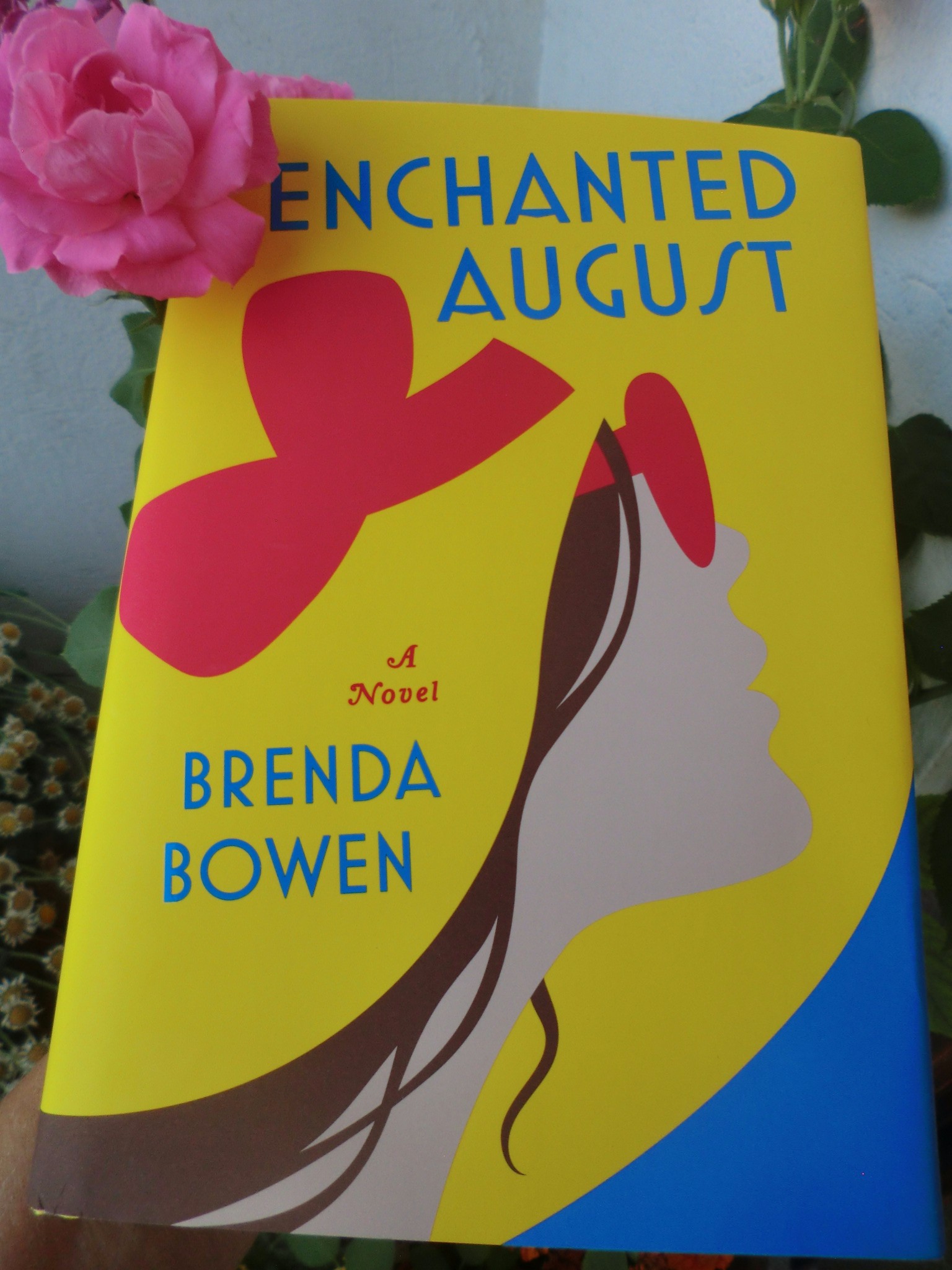
Brenda Bowen has written a work of fan fiction, published in June 2015, one that mirrors von Arnim’s work, set in contemporary Brooklyn and Maine featuring four ladies who will rent a cottage (not castle) on Little Lost Island, Maine.

Enchanted August

One to Watch Out For, Fan Fiction

Enchanting indeed, not just the month of April, but all that made this original classic so; the villa San Salvatore (inspired by the Castello Brown pictured below) on the cliffs of Portofino overlooking the sea, the blooming buds and flowers of Spring, four weeks stretched out in front of four unaccompanied women with no social obligations, no cooking, cleaning, nothing to do but enjoy the gardens, the villa, the seascape and one minor challenge, to tolerate each others company.

They are four women who remind me of the semi-autobiographical and coolly calculating character of Elizabeth, in von Arnim’s Elizabeth and her German Garden, for though the four women in this novel sought company for this séjour on the Ligurian coast of Italy, it was purely for financial reasons, most certainly not for companionship, the first hint of von Arnim’s well-known and often quoted attitude towards visitors.

Being with strangers, they each hoped to leave that part of themselves that must always meet the expectations of others behind. Mrs Wilkins  from Hampstead was the first to see the advertisement in The Times while visiting her London club.

To Those Who Appreciate Wisteria and Sunshine. Small mediaeval Italian Castle on the shores of the Mediterranean to be Let furnished for the month of April. Necessary servants remain. Z, Box 1000,

The Times.

Mrs Wilkins was certain another woman her age was reading the same ad and having a similar response to it, so true to her nature (though not typical of society’s expectation of a response) she seized the initiative suggesting they rented the place together.

Her initial reluctance overcome, once the two women realised it was possible, they needed only a solution to the expense which Mrs Wilkins solved by suggesting they place another ad to attract another two like-minded female souls, thus we are introduced to the beautiful, ever charming even when she is trying not to be, Lady Caroline Dester and the somewhat disagreeable and much older Mrs Fisher.

Once ensconced in their lodgings, the four women interact and are given a well-portrayed and at times humorous glimpse into their individual characters, made all the more interesting by the fact that these women were most unlikely to have ever encountered each other within their existing social circles.

Enchanted April

Mrs Wilkins and Mrs Arbuthnot are pleased to have escaped their husbands, though they each harbour an underlying sadness for how things were when they were newly married. They are not aged, in their thirties, they have more the air of self-accepting middle age. However, they hadn’t reckoned on the effect of a stay at San Salvatore.

Lady Caroline just wants to be left alone, unmarried and disinclined, she detests the attention her beauty and natural charm attract. The formidable Mrs Fisher appears malcontent for no more reason than that she’s been on Earth at least twice as long as the younger women, having lost what youthful exuberance she may ever have had long ago.

‘Mrs Fisher doesn’t seem happy – not visibly anyhow,’ said Mrs Arbuthnot, smiling.

‘She’ll begin soon, you’ll see.’

Mrs Arbuthnot said she didn’t believe that after a certain age people began anything.

Mrs Wilkins said she was sure no one, however old and tough could resist the effects of perfect beauty. Before many days, perhaps only hours, they would see Mrs Fisher bursting out into every kind of exuberance. ‘I’m quite sure, said Mrs Wilkins, ‘that we’ve got to heaven, and once Mrs Fisher realises that’s where she is, she’s bound to be different. You’ll see. She’ll leave off being ossified, and go all soft and able to stretch, and we shall get quite – why, I shouldn’t be surprised if we get quite fond of her.’

Things are about to change, as the castle San Salvatore, though solid and immovable, works its way into their psyches and each will fall under the spell of the charming fortress and its healing environment over the course of their four-week stay.

I thought The Enchanted April a wonderful, evocative read and witty insight into its very English characters, enjoyable for its sense of place and the lush season it evokes, von Arnim’s natural, subtle humour that she never ceases to inject into her narratives, in this novel there is no trace of the slight cynicism of her earlier work; she has allowed her four women to indulge this fantasy through to its natural conclusion.

And oh how fulfilling that can be for the reader, I know this little stretch of Italy and it invoked pleasant memories and incited future dreams of a possible return – with three women ‘bien sûr’!

Countess Elizabeth von Arnim

Born Mary (May) Annette Beauchamp in 1866, Elizabeth von Arnim was Australian by birth, English by upbringing, German and English through marriage, Swiss and French by choice and finally American by emigration. She published 21 books in her lifetime,  books where the central female character(s) were often witty and unreserved, possessing an unusual outlook on life. A number of them, including The Enchanted April were made into films.

An appearance of the novel Elizabeth and her German Garden in a recent episode of Downton Abbey, sparked renewed interest in the works of the author. That novel was so popular when first published, it was reprinted 21 times within a year of publication.

She was the cousin and contemporary of the New Zealand/English writer Katherine Mansfield. She died in Charleston, South Carolina in 1941.

KM logoElizabeth von Arnim Conference – In an extraordinary coincidence that I just discovered, the Katherine Mansfield Society is to hold an Elizabeth von Arnim Conference, at Lucy Cavendish College, University of Cambridge on Sept 13th 2015!

My review of Brenda Bowen’s Enchanted August.

Note: This book was an ARC (Advance Reader Copy) kindly provided by the publisher.

Frankenstein, or the Modern Prometheus by Mary Shelley

I had always intended to read Mary Shelley’s classic in 2015, however I hadn’t expected to come across it in so many forms before I picked it up in its traditional one, the book.

Captain R Walton and the scientist Victor Frankenstein, Arctic  Source: BBC Learning English

Captain R Walton and the scientist Victor Frankenstein, Arctic
Source: BBC Learning English

With the advanced English conversation class I teach, we began to listen to weekly episodes of Frankenstein via a BBC adapted audio drama, written for learners of the English language. Condensed to 10 episodes of about 7 minutes each, it introduces new vocabulary and a classic of English literature to learners, while keeping them entertained.

Midway through the audio drama, I heard that there was to be a relayed broadcast of the London National Theatre production of Frankenstein, starring Benedict Cumberbatch and Jonny Lee Miller, cast as the Creature and Victor Frankenstein, directed by Danny Boyle.

Throughout the season, the actors switched roles on alternate nights, Creature and Creator, inhabiting each others skin, developing each others mannerisms and tendencies, drawn together and repelled simultaneously. The version I saw showed Cumberbatch as the Creature, a stunning and visceral performance beginning with the birth-like slump onto the stage, the first stages of development and observation of the enigma of man.

Creature_birth

A Creature is Born, National Theatre London

After these two modern-day introductions, I was even more intrigued to read the original text and learn about the origin of a book that was itself born via 18-year-old Mary Godwin (later Shelley) telling ghost stories one cool June summer evening in 1816 at Lake Geneva with companions Lord Byron, the physician John Polidari, Percy Shelley and her stepsister Jane.

FrankensteinThe book starts out with letters written by a Captain R Walton, who is in St Petersburg preparing to leave for an excursion of discovery to the North Pole, to his sister Margaret in London.

Like Victor Frankenstein, the young scientist he will rescue from an ice floe in the Arctic and whose story he will listen to day after day while trapped in the ice, Walton has a thirst for knowledge and an agitated spirit that pushes him forward in his quest. He wishes to make his mark on the world and make a difference. Like Frankenstein he has immersed himself in studies of logic and now desires to achieve something of magnitude, having already failed to become a significant poet.

His prose is now dedicated only to his sister Margaret, through whose letters we will learn of Walton’s failed voyage and the story Victor Frankenstein will narrate to him, as he too gives up his pursuit of the Creature that was to be his mark upon the world, one that had already made a difference, though in ways he never dreamed of and lived to regret.

Upon hearing the voyager’s naive hopes, Victor Frankenstein shares his own story in an effort to try to thwart Walton from following his ideals  into what may become yet another foolhardy madness.

“Unhappy man! Do you share my madness? Have you drunk also of the intoxicating draught? Hear me; let me reveal my tale, and you will dash the cup from your lips!”

The story he tells is of his own youthful thirst for knowledge, his fascination with science, alchemy and existence itself. His obsession with creating life above all else, with no forethought of the consequence of such an act, his fear and neglect of that which he created and the terrible consequences wreaked upon him, his family and those closest to him as a result.

“You may easily perceive Captain Walton, that I have suffered great and unparalleled misfortunes. I had determined at one time that the memory of these evils should die with me, but you have won me to alter my determination. You seek for knowledge and wisdom, as I once did; and I ardently hope that the gratification of your wishes may not be a serpent to sting you, as mine has been. I do not know that the relation of my disasters will be useful to you; yet, when I reflect that you are pursuing the same course, exposing yourself to the same dangers which have rendered me what I am, I imagine you may deduce an apt moral from my tale, one that may direct you if you succeed in your undertaking and console you in case of failure.”

Victor Frankenstein grew up in the countryside of Switzerland, in a kind of reverie, with his adopted sister Elizabeth whom he always viewed as a gift, initially from his mother who brought her into the family and eventually as his future bride. But first he wished to fulfil his destiny, that alchemy of existence, he wanted to create a sustainable life-form.

He pursued it with zeal, neglecting all else, only to run in fear of what he had done, until it pursued him, confronting him. The Creature forced him to listen and hear of the curse he had inflicted on him, by making him in such a way that all humanity would abhor him, sentencing him to a life without love, without friends, unknown.

“I expected this reception,” said the daemon. ” All men hate the wretched; how, then, must I be hated, who am miserable beyond all living things! Yet you, my creator, detest and spurn me, thy creature, to whom thou art bound by ties only dissoluble by the annihilation of one of us. You purpose to kill me. How dare you sport thus with life? Do your duty towards me, and I will do mine towards you and the rest of mankind. If you will comply with my conditions, I will leave them and you at peace; but if you refuse, I will glut the maw of death, until it be satiated with the blood of your remaining friends.”

Victor Frankenstein listens to the Creature and is moved from the desire to kill his creation to consider creating another, a companion, the only chance he may have to live in harmony in this world, for to be alone has driven him to madness, murder and mayhem.

The book, while framed at both ends by the letters from the explorer to his sister, the middle part is split into three, the first and latter parts as told by and from the perspective of Victor Frankenstein, while the middle part recounts the Creature’s tale of exile and in doing so gives voice to the creature.

Benedict-Cumberbatch-Jonny-Lee-Miller

Benedict Cumberbatch and Jonny Lee Miller

It is in this section we have the most honest view of his creation and it is in this part that the theatre screenplay written by Nick Dear really excels.  It takes as the starting point, the metaphor of birth and Cumberbatch’s Creature slips from an embryonic web to the floor, resembling something more amphibian like than human, flaying its limbs about spasmodically as it tries to master them, this body with no instruction, no parent, a man with the gestures of a newborn.

Throughout his years of exile, his interactions with others teach him to survive, to communicate and slowly to understand the capacity and flaws of humanity. With understanding comes grief, he knows what is possible, that which will always be unreachable for him, a creature that thinks and is capable of acting as one of humankind but who will always be hated, rejected and worse, hunted to extinction.

“I cannot describe to you the agony that these reflections inflicted upon me; I tried to dispel them, but sorrow only increased with knowledge. Oh, that I had forever remained in my native wood, nor known nor felt beyond the sensations of hunger, thirst, and heat!”

An astounding read and such a pleasure after the introduction I had via the theatre and audio play. It’s true I’m not a great reader of the classics, but when they are given an alternate context and serve as inspiration in the way this creation has, I can’t help but read in awe the achievement that continues to inspire such great works in themselves.

A five star read for me!

For a glimpse of that theatre sensation, watch this one minute trailer, with extracts from the live production in London.

Danny Boyle’s Frankenstein with Benedict Cumberbatch

“All Paths Lead to Rome” – The Vatican Cellars by André Gide tr. by Julian Evans

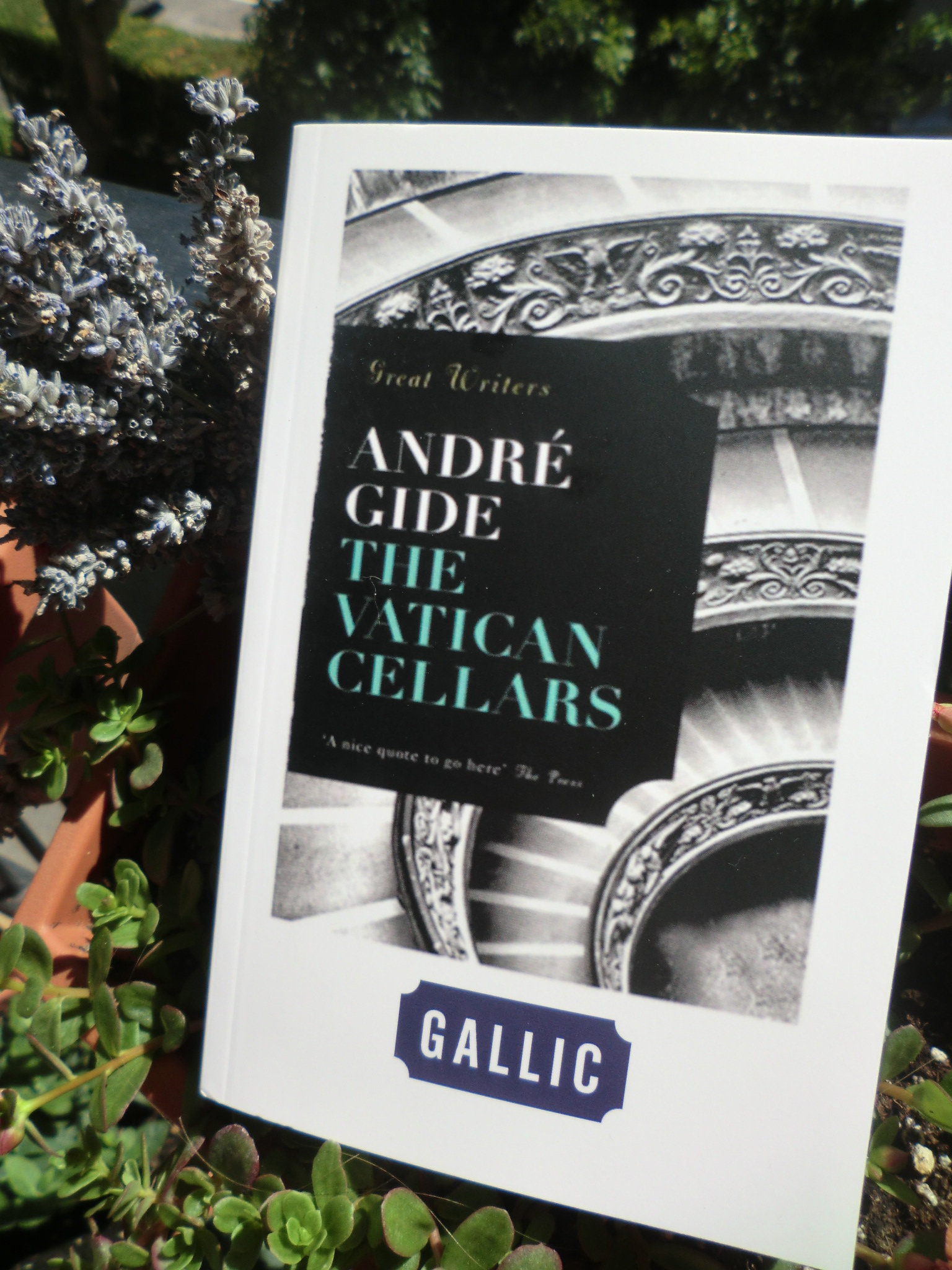
Vatican CellarsOriginally published in the summer of 1914, this year is the 100th anniversary of André Gide’s Les Caves du Vatican otherwise known as The Vatican Cellars and sometimes as Lafcadio’s Adventures in English.

André Gide had quite a reputation and was adored and detested in equal measure in the French literary community during his time. He was a provocative writer, not sensationalist by today’s standards, but he rocked the foundations of robust entities in the early 1900’s and tested some of his friendships with his provocative, satirical works, that challenged the solemnity of the novelistic form and bourgeois attitudes of the time.

He declared the book not to be a novel, but a sotie, a medieval farce in which the players freely mock the powers that be, more often than not, the Church.

“Even in the authentic soties of the Middle Ages there was the attempt to demonstrate the madness of the real world by showing it capsized and lead by fools.” Wallace Fowlie, Andre Gide: His Life and Art

He did this to stand apart from that tradition of European fiction, characterised by its extreme seriousness. Many chose to judge it at face value, or to apply an interpretation that wasn’t his own and cause him to be ostracized by some.

A Young Gide Source: Center for Gidean Studies andregide.org

A Young Gide
Source: Center for Gidean Studies
andregide.org

He wasn’t looking for recognition or accolades, but he was a writer who wasn’t afraid to take on a subject and look at it through a symbolic, metaphorical lens even if it did court contempt in some quarters. Though still highly controversial in France, he was awarded the Nobel Prize in Literature in 1947, he died in 1951 and a year later his works were placed on the Vatican’s list of banned books.

That act was certainly provocative and no doubt helped to heighten the author’s popularity as negative publicity tends to do. So when this book arrived unsolicited in my mailbox, I was curious to find out more, not just about the story, but André Gide, a writer previously unknown to me. In a strange coincidence, this week I see that Papal controversy – or is it just rumour, continue, when I read this headline in The Independent.

God isn’t a magician with a magic wand according to the pope and there are non-believing vicars 

The basic premise of The Vatican Cellars centres around the members of one family, whose connections are slowly revealed, whether by blood or marriage, the first three books (more like parts as the book is only 300 pages) are portrayed from each of the main characters point of view and running throughout the narrative is the effect of a rumoured plot that a gang has kidnapped the Pope and placed him in the Vatican cellars, an imposter installed in his place. The fourth book introduces us to the gang, referred to as The Millipede and the final book is dedicated to the young man Lafcadio and brings all the characters to Rome.

Book One introduces us to Anthime Armand-Dubois, a crippled freemason devoted to scientific research, an atheist who leaves France to settle in Rome to be near a specialist in rheumatic diseases. His departure causes his brother-in-law Julius De Baraglioul great sorrow and his wife Véronique small joy.

“As one of those people who fill their flat disappointed lives with countless small devotions, in her sterility she offered up to the Lord every attention that a baby would have demanded from her. Sadly she entertained almost no hope of leading her Anthime back to Him. She had known for a long time how much stubbornness that broad brow, knitted in perpetual denial, was capable of. Father Flons had warned her.”

Julius, his wife (Véronique’s sister) and their 9-year-old daughter Julie visit, during which Anthime experiences an apparition of the Virgin Mary and the miraculous healing of his affliction. He converts, but loses his freemason and lucrative research contacts and must move to Milan to await compensation promised by the Vatican.

André Gide Source: Centre for Gidean Studies andregide.org

André Gide
Source: Centre for Gidean Studies
andregide.org

Book Two is Julius De Baraglioul, a novelist who arriving back in Paris receives a letter from his father, who is on his deathbed and wishes him to anonymously make the acquaintance of a certain Lafcadio Wluiki to check out his ambitions and character. Julius visits the Lafcadio’s lodgings, meets Carola Venitequa and snoops around his things reading a private notebook since the room is unlocked and uninhabited. He eventually meets him and gives him a copy of his latest novel, one that has been panned by critics. Recognising the book is based on the author’s father, Lafcadio eyes the dying man as a potential new “Uncle” and goes to see him.

In Book Three we meet Amédée Fleurissoire, debated by some to be the true hero of this story; within these pages the entire plot to kidnap the Pope is unveiled. A priest calls on the widow Countess de Guy de Saint-Prix, Julius’s younger sister just after her return from her father’s funeral in Paris and regales her with the extraordinary tale of the Pope’s demise. And here there is an author interjection, a sidestep of the story plot to tell of the factual plot, as the story was inspired by real events that occurred in 1893 by a gang of fraudsters, taking advantage of the Pope’s sympathies toward the French Revolution.

“Whether God’s representative on earth could have been abducted from the Holy See and, by the intervention of the Quirinal, stolen from all of Christendom as it were, is an excessively thorny problem which I do not have the temerity to raise in these pages. But it is a historical fact that, around the end of 1893, rumours were circulating to that effect. It goes without saying that numerous devoted souls became deeply agitated. A pamphlet on the subject appeared in Saint-Malo and was suppressed. …There is no doubt that countless pious souls made financial sacrifices, but it was dubious whether all those who received donations were genuine campaigners, or whether some were perhaps fraudsters.”

The priest wishes the Countess to make a significant donation, so she rushes off to see Madame Fleurissoire, the younger sister of Véronique and Marguerite and wife of our genuine hero Monsieur Amédée Fleurissoire. Hearing about all the fuss Fleurissoire decides he must leave Pau and travel to Rome himself to see what can be done.

Book Four is The Millipede (the centipede) which continues to follow the travels of Amédée, the presence of the gang undetected. He is intercepted at the station and brought to slovenly rooms, where we again meet Carola and he is taken on a bit of a wild goose chase to Naples and back, bumping into Julius who has also appeared in Rome.

Then Book Five brings us back to Lafcadio, raised by his mother and five uncles, across different European countries, he is at home everywhere, but belongs nowhere. After his encounter with Julius’s dying father, he too decides to take the train south, but he is heading for adventure, his destination Borneo. He is the anti-hero, the free spirit, parentless, he lives without obligation or restraint, he can do as he pleases, provided he has the means. His charm takes care of that.

And what happens when they all find themselves in Rome? For that you’ll need to read the book.

As the literary critic Albert Guerard said:

“Perhaps only the maligned casual reader sees that les Caves du Vatican is above all a very funny book.”

It is a book that Gide had in the back of his mind for 20 years before writing it and many of the scenes were inspired from aspects of his own life or those close to him. For example, Anthime’s conversion is said to be based on Emile Zola’s Freemason cousin, who abjured his atheism in a public ceremony at a church in Rome.

The Vatican Cellars is an entertaining, easy read and can be intellectually stimulating if you are interested to analyse it further. I enjoyed it very much and all the more for having read around it, dipping into some of the published literary essays to understand the intentions of the author and the responses of the critics.

He was a humble author with a fascinating intellect who refused to accept literary prizes and acknowledgement at home, until it came to the Nobel, which he felt would have gone to Paul Valéry, if not for his untimely death and accepted it without reserve, though he was too ill to receive it in person.

In an open letter to several leading Swedish newspapers which had sought interviews, Gide confessed that he had received the Nobel Prize:

“with deep emotion, with tears in my eyes, like a schoolboy who has won a prize.”

I leave you with this very funny anecdote that I picked up from an essay by the critic George D.Painter.

“On 7 January 1930 Gide was returning by train from Toulon to Paris with Jacques de Lacretelle. At the opposite table, which was covered with flowers, sat a honeymoon couple, the husband engrossed in The Vatican Swindle. It was the first time Gide had ever seen a stranger reading himself. ‘Here’s your chance,’ said Lacretelle, ‘Tell him who you are – write him a dedication!’ But to do this, Gide would have had to feel sure that the unknown liked the book. Suddenly the young man pulled out a penknife. Good heavens, was he about, like Lafcadio, to plunge it in his thigh? But no, worse still, he seemed to intend to cut the book itself in pieces, and Lacretelle was seized with a fou rire. With great care the bridegroom cut the threads of the binding, detached the part he had read, handed it to his young wife; and both buried themselves in their reading.”

train reading

Note: Thank you most kindly to Gallic Books for sending me a copy of the book.

Testament of Youth by Vera Brittain

Vera BrittainThat Vera Brittain chose to name her autobiography a Testament, at first seems like an assertion of her intellectual inclinations, particularly in light of the decision she made to pause her hi-brow Oxford University studies when the First World War began as her closest friends, her fiancé Roland and brother Edward all signed up to participate, one by one departing for France.

She had fought hard to be accepted into Oxford, at a time when women were not exactly welcome, her own family and many of their social peers thought it a waste of time. It remained important, but while those she was closest to were sacrificing everything, it felt indulgent to be pursuing anything intellectual. She volunteered to become a VAD (Voluntary Aid Detachment) nurse as she sought the diversion of physically demanding work to lessen the idle hours of mental anguish concerning her male contemporaries at war.

Testament is more than one woman’s intellectual account, it is evidence of a generation’s stunted youth, a youth stolen by war and loyalty, one that for the men who participated, would continue to be acknowledged and remembered, their efforts appreciated and honoured. For Vera Brittain it would bring grief, disappointment and disillusionment.

She recalled one of her last bittersweet moments, punting up the river in Oxford with her friend Norah, whom she would not see again after the end of that term.

‘No evening on the river had held a glamour equal to that one, which might so well be the last of all such enchanted evenings. How beautiful they seemed – the feathery bend with its short, stumpy willows, the deep green shadows in the water under the bank, the blue, brilliant mayflies which somersaulted in the air and fell dying into the water, gleaming like strange, exotic jewels in the mellow light of the setting sun.

I had meant to do such wonderful things that year, to astonish my fellows by unprecedented triumphs, to lay the foundations of a reputation that would grow ever greater and last me through life; and instead the War and love had intervened and between them were forcing me away with all my confident dreams unfulfilled.’

Malta Vera Brittain

Vera Brittain, 3rd from left, in Malta, WWI

Her nursing efforts took her out of the northern provinces of England for good, away from her studies at Oxford to a military hospital in London, until events would propel her to volunteer for a foreign assignment, taking her to Malta and then close to the front line in France for the remaining years of the war.

Her account is all the richer for the journals she kept from 1913 to 1917 and rather than present them in full, she selects extracts to bring the era to life, sharing the angst and idealism of her youth, simultaneously looking back and narrating from the wisdom of early middle age, for she was 40 years old before she would finally see the much revised autobiography in print.

The book contains snippets of letters to and from Vera and her fiancé Roland and her brother Edward, they were her life blood, her motivation to face the relentless days in the hospital, where their work offered so much and yet did so little to stem the flow of blood and severed limbs, pain and hopelessness.

The letters that pass between Vera and Roland reveal the slow loss of hope, optimism and valour as they struggle to find meaning in war. Despite the often depressing content, they are fortunate to have each other, writing letters prolifically, drawing each other deeper into a love that they knew could be destroyed on any day.

After the war, Vera returns to Oxford and finds herself isolated. She has difficulty articulating her experience in a way that is understood and instead invites scorn and derision. A new generation of youth has swept up behind her and they have little time for the lessons that might be gleaned from a mature student who forsook her youth for volunteer nursing abroad. She gets involved in the debating society, and in one of the more excruciating passages in the book, valiantly tries to prove her point only to discover it will be she who is taught the lesson.

‘In the eyes of these realistic ex-High-School girls, who had sat out the war in classrooms, I was now aware that I represented neither a respect-worthy volunteer in a national cause nor a surviving victim of history’s cruellest catastrophe; I was merely a figure of fun, ludicrously boasting of her experiences in an already démodé conflict. I had been, I suspected, largely to blame for my own isolation. I could not throw off the War, nor the pride and the grief of it; rooted and immersed in memory, I had appeared self-absorbed, contemptuous and ‘stand-offish’ to my ruthless and critical juniors.’

Vera’s hope and her life purpose after the war, was to try to understand and then participate in any action that could prevent humanity from making the same terrible mistakes that caused the loss of so many lives. She changed her focus from Literature to History and searched for proof of anything that had been put in place to prevent such destructive hostilities from wiping out a generation of youth. She found what she was looking for in treaties and agreements and became an international speaker for the League of Nations attempting to advance understanding and awareness among the common population.

The book impressed me with its honesty, particularly as Vera Brittain was not afraid to portray her flaws; through the extracts from her journals we have a real sense of the character she was in her twenties and though she is the same person after the war and we recognise her inclinations, her direction in life is permanently altered by the experiences of those years.

The combination of experiencing the present through her diary and letters and her observations from the maturity of having survived war and gained some distance from it, from which to observe her former self, provides the reader a unique insight into humanity.

For me, it was a gripping read and although we learn much of the story in the opening introduction, it does nothing to lessen the effect as we witness Vera receiving news she has dreaded from the beginning and more than the individual events, the observation of emotional ups and downs and the effect of war on a generation seen from a young woman’s perspective is more insightful than any rendition of battles or victories I have ever read.

If the prospect of reading a 600 page book seems daunting, look out for the movie coming out in 2015!

Of Mice and Men by John Steinbeck

A book that has been read by so many and is such a tour de force that I wasn’t sure if I had anything to add to the millions of words already said and written and of much more critical depth than I plan to cover, so I waited until I was sitting in the airport yesterday and just decided to write whatever came to mind.

CIMG5356Steinbeck narrates a simple story that reads like a play, which it did indeed become. It was a time when Steinbeck believed the novel to be dead and his work seemed to sit on the cusp of genre, able to swing both ways.

“The work I am doing now, is neither a novel nor a play but it is a kind of playable novel.”

Lennie likes to keep a mouse in his pocket, he gains pleasure from the soft caress of fingers on a smooth pelt, the feel of silky hair, new-born puppies. He is a simple man and a hard worker, however his strength is fallible and his appreciation of the sense of touch incompatible with it.

The story is a short but life-changing episode in the lives of two friends George and Lennie, itinerant labourers on the Californian seasonal workers trail, trying to avoid trouble and dreaming like others of one day having their own plot of land, a few animals, vegetables, a working life yes, but one that would not be lived at the beck and call of those who claim superiority.

They meet others like them, they meet sceptics, they meet a man who would never have dared dream of what they pine for and they encounter those who have it already. Without needing to tell or describe, Steinbeck presents through sparse narrative and dialogue: friendship, cruelty (with and without intention), jealousy, indifference and fear. He uses the colloquial language of men of the time giving it a raw, frank boldness that requires no embellishment (the book was written in 1937, though perhaps inspired by his own experiences in the early 1920’s).

Crooks interrupted brutally.

“You guys is just kiddin’ yourself. You’ll talk about it a hell of a lot, but you won’t get no land. You’ll be a swamper here till they take you out in a box. Hell, I seen too many guys. Lennie here’ll quit an’ be on the road in two, three weeks. Seems like ever’ guy got land in his head.”

Candy rubbed his cheek angrily.

“You God damn right we’re gonna do it. George says we are. We got the money right now.”

Steinbeck himself spent time working as an itinerant agricultural worker in the Salinas Valley for nearly two years in the 1920’s after dropping out of university, so had first-hand observations of the kinds of men whose lives were entrenched in these routines and their familiar aspirations.

“Lennie was a real person” he told a New York Times reporter in 1937.

MenHis own experiences, observations, his compassion, perhaps born of a certain humbleness having left the hi-brow corridors of Stanford University where he would have brushed shoulders with another kind of person, lend the narrative authenticity and empathy.

An exceptional novella, told mostly through dialogue where every word is made to count without losing its beauty or power. We sense the inevitability of the outcome which unnerves the reader while we encounter a brilliant, sensitive portrayal of two friends with a similar dream, who if the world was a kinder place, should have been able to achieve it with the genuine camaraderie and work ethic they possessed .

Previous Steinbeck Reviews – A Pearl

The Foundling Boy – Le jeune homme vert by Michel Déon

Foundling2Thank you to publisher Gallic Books, who noticing that I had recently read The Lost Domain (le Grand Meaulnes) by Alain-Fournier suggested I might also enjoy Michel Déon’s The Foundling Boy. Originally written in French Le jeune homme vert was first published in 1975 and now translated into English for the first time, is beginning to be enjoyed by readers of the English language.

Set in Grangeville, Normandy in the inter-war years prior to WWII, it is a coming-of-age story of the young Jean Arnaud, who starts his life in a basket on the doorstep of Albert, a one-legged war veteran, now a pacifist gardener cum caretaker  and his wife Jeanne, who raise the child as their own.

Jean grows up in the shadow of Michel and Antoinette, children of Antoine de Couseau, an errant landowner whose father built up a fortune, only for his son to slowly lose it all – unsurprisingly as much of the first 200 pages is spent in his company, a man who whenever challenged by his wife or confronted by business decisions, takes to his latest model Bugatti, a car he replaces every year and heads south, following what becomes a well-worn trail via Lyon, Aix, St Tropez to Menton, allegedly to see his grown daughter Genevieve, recuperating in a hospital residence from lung problems.

The visits rarely last longer than a wave from the window before he heads off to enjoy the hospitality and warm sheets of various mistresses en route and this being France of course, the husbands all take it in their stride.

There is a real fascination throughout the novel for unique cars that love to take to the road. I went back to look at the references which I probably glossed over in my first read, now much more knowledgeable about Ettore Bugatti and his racing cars, from the 1923 Type 22 here on the left through many other models to the 1938 57SC Atlantic on the right. And Antoine de Couseau is not the only character whom Jean Arnaud meets, to possess a similar fascination. For being raised a peasant, he has seen many a luxurious interior when it comes to cars.

Jean too, has a love of his bike and travel and will spend four days in London, developing a taste and allure for freedom and adventure and not long after will follow in the footsteps of the writer Stendhal to Milan, Florence and Rome, meeting up with Ernst, a German lad who is following a similar trail in the footsteps of Goethe, his father’s hero – having swapped his son’s copy of Mein Kampf for Goethe’s Italienische Reise (Italian Journey).

Arnauds JourneyThe two young men share adventures, debate philosophical perspectives and encounter the fragility of friendship in the face of prejudice and racism.

Losing everything and having almost become the amoureux slave of a restaurant proprietor, who offers him a job so he can earn enough money to return home, Jean finally returns making the acquaintance of Palfry on his way, only to discover things at home vastly changed.

Throughout all Jean’s experiences, there are the interactions with family, friends, neighbours, villagers and people he meets along the way, it is not enough to accept the wisdom of others, he wants to explore for himself, whether it is the landscapes of neighbouring countries or the social acquaintances of his friend Palfry, a man who gave him a ride in his car dressed as a priest and whom he meets at various stages in his life who teaches him that things are not always as they seem. Ultimately, this searching might also be to understand who he really is, something within him, but that he also seeks outside from those he knows, the mystery of his birth.

“What is certain is that, overnight, Jean Arnaud matured by several years, learning that a priest may also be a plotter, and that without being thieves and murderers men might have to hide from the police because they were defending a noble cause. The world was not built of flawless blocks, of good and bad, of pure and impure. More subtle divisions undermined the picture he had so far been given of morality and duty. “

Fairly early on, it occurred to me that nearly every female character was caricatured as something of an object, the neighbour’s daughter, the house-maids, the women Antoine de Courseau encounters on his travels, even his daughter Geneviève becomes a ‘kept’ woman.

While it is an engaging and entertaining read, that moves along at the rambling, colourful pace of a joy-ride in a Bugatti, it began to feel like a book written for men, for it is they who travel (with the exception perhaps of Geneviève), have adventures, engage in meaningful banter, witty dialogue and to whom much of the advice within is given.

I admit to a moment of despair in being unable to think of one woman with redeeming qualities, that a female reader might relate to, why even the landlady of the Bed & Breakfast in Dover drags the poor 13-year-old youth off to the pub keeping him there till closing, Jean’s first impression of England is certainly one that stays long in his memory.

Jean purchases himself a notebook early on in his journeys and in his letters and notes, we are witness to how he begins to see the world:

I’ve bought myself a notebook where I’ve started making a few notes:

a) Duplicity: absolutely necessary for a life without dramas. You have to harden your heart. I need to be capable, without blushing to my roots, of sleeping with a woman and then being a jolly decent chap to her lover or husband. This is essential. Without it society would be impossible.

I guess, we could just say it is delightfully French and certainly the women are not portrayed as victims, quite the opposite in many cases, but they did make this reader pause for reflection. An eye-opening, memorable journey through the European landscape whilst inhabiting a very French culture and perspective.

Michel Déon inhabits his male characters with pride and indeed enjoys himself so much, he can’t help but put himself into the narrative from time to time speaking with much enthusiasm and familiarity directly to the reader. And with good reason, for it has been said of his young hero that:

“The character of Jean Arnaud has been heralded as one of French literature’s great adolescents, alongside Flaubert’s Frédéric Moreau, Stendhal’s Julien Sorel and Alain-Fournier’s Augustin Meaulnes.”

les vingt ans

Michel Déon has the last say, as he leaves Jean Arnaud in a military camp on the eve of war, a sealed envelope in his pocket with instructions not to open it unless he is in extreme need, his life full of promise yet hardly begun by telling us not to worry about those things he has not revealed, that here he was a foundling boy and in another book, he will tell the story of how his protagonist becomes a man.

The sequel, The Foundling’s War (Les Vingt Ans du Jeune Homme Vert) is due to be translated into English and published also by Gallic Books. I am intrigued to know what Jean Arnaud makes of life given his experience thus far and how war might change him. Watch this space!

The Literary Blog Hop – #Giveaway

Today and until 12 February, I’m participating in a literary giveaway blog hop hosted by Judith at Leeswammes’ Blog, an avid reader and blogger.

literarybloghop

All the blogs listed below are participating and offering a literary giveaway to readers. Just leave a comment below to be in the draw for my giveaway and visit any of the blogs listed below, to be in with a chance to win a book. This giveaway is open to you all, worldwide!

WIN A COPY of

Philippe Claudel’s Brodeck’s Report !

I am giving away a copy of one of the best books I read in 2013, a brilliant English translation of a contemporary French novel and winner of a French literary Prize Brodeck’s Report by Philippe Claudel.

You can read My Review here or the brief summary I wrote immediately upon finishing it.

Quietly devastatingly brilliant. Claudel takes one village which happens to be near the border – and what is a border but an imagined line – of an occupying nation and uses the village and its resident to portray humanity and its many inclinations, when a stranger rides into town, makes himself comfortable and goes about his business, without letting anyone know what that business was.

Brodeck is tasked with writing an account of events that take place and as he does so, he simultaneously writes another account, his own, of what is occurring now and what has happened to them all in the recent past, he tries to make sense of it, as is his nature and to know what to do.

I have another giveaway running concurrently (only open to US readers), if you like historical fiction, I am offering a copy of the recently published I Always Loved You by Robin Oliveira recounting the life of the artist Mary Casssat and her friend Edgar Degas in Paris in the late 1800’s. Read my review here and enter the giveaway here.

This is a great opportunity to visit blogs that review literary books and win a book! Entry into the draw via comments are open until 12 February.

Linky List:

  1. Leeswammes
  2. Seaside Book Nook
  3. Booklover Book Reviews
  4. Biblionomad
  5. Laurie Here
  6. The Well-Read Redhead (US/CA)
  7. River City Reading
  8. GirlVsBookshelf
  9. Ciska’s Book Chest
  10. The Book Stop
  11. Ragdoll Books Blog
  12. Nishita’s Rants and Raves
  13. Lucybird’s Book Blog
  14. Reading World (N-America)
  15. Journey Through Books
  16. Readerbuzz
  17. Always With a Book (US)
  18. 52 Books or Bust (N.Am./UK)
  19. Guiltless Reading (US/CA)
  20. Book-alicious Mama (US)
  21. Wensend
  22. Books Speak Volumes
  23. Words for Worms
  24. The Relentless Reader
  25. A Lovely Bookshelf on the Wall (US)
  1. Fourth Street Review
  2. Vailia’s Page Turner
  3. The Little Reader Library
  4. Lost Generation Reader
  5. Heavenali
  6. Roof Beam Reader
  7. Mythical Books
  8. Word by Word
  9. The Misfortune of Knowing
  10. Aymaran Shadow > Behind The Scenes
  11. The Things You Can Read (US)
  12. Bay State Reader’s Advisory
  13. Curiosity Killed the Bookworm
  14. Lizzy’s Literary Life
  15. Books Can Save a Life (N. America)
  16. Words And Peace (US)
  17. The Book Club Blog

This giveaway is now closed.

Eugene Onegin Chapters Five & Six Alexander Pushkin

O, never know these frightful dreams,

thou, my Svetlana!

VASILY ZHUKOVSKY

Eugene Onegin5

Reading the epigram above and looking into its source, I discover how little I really know about this poem, because of my ignorance of Russian poets and folklore, for Vasily Zhukovsky, a prominent figure in Russian literature in the 1800’s and tutor to a Duchess and her son, the future Tsar-Liberator Alexander II, was highly esteemed by Pushkin. His heroine Tatyana is modelled in some way on the heroine Svetlana in Zhukovsky’s poem of the same name, where there are dreams of snowy nights, a hovel and a corpse who manifests into her beloved, just as there are in Chapter 5 of Pushkin’s poem.

Chapter Five

Vasily Zhukovsky_1815

Vasily Zhukovsky, 1815
Source: Wikipedia

Tatyana, who is prone to superstition and susceptible to clairvoyance, is plagued by dreams, of a snowstorm and a large bear stalking her, she can’t escape the sense of being pursued and will be taken by the bear to a gathering in a hovel, where she is reunited with her love Eugene Onegin, who feasts with bizarre creatures. Her happiness is short-lived as he embarrasses her in front of the audience gathered, only to claim her like a worthy hero, making her swoon in quickly forgiven ecstasy.

Tatyana is troubled by her dream and won’t speak of it to her sister, instead she descends into the safe passages of a book, with their trustworthy, predictable heroes.

January 25, her name day arrives and the mood changes as friends, family, neighbours, the local army Major and more descend upon the Larin household and word has it the regimental band is coming!

Dinner is served amid much excitement and the merriment rises in volume when the doors open to admit the latecomers Lensky the poet and his friend Eugene Onegin. Finally! Seated opposite Tatyana, who becomes a bundle of nerves, our hero isn’t impressed with her lovesick feminine display and mentally passes judgement on them all. I ask myself, is the man a psychopath, he displays zero empathy!

Fortunately no one notices, the gluttons, as more food arrives and flutes for champagne and cries of ‘Speech’ to toast the beautiful Tatyana who pulls herself together to respond to each guest individually, stumbling when she reaches Eugene, who seems to take pity, for his face shows something she interprets as tenderness – more fool her!

They move to the salon, tea and cards and the sound of the band arriving, the ball is underway, the Russian Waltz on display! And now the trouble starts as Eugene claims Olga, shocking the crowd in their stomping frenzy and outraging his friend! What is he up to this player of dangerous games! How will Lensky react?

He finds the shock beyond all bearing;

so, cursing women’s devious course,

he leaves the house, calls for his horse

and gallops. Pistols made for pairing

and just a double charge of shot

will in a flash decide his lot.

Chapter Six

Seeing his friend depart, Eugene becomes bored with his game and will leave alone. While bodies sprawl everywhere in sleep, Tatyana sits at her window and peers into the darkness, a coldness creeping over her heart.

We meet another landowner with a shady past, who delivers a message to Eugene, a letter from his friend Lensky, challenging him to a duel. He accepts, this manly hero, though on his own he laments his role.

With reason, too: for when he’d vetted

in secret judgement what he’d done,

he found too much that he regretted:

last night he’d erred in making fun,

so heartless and so detrimental,

of love so timorous and gentle.

Lensky wakes in anger like a raging bull intent on not seeing his love, but relents and is confused to find her as much in love as she ever was, his anger abates and he regrets his haste, but wants to teach his friend a lesson. No one spares a thought for our heroine. Lensky cleans his pistols and spends all night writing his last poem.

How did these two friends becomes foes and what madness have they entered into, to continue this game of death. Pistols ready, they march, they turn, a shot. Our poet holds his hand to his heart, inspired right up to his last seconds in this world, he departs.

Reader, whatever fate’s direction,

we weep for the young lover’s end,

the man of reveries and reflection,

the poet struck down by his friend!

Even the narrator stalls, he can not go on, he needs to pause. He will come back and tell us what will happen when he can face it.

Reactions

A.S.Pushkin

Alexander Pushkin by Vasily Tropinin
Source: Wikipedia

Since Tatyana and her sister rarely speak, the dream sequence helps us understand her state of mind, her fears and desires, her confusion and unwillingness to share it with anyone. It is like a premonition of what will come, the roller coaster of highs and lows on her name day, where even then the only high note she experiences in relation to her beloved is a look on his face that may or may not have been tenderness.

My opinion of Eugene Onegin has not changed, he has not a shed of empathy, neither for Tatyana or ever more tragically for his dear friend, the poet Lensky. How will he redeem himself from this pistol waving mess!

And the Narrator? I recall that this poem was written over several years and when the Narrator interjects and seems to need to pause, I find myself wondering if these pauses represent the intervening years. No doubt some scholar has the answer.

Brilliant. Loving this!

Click here to read the final follow up review of Eugene Onegin Chapters 7 & 8