Seeing For Ourselves and Even Stranger Possibilities by Suhaiymah Manzoor-Khan

Essays, Prose and a Play on Seeing

I first came across the writer Suhaiymah Manzoor-Khan in 2021, she wrote the opening essay ‘I Am Not An Answer, I Am The Question’ in Cut From The Same Cloth?Muslim Women on Life in Britain edited by Sabeena Akhtar. Her essay was about the understanding she came to while a student at the University of Cambridge where she encountered a tool for attempting to ‘unlearn’: questioning.

I realised that most feminist and anti-racist politics I had engaged with up until that point were shallowly asking the wrong questions. Most of the questions being asked were not my questions at all. So much of my educational and consciousness-raising work had been the work of answering questions posed by others.

Her book Seeing For Ourselves and Even Stranger Possibilities is an extension to the understanding she shared in that initial essay.

It is interesting to read the opening pages where she is grappling with her purpose for writing and how to begin this book, having just finished reading Annie Ernaux’s nobel lecture, where she reaches back sixty years to a diary entry and finds her opening line (her purpose for writing), in the words ‘j’écrirai pour venger ma race’ (I will write to avenge my people).

Manzoor-Khan writes about ‘the gaze of the other’ and questions whether she has anything to add to a complex and much discussed subject and finds out she does when she turns the topic on its head.

Ernaux was writing from the perspective of a higher educated French working class woman in the closing years of a writing career, while Manzoor-Khan writes from the perspective of a higher educated British Muslim woman at the beginning of hers.

Troubled by such doubts, I started to consider why being a subject rather than an object was the furthest horizon I could dream of. What lay beyond ‘seeing with my own eyes’? What if ‘seeing for ourselves’ wasn’t actually the best way to see? What could transcend the desire to be see-er instead of seen? What if I closed my eyes and did not prioritise seeing at all?

Looking into these stranger possibilities, she contemplates the how to, and finds no easy route than to go forth and try. What results is a combination of prose, poetry and a short play interspersed throughout the text; looking at the question from different angles and so too, using different genres.

Need, Want, Seeing, Overcoming

The book is structured into seven parts:

the need - how I am found
the want - how I find myself
becoming a sight - the portal of objecthood
striving to see - seeking subjecthood is a circle
escaping the cycle - even stranger possibilities
grief is a type of ghaib - love is a type of sight
a note on endings - the impossibility of concluding

The need is about clarifying intention and the want is to bear witness to an existence. This latter section opens with a poignant vignette on hoarding nineteen white IKEA boxes in the author’s room that cause her shame. On further reflection, she discovers their ‘why’, they are evidence of a life.

I am afraid to let on about this in case it becomes obvious how afraid I am to go unseen. In case it becomes obvious how powerful it is to destroy a people’s history. How catastrophic it is to leave them believing they are suspended. To eliminate their past, present and knowledge.

The Writer and The Book in Conversation

Photo by Monica Silvestre on Pexels.com

Throughout the text are acts, scenes from a short play. It is how the book opens, Act 1, a conversation between the writer and the book.

the writer: You’re not what I expected you to be.

the book: What did you expect?

the writer: You were supposed to be about seeing and being seen
About the different gazes upon us
And how to see ourselves without them

the book looks smirkingly at the writer, knowing more than her (as always).

The way these brief interludes are positioned lightens the tone of the book, giving it a different vibe, featuring characters such as the writer, the book, her head, her heart, her fear, her eyes, her soul.

Because of their brevity, the voices of those characters speak more loudly and succinctly than the more existential meanderings of the author on changing her perspective of the gaze, from ‘others’ on her to (even stranger possibilities) just the ‘one’. The many different forms that address her subject, allow the reader to consider, reflect and attempt to understand the perspective being shared.

It is a philosophical read, of short easy-reading vignettes,some that challenge more than others, of poetry and the interspersed acts and scenes of the play featuring the writer, the book, her eyes, her fear, her head, her soul. In another scene, a group of onlookers struggle with the question of being seen, of invisibility, of too much visibility, of how we are perceived by others, by ourselves, by the Divine Presence…

It is a companionable read, though not easy to review, as the author reminds us, this is a book of questions, and it is also a journey, it is not a conclusion or a set of answers, it is observations, reflections, it invites participation, it does not exist in isolation.

It puts into word the frustrations and injustice of invisibility and challenges that which is seen (the blind scrutiny) in its place.

Perhaps rather than the head, the intellect, the eyes, the judgments, we ought to perceive with the soul, if so, what might that look like?

Rather than striving to be seen, approved or understood by gazes that shrink me, all I have to do is that which brings me closer to my Maker, who sees the full context of me. Everything else is either a means to this or a diversion from it.

The book is available from its UK publisher Hajar Press, and as an ebook here.

Further Reading

The Skinny: ReviewSuhaiymah Manzoor-Khan’s cross-disciplinary book is a beautiful consideration of devotion to faith, family and politics by Paula Lacey

Suhaiymah Manzoor-Khan, Author

Suhaiymah Manzoor-Khan is a poet and writer whose work disrupts assumptions about history, race, violence and knowledge.

She is the author of Tangled in Terror and the poetry collection Postcolonial Banter; a co-author of A FLY Girl’s Guide to University; and a contributor to the anthologies Cut from the Same Cloth? and I Refuse to Condemn.

Her writing has also featured in The Guardian and Al Jazeera, and her poetry has been viewed millions of times online. She is a co-founder of the Nejma Collective, a group of Muslims working in solidarity with people in prison. She is based in Leeds and is currently writing for theatre.
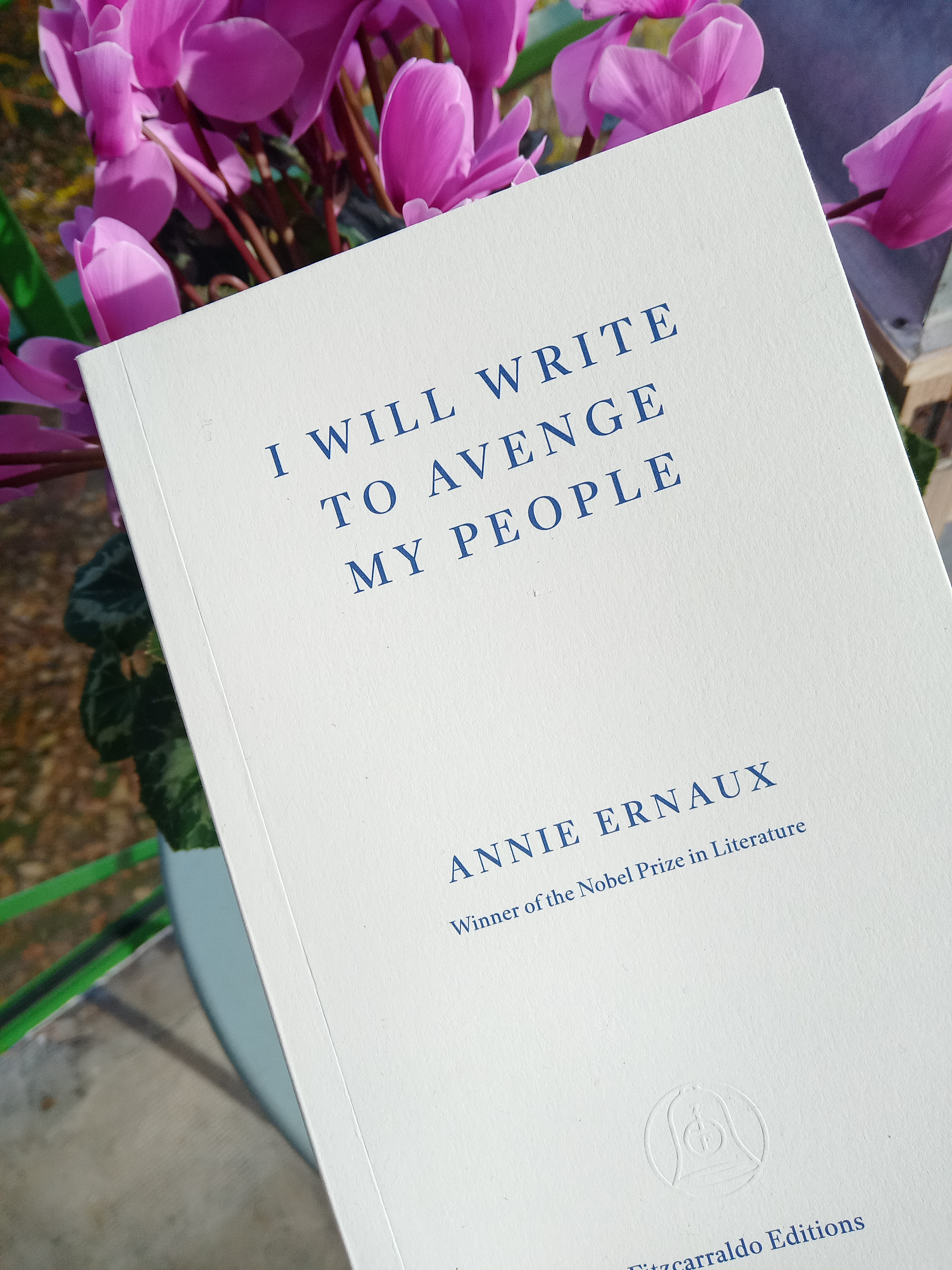
I Will Write To Avenge My People, The Nobel Lecture by Annie Ernaux tr. Alison Strayer & Sophie Lewis

Winner of the Nobel Prize in Literature 2022

In October 2022 the French author Annie Ernaux became the first French woman (the seventeenth woman) to win the Nobel Prize in Literature.

Read together, the reflections of the Nobel women reveal a diversity of ideas about what literature can do and a sense of a practitioner’s responsibility to these ideas. While the lectures vary widely in content—from Lessing’s and Gordimer’s concrete political lessons to Szymborska’s larger abstract musings to fables personal (Müller) and universal (Morrison)—each contains observations that are at once totally complex and completely true. – extract from LitHub article by Jessi Haley

The Agony and Experience of Class

The Nobel Committee recognised that ‘in her writing, Annie Ernaux consistently and from different angles, examines a life marked by strong disparities regarding gender, language and class

They awarded her the prize:

“for the courage and clinical acuity with which she uncovers the roots, estrangements and collective restraints of personal memory”

In this slim volume is the acceptance speech given by Annie Ernaux on 7 December, 2022 in Stockholm, Sweden, alongside a short biography (both translated by Alison L.Strayer). There is a brief banquet speech included, translated by Sophie Lewis.

It is a brilliant introduction to the motivation of the lifetime of work and writing by Annie Ernaux, opening with a reference to the title – alluding to the challenge of a search for the perfect opening line to her upcoming Nobel Prize lecture:

Finding the sentence that will give me the freedom and the firmness to speak without trembling in this place to which you have invited me this evening.

She doesn’t have to look far, she says, although the line she refers to – the title of her talk – is one she wrote in a diary sixty years ago.

j’écrirai pour venger ma race

It was written when she was 22 years old, the daughter of working class parents, studying literature in a faculty of sons and daughters of the local bourgeoise; an echo of Arthur Rimbaud’s cry in Une saison en enfer (A Season in Hell):

‘I am of an inferior race for all eternity.’

A young woman, the first of her family to be university educated, her youthful idealism was projected into those words.

I proudly and naively believed that writing books, becoming a writer, as the last in a line of land-less labourers, factory workers and shop keepers, people despised for their manners, their accent, their lack of education, would be enough to redress the social injustice linked to social class at birth.

Turning Away From Convention

Her first attempt at the novel was rejected by multiple publishers, but it was not this that subdued her desire and pride, to eventually seek a new form of expression.

It was life situations in which the weight of difference between a woman’s existence and that of a man was keenly felt in a society where roles were defined by gender, where contraception was prohibited and termination of pregnancy a crime.

These situations and circumstances instilled in her a pressing need to move away from the “illusory ‘writing about nothing’ of my twenties, to shine light on how her people lived, and to understand the reasons that had caused such distance from her origins.

Like an immigrant now speaking a language not their own, a class-defector, she too had to find her own language, however, it was not to found in the pages of the esteemed writers she had been studying and was teaching:

I had to break with ‘writing well’ and beautiful sentences – the very kind I taught my students to write – to root out, display and understand the rift running through me. What came to me spontaneously was the clamour of a language which conveyed anger and derision, even crudeness; a language of excess, insurgent, often used by the humiliated and offended as their only response to the memory of others’ contempt, of shame and shame at feeling shame.

Recognising that when a reader was culturally privileged they would maintain the same imposing and condescending outlook on a character in a book, as they would in real life, she sought to elude that kind of gaze and thus her trademark style evolved:

I adopted a neutral, objective kind of writing, ‘flat’ in the sense that it contained neither metaphors nor signs of emotion. The violence was no longer displayed; it came from the facts themselves and not the writing. Finding the words that contain both reality and the sensation provided by reality would become, and remain to this day, my ongoing concern in writing, no matter what the subject.

It’s an enrapturing lecture and an excellent introduction and insight into Ernaux’s particular and individual style, and wonderful that her volume of work has been recognised and celebrated at this esteemed level. You can read the lecture using the link below.

I have read one book by Ernaux, A Man’s Place and I am planning to read Shame, A Simple Passion and her masterpiece The Years.

Shame Simple Passion The Years Annie Ernaux Nobel Prize Winner 2022

Have you read any books by Annie Ernaux? Are you planning to read any?

Further Reading

The Nobel Prize Website: Annie Ernaux Nobel Lecture (Read the lecture here)

LitHub Article: A Brief History of All the Women Who Have Won the Nobel Prize in Literature by Jessi Haley

Annie Ernaux, French Author

Born in 1940, Annie Ernaux (née Duchesne) was born in Lillebonne and grew up in Yvetot, Normandy, where her parents ran a café-grocery store in the spinning mill district.

They had lost a little girl of seven before I was born. My first memories are inseparable from the war, the bombings that devastated Normandy in 1944.

She was educated at a private Catholic secondary school, encountering girls from more middle-class backgrounds, and experiencing shame of her working-class parents and milieu for the first time.

After abrief stint in Finchley, London, cleaning houses all morning and reading from the library all afternoon, she returned to France to study at the University of Rouen. Obtaining a degree in modern literature, she became a school teacher. From 1977 to 2000 she was a professor at the Centre National d’Enseignement par Correspondance.

Her books, in particular A Man’s Place (La Place) and A Woman’s Story (Une femme) have become contemporary classics in France. These books marked a break from the definitive novelistic form, she would continue teaching in order to never depend on commercial success.

One of France’s most respected authors, she has won multiple awards for her books, including the Prix Renaudot (2008) for The Years (Les Années) and the Marguerite Yourcenar prize (2017) for her entire body of work. The English translation of The Years (2019) was shortlisted for the Man Booker prize International and won the Warwick Prize for Women in Translation (2019).

The main themes threaded through her work over more than four decades are: the body and sexuality; intimate relationships; social inequality and the experience of changing class through education; time and memory; and the overarching question of how to write these life experiences.

Fitzcarrraldo Editions have now translated and published eleven of her works into English, including this booklet.

Ernaux’s work is uncompromising and written in plain language, scraped clean. And when she with great courage and clinical acuity reveals the agony of the experience of class, describing shame, humiliation, jealousy or inability to see who you are, she has achieved something admirable and enduring. – Nobel Prize Committee

The Booker Prize Winner 2023

Back in August the Booker Dozen 13 novels were longlisted for the Prize, which in September became a shortlist of six novels, and today a winner announced.

The judges were looking for the best work of long-form fiction, written in English, selected from entries published in the UK and Ireland between 1 October 2022 and 30 September 2023.

I read two from the longlist, both Irish novels that I very much enjoyed, Sebastian Barry’s Old God’s Time and Elaine Feeney’s How To Build A Boat. Sadly, neither made the shortlist below, but another two Irish novels did make it, The Bee Sting by Paul Murray which just won the Irish Novel of the Year and Paul Lynch’s Prophet Song.

From this shortlist of six novels, the winning novel is:

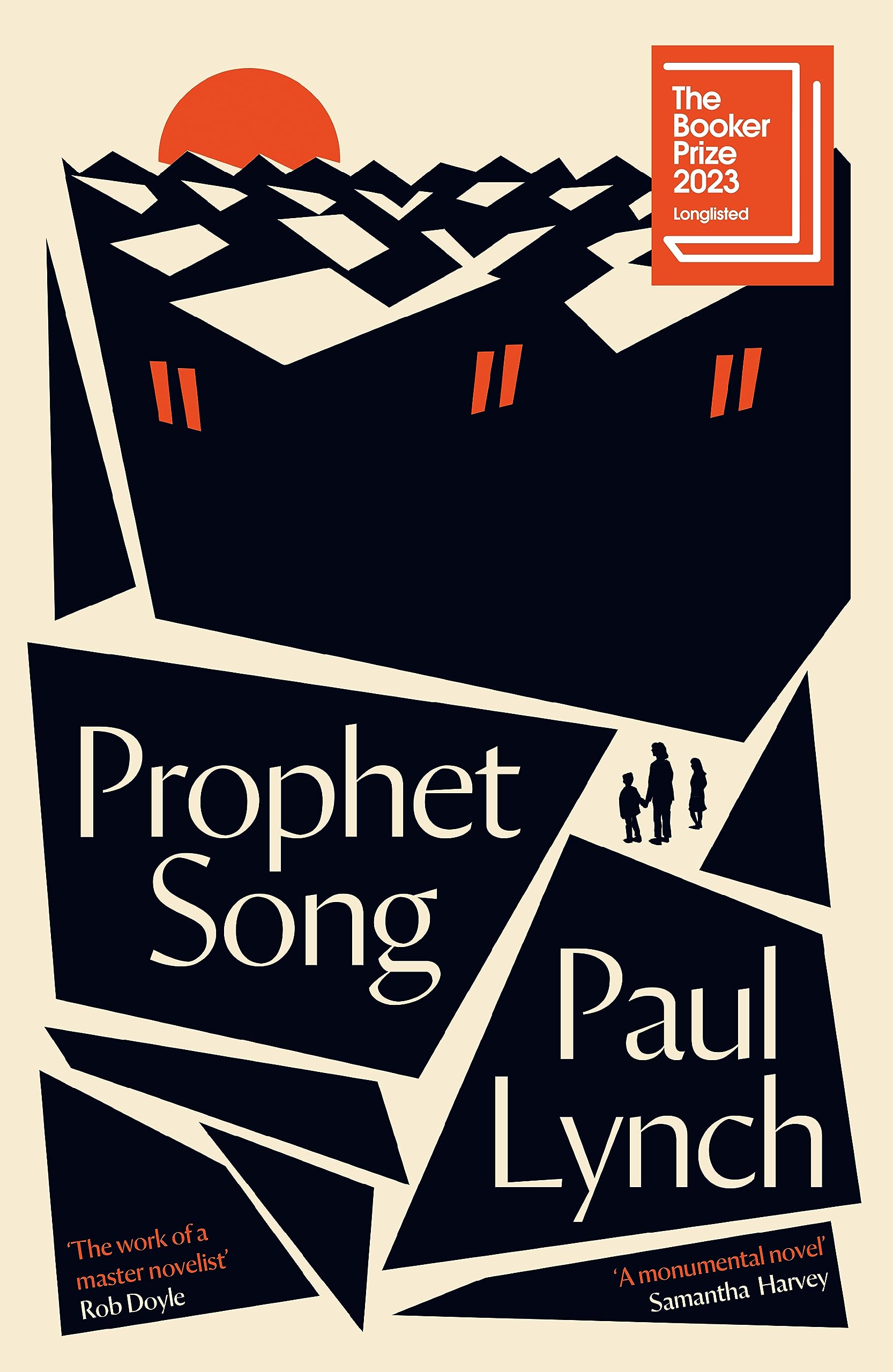
Prophet Song by Paul Lynch

Why You Should Read This Book According to the Judges

How would you summarise this book in a sentence to encourage readers to pick it up? 

Prophet Song follows one woman’s attempts to save her family in a dystopic Ireland sliding further and further into authoritarian rule. It is a shocking, at times tender novel that is not soon forgotten.  

Is there something unique about this book, something that you haven’t encountered in fiction before? 

The prose is a feast, with gorgeous rolling sentences you sink into. A stylistic gem.  

What do you think it is about this book that readers will not only admire, but really love? 

It is propulsive and unsparing, and it flinches away from nothing. This is an utterly brave performance by an author at the peak of his powers, and it is terribly moving.  

Can you tell us about any particular characters that readers might connect with, and why? 

Eilish is our guide through this relentless world, and we feel as deeply as she feels. The situations are sometimes dire, and yet she remains resilient, determined and, above all, human. She breaks our hearts. 

Although it’s a work of fiction, is there anything about it that’s especially relevant to issues we’re confronting in today’s world? 

Far from didactic, the book warns of the precarity of democratic ideals and the ugly possibilities that lie beyond their desecration. 

Is there one specific moment in the book that has stuck in your mind and, if so, why?  

Prophet Song has one of the most haunting endings you will ever read. The book lives long in the mind after you’ve set it down.

* * * * * * * * * * *

That’s a wrap, the end of the literary award season 2023.

Have you read Prophet Song, or if not, do you think you might be tempted to read it?

So Late In the Day by Claire Keegan

So Late in the Day (2023) was recently shortlisted for the Irish Book Awards Novel of the Year; it didn’t win that award however Claire Keegan won Author of the Year 2023.

The Literary Withhold

I read So Late in the Day as if it were a kind of literary mystery.

It is so short, (it’s a small square book of 4 chapters, 47 pages, around 11,000 words), that with Keegan’s combination of economy and precision with words, I found I was reading vigilantly between the lines as I went, not being able to stop myself from trying to guess the significance of every utterance and carefully constructed phrase. I mean, right from that opening line…

On Friday, July 29th, Dublin got the weather that was forecast.

…it read to me like something imbued with meaning. Did something or someone get what they deserved, I wondered?

Recalling other stories of Keegan’s, like Foster and Small Things Like These, I would suggest this is a motif of her storytelling, the slow reveal, the building up of a sense of something untold, omitted. The reader can’t help but wonder, question, try and guess as each page reveals a little more, what might be coming, the denouement.

Keegan herself suggested in a recent interview that the book requires a second reading:

So Late in the Day deploys her typically hushed technique to devastating effect; plain sentences unfurl their full implication only on rereading, the narration a veiled disclosure of the protagonist’s poisonous habits of thought.  – extract from Guardian article

Review

A young man, Cathal, is at his workplace on a Friday afternoon and seems very conscious of the time, in the first couple of pages it is mentioned twice, it passes slowly, perhaps excruciatingly. People act on guard around him, they know something we don’t.

It was almost ready (his coffee) when Cynthia, the brightly dressed woman from accounts, came in, laughing on her mobile. She paused when she saw him, and soon hung up.

Photo by R.Esquivel Pexels.com

His boss indicates he needn’t stay the rest of the day, and Cathal is aware of him closing his door softly, all of which makes the reader wonder why, what has happened to this young man that people seem to be treading carefully around him? As he leaves the office at the end of the day and waits for the lift, on hearing someone approach, he pushes open the door to the stairwell.

On the bus ride home, another clue:

He would ordinarily have taken out his mobile then, to check his messages, but found he wasn’t ready – then wondered if anyone ever was ready for what was difficult or painful.

The final clue before the end of the chapter is when a young woman gets on the bus and sits in a vacant seat opposite him. He breathes in her scent…

until it occurred to him that there must be thousands if not hundreds of thousands of women who smelled the same.

A Relationship Unravelled

He returns home, steps over wilted flowers on his doorstep and spends the evening alone, consuming a weight watchers microwave dinner and opens a bottle of champagne.

The four short chapters alternate between the past and the present. When the narrative steps back in time, we learn about his relationship with a half French, half English girl Sabine that he’d met in Toulouse. The dialogue between them reveals a disconnect that goes unnoticed by him and is ignored by her.

It is the discordant undertones within their conversation and his contemptuous observations that reveal the long, dark shadow of influence and inference.

After the reveal, when we learn what has happened to him, who he is, he recalls things about his own mother, his father, things from the past that shaped them, though he does not acknowledge that.

If a part of Cathal now wondered how he might have turned out if his father had been another type of man and had not laughed, Cathal did not let his mind dwell on it. He told himself it meant little, it was just a bad joke.

A Take on Language and Lore

It is a thought-provoking, provocative read, that subtly explores a seismic patriarchal crack in Irish society, one that infiltrates language, habits, behaviours and attitudes.

It is ironic, that the title in English is ‘So Late in the Day‘ compared to the French translated title which was translated or treated as ‘Misogynie‘. One title refers to the actions of the female character while the other refers to the behaviours of the male character. The story is told through the observations of Cathal, so the English language title belongs to his perception of reality, while the French title takes on a more overarching thematic approach.

In the article below, in The Guardian, it was revealed that the American author George Saunders was a fan of the story and recently chose it when invited to pick a favourite New Yorker story to discuss on the magazine’s podcast, but stopped short of reading it, due to one of the words used.

Keegan (who read the story herself, with riveting poise) tells me she respects his reluctance “even though he considered it to be the perfect word – as I do. It’s what Irish men often call women here. Writing the language people use is part of what a writer does to portray the lives we lead, the world we live in.”

Further Reading

The Guardian Interview: Claire Keegan: ‘I can’t explain my work. I just write stories’ by Anthony Cummins

Warwick Prize for Women in Translation Winner 2023

Today the winner of the Warwick Prize for Women in Translation was chosen from eight books shortlisted. The full longlist of 16 titles and descriptions can be seen here.

The 2023 competition received a total of 153 eligible entries representing 32 languages; this was the largest number of submissions made to the prize to date. The longlist covered 11 languages and for the first time included a title translated from Vietnamese. Arabic, Chinese, Hungarian and Italian were represented more than once. 

A Graphic Novel Debut From Egypt Wins

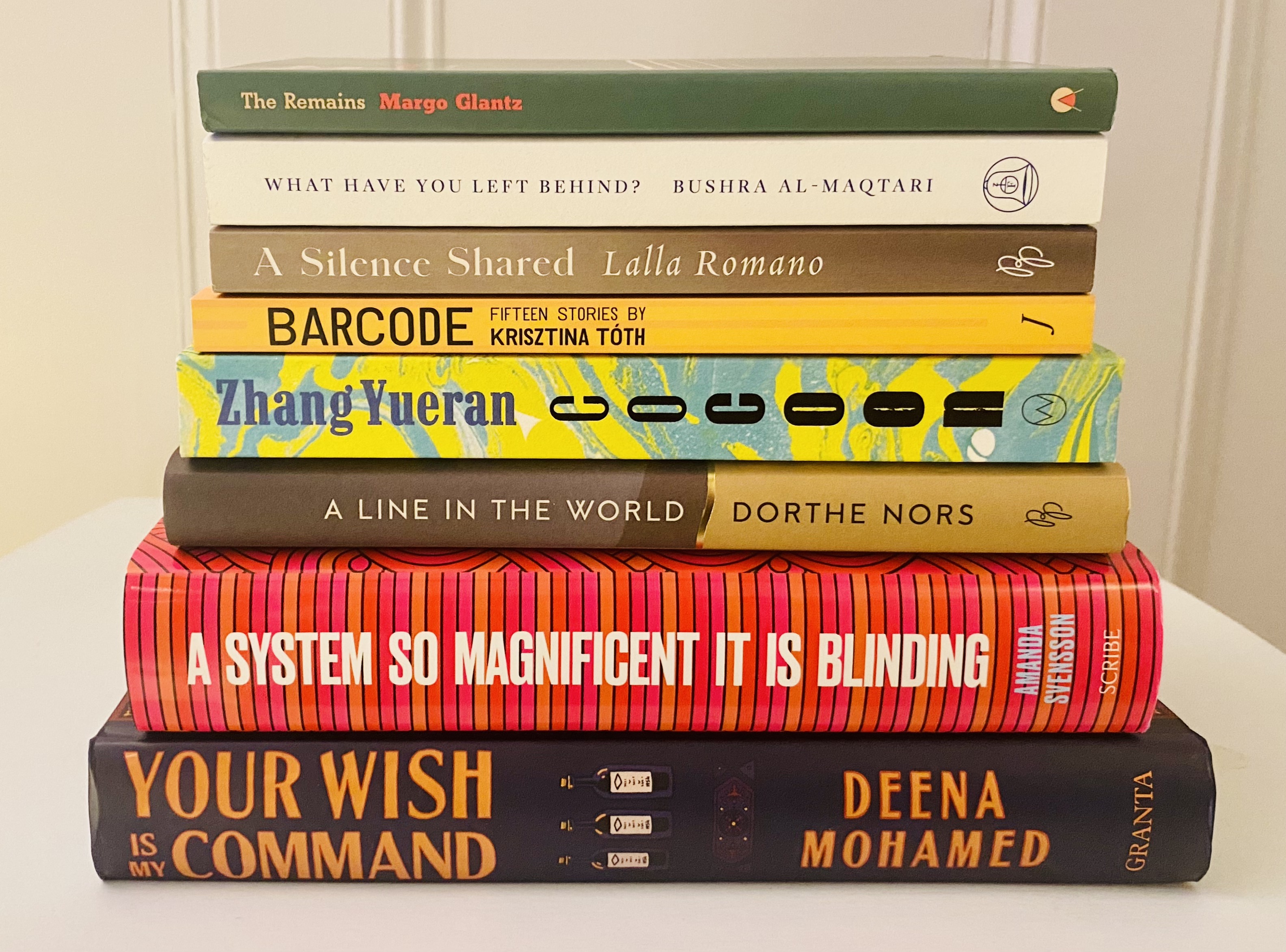
The winning novel by Deena Mohamed (Egypt) is the graphic novel Your Wish Is My Command, translated from Arabic by Deena Mohamed, published by Granta.

The illustrated novel imagines what might happen if you could buy and sell wishes. The book follows Shokry, a kiosk owner in Cairo, Egypt, as he tries to sell off three wishes he inherited from his father.

It combines fantasical elements alongside everyday realities in contemporary Cairo, as the characters cope with the challenges they face.

In the translation, on the opening page (which is at the back, the book reads from right to left, as it would in Arabic) is an inscription, from a reader:

Shubeik Lubeik (Your Wish Is My Command) is easily the most subversive book I’ve read in decades, Deena Mohamed has much to say about the human condition, but she does so with effortless grace, superb cartooning, and brimming with intelligence both emotional and intellectual – all while maintaining an incredible sense of humour.” Ganzeer, author/artist of The Solar Grid.

Further Reading

NPR Review by Malaka Gharib

New Yorker Review by Yasmine AlSayyard

The Guardian – Your Wish Is My Command by Deena Mohamed review – a spellbinding fantasy from Egypt by James Smart

Washington Post review – What Egyptians Wish For – In ‘Shubeik Lubeik,’ a new graphic novel by Deena Mohamed, genies really do come in bottles — but only for those rich enough to afford them by Jonathan Guyer

A Special Commendation, Non Fiction Essays from Denmark

The judges have also selected a title for special commendation this year:

A Line in the World, A Year On the North Sea Coast’ by Dorthe Nors, translated from Danish by Caroline Waight and published by Pushkin Press – a year travelling along the North Sea coast—from the northern tip of Denmark to the Frisian Islands.

In 14 essays, it traces the history, geography, and culture of the places she visits while reflecting on her childhood and her family and ancestors’ ties to the region.

She writes of the ritual burning of witch effigies on Midsummer’s Eve; the environmental activist who opposed a chemical factory in the 1950s; the quiet fishing villages surfers transformed into an area known as Cold Hawaii in the 1970s.

She connects wind turbines to Viking ships, 13th century church frescoes to her mother’s unrealised dreams. She describes strong waves, sand drifts, storm surges, shipwrecks; nature asserting its power over human attempts to ignore or control it.

In Case You Missed It

In 2022, the prize was jointly awarded to Osebol by Marit Kapla, translated from Swedish by Peter Graves and published by Allen Lane/Penguin Random House, and to Tomb of Sand by Geetanjali Shree, translated from Hindi by Daisy Rockwell and published by Tilted Axis Press.

Irish Book Awards Winners 2023

There were lots of winners at the An Post Irish Book Awards in Dublin, there being so many different categories from fiction, non-fiction, popular fiction, crime fiction to newcomer. From a small base of three categories, the awards now include eighteen categories spanning a broad range of literary genres. Thousands of readers vote to select the winners every year.

The Novel of the Year prize for which there were eight worthy contenders on the shortlist, went to the Booker shortlist nominated Paul Murray for his fourth novel, the tragicomedy The Bee Sting. Read a Q & A with the author here.

Set in a town in the Midlands in 2014, at the tail end of the financial crash, the Barnes family has a car dealership – they’ve just about managed to survive until now, but as the novel begins the business is on the brink of going under, and the family may be going down with it. The book navigates a family facing this calamity with irony, panging emotion and existential tones. Described as a masterful tragicomedy of familial chaos and dynamics. 

The one book I was championing (reviewed here), the moving, courageous and inspiring Poor by Katriona O’Sullivan, scooped two awards, Biography of the Year and the Listener’s Choice award.

Mark O’Connell won the Non-Fiction Book of the Year with his profound confrontation of true crime, A Thread of Violence a negotiation with the act of writing about murder, and a navigation of the chasm and interplay between fiction and non-fiction, taking the infamous case of Malcolm Macarthur as its subject, while Liz Nugent took the Crime Fiction Book of the Year for Strange Diamond Sally.

Newcomer of the Year went to rising Irish talent Colin Walsh for Kala, a gripping literary thriller, set in a small Irish town suffocating on its own secrets as three friends reunite in their hometown where their friend Kala disappeared fifteen years ago.

In an interesting and informative Q & A interview for the prize, Walsh was asked:

Q: Ireland is such a literary powerhouse, was it supportive of new writers?

The short answer is yes – and not just new writers. Ireland’s a literary powerhouse precisely because we’ve got an Arts Council-supported infrastructure of journals, festivals, indie publishers, etc. That creates a rich writing ecosystem, which is essential to maintaining individual artists and the wider literary culture. Writing is unpredictable magic on the page, but magic always needs concrete structures within which to thrive – that’s what Ireland provides for writers, and that’s why we punch so far above our weight internationally.

The winners of the individual categories will go forward to compete for the title of the overall Irish Book of the Year.  The winner is decided by the An Post Irish Book of the Year judging panel. Watch this space!

In 2022 Sally Hayden won that award for her incredible work of nonfiction My Fourth Time, We Drowned.
The nominations for Irish Book of the Year are the six titles shown below:

Soldier Sailor by Claire Kilroy

Soldier Sailor is on the shortlist for the Irish Book Awards 2023.

Cathy at 746 Books praised this one, as her pick for Novel of the Year, saying it deserved the award attention, so I decided to read it to find out what that was about.

The Clash of Fierce Love versus Stolen Identity

Irish Book Awards 2023 motherhood literary fiction

So, after an eleven year gap since the publication of her last book, following the birth of her son, Claire Kilroy has overcome her writer’s block and “angry few years”, to produce a piercing, visceral account by the unnamed narrator Soldier ravaged by new motherhood, to the child, Sailor.

Here is how the author describes her book:

Soldier Sailor is a mother talking to her sleeping child explaining what was going on during those years he was too young to understand or remember the events around him. She tells him of her love, but also of how difficult, how isolating she found it when motherhood ended her old life. Nothing much happens; one of the main characters, Sailor, has no dialogue. The whole experience is a non-event from the outside, but when you are that soldier pushing the pram, my, what a psychodrama it is.

The novel as the image depicts, zooms right in to the responsibility, the bond and the practice of being mother to a small child, to how it changes EVERYTHING. From the entering into a relationship like no other that exists and the loss of what came before it; to the very different support that a mother might need, and the unlikely place(s) she might find it.

A Mother’s Instinct to Kill

It is not a reflection, it is an act, you will read it and live it, or relive aspects of it, if you have already been there.

Do you know what I would I do for you? I hope not. What would I not do, is the question. The universe careens around us and I shield your sleeping body with my arms, ready to proclaim to the heavens that I would kill for you: that I would kill others for you, that I would kill myself. I would even kill my husband if it came down to it. I swear every woman in my position feels the same. We all go bustling about, pushing shopping trolleys or whatever, acting like love of this voltage is normal; domestic, even.That we know how to handle it. But I don’t.

Using the second person “you” addressed as a monologue to her baby son, the narrative swings between the emotional peaks of a tireless love, to violent frustration and resentment; from the misleading two second Instagram snaps sent to the elsewhere husband, to her thirty second screaming telephone rages, with only the reader, witness to and understanding the riding crescendo of events that lead from one of those events to the next. A bewildered husband, observing the peaks, oblivious.

Your sleeve is in your dinner, my husband remarked. He wasn’t there but he didn’t have to be there. He was always there when things were going wrong. Yet never there to help. The luxury, the sheer luxury of sending a last-minute message saying you wouldn’t be home that evening. It would be a decade – more – before I could do the same. What does he eat? he had texted me the one time he was left in charge?

Sons and Fathers Take Note

To read this account, especially because of the culture within which it stems from, one that for many years locked up its women who expressed too loudly their discontent, or behaved in ways considered improper, is to understand a little of what was labelled hysteria – one of the natural consequences of needs not being met. Forget the narrative arc, read this and you plunge into the subject, you become it, you feel it, you remember bits of it. The son is warned, made to understand, his future depends on it.

I was firmly in my wrong mind and liable to do anything, so off I went, down the stairs, out the door, up the drive, through the gate, along the road, overcome by a wildness that I needed to convert to movement or else risk doing something stupid, and by stupid I mean destructive because words have many meanings, Sailor, and you must deploy them with care because they can inflict real hurt.

The mother like her infant child, is reborn yet will only realise she has inhabited this new being ‘the mother who birthed‘ when it is too late, when this tiny creature she loves so fiercely and will protect with her life, claims her, and in her most challenging moments, she like him, will feel the desire to scream, to run, to escape or somehow figure out, how to make ‘the other’ understand.

What struck me as the starkest contradiction of all was that, having navigated this much of life – the volatility of youth, of love and loss, the agony and the ecstasy – the closest I had come to losing my mind was during the period known as settling down.

Friendship for Hope and Healing

motherhood Soldier Sailor Claire Kilroy
Photo by Oleksandr P on Pexels.com

This text will not speak of the quiet moments, it is the intersection of all the moments lived, of the brutal awakening that is ‘becoming a mother’ and the warning to ‘the other’ that did not give birth, who is part of the journey, to prepare for this change and get ready to adapt, to support, to listen, to learn to be ‘the friend’ she is going to need.

One day she encounters an old friend, and these follow up meets mark a turning point, to being seen again, to being understood, and something dangerous shifts, quiets. Small gestures, moments of listening, the beginning of a form of solidarity.

We were better together my friend and I. Better parents. I was anyway. I was a better mother to you when I was around my friend. But a worse wife.

We arrive at the end – where she imagines moments years down the road ahead – with a kind of relief, knowing that with age and stage, the distance between those peaks will lessen, the relationships will either adapt or crumble, that true friendships will witness and endure it all.

An utterly compelling read that you won’t want to put down.

Further Reading

The Observer Review: Soldier Sailor by Claire Kilroy review – a mother’s confession after the fight of her life by Stephanie Merritt, 12 June 2023

The Irish Times Review: Soldier Sailor by Claire Kilroy: An astute, provocative, intriguing novel about motherhood – A virtuosic set-piece late on veers so far into nightmare territory, it feels as if we’re reading a thriller by Sarah Gilmartin

Eason Novel of the Year, Interview Q & A With Claire Kilroy

Claire Kilroy, Author

Claire Kilroy is the author of five novels including Soldier SailorAll SummerTenderwire, and The Devil I Know. She was awarded the Rooney Prize for Irish Literature in 2004 and has been shortlisted for many other prizes, including the Irish Novel of the Year and the Kerry Group Irish Fiction Award.

She studied at Trinity College and lives in Dublin.

What do you hope readers will take away from your narrative?

It is so easy to dismiss a mother and her work, and a father and his – one of the main characters is a stay-at-home dad. I had no idea what minding an infant involved and had regarded it as easy, unchallenging (I am mortified to admit that), so I hope I have revealed how demanding it is, but also how rewarding, never mind how important. I hope more fathers will get involved in raising children because it changes you, it remakes you, you become more compassionate. I don’t think Trump and Putin would be the awful tyrants they are had they cared for, well, anyone. It doesn’t have to be a child, just any person or creature who needs care.    

Literature Award Season Wrap Up Week

Remembering the past Spring Literature Awards Season

Back in March/April the Spring Literature Award Season saw the Women’s Prize for Fiction 2023 won by Barbara Kingsolver for Demon Copperhead, a book I did eventually read but didn’t review; the Dublin Literary Award, a celebrated worldwide librarian nominated award, won by Katja Oskamp, translated from German by Jo Heinrich, for the excellent, life-affirming novella Marzhan, Mon Amour, a book I absolutely loved – how could I not, a writer turned well-being practitioner protagonist (much like Oskamp herself), who soothes aches and pains of the body, mind and soul of her small, often misunderstood community.

Then there was the International Booker Prize (fiction in translation) shortlist, from which I read three novels, the outstanding read for me being Mexican author Guadalupe Nettel’s Still Born, the top prize going to Bulgarian author Georgi Gospodinov for his novel Time Shelter, translated by Angela Rodel.

I shared the results of the New Zealand Book Awards and though these titles are not easy to get hold of, I did manage to read Grand: Becoming My Mother’s Daughter by Noelle McCarthy which won the Best First Book in the General Nonfiction category, with Catherine Chidgey’s The Axeman’s Carnival winning the fiction award, one I hope to read in 2024.

Autumn Literature Award Winner Week

This week will see the unveiling of three more literature awards that I’m curious about.

Irish Book Awards 2023

On Wed 22 November, the winners of the Irish Book Awards 2023 will be announced. I’ve been reading a lot of Irish literature this year, including almost half of the 8 fiction titles shortlisted for Novel of the Year and one title Poor by Katriona O’Sullivan that is shortlisted for both Biography of the Year and the Listener’s Choice Awards.

So far, I’ve read and reviewed Sebastian Barry’s Old Gold’s Time which I thought was excellent and would certainly be a worthy winner, Elaine Feeney’s How To Build a Boat, a character lead scenario that I very much enjoyed, I’m almost finished reading Claire Kilroy’s intense, visceral portrayal of a young mother on the edge of parental overwhelm Soldier Sailor and I’ll soon be reading the very short contender by Claire Keegan (so short it might not even be a novella) So Late In the Day.

The Booker Prize 2023

It’s a strong fiction lineup for the Irish Awards, with four of their shortlisted titles already featured on the Booker Prize longlist, two of which made it to the shortlist (none of which I have read); the winner will be announced on Sunday 26 November. This group of six books below was said by the judges to “showcase the breadth of what world literature can do, while gesturing at the unease of our moment.” In this case, I found more of interest in the longlist than the shortlist.

The Warwick Prize for Women In Translation 2023

And last but not least, the winner of the Warwick Prize for Women in Translation will be announced on Thursday 23 November.

I have read one title from this shortlist, though it has only just appeared in English thanks to Charco Press, The Remains by Mexican author Margo Glantz was originally published in 2002. I describe this literary masterpiece as a lyrical elegy of tempo rubato, z divorced woman feels out of place and yet connected at her ex-husbands wake, a riveting, mind blowing (or perhaps expanding), rhythmic reading experience, just WOW!

Despite being one of the most iconic figures in Latin American literature, her work is little known in English. Charco Press now bring her work to a new audience with this excellent translation by Ellen Jones.

So watch this space this week for the winners of these three sets of awards.

Have you read any works from these shortlists? Any favourites? Predictions?

Sambac Beneath Unlikely Skies (2021) by Heba Hayek

Tender, nostalgic vignettes of a childhood growing up in Gaza, often told from the perspective of the twenty-something narrator looking back from the present, now living in exile in London. She is constantly longing for old places while finding new ones, the past never far from being elicited by the present.

Each new chapter has an associated song, vignettes accompanied by a playlist.

The image of the sambac, the tree that filled our back yard with its sweet, creamy scent, appears in my narrator’s attempts to create life where this shrub doesn’t naturally thrive.

short stories Palestinian Literature Gaza Hajar Press

The little stories are so compelling, I finished them in one sitting and was left wanting to read more. I sincerely hope the author is writing more stories, preserving important memories, while there is a terrible war raging in her home town.

These stories are the anti-thesis of that violent incursion, they speak of family outings to the sea, of friendships, of Aunties, though so many are tinged with reminders that it is almost never without some reference to loss.

As the narrator grows into unlikely circumstances away from Gaza, memory is her greenhouse; her way to bring back the voice of the girl who was sacrificed and born in the hands of her identity. At her desk in a flat in Southeast London, she writes of what makes her soul flicker: community love, especially the kind embodied by circles of women and girls.

Guns and Figs

In this vignette, our narrator shares a childhood memory of driving along the Gaza coast with her parents, beside the Mediterranean, in her favourite place, by the window facing the sea, window down, sea breeze rushing in, an unchanging view for the duration of the 20 minute drive.

The song accompanying the vignette is Fairuz ”Nassam Alayna El Hawa’ (The Breeze Is Upon Us)

Photo by Kadir Akman on Pexels.com

My brother and I each had assigned places in the car, until our little sister grew old enough to claim her window-seat rights. Then the rotation became tricky, involving fights that mostly ended with my brother crying in the middle.

I usually sat by the window, facing the sun and the sea, breathing the salty, creamy air and occasionally eating grapes and figs: the ultimate Mediterranean snack.

These drives all felt the same, until the last one.

At a checkpoint, a soldier indicates they should pull over, “I’ll just be a minute” says her father. An hour later he returns, the Friday barbecue trips end indefinitely that day, though she is never told why.

I started to notice Baba paying more attention to the road; it seemed like he was avoiding certain checkpoints. Every so often, he would point out something ahead and wonder aloud whether it was a checkpoint or a fruit cart. As Fairuz sang from the cassette player, Baba drove on, trying to guess the difference between guns and figs.

Friendship, Fear and Foreign Places

Other stories ‘Ask Me Anything’ tell of school days interrupted by explosions, of friendships interrupted by disappearances, ‘A Carry-On Full Of Pictures and Letters’.

We were never trained for emergencies at school. We just knew what to do. We would sit on the floor under our tables each time we heard the recurrent loud explosions – ignore the first two, exchange a few nervous looks, and then, in one swift move, we’d all be in our places by the third. That consistency was comforting. The fact that we had survived the first two was a good enough sign that it’d be worth shielding ourselves from the rest.

In an attempt at reassurance, our teacher would remind the class: ‘The one you hear isn’t the one that kills you.’

One day her best friend Lubna leaves Gaza without telling anyone. She had visited the Al-Shifaa hospital after breaking her arm and never returned.

When she was ten, Lubna’s dad had been one of seven people martyred after the occupation forces targeted a car in the middle of a busy street. She’d been planning her exit for years; I just didn’t think it was really going to happen.

Three years later, she visits her friend in Amsterdam where she now lives.

Song: Lucy Dacus – ‘Yours and Mine’.

That day feels like the oldest memory I have. Yet somehow I can barely remember it at all, or the person I was when I hadn’t yet imagined what it meant to leave.

‘I love my mother, but she couldn’t protect me. I love you, but you couldn’t either. I’m a lot better now, you see?’ She waves her hand in the air, and I look around and nod.

A Moving Tale, Of Family Drama

Song: Nina Simone – ‘I Wish I Knew How It Would Feel To Be Free’

In this vignette, we first hear that our narrator has been kicked out of her flat after secretly hosting an Airbnb guest to help pay the rent. Homeless, she moves into the office where she works and takes on additional responsibilities.

Sometimes, I even feel content in my windowless bunker, stealing bits of people’s lunches from the common lounge – not the entire meal. As I look up flats in my small college town, I think of my first big move.

Here, we learn of when our narrators parents leave the family home, the summer she turns six, after problems around inheritance became intolerable. Their last day living in an apartment above her grandmother Sitti, arrives:

Moving out of the family house was never a casual affair, but rather a statement. It’s like leaving home for the first time – making a point that it’s time to move on. Changes like these usually carried an undertone of wives taking their husbands away from their families and keeping them for themselves.

The move also meant that no one was going to interfere in how to raise us, except for my parents. It was a bit of a slap in the face, especially for Sitti. But I was excited about it; I wanted to be like my other cousins who visited only on Fridays and wore something new each time: a little bag or a hair tie, or even a completely different hairstyle. I was ready to rebel with my parents and become the daughter of a mean woman. I started to imagine what I would wear the next Friday.

Some years later, she visits her grandmother in Belgium, where she now lives and finds her safe, but malcontent.

Song: Idir – ‘A Vava Inouva’

Seventy years since her birth,our Grandma is in a French-speaking town, barely able to move, again a refugee. She tells me she didn’t want to leave Gaza, and that she regrets it.

‘Who leaves at this age?’ she says, slightly ashamed of her attempt at survival. As though there were an age limit to craving life, or to that quiet longing older folks back home often fear expressing.

Photo by u015eeyma D. on Pexels.com

It is a wonderful collection, that preserves childhood memories and shares with the rest of us, a slice of life for a member of a Palestinian family in Gaza, where growing up is fraught with uncertainty, trauma and nothing can be taken for granted.

From afar, the beauty of family and fragmented moments of friendship gain additional significance, as a way of life is slowly and methodically destroyed.

A must read, excellent portrayal of a lonesome yearning for home.

To order a copy of this book, visit Hajar Press here.

Heba Hayek, Author

Heba (she/they) is a London-based, Gaza-raised Palestinian author, creative and facilitator. She completed an MFA in Creative Writing at Miami University, Ohio, and studied for an MA in Social Anthropology at SOAS University of London.

Rooted in anti-nation-state, decolonial, queer, Afrikan feminist thought, Heba’s work navigates topics such as disposability, Global South solidarity movements, land justice, Palestinian drill music, and more.

Heba’s first book, Sambac Beneath Unlikely Skies, won the Creative Award in the 2022 Palestine Book Awards and was chosen as a 2021 Book of the Year by The White Review, Middle East Eye and The New Arab.

My Fourth Time, We Drowned by Sally Hayden

Seeking Refuge On the World’s Deadliest Migration Route

Sally Hayden is a correspondent for the Irish Times, who has reported stories across Africa and the Middle East for a wide range of media, including the Guardian, CNN, Al Jazeera, Channel 4 News, the Washington Post and the New York Times.

Earlier this year, I read River Spirit by Sudanese/Scottish author Leila Aboulela and as I was interested to understand a little more of the history of Khartoum, Sudan, I started reading some informative news articles by the Irish correspondent Sally Hayden.

I then discovered she had recently written a book, a very powerful and important book.

A Non-Fiction Tour de Force

Her book My Fourth Time, We Drowned was the winner of the 2022 Orwell Prize for Political Writing, Irish Book Awards Book of the Year 2022, it was shortlisted for the Bailee Gifford Prize for Non-Fiction 2022.

In 2018, Sally was contacted by refugees incarcerated in Libyan migrant detention centres, who were using hidden phones to appeal for help.

“Sister Sally,” a man WhatsApped her in 2018 from a Libyan detention centre for refugees, “we need your help.”

“I had stumbled, inadvertently, on a human rights disaster of epic proportions,” Hayden remembers.

From that day, she became a kind of lifeline to many, staying in contact, travelling across the region verifying facts and keeping a vigilant eye on those she had come to know travelling along the Central Mediterranean migration route, between Libya or Tunisia and Italy or Malta. The UN has called it the deadliest migration route in the world.

A 21st Century Human Rights Scandal

Since 2014, more than 28,200 men, women and children have died or gone missing on the Mediterranean Sea while trying to reach Europe – more than 22,400 of them along this route.

In her book, she documents the messages and traces what happens to some of these people, and referring to a map, focuses on every detention centre and shares the conditions and some of the events that occurred in each of those places. It is a compilation of evidence and an act of ‘seeing’ those individuals whose lives have been demeaned and exposes the reality of unwholesome alliances forged between European leaders with warlords, militias and rebels who profit from the movement of human beings through political funding and extortion.

Returning people to Libya traps them in a cycle that also involves human smugglers. The smugglers work in league with both the coastguard and the detention centre management – this has been documented by an independent UN fact-finding mission, as well as by me. Videos of captives being tortured are even circulated by their families on social media, in a desperate bid to raise ransom money through crowdfundingEritrean journalist Meron Estefanos says around one billion euros in ransoms could have been paid to smugglers in Libya by now. 

The main reason for her focus on the Central Mediterranean route was because of the role and impact of the European Union (EU). A law graduate with a Master’s in International Politics, she would investigate and report on the circumstances that lead to this becoming a major humanitarian crisis, as a result of EU policy, that funded and facilitated thousands of people being captured and forced back to a militia-run state where they were often locked up indefinitely in detention centres.

Each chapter focuses on a different location, sharing the messages from people being held, the dire conditions, the punishments, the ransom demands, the deaths. The ineffectiveness of the UNHCR (United Nations High Commissioner for Refugees), the suggestion of Rwanda as a new route for safety, the trial of known smugglers at Addis Ababa, where Hayden is the only foreign correspondent present. The humanitarian lawyers who made a submission to the International Criminal Court calling for the EU to be charged with crimes against humanity.

She also travels to parts of Africa where some have returned home to, to find out how they are faring, and then the few who made it to a safe country, who ares starting new lives – how it is now for them.

It is difficult to encapsulate the extent of this testament to the experience and situation of a large group of people made to live and die in terrible, inhumane conditions here, but it is an opportunity to avail ourselves of the knowledge of the repercussions of these funding policies and to understand what is behind these so-called solutions to a humanitarian crisis.

“The world will not be destroyed by those who do evil,” wrote one detained Eritrean refugee, “but by those who watch them without doing anything.”

An extraordinary, detailed and condemnatory read. Highly Recommended.

Journalist of the Year, Irish Journalism Awards 2023

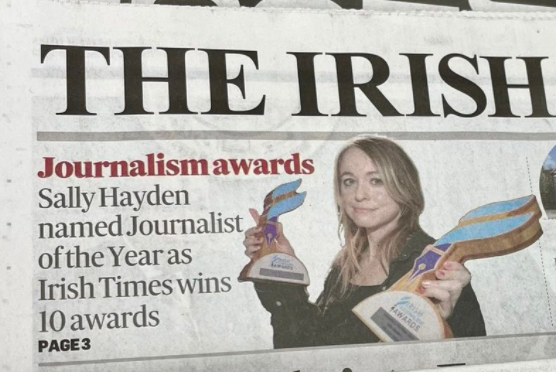
Just this week (Nov 15, 2023) Sally Hayden was named journalist of the year at the 2023 Irish Journalism Awards. Hayden also received the award for best foreign coverage for Irish Times articles on famine risks in Somalia, Sudan’s pro-democracy movement and unrest in Sierra Leone over its cost of living crisis.

Further Reading

A Speech Sally Hayden Gave to the European Parliament, 9 Nov, 2023 – on Why People Want to Come to Europe

Irish Times Article: Sally Hayden: ‘You have to be careful not to let your empathy or your humour be torn away’

Interview, Women In Foreign Policy: Sally Hayden on her career as a journalist and reporting on the migration crisis

Sally Hayden, Author

Sally Hayden is an award-winning journalist and photographer focused on migration, conflict and humanitarian crises. She is currently the Africa correspondent for the Irish Times and in 2023 won journalist of the year at the Irish Journalism Awards.

Her writing has been translated into nine languages and she has appeared on national and international media.

David Edgerton, the Chair of Judges for The Orwell Prize for Political Writing 2022, commented:

Hayden’s reporting is an extraordinary exploration of a modern reality using modern means: truly a book of our times. While many people seeking refuge from the terrible logics of repression, war and poverty cannot easily cross frontiers, phone and Facebook messages can. They allow contact with home but are also the means by which ransoms are gruesomely demanded by traffickers. But they are also the way in which Hayden explores the lives of people stuck under the control of traffickers, militias, the UN, and lets them speak to us as full human beings: hungry, ill, and often doomed in their quest for safety. She gets the terrible truth out to a world that has been far too indifferent.