The Red Sofa by Michèle Lesbre

translated by David Ball, Nicole Ball

An Unexpected Trans-Siberian Railway Trip
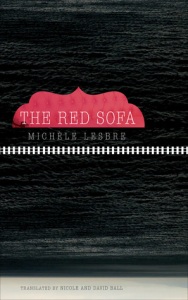
le canapé rouge the red sofa michèle Lesbre

A French novella that I read in an afternoon, we accompany our Parisian protagonist Anne, on a train journey towards Lake Baikal, in Southern Siberia, a journey she makes on a local train, having spontaneously decided to find out why her friend Gyl is no longer responding to her letters.

For the first six months he had written often, telling me he had time to go fishing for omul in the lake and make kites for children.
And then, silence.

Once on the train and it’s a long journey, she has time to think and recall their friendship, they were lovers many years ago and while she holds no flame for him, the journey allows her to reflect on the highs and lows of their union.

I knew that the return trip is the real journey, when it floods the days that follow, so much so that it creates the prolonged sensation of one time getting lost in another, of one space losing itself in another. Images are superimposed on one another – a secret alchemy, a depth of field in which our shadows seem more real than ourselves. That is where the truth of the voyage lies.

Get To Know Your Neighbour

What she does spend time thinking of, is her recent past and another spontaneous decision, to knock on the door of a neighbour whom she has never seen, an elderly woman.

I had never run into her in the lobby of the building, not on the stairs. I knew all the other people who lived there, or at least their names and faces, but Clémence Barrot remained a mystery. No sounds would ever reach me when I walked by her door, and if I asked questions about her, all I got were laconic answers and knowing looks…A character!

The door is opened by a young girl and peering inside she sees the older woman sitting on a red sofa by a window. As an excuse for her curiosity she mentions there might be noise as she has people coming for dinner that evening. The woman asks her a favour in return for the anticipated inconvenience.

With a big smile, she retorted that she would rather we proceeded differently: for all past dinners, for this one and the next ones, she would only ask in exchange that I occasionally read to her a little, if I had the time.
Passionate French Women Who Faced Death Unflinchingly

And so we meet some bold French female heroines of the past, sadly a number of whom for their feminist inclinations in the wrong era, lose their lives at the guillotine.

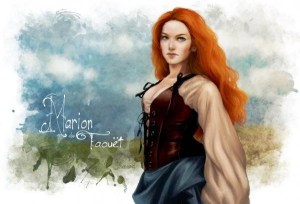
“Tell me about that gutsy girl again,” Clémence Barrot would sometimes ask about Marion de Faouët and her army of brigands. She had, just as I did, a real affection for that child who had not grown up to become a lady’s companion despite all the efforts of the Jaffré sisters. No, she became a leader of men instead, an avenger of Brittany which had been starved during the 1740’s.

A wild beauty, faithful to her village, her loves and her ideals, Marion had been imprisoned several times before dying on the gallows at the age of thirty-eight.

While these stream of consciousness thoughts pass through her mind, various locals enter and exit the train. She is happy to be immersed in the languages of the area and in two books she has brought with her, Dostoevsky’s War and Peace and a book by the philosopher Jankélévitch.

Travel To Exotic Destinations Through Story

le canapé rouge the red sofa Michèle Lesbre WIT Month

Becoming particularly interested in one man whom she can’t communicate with – Igor – she imagines things about him from the little she observes and seeks him out more than one time when he disappears.

I had just read ‘There are encounters with people completely unknown to us who trigger our interest at first sight, suddenly, before a word has even been said…”

It’s an engaging read considering not much happens, but there is just the right mix of action and reflection and indeed, by the end a build up to a couple of dramas and quiet resolution.

I really enjoyed the read and was surprised at how captivated I was by the journey. I do love long train journey’s and hers was such an indulgent whim, that the suspension of what she will encounter is enough to keep the reader interested, and the relationship with her elderly neighbour provides a brilliant counterpoint and empathic adjunct, becoming the more significant event to the ‘thousands of miles’ distraction.

N.B. This was one of the many Seagull Books offered weekly to readers during the period of confinement.

Further Reading

Reviewed by Rough Ghosts 

Seagull Books: More of their extensive collection of titles by Women In Translation
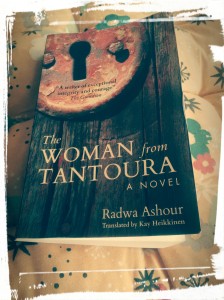
The Woman From Tantoura by Radwa Ashour (2010)

translated by Kay Heikkinen.

Radwa Ashour

Radwa Ashour Woman from Tantoura Granada WITMonth

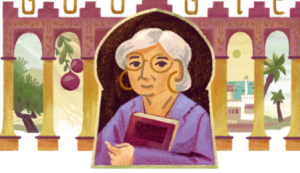
Radwa Ashour (1946 – 2014) was a highly acclaimed Egyptian writer and scholar who after studying a BA and MA in Comparative Literature in Cairo, went on to do a PhD in the US in African-American Literature.

As a university student in her native Cairo in the early 1970s, says Ashour, she’d found no one who considered writers in the African diaspora worthy of study. But in 1973, a joyfully-cultivated friendship with Shirley Graham Du Bois ­ world traveler, litterateur, and widow of W.E.B.du Bois­ led Ashour to UMass. Madame Du Bois, as the école-educated Ashour still calls her late liaison to Amherst, was living in Cairo at the time, and pointed the young Egyptian toward the then-infant Afro-American Studies department here.

Her interest in African-American literature was due to her view that “works on oppression and the overcoming of oppression speak deeply to readers in the Arab world.” She was passionate about social justice, evident in her writing, which sought to personalise the lives and conditions of marginalised groups.

Throughout her career she wrote more than fifteen works of fiction, memoir and criticism, including the novels Granada and Spectres.

The Woman From Tantoura

Radwa Ashour Tantoura WITMonthThe more I read, the more this novel got its hooks into me. After a while, a pattern begins to emerge, one that is universal. To find a place where one can live authentically, and be at home.

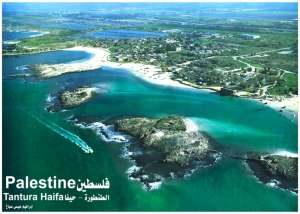
Because of the initial setting, a fishing village in Tantoura, Palestine, in 1948 – the year of ‘The Nakba‘ I expected it was going to be traumatic, it’s the part we don’t wish to linger in, to be witness to the horrific expulsion of families from their homes, of the disappearance of sons and fathers, the rest either becoming refugees in their own country or fleeing to find refuge elsewhere.

Even if we know it can’t begin well, sometimes, we need to read through, to follow the life of a thirteen year old girl into womanhood, in the hope that we see her find solace, to have empathy for her worry and anxiety for her own children and husband after all she has witnessed.

The story begins with Ruqaya standing on the seashore, seeing a young man come out of the sea as if he were of it, as if the waves released him on to land. She is mesmerised. The man will become her fiance, though they will never marry. It is the end of her childhood, the end of blissful days on that shoreline, though memories and the scent of it will stay with her forever, through all the moves that follow. And the key to the old house.

Looking for a Place to Call Home

Key Tantoura Palestine Radwa Ashour

Photo by Ylanite Koppens on Pexels.com

Later on I would learn that most of the women of the camp carried the keys to their houses, just as my mother did. Some would show them to me as they told me about the villages they came from, and sometimes I would glimpse the end of the cord around their necks, even if I didn’t see the key.

The novel is narrated by her 70-year-old self, pushed into writing down and describing the many experiences and turning points in her life, by her middle son.

It’s not only the story I’m interested in, I’m after the voice, because I know its value and I want others to have the chance to hear it.

A reluctant narrator, the timeline moves back and forth,  less a chronology events than a response to emotions that arise that provoke the memory. It’s a recollection of a life lived in the wake of tragedy, of determination and survival, of not forgetting, maintaining a connection to a culture and values as best one can.

There was no acceptable or reasonable answer for the question for “why?” however much it rose up, loud and insistent.  I did not ask “why”. I mean I didn’t ask the word, and perhaps  I was not conscious that it was there, echoing in my breast morning and evening and throughout the day and night. I didn’t say a thing; I fortified myself in silence.

Tantoura Palestine Radwa AshourWhile her mother uses imagination to create a vision of what happened and where the missing are, Ruqayya’s advances then retreats, as the present awakens the past, rarely does she dwell in an idealised future.

Am I really telling the story of my life or am I leaping away? Can a person tell the story of his life, can he summon up all its details? It might be more like descending into a mine in the belly of the earth, a mine that must be dug first before anyone can go down into it.Is any individual, however strong or energetic, capable of digging a mine with their own two hands?

Seeking Refuge

To see them seek refuge in another country, where a similar tragedy can happen, one understands what it must feel like to feel that no place is safe, and then when she finds a ‘safe place’ with her high achieving son, the culture shock is too much to bear, bringing to mind the memoir of the Palestinian intellectual Edward Said’s Out of Place.

Bird of Paradise Radwa Ashour TantouraThere is no place that quite replaces the childhood environment and home, except perhaps to create one’s own family, and this Raqayya will do, with her son’s and the daughter, a girl Maryam her husband brings home one day from the hospital, adopting her as their own. And in growing things, not the almond tree or the olives,  but flowers, a thing of beauty, the damask rose, the bird of paradise.
I found similarities in reading this novel, to the feeling evoked in reading Nella Larsen’s Quicksand, her constant search too, for the place where she could be herself, though her search was all the more elusive and complex, there being no place or people who accepted her rootlessness, her mixed blood, something that the clannishness of many ‘peoples’ reject.

“In Egypt, we have a flag, an airline of our own, we are an independent country,” she said. “But there is this feeling we are not free to be who we are in the new world order.” I am always conscious I’m a person from the Third World. I’m an Egyptian, an Arab, and an African all in one. Also, I’m a woman. I know to be all these things is to be particularly conscious of constraint.” Radwa Ashour

The Woman From Tantoura is my first read for #WITMonth, reading Women in Translation.

Women in Translation 2018 Summary #WITMonth

During August I was back in reading mode after a busy period, so here is a brief impression of the books I read for Women in Translation month, an annual reading challenge I participate in as it fits appropriately with the kind of books I like to discover, those coming from countries and cultures other than Anglo, originally written in another language.

The reason they are highlighted in August is an attempt to raise awareness of the very narrow choice we give ourselves by only reading books in English, or from one’s own country and to highlight the fact that even when we do read outside our first language, the majority of books published, promoted and reviewed are written by men.
WIT Month is an attempt to redress the balance, and the hope is that publishers also respond by making more of an effort to seek books from voices that are little seen in print.

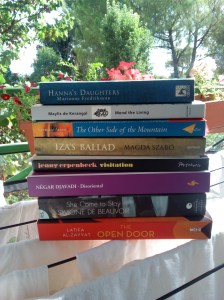
So this was my stack of possibles, there were eight books to choose from, I read six of them and I’m still reading the seventh (being back in another busy period, it may take a while to finish).

I read three books translated from French, one from German, one from Arabic (Egypt), one from Turkish and the one I didn’t read Iza’s Ballad by Magda Szabo (I have read and enjoyed her novel The Door) was originally written in Hungarian.

Here are the summaries below, click on the title to read the full review:

Mend the Living by Maylis de Kerangal      🌟🌟🌟🌟🌟

Wow, this was a novel like other, translated from the French, embracing long descriptive, metaphoric passages, as it navigates 24 hours in the life of a young surfer, through snapshots of all he comes into contact with, or those whose lives will be affected by what has just happened to him. It is unique, original, dramatic, insightful, gut-wrenching at times and stays with you for a long time after, due to its thought-provoking subject.

In the process of writing the book, the author’s father had a heart attack, putting the writing on hold  sent her thoughts to even greater depths:

“A few months later I was in Marseille and I wanted to understand what is a heart. I began to think about its double nature: on the one hand you have an organ in your body and on the other you have a symbol of love. From that time I started to pursue the image of a heart crossing the night from one body to another. It is a simple narrative structure but it’s open to a lot of things. I had the intuition that this book could give form to my intimate experience of death.”

Visitation by Jenny Erpenbeck     🌟🌟🌟

One I’ve tried to read over the years, but never got past the first few pages, this time I succeeded, though wasn’t wowed by it. A German novel focusing on a property by a lake, which we are reminded in the opening pages has been there for millions of years, since the glacial age.

The chapters that follow highlight aspects of the lives of a few human dwellers over a period of about one hundred years, shadowed by the tumultuous history of a landscape and the psyche of those who’ve tried to live in and control it.

“As the day is long and the world is old, many
people can stand in the same place, one after the other.”
– Marie in Woyzeck, by George Buchner

Disoriental by Négar Djavadi 🌟🌟🌟🌟🌟

I’m no sentimentalist, but when this one abruptly finished, a little salt water leaked from my eyes, witnessed by my 15-year-old son, staring at me in disbelief. It’s brilliant.

A woman sits in a Paris fertility clinic and spends the entire book giving up little updates on what that is all about, while she reflects on her childhood and upbringing in Iran, the lives of her parents, her gender confusion, her great-grandfather and his harem of 52 wives, the blue-eyed gene they all carry, the political activism of her parents, which would send them across the Kurdish mountains to exile in France via Turkey.

The Open Door by Latifa Al-Zayyat      🌟🌟🌟🌟

A unique and riveting view on a young woman’s coming of age in Cairo, Egypt, the roller coaster of emotions she goes through as she hits that turbulent period of becoming aware of the effect she has on a young man and what his proximity does to her.

It is heightened by the fear of how she will be perceived and judged by her peers, family and society, causing her to suppress her feelings and turn inward, when she really wants to express herself or explode. Which path will she choose?

“In ‘El Bab El Maftuh’ (The Open Door), Latifa al-Zayyat took on the widespread misogyny in Egyptian society like no other writer before her. The novel criticised the way women had to behave and dress, without attracting the slightest attention to themselves; the self-hatred with which the protagonist Laila grows up because she is a girl; and the social barriers that are placed in front of young women in the name of tradition and morality.” Sherif Abdel Samad

Smoking Kills by Antoine Laurain      🌟🌟🌟🌟

Another light-hearted novella from one of my favourite French authors for humorous literature, this time he makes a parody of the newly introduced smoking laws, shining a hazy light on the reactions of some members of French society to the law and their efforts to avoid cooperating with it.

One man in particular seeks out a hypnotherapist and then wishes to undo the effect. It’s a laugh-out-loud entertaining read that will delight fans of The President’s Hat and The Red Notebook.

The Other Side of the Mountain by Erendiz Atasü       🌟🌟🌟

It reads like a mix of memoir, history and storytelling, as one woman reflects on her mother’s life, how little she knew of her and struggles to try to understand through what she has left behind.

It’s a theme I’ve noticed recently, the lack of understanding from only knowing a mother for the adult part of her life, the events that shaped her buried deep, coming out in behaviours misunderstood by the generations that follow, pondered on when it’s too late to find out more.

The story is told in the shadow of a period of Turkish history that traverses the Ottoman period to the Republic and beyond, across three generations of women. A little disjointed with the change in narrative perspective,  but a thought-provoking and informative read.

“The Revolutionary aim of the Republic was to create a social and cultural synthesis of East and West, and so bright students were sent to leading European universities to be educated not only in the sciences and technology, but also in literature, music and art.”

Hannah’s Daughters by Marianne Fredriksson

Another story of three generations of women, this time in Sweden and how the environment and attitudes of their community affected the way they dealt with life’s challenges as perceived by their daughters.

Here, a grand-daughter looks back and tries to understand her grandmother, digging into questions never previously asked, ( now demanding of her dying mother) wondering what had been behind the mask this fearful woman presented and how that might have affected her own mother, set against a history of people living on the border of Sweden and Norway from the late 1800’s until to the present.

‘Why isn’t she a proper Gran? Whose lap you can sit on and who tells stories?
And her mother’s voice: ‘She’s old and tired, Anna. She’s had enough of children. And there was never any time for stories in her life?’

She Came to Stay by Simone de Beauvoir

And finally the book I am reading now, the author’s debut novel, an autobiographical, philosophical novel on the human condition, said to have been written as an act of revenge against the women who came between the author and her long time partner Jean-Paul Satre.

The novel’s main character, Françoise, is based on de Beauvoir, and Pierre a thinly disguised Sartre. A younger woman, Xaviere, enters their lives as they form a ménage a trois. Xaviere is a mash-up of sisters Olga and Wanda Kosakiewicz.

******************************

Have you read any good novels by women in translation recently? Or any of the above?

Do any of those above interest you?

Buy Any One of these Books via Book Depository

The Other Side of the Mountain by Erendiz Atasü tr. Elizabeth Maslen #WITMonth

One of the best things about August’s WIT Month (reading literature by women in translation) is the abundance of reviews that come out, that will often be my source of prospective purchases for the year ahead, as there is no better time where there is such a proliferation of titles being discussed.

The Other Side of the Mountain by Erendiz Atasü is one of those books I came across in a blog post I read in 2017, a post entitled Contemporary Turkish Writers Available in English Translation by Roberta Micallef.

Have you read any novels or books by Turkish women? I was thinking about that as I read these opening words:

Turkish literature is a rich, creative, wonderful treasure trove that is well worth exploring. I am delighted to have this opportunity to share works by extraordinary contemporary Turkish women authors whose works have been translated into English.

I visited Istanbul in 2013 (see my post Ottoman Distractions) and was excited to visit a local bookshop and get some books by local writers, it’s true I had already read quite a few books by Orhan Pamuk and while in Turkey I read his excellent, if somewhat melancholic work,  Istanbul, Memories of a City and I have read quite a few novels by Elif Shafak, The Forty Rules of Love, The Bastard of Istanbul, Honour, Three Daughters of Eve and her thought provoking non-fiction essay, The Happiness of Blond People: A Personal Meditation on the Dangers of Identity.

Topkapi Palace Library

But what was everyone else in Turkey reading, what other woman writers were writing stories, telling their history’s? Turkey has such a rich culture and history, straddling both the European and Asian continents, its families with strands often reaching back to geographies they’ve had to flee, a gateway between worlds.

The bookshop owner pushed two books into my hands, the classic Portrait of a Turkish Family by Irfan Orga and an archeological mystery Patasana by Ahmet Ümit. But no books by women authors.

Erendiz Atasü’s novel reads like a mix of memoir, history and storytelling, as one woman reflects on her mother’s life, how little she knew of her and struggles to try to ameliorate that through what she has left behind. It’s a theme I’ve noticed often recently, the lack of understanding that comes from only knowing or observing a mother for the adult part of her life, the events that shaped her buried deep, coming out in behaviours misunderstood by the generations that follow, pondered on when it’s too late to find out more.

Vicdan and her friend Nefise have won state scholarships to university in Cambridge, England. They’ve won them on merit and they are excited by the opportunity presented. They are also part of a political strategy which the author shares when sharing some of the inspiration for the novel, her mother was a recipient of such a scholarship in 1929:

The Revolutionary aim of the Republic was to create a social and cultural synthesis of East and West, and so bright students were sent to leading European universities to be educated not only in the sciences and technology, but also in literature, music and art.

The girls travel together, taking the boat to Marseille, travelling up to England, later they will holiday in Berlin, a visit that leaves dark impressions, they read in other languages, they mix with young people from many cultures. Nefise is at first tempted to cross lines Vicdan is resolutely against. Vicdan stays strong and true to her intention of gaining her education and returning to Turkey to benefit her country. She recalls the struggles of childhood, her family fleeing their home in the Balkans, her father called on to participate in the first world war, her brothers sent away, the prejudices of others if your accent wasn’t right, or your birthplace.

Nefise receives a proposal of marriage, the young man doesn’t understand her rejection of him:

‘I am a Republican,’ Nefise had said, ‘and you are an army officer serving an Empire.  We have nothing in common.’

Ted had been shaken; he found politics unsavoury. However, while an honourable officer might not be interested in politics, he would not hesitate to die for his King and country if necessary.

‘What country?’ Nefise had said, ‘Is India your country?’

While the narrative begins with girls going off to England, it chops and changes in perspective, telling the story of Vicdan’s family and how events changed their circumstances and destiny, the death of the father, the remarriage of the mother, her brother’s Reha and Burhan sent away to a military academy chosen by their stepfather before the wedding ceremony (a fact Burhan never forgave), their childhood over, while another would begin with the subsequent arrival of a younger half-brother, never truly accepted by his older brothers.

Reading Area in the Palace Library, Istanbul

As the narrative changes perspectives, it is interspersed with the thoughts of the various characters, demonstrating the different attitudes, resentments, all the many things never said, that build a picture of the impact of historical events on a family and the ties that bind them together, no matter what happens.

With this characteristic of writing, it can become both insightful and confusing, insightful as we are taken inside the mind and letters of a character and confusing as we skip back and forth across time.

As the author says, her interest is in:

‘the essence of things that happen,  the reasons for them and the results, the impact they have on individual psyches, the impressions on inner selves, have always been the issues of paramount importance to my mind.’

and on three people whose influence on her heart mind resonate throughout the book:

‘Mustafa Kemal Atatürk, whose being supplied the sap which has sustained my country’s life; that major poet Nazim Hikmet; and the major writer Virginia Woolf, whose work has drawn me closer to the writer hidden in me’

It was an interesting read for me and I enjoyed the blend of history and perspective and how it impacted the lives of characters throughout the novel. The author captures the influences,  and penetrates the minds of her characters and so begin to understand what they can not, how each generation if formed by their experiences and their hopes are placed in those who inspire them in their youth, but these things are not experienced in the same way as the years pass by, one who was venerated yesterday can become hated by the youth of tomorrow.

I did find the sequence it was written confusing at times, but that didn’t really distract from the overall impression, which was the diversity of backgrounds lived through and that aspiration to build a bridge between different parts of the world and their people and the importance literature has in contributing to that.


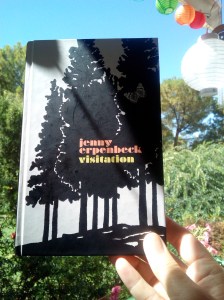
Visitation by Jenny Erpenbeck tr. Susan Bernofsky #WITMonth

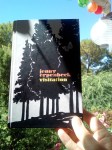
I’ve attempted to read Visitation about four times and never succeeded in getting past the first few chapters, but this year I persevered as I felt I hadn’t given it a fair chance.

Now that I’ve finished it, I realise I held unrealistic expectations when I first came across it. I bought my hardcover version in Daunt Books in Marylebone on a visit to London in 2010, I was aware of it after having read a review in the Guardian, this was in the early days when I was newly discovering works by writers in translation.

Jenny Erpenbeck was being hailed as “the rising star of the German literary scene” and her work described as “one of the most striking and original new voices in German writing.” I wanted to discover what that meant, to read it and feel it. Naive. I wasn’t yet able to discern in the little explored world of translations, which voices I would lean towards and appreciate, or to value my reading perceptions.

I began this book a few times and the striking and original wasn’t happening. I shouldn’t have read those blurbs, I should have read it without any expectation and then moved on to her next books, which have gone on to develop a wider audience, won prizes and further established her as that which that was predicted.

Visitation is a veiled narrative that shows a little of the lives of a few people who lived alongside a lake that was formed about thirteen thousand years, whose origins might be traced back to a glacier from twenty-four thousand years ago. Beginning the book with this geological origin reminds us of our insignificance and the inevitability of change and transformation.

“As the day is long and the world is old, many
people can stand in the same place, one after the other.”
– Marie in Woyzeck, by George Buchner

The first chapter is entitled ‘The Wealthy Farmer and his Four Daughters’ and tells of the local mayor, who comes from a long line of men, all who have been Mayor of the village, the chapter tells of many traditions, rituals and superstitions, of what is meant to be, to happen, to the point of extreme ridiculousness, as if thousands of years of rituals have piled up on top of one another, awaiting the seismic event that will topple them all. Because he has only procured girls, the inevitable is indeed waiting to happen, for there will be no new Mayor from his family and change is coming to Brandenburg. History as we know is about to impact this family and others, people are going to have to leave and strangers are going to arrive.

When they returned to Germany, it was a long time she and her husband could bring themselves to shake hands with people they didn’t know. They had felt a virtually physical revulsion when faced with all these people who had willingly remained behind.

In between the chapters with titles encompassing their time there, like ‘The Architect’, the Architect’s Wife’, ‘the Red Army Officer’, ‘the Subtenants’, ‘the Girl’, ‘the Writer’, ‘the Visitor’, ‘the Childhood Friend’, are the chapters of ‘The Gardener’, the one closest to nature, the one consistent thread that exists throughout all the others, as the others succumb to the effects of the era in history they embrace – pre-war(s) to post war Germany, is the man with no name, who looks after everything, but who is a cycle of nature himself, so that by the end, as his (in)ability changes, so too do others that come in have to either take up his responsibilities or allow things to fall into neglect.

Laced with melancholy, it offers snippets of lives of those who dwell(ed) near this lake, wood, village – the compromises, the passing of seasons, the building, destroying of things, relationships – why strangers are both spurned and revered and always The Gardener, the one who tends, who observes, who slowly wilts, forcing others to adapt.

While I appreciate what it attempts to do, I didn’t find the novel engaging, that melancholy combined with the veiled effect, of keeping the reader at a distance from the characters, of only seeing so much, instilled in it for me, a kind a quiet dread, a feeling drained of hope, as if there was no escape from a dire inevitability, no matter what it was. The psyche of the era it was set in perhaps; if so, it succeeds in creating an atmosphere of a country, its people and the spectre of its past.


The Days of Abandonment by Elena Ferrante (Italy) tr. Ann Goldstein #WITMonth

ItalyOn the day when the nation is shocked and grieving after a devastating earthquake, that has destroyed entire villages and resulted in a significant loss of life, I don’t know how appropriate it is to share their literature, perhaps in the case of this particular novel, it serves to put things in perspective.
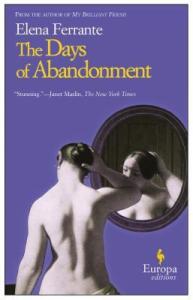
For while the protagonist of this novel may have felt her world was coming to an end, knowing how quickly and without warning life and home can be snatched away, might prompt us get over the more indulgent grievances of the heart.

Days of AbandonmentA national bestseller for almost an entire year, The Days of Abandonment shocked and captivated its Italian public when first published.

“One April afternoon, right after lunch, my husband announced that he wanted to leave me.”

Like an orchestrated composition that begins with a quiet, solo voice and rises to a crescendo with the addition of more instruments, Ferrante’s novel and its female character move from reasonable, melodic harmony to loud, discordant cacophony.

“I listened to him attentively, I contradicted him calmly, I didn’t ask him questions of any kind nor did I dictate ultimatums, I tried only to convince him that he could always count on me. But I have to admit that, behind that appearance, a wave of anguish and rage was growing that frightened me.”

Like the stages of grief, The Days of Abandonment charts the stages of decline following a lost love, beginning with the irony of a love more fierce than it was when it was present, then the deterioration, as the realisation and reality of life without it comes to pass for this mother of two children, cooped up in her apartment one hot August, with only the sad figure of a morose cellist living downstairs to observe her descent.

The abandoned woman acts terribly reasonably, only to deteriorate into desperate disillusionment. Like madness descending, the loss of love and the feeling of abandonment rages through the various emotions like a tempest, no person or animal immune to its violent, destructive force.

“The circle of an empty day is brutal and at night it tightens around your neck like a noose.”

It is shocking in how far the madness delves and astounding as it reaches a turning point and she is able slowly to perceive herself and the illusion of what she thought she had, for what it really was.

“It was really true, there was no longer anything about him that could interest me. He wasn’t even a fragment of the past, he was only a stain, like the print of a hand left years ago on a wall.”

Elena Ferrante observes the minutiae of human emotion and suffering, the obstinacy of a grasping, possessive love, the effect of our behaviour on those around us and the resilience of the human spirit.

Exhausting, terrifying, ferocious, we are both beast and beauty.

Elena Ferrante is the pseudonym of an Italian novelist, whose true identity remains a mystery, author of the four novels in the Neapolitan tetralogy My Brilliant Friend, The Story of a New Name, Those Who Leave and Those Who Stay and The Story of the Lost Child. The Days of Abandonment was the first of her novels to be translated into English by Europa Editions in 2005.

Buy The Days of Abandonment via Book Depository

WIT logo