
 Selected in 2010 as one of The Best of Young Spanish Language Novelists by Granta, Bolivian author Rodrigo Hasbún’s Affections is his second novel and will be published in ten languages. It was the winner of an English PEN Award 2016.
The novel is less a story and more a set of loosely connected vignettes from the lives and perspectives of the three daughters of Aurelia and Hans Ertl, a family who fled post-war Germany in the wake of their father’s position as a cameraman, (he had worked on several Nazi propaganda films), to live in exile in Bolivia.
One of his daughters Monika Ertl became involved with the survivors of Che Guevara’s guerrilla movement and was allegedly involved in the assassination of the Bolivian consul in Hamburg, a man said to have ordered the hands of Guevara be cut off and sent to La Paz.
Hasbún’s novel takes these threads and weaves a disparate narrative, that highlights different moments in the lives of all members of this family, whose life trajectory was dramatically altered by their geographic displacement.
No sooner have they arrived, than Hans, a climber, explorer, photographer, seeker of adventure announces he is quitting climbing and organising an expedition to find a lost Inca city named Paititi buried somewhere deep in the Amazon forest. Two of his daughters come with him, and for his eldest Monika, it becomes a first step towards a life of social activism, which will result in her involvement in revolutionary guerilla warfare.
With a father seeking adventure and a mother prone to melancholy, the girls find themselves in a place they can never truly call home, where they will always be viewed as outsiders and find it difficult to find solace even among their ex-pat community, which in a cruel twist of fate, view them similarly to the way they were regarded in post-war Germany, only now it seems futile to escape their fate.
“All that grind to end up back where I started,” he complained to me one day down the phone. He said he’d experienced something similar after the war, that they’d already made him feel like an outcast once before, that during that period they closed one door after another to him, but that this time he wouldn’t move an inch.
Also included in the narrative are what appear to be the responses to an interview or interrogation of one of Monika’s lovers Reinhard, who was her brother-in-law, probably in a follow-up to the assassination of the Bolivian consul.
//yes, she’s the only one who matters now, the misunderstood child, the chaotic, rebellious teenager, the woman who went on to lose all perspective and no longer knew where to stop and ended up hurting herself and others. //Yes, if you pressed me I would say this is the definition of her that sticks: the woman who went on to cause so much hurt.
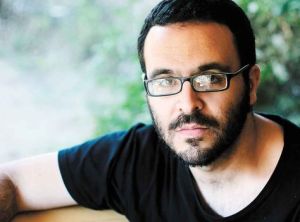
Bolivian Author, Rodrigo Hasbún
It is a fragmentary novel that depicts a family set adrift, unable to remain united nor to be held together by their adopted community, the daughters seek to carve out a life of their own, struggling in isolation.
The piecemeal structure of the novel with its alternating narrators is symbolic of that disconnect and isolation, exile may have heralded adventure and discovery, however the expedition to discover a lost city, became the catalyst to the disintegration of all that once kept them together.
It’s not true that memory is a safe place. In there too, things get distorted and lost. In there, too, we end up turning away from the people we love the most.
Note: Thank you to the publisher Pushkin Press for a copy of this haunting novella.
Further Reading
The City and the Writer: In Cochabamba with Rodrigo Hasbún – an interview by Nathalie Handal.
 Finding a book like this on the English language shelves of our local French library, is one of life’s small pleasures in a world that offers few escapes these days from tragic reality.
 The story is narrated in alternate chapters, one entitled Isaac, the other Helen. Isaac takes place during a short period in the life of the male protagonist after he has left the family village somewhere in Ethiopia, planning never to return, arriving in Kampala, a city in Uganda where he hopes to study at the university.
 It reminded me a little of Elizabeth Strout’s
 When I came to S&S, I told everyone here I wanted to publish books that deepen the cultural conversation and take readers to places they couldn’t otherwise go. – Jonathan Karp, Simon & Schuster
 population (1-2 million) died. The regime was finally overthrown by the Vietnamese military in January 1979.
 Terrible as it is and damaged as they are, it is those who survive and who are still able to maintain some belief in the human spirit and humanity that bring one of the few gifts that such terror evokes. It is a price no person would ever wish to pay.
 I picked up Justin Wintle’s book ‘Perfect Hostage’ Aung San Suu Kyi, Burma and the Generals, believing it a biography, mislead perhaps by the striking portrait which graces the cover and select testimonials describing it as so. In fact, I would call it a historic treatise of Burma and while of significant interest in itself, I did find it frustrating that it took close to 200 pages to encounter Aung San Suu Kyi within its covers. Though there is depth in the historical account, I found the reverse to be true in terms of the author’s evocation of Aung San Suu Kyi, in fact I found many of his comments patronising and uncomfortable:
 However, letting go of the expectation of an exquisite biography and seen as the historical treatise that it is, I find a thorough and detailed account of a remarkable country and ethnic melting pot of people who have long been subject to tyrannical rule. Sitting between India in the west and China in the east with borders that touch so many countries, Tibet, Laos, Thailand, Bangladesh, it is not surprising that it comprises so many ethnic groupings and hill tribes and has encountered so much conflict. It has a unique history of rising to great prominence and descending into chaos, as each successive victor sought to impose their will.
 Isabel Allende.
 bookish path, just as ‘Island Beneath the Sea’ did recently, spotted on my book buddy’s shelf while feeding her son’s cat Oscar.


 A ‘lucuna’ is a space or a void, a deep underwater cave, something hidden, unknown; already we see its metaphorical potential and Barbara Kingsolver puts it to good use in this excellent novel which intertwines the fictional story of 12 year old Shepherd, through historical events of Mexico and the US in the 1930’s and 40’s, including time spent in the household of Diego Rivera and Frida Kahlo and their controversial houseguest Leon Trotsky.
 Word by Word