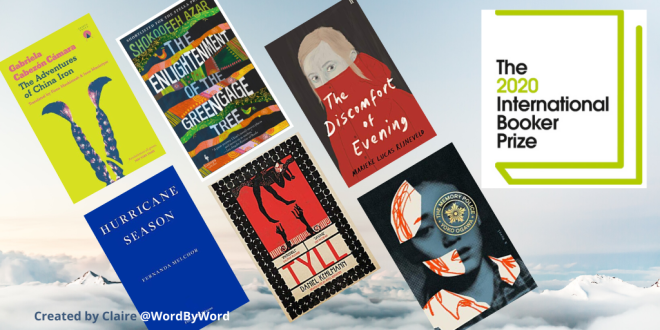
International Booker Prize Shortlist 2020

Today something different as the shortlist has been announced for the Booker International Prize 2020. If you missed the long list click on the link, containing summaries of the original 13 books, as it’s often from the long list that we find the gems! Long List of International Booker Prize 2020

All these books have been translated into English from another language and culture. The judges have gathered and continued their discussion from their respective homes in Lyon, Bangalore, New York, Los Angeles, London and Scotland.

The shortlist features titles translated from five languages: Spanish, German, Dutch, Farsi and Japanese. The shortlisted authors represent six countries and their books examine humanity’s need to understand the world through narrative, either through sharing our own stories, through understanding our histories and origins, or through processing trauma and grief.

Three of the novels, The Enlightenment of the Greengage Tree by Shokoofeh Azar (Iran), The Adventures of China Iron by Gabriela Cabezón Cámara (Argentina) and Tyll by Daniel Kehlmann (Germany) were inspired by their nations’ histories – namely the 1979 Islamic Revolution in Iran, gaucho culture in 1870s Argentina, and the Thirty Years’ War in Germany.

Each of these books borrows existing myths, legends and origin stories but reinterprets these tales with modern sensibilities, celebrating the pursuit of intellectual freedom, the exploration of sexual identity, and survival in the face of political unrest and sweeping illness.

The other three shortlisted titles, Hurricane Season by Fernanda Melchor (Mexico), The Memory Police by Yoko Ogawa (Japan) and The Discomfort of Evening by Marieke Lucas Rijneveld (The Netherlands) all touch on how trauma, whether through violent acts or emotional loss, shape our experiences and approach to the world.

Here is what each of the judges said today in their collective announcement:

We were looking for novels that had a really clear and potent voice. That haunted us and stayed with us. We were looking for novels that were incredibly well translated. Ted Hodgkinson, Head of Literature & Spoken Word, Southbank Centre, Chair of Judges

I think it’s a brave shortlist. We’ve picked books that are daring,  experimental, not at all conventional. This moment that we are living, it has forced each of us to slow down and think about the things we usually take for granted. Valeria Luiselli, Award Winning Author

This shortlist is electric and resonant and absolutely meaningful. It’s a list that each one of us is proud of. Jeet Thayil, Author, Poet & Musician

It was so hard to narrow it down from such an incredibly wonderful long list. Each of them is so expertly crafted and so beautiful.  Jennifer Croft, Translator & Winner of International Booker 2018

It will be just as exciting, just as challenging to narrow this down to the one winner. And I feel that collectively we all believe that each book on this shortlist of six could potentially be a winner. Lucie Campos, Translator, Cultural Director of La Villa Gilet

I had already read two of the titles before the long list was announced, The Memory Police and The Enlightenment of the Greengage Tree. Both are excellent reads and very thought provoking. I’m really happy to see that they’ve both made it through to this stage, which means more people are likely to read them.

I have The Adventures of China Iron on my shelf to read, a result of my Year of Reading Contemporary Latin American Fiction and subsequent subscription to Charco Press, so I might make that my next read, since its piqued my interest further. It’s about a 19th-century woman who flees a gaucho encampment and takes off with a friend on a journey across the countryside. The book, told in verse, is a parody of one of Argentina’s most important historical texts.

Have you read any of these titles on the shortlist?

Celestial Bodies by Jokha Alharthi tr. Marilyn Booth

Celestial Bodies won the 2019 International Booker Prize, a literary prize open to newly translated works of fiction into English.

Jokha Alharthi is from Oman and her novel was originally written in Arabic. She is the first female Omani novelist to be translated into English and the first author from the Arabian Gulf to win the prize. The judges had this to say:

“It’s less flamboyant than some of the other books, there’s a kind of poetic cunning to it. It starts feeling like a domestic drama in a fascinating world, but with the layers of philosophy, psychology and poetry, you are drawn into the prose, through the relationship between the characters. It encouraged us to read in a slightly different way.”

It is a read that requires just letting go and going with the flow, allowing the characters to lead us wherever it is the author is taking us. I say that because it is a non-linear narrative, that moves its narrative perspective often from one character to another and also across time seemingly randomly, as events trigger memories and take the story back to their origin.

There is a family tree in the opening pages, which I did refer back to often, though perhaps it wasn’t really necessary, sometimes just knowing it is there is an excuse to refer to it, but it’s not really necessary for a story that follows no chronological order, that moves from the present to the past and back generations according to the feelings, thoughts and behaviours of its characters.

Abdullah’s thoughts occupy us more than most, and they often refer him back to a childhood memory, that turns into a recurring adult nightmare of being suspended by ropes in a well, a punishment for taking his father’s rifle to shoot magpies with the boys who lured him out to join them. Only they beat him.

He is married to Mayya, who he loves, since the first day he saw her – and because he was a man, he could have her as his wife. The feelings aren’t reciprocated and love doesn’t flourish there. Unbeknown to him there is another ‘celestial body’ orbiting in his universe that intends to reel him in.

For me, this felt like a novel that centred around the lives of those connected with ‘The Big House’ whether they were descendants of the one who built it, to contain his family, slaves, to be place friends could visit. For some it is a sort of prison, not necessarily the slaves, for they have certain freedoms not given to those who are part of the family, especially those who have no memory of being stolen.

It is useless, Zarifa, to try telling this man that no one stole you. That you were born a slave because your mother was a slave and that’s the way life is. That slavery passes to you from your mother. That no one stole you, and al-Awafi is your place, its people are yours.

Her husband remembers and shouts when she says such things.

The second child of his mother who had five boys in all, he remembers everything: the local gangs that attacked their village wanting money, or perhaps to pay old scores; the merchants, a jumble of Baluchs and Arabs, who bought them, there on the plains, the filthy crammed ships those merchants crammed them into; the eye disease that spread fast from one child to the next on shipboard; his mother’s screaming for her other children, who’d been shoved onto other boats; the nursing baby who died of smallpox while on her breast, so the slave traders snatched him away and threw him into the sea.

Her son also sees things differently:

He spoke through clenched teeth. Listen to me. Merchant Sulayman raised me and, yes, he put through me through a little schooling, and he found me a wife, but it was all for his own self-interest, all because he meant me to serve him, and to have my wife as his servant too, and then my children later on.

Even those who leave, (to Cairo), when tragedy strikes, in their upset they return to this small town of The Big House, forever connected to those who reside there.

At certain points in their domestic history, there are things that are changing in the external and international world, like the abolition of slavery, though those affected by it here, seem immune to the changes, their lives don’t change, they are not even aware of their rights. Change here happens slowly, in the rebelliousness of each new generation, challenging what came before in some way.

Time changes them, multiple generations must live together in understanding and be misunderstood. Some things are never understood and leave some always seeking the truth, to the point of obsession.

Do you see the way people move life – and I mean, just the bits of their lives you can see? Most of their movement through life is invisible, it goes on inside of them, so for us it exists beneath the surface. Their own private worlds, their imaginations. When I liberated myself from living through my father’s head I created my own imagination with a paintbrush.
.
My art saved me from acting out the image my father had made for me.
.
When I could finally shake myself loose, when I managed to no longer live inside the image of me he had in his head, I finally found out what freedom tastes like….How liberated a person feels when it’s finally no longer a question of being just an extension or embodiment of someone else’s fancy, even if that someone is your father.

It doesn’t follow a conventional plot and just as in life, the voices of the household come through chapters almost haphazardly, just as thoughts do, and yet over the span of 240 pages we have a sense of this extended family and community of the pressure of time moving on, of lives changing and challenging old perceptions.

As I look back at the book, I see so many passages highlighted and randomly opening to any of them I immediately see what it was that attracted me and understand why this book elevated itself above the rest, to win the Man Booker International Prize in 2019. There is a richness to it, a complete immersion, a gathering of influences, duty alongside rebelliousness, tradition nestled with change, love and loss, history and modernity.

International Booker Long List 2020

The International Booker Prize long list was announced today Feb 27. Thirteen novels of translated fiction from 8 languages, 11 countries, six male authors and seven women. The judges this year were looking for distinctive voices that stayed with them, fiction that once you’d read it, you couldn’t stop thinking about.

The prize is awarded every year for a single book that is translated into English and published in the UK or Ireland. It aims to encourage more publishing and reading of quality fiction from all over the world and to promote the work of translators.  The contribution of both author and translator is given equal recognition, with the £50,000 prize split between them.

Ted Hodgkinson, Chair of Judges said:

‘What a thrill to share a longlist of such breadth and brilliance, reflecting a cumulative artistry rooted in dialogue between authors and translators, and possessing a power to enlarge the scope of lives encountered on the page, from the epic to the everyday. Whether reimagining foundational myths, envisioning dystopias of disquieting potency, or simply setting the world ablaze with the precision of their perceptions, these are books that left indelible impressions on us as judges. In times that increasingly ask us to take sides, these works of art transcend moral certainties and narrowing identities, restoring a sense of the wonderment at the expansive and ambiguous lot of humanity.’

Below are the novels on the list with a short summary of their premise. Surprisingly, I have read and reviewed two (reviews linked below) and they are indeed thought provoking novels, and I have The Adventures of China Iron on my shelf to read. The shortlist will be announced on April 2nd.

The Enlightenment of The Greengage Tree by Shokoofeh Azar (Iran) Translated by Anonymous from Farsi

Set in Iran in the decade following the 1979 Islamic Revolution, this moving, richly imagined novel is narrated by the ghost of Bahar, a 13-year-old girl whose family is compelled to flee their home in Tehran for a new life in a small village, hoping in this way to preserve both their intellectual freedom and their lives. They soon find themselves caught up in the post-revolutionary chaos that sweeps across the country, a madness that affects both living and dead, old and young.
The Enlightenment of the Greengage Tree speaks of the power of imagination when confronted with cruelty, and of our human need to make sense of the world through the ritual of storytelling. Through her unforgettable characters and glittering magical realist style, Azar weaves a timely and timeless story that juxtaposes the beauty of an ancient, vibrant culture with the brutality of an oppressive political regime.
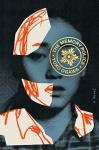
The Memory Police  by Yoko Ogowa (Japan) Translated by Stephen Snyder from Japanese

Hat, ribbon, bird, rose. To the people on the island, a disappeared thing no longer has any meaning. It can be burned in the garden, thrown in the river or handed over to the Memory Police. Soon enough, the island forgets it ever existed. When a young novelist discovers that her editor is in danger of being taken away by the Memory Police, she desperately wants to save him. For some reason, he doesn’t forget, and it becomes increasingly difficult for him to hide his memories. Who knows what will vanish next?
The Memory Police is a beautiful, haunting and provocative fable about the power of memory and the trauma of loss, from one of Japan’s greatest writers.

The Adventures of China Iron by Gabriela Cabezón Cámara (Argentina)Translated by Iona Macintyre & Fiona Mackintosh from Spanish

1872. The pampas of Argentina. China is a young woman eking out an existence in a remote gaucho encampment. After her no-good husband is conscripted into the army, China bolts
for freedom, setting off on a wagon journey through the pampas in the company of her new-found friend Liz, a settler from Scotland. While Liz provides China with a sentimental education and schools her in the nefarious ways of the British Empire, their eyes are opened to the wonders of Argentina’s richly diverse flora and fauna, cultures and languages, as well as to the ruthless violence involved in nation-building.
This subversive retelling of Argentina’s foundational gaucho epic, Martín Fierro, is a celebration of the colour and movement of the living world, the open road, love and sex, and the dream of lasting freedom. With humour and sophistication, Gabriela Cabezón Cámara has created a joyful, hallucinatory novel that is also an incisive critique of national origin myths and of the casualties of ruthless progress.
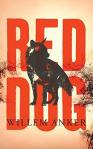
Red Dog by Willem Anker (South Africa) Translated by Michiel Heyns from Afrikaans

In the 18th century, a giant bestrides the border of the Cape Colony frontier. Coenraad de Buys is a legend, a polygamist, a swindler and a big talker; a rebel who fights with Xhosa chieftains against the Boers and British; the fierce patriarch of a sprawling mixed-race family with a veritable tribe of followers; a savage enemy and a loyal ally. Like the wild dogs who are always at his heels, he roams the shifting landscape of southern Africa, hungry and spoiling for a fight.
Red Dog is a brilliant, fiercely powerful novel – a wild, epic tale of Africa in a time before boundaries between cultures and peoples were fixed.

The Other Name: Septology I – II byJon Fosse (Norway) Translated by Damion Searls from Norwegian

Follows the lives of two men living close to each other on the west coast of Norway. The year is coming to a close and Asle, an ageing painter and widower, is reminiscing about his life. He lives alone, his only friends being his neighbour, Åsleik, a bachelor and traditional Norwegian fisherman-farmer, and Beyer, a gallerist who lives in Bjørgvin, a couple hours’ drive south of Dylgja, where he lives. There, in Bjørgvin, is another Asle, also a painter. He and the narrator are doppelgangers – two versions of the same person, two versions of the same life. Written in hypnotic prose that shifts between the first and third person, The Other Name calls into question concrete notions around subjectivity and the self. What makes us who we are? And why do we lead one life and not another? With The Other Name, the first volume in a trilogy of novels, Fosse presents us with an indelible and poignant exploration of the human condition that will endure as his masterpiece.
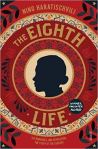
The Eighth Life by Nino Haratischvili (Georgia) Translated by Charlotte Collins and Ruth Martin from German

At the start of the 20th century, on the edge of the Russian empire, a family prospers. It owes its success to a delicious chocolate recipe, passed down the generations with great solemnity and caution. A caution which is justified: this is a recipe for ecstasy that carries a very bitter aftertaste…
Stasia learns it from her Georgian father and takes it north, following her new husband Simon to his posting at the centre of the Russian Revolution in St Petersburg. But Stasia’s will be the first of a symphony of grand, if all too often doomed, romances that swirl from sweet to sour in this epic tale of the red century.
Tumbling down the years, and across vast expanses of longing and loss, generation after generation of this compelling family hears echoes and sees reflections. Great characters and greater relationships come and go and come again; the world shakes, and shakes some more, and the reader rejoices to have found at last one of those glorious old books in which you can live and learn, be lost and found, and make indelible new friends.

Serotonin by Michel Houellebecq (France) Translated by Shaun Whiteside from French

Dissatisfied and discontented, Florent-Claude Labrouste feels he is dying of sadness. His young girlfriend hates him and his career as an engineer at the Ministry of Agriculture is pretty much over. His only relief comes in the form of a pill – white, oval, small. Recently released for public consumption, Captorix is a new brand of anti-depressant which works by altering the brain’s release of serotonin.
Armed with this new drug, Labrouste decides to abandon his life in Paris and return to the Normandy countryside where he used to work promoting regional cheeses, and where he had once been in love. But instead of happiness, he finds a rural community devastated by globalisation and European agricultural policies, and local farmers longing, like Labrouste himself, for an impossible return to what they remember as the golden age.

Tyll by Daniel Kehlmann (Austria-Germany) Translated by Ross Benjamin from German

He’s a trickster, a player, a jester. His handshake’s like a pact with the devil, his smile like a crack in the clouds; he’s watching you now and he’s gone when you turn. Tyll Ulenspiegel is here!
In a village like every other village in Germany, a scrawny boy balances on a rope between two trees. He’s practising. He practises by the mill, by the blacksmiths; he practises in the forest at night, where the Cold Woman whispers and goblins roam. When he comes out, he will never be the same. Tyll will escape the ordinary villages. In the mines he will defy death. On the battlefield he will run faster than cannonballs. In the courts he will trick the heads of state. As a travelling entertainer, his journey will take him across the land and into the heart of a never-ending war. A prince’s doomed acceptance of the Bohemian throne has European armies lurching brutally for dominion and now the Winter King casts a sunless pall. Between the quests of fat counts, witch-hunters and scheming queens, Tyll dances his mocking fugue; exposing the folly of kings and the wisdom of fools.
With macabre humour and moving humanity, Daniel Kehlmann lifts this legend from medieval German folklore and enters him on the stage of the Thirty Years’ War. When citizens become the playthings of politics and puppetry, Tyll, in his demonic grace and his thirst for freedom, is the very spirit of rebellion – a cork in water, a laugh in the dark, a hero for all time.

Hurricane Season by Fernanda Melchor (Mexico) Translated by Sophie Hughes from Spanish

Hurricane Season opens with the macabre discovery of a decomposing body in a small waterway on the outskirts of La Matosa, a village in rural Mexico. It soon becomes apparent that the body is that of the local witch, who is both feared by the men and relied upon by the women, helping them with love charms and illegal abortions.
Mirroring the structure of Gabriel García Márquez’s Chronicle of a Death Foretold, the novel goes back in time, recounting the events which led to La Matosa’s witch’s murder from several perspectives. Hurricane Season quickly transcends its detective story constraints: the culprits are named early on in the narrative, shifting the question to why rather than who. Through the stories of Luismi, Norma, Brando and Munra, Fernanda Melchor paints a portrait of lives governed by poverty and violence, machismo and misogyny, superstition and prejudice. Written with a brutal lyricism that is as affecting as it is enthralling, Hurricane Season, Melchor’s first novel to appear in English, is a formidable portrait of Mexico and its demons.

Faces on the Tip of My Tongue by Emmanuelle Pagano (France) Translated by Sophie Lewis & Jennifer Higgins from French

Meetings, partings, loves and losses in rural France are dissected with compassion.
The late wedding guest isn’t your cousin but a drunken chancer. The driver who gives you a lift isn’t going anywhere but off the road. Snow settles on your car in summer and the sequins found between the pages of a borrowed novel will make your fortune. Pagano’s stories weave together the mad, the mysterious and the dispossessed of a rural French community with honesty and humour. A superb, cumulative collection from a unique French voice.

Little Eyes by Samanta Schweblin (Argentina) Translated by Megan McDowell from Spanish

They’ve infiltrated homes in Hong Kong, shops in Vancouver, the streets of Sierra Leone, town squares of Oaxaca, schools in Tel Aviv, bedrooms in Indiana.
They’re not pets, nor ghosts, nor robots. They’re real people, but how can a person living in Berlin walk freely through the living room of someone in Sydney? How can someone in Bangkok have breakfast with your children in Buenos Aires, without you knowing? Especially when these people are completely anonymous, unknown, untraceable.
The characters in Samanta Schweblin’s wildly imaginative new novel, Little Eyes, reveal the beauty of connection between far-flung souls – but they also expose the ugly truth of our increasingly linked world. Trusting strangers can lead to unexpected love, playful encounters and marvellous adventures, but what if it can also pave the way for unimaginable terror? Schweblin has created a dark and complex world that is both familiar but also strangely unsettling, because it’s our present and we’re living it – we just don’t know it yet.
The Discomfort of Evening by Marieke Lucas Rijneveld (The Netherlands) Translated by Michele Hutchison from Dutch

Jas lives with her devout farming family in the rural Netherlands. One winter’s day, her older brother joins an ice skating trip. Resentful at being left alone, she makes a perverse plea to God; he never returns. As grief overwhelms the farm, Jas succumbs to a vortex of increasingly disturbing fantasies, watching her family disintegrate into a darkness that threatens to derail them all.
A bestselling sensation in the Netherlands by a prize-winning young poet, Marieke Lucas Rijneveld’s debut novel lays everything bare. It is a world of language unlike any other, which Michele Hutchison’s striking translation captures in all its wild, violent beauty.

Mac and His Problem by Enrique Vila-Matas (Spain) Translated by Margaret Jull Costa & Sophie Hughes from Spanish

Mac is not writing a novel. He is writing a diary, which no one will ever read. At over 60, and recently unemployed, Mac is a beginner, a novice, an apprentice – delighted by the themes of repetition and falsification, and humbly armed with an encyclopaedic knowledge of literature.
Mac’s wife, Carmen, thinks he is simply wasting his time and in danger of sliding further into depression and idleness. But Mac persists, diligently recording his daily walks through the neighbourhood. It is the hottest summer Barcelona has seen in over a century.
Soon, despite his best intentions (not to write a novel), Mac begins to notice that life is exhibiting strange literary overtones and imitating fragments of plot. As he sizzles in the heatwave, he becomes ever more immersed in literature – a literature haunted by death, but alive with the sheer pleasure of writing.

 

The Memory Police by Yoko Ogawa tr. Stephen Snyder

From an extraordinary writer and storyteller who defies categorisation, another tale that stretches and flexes the readers imagination, hauntingly written, leaving me to wonder just how she does it, a thought I had after reading her novel, or story collection Revenge in 2013.

The Memory Police are an oppressive, bureaucratic menace slowly making things on the island disappear along with all memories of them in the minds of inhabitants. And they enforce forgetfulness. Checking up on people to be sure memory has been erased, because though for most the memories disappear without effort, in some they linger. Those whose memory somehow stays intact live in danger, they begin to disappear, go in to hiding or are forcefully removed.

Our unnamed narrator has lost both her parents, taken by the police and no longer heard of; though her mother tried to preserve and hide some of the things that disappeared through her art. The daughter is a novelist, as long as words, imagination and voice exist she continues to write. She accepts her fate and continues to adapt to each disappearance with the help of an old man she is close to and the company of the neighbour’s dog, when its owners are removed.

Her editor R goes into hiding due to his ability to remember and tries to instill in her the importance and value of memories, while sometimes a memory returns, for her, it no longer has emotional significance or meaning. She possesses empathy but is void of nostalgia, without the objects the memories disappear and even when one reappears, it no longer evokes any emotion or feeling.

Gathering photographs (when they become the next thing to disappear) and albums to burn, R makes a desperate effort to stop her:

“Photographs are precious. If you burn them, there’s no getting them back. You mustn’t do this. Absolutely not.”
“But what can I do? The time has come for them to disappear,” I told him.
“They may be nothing more than scraps of paper, but they capture something profound. Light and wind and air, the tenderness or joy of the photographer, the bashfulness or pleasure of the subject. You have to guard these things forever in your heart. That’s why photographs are taken in the first place.”

It’s a dystopian novel that focuses more on the survival of the citizens than on exploring the tyranny that oppresses them, the Memory Police don’t seem to be afflicted with “forgetting” and we don’t understand what motivates them. Is it an allegory of collective degeneration, or an attempt to make the reader understand something that is universal among the aged? Suffering seems to rest with those to retain memory, those who forget adapt, and forget that they have forgotten.

There doesn’t seem to be any purpose, merely an exploration of those aspects of humanity of the oppressed to survive and care for one another, whether that means putting one’s life at risk to hide someone who does retain memories, to seek out old memories at the risk of being caught, caring for an old man and a dog.

Some things are innate to humanity and no matter what afflicts us, we are endlessly adaptable, continuing to find ways to work around and/or accept obstacles, here presented in a somewhat absurd manner, highlighting our inability to fight against adaptability. We have no choice but to adapt, it’s written into our genes, and this regime has somehow managed to find a way to control and rewrite them.

Alongside what is happening on the island’s (sur)real world, our protagonist writes a novel about a woman taking typing lessons from a man who will put her in a tower, these chapters are interspersed throughout the narrative and provide an alternative, thought-provoking aspect to the wider story.

When novels disappear and hers remains unfinished despite numerous attempts to write at the request of R, and a loss of inspiration, the old man asks her if it’s possible to write about something in a novel if you’ve never experienced it.

“I suppose it is. Even if you haven’t seen or heard about something, it seems you can just imagine it and then write it down? It doesn’t have to be exactly like the real thing; it’s apparently all right to make things up or even lie.”

“That’s right. Apparently no one blames you for lying in a novel. You can make up the story out of nothing, starting from zero. You write about something you can’t see as though you can see it. You make something that doesn’t exist just by using words. That’s why R says we shouldn’t give up, even if our memories disappear.”

Each disappearance activates the reader’s imagination and the novel provokes many questions that make this an interesting one to discuss.

It’s a novel that stayed with me long after reading, wondering what it was getting at; just as you think you’ve found some deeper meaner, it kind of gets erased, there are no easy conclusions…it’s like the advent of short term memory loss, a literary version of mild cognitive impairment, an affliction all humans post middle age experience and one this novel makes you experience what that might be like in reading. Astonishing.

Further Reading

The Guardian: The Memory Police by Yōko Ogawa review – profound allegory of loss by Madeleine Thien

NY Times Article: How “The Memory Police” makes you See  by Jia Tolentino

Thanks to an email from Peirene Press this morning sharing news of the long list nomination of their novella Faces On the Tip of My Tongue by the French author Emmanuelle Pagano, I see that both The Memory Police and The Enlightenment of the Greengage Tree by Shokoofeh Azar have also been nominated for the International Booker 2020.

The Enlightenment of the Greengage Tree by Shokoofeh Azar

In yesterday’s post I mentioned I had just finished reading this book, a wonderful, if challenging work of translated fiction by the Iranian author Shokoofeh Azar, who lives in exile in Australia. This novel was shortlisted for the Stella Prize in 2018 (a literary award that celebrates Australian women’s writing and an organisation promoting cultural change).
I was very quickly pulled into this book and for the most part seamlessly travelled between the realistic part of the story and parts where the author shifted into the character’s imagination.

Azar uses the lyrical magic realism style of classical Persian storytelling to tell the story of a family of five in the period immediately after the 1979 Islamic revolution and the story is narrated by the spirit of the 13 year old daughter. When fire takes their daughter and much that have till then valued, the family flees Tehran in search of a place as far away as possible from conflict and interference, making their home on a hill above the sleepy village of Razan.

One day Beeta tells Bahar: ‘When life is so deficient and mundane, why shouldn’t imagination supplement reality to liven it up?’

The story shifts between the quiet lulls where it appears they have realised such a utopia and flights of the imagination, where we are temporarily protected from exposure to the harshness and brutality of reality, just as this family attempts to do to preserve their way of life and life itself.

Azar says she wrote the story, in an attempt to answer this question:

Can we survive without passion and hope in a religious dictatorial system?

By letting go of the need to have all of the story narrated in the realistic voice, we hang loosely onto the storyline and then detach, like a kite being given more length of string, flying high above, sometimes so high we no longer recognise where we are, before being pulled back to ground.

I managed to stay with the narrative until Beeta’s metamorphosis around page 178, where I felt my mind spinning, trying to stay with it, wondering what was happening. I almost felt defeated, and then arrived that wonderful moment of clarification, when without giving anything away, the father is forced by the dictatorship to write a statement, and as readers we are given insight into the reality we have been protected from and how the imagination has carried us through it. And though we might question what was real and what wasn’t, it no longer matters, because we have been made to understand why.  As if the universe is making a point here, this realisation ironically appears on page 222.

Dad wrote everything again. This time he cut out all the parts he had realized were incomprehensible to their stale minds, and embellished here and there to make it thoroughly believable.

This made me very curious to understand more about the Persian style of storytelling, whether this was the author’s imagination or something that was inherent in the culture she came from. And this is one of the reasons I love reading translated fiction, because of the gift of this kind of insight into another culture’s storytelling and way of thinking, how they cope with the often harsh reality of life.

Asked in an interview with the LARB (LA Review of Books) about her use of magical realism, Azar said:

Magical realism comes from an old or ancient deep-seated insight. It is more than a literary style that you can learn at university or from the books. I did not learn it only by reading magic realism modern fictions, but I also learned from mythic texts, Persian classic texts, and my own people’s culture. People of old or ancient cultures sometimes seek the metaphysical solution for realistic problems. And it has nothing to do with superstition or religion. If you learn to look at these beliefs in the right way and deeply, you can find the roots of myths, and important and beautiful meanings in these beliefs.

I highlighted many passages, too numerous to include, but leave you with this one:

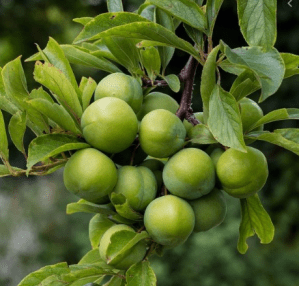
Persian Greengage Plum Tree

I looked at the eyes of the ghosts sitting around the fire and at Beeta, and suddenly I realized that we dead are the sorrowful part of life, while the living are the joyful side of death. And yet, Beeta was not joyful and it was the sad side of life that she didn’t even know she should be joyful in life because there was nothing else she could do. I wanted to tell her this, but was afraid of bringing her damaged spirit down even further. Fortunately, she herself eventually spoke and said, “It seems that from among you, I am the more fortunate because nobody killed me. But I don’t feel happy at all.”

She looked at we who had died. The dead who had been the first to meet her in the world of the living outside Razan. An old man in the group responded, “This is because you don’t yet realize how beautiful, young, and healthy you are.” Beeta smiled and her cheeks reddened by the light of the fire in silent emotion; and all of us who were dead saw how good the smile looked on her. But as she recalled dark memories, her smile faded and she said, “But the man who loved me simply turned his back on me and married a young girl.” The middle-aged man said, “All the better! It means you were lovable enough but he wasn’t smart enough to realize it.”

This is one of those books that demands perseverance, for which we are warmly rewarded when we do so. I am pleased to read that she is at work on a second novel in a similar style asking the question:

Can true love exist in a religious dictatorship in which the body and love are censored? When you are not allowed to love your body and mind, can you truly be in love with another’s body and mind?

Further Reading:

Deep Into the Heart: An Interview With Shokoofeh Azar by Robert Wood, LARB

The Stella Interview: where she discusses the experiences that informed the novel, the writers that inspire her work and how writing is a means of resistance

Thank you to Daniela at Europa Editions for sending me a review copy.

Top 10 Books by Women In Translation #100BestWIT

Meytal Radzinski, the founder of #WITMonth, an initiative to encourage people to read more books by women that have been translated from another language, therefore promoting diversity, has asked readers to share their top 10 ten books by women writers in translation.

I initially shared mine in a thread on twitter, but since not everyone uses twitter, I thought I’d share my ten reads here as well before #WITMonth starts (August 1st) and if I can manage it, I may even share a picture of the pile of books from which I hope to read during August.

So here are my top 10 reads of books by women in translation, with links to my reviews, not in any particular order, although I have to say the first probably is my absolute favourite.

My Top 10 Books by Women in Translation

1. The Bridge of Beyond by Simone Schwartz-Bart (Guadeloupe) tr.Barbara Bray (French)

– the life of Telumee, the last in a line of proud Lougandor women on the French Antillean island of Guadeloupe. My Outstanding Read of 2016.

“a fluid, unveiling of a life, and a way of life, lived somewhere between a past that is not forgotten, that time of slavery lamented in the songs and felt in the bones, and a present that is a struggle and a joy to live, alongside nature, the landscape, the community and their traditions”

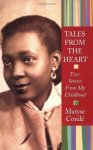
2. Tales From The Heart, True Stories From My Childhood by Maryse Condé (Guadeloupe)tr. Richard Philcox (French)

– essays of her early years in Guadeloupe, her education, and growing awareness of her ignorance of literature from the Caribbean & her own family history, when she moves to further her studies in Paris.

The ideal introduction to her many wondrous novels, including her masterpiece, the historical novel Segu and the novel of her grandmother’s life Victoire, My Mother’s Mother.

3. Zuleikha by Guzel Yakhina (Russia) tr. Lisa Hayden (Russian)

– an historical novel inspired by the author’s grandmother’s memories of exile in a Russian gulag (labour camp), published in English 100 years since the gulags first began in Russia.

The novel  follows the story of a young woman for whom exile is a kind of emancipation, freed from the tyranny of marriage, she finds a new role and skills despite the hardship, and experiences genuine love for the first time.

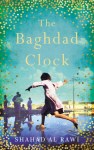
4. The Baghdad Clock by Shahad Al Rawi (Iraq) tr. Luke Leafgren (Arabic)

– Slightly surreal, nostalgic, deeply philosophic portrayal of a neighbourhood in Baghdad, of childhood and early youth lived in the shadow of war.

We are the last teardrop aboard the ship, the last smile, the last sigh, the mast footstep on its ageing pavement. We are the last people to line their eyes with its dust. We are the ones who will tell its full story. We will tell it to neighbours’ children born in foreign countries, to their grandchildren not yet born – we, the witnesses of everything that happened.

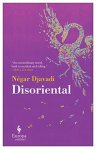
5. Disoriental by Negar Djavadi (Iran) tr. Tina Kover (French)

– the story of a family forced to flee Iran, a family history, a modern young woman now living in France, sits in a fertility clinic but something about her situation isn’t as it should be, she reflects on the past, while waiting to control the outcome of her present, a clash of the old and the new.

“That’s the tragedy of exile. Things, as well as people, still exist, but you have to pretend to think of them as dead.”

6. So Long A Letter by Mariama Bâ (Senegal) tr. Modupé Bodé Thomas (French)

– an epistolary novella, a letter from a widow to her best friend, reflecting on the emotional fallout of her husband’s death, unable to detach from memories of better times, a lament.

I am not indifferent to the irreversible currents of the women’s liberation that are lashing the world. This commotion that is shaking up every aspect of our lives reveals and illustrates our abilities.
My heart rejoices every time a woman emerges from the shadows. I know that the field of our gains is unstable, the retention of conquests difficult: social constraints are ever-present, and male egoism resists.
Instruments for some, baits for others, respected or despised, often muzzled, all women have almost the same fate, which religions or unjust legislation have sealed.

7. The Complete Claudine by Colette (France) tr. Antonia White (French)

– Claudine at school, in Paris, in Marriage and with her friend Annie, the unfettered, exuberant joys of teenage freedom vs the the slap in the face of an approaching adult, urban world.

“a novel that anticipates by ninety years, the contemporary fashion for wry, first-person narratives by single, thirty something career women. Its heroine examines her addictions to men with amused detachment, and flirts, alternately, with abstinence and temptation. Is there love without complete submission and loss of identity? Is freedom really worth the loneliness that pays for it? These are Colette’s abiding questions.”

8. Woman at Point Zero by Nawal El Saadawi (Egypt) tr. Sherif Hetata (Arabic)

– an Egyptian woman is imprisoned for killing a man, soon to be executed. Nawal El Saadawi gains permission to interview before her death. A spell-binding tale of lifelong oppression & desire to be free of it, told with compassionate sensitivity.

The idea of ‘prison’ had always exercised a special attraction for me. I often wondered what prison life was like, especially for women. Perhaps this was because I lived in a country where many prominent intellectuals around me had spent various periods of time in prison for ‘political offences’. My husband had been imprisoned for thirteen years as a ‘political detainee’.

9. Human Acts by Han Kang (South Korea) tr. Deborah Smith (Korean)

– the Gwangju massacre in South Korea in 1980 witnessed from multiple perspectives, an attempt at understanding humanity.

At night, though, when all the grown-ups were all sitting in the kitchen and I knew I’d be safe…I crept into the main room in search of that book. I scanned every spine until finally I got to the top shelf; I still remember the moment when my gaze fell upon the mutilated face of a young woman, her features slashed through with a bayonet. Soundlessly, and without fuss, some tender thing deep inside me broke. Something that, until then, I hadn’t even realised was there.

10. The Wall by Marlen Haushofer (Austria) tr. Shaun Whiteside (German)

– living behind an invisible wall, alone, with a few animals, a stream of consciousness narrative of one woman’s courageous survival, using the feminine instinct .

The Wall is a muted critique of consumerism and a delicate poem in praise of nature, a challenge to violence and patriarchy, an encomium to peace and life-giving femininity, a meditation on time, an observation on the differences and similarities between animals and humans, and a timeless minor masterpiece.

If you have a top 5 or 10 to share, or even just one favourite, share it on twitter or instagram using the hashtag below:

Booker Prize Longlist 2019 Announced

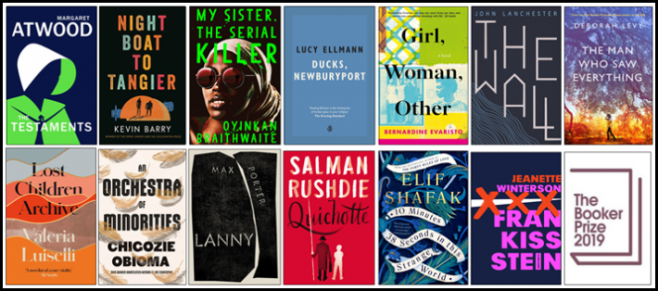
The longlist, or ‘Booker Dozen’, for the 2019 Booker Prize was announced on Tuesday 23 July.
The list of 13 books was selected by a panel of five judges: founder and director of Hay Festival Peter Florence (Chair); former fiction publisher and editor Liz Calder; novelist, essayist and filmmaker Xiaolu Guo; writer, broadcaster and former barrister Afua Hirsch; and concert pianist, conductor and composer Joanna MacGregor.

“If you only read one book this year, make a leap. Read all 13 of these. There are Nobel candidates and debutants on this list. There are no favourites; they are all credible winners. They imagine our world, familiar from news cycle disaster and grievance, with wild humour, deep insight and a keen humanity. These writers offer joy and hope. They celebrate the rich complexity of English as a global language. They are exacting, enlightening and entertaining. Really – read all of them.” Peter Florence

Featuring 8 women and 5 men with authors from the UK, Canada, Ireland, Nigeria, the United States, Mexico, Italy, India,  South Africa and Turkey, the nominated titles are:

Margaret Atwood (Canada), The Testaments (Vintage, Chatto & Windus)

– the sequel to The Handmaid’s Tale, fifteen years later, as told by three female characters.

Kevin Barry (Ireland), Night Boat to Tangier (Canongate Books)

– sex, death, narcotics, sudden violence and old magic in a Spanish port town

Oyinkan Braithwaite (UK/Nigeria), My Sister, The Serial Killer (Atlantic Books)

– a blackly comic novel about how blood is thicker – and more difficult to get out of the carpet – than water.

Lucy Ellmann (USA/UK), Ducks, Newburyport (Galley Beggar Press)

– A scorching indictment of America’s barbarity, past and present, a lament for the way we are sleepwalking into environmental disaster.

Bernardine Evaristo (UK), Girl, Woman, Other (Hamish Hamilton)

– Generations of women, the people they have loved and unloved – the complexities of race, sex, gender, politics, friendship, love, fear and regret.

John Lanchester (UK), The Wall (Faber & Faber)

– a chilling fable, dystopian novel that blends the most compelling issues of our time—rising waters, rising fear, rising political division—into a suspenseful story of love, trust, and survival.

Deborah Levy (SouthAfrica/UK), The Man Who Saw Everything (Hamish Hamilton)

–  the difficulty of seeing ourselves and others clearly. Specters that come back to haunt old and new love, previous and current incarnations of Europe, conscious and unconscious transgressions, and real and imagined betrayals, while investigating the cyclic nature of history and its reinvention by people in power. And a man crossing Abbey Road.

Valeria Luiselli (Mexico/Italy), Lost Children Archive (4th Estate)

– inspired by the experiences of desperate children crossing the desert border between Mexico, New Mexico and Arizona, and the Apache warriors who made their last stand in the desert, told as a family sets off on a road trip.

Chigozie Obioma (Nigeria), An Orchestra of Minorities (Little Brown)

– contemporary twist on the Odyssey, narrated by the chi, or spirit of a young poultry farmer, a heart-wrenching epic about destiny and determination.

Max Porter (UK), Lanny (Faber & Faber)

– an experimental fantasy set in an English village where a child goes missing, highlighting societal issues, history and the environment.

Salman Rushdie (UK/India), Quichotte (Jonathan Cape)

– a tour-de-force that is both an homage to an immortal work of literature and a modern masterpiece about the quest for love and family, a dazzling Don Quixote for the modern age.

Elif Shafak (UK/Turkey), 10 Minutes 38 Seconds in This Strange World (Viking)

– After death, a woman’s brain remains active for 10 minutes 38 seconds, during which her memories recall significant moments of her life and stories of 5 close friends she met at key stages in her life.

Jeanette Winterson (UK), Frankissstein (Jonathan Cape)

– a young transgender doctor called Ry is falling in love – against their better judgement – with a celebrated professor leading the public debate around AI.  Alternating with chapters narrated by 19 year old Mary Shelley, who is writing a story about creating a non-biological life-form.

The list was chosen from 151 novels published in the UK or Ireland between 1 October 2018 and 30 September 2019. The shortlist will be announced Tuesday 3 September.

I like that it’s such an international list, with voices from a variety of different countries and cultures, bringing more depth and diversity to the prize.

I haven’t read any of these titles, but I’m interested in Chigozie Obioma’s An Orchestra of Minorities novel, Valeria Luiselli’s Lost Children Archive and Deborah Levy’s and Bernadine Evaristo’s novelsThat said, I’m only reading #WIT Women in Translation during August, so I’ll be watching and reading the reviews of these longlisted titles to see which really tempt me.

And you? Have you read any of these? Interested in any?

Further Reading

The Guardian article: Not Read Them Yet? A cheat’s guide

Gardens in the Dunes by Leslie Marmon Silko

2019 is becoming my year of reading Silko, this now is the second novel I’ve read after Ceremony and I loved it as much, in some ways perhaps more, given the journey it takes the reader on. It follows on from two other books I read, reviews linked here, her excellent memoir The Turquoise Ledge and a slim collection of letters between Silko and the Pulitzer prize winning poet James Wright, The Delicacy and Strength of Lace.

While Ceremony was the coming of age of a young man set over a short period of time, Garden in the Dunes is more of a historical novel, set in the late 1800’s, tracing the lives of two native American sisters, Indigo and Sister Salt and at various times, their Grandmother and the newlywed white woman Hattie who provides refuge for Indigo for a period of time after she escapes the boarding school she has been imprisoned within.
Hattie and her husband Edward take Indigo with them to Europe for the summer, where she experiences differences in their way of life, but also finds something in the old world that she connects with. Archeological art in Bath, sculptures in a garden in Lucca from pre-Christian Europe create a link with American Indian symbolism through Indigo’s observations and experiences.

Along the way, as she had learned in the dunes, she collects seeds (the old ways) and flower bulbs (a new interest) for replanting when she returns home. She represents the connection to the past and also the future, learning new skills that will improve, add to their lifestyle.

Silko traces the transcultural histories and significances of sacred snakes and their feminine symbolism, unsurprising given her own close relationship to those that dwell beneath her own home in Tuscon. The final scene in the novel is fittingly given over to the return of a snake, a lasting metaphoric image of generational continuance and survival.

The novel rests in numerous locations where the girls live and must adapt, but their spiritual home and the place they always wish to return to, the place where their Sand Lizard people come from are the gardens in the dunes, inland from the river, where there is a natural spring and if enough rain, plentiful opportunity to grow what they need to survive.

Sister Salt remembers everything. The morning the soldiers  and the Indian police came to arrest the Messiah, Grandma Fleet told Sister Salt to run. Run! Run get your little sister! You girls go back to the old gardens! Sister Salt was big and strong. She carried Indigo piggyback whenever her little sister got tired. Indigo doesn’t remember much about that morning except for the shouts and screams.

When the girls are with their Grandmother and return to the gardens they have a purpose, they learn when and how to plant, to prepare food, to stock it, to identify edible plants, they are natural foragers. When they are removed from their natural home, they have to find other ways to survive.

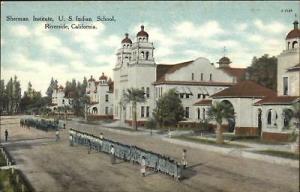
Sherman Institute, Riverside, California

At times it has been necessary to flee, when there is insufficient rain or when pursued by authorities, who effectively kidnap Indian children, separating them from their families and way of life to put them into institutions, forcing another form of education on them, removing their connection to their culture.

The authorities judged Sister Salt to be too much older than the others to be sent away to Indian boarding school. There was hope the little ones might be educated away from their blankets. But this one? Chances were she’d be a troublemaker and might urge the young ones to attempt escape. Orders were for Sister Salt to remain in custody of the Indian agency at Parker while Indigo was sent to the Sherman Institute in Riverside, California.

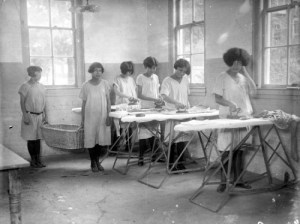
American Indian Girls in a state run Laundry

Sister Salt is sent to work in an Indian laundry in the vicinity of water dam projects of the Southwest; she and twin sisters she befriends decide to set up their own laundry service, living near one of the dam construction sites, becoming knowledgeable of the needs of the men working there, finding protection and collaboration with the chef Big Candy, the girls surviving together, supporting each other.

Throughout the novel, the men are involved in moneymaking projects, whether it’s Edward collecting orchid samples, his companions seeking rubber plant specimens, the men at the dam with their side interests in illegal gambling, brewing beer and the laundry.

The dam project diverted water to Los Angeles and made Indian lands less productive, initially it provided employment, but slowly the people realise what it is taking away from them, their land, their homes, their riverside livelihoods. Those with profit making motives have little or no concern for the destruction and loss caused in their wake. But they too risk falling victim to their own kind, Silko doesn’t miss the opportunity to make them suffer the consequences of their own greed.

Most native tribes did not adhere to the European view of land as property. For most Indians, land was communal, and its resources were to be protected and shared. This was in direct contradiction to European notions of land as individual property.

Ancient Minoan Snake Goddess

It’s far-reaching in its geographic span and themes, which through adept storytelling are repeated via the behaviours of characters. Women stick together, collaborate, survive and when not separated from each other, begin to thrive, though they remain wary of those from other tribes or cultures. Exploitation, greed and corruption are everywhere, interfering in the way people try to live their lives, imposing their ways, trying to keep people(s) separate or making them conform to a perceived way of being.

Indigo never loses the essence of who she is, despite being groomed and dressed like a white American to accompany Hattie and her prospector/explorer husband and being taken far away to Europe, her heart is like a magnet, she never ceases thinking of her intention to find her sister and mother.

Fortunately, Hattie is a sensitive and intelligent woman, who though the child brings out a maternal response and desire, promises to help her find them when they return. Hattie’s father was a free thinker who encouraged her higher education giving her access to libraries of friends to pursue her studies. She is sympathetic to their ways, but will also confront barriers when trying to cross over in her efforts to support them.

It’s a brilliant depiction of so many issues around origins and identity and the ways people survive and thrive, in particular women. We witness their attempts, how they are thwarted, see them compromise and discover that being with other women provides them with a force, even when they are from different tribes or cultures, sometimes that is a necessary element to their survival, to learn from other women, from other experiences, to share what they know.

Despite being a relatively long read (477 pages), it felt like it could have gone on, some threads leave the reader wondering what happened next, endings come about a little quickly. It could easily have been more than one book.

The final page and the closing sentences are beautifully given over to nature, to a demonstration that though we may grieve at what is passing, nature will always ensure that new life prevails, that something will survive from the ruin. That hope can manifest, though it may not be what we expect.

“Nearly all human cultures plant gardens, and the garden itself has ancient religious connections. For a long time, I’ve been interested in pre-Christian European beliefs, and the pagan devotions to sacred groves of trees and sacred springs. My German translator gave me a fascinating book on the archaeology of Old Europe, and in it I discovered ancient artifacts that showed that the Old European cultures once revered snakes, just as we Pueblo Indian people still do. So I decided to take all these elements – orchids, gladiolus, ancient gardens, Victorian gardens, Native American gardens, Old European figures of Snake-bird Goddesses – and write a novel about two young sisters at the turn of the century.” – Leslie Marmon Silko, Gardens in the Dunes (1999)
“I suppose at the core of my writing is the attempt to identify what it is to be a half- breed or mixed-blooded person; what it is to grow up neither white nor fully traditional Indian. It is for this reason that I hesitate to say that I am representative of Indian poets or Indian people. I am only one human being, one Laguna woman.”  – Leslie Marmon Silko, Laguna Woman (1974)

Buy a Copy of Gardens in the Dunes via Book Depository

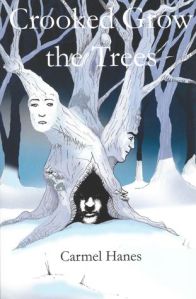
Crooked Grow the Trees by Carmel Hanes

Crooked Grow the Trees is an engaging, insightful and well-informed read that I remain in awe of since I finished reading it. I bought it not long after an online group conversation on Goodreads with Carmel Hanes about Bernice L. McFadden’s Praise Song for the Butterflies.
Since our connection is a little story in itself, I will share the comments that lead to my discovery that she had written a book and my desire to read it.

My comment on Praise Song for the Butterflies read:

Without resorting to a happy ever after cliche, I enjoyed the possibility that the experience of trauma didn’t have to equate to continual suffering, that one’s personal narrative does not have to continue to be that which happened in the past, that it is possible to change, to move on, to find community in another place, to rebuild, to have hope. Perhaps that is what happiness really is, a space where hope can grow, might exist, not necessarily the fulfillment of, but the idea, the expression.

to which Carmel replied:

What an eloquent and delightful summary of what happiness might be. “Hope” being the magnet that pulls one through life’s bitter shavings. Thanks for sharing that perspective….I love it.

What a beautiful, illustrative metaphor of hope being the magnet, pulling one through life’s shavings. I was enamoured by the ease with which her turn of phrase became a metaphor and wondered what else she had been reading, only to learn she was a published author, described as follows:

She hid among the likeable misfit toys she worked with in public schools and detention centers during a thirty year career as a school psychologist. The indelible imprint they left on her insisted on expression in this debut novel, exposing the struggles we all have to overcome early influences.

Well that combination of the spontaneous metaphor, a career of working with misfits and the promise of insights into dealing with young people who had been the victim of trauma was enough to make me curious. And what a find it was!

Review

Crooked Grow the Trees is an intriguing title, one I imagine refers to the impact traumatic events have on the growth and development of young minds, some children are unable metaphorically to grow as straight and tall as they ought to, depending on their influences and experiences during childhood.

The novel is a dual narrative between Sophia’s professional life dealing with the boys in the detention centre and her personal life, which has brought her siblings together as their father awaits death, awakening a past she has long buried.

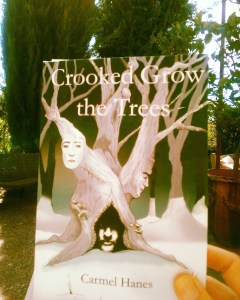
The brilliant cover art depicts the main protagonist Sophia and her brother Marcus, whose way of being in the world has been significantly affected by memories and perspectives of childhood, in particular in relation to their father, the dark element seen in the base of the trunk. Nevertheless, they are survivors, they have used their experience to forge their way ahead (even if they face opposite directions), each attempting to consciously eradicate while subconsciously using to good effect, that which left a mark on them.

Navigating the complex relationship with her father had been like walking through an emotional minefield.  Explosion after explosion had blown so many parts off the relationship there was nothing recognizable left but a spongy mass of raw nerves and charred intentions.

Unfortunately that resulted in them having opposite views in many areas of life, a source of friction that kept them apart, rarely seeing each other, until now circumstances force them to be together again.

They had little in common other than shared ancestry. Marcus held strong opinions that bordered on bigotry, while Sophia was inclined to see people as complex and multi-dimensional, not categorizing as quickly as her brother. They were on different sides of the political divide and rarely agreed on how to solve the social and financial issues the country faced.

What seems like an irredeemable divide proves challenging when it comes to dealing with their father’s affairs, Marcus is inconsolable and Sophia wants to understand why he acted the way he did. Hanes cleverly puts the siblings in a room where unknown elements of their parents lives are revealed, they are able to talk about, clarify and recalibrate events from the past, in a way that helps them understand each other better, healing some of the latent trauma.

A foundational brick in her self-view had been flawed. Years of experience wrapped around this inner core, tendrils of assumptions and beliefs, unraveled as the core foundered. How do you reframe a lifetime of feelings? How do you rewrite decades of misunderstanding?

Similarly in the workplace, when there is disruption, she comes into conflict with the position of staff who take a more punitive approach to dealing with the young. Uninterested in investigating what happened, or any extenuating circumstances, some advocate for severe punishment.

I don’t care what the excuses might be; they simply have to follow the rules regardless of what is happening. WE are in charge not them. The more they get away with these take-it-in-my-own-hands decisions the more at risk we are, not to mention their families and the community when they finally do make it out of here.

Sophia and her colleague appeal for a different approach:

“I think it’s important to understand what led to their decisions and reactions in order to best support them and teach them,” countered Dr Blain. “One cannot separate their actions from their histories, and change only happens when we understand what drives them so we can help them understand that as well. That is our mission, not simply to punish them for wrong actions. We can only gain that understanding through investigating all angles and hear what each person has to say.”

It’s a captivating read, enriched by experience that succeeds in presenting multiple moral viewpoints, forcing the reader to indulge and reflect on all perspectives and attitudes in the various conflicts. The conversations with each of the boys and the situations they respond to are brilliantly depicted, the dilemma feels real, the reader desperately wants them to succeed in being transformed.

Crooked Grow the Trees shows relationships healing through understanding and how those with opposite views can find common ground and forgiveness when memories and events that formed them are shared and discusses. Sadly, it is often not the case that the cause is known or shared or that people have the chance to heal from those traumas that damage them.

I find myself rereading my comment above, seeing how it resonates here too.

Perhaps that is what happiness really is, a space where hope can grow, might exist, not necessarily the fulfillment of, but the idea, the expression.

Buy a Copy of Crooked Grow the Trees via BookDepository

Man Booker International Prize Winner 2019 – Celestial Bodies by Jokha Alharthi

It’s been a couple of days since the winner was announced, view the shortlist here, so if like me you hadn’t heard, the winner of the Man Booker International Prize for 2019, an international foreign language work translated into English is:

Celestial Bodies by Jokha Alharthi translated by Marilyn Robinson

“It’s less flamboyant than some of the other books, there’s a kind of poetic cunning to it. It starts feeling like a domestic drama in a fascinating world, but with the layers of philosophy, psychology and poetry, you are drawn into the prose, through the relationship between the characters. It encouraged us to read in a slightly different way.”

The £50,000 prize celebrates the finest works of translated fiction from around the world and is divided equally between its author and translator.

This was the book I was most intrigued by from the initial list to be honest, it ticks so many boxes in my reading curiosity, it comes from a little known culture, Oman, and it’s history from the other side, focused on women and ex-slaves (slavery is still a taboo subject in Oman, outlawed there in 1970).

“It’s a sensitive subject and kind of a taboo,” Alharthi said in an onstage interview. “But I think literature is the best platform to discuss sensitive issues. And slavery is not exclusive to Oman – it’s part of human history.”

The paperback comes out in five days, I’ve pre-ordered it, so watch this space for a review soon.

Celestial Bodies tells of family connections and history in the coming-of-age account of three Omani sisters. It is set against the backdrop of an evolving Oman, which is slowly redefining itself after the colonial era, at the crossroads of its complex present.

Jokha Alharthi, the first female Omani novelist to be translated into English, is the first author from the Arabian Gulf to win the prize. A Professor with a PhD in Classical Arabic Poetry, she is author of two other novels, two collections of short fiction and a children’s book, her work has been published in English, German, Italian, Korean, and Serbian.  An award-winning author, she has been shortlisted for the Sahikh Zayed Award for Young Writers and won the 2010 Best Omani Novel Award for Celestial Bodies.

Marilyn Booth is an American academic and translator who has translated many works of fiction from Arabic. A fellow at Magdalen College, Oxford, she holds the Khalid bin Abdallah Al Saud Chair for the Study of the Contemporary Arab World at the Oriental Institute.

I love how the judges summed it up:

A reader picking up this book will be absolutely entranced by this new world of human experience that it opens up. This books tells us about the extreme complexity of the emotional relationships that we have and our engagement with history. We were very impressed by the subtlety of the style and the depth of the writing, its intellectual reach. But also its ability to flex moral muscle. It is a precise and also lyrical translation, and it brings in the music of everyday speech and the music of the poetry that it draws in. The extraordinary thing about this book is it talks of a world in transition, philosophically, politically, intellectually, socially, and that is the age that we live in now.

And what better metaphor of a world in transition, on this week that an Omani woman Jokha Alharthi wins this pretigious literature prize, that this morning on May 23, 2019 her Aunt, Nadhira Alharthy was the first Omani woman to reach the summit of Mt Everest!

The morning after the prize was announced, the Sharjah Book Authority in the United Arab Emirates announced the creation of the Turjuman* Award, valued at $350,000, which will go to publishing houses that facilitate the translation of Arabic literature.

Buy a Copy of Celestial Bodies by Jokha Alharthi via Book Depository

*Turjuman comes from an Arabic root for interpreter or guide, a translator.

Have you read it, or any others from the shortlist?