Simple Passion by Annie Ernaux translated by Tanya Leslie

After reading Annie Ernaux’s Nobel Prize Lecture I Will Write to Avenge My People, I decide to read the slim titles Simple Passion (48 pages) and next I will read Shame (86 pages). I have already read A Man’s Place, and eventually I will get to her more lengthy masterpiece The Years.

Simple Passion was the #1 national bestseller in France for over three months when it was first published in 1991, and a celebrated scandal even in France’s liberal society. It was followed up ten years later by a second book Se Perdre (2001) (Getting Lost), which explores the affair through a series of diary notes.

In this book, Annie Ernaux observes herself throughout the life-cycle of an affair, the in-between moments of a conditional relationship, describing how that passion drew her in and ruled her, even when she took herself away from it.

She writes of this encounter with hindsight, as if observing something external to her, like a work of art, looking for some kind of truth or meaning behind the physical and mental experience, now that she has some distance from it. Her interest in writing is not to focus on the man (who could be any man) but on the obsession itself.

A Simple Passion Reveals a More Complex Humanity

The man, referred to as A, is from another country, he is married; the 18 months he is in her life, this ‘simple passion’ is depicted like an illness or a condition, she is able to see how it changes her. She studies it.

I am not giving the account of a liaison, I am not telling a story (half of which escapes me) based on a precise – ‘he came on 11 November’ – or an approximate chronology – ‘weeks went by’. As far as I was concerned, that notion did not enter the relationship. I could experience only absence or presence. I am merely listing the signs of a passion, wavering between ‘one day’ and ‘every day’, as if this inventory could allow me to grasp the reality of my passion.

A Life Suspended, Waiting for a Man

Photo by A.Piacquadio Pexels.com

She observes this condition, though she is virtually powerless to overcome or stop it, it will run its course and she will create an honest, transparent account of it, documenting the range of emotions, behaviours and instinct that run through her.

She observes how this desire becomes the lens through which she sees everything around her, how she spends her time endlessly waiting; waiting for him to call, waiting for him to arrive, waiting for the inevitable end of their association.

This endless wait reduces every other experience, as if they were lived by someone else, while magnifying the space in her mind given to thinking about him, of their time together – amid brief lucid moments of realising the insignificance of him, of the exaggerated importance she has temporarily given him.

I often wondered what these moments of lovemaking meant to him. Probably nothing more than just that, making love. There was no point looking for other reasons. I would only ever be certain of one thing: his desire or lack of desire. The only undeniable truth could be glimpsed by looking at his penis.

Fulfilling Life’s Purpose, Finding Meaning

The passion passes through a cycle from its beginning, middle, near-end and end, passing through excitement, anticipation, acceptance, moving on, overcoming towards finding meaning.

Yet it is that surreal, almost non-existent last visit that gives my passion its true meaning, which is precisely to be meaningless, and to have been for two years the most violent and unaccountable reality ever.

Written in short fragments, paragraphs, it is a hypnotic read. I have never read anything quite like it, an introspective interrogation of the self, she is able to set aside society’s judgments and write in a way that is as intimate as a journal, but in a short succinct way that has her own purpose, to better understand the human condition.

I discovered what people are capable of, in other words, anything: sublime or deadly desires, lack of dignity, attitudes and beliefs I had found absurd in others until I myself turned to them. Without knowing it, he brought me closer to the world.

The author presses forward towards fulfilling that promise made to her 22 year old self, as we learned of in her novel lecture, to interrogate her own actions, her own mind in the life she has created, having ventured far from humble beginnings. In writing to avenge her people, she writes to avenge all.

He had said, ‘You won’t write a book about me.’ But I haven’t written a book about him, neither have I written a book about myself. All I have done is translate into words – words he will probably never read, which are not intended for him – the way in which his existence has affected my life. An offering of a sort, bequeathed to others.

Soldier Sailor by Claire Kilroy

Soldier Sailor is on the shortlist for the Irish Book Awards 2023.

Cathy at 746 Books praised this one, as her pick for Novel of the Year, saying it deserved the award attention, so I decided to read it to find out what that was about.

The Clash of Fierce Love versus Stolen Identity

Irish Book Awards 2023 motherhood literary fiction

So, after an eleven year gap since the publication of her last book, following the birth of her son, Claire Kilroy has overcome her writer’s block and “angry few years”, to produce a piercing, visceral account by the unnamed narrator Soldier ravaged by new motherhood, to the child, Sailor.

Here is how the author describes her book:

Soldier Sailor is a mother talking to her sleeping child explaining what was going on during those years he was too young to understand or remember the events around him. She tells him of her love, but also of how difficult, how isolating she found it when motherhood ended her old life. Nothing much happens; one of the main characters, Sailor, has no dialogue. The whole experience is a non-event from the outside, but when you are that soldier pushing the pram, my, what a psychodrama it is.

The novel as the image depicts, zooms right in to the responsibility, the bond and the practice of being mother to a small child, to how it changes EVERYTHING. From the entering into a relationship like no other that exists and the loss of what came before it; to the very different support that a mother might need, and the unlikely place(s) she might find it.

A Mother’s Instinct to Kill

It is not a reflection, it is an act, you will read it and live it, or relive aspects of it, if you have already been there.

Do you know what I would I do for you? I hope not. What would I not do, is the question. The universe careens around us and I shield your sleeping body with my arms, ready to proclaim to the heavens that I would kill for you: that I would kill others for you, that I would kill myself. I would even kill my husband if it came down to it. I swear every woman in my position feels the same. We all go bustling about, pushing shopping trolleys or whatever, acting like love of this voltage is normal; domestic, even.That we know how to handle it. But I don’t.

Using the second person “you” addressed as a monologue to her baby son, the narrative swings between the emotional peaks of a tireless love, to violent frustration and resentment; from the misleading two second Instagram snaps sent to the elsewhere husband, to her thirty second screaming telephone rages, with only the reader, witness to and understanding the riding crescendo of events that lead from one of those events to the next. A bewildered husband, observing the peaks, oblivious.

Your sleeve is in your dinner, my husband remarked. He wasn’t there but he didn’t have to be there. He was always there when things were going wrong. Yet never there to help. The luxury, the sheer luxury of sending a last-minute message saying you wouldn’t be home that evening. It would be a decade – more – before I could do the same. What does he eat? he had texted me the one time he was left in charge?

Sons and Fathers Take Note

To read this account, especially because of the culture within which it stems from, one that for many years locked up its women who expressed too loudly their discontent, or behaved in ways considered improper, is to understand a little of what was labelled hysteria – one of the natural consequences of needs not being met. Forget the narrative arc, read this and you plunge into the subject, you become it, you feel it, you remember bits of it. The son is warned, made to understand, his future depends on it.

I was firmly in my wrong mind and liable to do anything, so off I went, down the stairs, out the door, up the drive, through the gate, along the road, overcome by a wildness that I needed to convert to movement or else risk doing something stupid, and by stupid I mean destructive because words have many meanings, Sailor, and you must deploy them with care because they can inflict real hurt.

The mother like her infant child, is reborn yet will only realise she has inhabited this new being ‘the mother who birthed‘ when it is too late, when this tiny creature she loves so fiercely and will protect with her life, claims her, and in her most challenging moments, she like him, will feel the desire to scream, to run, to escape or somehow figure out, how to make ‘the other’ understand.

What struck me as the starkest contradiction of all was that, having navigated this much of life – the volatility of youth, of love and loss, the agony and the ecstasy – the closest I had come to losing my mind was during the period known as settling down.

Friendship for Hope and Healing

motherhood Soldier Sailor Claire Kilroy
Photo by Oleksandr P on Pexels.com

This text will not speak of the quiet moments, it is the intersection of all the moments lived, of the brutal awakening that is ‘becoming a mother’ and the warning to ‘the other’ that did not give birth, who is part of the journey, to prepare for this change and get ready to adapt, to support, to listen, to learn to be ‘the friend’ she is going to need.

One day she encounters an old friend, and these follow up meets mark a turning point, to being seen again, to being understood, and something dangerous shifts, quiets. Small gestures, moments of listening, the beginning of a form of solidarity.

We were better together my friend and I. Better parents. I was anyway. I was a better mother to you when I was around my friend. But a worse wife.

We arrive at the end – where she imagines moments years down the road ahead – with a kind of relief, knowing that with age and stage, the distance between those peaks will lessen, the relationships will either adapt or crumble, that true friendships will witness and endure it all.

An utterly compelling read that you won’t want to put down.

Further Reading

The Observer Review: Soldier Sailor by Claire Kilroy review – a mother’s confession after the fight of her life by Stephanie Merritt, 12 June 2023

The Irish Times Review: Soldier Sailor by Claire Kilroy: An astute, provocative, intriguing novel about motherhood – A virtuosic set-piece late on veers so far into nightmare territory, it feels as if we’re reading a thriller by Sarah Gilmartin

Eason Novel of the Year, Interview Q & A With Claire Kilroy

Claire Kilroy, Author

Claire Kilroy is the author of five novels including Soldier SailorAll SummerTenderwire, and The Devil I Know. She was awarded the Rooney Prize for Irish Literature in 2004 and has been shortlisted for many other prizes, including the Irish Novel of the Year and the Kerry Group Irish Fiction Award.

She studied at Trinity College and lives in Dublin.

What do you hope readers will take away from your narrative?

It is so easy to dismiss a mother and her work, and a father and his – one of the main characters is a stay-at-home dad. I had no idea what minding an infant involved and had regarded it as easy, unchallenging (I am mortified to admit that), so I hope I have revealed how demanding it is, but also how rewarding, never mind how important. I hope more fathers will get involved in raising children because it changes you, it remakes you, you become more compassionate. I don’t think Trump and Putin would be the awful tyrants they are had they cared for, well, anyone. It doesn’t have to be a child, just any person or creature who needs care.    

The Bird Within Me by Sara Lundberg (Sweden)

translated by B.J.Epstein

The Swedish Artist Berta Hansson

The concept of this illustrated children’s book really appealed to me. It’s inspired and based on the childhood of the Swedish artist Berta Hansson (1910-1994) during the period in her life when she was 12 years old and wanted to be outdoors in nature or painting or making birds out of clay.

However, her father was strict and serious and her mother was frail and in bed very ill, so she was needed to help out in the home and on the farm, and all the more so when one of her older sisters was sent away to study domestic science, to learn how to become a better homemaker.

She initiates a form of protest.

Housewife. Housewives.

That’s what Dad wants us to be –

Julia, Gunna and me –

because that’s how it’s always been

and that’s how it’s going to be.

A Role Model or a Muse

Berta wanted something else for her life, but had no role model or knowledge of how to make her dreams a reality. Her Uncle Johan whom she secretly admired, painted with oil paints and made fiddles instead of spending all his time on farm work, sadly he was looked down on and derided, referred to as the ‘theatre farmer‘.

Sometimes late at night she would sneak out and wander over to a copse of trees by the Doctor’s house, one of the few people who had ever complimented her art.

The Bird Within Me Painting Muse

Photo by Zaksheuskaya on Pexels.com

I peer in.
He sits in the armchair,
reading and smoking his pipe.
If he saw me, I would die.
Paintings hang on his walls from the floor to the ceiling.
They are so beautiful.
I can’t stop looking at them.
To think that someone has painted them.

Breaking Out

It is a story of family and obligations, and of the longing a child has for something that is difficult to articulate or express in words, little understood by the world of adults who harbour expectations.

How to sustain and realise dreams when the way is not clear.

It’s a celebration of the exploration of art and observation in youth and of the struggle against the familial and cultural conditioning and expectations of girls.

A beautiful and thought provoking book for all ages.

You can find a copy of the book here.

Happy Mother’s Day

Happy Mother’s Day to you all and especially if you live in one of the country’s where it was celebrated today. Here in France it is not La Fête des Mères yet.  It is usually the last Sunday in May but it is moved to the first Sunday in June if that day falls on Whit Sunday/Pentecost, which it does this year. So it is on Sunday 7 June this year and will revert back to the 31st of May in 2021.

A few other countries celebrate Mother’s Day on the second Sunday in May, today Sunday 10 May, including New Zealand, Australia, Canada, the US, Denmark, Finland, Italy, Switzerland, Turkey, Belgium, India, China, Japan, the Philippines, Kenya and South Africa. In some countries such as Argentina and Ethiopia it is celebrated in autumn.

Confinement In France

I received a few messages from friends and family in New Zealand wishing me a Happy Mother’s Day, which was lovely and unexpected.

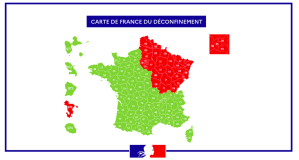
We have had a lovely light rainy day here in Aix-en-Provence today, though thunderstorms are forecast, I now love the rain, it being such a rarity here, and it is the eve of #DeConfinement. We are in the green zone so must follow guidelines accordingly. Sadly Paris is still in the red zone.

Tomorrow we are allowed to go out without the printed attestation (certificate) that declared our name, date and place of birth, address, signature, the time and reason for leaving home, which for the last 6 weeks for me had been limited to supermarket shopping (I’ve been twice) and walking up to 1 kilometre from said address. I take my hour every day, a small liberty for which I have immense gratitude. I haven’t been able to work for 6 weeks, tomorrow that changes.

I think I will write a whole post about my daily walk with images as it has been an interesting experience, almost like a little short story, so perhaps I will create that before things change too much.

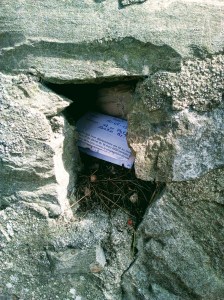
I’ll begin by sharing this one image, which is a hole in a wall on my walk, where there is something hidden inside, a little mystery that I partially solved and have a theory on, but I will save that for another day and leave you with just this clue.

Making Simple Graphics

Something I have recently discovered and will share in case anyone else is interested is how to create simple free graphics using Canva. They make it simple to use and you can use your own photos or their templates and backgrounds. I created this image below today and shared it on twitter with a quote from the book I am reading, just for fun and to acknowledge the serendipitous event of reading it on Mother’s Day.

On Chapel Sands

On Chapel Sands is written by Laura Cumming the art critic for the Observer (an excellent Sunday newspaper in the UK). I haven’t finished the book yet, it’s a memoir and it’s brilliant, unlike anything you will have ever read, as she brings her art historian talent for interpretation of the visual image into her investigation of her mother’s life.

It’s brilliantly done, especially if you appreciate having art works explained to you by a knowledgeable guide or expert.  And she keeps some of the mystery back, making it a slow revelation of the past and finding out what really happened when her mother went missing from the Lincolnshire beach when she was three years old.

Today is about appreciating and remembering mother’s, so I leave you with a quote from Laura’s book about her mother Elizabeth and her grandmother Vera, in remembrance of all mother’s.

“To commemorate Veda’s life, Elizabeth planted thousands of daffodil bulbs in the grounds of Chapel school for the pupils to pick on Mother’s Day each year, so that no future mother would ever be forgotten.” Laura Cumming, On Chapel Sands


A Long Absence, I Am Dust by Louise Beech

I don’t know why, but today something nudged me to write a few words about a book I have just finished reading. The first time I have had anything noteworthy to say about a work of fiction since August 2019.

I also have a couple of reviews I wrote in August, that I hadn’t posted yet, part of Women in Translation month that I will share belatedly. All coming soon…

It was the debut novel of Iranian author Shokoofeh Azar, The Enlightenment of the Greengage Tree. It won’t be for everyone, as it’s written in a lyrical magical realist style, narrated by the spirit of a thirteen year old girl whose family flees Tehran during the Islamic Revolution.

Europa Editions, one of my favourite publishers, describes it in this way:

From the pen of one of Iran’s rising literary stars, The Enlightenment of the Greengage Tree is a story about the unbreakable connection between the living and the dead, and about the way a nation’s shared trauma shapes its national and personal narratives.

It speaks of the power of imagination when confronted with cruelty, and of our human need to make sense of the world through the ritual of storytelling itself.

That power of imagination and the use of storytelling to express something in another form, whether its verbal, written or visual, to make sense of how someone views the world around them was something very close to my heart, almost overwhelming, as I too struggle to make sense of it, yet appreciate the gift.

Allia Jen

I haven’t published anything here nor felt like reading or even thinking about storytelling, because in mid August my 17-year-old daughter Allia Jen passed away suddenly, without warning. And as you might imagine, something like that, changes something in us.

Though she was very young, she had already lived an extraordinary life, with both significant challenges and immense joys. And though it is little recompense, we have a bulging suitcase of her drawings and artwork, which she worked on and created prolifically – literally – as if there were no tomorrow. Though she didn’t quite make it to her 18th birthday and the independence she was so looking forward to, I am somehow comforted by the knowledge that in the belief system of her paternal culture, she is considered a Bird of Paradise, granted direct passage into Paradise.

I can’t write about reading without first acknowledging this personal loss, as something new begins to blossom and I  begin writing again. I am working on a new project I hope to finish this year and I have the intention to visit here from time to time, sharing what I’m reading, and if not here, at the very least on Goodreads.

I Am Dust

In the first of so many I still owe thank you’s to, I would like to say a heart-felt public thank you to a woman who makes magic with words, author Louise Beech, whom I first connected with while spending 10 days in Timone hospital with Allia as she recovered from a successful but distressing operation to correct a curvature of the spine.

I was reading Louise’s incredible, unforgettable debut novel How To Be Brave  inspired by her journey with her daughter and a Type 1 diabetic diagnosis (something we shared as mothers). We have stayed in touch ever since and she has written many more excellent, unputdownable novels.

Her latest novel, which I urge you all to read and share, is out now as an e-book but due for printed publication on 16 April 2020. Set in a haunted theatre I Am Dust begins with an amazing poem written by Louise’s daughter Katy and the following generous, kind and much appreciated dedication:

This is dedicated to the people

who pick up the glitter.

And to a girl who was glitter: Allia

Jen Yousef, or simply Jen.

I’ll now have to wait until after

the dust settles

to finally meet you.

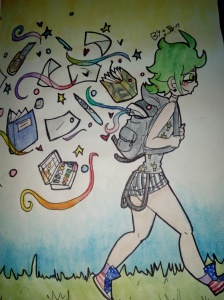
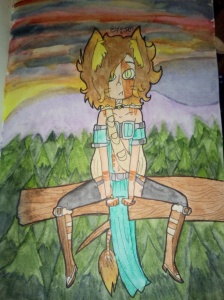
I leave you with a few of my favourite pictures Allia drew, all of which are semi-self portraits and encapsulate something of her essence. She is in a good place now and has reversed our roles, I feel her presence around me constantly and will always be inspired by what she taught me in her short life.

I guess she’s telling me to get on with some of the things I’ve been neglecting, just as she would have done, by awakening the inspiration to want to share again.

Thank you for your kind thoughts.

Claire

Buy a copy of I Am Dust via Kenny’s

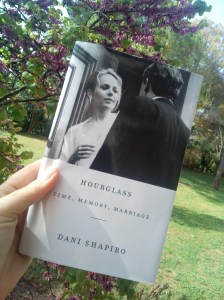
Hourglass – Time, Memory, Marriage by Dani Shapiro

I’ve not read any of Dani Shapiro’s previous works, this short book was passed to me by a friend and read in an afternoon. I enjoyed reading it, though I couldn’t say I related to it. It’s a very personal observation of a marriage, of the passage of time, a woman observing herself change, reflecting on her inclinations and trying to understand herself, her husband and their evolving relationship. As the title indicates, it’s a reflection on time passing, on memory and on marriage. It’s full of nostalgia for moments passed, brought back to life as she picks up journals from girlhood and her earlier life and quotes from them, in particular, from her honeymoon spent in France. She wonders about the woman she was then. She worries about the lack of a plan, despite being in her fifties and her husband almost sixty. She shares these anxious moments, as she begins to lose a little faith in the words her husband has uttered in the past, words that gave her reassurance “I’ll take care of it”. Anyone who has lived with that kind of comfort will likely relate, but inherent within it lies a deep vulnerability, a fissure, a unassuageable fear of loss. It is here her words pierce the fabric of living, when they illuminate the cracks in the facade, opening a small window into that anxiety-inducing perception of reality that sees itself as separate. It is that undercurrent of misplaced fear that disconcerts me, for there is no hint of resolution, little evidence of a desire to go within and face the abyss, to heal it. She remains focused on that which is external and therein perhaps lies the problem. Maybe that is a memoir still to come, when she will embark on the inner journey and learn to listen to her own guidance, to the whispers of her soul that are capable of reassuring her more than anyone or anything on the outside. Something that marriage appears to protect us from, at least until menopause, a subject she doesn’t mention but one that can also unravel our perceptions of the life structures we’ve created in our minds.

Photo by Tom Fisk on Pexels.com

It is a work of quietly observed transformation, the writer is trying to observe herself from both without and within, she has a long experience of observing from a distance and now she feels the pull to go within, yet it’s as if she has only just begun to put her toe in the river. She is aware of the pull of the river and quotes from Virginia Woolf:
The past only comes back when the present runs so smoothly that it is like the sliding surface of a deep river. Then one sees through the surface to the depths…But to feel the present sliding over the depths of the past, peace is necessary. The present must be smooth, habitual. For this reason – that it destroys the fullness of life – any break… causes me great distress; it breaks; it shallows; it turns the depths into hard splinters. As I say to L[eonard]: “What’s there real about this? Shall we ever live a real life again?
She recalls that she used to tell her students that to write good memoir, the kind that would be of interest to the disinterested reader, the writer had to have some distance from the material, not to write from feelings but from the wisdom and insight of retrospect.
But like every fixed idea, this one has lost its hold on me as years have passed and the onrushing present – the only place from which the writer can tell the story – continues to shift along with the sands of time. Our recollections alter as we attempt to gather  them. Even retrospect is mutable. Perspective, a momentary fragment of consciousness. Memoir freezes a moment like an insect trapped in amber. Me now, me then. This woman, that girl. It all keeps changing. And so: If retrospect is an illusion, why not attempt to tell the story as I’m inside of it?  Which is to say: before the story has become a story?

Photo by Jordan Benton on Pexels.com

And so as her reflections come to an end, they indicate that she may be at another beginning.
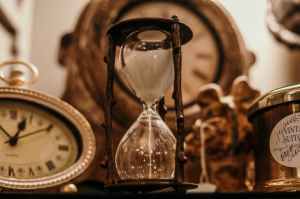
Somewhere, a clock ticks. Sand pours through the hourglass.  I am no longer interested in the stories but rather, what is underneath the stories: the soft, pulsing thing that is true. Why now?  What is this insistence?  All of me – the whole crowd – wants to know.
I am left intrigued to know what she will write next, where her inner journey will take her, when she lets go of looking through the lens of marriage, time and memory and observes life through a newly expanded awareness.

An Affair with My Mother by Caitriona Palmer

It seems a strange title for a book, until we understand it is a memoir of adoption, of secrecy, of a love denied, forbidden. And the woman writing it, comes to realise, how very similar the continued secrecy surrounding spending time with her birth mother is, to conducting an illicit affair. So she calls it that. It’s like an unwritten 13th commandment: Thou shalt not have any relation whatsoever with thy illegitimate child.

It’s set in Ireland, a country reluctant to let go of old ways, still in throe to a traditional family culture that shamed, blamed and punished young women for being the life-bearers they are – insisting they follow a code of moral behaviour documented by a system of domination, upheld by the church, supported by the state – a system that bore no consequence on men – young or old – who were equally responsible for the predicament of women.

“If there is anger in this book it is anger at the profound and despicable sexual double standard in Ireland. Men walked away without ever having to confront their role in these relationships.”

Eventually women in Ireland were given access to a means of preventing unwanted pregnancy, though not until Feb 20, 1985 when the Irish government defied the powerful Catholic Church, seen until this day as lacking compassion, in approving the sale of contraception, and more recently in a 2018 referendum, repealing its abortion ban (outlawed in 1861 with possible life imprisonment), acknowledged as a dramatic reversal of the Catholic church’s domination of Irish society.

For years, Ireland created and implemented what is referred to as an architecture of containment, institutions such as the Magdalen laundries (also referred to as asylums) removed morally questionable women from their homes (young women who became pregnant outside of marriage, or whose male family members complained about their behavior). They removed their children if they were pregnant then put them to work, washing ‘the nation’s dirty laundry’, thanks to lucrative state contracts provided to the institutions to fulfill. The last Magdalene laundries closed in Dublin in 1996 and the truth of what happened to those unmarried mothers continues to be investigated through the CLANN project.

Book Review

Caitriona Palmer was born in Dublin, raised in a caring family with two children of their own, the parents adopting after a miscarriage and recommendation Mary (the mother) should have a hysterectomy. If they wanted another child, adoption would be the only path.

She had a happy childhood and grew up in a very happy home, defiantly happy in fact, she would tell people early on she was adopted, almost proud of it she said, in her mind it had had no impact on her life, it didn’t change her or make her who she was, however she was constantly shadowed by a consistent ache, something she refused to confront or admit had anything to do with being separated from her biological mother at birth.

The book opens as Caitriona is about to meet her birth mother Sarah (not her real name) for the first time, a highly anticipated event, and yet as it unfolds, and she hears someone walk up the steps, about to fulfill a desire she has initiated, she becomes filled with dread and as the woman rushes towards her, repeating her name:

I said nothing. I felt nothing.

‘I’ll leave you both to it then,’ I heard Catherine say.

‘Don’t go’, I wanted to scream at her. ‘Please don’t go. Stay. Stay here with me, please. Don’t leave me alone with this woman.’

It is the beginning of the many conflicted feelings she will encounter within herself as that aspect of herself she was born into awakens as an emotional itch deep inside her she can neither locate or explain, at a time in her life when outwardly, living life as the person she was raised to be, she couldn’t have been happier. She was 26 years old, working in a dream job for Physicians for Human Rights in the US, in love and happy.  She put her anxiety down to problems with her expiring student visa, though when her employer found a solution by transferring her to Bosnia, it didn’t heal the anxiety, if anything it made it worse.

There, a small team of forensic scientists was overseeing the exhumation of hundreds of mass graves left after the war and attempting to determine the fate of over 7,500 missing men and boys from the UN safe haven of Srebrenica, which had been overrun by Serb forces four years earlier.

After a day when she and a small team broke into an abandoned hospital in search of records, the source of her own anxiety presented itself to her.

In that moment, filling our arms with the dusty paperwork, I felt a sliver of illumination. Driving back to Tuzla later that afternoon, our pilfered medical dossiers on our laps, the mood in the car jovial, I returned again to that moment, massaging the memory, trying to knead to the surface the revelation lurking beneath. What was I doing helping to search for the files of dead strangers when it was plainly obvious that I needed to search for own?

Though there could be no comparison between her loss and that of these families, it was this extreme situation that revealed her own source of anxiety and set her on a path to do something she had denied she would ever do.

She embarks on her search and despite the difficulties many encounter in Ireland, where Irish adoptees have no automatic right to access their adoption files, birth certificate, health, heritage or history information she manages to access information about her birth relatively easily. The agency traces her birth mother and facilitates that first and many subsequent meetings.

Despite the initial shock, they develop a close relationship, but with one significant and ultimately destructive condition, that she remain a secret, for her birth mother continued to harbour great shame and was terrified of the impact this knowledge might have on her current life.

By the close of that year, I had come to detest the power imbalance in our relationship, seeing myself as the cause of Sarah’s shame and paranoia, her sadness and regret. I hated being invisible to her husband, evidently a good man who adored her, and to her three children, half-siblings that I longed to meet.

Palmer digs deep into the history of adoption in Ireland, armed with journalistic skills (now a freelance journalist in Washington DC) she researches archives and interviews her parents and birth mother as if subjects of a news story, to get to the heart of this institution that wrenched families apart and caused such fear and trauma in young Irish women, leaving emotional scars many of them would have all their lives.

Feminism might have been on the march, but the women in Sarah’s world … had conspired to punish her for stepping out of line. ‘If you want to get people to behave, show what happens to those who don’t,’ an Irish historian once said to me about Ireland’s culture of female surveillance and the institutionalization of unmarried mothers. ‘Make them feel part of that punishment.’ Her Aunt’s verdict – “Nobody will ever look at you again. You’re finished.” – echoed constantly in Sarah’s mind.

One couple she researched, were married with more children, but didn’t want to know the child they had parented and given away before marriage.

“What is that? How can this legacy of shame even prevent a couple from accepting their own biological child? Why can they not open the door?

“This book was meant to answer that. But I don’t know why Ireland has let so many people down. I was meant to grow up and be grateful and never want to look at my past. Because things worked out well; I was given a wonderful family and have done well; that’s meant to be enough.”

For an adoptee or a birth mother, it’s both insightful and an extremely painful read, especially given the author’s own awakening from that happy dreamy childhood and early adult life that held no place for her unknown genetic history, or for any other familial bond or connection. She couldn’t recognise what she hadn’t known or experienced and because her adoption was something known, it seemed as if this life could be lived without consequence. In a recent interview post publication, Palmer describes this:

What I didn’t understand was that that primary loss impacted me, it did change me, I’m still grieving her. Despite my wonderful happy life, amazing husband and children… I’m internally grieving, this woman, this ghost, that’s a love that I’ll never regain in a way, memoir is an attempt to grasp at that.

I wanted people to know you can grow up happily adopted and still have this hole, I always feel like there is a hole deep down inside of me that I can’t quite fill, in spite of the abundance of love that surrounds me, this primary loss is profound.

It’s a story that doesn’t end on the last page, and will leave readers like me, curious to know what impact this book had on the relationship. The podcast below, brings us up to date with where things are at since the book was published, including mention of the hundreds of letters that Caitriona has received, the many people who have had similar experiences, heartened to learn that their experience brought solace to some, in their ability to share with her their stories.

Asked, given what has transpired, would she still do what she did, she responds:

I would have done the same, as it was approached ethically and with love – but I wouldn’t allow it to remain a secret so long, the weight of a secret… every human being wants this sense of belonging and yet we are expected to express gratitude and get along, we are a part of each of those things and that’s a beautiful thing…

The big gap in all this, and for this entire process, is the lack of facility for healing, for giving adoptive parents, birth parents and the children affected by adoption, resources to help them understand what they might go through and if they do, how to manage that, how to heal from that, live with that, recognise the characteristics that come with having lived though such trauma.

The world we live in today is a long way from being accomplished at providing that, and some countries are no doubt better than others, hopefully it is coming, it doesn’t take too much digging if one can find tools of well-being that might bring about individual change and healing.

Further Reading/Listening

Caitríona – I’m Still Grieving Her – Podcast – on building a relationship with her birth mother, the heartbreak of being kept a secret and the high cost she’s paid for sharing her story

The State has a duty to tell adoptees the truth Caitríona Palmer: Shadowy adoption system is the last obstacle to a modern Ireland – June 2018

CLANN: IRELAND’S UNMARRIED MOTHERS AND THEIR CHILDREN – establishing the truth of what happened to unmarried mothers and their children in 20th century Ireland, providing free legal assistance

The Hope Fault by Tracy Farr

Uplevelling my blending skills

I’ve been busy doing some studies and practice in ‘Spiritual Phytoessencing’ which is all about blending essential oils which deal with disharmony in an individual’s soul. It might sound ethereal, however, it’s been quite demanding intellectually and so for the past two months my reading has had to be complementary to my studies, so I haven’t been reading any fiction.

Yesterday however, I finally finished a novel I’d been wanting to get to for a while, escaping the current heat wave happening here in the south of France, with this book, its beautiful raindrops on the cover, so enticing.

I loved Tracy Farr’s The Life and Loves of Lena Gaunt (review link) so I was looking forward to this, her next book.

Hope in a Heatwave

The Hope Fault for the most part, takes place over a long weekend as a small, extended family meet at the family beach house that has now been sold, as all their lives are moving on. They meet to pack everything up, to have one last party and to acknowledge their youngest member, the month old Baby that has yet to be given a name.

The one family member that is missing is 99-year-old Rosa, days shy of her 100th birthday, she’s in a care facility, but remembered often throughout the weekend and among the various objects that are unearthed as they pack.

The mid-section of the novel is given over to Rosa, in a unique, slow revealing way, it maps out snippets of her life from the present, through the past, snapshots that reveal the cracks, turning points and little known aspects of her life, that have unbeknownst to the group that now meets, had an impact on their lives.

Although it is ostensibly a novel about families, there are poems and letters from a geologist, which I won’t reveal, as they are part of the mystery and intrigue of the novel, but they provide an interesting connection and create one aspect of the metaphor of the ‘hope fault’, natural occurrences that disrupt and reform landscapes, families and humanity.

They also represent that aspect of the past, of our parents or grandparents lives that most of us don’t know about, things that happened before we were born, which may never have been spoken about or revealed, clues in the junk that gets thrown away, imprints often carried forward in our behaviours, the non-genetic aspects inherited within families, hidden within the stories never told, secrets never shared, loves never realised.

Knowing that Tracy Farr has lived many years in NZ, I imagine she was in part inspired by the Nov 2016 earthquake in Kaikoura, NZ, a complex 7.8 earthquake of 21 faults (some previously unknown) that ruptured the landscape in various ways, raising the seabed by more than a metre. It is thought to be part of the evolution of the boundary between the Australian and Pacific plates, underlying planetary change that can remain dormant for years, then suddenly reform, disrupt, create anew.

Kaikoura Earthquake, New Zealand Nov 2016

The fault is that unseen force that underlies what we think is a solid reality, it represents change, movement, transformation, as it has done so in the past, as it will do in the future, there for us to see in the present if we open our eyes and mind to it.

For me, this is what this story is about, change, transformation, moving on, new generations replacing old, letting go, the awkwardness and disturbance of youth as they encounter parts of themselves they don’t understand, the various manifestations of middle life, how men and women deal with it, how it impacts families and of just making the best of it all, of not judging others for their flaws.

In dealing with its faults, cracks and flaws, it’s actually a novel of quiet hope.

P.S. One little intrigue this novel does reveal, which isn’t about the storyline per se, is the connection to the authors twitter account. I’d noticed a long time ago that Tracy Farr’s twitter handle is @hissingswan and wondered what that was a reference to. In reading this novel, at least one of the reasons for this reference is revealed!  How Mister Willow came to Missus Maker, from Miss Fortune’s Faery Tales by Rosa Fortune. Read it to find out more.

P.P.S. Thank you to Gallic Books for providing me with this ARC (Advance Reader Copy).

Buy a Copy of The Hope Fault via Book Depository

If you’re interested in the book, why not Look Inside read the first few pages, click on the images or words below:

Read a Sample from The Hope Fault

The Mountain In My Shoe by Louise Beech

Louise Beech is a unique author who I feel like I have a personal connection with, after the incredible experience of reading her debut novel How To Be Brave in October 2016, which for me included communicating with her as I endured a hellish experience on the 9th floor of Timone Hospital in Marseille. Twitter hashtags truly can bring incredible people into your lives at pivotal moments, both the living and those that have passed on. #LouiseBeech

I originally bought her book because it was an intriguing fictional response, written by a mother whose daughter at the age of nine was diagnosed with Type-1 diabetes, as my daughter had been. Curious, I read that she had used fiction as a conduit for channelling her experience as a distraught mother and the roller coaster journey the two of them went through during those early months of the diagnosis, as it would change them irreversibly.

What made it all the more appealing was the difficulty they had endured, I’d been exposed to too many “good” stories, examples of where children had so readily adapted to this new routine of four injections a day for life, and gone on to do great things, I wanted to read about the opposite, I wanted to hear from those who had found it tough, those who’d rejected it, fought against it, mothers who’d almost been broken by it, and had found a way through; Louise Beech was that mother for me, she still is; an incredible role model, a fabulous writer, unique storyteller and a woman with a great sense of humour.

It was also the story of her grandfather who had been lost at sea for over 50 days when he was a young man.  Both the diagnosis and the story of the grandfather are true stories, however she used her creativity and imagination to write a novel that blends fact and fiction, taking the reader on an emotionally charged, high sea journey towards healing.

If you haven’t already read How To Be Brave, do read my review (linked) and better still buy the book, it is a courageous story and it coincided with a personal experience I will never forget.

But I digress, for this is a review of her second novel The Mountain in My Shoe beautifully prefaced by the wonderful Muhammad Ali quote displayed below.

The novel begins with a chapter entitled The Book and from then on each consecutive chapter is an extract from this book, which we learn is something called ‘A Life Book’ and as one of the inserts in the book explains:

Lifebook – Principles and Aims

Every Looked-After Child is entitled to an accurate and chronological account of his or her early life. It should have enduring value and can be given to them when they reach adulthood, or sooner if preferable.

It is a book that social workers and foster carers write notes and memories in, and can place mementos and/or photos of important people in their lives.

In chapter two a woman named Bernadette tells us that the book is missing. It is the day she has finally summoned the courage to leave her husband, she’s spent all day preparing and fretting about it, he is a man who values impeccable timing, expecting others to meet his standards, especially his wife Bernadette. She is waiting for him to walk through the door at 6pm like he does every evening before she intends to leave. Only he is late, more than late, he doesn’t come home at all.

Neither does Conor, the ten-year-old boy she has officially befriended for the past five years, whose Life Book she had hidden on the bookshelf, that document that should be preserved until he comes of age. And much to Bernadette’s horror, the book is missing too.

As the narrative progresses we follow Bernadette and Conor’s foster carer Anne on their journey to try to find Conor, we learn more about him from the pages of his Life Book that unfold between each chapter. It is a sad depiction of the inability to nurture, and the damage caused by those who think they can but are incapable, the yearning created by absence and neglect and the profound ability of unconditional love to heal and bring joy.

It’s a compelling, hair-raising read as we get closer to finding Conor and try to ignore that terrible feeling that somehow grows inside of being a little too late. In that respect, it reads like a psychological thriller as Beech cleverly leads the reader to a few false conclusions before the facts are revealed.

While nothing can match the experience of reading her debut How to Be Brave, The Mountain in My Shoe is equally compelling, a heart-felt read that I loved. Fortunately there is a third novel recently published called Maria in the Moon, I can’t wait to read that one too.

Click here to buy one of Louise Beech’s books at Kenny’s

Worthy by Nancy Levin

“And the day came when the risk to remain tight in the bud was more painful than the risk it took to blossom.” Anaïs Nin

Nancy Levin is an author, speaker and coach/mentor who used to be an Events Organiser for Hay House until one day she decided she wanted to re-orient her life and fortunately had such a good relationship with her boss, she was able to be open and honest about the need for a change and given the time to prepare for doing so.

He advised her not to do anything rash straightaway, to go away and research what she wanted to do and then when she was ready and prepared for the transition, she could do so with less fear and with their support. Thus she went from being the organiser to being a coach herself, for people who could identify with where she had been, the kind of constraints she had confronted and were ready for her to inspire them to do the same.

That transition she made and the mentoring she received became the subject of her first book Jump…and your life will appear – an inch by inch guide to making a major change in your life.

I haven’t read this earlier book, I came across Nancy Levin via the intuitive coach I regularly listen to Colette Baron Reid whose book Uncharted, I read and reviewed in 2016. As a part of the lead up to reading Colette’s book, I listened to a lot of her ‘real and raw’ conversations she had with people whose work she admired, unscripted conversations talking about their perspectives on spirituality, the universe and the things that were helping them to navigate life, that they shared. All these conversations are really interesting and we find that some resonate more than others.

Nancy Levin’s conversation was particularly interesting because she had been in quite a traditional realm prior to making this jump, so I think she attracts quite a few followers who are not quite ready to jump, who are dependent on an unfulfilling job, their spouse, their family, their home, but who have that feeling that they not entirely fulfilled by what they are doing in their lives and would like some tools or resources to help them make the shift.

During the conversation, they explore how people often put their worth in the hands of others, that worth isn’t related to what we do or do not do, it’s about coming into the right relationship with ourselves first, the subject explored in her new book.

In WorthyBoost Your Self-Worth to Grow Your Net Worth, she takes the jump a step further and analyses what might be behind the reluctance, or resistance as she likes to call it, to change. She tells the story behind the story of her own life, of how she rarely spent money on herself, but often on her husband because she was trying to make him happy. Through coaching, she was able to have greater awareness of her own patterns and see how she was getting in her own way of achieving what she wanted.

However, just having this knowledge isn’t enough to make a change, so in the new book, she takes the reader through a number of exercises to discover our own patterns, habits and inclinations and how they might be limiting our ability to move into that life that we would prefer to be living.

She refers to them as shadow beliefs, a term introduced by her mentor Debbie Ford, beliefs formed when we were so young, they hide outside our conscious awareness. They are nourished by thoughts and situations that confirm their existence, providing further resistance against any desire to change.

Having identified those beliefs (or excuses), she then invites us to prove them wrong, to find the counter belief and phrase it.

“Excuses are actually just well packaged resistance. But our resistance has a lot to do with our self-worth. When we feel worthy, we don’t resist what’s good for us. We feel we deserve what we want, so we find it much easier to step right over our fears and go for it. That’s the blessing of worthiness. If we don’t feel we deserve what we want, we let resistance keep us down.”

She dissects a number of the more common excuses and beliefs and uncovers the real reason for the resistance beneath it, using case studies of clients she has worked with and her own personal story.

The book moves further on, into defining what you want most and how to move from excuses to action, to taking back your power, taking responsibility, practising self-trust and self-respect.

A lot of the messages relate to financial empowerment and how this connects to other aspects of our lives and ability to make decisions. It ends with an exercise to create a list of 50 desires, five of which must be altruistic desires for other people, readying the reader for taking action, getting ready to do the impossible.

It’s a thought-provoking read that’s likely to be uncomfortable at times, digging into one’s own limiting beliefs, but rewarding by allowing us a way to explore the shadow side and then express the opposite, the things that you want to do, that you may not have ever taken seriously or even expressed and daring you to take action and allow those desires to manifest.

“What is now proved was once only imagined.” William Blake

To Buy a Copy of Worthy, Click Here

Note: This book was an ARC (Advance Reader Copy) kindly provided by the publisher (Hay House) via NetGalley.