
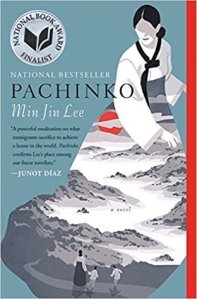
 A New York Times Bestseller, Pachinko is a work of historical fiction set in Korea and Japan that follows the lives of one family and how their circumstances and choices continue to reverberate through the generations.
It demonstrates how discrimination towards ‘perceived outsiders’ and their descendants becomes so deeply ingrained within a culture it distorts the way people live, even when from the outside there is no visible difference.
I won this book from the publisher after answering the question, “What do you think Min Jin Lee wanted to express with her first line of the book?” I hadn’t read the book then, but I liked how thought-provoking the first line (below) was. I’ll share my response at the end of the review.
History has failed us, but no matter.
Review

Photo by Jayant Kulkarni on Pexels.com
When we meet the family it is 1910, an ageing fisherman and his wife live in Yeongdo, a coastal village near Busan in Korea. They decide to take in lodgers for extra money. They’ve had three sons, but only Hoonie, (27) the eldest and weakest survived.
Hoonie was born with a cleft palate and a twisted foot; he was however, endowed with hefty shoulders, a squat build, and a golden complexion. Even as a young man, he retained the mild, thoughtful temperament he’d had as a child.
1910 was the year Japan annexed Korea. After years of war, intimidation and political upheaval; the country would be considered a part of Japan until 1945.
Hoonie went to school long enough to learn to read and write Korean and Japanese well enough to manage the boarding house ledger and do sums so he wouldn’t be cheated in the market. They raised him to be clever and capable ensuring he’d manage when they weren’t around. One day a matchmaker paid them a visit.
We cannot help but be interested in the stories of people that history pushes aside so thoughtlessly.
Marriage in that era was like a business transaction, a person’s chances were attributable partly due to physical attributes and mostly by their family’s potential for a dowry and gifts. Hoonie was fortunate, he married Yangjin who after losing her first three, gave birth to Sunja, her fourth child and only girl. When she was 13 her father died of tuberculosis.
Photo by James Lucian on Pexels.com
Sunja and her mother work hard running the boarding house; her life is turned around when at 16, she is cornered by a group of boys on her way home from the market. Husan, a man twice her age, intervenes and forms a friendship with her, eventually seducing her; she believing he will marry her.
When she learns of his wife and family in Osaka, she severs contact and accepts an offer of marriage from a Isak, a gentle, young man recovering from illness in their boarding house, soon to depart for Osaka to be with his brother and take up a role as assistant minister in the church.
Isak noticed that when Sunja worried, she furrowed her brow like she was trying to see better. He liked being with her; she was capable and level-headed. She was not helpless, and that was appealing because, although he wasn’t helpless himself, Isak knew that he was not always sensible. Her competence would be good for what his father had once termed Isak’s “impractical nature”.
The couple move to Osaka and live with Yoseb and his wife and discover life is more difficult than Isak realised. Survival is already a challenge, but being outside their native country they encounter for the first time that they are foreigners, perceived differently.
Living everyday in the presence of those who refuse to acknowledge your humanity takes great courage.
After giving birth to her son Noa, they have a son together and the boys are raised as if Isak is father to them both. Sunja’s affinity for hard work and her ability to negotiate and stand up to situations, leads her and her sister-in-law into working to support the family despite resistance from her brother-in-law.
Isak knew how to talk with people, to ask questions, and to hear the concerns in a person’s voice; she seemed to understand how to survive, and this was something he did not always know to do. He needed her; a man needed a wife.

Photo by Linn Htut on Pexels.com
The women in this lengthy saga are stalwarts, it is their story, their trials and tribulations that carry the narrative and make it unique. This could easily have been a story about the underworld inhabited by men who survive and thrive on the other side of the law; instead the author ventures into the lives of women, showing how they support and strengthen families.
It is a story of their endurance and survival and how perceptions change as one generation segues into the next and yet shame and stigma continue to exert their undermining influence.
I loved the book and the immersive experience it offered due to the combination of carefully drawn characters, the attention to the detail of their lives and the expectations under which they lived.
It is clearly a work of great dedication and love, the author originally wrote a version called ‘Motherland‘ which was completely rewritten after living in Tokyo for five years, meeting and interviewing many Korean-Japanese people, discovering how much more complex their lives, identities and connections to both countries were. It necessitated a complete rewrite, taking the story back to 1910, resulting in this extraordinary, all-encompassing, immersion into a rich cultural and familial history.
The Title
 It is not until page 142 that we come across ‘pachinko’, the Japanese name for pinball, a huge industry in Japan at the entry into the workforce of Sunja’s son Mozasu.
We discover the difficulty Korean-Japanese citizens have in the workforce, unable to work in ordinary professions, pushed out to the margins of society where they become street traders or involved in ‘less than ideal’ industries such as pachinko parlours. Many Korean-Japanese person she met had a historical or social connection to pachinko.
It is a metaphor for the predicament of Koreans in Japan, caught in the aftermath of historical conflicts as they win, lose, struggle to survive, sometimes thrive and sustain their gains.
I did not know until I lived in Japan that it was a business dominated by the Korean Japanese. It’s also seen as very second class and kind of vulgar and dirty and dangerous business,” said Lee, adding that these sorts of words and attitudes are still commonly associated with Korean Japanese, even those who have lived in Japan for decades.
My Response to That Question
On the opening line of the novel: History has failed us, but no matter.
History refers to the past and it seems that there are situations or circumstances that have been lived through before, whose lessons have not filtered through to future generations. Tragedy, destruction, suffering and corruption continue. Certain people of every generation encounter inequality and discrimination, no matter what they do to blend in.
However, we should not lose hope, as somewhere in our subconscious we carry the will to survive and thrive no matter what the circumstance. The future belongs to all of us, as yet unknown, to be ventured forth into without preconception.
Further Reading
YouTube – What is Pachinko? Japan’s Strangest Obsession
Business Insider Article – Japan’s pinball gambling industry rakes in 30 times more cash than Las Vegas casinos
Buy a copy of Pachinko via Book Depository
 A mysterious novella that begins in a quiet humble way as we meet the young widow Yasuko whose husband, the only son of Meiko Togano, we learn died tragically in an avalanche.
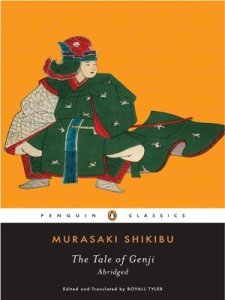 It is worth knowing a little about the plot of The Tale of Genji and the ‘Masks of Noh’ from the dramatic plays, as we realise there are likely to be references and connections to what is unfolding here. And not surprising given Fumiko Enchi translated this 1,000+ page novel into modern Japanese.
 Fumiko Enchi was a Tokyo born novelist and playright, the daughter of a distinguished philologist and linguist. Poorly as a child, she was home-schooled in English, French and Chinese literature by private tutors.




 Haruki Murakami’s work was introduced to me by
  In this volume Toru Okado is looking for a job, and while living through this in-between stage, in between jobs – his wife doesn’t return home one day thus he enters into a strange period where each of his interactions take on questionable qualities as he tries to navigate his days and understand what is happening around him.
 Revelations came to me also, weird dreams of deep wells and immersing in blue pools of water and seeing things clearly.
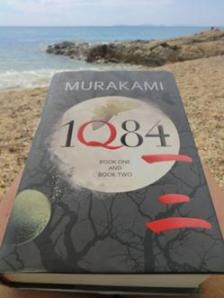 Aomame is a loner, growing up in a Jehovah’s Witness family she had no real friends and rejected her family’s way of life early on. The one true friend she did have later in life met a tragic end which changed Aomame’s life; she couldn’t save her friend but through her skills and work she ensured that many other women were saved from a similar fate.
 He wears a badge his father gave him that reads ‘I am Chinese’, what it really means is ‘I am NOT Japanese’ for it is 1942 in Seattle and anyone who looks Japanese is being sent away to a special ‘camp’.
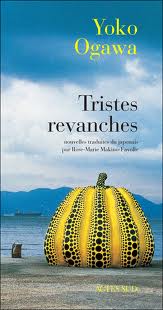
 Having recently discovered and read Yoko Ogawa’s
 The housekeeper arrives each morning and introduces herself as if they have never met. Slowly, she and her ten year old son, whom the Professor refers to as Root – a reference to the square root sign and his hair, are drawn into the Professor’s reduced world where numbers reign supreme and the two visitors begin to understand the magic and meaning behind what they had always thought of as ordinary numbers.
 I picked up this slim volume of three enticing novellas during one of my scouts of the excellent Oxfam bookshops in London recently. I was intrigued by the cover and the discovery of an international author I had not read before whose credentials intrigue but I was sold by the quote on the cover by Nobel Prize-winning author
 Word by Word