The Hidden Lamp edited by Florence Caplow

Stories from Twenty-Five Centuries of Awakened Women

The Hidden LampThe Hidden Lamp is a rich source of feminine wisdom, a compilation of one hundred stories, some a mere paragraph long, each one chosen by one woman and commented on, sharing a contemporary perception of how that text speaks to her.

We as readers have the opportunity to receive the wisdom of the original text, reflect on it ourselves, observe the comments of the woman who has chosen to share it with us, often with a personal anecdote in this unique collection of twenty-five centuries of awakened women – those who in Buddhist terms have gained enlightenment.

Most well-known Zen stories or koans (according to American Zen Master, poet and author Zoketsu Norman Fischer) come from three collections Blue Cliff Record (12th C), The Book of Serenity (12th C), and The Gateless Barrier (13th C) and are an almost exclusively male domain.

In this collection, we find the long missing stories of women, shared in a unique collaborative style between its editors and commentators. Many of those interpreting the texts are Zen teachers and many others come from a wide range of Buddhist traditions and lineages, lending the collection an open-minded virtue, accessible to all, whether male or female, and regardless of knowledge of Buddhism philosophy and practice.

“Koans are powerful and succinct stories, most often about encounters between Zen teachers and students. They can be playful and humorous, mysterious, opaque or even combative.”

It is an invitation to consider what has been said, to ponder it and respond ourselves.

Reading the stories make fables seem like children’s stories. These excerpts often require an extraordinary stretch of the imagination to understand and there will be some we are simply not ready to interpret.  For those who have studied them, their revelations have often taken months or even years to realise.  Thanks to the commentaries, we can at least read of another’s insight although this does not in all cases necessarily bring clarity. We must accept that we are not yet ready for their learning.

Joko Beck

Charlotte Joko Beck

One of the first stories came from Peg Syverson’s reflection after listening to Joko Beck* give a talk. A young man raised his hand and bluntly asked “Are you enlightened?” to which she replied “I hope I should never have such a thought!”

Peg Syverson shared that she had thought of this exchange many times since she first heard it, that many of the things this teacher of hers said, surprised her. She likened it to another story of a Japanese master Nan-in, serving tea to a professor, pouring the tea until the cup filled and then overflowed, and still he continued to pour until the professor said, “It is overfull! No more will go in!”

“Like this cup”, said Nan-in, “you are full of your own opinions and speculations. How can I show you Zen unless you first empty your cup?”

The responses are often unexpected and penetrating. Their meaning isn’t obvious on first reading, they require us to look at the question, and at what those who ask are bringing along with the question. Syverson recounts her own audience with Joko, the question she was required to ponder and respond to, then despite several weeks of contemplating an answer, when she gave it, would receive another insightful, thought-provoking response, which upon reflection, changed the nature of her relationship with her son, the subject of her initial question. The clarity of the teacher’s mind in responding so succinctly is astonishing.

The answers seem nearly always to require that you go away and reconsider the exchange, eventually revealing the answer that perhaps was always within you. It is a kind of active learning, rather than the passive receipt of an interpretation and response, which can easily be set aside or forgotten.

The Hidden Lamp is not a book to read in one sitting, it is a reference to draw on now and then and a rich source of ancient feminine wisdom and modern thought, whose content is valid for one and all. Some of the names of the women in the book will be well-known and others less so, however their contributions might as well be nameless, as it is the story that brings the richness to the reader, the reputation of all the contributions having already been established.

His Holiness the 14th Dalai Lama of Tibet

His Holiness the 14th Dalai Lama of Tibet

Personally I always have at least one text of Buddhist thought/philosophy on the bedside table, I find them a quiet source of intellectual wisdom that easily resonates with my own world view.

Whether it’s a collection like this or one of the many excellent works of the Dalai Lama, or the pocket books of Pema Chodron, they all share a wisdom that comes from the practice of kindness, empathy and altruism while providing a prism of compassion through which to observe our everyday thoughts and encounters. A kind of preventative medicine for the mind, these awakened beings have spent years pondering the nature of suffering and both their practices and their words are a thoughtful guide and nurturing remedy to all negative emotion or thought.

* Joko Beck (American, 1917 – 2011) was a pianist and mother of four, who began Zen practice in her 40’s, founded two schools and wrote two books Everyday Zen: Love and Work and Nothing Special: Living Zen.

Note: This book was an Advance Reader Copy(ARC) provided by the publisher via NetGalley.
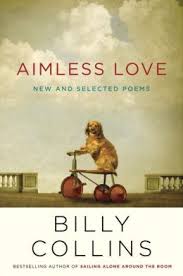
Aimless Love by Billy Collins

Aimless LoveI am a relative newcomer to the poetry of Billy Collins, but thanks to an admiring fan, I was lent a copy of his collection Sailing Alone Around the Room which was an extremely readable, entertaining and at times even hilarious read and so when I saw this new collection was coming out I requested it.

Who even knew that one could study for a PhD in Romantic Poetry? Does that make him of Doctor of Love I wonder?

His poems speak of ordinary things but steer clear of cliché, and Aimless Love as a title for this collection of collections as well as some new poems, seems perfectly apt for all manner of common things he appreciates and shares with us.

Aimless Love brings together selected poems from previous collections as well as some new poems

Here are a few extracts from moments of pure joy in reading Billy Collins Aimless Love:

The Country

I wondered about you

when you told me never to leave

a box of wooden, strike-

anywhere matches

lying around the house because

the mice

might get into them and start a fire.

But your face was absolutely

straight

when you twisted the lid down

on the round tin

where the matches, you said, are

always stowed.

Who could sleep that night?

Artwork by our Allia

Artwork by our Allia

Who could whisk away the thought

of the one unlikely mouse

padding along a cold water pipe

behind the floral wallpaper

gripping a single wooden match

between the needles of his teeth?

And who could not be tempted to read and understand more of this familiar relationship between the poet and his parents in:

No Time

In a rush this weekday morning,

I tap the horn as I speed past the

cemetery

where my parents lie buried

side by side under a smooth slab

of granite.

And this line from a poem called

Monday

Just think –

before the invention of the window,

the poets would have had to put on a jacket

and a winter hat to go outside

or remain indoors with only a

wall to stare at.

There are other fabulous poems like The Great American Poem, Horoscopes for the Dead, and Ode to a Desk Lamp.

But just as good as reading his poetry is listening to him read aloud, he has a melodic voice that lulls the listener into a kind of warm familial comfort, his words caress like a gentle tide of steaming bath water with the scent of Cedarwood. Well, perhaps if you close your eyes while listening, like I do.

Here he is reading just a few days ago, the title poem to this collection Aimless Love, so sit back, close your eyes, listen and be soothed:

Note: This book was an Advance Reader Copy, provided by the publisher via NetGalley.

and the Man Booker Prize winner is…

Catton2

The Luminaries by Eleanor Catton

I have just put it aside on page 508 to watch the presentation and I could not be more pleased!

Congratulations to our young and so talented novelist, from whom we will no doubt see much more.

The book is still alive and rather than cower under the threat of the alternative entertainment available to people today, they are taking the book to the masses.

According to the Man Booker Prize website, there is to be a free event at London’s Regent Street Apple Store, where Eleanor Catton will discuss her book and what it means to win the prize.

I hope Apple are offering the books for sale and not just their own devices to read them.

Ok, a big event is about to take place in the book too, so I’m off back there to find out what’s happening.

#ManBookerLive at the SouthBank Centre

Listening to Six Shortlisted Authors Read

Last night the six shortlisted authors of the Man Booker Prize came together at the SouthBank Centre in London’s Royal Festival Hall and thanks to seeing a tweet from someone present I discovered that it was streaming live from the Man Booker website.

So instead of reading another 200 pages of Eleanor Catton’s The Luminaries, I listened to her, NoViolet Bulawayo, Jim Crace, Jhumpha Lahiri, Ruth Ozeki and Colm Tóibín read from their books and answer questions from the host Mark Lawson and the audience.

2013

It was a wonderful evening and risks making us want to read all the books, to see the writers presenting their works and sharing their private anecdotes about the journey to publication.

Today the live event has been uploaded to YouTube, so if you are interested to hear more about these excellent books, before tomorrow evenings announcement of the winner, here is the link to watch it yourself.

The event starts at 28 minutes 20 seconds.

Don’t expect it to help you decide, I think they are all winners and have no idea who the judges will choose. The bookmakers and the BBC are backing  Jim Crace, the quintessential English vote.

Man Booker Prize Shortlist 2013

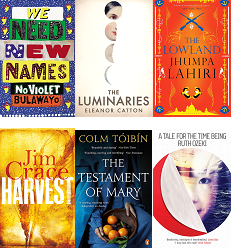
The Man Booker Prize shortlist was announced today and looks like an interesting and diverse offer, with two previous nominees*, four fabulous women writers and stories that will transport us to many far reaches of the world.

One of the judges, Robert Macfarlane had this to say:

‘Global in its reach, this exceptional shortlist demonstrates the vitality and range of the contemporary novel at its finest. These six superb works of fiction take us from gold-rush New Zealand to revolutionary Calcutta, from modern-day Japan to the Holy Land of the Gospels, and from Zimbabwe to the deep English countryside. World-spanning in their concerns, and ambitious in their techniques, they remind us of the possibilities and power of the novel as a form.’

The shortlist comprises:

2013

NoViolet Bulawayo We Need New Names                  my review here

Eleanor Catton The Luminaries

Jim Crace Harvest

Jhumpa Lahiri The Lowland

Ruth Ozeki A Tale for the Time Being

Colm Tóibín The Testament of Mary

I have only read Bulawayo and I’m happy to see her on the list and I’m also ecstatic to see a fellow New Zealander make the list. I can’t help but hope that Eleanor Catton wins and I’m really looking forward to reading her novel The Luminaries, which has had some fantastic reviews.

The judges have one month to re-read the shortlist and the winner will be announced on 15 October 2013 at a ceremony at London’s Guildhall.

So have you read any from the list and any guesses for a winner?

*Colm Tóibín was previously shortlisted for The Blackwater Lightship in 1999 and The Master in 2004 while Jim Crace was shortlisted in 1997 for Quarantine.

A Regular Fix of Contemporary European Literature

While no slave to social networking, I do appreciate those needle in a haystack gems of information that twitter occasionally throws out. It’s a little like a child knowing that there is a lolly scramble going on behind a door that opens once a day and if you stand in one spot with your hand out, you might just catch something. Much of it passes us by, but the one that lands in the hand, is appreciated all the more for the scant chance it had of being captured.

Which is what this little tweet I caught in late May did.

I remembered that when I wrote about Deborah Levy’s Booker short-listed novel Swimming Home and mentioned the subscription based publisher And Other Stories, that @MarinaSofa mentioned Pereine Press. I looked at their website and started following them on twitter.

CIMG4717Pereine Press publish contemporary European literature, in the form of novellas, a new book coming out every 3 months. So they provide an opportunity to introduce readers to new authors, outside what we might normally read in English and a book that doesn’t require a long time to read, each book can supposedly be read in an afternoon. No 400+ page tomes here.

So the tweet reminded me that I did want to read their books and there’s nothing like the threat of a price increase to motivate one to act. So now I am a Pereine Press subscriber and I have the first two books from this years series on the shelf.

Mussel FeastEach year has a theme, in 2013 it is Revolutionary Moments and the first book is the German classic The Mussel Feast by Birgit Vanderbeke which I have now read and will tell you about very soon. Very well-known in Germany I am sure and a gripping read, I devoured as hungrily as I would moules frites.

Not only does this subscription mean there will be European literature arriving regularly, but subscribers are invited to participate and attend literary events with the authors whose books have been published, including the revival of a literary salon, which sounds intriguing. The events take place in London and I hope one day I might coincide a visit to be able to attend one. I love that this type of event is coming back into vogue.

So more contemporary European literature reviews coming here soon…

Fetish or Inspiration, Uplifting Shoe Art

manolo blahnok drawings

I mentioned in my recent review of Deborah Batterman’s Shoes Hair Nails that it had reminded me of a book lurking on my daughter’s shelf, a gift from a family member who is a designer.

The book is manolo blahník’s drawings, a small pocket-book of 120 original sketches and quotes that create a visual history of the talent of one of Spain’s most creative and alluring shoe designers. Being a book full of hand drawn images, there isn’t much to say about the content, because it just must be seen and appreciated.

Manolo Blahník

Born in the Canary Islands, he has been sketching shoes since the age of seven and had hopes of becoming a set designer, before fashion editor Diana Vreeland suggested he concentrate on shoes. No surprise that there is a theatricality to his designs and a sense of the artist at work.

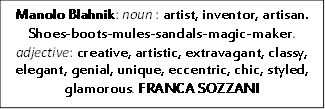
One of the best quotes, this definition of Manolo Blahník, expressed by Franca Sozzani, Editor-in-Chief of Vogue Italia:

Manolo Blahnik

Manolo Blahník

While I am not a great fan of shopping for and trying on shoes, I do love looking at and admiring them and these designs are pure inspiration, going beyond any practical requirement and into the realm of art which is more likely the reason I was so keen to visit the Shoe Gallery when it opened in London a couple of years ago.

These are some of my favourite images from the book.

Manolo speaks through his shoes. For him, the foot, the shoe, implies the whole nature of a person, and expresses a story. ANNA PIAGGI

The day we bought the book (from Liberty’s in London) was also the day of the opening of the Shoe Gallery in Selfridges in London.  A gallery of shoes and in 2010, while the middle class were keeping a low profile in the gardened suburbs due to the recession, it seems the creative younger generation of London were being inspired to flaunt shoe art!
Selfridges Shoe Gallery

Designed by the architect Jamie Fobert and the largest shoe department in the world, it contains 6 salons, 11 brand boutiques and more than 4,000 pairs of shoes. And what an outrageously joyous wander around that was, a gallery with none of the pressure of a shoe shop, one is free to wander around and admire the masterpieces of the many diva’s of shoe design. There was even a Shoe Booth, where you could have a photo taken with your favourite pair, how generous is that!

Instead of one large department, you enter six different zones, each space a character in itself. The line of Spanish alabaster plinths modelling their shoes in regal splendour, give it a real feeling of a gallery, the shoe taking pride of place and unlike in a gallery or museum, all available to buy. The architects only managed to convince Selfridges to go with concept of plinths, having proven that sales of shoes displayed on them, far outstripped sales all other pairs. It seems we all aspire to the pedestal, no matter who or what sits on top of it!

Shoe Cerise

So does anyone own a pair of Manolo’s and is it true that some like Anna Wintour will wear no other?

Women’s Prize for Fiction Winner Announced

CIMG4526Excellent timing, the women’s prize for fiction is announced during the London Literature Festival at the Royal Festival Hall on the South Bank, which I had the opportunity to visit on Saturday (more on that excitement later!).

A strong list, and some equally strong and divided opinions about the books that made the list and a bit of a surprise result, it has to be said.

So to remind you, the six shortlisted authors and their books were:

*

In the opinion of the judges the book chosen mostly ably fulfilled the criteria of the award, being originality, accessibility and excellence.

And the winner was:

May We Be Forgiven by AM Homes

A first book award for her 10th book, a career spanning 25 years and a dream fulfilled at last. The author paid tribute to her father who sadly passed away a month ago, knowing that his daughter had made the short list and also to her grandmother who lent her the money for her first typewriter and made sure she paid it back.

“… this book really struck all the judges, partly because of just the pure quality of its writing, it has this incredible energy, at times its very vicious and very bleak, but it also has this warmth that comes through at the ending… it is one of those books that speaks to people in different ways and really is something that begins conversations and begins thoughts…” Natasha Walter, Judge

The new sponsor has also been announced and there was plenty of the beige drink being served from all accounts, so from next year expect to hear about the Bailey’s Women’s Prize for Fiction

Well done AM Homes, up against strong contenders, including the almost invincible Hilary Mantel.

Let’s hope that it’s a good omen for her publisher Granta, after the rapid departure of most of their management team, the publisher/magazine currently having to rebuild itself from scratch.

Looks like I have yet another book to add to the list!

Ottoman Distractions

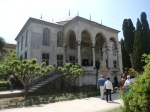
Sultanahmet (Blue Mosque)

Sultanahmet (Blue Mosque)

Greetings from a vibrant and bustling Istanbul.

There is too much opportunity to observe, appreciate, participate and marvel at this wonderful city situated where Europe meets Asia and where on every corner there lies evidence of humanity’s incredible vision going back many hundreds and thousands of years, one must put down the books and just dwell in its presence.

So no update on reading, though I do have some reading related pictures to share and I have bought two books to add to my Turkish literature collection. Not far from Sultanahmet (the Blue Mosque) is a bookshop with an enticing window showing off its collection of English translated works, works by Turkish authors written in English and any writer, whose work focuses on the area.

The owner’s brother was quick to recommend Louis de Bernières Birds Without Wings, which I told him was already in my top all-time favourite reads and of course Elif Shafak and Orhan Pamuk’s works are all there.

Portrait of a FamilyHe then handed me Portrait of a Turkish Family and promised with stalwart confidence that this little masterpiece would replace my current favourite. Sales-speak or the truth, I shall soon find out.

PatasanaI was actually looking for a copy of A Memento of Istanbul, by Ahmet Ümit, a writer I have not read before, master of the Turkish thriller and after Turkey’s profile at the London Book Fair, watch out for more from this author. I was interested in this particular book as it is said to highlight seven significant attractions introducing something of the city’s rich culture and history. They only had one book left in English by this writer, Patasana, so A Memento can wait, this is where I shall start. Thrilled already!

Istanbul is a fabulous city to visit and the children and I have totally fallen for the historic part of town. I am sure we will be back and would recommend it to you all if you ever have the opportunity to visit.

Some of the highlights:

Five Favourite Fiction Reads

I recall stumbling across Chalk the Sun and reading many of the posts, Julie had read many books I loved and many more that I aspired to read. The first review I read there was The Buddha in the Attic, the first time I had heard of both the book and its author Julie Otsuka. Since then, I have been an avid follower of Chalk the Sun. Not only is Julie a talented, observant, evocative writer and reader, she is working on her own book set in France, which many of us are waiting to read!

Photo0650Julie tagged me in the Five Favourite Reads challenge, a near impossible task, so I will share 5 favourites that come to mind spontaneously.

Kimberly, a Bostonian writer living in Rome, also nominated me in the Happy Booker Alternative Book Award and since she’s stretched the rules to choose outside the 2012-2013 year, I’m going to combine these two awards and exercise freedom in choosing.

Whenever I visit Kimberly’s blog, she’s either reading, visiting a European city (known to be inspired to write a short story as a result), winning prizes for those excellent short stories, or planning to go to the Women’s Fiction Festival in Matera, Italy. This is a blog to linger in and be inspired by.

Thanks also to writer Deborah Brasket of Living on the Edge of the World for nominating this blog for the Inspiring blog Award and to Red Headed Stitcher who has nominated me in the past for the Sisterhood of Bloggers award and more recently the Liebster Award. I’m not too good at participating in awards, but thank you to all those who passed them on to me, I appreciate every gesture.

First, five out of too many bloggers whose posts I look forward to reading, whose exchanges I appreciate and whose favourite books I’d love to know (no obligation though):

Five Great Blogs

ReadEng Didi’s Press – lives and works in the north of France, loves books and the English language, sound familiar?

Three Hundred Sixty Five – it’s an ambitious challenge guaranteed to improve your writing skills and Fransi is doing it, I’m reading it in awe.

JoV’s Book Pyramid – reading around the world, across genre, an eclectic collection of book gems to be found here.

PB Writes – poet, writer doing the NaMeSitDifStarDaiWri(expletive)Po check her out and be inspired, I was, I wrote 2 poems this week, first in 2 years!

Books Can Save a Life – thoughts on books and how they make us who we are, with an emphasis on the personally meaningful.

My Five Great Fiction Reads

010413_1256_TheIndustry1.jpgThe Industry of Souls, Martin Booth My first read on 2013 was a reread one of my all-time favourite books and one that has stayed with me over the years and stood the test of time. He wrote one other novel Islands of Silence which I also loved and a memoir which I have still to read, Gweilo: Memories Of A Hong Kong Childhood. Sadly, he died in 2004 just after finishing this memoir. My recent review here.

Astonishing GodsAstonishing the Gods, Ben Okri This was a real favourite from my twenties, when life was full of indecision and anything was possible. I love a good fable and this small volume was a surprise read after struggling through Okri’s more infamous, head spinning work The Famished Road.

Birds Without WingsBirds Without Wings, Louis de Bernières When this book was published Loius de Bernières had not published a book for 10 years, so it arrived amidst significant intrigue. He is something of a hit or miss author, Captain Corelli’s Mandolin was a word of mouth sensation, even if was a struggle to get into, however this is his masterpiece. Birds without Wings is a book to read slowly and savour each word, each character, each facet of that tragic and bitter struggle between the Greeks and the Turks during the collapse of the Ottoman Empire. Epic and profoundly humane.

HummingbirdHummingbird, James George In 2006, three New Zealand writer’s, Elisabeth Knox, James George and Vincent O’Sullivan visited Aix-en-Provence and I listened to them read. I had read Knox’s Vintner’s Luck, I knew of Vincent O’Sullivan’s work, but wasn’t familiar with James George. He read from his book Hummingbird and I was entranced. Just those few pages and I knew it was a book I had to read.

Three strangers arrive at a camping ground on a part of the barren, isolated Ninety Mile Beach. They are a former prostitute, a young man just released from prison, and a retired Cambridge don, former Battle of Britain pilot and veteran of the Battle of Crete. Slowly we learn their stories as the author examines their past, lost souls who find solace in this endless sea, sand and sky. It is an incredibly moving, lyrical work from a little known but exceptionally talented writer and poet.

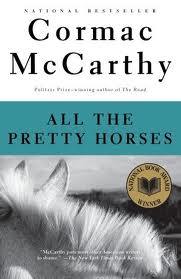
all the pretty horsesAll the Pretty Horses, Cormac McCarthy I picked this up in the library, not realising it was the first in The Border Trilogy, and what a thrill it was to discover that McCarthy, though bleak in his subject writes such pure, lyrical prose.

This coming of age novel and it’s sequel The Crossing are something of the best a book can offer someone like me, a great story, exceptional visual writing, inspiring awe. It’s like unlocking another door to that mystery of what makes us tick, it remains something of a mystery true, but I know that Cormac McCarthy’s way of expressing and describing in words is one of my keys.

So, what are the first books that spontaneously come to mind as your favourites?